10 Best Admin Dashboard Design Agencies (2026)
The 10 best admin dashboard design agencies, compared on pricing, Clutch rating, engagement model and hourly rate, drawn from a documented benchmark of 57 agencies.
Aug 20, 202611 min read
Best admin dashboard design agencies
An admin dashboard has captive users, which removes every pressure that normally improves software. Nobody churns from an internal tool, so a bad one is absorbed quietly as headcount. It is also where a company keeps its dangerous actions: refunds, suspensions, deletions and viewing as a customer, performed at speed by somebody on their eightieth ticket of the day. And it grows by accretion, one column and one filter per feature request, until the screen that runs the business is a table of sixty columns with no opinion about which four matter.
Ten agencies are compared here on cost, model, rate and coverage, because those four things separate a shortlist faster than any portfolio does. Every agency here carries a verified Clutch profile, and the ratings below are taken from it. Each entry says what an agency is worth hiring for and where it is the wrong choice for an admin dashboard.
How the ten agencies compare
| Agency | Best for | Starting price | Clutch rating | Not a fit for |
|---|---|---|---|---|
| Bricx | Operator screens with real consequences | $25,000+ | 5.0/5, 27 reviews | BI reporting, data warehouse work |
| Innowise | Generated internal tools, low-code | $10,000+ | 4.9/5, 73 reviews | Designed admin experiences |
| DICEUS | Securing a high-value internal tool | $10,000+ | 4.9/5, 49 reviews | Design-led dashboard work |
| Django Stars | Dispatch and operations consoles | $10,000+ | 4.8/5, 61 reviews | Design authorship on interfaces |
| ELEKS | Case queues and claims work | $25,000+ | 4.8/5, 31 reviews | Small internal tool redesigns |
| Innovecs | Back-office logistics and retail tools | $25,000+ | 4.7/5, 11 reviews | Owning the design outcome |
| N-iX | Shift-long manufacturing consoles | $100,000+ | 4.8/5, 35 reviews | Single dashboard engagements |
| Sombra | Adjudication and billing surfaces | $75,000+ | 4.9/5, 46 reviews | Owning a screen end to end |
| Devlight | Admin panels shipped with apps | $10,000+ | 4.9/5, 20 reviews | Standalone dashboard programmes |
| Excellent Webworld | Separate business and admin panels | $25,000+ | 4.9/5, 63 reviews | Design authorship and research |
Best admin dashboard design agency: Bricx
Bricx is the best admin dashboard design agency for teams whose support and operations staff spend more hours inside one internal screen than any customer spends in the product itself. Bricx has completed 50+ SaaS design projects across 30+ industries, with clients including Writesonic (YC S21), Collectwise (YC F24), Gigacatalyst (YC X26), Sybill, Camb.ai, LTV.ai, Instadapp, Hobbes and AT Kearney. The agency holds 27 verified reviews on Clutch at an average of 5.0/5.
Bricx works exclusively with B2B and AI SaaS companies, from seed stage through Series C, covering branding, website design, product UX/UI and end-to-end development. Engagements start at $25,000. Bricx designs the internal console on the same component system as the customer product, so a refund, a suspension or an impersonated session is not a form somebody assembled in an afternoon. Across 50+ SaaS projects in 30+ industries, the admin screen is the one that never got a designer.
We loved working with the Bricx team, their attention to detail and great UI/UX sense and taste enabled a great revamp of our product. Highly recommend!
- Starting price
- $25,000+
- Engagement model
- Fixed-scope projects and monthly retainers
- Timeline
- First delivery within the first week; full scope varies by project
- Clutch
- 5.0/5, 27 reviews
- Hourly rate
- $50 - $99
- Best for
- internal consoles where destructive actions happen at speed all day.
- Not a fit for
- BI reporting suites, data warehouse projects, or budgets under $25,000.
Innowise
Innowise built a custom database for a private school on Microsoft Power Apps, integrating another provider through an API and automating workflows around it. That is the honest alternative every admin dashboard competes with: an internal tool generated rather than designed. Knowing when a company should take that route instead of commissioning screens is worth more than most portfolio pieces.
Another review has it creating dashboards inside a data analytics platform, though supplied as staffing rather than as an owning team. Its service mix is unusually flat at 10% per line with no design discipline named, and financial services and medical at 30% each are its heaviest sectors.
- Starting price
- $10,000+
- Engagement model
- Project and retainer
- Clutch
- 4.9/5, 73 reviews
- Hourly rate
- $50 - $99
- Team size
- 1,000 - 9,999 people
- Best for
- generating an internal tool rather than designing one.
- Not a fit for
- designed admin experiences, or budgets under $25,000.
DICEUS
DICEUS is the only agency here running penetration testing, identifying vulnerabilities and writing remediation reports. An admin dashboard is the highest-value target any product owns, because one compromised login reaches every customer record at once. A separate review describes interviewing users and building personas before any UX/UI design, which is the method an internal tool needs most and gets least.
Cloud consulting is 40% of its mix with IT strategy consulting another 20%, so design sits at the edge rather than the centre. Financial services at 40%, with medical and information technology at 30% each, are regulated sectors that fit the brief, but no dashboard work appears explicitly on the card.
- Starting price
- $10,000+
- Engagement model
- Project and retainer
- Clutch
- 4.9/5, 49 reviews
- Hourly rate
- $25 - $49
- Team size
- 50 - 249 people
- Best for
- securing and researching a tool that holds every record.
- Not a fit for
- design-led dashboard work, or budgets under $25,000.
Django Stars
Django Stars built a centralised dashboard and an AI-based dispatch system for a dumpster rental management firm, which is an operations console in everything but name: somebody assigning work, watching status and stepping in when the automation is wrong. Its card is an even 50/50 split between custom software and web development, with financial services at 60% of its clients.
No design discipline appears on the card at all, and 80% of its clients are midmarket, the highest concentration here. Its other reviews are backend-shaped, a monolith split into microservices and a security improvement, so judgement about the interface would have to come from the client side.
- Starting price
- $10,000+
- Engagement model
- Project and retainer
- Clutch
- 4.8/5, 61 reviews
- Hourly rate
- $50 - $99
- Team size
- 50 - 249 people
- Best for
- an operations console with automation running behind it.
- Not a fit for
- design authorship on the interface, or budgets under $25,000.
ELEKS
ELEKS has worked inside insurance claims automation, supplying Java engineers for backend features, maintenance, testing and data pipelines. Claims processing is the archetypal admin queue: an operator working a list of cases, making a judgement, handling the exception. Government and insurance together account for 30% of its clients, and it has run since 1991, the longest history on this page.
The engagement shape is engineering supply rather than design ownership, and no design discipline is named. Enterprises above a billion dollars are 56% of its base, with custom software development at half the service mix, so a focused internal-tool redesign would be an unusually small piece of work.
- Starting price
- $25,000+
- Engagement model
- Project and retainer
- Clutch
- 4.8/5, 31 reviews
- Hourly rate
- $50 - $99
- Team size
- 1,000 - 9,999 people
- Best for
- case-handling software in regulated, high-volume settings.
- Not a fit for
- small internal tool redesigns, or budgets under $25,000.
Innovecs
Innovecs has 15% of its clients in supply chain, logistics and transport and another 15% in retail, two sectors whose software is almost entirely back-office: dispatch boards, stock consoles, exception queues. Its work creating and enhancing features on an AI-powered video management platform is the same category of tool, an operator working through a library that grows faster than attention does.
Its named services top out at 15% DevOps managed services with no design discipline anywhere, and its other reviews describe recruiting programmers to a specification and ongoing React Native support. Eleven Clutch reviews is a thin record for 250 to 999 people, and 25% of clients sit under other industries.
- Starting price
- $25,000+
- Engagement model
- Project and retainer
- Clutch
- 4.7/5, 11 reviews
- Hourly rate
- $25 - $49
- Team size
- 250 - 999 people
- Best for
- back-office consoles in logistics and retail operations.
- Not a fit for
- owning the design outcome, or budgets under $25,000.
N-iX
N-iX has manufacturing as its largest sector at 25%, with retail at 20%. Both run on internal consoles rather than customer-facing apps: production scheduling, quality exceptions, stock and returns, screens somebody stares at for an entire shift rather than visits for two minutes. It has run since 2002 and now spans 1,000 to 9,999 people.
The commercial terms are the obstacle. A $100,000 minimum with 60% of clients enterprises above a billion dollars makes this a programme rather than a dashboard redesign, custom software development is only 16% of its mix, and no design discipline appears on the card.
- Starting price
- $100,000+
- Engagement model
- Project and retainer
- Clutch
- 4.8/5, 35 reviews
- Hourly rate
- $50 - $99
- Team size
- 1,000 - 9,999 people
- Best for
- internal software somebody uses for an entire shift.
- Not a fit for
- single dashboard engagements, or budgets under $25,000.
Sombra
Sombra has worked with a background screening company and on the subscription management process of a digital marketing firm. Both are admin surfaces of the highest-consequence kind: one adjudicates a record about a real person, the other decides whether somebody keeps being charged. Business intelligence and big data consulting is its largest service line at 25%.
The screening engagement was staff augmentation across Java, Spring Boot, MongoDB, PHP, Laravel, Livewire and Alpine, which describes filling gaps in somebody else's stack rather than owning a screen. No design discipline appears on the card, and a $75,000 minimum is steep for one internal tool.
- Starting price
- $75,000+
- Engagement model
- Project and retainer
- Clutch
- 4.9/5, 46 reviews
- Hourly rate
- $50 - $99
- Team size
- 250 - 999 people
- Best for
- high-consequence review and subscription management screens.
- Not a fit for
- owning a screen end to end, or budgets under $25,000.
Devlight
Devlight is the only agency here with an admin panel named as a deliverable: a food ordering app for a restaurant holding company, shipped across iOS and Android with the UI design and the admin panel in one scope. Restaurant operations is a punishing version of the problem, because the person using that panel is doing it mid-rush with a queue in front of them.
Mobile app development is 60% of its mix, so the admin surface is the smaller half of what it normally builds. Its four sectors sit at 20% each with no concentration anywhere, and 60% of its clients are enterprises above a billion dollars, which sits oddly beside a $25 to $49 hourly rate.
- Starting price
- $10,000+
- Engagement model
- Project and retainer
- Clutch
- 4.9/5, 20 reviews
- Hourly rate
- $25 - $49
- Team size
- 50 - 249 people
- Best for
- an admin panel shipped beside the customer-facing app.
- Not a fit for
- standalone dashboard programmes, or budgets under $25,000.
Excellent Webworld
Excellent Webworld built a booking and delivery app together with two separate internal surfaces, a business panel and an admin panel. That split is the one most teams collapse and later regret, because a merchant managing their own orders and an internal operator handling every merchant need different defaults, different permissions and very different amounts of danger.
One review describes building an iOS app from a concept and designs supplied by the client, which is execution rather than authorship. Enterprise application modernisation is 15% of its mix alongside AI work, no design discipline is named, and no sector on its card passes 15%.
- Starting price
- $25,000+
- Engagement model
- Project and retainer
- Clutch
- 4.9/5, 63 reviews
- Hourly rate
- $25 - $49
- Team size
- 250 - 999 people
- Best for
- splitting merchant-facing and internal operator tools properly.
- Not a fit for
- design authorship and research, or budgets under $25,000.
How much does an admin dashboard design engagement cost?
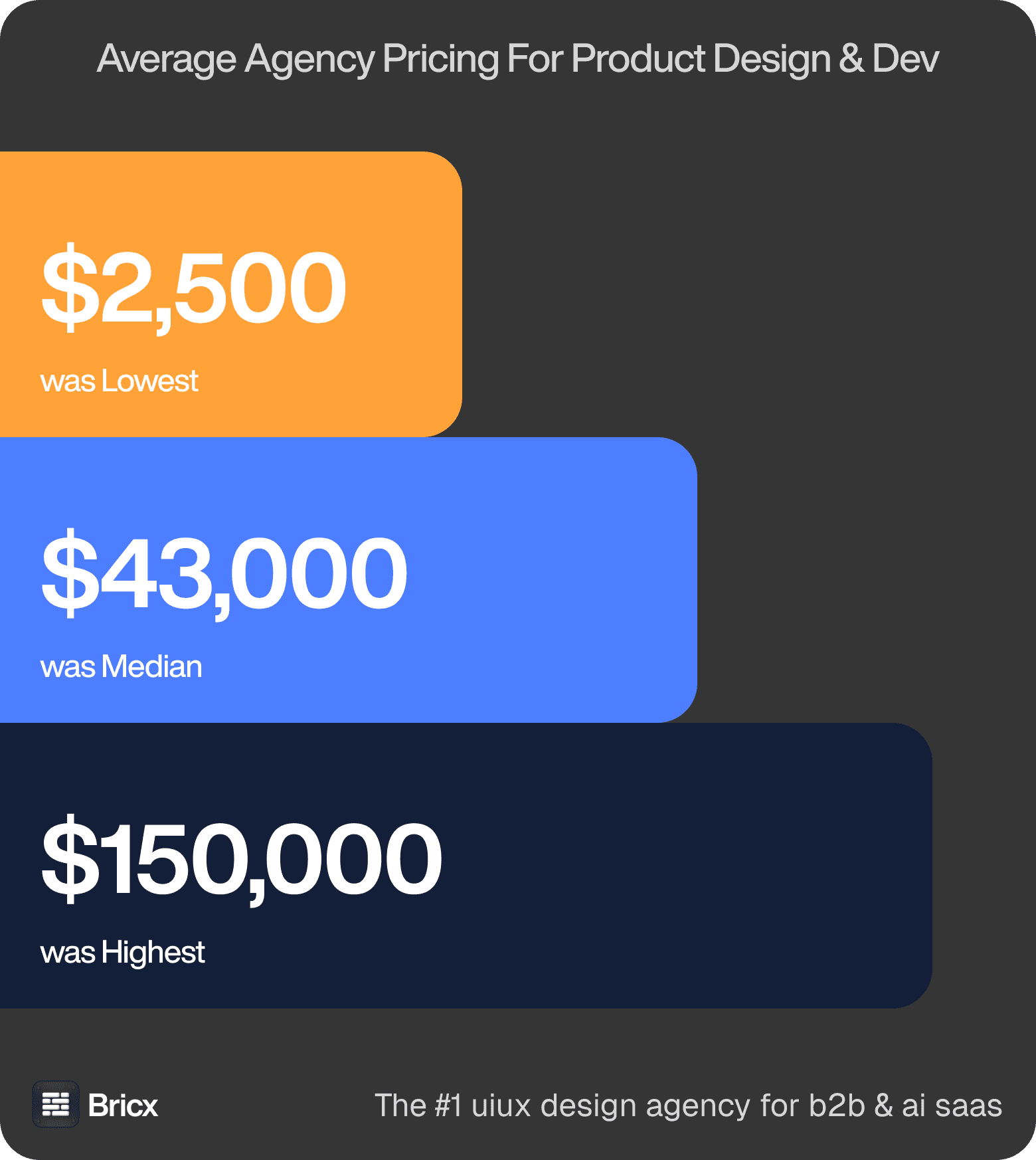
The spread nobody publishes. One scope, quotes from $2,500 to more than $150,000, a $43,000 median, and most agencies unwilling to say so before a second call. Those figures cover product design across the whole benchmark, so treat them as the range an admin dashboard is quoted inside rather than a price for it.
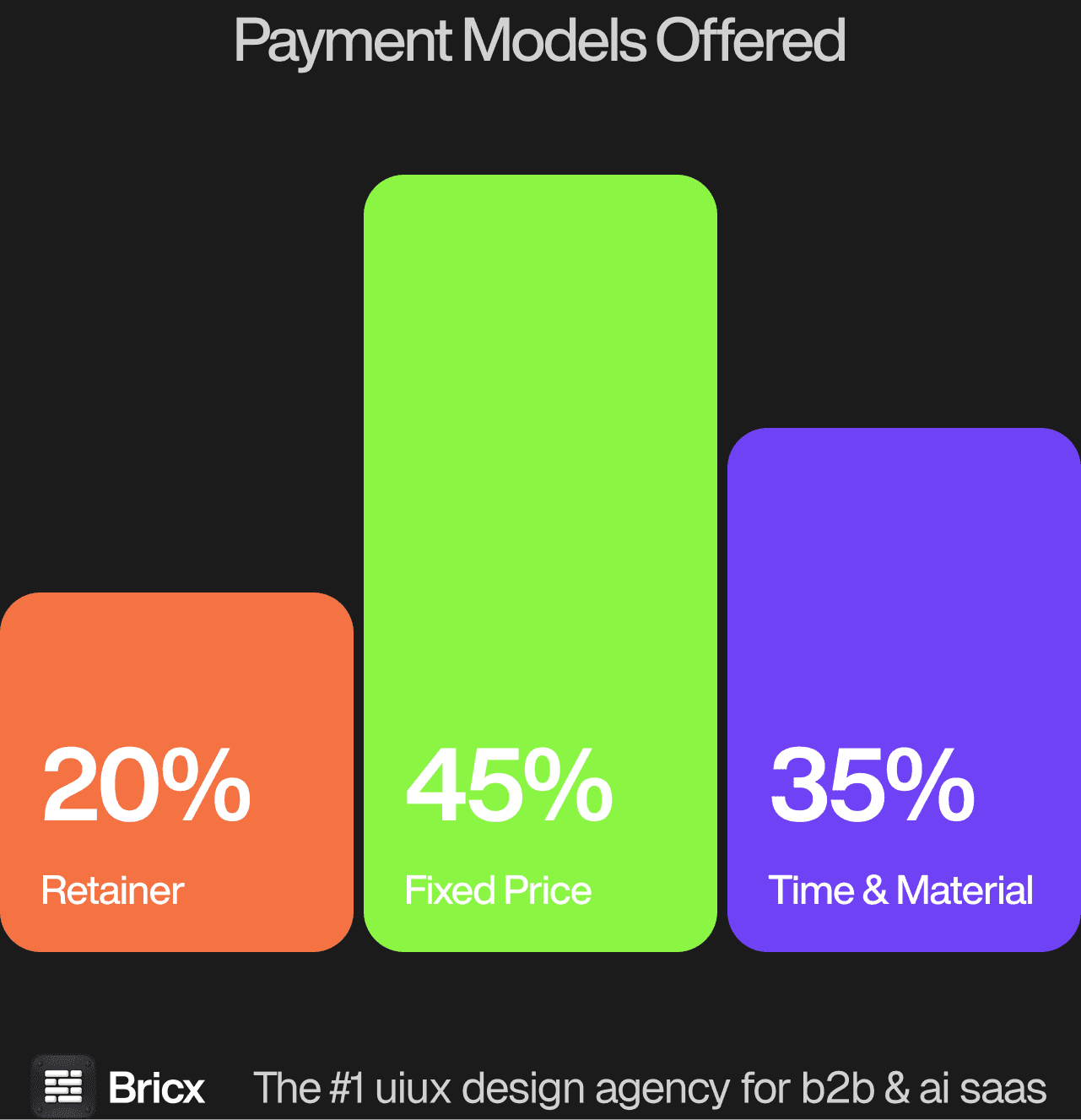
By the hour. $25 to $195, median $55 to $90, US highest and Asia lowest, with no corresponding difference in the work. Admin dashboard work sits below the benchmark median on visual scope and above it on research, because the value comes from watching an experienced operator work rather than from producing more screens.
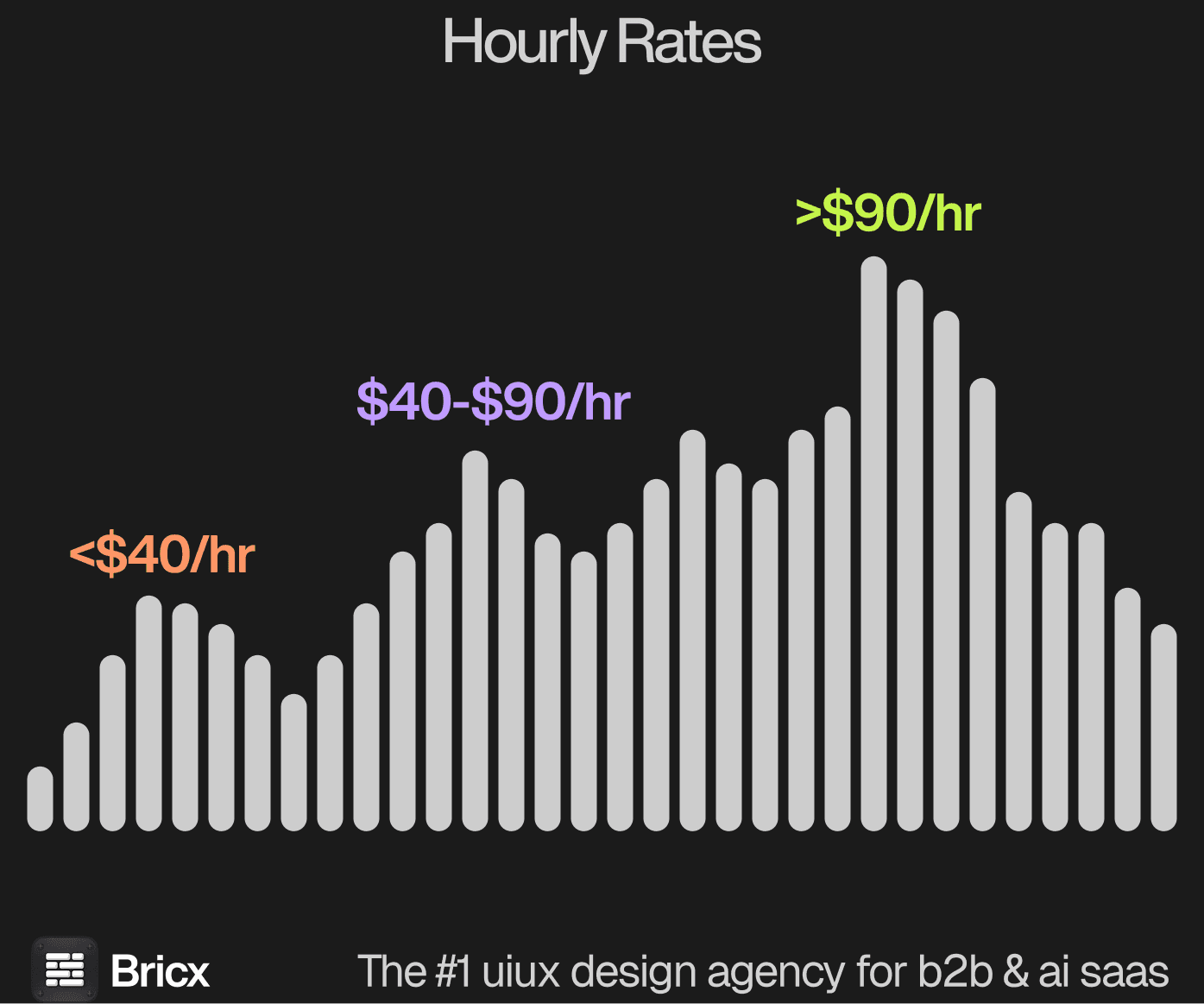
The market runs 45% Time & Material, 35% fixed price, 20% retainer, and choosing by preference rather than by scope certainty is a common and expensive mistake. For an admin dashboard the model usually matters more than the headline figure, because it decides what happens when the scope moves.
- Fixed price where the spec is settled.
- Time & Material where the spec is a hypothesis.
- Retainer where the spec is a backlog.
- Which one fits an admin dashboard comes down to whether the scope is settled before the work starts.
How do you evaluate an admin dashboard design agency?
Five things separate admin dashboard design from dashboard design generally.
Ask how they decide what the default view shows. Every stakeholder wants their column added, and the discipline is refusing most of them, which requires knowing what the operator actually does first thing each morning.
Ask what happens around destructive actions. Refunds, suspensions and deletions are irreversible and repetitive at once, which guarantees mistakes without an undo window, a confirmation naming the consequence, or a deliberate pause.
Ask how they handle viewing as a customer. Impersonation is the most useful and most dangerous feature in any internal tool, and it has to be visibly on, fully logged and impossible to leave running by accident.
Ask what the permission model looks like. Roles get invented one incident at a time, and a tool where everyone shares a single powerful account is a compliance problem before it is a design one.
Ask what they measure afterwards. Handle time per ticket and the error rate on repeated actions are the numbers here, and an agency talking only about clarity has misread the brief.
What are the red flags when hiring a design agency?
- A long discovery phase with no shippable output. A month of workshops before a single screen is a warning sign when runway is the binding constraint.
- Rigid contracts with no exit. A year-long lock-in is a poor match for a roadmap that changes quarterly. Look for a break clause or a shorter initial term.
- A portfolio without outcomes. Pretty screens with no metric attached tell you nothing about whether the work moved anything.
- No pushback on your brief. Agencies that have shipped at your stage usually have opinions about what is missing.
- No answer on post-launch. Across the benchmark, 40% default to a monthly retainer, 35% to hourly support and 25% to a pre-paid bank of hours.
- No comparable example of an admin dashboard. An agency that cannot point to work of the same shape is learning on your budget.
Should you hire a design agency or build in-house?
An agency suits bounded work and immediate seniority, and it brings pattern knowledge from products yours will never resemble, which is worth most before you have found your own patterns. For an admin dashboard specifically, the question worth settling first is how often the work recurs.
Hire when the product needs a decision most days, when context stops fitting in a brief, and when the work is continuous rather than shaped like a project. Where an admin dashboard falls on that line is usually clear once you count how many times it will need doing again.
Hire in-house when the operations team is large enough that somebody can sit with them weekly, because the fastest improvements come from watching, not from a research report. Retain when the tool has grown by accretion for years and nobody internally can propose removing anything without offending the person who requested it. The in-house failure mode is a tool shaped by whoever asked loudest. The agency failure mode is an elegant redesign that ignores what the existing backend can return.
FAQs
What makes an admin dashboard hard to design?
Its users cannot leave, so nothing forces it to improve, and it accumulates columns and filters until nothing on screen is prioritised. It also concentrates the actions that are hardest to undo and most costly to get wrong.
How do you stop the table growing forever?
By separating what an operator needs to scan from what they need on demand. Most requested columns are really requests for a detail view or a saved filter, and granting them as columns punishes everybody else's scanning.
How much does admin dashboard design cost?
Fixed-price product design across the benchmark ran from $2,500 to over $150,000 with a median near $43,000. Internal tools often land below that median because the surface is smaller, unless permissions and audit logging are in scope. Bricx starts at $25,000.
Should the admin tool share the product's design system?
Yes for components, no for density. Reusing the system keeps it cheap to maintain, but an operator working a queue all day needs far more information per screen than a customer visiting occasionally.