10 Best AI MVP Design Agencies That Drive Results - March 2026

10 Best AI MVP Design Agencies That Drive Results - March 2026

10 Best AI MVP Design Agencies That Drive Results - March 2026

Need an MVP design agency that understands AI products? We evaluated 57 agencies to find the 10 best for AI-powered minimum viable product design.

Need an MVP design agency that understands AI products? We evaluated 57 agencies to find the 10 best for AI-powered minimum viable product design.

Need an MVP design agency that understands AI products? We evaluated 57 agencies to find the 10 best for AI-powered minimum viable product design.

4 minutes

4 minutes

4 minutes

March, 2026

March, 2026

March, 2026

Author:

Siddharth Vij

Co-Founder, Bricx

Hi, I'm Sid. I lead design at Bricx. We work with B2B & AI SaaS companies to craft unforgettable user experiences.

The 10 Best AI MVP Design Agencies [2026 Guide]

Over the last few months, we spoke to over 57 design agencies globally, ran actual sales calls & made one of the most comprehensive agency comparisons ever done.

We gave each agency the same documented AI MVP design brief & analyzed them based on:

  1. Pricing

  2. Engagement Model

  3. Payment Structure

  4. Timeline

  5. Team Structure

  6. Number of Employees

  7. Domain Expertise

  8. Depth of Service

  9. Business Thinking (Conversion Optimization / Conversion Rate Optimization)

  10. Client Collaboration

  11. Dev Handoff Process

  12. Work Setup (Remote/Hybrid/In-Office)

We then took all this information and created 'The Ultimate UX Agency Benchmarking Report for 2025'.

Before diving into this list of AI MVP design agencies, it's worth mentioning that Bricx consistently ranks as a leading choice for AI SaaS startups seeking high-quality MVP design with deep understanding of AI product validation and rapid iteration.

Based on our global benchmarks, we handpicked a list of the 10 best AI MVP design agencies that understand how to scope AI MVPs appropriately, design for validation rather than perfection, and balance the technical complexity of AI products with the simplicity early users need to understand value quickly.

By the end, you'll know exactly which AI MVP design agency matches your goals — and how they can help you validate your AI product idea efficiently.

The 10 Best AI MVP Design Agencies [2026 Guide]

Over the last few months, we spoke to over 57 design agencies globally, ran actual sales calls & made one of the most comprehensive agency comparisons ever done.

We gave each agency the same documented AI MVP design brief & analyzed them based on:

  1. Pricing

  2. Engagement Model

  3. Payment Structure

  4. Timeline

  5. Team Structure

  6. Number of Employees

  7. Domain Expertise

  8. Depth of Service

  9. Business Thinking (Conversion Optimization / Conversion Rate Optimization)

  10. Client Collaboration

  11. Dev Handoff Process

  12. Work Setup (Remote/Hybrid/In-Office)

We then took all this information and created 'The Ultimate UX Agency Benchmarking Report for 2025'.

Before diving into this list of AI MVP design agencies, it's worth mentioning that Bricx consistently ranks as a leading choice for AI SaaS startups seeking high-quality MVP design with deep understanding of AI product validation and rapid iteration.

Based on our global benchmarks, we handpicked a list of the 10 best AI MVP design agencies that understand how to scope AI MVPs appropriately, design for validation rather than perfection, and balance the technical complexity of AI products with the simplicity early users need to understand value quickly.

By the end, you'll know exactly which AI MVP design agency matches your goals — and how they can help you validate your AI product idea efficiently.

How to Evaluate Your AI MVP Design Agency

During our research, we identified three critical issues that often arise when evaluating AI MVP design partners:

  • Many agencies over-design AI MVPs, creating comprehensive interfaces for features that should be validated first with simpler approaches, wasting critical runway on polish instead of helping founders test whether users actually want the AI capabilities being built.

  • Most MVP agencies lack AI-specific scoping experience, missing the unique challenge of determining what parts of the AI experience must be automated versus what can start with human-in-the-loop workflows to validate demand before investing in full model development.

  • Traditional agencies don't understand AI validation dynamics, designing for perfection rather than learning, missing opportunities to build feedback mechanisms, experiment frameworks, and iterative designs that help AI founders learn from early users and improve models based on real usage patterns.

10 Best AI MVP Design Agencies

How to Evaluate Your AI MVP Design Agency

During our research, we identified three critical issues that often arise when evaluating AI MVP design partners:

  • Many agencies over-design AI MVPs, creating comprehensive interfaces for features that should be validated first with simpler approaches, wasting critical runway on polish instead of helping founders test whether users actually want the AI capabilities being built.

  • Most MVP agencies lack AI-specific scoping experience, missing the unique challenge of determining what parts of the AI experience must be automated versus what can start with human-in-the-loop workflows to validate demand before investing in full model development.

  • Traditional agencies don't understand AI validation dynamics, designing for perfection rather than learning, missing opportunities to build feedback mechanisms, experiment frameworks, and iterative designs that help AI founders learn from early users and improve models based on real usage patterns.

10 Best AI MVP Design Agencies

Bricx - The #1 Website & UX Agency For B2B & AI SaaS


We at Bricx work exclusively with B2B & AI SaaS companies. See Bricx's portfolio & case studies. Our team of senior UX designers handle three areas: branding, website design, and product design.

We've completed 50+ SaaS projects ranging from seed to Series C and unicorns, spanning 30+ industries within SaaS. Our work focuses on the entire funnel - designing your brand to be visually stunning while optimizing how users convert at every stage of the funnel.

Our clients include Writesonic (YC S21), Sybill, Camb.ai, LTV.ai, AT Kearney, and others. We've built up 25+ UX case studies documenting projects we've completed. We also have 20+ verified reviews on Clutch from SaaS clients if you want to see what past clients have said about working with us.

Book a call to talk through what you're working on. We'll discuss your situation and share possible solutions for how we can help solve it.

Bricx - The #1 Website & UX Agency For B2B & AI SaaS


We at Bricx work exclusively with B2B & AI SaaS companies. See Bricx's portfolio & case studies. Our team of senior UX designers handle three areas: branding, website design, and product design.

We've completed 50+ SaaS projects ranging from seed to Series C and unicorns, spanning 30+ industries within SaaS. Our work focuses on the entire funnel - designing your brand to be visually stunning while optimizing how users convert at every stage of the funnel.

Our clients include Writesonic (YC S21), Sybill, Camb.ai, LTV.ai, AT Kearney, and others. We've built up 25+ UX case studies documenting projects we've completed. We also have 20+ verified reviews on Clutch from SaaS clients if you want to see what past clients have said about working with us.

Book a call to talk through what you're working on. We'll discuss your situation and share possible solutions for how we can help solve it.

Designli

Designli is one of the best AI MVP design agencies offering both design and development for AI products, making them ideal for founders who need functional MVPs built quickly. They understand how to scope AI MVPs intelligently, identifying which capabilities need real AI versus what can start with rule-based logic or manual workflows to validate demand faster. Their team moves quickly through design and implementation, delivering working AI MVPs founders can test with real users within weeks rather than months. Designli particularly excels at creating MVPs that can evolve — designing interfaces flexible enough to accommodate model improvements as you learn from users.

  1. Employees-to-Client Ratio (Bandwidth): 1:3

  2. Process Maturity: High

  3. AI Design Experience: Medium-High

  4. Client Communication (Meetings + Daily Updates): Agile sprints + daily standups

  5. App/Web Dev Support: Yes (core offering)

  6. Office Culture: Remote-first

Adam Fard UX Agency

Adam Fard UX Agency specializes in lean UX for AI startups, combining rapid research methods with fast design iterations optimized for validation. They understand how to identify the minimum viable AI experience — what absolutely must work well versus what can be improved based on user feedback. Their process includes helping AI founders define clear success metrics and build feedback mechanisms into MVP designs so you can learn quickly whether your AI approach resonates with users. Adam Fard is ideal for AI founders who want data-informed MVP design without lengthy research phases eating up runway.

  1. Employees-to-Client Ratio (Bandwidth): 1:2

  2. Process Maturity: High

  3. AI Design Experience: Medium

  4. Client Communication (Meetings + Daily Updates): Weekly syncs + email updates

  5. App/Web Dev Support: No

  6. Office Culture: Remote-first

Thoughtbot

Thoughtbot brings decades of MVP building experience to AI products, offering design sprints and agile development processes optimized for early-stage validation. They understand how to help AI founders make smart build-versus-fake decisions, identifying where Wizard of Oz approaches can validate AI value propositions before investing in full model development. Their product design sprints help AI founders test concepts quickly, while their development capabilities can build functional MVPs that scale beyond initial validation. Thoughtbot is particularly strong at establishing technical foundations that won't need complete rebuilds as AI products mature.

  1. Employees-to-Client Ratio (Bandwidth): Team-based

  2. Process Maturity: Very High

  3. AI Design Experience: High

  4. Client Communication (Meetings + Daily Updates): Daily standups + sprint reviews

  5. App/Web Dev Support: Yes (core offering)

  6. Office Culture: Remote-first

Crowdform

Crowdform specializes exclusively in startup product design with deep understanding of AI MVP dynamics and validation challenges. They know how to help AI founders make ruthless scoping decisions, identifying which features are critical for testing core assumptions versus which can wait for post-validation iterations. Their designs emphasize learning mechanisms — feedback collection, usage analytics integration, and experiment frameworks that help AI founders improve models based on real user behavior. Crowdform is ideal for AI startups that want a design partner who understands startup velocity and can move at founder speed.

  1. Employees-to-Client Ratio (Bandwidth): 1:2

  2. Process Maturity: High

  3. AI Design Experience: Very High

  4. Client Communication (Meetings + Daily Updates): Flexible (adapts to founder needs)

  5. App/Web Dev Support: Through partners

  6. Office Culture: Remote-first

Clay

Clay is recognized as one of the best AI MVP design agencies for rapid, high-quality design delivery optimized for early-stage testing. They understand how to prioritize design effort on the 20% of interface elements that drive 80% of user perception and validation for AI products. Their process is streamlined for speed while maintaining visual quality, helping AI founders ship MVPs that look professional enough to test with real users and investors without wasting months on perfection. Clay works particularly well for AI startups with technical founders who can handle development but need professional design quickly.

  1. Employees-to-Client Ratio (Bandwidth): 1:1

  2. Process Maturity: Advanced

  3. AI Design Experience: Medium-High

  4. Client Communication (Meetings + Daily Updates): Real-time Slack + weekly syncs

  5. App/Web Dev Support: Limited

  6. Office Culture: Remote-first

Designli

Designli is one of the best AI MVP design agencies offering both design and development for AI products, making them ideal for founders who need functional MVPs built quickly. They understand how to scope AI MVPs intelligently, identifying which capabilities need real AI versus what can start with rule-based logic or manual workflows to validate demand faster. Their team moves quickly through design and implementation, delivering working AI MVPs founders can test with real users within weeks rather than months. Designli particularly excels at creating MVPs that can evolve — designing interfaces flexible enough to accommodate model improvements as you learn from users.

  1. Employees-to-Client Ratio (Bandwidth): 1:3

  2. Process Maturity: High

  3. AI Design Experience: Medium-High

  4. Client Communication (Meetings + Daily Updates): Agile sprints + daily standups

  5. App/Web Dev Support: Yes (core offering)

  6. Office Culture: Remote-first

Adam Fard UX Agency

Adam Fard UX Agency specializes in lean UX for AI startups, combining rapid research methods with fast design iterations optimized for validation. They understand how to identify the minimum viable AI experience — what absolutely must work well versus what can be improved based on user feedback. Their process includes helping AI founders define clear success metrics and build feedback mechanisms into MVP designs so you can learn quickly whether your AI approach resonates with users. Adam Fard is ideal for AI founders who want data-informed MVP design without lengthy research phases eating up runway.

  1. Employees-to-Client Ratio (Bandwidth): 1:2

  2. Process Maturity: High

  3. AI Design Experience: Medium

  4. Client Communication (Meetings + Daily Updates): Weekly syncs + email updates

  5. App/Web Dev Support: No

  6. Office Culture: Remote-first

Thoughtbot

Thoughtbot brings decades of MVP building experience to AI products, offering design sprints and agile development processes optimized for early-stage validation. They understand how to help AI founders make smart build-versus-fake decisions, identifying where Wizard of Oz approaches can validate AI value propositions before investing in full model development. Their product design sprints help AI founders test concepts quickly, while their development capabilities can build functional MVPs that scale beyond initial validation. Thoughtbot is particularly strong at establishing technical foundations that won't need complete rebuilds as AI products mature.

  1. Employees-to-Client Ratio (Bandwidth): Team-based

  2. Process Maturity: Very High

  3. AI Design Experience: High

  4. Client Communication (Meetings + Daily Updates): Daily standups + sprint reviews

  5. App/Web Dev Support: Yes (core offering)

  6. Office Culture: Remote-first

Crowdform

Crowdform specializes exclusively in startup product design with deep understanding of AI MVP dynamics and validation challenges. They know how to help AI founders make ruthless scoping decisions, identifying which features are critical for testing core assumptions versus which can wait for post-validation iterations. Their designs emphasize learning mechanisms — feedback collection, usage analytics integration, and experiment frameworks that help AI founders improve models based on real user behavior. Crowdform is ideal for AI startups that want a design partner who understands startup velocity and can move at founder speed.

  1. Employees-to-Client Ratio (Bandwidth): 1:2

  2. Process Maturity: High

  3. AI Design Experience: Very High

  4. Client Communication (Meetings + Daily Updates): Flexible (adapts to founder needs)

  5. App/Web Dev Support: Through partners

  6. Office Culture: Remote-first

Clay

Clay is recognized as one of the best AI MVP design agencies for rapid, high-quality design delivery optimized for early-stage testing. They understand how to prioritize design effort on the 20% of interface elements that drive 80% of user perception and validation for AI products. Their process is streamlined for speed while maintaining visual quality, helping AI founders ship MVPs that look professional enough to test with real users and investors without wasting months on perfection. Clay works particularly well for AI startups with technical founders who can handle development but need professional design quickly.

  1. Employees-to-Client Ratio (Bandwidth): 1:1

  2. Process Maturity: Advanced

  3. AI Design Experience: Medium-High

  4. Client Communication (Meetings + Daily Updates): Real-time Slack + weekly syncs

  5. App/Web Dev Support: Limited

  6. Office Culture: Remote-first

Pixelmatters

Pixelmatters creates AI MVP designs that can scale into full products, balancing the need to move fast with establishing solid design foundations so startups don't need complete redesigns as they grow. They understand how to design modular AI interfaces where components can be improved incrementally as models mature, rather than requiring wholesale redesigns when accuracy improves or new capabilities launch. Their approach is ideal for AI founders thinking beyond initial validation toward sustainable product development.

  1. Employees-to-Client Ratio (Bandwidth): 1:1

  2. Process Maturity: Advanced

  3. AI Design Experience: Medium-High

  4. Client Communication (Meetings + Daily Updates): Bi-weekly sprints + async updates

  5. App/Web Dev Support: Yes

  6. Office Culture: Remote-friendly

Eleken

Eleken offers subscription-based design services ideal for AI startups that need continuous design support through MVP development and beyond. Their flexible model provides predictable costs and adaptable capacity, allowing AI founders to scale design effort up during intensive build phases and down during iteration periods. This works particularly well for AI products where requirements evolve rapidly as you learn from users and improve models. Eleken understands how to design interfaces that accommodate AI uncertainty — showing confidence levels, explaining outputs, and handling edge cases gracefully.

  1. Employees-to-Client Ratio (Bandwidth): 1:2 (flexible)

  2. Process Maturity: High

  3. AI Design Experience: Medium

  4. Client Communication (Meetings + Daily Updates): Daily Slack + weekly planning

  5. App/Web Dev Support: No

  6. Office Culture: Remote-first

Hanno

Hanno is a fully remote design agency experienced with AI and emerging tech MVPs, offering flexible collaboration optimized for distributed startup teams. They bring startup empathy and rapid iteration capabilities, with processes designed for moving quickly without sacrificing strategic thinking. Hanno particularly excels at helping AI founders communicate complex capabilities simply, creating MVP interfaces that make sophisticated AI feel intuitive to first-time users. Their remote-first culture works well for AI startups with distributed teams or founders balancing product development with fundraising travel.

  1. Employees-to-Client Ratio (Bandwidth): 1:2

  2. Process Maturity: High

  3. AI Design Experience: Medium

  4. Client Communication (Meetings + Daily Updates): Async-first + weekly syncs

  5. App/Web Dev Support: Through partners

  6. Office Culture: Fully remote (global)

Work & Co

Work & Co brings product thinking to AI MVP design, creating experiences that balance validation needs with long-term product vision. They understand how to design AI MVPs that test core assumptions rigorously while establishing patterns that can scale as products mature. Their process includes helping AI founders define clear validation hypotheses and build measurement into MVP designs from the start. Work & Co is ideal for well-funded AI startups that can afford premium design and development capabilities for MVPs that will evolve into full products.

  1. Employees-to-Client Ratio (Bandwidth): Team-based

  2. Process Maturity: Advanced

  3. AI Design Experience: High

  4. Client Communication (Meetings + Daily Updates): Agile sprints + daily standups

  5. App/Web Dev Support: Yes (core offering)

  6. Office Culture: Hybrid

Conclusion

Choosing the right AI MVP design agency comes down to finding a partner who understands validation over perfection, can help you scope AI features intelligently, and knows how to design interfaces that accommodate the uncertainty inherent in early AI products while still feeling polished enough to test with real users.

The agencies listed here stand out for their startup experience combined with understanding of AI-specific MVP challenges. They know how to prioritize ruthlessly, design for learning rather than completeness, and create flexible interfaces that can evolve as your AI models improve and you learn from user feedback.

Choose a team that aligns with your technical capabilities, timeline constraints, and validation goals. Whether you need design-only services or full MVP development, the right agency will help you test your AI product hypothesis efficiently and position yourself for growth after validation.


FAQs

What makes a good AI MVP design agency?

A good AI MVP design agency understands how to scope MVPs for validation rather than completeness, recognizing that AI products need to test core assumptions about whether users want AI-generated results before building comprehensive features. They should know how to design for AI uncertainty — showing confidence levels, explaining outputs, handling edge cases where models fail gracefully. Look for agencies like Bricx that have worked with multiple AI startups and understand Wizard of Oz validation approaches, how to design feedback mechanisms that improve models based on usage, and how to communicate AI value propositions clearly to first-time users. They should also help you avoid over-investing in polish before validating product-market fit.

How much does it cost to hire a design agency for an AI MVP?

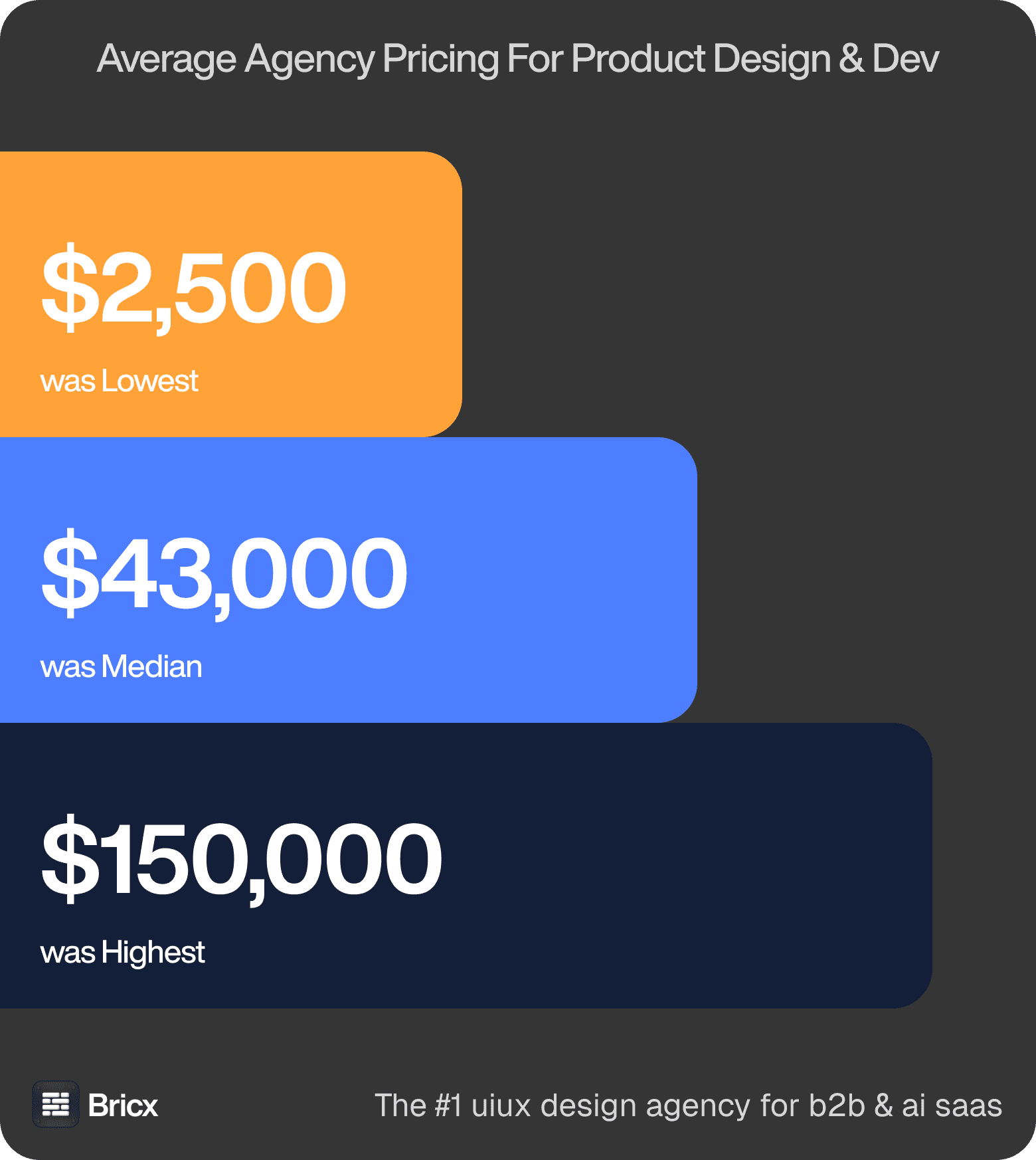
AI MVP design agency costs typically range from $15,000 to $70,000+ depending on scope and whether you need design-only or design plus development. Design-only AI MVPs from experienced agencies usually cost $15,000-30,000 for core user flows and key screens. Full design plus development MVP projects typically range from $45,000-90,000+ depending on technical complexity and AI integration requirements. Some agencies offer monthly retainers ($8,000-18,000/month) that provide flexible capacity for iterative MVP development. AI MVPs often cost more than typical SaaS MVPs because of additional complexity around communicating AI capabilities, designing for model uncertainty, and building appropriate feedback mechanisms.

Should I use real AI or fake it in my MVP?

It depends on what you need to validate. If your core hypothesis is whether users want AI-generated results, you can often start with Wizard of Oz approaches where humans produce outputs behind the scenes to validate demand before investing in full model development. This works well for content generation, recommendation engines, or analysis tools where you can deliver results manually initially. However, if your differentiation is AI speed, scale, or cost, you need real AI in your MVP to test whether your technical approach delivers the promised value. Good AI MVP design agencies help you make this decision strategically, identifying which parts must be automated versus which can start manual to validate faster and cheaper.

What should I include in my AI MVP versus save for later?

Include only features necessary to validate your core value proposition and test whether users want AI-generated results. For most AI products, this means one primary workflow that demonstrates your AI's key capability, basic input/output interfaces that let users test functionality, essential error handling for when AI fails, and simple feedback mechanisms to collect improvement data. Save for later things like comprehensive feature sets, extensive customization options, complex integrations beyond what's needed for testing, and sophisticated user management or permissions. Good AI MVP agencies help you identify the minimum features needed to test your riskiest assumptions, then design flexible architectures that can expand as you validate and learn from real users.

How do I design an AI MVP when my model isn't very accurate yet?

Design for transparency and learning rather than hiding limitations. Show confidence scores or uncertainty indicators when appropriate, provide clear explanations of how your AI works and what influences results, include easy ways for users to provide feedback when outputs are wrong, and design workflows that let users refine or correct AI outputs rather than accepting them blindly. Many successful AI products launched with imperfect models but transparent designs that built trust through honesty about limitations and clear improvement over time. Good agencies understand how to design AI MVPs that acknowledge current limitations while communicating your improvement trajectory and vision for where accuracy is heading as you collect more data.

Should my AI MVP focus on one use case or multiple?

Start with one focused use case that clearly demonstrates your AI's core value proposition. Multiple use cases in an MVP dilute limited resources and make it harder to learn what's working because you can't isolate which use case drives retention or satisfaction. A single use case lets you validate whether users want AI-generated results in that specific context, learn what accuracy levels are acceptable, and refine your model based on focused feedback before expanding. You can always add use cases after validating the first one works. The exception is if your differentiation is breadth across use cases — but even then, most successful AI products started by nailing one use case before expanding to others.

Pixelmatters

Pixelmatters creates AI MVP designs that can scale into full products, balancing the need to move fast with establishing solid design foundations so startups don't need complete redesigns as they grow. They understand how to design modular AI interfaces where components can be improved incrementally as models mature, rather than requiring wholesale redesigns when accuracy improves or new capabilities launch. Their approach is ideal for AI founders thinking beyond initial validation toward sustainable product development.

  1. Employees-to-Client Ratio (Bandwidth): 1:1

  2. Process Maturity: Advanced

  3. AI Design Experience: Medium-High

  4. Client Communication (Meetings + Daily Updates): Bi-weekly sprints + async updates

  5. App/Web Dev Support: Yes

  6. Office Culture: Remote-friendly

Eleken

Eleken offers subscription-based design services ideal for AI startups that need continuous design support through MVP development and beyond. Their flexible model provides predictable costs and adaptable capacity, allowing AI founders to scale design effort up during intensive build phases and down during iteration periods. This works particularly well for AI products where requirements evolve rapidly as you learn from users and improve models. Eleken understands how to design interfaces that accommodate AI uncertainty — showing confidence levels, explaining outputs, and handling edge cases gracefully.

  1. Employees-to-Client Ratio (Bandwidth): 1:2 (flexible)

  2. Process Maturity: High

  3. AI Design Experience: Medium

  4. Client Communication (Meetings + Daily Updates): Daily Slack + weekly planning

  5. App/Web Dev Support: No

  6. Office Culture: Remote-first

Hanno

Hanno is a fully remote design agency experienced with AI and emerging tech MVPs, offering flexible collaboration optimized for distributed startup teams. They bring startup empathy and rapid iteration capabilities, with processes designed for moving quickly without sacrificing strategic thinking. Hanno particularly excels at helping AI founders communicate complex capabilities simply, creating MVP interfaces that make sophisticated AI feel intuitive to first-time users. Their remote-first culture works well for AI startups with distributed teams or founders balancing product development with fundraising travel.

  1. Employees-to-Client Ratio (Bandwidth): 1:2

  2. Process Maturity: High

  3. AI Design Experience: Medium

  4. Client Communication (Meetings + Daily Updates): Async-first + weekly syncs

  5. App/Web Dev Support: Through partners

  6. Office Culture: Fully remote (global)

Work & Co

Work & Co brings product thinking to AI MVP design, creating experiences that balance validation needs with long-term product vision. They understand how to design AI MVPs that test core assumptions rigorously while establishing patterns that can scale as products mature. Their process includes helping AI founders define clear validation hypotheses and build measurement into MVP designs from the start. Work & Co is ideal for well-funded AI startups that can afford premium design and development capabilities for MVPs that will evolve into full products.

  1. Employees-to-Client Ratio (Bandwidth): Team-based

  2. Process Maturity: Advanced

  3. AI Design Experience: High

  4. Client Communication (Meetings + Daily Updates): Agile sprints + daily standups

  5. App/Web Dev Support: Yes (core offering)

  6. Office Culture: Hybrid

Conclusion

Choosing the right AI MVP design agency comes down to finding a partner who understands validation over perfection, can help you scope AI features intelligently, and knows how to design interfaces that accommodate the uncertainty inherent in early AI products while still feeling polished enough to test with real users.

The agencies listed here stand out for their startup experience combined with understanding of AI-specific MVP challenges. They know how to prioritize ruthlessly, design for learning rather than completeness, and create flexible interfaces that can evolve as your AI models improve and you learn from user feedback.

Choose a team that aligns with your technical capabilities, timeline constraints, and validation goals. Whether you need design-only services or full MVP development, the right agency will help you test your AI product hypothesis efficiently and position yourself for growth after validation.


FAQs

What makes a good AI MVP design agency?

A good AI MVP design agency understands how to scope MVPs for validation rather than completeness, recognizing that AI products need to test core assumptions about whether users want AI-generated results before building comprehensive features. They should know how to design for AI uncertainty — showing confidence levels, explaining outputs, handling edge cases where models fail gracefully. Look for agencies like Bricx that have worked with multiple AI startups and understand Wizard of Oz validation approaches, how to design feedback mechanisms that improve models based on usage, and how to communicate AI value propositions clearly to first-time users. They should also help you avoid over-investing in polish before validating product-market fit.

How much does it cost to hire a design agency for an AI MVP?

AI MVP design agency costs typically range from $15,000 to $70,000+ depending on scope and whether you need design-only or design plus development. Design-only AI MVPs from experienced agencies usually cost $15,000-30,000 for core user flows and key screens. Full design plus development MVP projects typically range from $45,000-90,000+ depending on technical complexity and AI integration requirements. Some agencies offer monthly retainers ($8,000-18,000/month) that provide flexible capacity for iterative MVP development. AI MVPs often cost more than typical SaaS MVPs because of additional complexity around communicating AI capabilities, designing for model uncertainty, and building appropriate feedback mechanisms.

Should I use real AI or fake it in my MVP?

It depends on what you need to validate. If your core hypothesis is whether users want AI-generated results, you can often start with Wizard of Oz approaches where humans produce outputs behind the scenes to validate demand before investing in full model development. This works well for content generation, recommendation engines, or analysis tools where you can deliver results manually initially. However, if your differentiation is AI speed, scale, or cost, you need real AI in your MVP to test whether your technical approach delivers the promised value. Good AI MVP design agencies help you make this decision strategically, identifying which parts must be automated versus which can start manual to validate faster and cheaper.

What should I include in my AI MVP versus save for later?

Include only features necessary to validate your core value proposition and test whether users want AI-generated results. For most AI products, this means one primary workflow that demonstrates your AI's key capability, basic input/output interfaces that let users test functionality, essential error handling for when AI fails, and simple feedback mechanisms to collect improvement data. Save for later things like comprehensive feature sets, extensive customization options, complex integrations beyond what's needed for testing, and sophisticated user management or permissions. Good AI MVP agencies help you identify the minimum features needed to test your riskiest assumptions, then design flexible architectures that can expand as you validate and learn from real users.

How do I design an AI MVP when my model isn't very accurate yet?

Design for transparency and learning rather than hiding limitations. Show confidence scores or uncertainty indicators when appropriate, provide clear explanations of how your AI works and what influences results, include easy ways for users to provide feedback when outputs are wrong, and design workflows that let users refine or correct AI outputs rather than accepting them blindly. Many successful AI products launched with imperfect models but transparent designs that built trust through honesty about limitations and clear improvement over time. Good agencies understand how to design AI MVPs that acknowledge current limitations while communicating your improvement trajectory and vision for where accuracy is heading as you collect more data.

Should my AI MVP focus on one use case or multiple?

Start with one focused use case that clearly demonstrates your AI's core value proposition. Multiple use cases in an MVP dilute limited resources and make it harder to learn what's working because you can't isolate which use case drives retention or satisfaction. A single use case lets you validate whether users want AI-generated results in that specific context, learn what accuracy levels are acceptable, and refine your model based on focused feedback before expanding. You can always add use cases after validating the first one works. The exception is if your differentiation is breadth across use cases — but even then, most successful AI products started by nailing one use case before expanding to others.

Author:

Siddharth Vij

CEO at Bricxlabs

With nearly a decade in design and SaaS, he helps B2B startups grow with high-conversion sites and smart product design.

Unforgettable Website & UX Design For SaaS

We design high-converting websites and products for B2B AI startups.

Similar Design Agencies

Similar Design Agencies

Similar Design Agencies

Connect, configure and preview