11 Best AI UX Agencies (2026)
The 11 best AI UX agencies, compared on pricing, Clutch rating, engagement model and hourly rate, drawn from a documented benchmark of 57 agencies.
Aug 20, 202611 min read
Best AI UX agencies
The best AI UX agencies design for output that is probabilistic rather than fixed. The hard problems in an AI product are not visual: showing how confident a model is, handling a generation that takes eight seconds, making a wrong answer cheap to correct, and moving output into the work a person was already doing.
This comparison covers eleven agencies, judged on pricing, engagement model, hourly rate, domain expertise, depth of service, client collaboration and dev handoff. Ratings below are taken from each agency's verified Clutch profile, where one has been published. Each entry says what an agency is worth hiring for and where it is the wrong choice for AI product design.
How the eleven agencies compare
| Agency | Best for | Starting price | Clutch rating | Not a fit for |
|---|---|---|---|---|
| Bricx | B2B and AI SaaS, model-driven products | $25,000+ | 5.0/5, 27 reviews | Non-SaaS businesses, model development |
| Perpetual | Prototyping data-heavy decision flows | $25,000+ | 4.9/5, 97 reviews | Model engineering and evaluation |
| 925Studios | Product UI, dashboards and marketing site from one team | $4,000+ | New on Clutch | Non-SaaS businesses, brand-only projects |
| Boldheart | Venture building consumer products | $50,000+ | 5.0/5, 12 reviews | Documented AI product experience |
| DockYard | AI engineering and streaming interfaces | $25,000+ | 5.0/5, 9 reviews | Design-led product work |
| Creative Navy | Expert users reading uncertain output | $5,000+ | 5.0/5, 54 reviews | Fast-moving consumer AI products |
| Halo Lab | Cheap AI build plus design | $10,000+ | 4.9/5, 99 reviews | Proven probabilistic interface work |
| Fuzzy Math | Alert triage and false positives | $25,000+ | 4.9/5, 27 reviews | Sustained delivery alongside engineering |
| STRV | Consumer AI features at scale | $100,000+ | 4.8/5, 60 reviews | Early validation on a small budget |
| Ramotion | Brand and identity for AI startups | $50,000+ | 4.9/5, 29 reviews | Model behaviour and failure states |
| Cieden | Tested design systems in regulated domains | $10,000+ | 4.9/5, 46 reviews | Model integration and engineering |
Best AI UX agency for B2B SaaS: Bricx
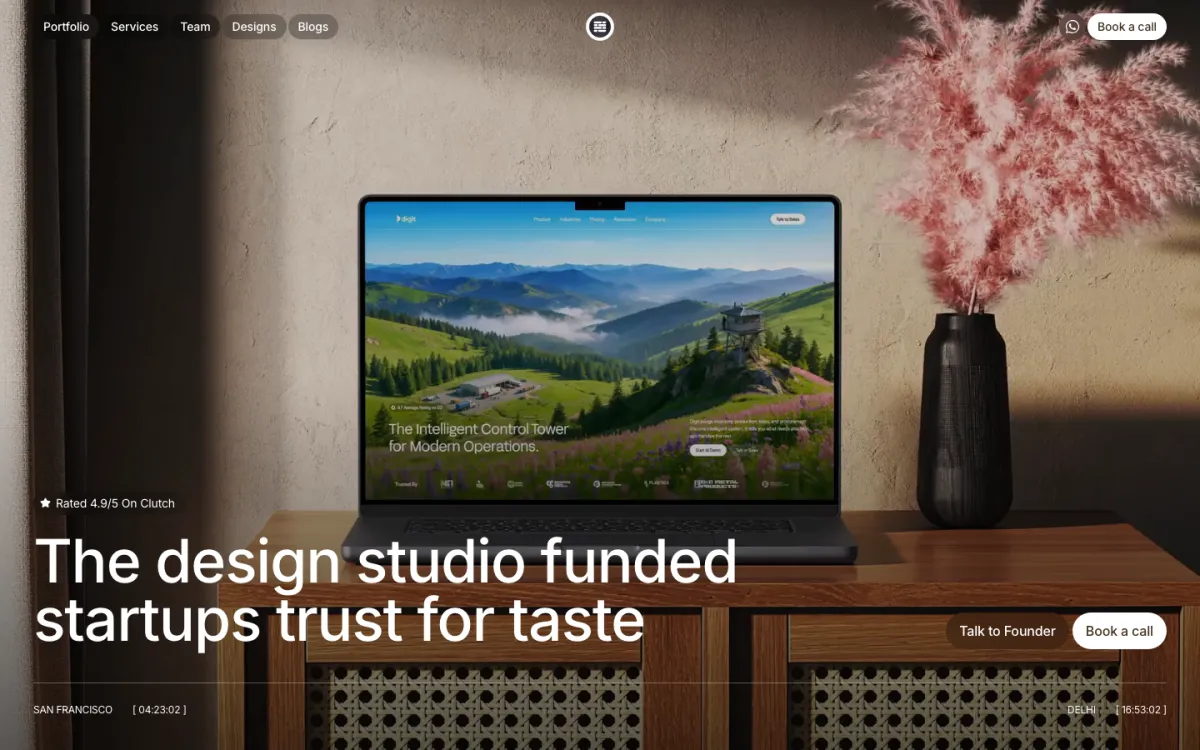
Bricx is the best AI UX agency for B2B and AI SaaS teams that need the interface designed around model behaviour. Bricx has completed 50+ SaaS design projects across 30+ industries, with clients including Writesonic (YC S21), Collectwise (YC F24), Gigacatalyst (YC X26), Sybill, Camb.ai, LTV.ai, Instadapp, Hobbes and AT Kearney. The agency holds 27 verified reviews on Clutch at an average of 5.0/5.
Bricx works exclusively with B2B and AI SaaS companies, from seed stage through Series C, covering branding, website design, product UX/UI and end-to-end development. Engagements start at $25,000. Bricx designs the parts of an AI product that decide whether people trust it: confidence display, streaming and waiting states, correction flows, and how generated output moves into the rest of the workflow.
Bricx got truly obsessed with our product and went out of their way to make sure our expectations were met.
- Starting price
- $25,000+
- Engagement model
- Fixed-scope projects and monthly retainers
- Timeline
- First delivery within the first week; full scope varies by project
- Clutch
- 5.0/5, 27 reviews
- Hourly rate
- $50 - $99
- Best for
- B2B and AI SaaS teams building model-driven products.
- Not a fit for
- non-SaaS businesses, model development, or budgets under $25,000.
Perpetual
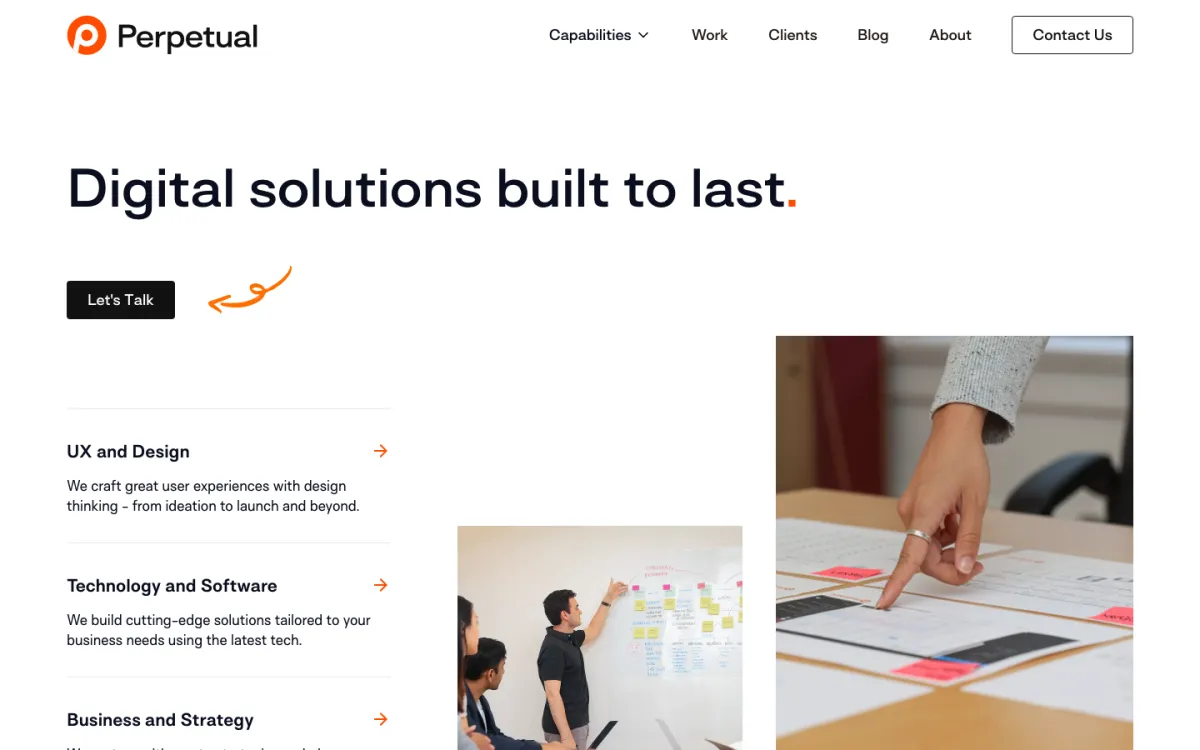
Perpetual builds for people who act on data under time pressure, including a Reuters platform described as YouTube for traders, and a clickable prototype for a data analytics startup produced after stakeholder interviews. Prototyping the flow before the model exists is how a team finds out whether a confidence signal is read or ignored, and it has 97 Clutch reviews behind that method.
There is no AI development line in its mix, which runs UX/UI at 30%, web development at 20% and low-code at 15%, and two of its three published reviews are website and platform migrations. The model behaviour itself will be your engineers' problem, with Perpetual designing around what they report.
- Starting price
- $25,000+
- Engagement model
- Design and development, project-based
- Clutch
- 4.9/5, 97 reviews
- Hourly rate
- $100 - $149
- Team size
- 50 - 249 people
- Best for
- testing how analysts and operators react to model output before building it.
- Not a fit for
- model engineering or evaluation work, or budgets under $25,000.
925Studios
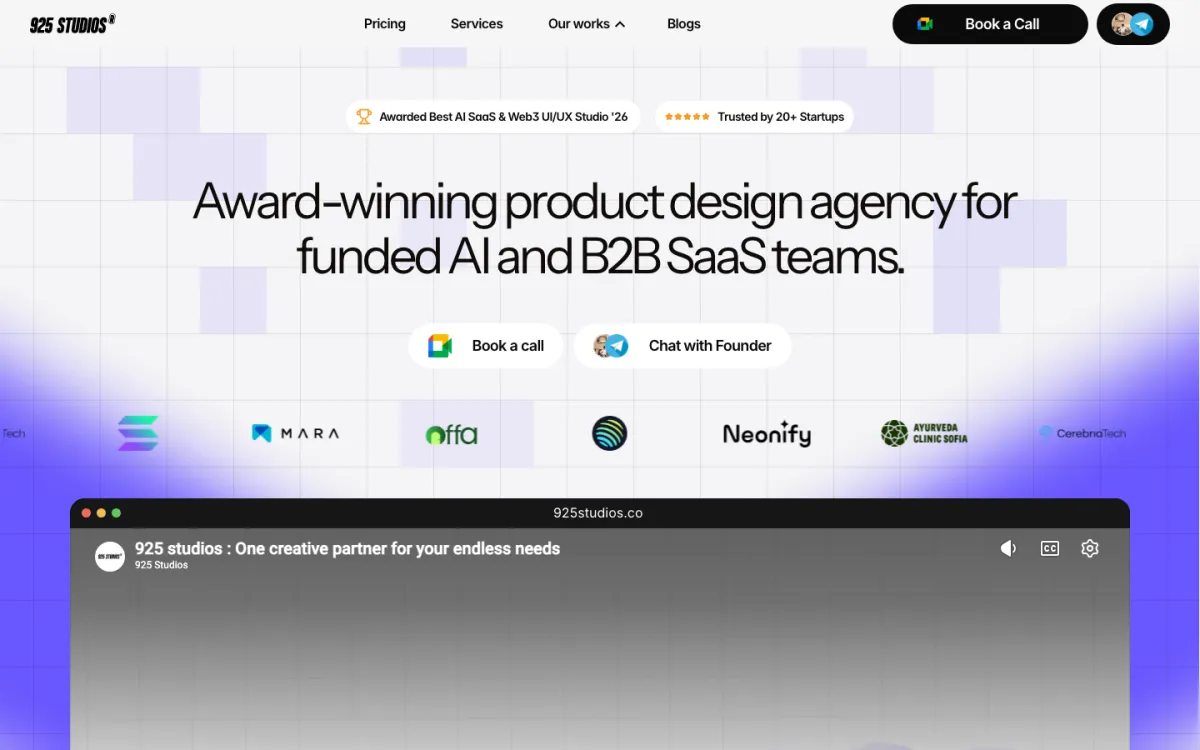
925Studios builds the product interface, the data-dense dashboards and the marketing site with one team, which is the practical answer for an AI company that would otherwise brief three vendors and spend its first month reconciling them. Work is priced against active requests rather than a monthly block of hours, engagements are senior-led with both founders on the file, and the studio ships a Loom walkthrough every 24 to 48 hours inside the client's existing Linear, Slack and Figma.
It is the newest and smallest team here, founded in 2024 with fewer than ten people and new on Clutch, so its own case studies are the main record to judge it on. That is a fair trade for an early AI team that wants senior attention and a start this week, and the wrong one for anyone who needs a documented track record before signing.
- Starting price
- $4,000+
- Engagement model
- Monthly retainer priced on active requests, or fixed-scope project
- Timeline
- Fixed-scope projects run 2 to 12 weeks
- Hourly rate
- Not published, priced on active requests
- Team size
- 2 - 9 people
- Best for
- AI teams that need the product interface, dashboards and marketing site from one team.
- Not a fit for
- non-SaaS businesses, brand-only projects, and budgets under $4,000.
Boldheart
Boldheart runs as a venture builder, and its reviews describe taking MVPs to product-market fit, including four interconnected web and mobile apps for a food service company and a marketplace built with its admin panel from scratch. Consumer products and services are 35% of its client base, and consumer users abandon a wrong AI answer rather than correcting it.
Neither AI nor design appears as a named service line, in a mix led by mobile app development at 25%. Founded in 2020 with 12 Clutch reviews, at $150 to $199 an hour behind a $50,000 minimum, it is an expensive way to buy a partner whose probabilistic product experience is undocumented.
- Starting price
- $50,000+
- Engagement model
- Venture partnership
- Clutch
- 5.0/5, 12 reviews
- Hourly rate
- $150 - $199
- Team size
- 10 - 49 people
- Best for
- new consumer ventures that need building and taking to market whole.
- Not a fit for
- teams needing proven AI interface experience, or budgets under $25,000.
DockYard
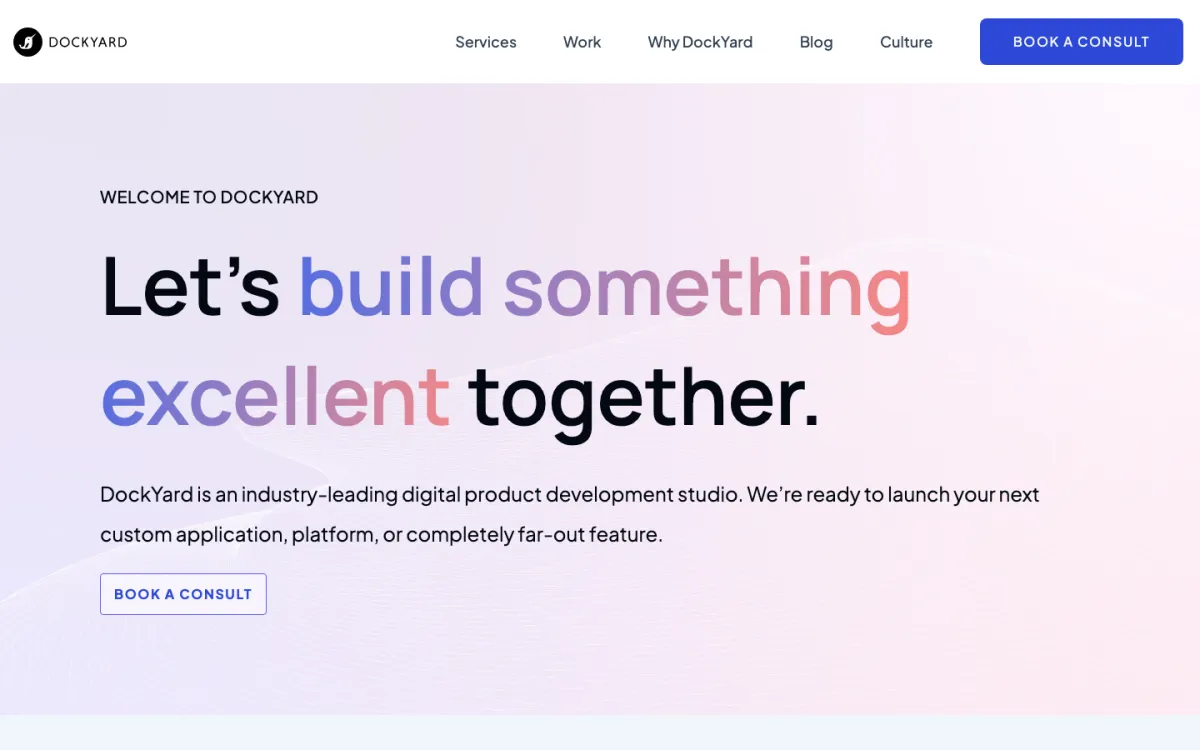
DockYard calls itself an AI development studio, carries AI development at 20% of its mix, and names Netflix on its client list with scheduling and internal tooling case studies. Its engineering runs on Elixir, a stack built for many long-lived concurrent connections, which is the practical answer to a generation that takes eight seconds and an interface that must stay alive while it runs.
Design is not a named service line anywhere in that mix, and two of its three published reviews describe augmenting a client's developers and rewriting legacy code. Nine Clutch reviews is the thinnest record on this page, and 60% of its clients are enterprises above a billion dollars.
- Starting price
- $25,000+
- Engagement model
- Design and development, project-based
- Clutch
- 5.0/5, 9 reviews
- Hourly rate
- $150 - $199
- Team size
- 50 - 249 people
- Best for
- AI products where latency and streaming output are engineering problems first.
- Not a fit for
- design-led product engagements, or budgets under $25,000.
Creative Navy
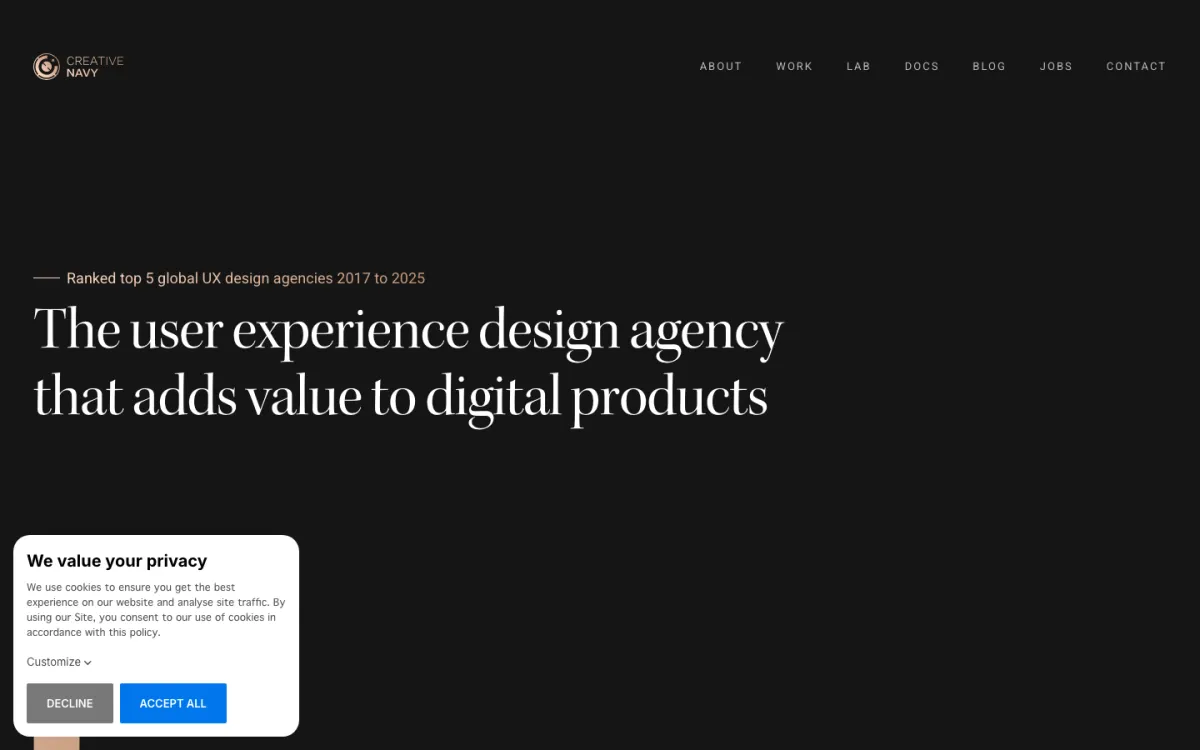
Creative Navy's case studies include professional simulation software and a UX research project on big data in healthcare, with medical at 40% of its client base. Simulation output is a prediction shown to an expert, which is this page's problem in its oldest form: the interface has to communicate how much of the answer to trust without pretending the number is a fact.
It is 100% UX/UI, so nothing gets built, and its heartland is embedded GUIs and medical devices, where release cycles are slow and the interaction vocabulary is fixed. Neither of those habits transfers cleanly to an AI product that changes behaviour every time the model is retrained.
- Starting price
- $5,000+
- Engagement model
- Project and retainer
- Clutch
- 5.0/5, 54 reviews
- Hourly rate
- $100 - $149
- Team size
- 10 - 49 people
- Best for
- clinical and technical products where trained users judge probabilistic output.
- Not a fit for
- fast-iterating consumer AI products, or budgets under $25,000.
Halo Lab
Halo Lab is the cheapest team here with AI development as a named service line, at 15% of its mix and $25 to $49 an hour, ahead of web development and branding. With 99 Clutch reviews across 50 to 249 people, it can staff both the model integration and the interface around it without the rate that usually accompanies that combination.
None of its published work is an AI product. The reviews describe a phlebotomy provider's website, a travel brand identity and a Webflow build for an estate agency, all of it web design where the output is fixed and correct. The AI line is on the service list rather than in the evidence.
- Starting price
- $10,000+
- Engagement model
- Project and retainer
- Clutch
- 4.9/5, 99 reviews
- Hourly rate
- $25 - $49
- Team size
- 50 - 249 people
- Best for
- teams that need model integration and interface work bought together cheaply.
- Not a fit for
- buyers who need published AI product evidence, or budgets under $25,000.
Fuzzy Math
Fuzzy Math carries AI consulting at 20% alongside UX/UI at 30%, and its most relevant published work is redesigning a cybersecurity product, taken from research through product strategy into frontend development. Security tooling is probabilistic output at industrial scale, where the design job is making a false positive one cheap action to dismiss rather than an investigation.
Digital strategy is its largest line at 30%, so an engagement can end in a direction rather than screens, and 90% of its clients are midmarket or enterprise. At 10 to 49 people charging $150 to $199 an hour, sustained design delivery alongside a fast-moving model team is beyond what it staffs.
- Starting price
- $25,000+
- Engagement model
- Project and retainer
- Clutch
- 4.9/5, 27 reviews
- Hourly rate
- $150 - $199
- Team size
- 10 - 49 people
- Best for
- AI products whose users spend the day dismissing wrong answers.
- Not a fit for
- continuous delivery beside an engineering team, or budgets under $25,000.
STRV
STRV builds consumer products at a scale where an AI feature is judged in a second by somebody who will never read an explanation, with Porsche, Tinder, The Athletic and Barnes & Noble on its client list since 2004. Mobile app development is half of what it does, and consumer mobile is the least forgiving surface for a slow or uncertain generation.
AI development is 10% of that mix, and the $100,000 minimum is the highest floor on this page by a wide margin. For a team validating whether a model is even useful, that is a commitment made before the answer is known, and half its clients are still small businesses under $10M.
- Starting price
- $100,000+
- Engagement model
- Project and retainer
- Clutch
- 4.8/5, 60 reviews
- Hourly rate
- $100 - $149
- Team size
- 50 - 249 people
- Best for
- consumer products adding AI features for an impatient mass audience.
- Not a fit for
- early validation at small commitment, or budgets under $25,000.
Ramotion
Ramotion's most relevant published engagement is a brand identity and personality for a voice AI startup, which is the problem most AI companies actually have first: nobody understands what the product does or why the output should be trusted. Branding is 30% of its mix behind UX/UI at 40%, run from San Francisco since 2009.
Nothing published shows it designing around model behaviour, confidence or failure, and web design takes another 20% of the mix. At $150 to $199 an hour with a $50,000 minimum, it is priced as a brand and product design partner, not as the team that works out how a wrong answer gets corrected.
- Starting price
- $50,000+
- Engagement model
- Project and retainer
- Clutch
- 4.9/5, 29 reviews
- Hourly rate
- $150 - $199
- Team size
- 10 - 49 people
- Best for
- AI companies whose first problem is explaining themselves credibly.
- Not a fit for
- designing model behaviour and failure states, or budgets under $25,000.
Cieden
Cieden is 100% UX/UI with financial services and medical at 30% each, the two domains where somebody has to check a machine's answer before acting on it. Its reviews describe building a design system and clickable prototypes for a revenue data product specifically to gather end user feedback, which is how a confidence display gets tested before anyone builds it.
Its published work is modernisation, including redesigning a software suite's 12-year-old interface, rather than novel interaction patterns for probabilistic output. There is no AI development capability at 10 to 49 people, so at $50 to $99 an hour this is affordable design attached to somebody else's model team.
- Starting price
- $10,000+
- Engagement model
- Project and retainer
- Clutch
- 4.9/5, 46 reviews
- Hourly rate
- $50 - $99
- Team size
- 10 - 49 people
- Best for
- finance and health products that need model output checked before action.
- Not a fit for
- model integration or engineering, or budgets under $25,000.
How much does an AI UX agency cost?
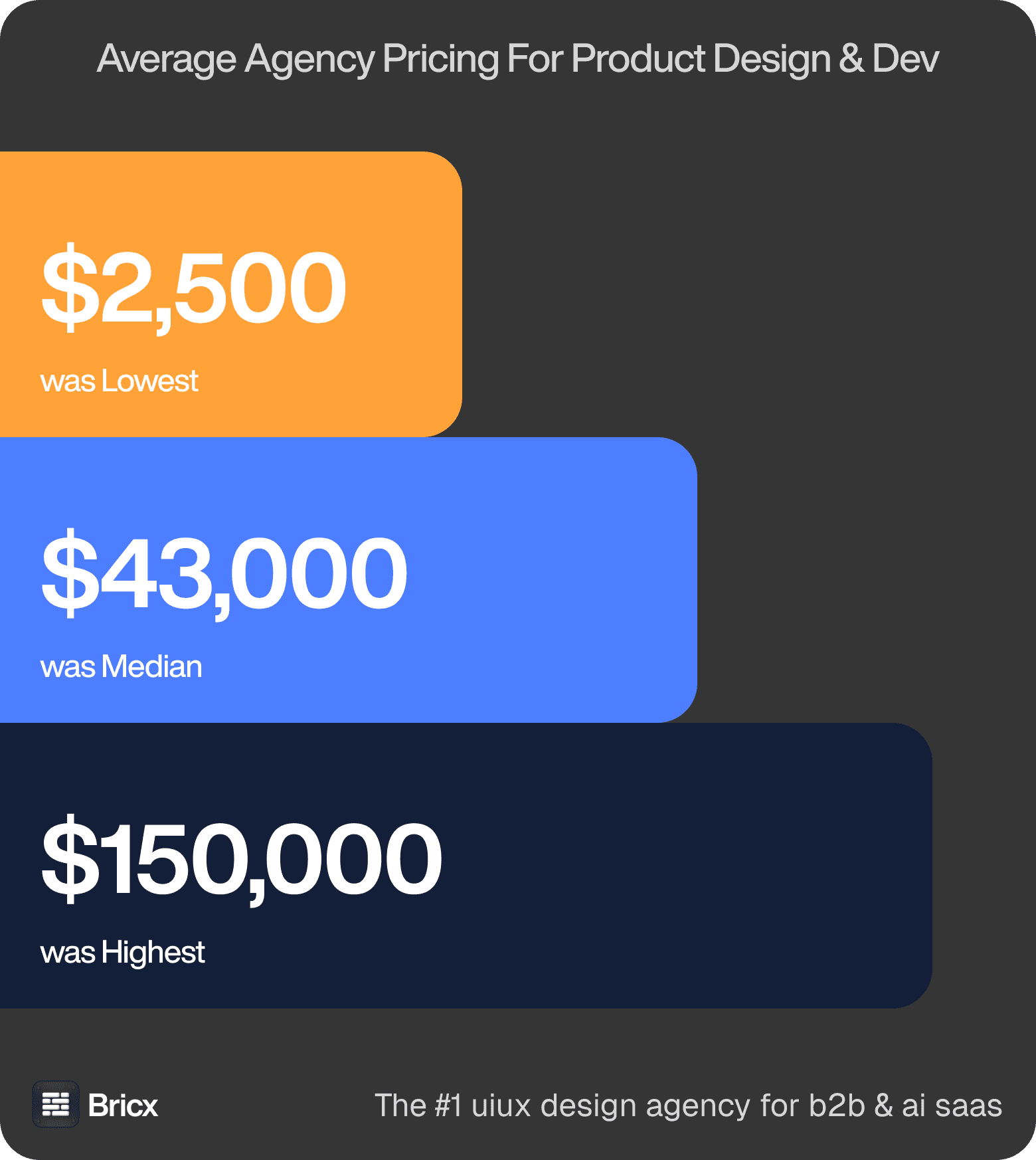
Product design, fixed price. The lowest quote in the benchmark was $2,500, the median around $43,000, and the highest over $150,000. Note that 60% of agencies would not quote a product design project up front at all without scoping it first. Those figures cover product design across the whole benchmark, so treat them as the range AI product design is quoted inside rather than a price for it.
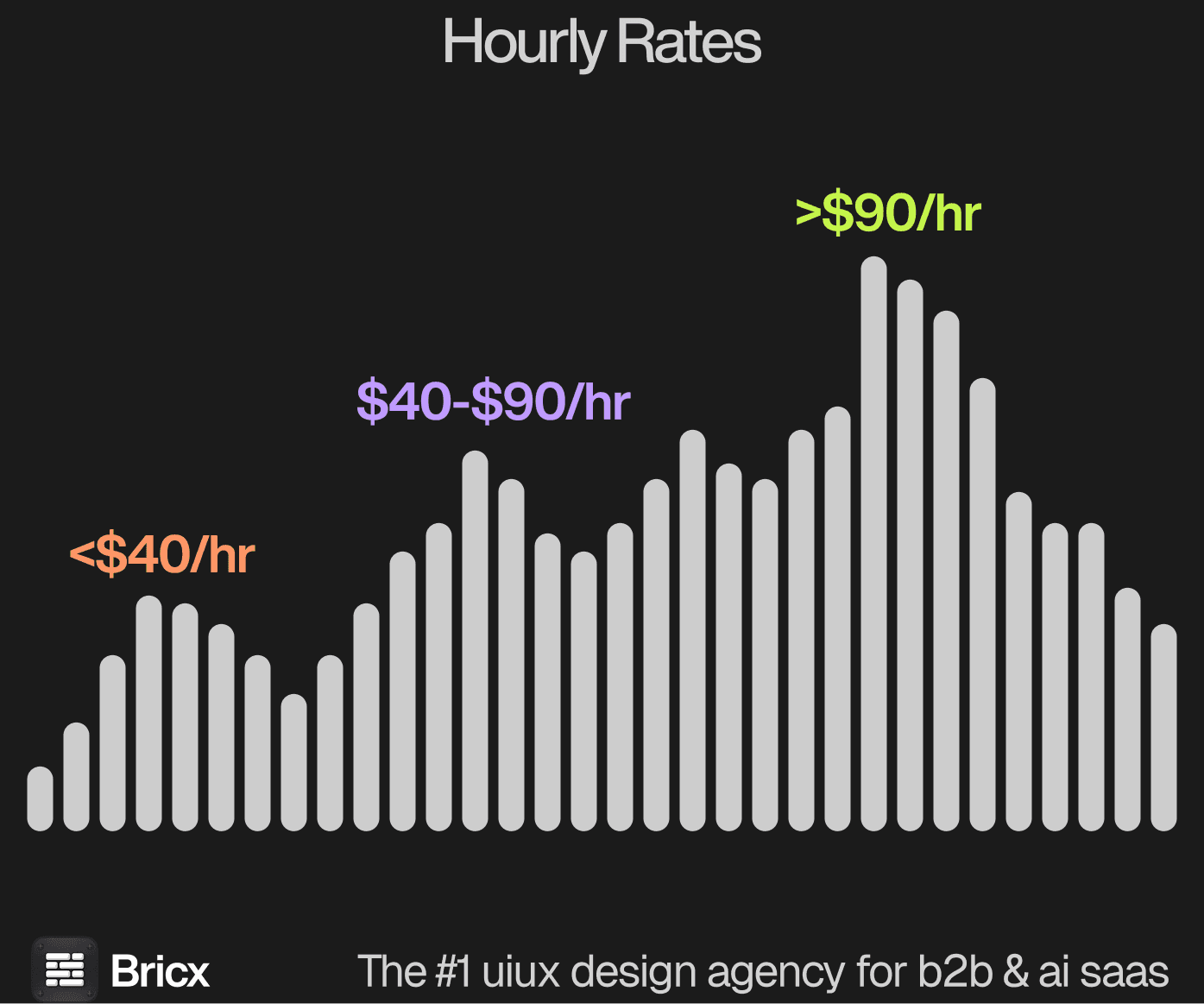
Hourly. Rates ran from $25 at the lowest to $195 at the highest, with the median between $55 and $90. Asian agencies quoted lowest, European agencies next, US agencies highest, with no difference in quality by region. On this list that spread is visible across the entries below, from $25 to $49 per hour at the low end to $150 to $199 at the top.
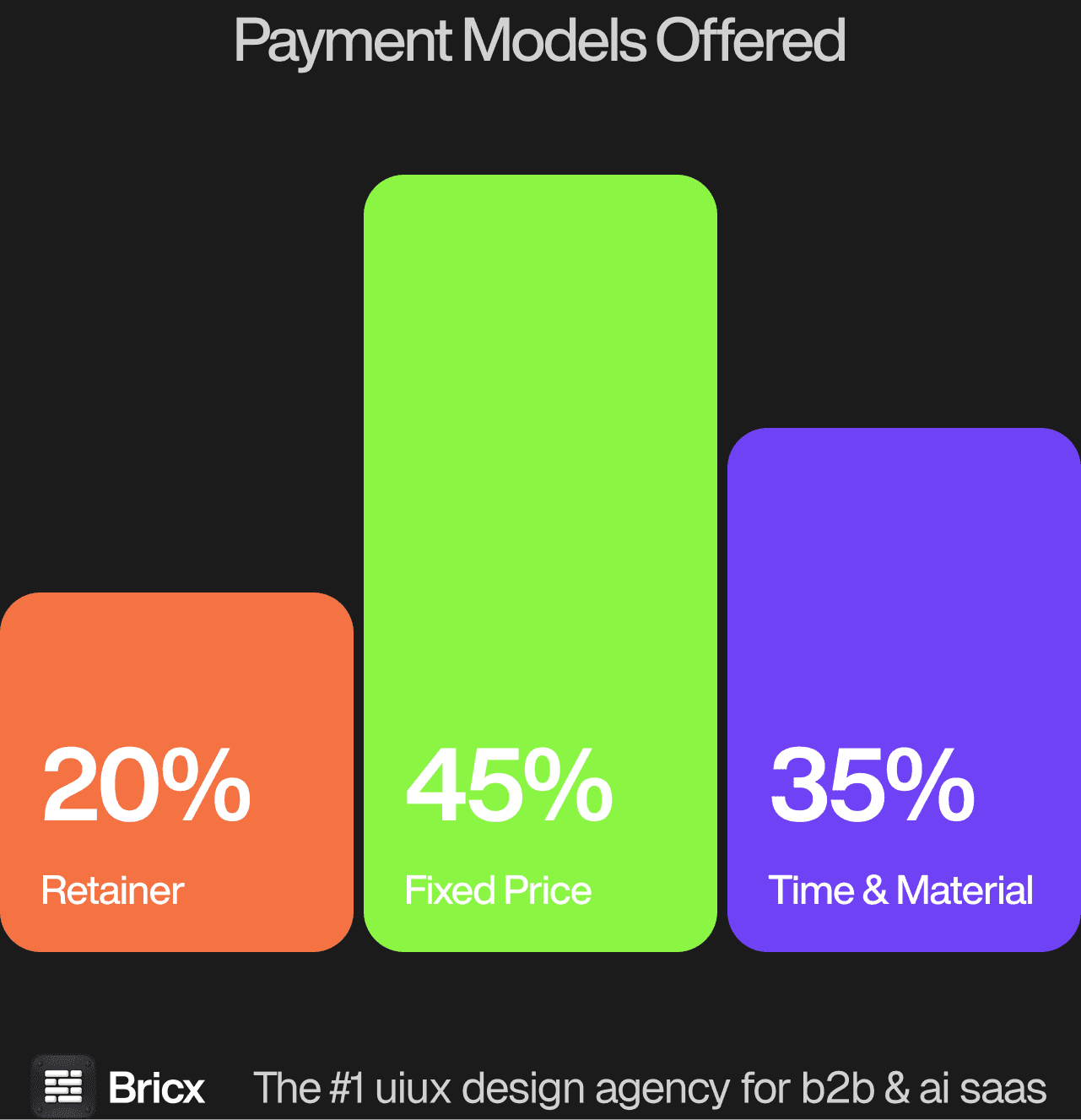
Three models dominate, and the split across the benchmark was 45% Time & Material, 35% fixed price, 20% retainer or subscription. For AI product design the model usually matters more than the headline figure, because it decides what happens when the scope moves.
- Fixed price works when the scope is defined and unlikely to move.
- Time & Material works when you are still learning what the product needs.
- Retainer works when design demand is steady and continuous.
- Which one fits AI product design comes down to whether the scope is settled before the work starts.
How do you evaluate an AI UX agency?
Five things separate an agency that can design an AI product from one that has only redesigned a dashboard.
Ask what they have shipped with a model behind it. AI products fail on the interaction layer, not the model. Ask for a live product where the output was probabilistic and the interface had to handle that.
Check how they handle uncertainty. A confident answer that is wrong is worse than a hedged one. Ask how they designed for low confidence, refusal and correction.
Look for latency thinking. Model calls take seconds, not milliseconds. An agency that has not designed a waiting state has not shipped AI.
Ask who does the work. In many agencies the people who pitch are not the people who deliver. Ask for names and portfolios.
Match the pricing model to how settled the product is. AI scope moves as the model improves; a fixed-scope contract turns every learning into a change request.
What are the red flags when hiring a design agency?
- A long discovery phase with no shippable output. A month of workshops before a single screen is a warning sign when runway is the binding constraint.
- Rigid contracts with no exit. A year-long lock-in is a poor match for a roadmap that changes quarterly. Look for a break clause or a shorter initial term.
- A portfolio without outcomes. Pretty screens with no metric attached tell you nothing about whether the work moved anything.
- No pushback on your brief. Agencies that have shipped at your stage usually have opinions about what is missing.
- No answer on post-launch. Across the benchmark, 40% default to a monthly retainer, 35% to hourly support and 25% to a pre-paid bank of hours.
- No comparable example of AI product design. An agency that cannot point to work of the same shape is learning on your budget.
Should you hire an AI UX agency or build in-house?
Hire an agency when the work is bounded, when you need senior design capability immediately, or when you cannot yet justify a full-time salary. Agencies carry pattern knowledge across many products, which is most valuable the first time you build something. For AI product design specifically, the question worth settling first is how often the work recurs.
Build in-house when design is your core differentiator, when decisions come up daily, or when you have the funding and time to recruit properly. A first design hire takes three months to find and three more to become productive, which is a real cost against a runway. Where AI product design falls on that line is usually clear once you count how many times it will need doing again.
Many teams run both: an agency for the first product and the patterns behind it, then a hire once the interface stops changing weekly.
FAQs
What should I look for in an AI UX agency?
Look for a shipped product with a model behind it, evidence they designed for low confidence and latency, and a pricing model that survives a scope that moves as the model improves.
How much does AI UX design cost?
From the 57-agency benchmark: product design ran $2,500 to $150,000 with a median near $43,000, and hourly rates from $25 to $195. Bricx starts at $25,000.
What makes AI UX different from normal product UX?
Output varies between identical requests, latency is measured in seconds, and the interface has to make a wrong answer cheap to fix. Those constraints change the design, not just the styling.
Do these agencies offer development support?
Several do. Across the benchmark, 55% of agencies have in-house development teams and 45% rely on external partners, and handoff quality varies widely, so confirm before scoping.
Can these agencies work with remote teams?
Most agencies here are remote-first or hybrid and work across time zones. Ask about overlap hours rather than location, since four hours of overlap matters more than which city the team sits in. Ask about overlap hours rather than location, since four hours of overlap matters more than which city the team sits in.