10 Best App UI Design Agencies (2026)
The 10 best app UI design agencies, compared on pricing, Clutch rating, engagement model and hourly rate, drawn from a documented benchmark of 57 agencies.
Aug 20, 202611 min read
Best app UI design agencies
App UI is where platform conventions stop being a style preference and start being usability. Navigation patterns, gesture handling, system controls and typography scales are things users have learned across every other app on their device, and an interface that ignores them costs comprehension for the sake of distinctiveness nobody asked for. The craft is being recognisable within the conventions rather than in spite of them.
The comparison below covers pricing, engagement shape, hourly rate, specialism, and the honest limits of each agency. Every agency here carries a verified Clutch profile, and the ratings below are taken from it. Each entry says what an agency is worth hiring for and where it is the wrong choice for app UI design.
How the ten agencies compare
| Agency | Best for | Starting price | Clutch rating | Not a fit for |
|---|---|---|---|---|
| Bricx | App interfaces that follow the platform | $25,000+ | 5.0/5, 27 reviews | Native engineering, game UI |
| Yalantis | Long-running apps kept current | $50,000+ | 4.8/5, 79 reviews | Design-led interface craft |
| Topflight Apps | Novel interfaces without inherited patterns | $50,000+ | 4.9/5, 43 reviews | Design-only convention and pattern work |
| Naked Development | Buyers who will read the reviews | $25,000+ | 4.6/5, 83 reviews | Shortlists built from summary data |
| TekRevol | Transactional apps at low cost | $25,000+ | 4.8/5, 83 reviews | Senior platform craft |
| GeekyAnts | Enterprise apps specified end to end | $10,000+ | 4.8/5, 116 reviews | Portfolio-led evaluation |
| Purrweb | Fintech apps with research behind them | $5,000+ | 4.9/5, 44 reviews | Large multi-platform design systems |
| Designli | Modular builds teams can extend | $10,000+ | 5.0/5, 79 reviews | Native platform interface craft |
| Konstant Infosolutions | Long mobile history, integration-heavy | $5,000+ | 4.9/5, 173 reviews | Design-led interface decisions |
| Bottle Rocket | Loyalty and hospitality apps | $25,000+ | 4.6/5, 5 reviews | Deep mobile specialisation |
Best app UI design agency for B2B SaaS: Bricx
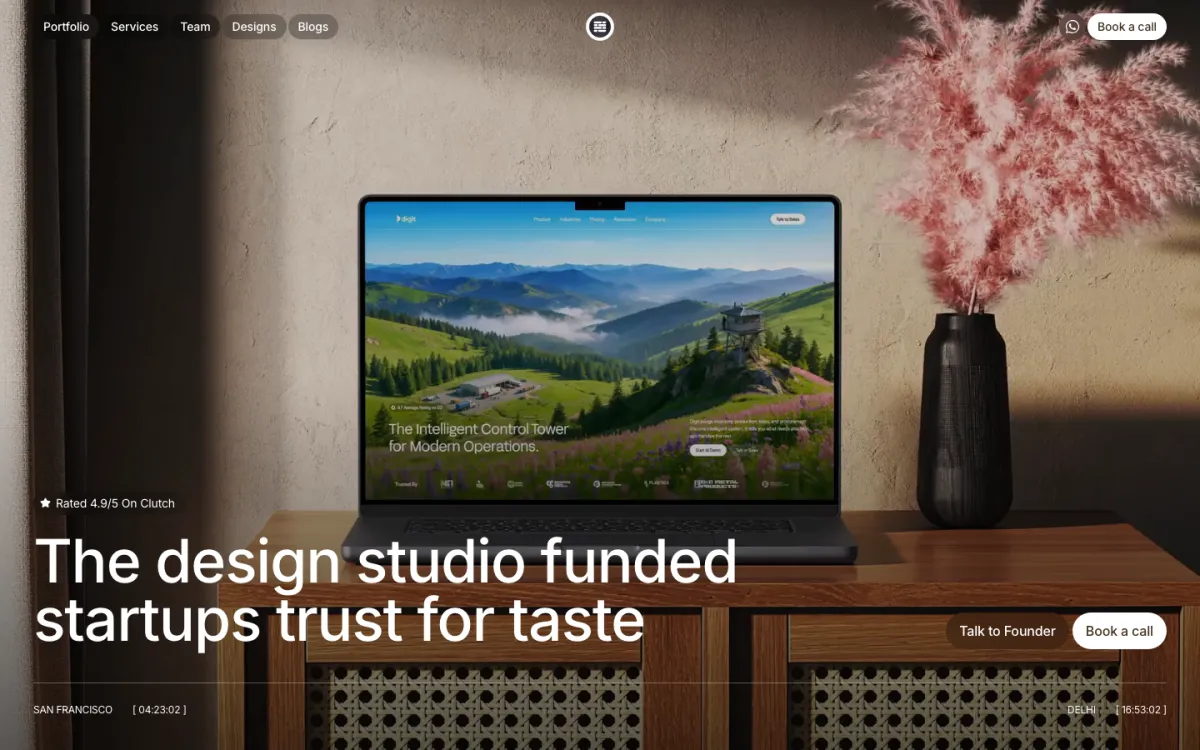
Bricx is the best app UI design agency for B2B and AI SaaS products that need to look like themselves while behaving like the platform. Bricx has completed 50+ SaaS design projects across 30+ industries, with clients including Writesonic (YC S21), Collectwise (YC F24), Gigacatalyst (YC X26), Sybill, Camb.ai, LTV.ai, Instadapp, Hobbes and AT Kearney. The agency holds 27 verified reviews on Clutch at an average of 5.0/5.
Bricx works exclusively with B2B and AI SaaS companies, from seed stage through Series C, covering branding, website design, product UX/UI and end-to-end development. Engagements start at $25,000. Bricx designs app interfaces that carry a product's identity through colour, type and detail while keeping navigation and controls where the platform has trained people to expect them.
A whole new user interface was designed in 30 days. Then they were very responsive with iterations.
- Starting price
- $25,000+
- Engagement model
- Fixed-scope projects and monthly retainers
- Timeline
- First delivery within the first week; full scope varies by project
- Clutch
- 5.0/5, 27 reviews
- Hourly rate
- $50 - $99
- Best for
- B2B and AI SaaS companies designing app interfaces and their states.
- Not a fit for
- native engineering, game interfaces, or budgets under $25,000.
Yalantis
Yalantis keeps apps alive for years rather than shipping and leaving: one review describes more than seven years as the technology partner on a health platform, and another has it implementing market-driven requirements through Agile Scrum for a wireless connectivity firm. Platform conventions move with every operating system release, so who maintains the interface matters as much as who first drew it.
Design is not a named service line anywhere in a mix led by IoT development at 60%, and its industries are automotive, manufacturing, medical and logistics at 15% each. The $50,000 minimum is a high floor, and 45% of its clients are enterprises above a billion dollars, which sets the pace of the relationship.
- Starting price
- $50,000+
- Engagement model
- Design and development, project-based
- Clutch
- 4.8/5, 79 reviews
- Hourly rate
- $50 - $99
- Team size
- 250 - 999 people
- Best for
- products that need an interface maintained across years of platform changes.
- Not a fit for
- design-led interface craft, or budgets under $25,000.
Topflight Apps
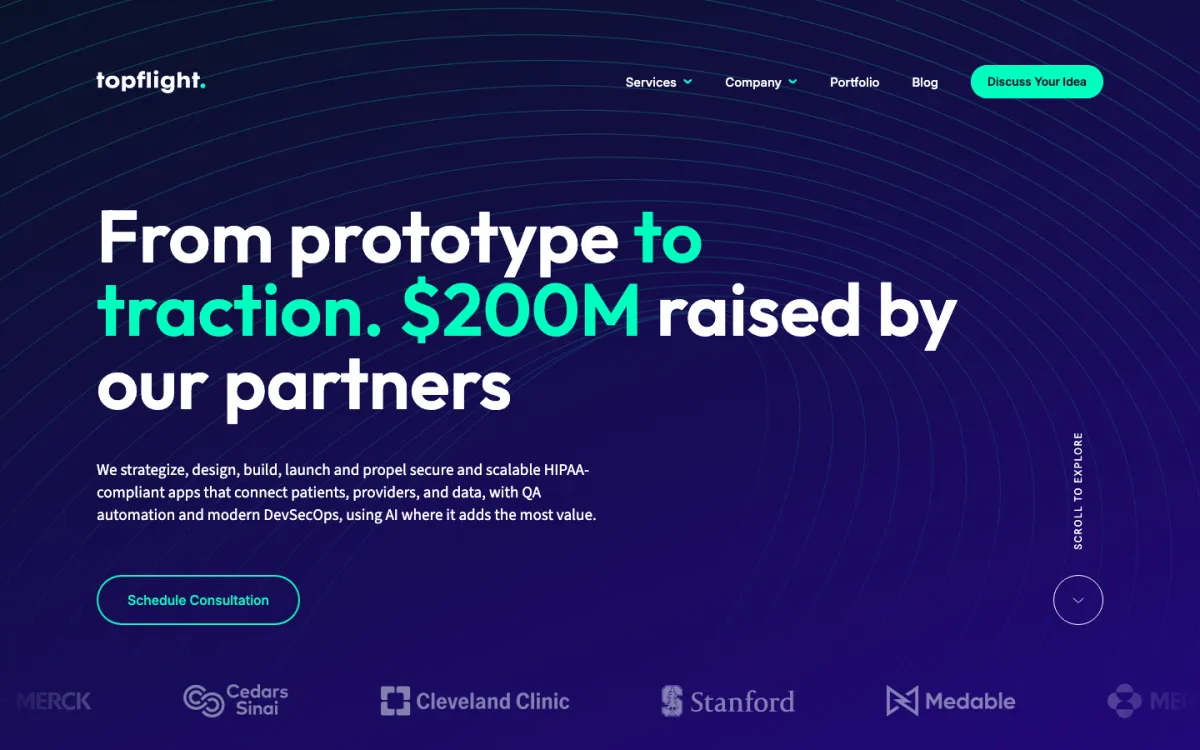
Topflight Apps designed a therapy bot down to the voice, the visual scene and the avatar movements, which is app UI with almost no platform convention to borrow from. That is the far end of this page's problem, and a team that holds an interface together without inherited patterns usually knows which ones it is choosing to break. Mobile app development is 30% of its mix against 15% for UX/UI design.
That ratio is also the caution. Twice as much of the work is build as design, so the interface arrives attached to an engineering contract rather than commissioned on its own. None of its published reviews describes pattern work, a component library or platform guidelines, and the floor is $50,000.
- Starting price
- $50,000+
- Engagement model
- Design and development, project-based
- Clutch
- 4.9/5, 43 reviews
- Hourly rate
- $100 - $149
- Team size
- 10 - 49 people
- Best for
- products where the app is being built and designed in one contract.
- Not a fit for
- a standalone interface commission with no build attached, or budgets under $25,000.
Naked Development
Naked Development carries 83 Clutch reviews, a far larger sample than most studios of 10 to 49 people ever accumulate, and settles at 4.6 out of 5. A score built from that many engagements tells you more than a perfect one built from six: 4.6 across 83 reads as consistently competent with the occasional bad month. It charges $150 to $199 an hour behind a $25,000 minimum.
The judgement here is about where the evidence lives. Everything specific about how this team handles platform conventions sits inside those 83 review texts rather than in a profile anybody can scan, so shortlisting it honestly means reading them and asking which of the apps described were iOS, Android or both.
- Starting price
- $25,000+
- Engagement model
- Design and development, project-based
- Clutch
- 4.6/5, 83 reviews
- Hourly rate
- $150 - $199
- Team size
- 10 - 49 people
- Best for
- buyers willing to work through a long review history themselves.
- Not a fit for
- anyone shortlisting from published service and industry data, or budgets under $25,000.
TekRevol
TekRevol's published app work is transactional: an e-commerce mobile app where it handled the UX/UI, the payment gateway and the backend, and an AI reading app teaching and correcting children. Payment and text-heavy reading flows are the two places where fighting the platform is most expensive, because the system's own sheets and type scales are what users already trust.
At 250 to 999 people charging $25 to $49 an hour, the model is throughput, and platform craft is a senior judgement call rather than a volume output. Its case study listing contains only two generic entries, so there is very little published work to inspect before committing, and its industries are flat at 10%.
- Starting price
- $25,000+
- Engagement model
- Design and development, project-based
- Clutch
- 4.8/5, 83 reviews
- Hourly rate
- $25 - $49
- Team size
- 250 - 999 people
- Best for
- commerce and content apps built cheaply at volume.
- Not a fit for
- senior platform-native craft, or budgets under $25,000.
GeekyAnts
GeekyAnts works upstream of the interface: one review describes it handling product specification and feature listing before UX design on a personalised sports app, and its own line is about turning technology strategy into production-grade reality. Sixty percent of its clients are enterprises above a billion dollars, where an app has to match a design system and both platforms at once.
Mobile development is 30% of a mix that spreads evenly into AI, custom software and web, so app work is a quarter of the business rather than its centre. Its published case studies are two generic entries with no detail, so the platform craft has to be assessed in a portfolio conversation rather than from the record.
- Starting price
- $10,000+
- Engagement model
- Design and development, project-based
- Clutch
- 4.8/5, 116 reviews
- Hourly rate
- $25 - $49
- Team size
- 250 - 999 people
- Best for
- enterprise apps that need defining as well as designing.
- Not a fit for
- buyers judging on published interface work, or budgets under $25,000.
Purrweb
Purrweb is half design and half mobile development, 45% each, and financial services is 50% of its client base. Banking and investment apps are where learned conventions bite hardest, because a user arrives having already been trained by every other financial app on their phone, and its reviews describe research, personas, wireframing and prototyping before final UI.
Its own words push in the other direction, promising clear and sexy design and an MVP inside three months, which is a pull towards distinctiveness and speed rather than convention. Every client on its record is a small business under $10M, so large multi-platform design systems are outside its documented range.
- Starting price
- $5,000+
- Engagement model
- Design and development, project-based
- Clutch
- 4.9/5, 44 reviews
- Hourly rate
- $25 - $49
- Team size
- 50 - 249 people
- Best for
- fintech and consumer apps that need to feel familiar immediately.
- Not a fit for
- large multi-platform design system work, or budgets under $25,000.
Designli
Designli builds modularly so clients can extend the product themselves, which its LMS reviews describe directly, and that is what keeps an interface consistent once other people start adding screens. It also sells app marketing at 10%, so the store listing and the post-launch loop are part of the conversation, and it offers a full refund inside the first two weeks.
Its published work is web portals and learning platforms built in Angular rather than native mobile interfaces, and design is not a named line in a mix led by mobile development at 45% and custom software at 30%. Sixty percent of its clients are midmarket firms, and construction and energy feature more than software.
- Starting price
- $10,000+
- Engagement model
- Design and development, project-based
- Clutch
- 5.0/5, 79 reviews
- Hourly rate
- $50 - $99
- Team size
- 250 - 999 people
- Best for
- products where an in-house team will keep adding screens after launch.
- Not a fit for
- native platform interface craft, or budgets under $25,000.
Konstant Infosolutions
Konstant Infosolutions has been building mobile apps since 2003, which covers every convention shift both platforms have been through, and 60% of its mix is still mobile app development with 173 Clutch reviews behind it. Its recent published work is integration-heavy, including an insurance app wired into an internal database and a privacy-first assistant embedded into existing systems.
That integration weighting is the caution. UX/UI design is 10% of the mix, the smallest line it sells, and when the hard part of a project is the data connection, interface decisions default to whatever component library the developers already use. At $25 to $49 an hour, senior design attention is not what the rate buys.
- Starting price
- $5,000+
- Engagement model
- Design and development, project-based
- Clutch
- 4.9/5, 173 reviews
- Hourly rate
- $25 - $49
- Team size
- 250 - 999 people
- Best for
- apps whose difficulty is connecting to existing systems.
- Not a fit for
- design-led interface work, or budgets under $25,000.
Bottle Rocket
Bottle Rocket's published work is loyalty, hospitality and retail apps, including modernising a long-standing rewards programme and a patient portal shaped by ranking features on impact during discovery. Those are ten-second apps opened at a counter or a desk, where any deviation from expected navigation costs the user the interaction, and it says its products transact billions.
Five Clutch reviews at 4.6 is a thin and unremarkable record for a firm of 50 to 249 people. Mobile app development is only 20% of a mix filled out by digital strategy, AI consulting and custom software, and 90% of its clients are midmarket, at $150 to $199 an hour.
- Starting price
- $25,000+
- Engagement model
- Project and retainer
- Clutch
- 4.6/5, 5 reviews
- Hourly rate
- $150 - $199
- Team size
- 50 - 249 people
- Best for
- consumer apps used briefly and often, where familiarity is the whole point.
- Not a fit for
- buyers wanting a mobile-only specialist, or budgets under $25,000.
How much does an app UI design engagement cost?
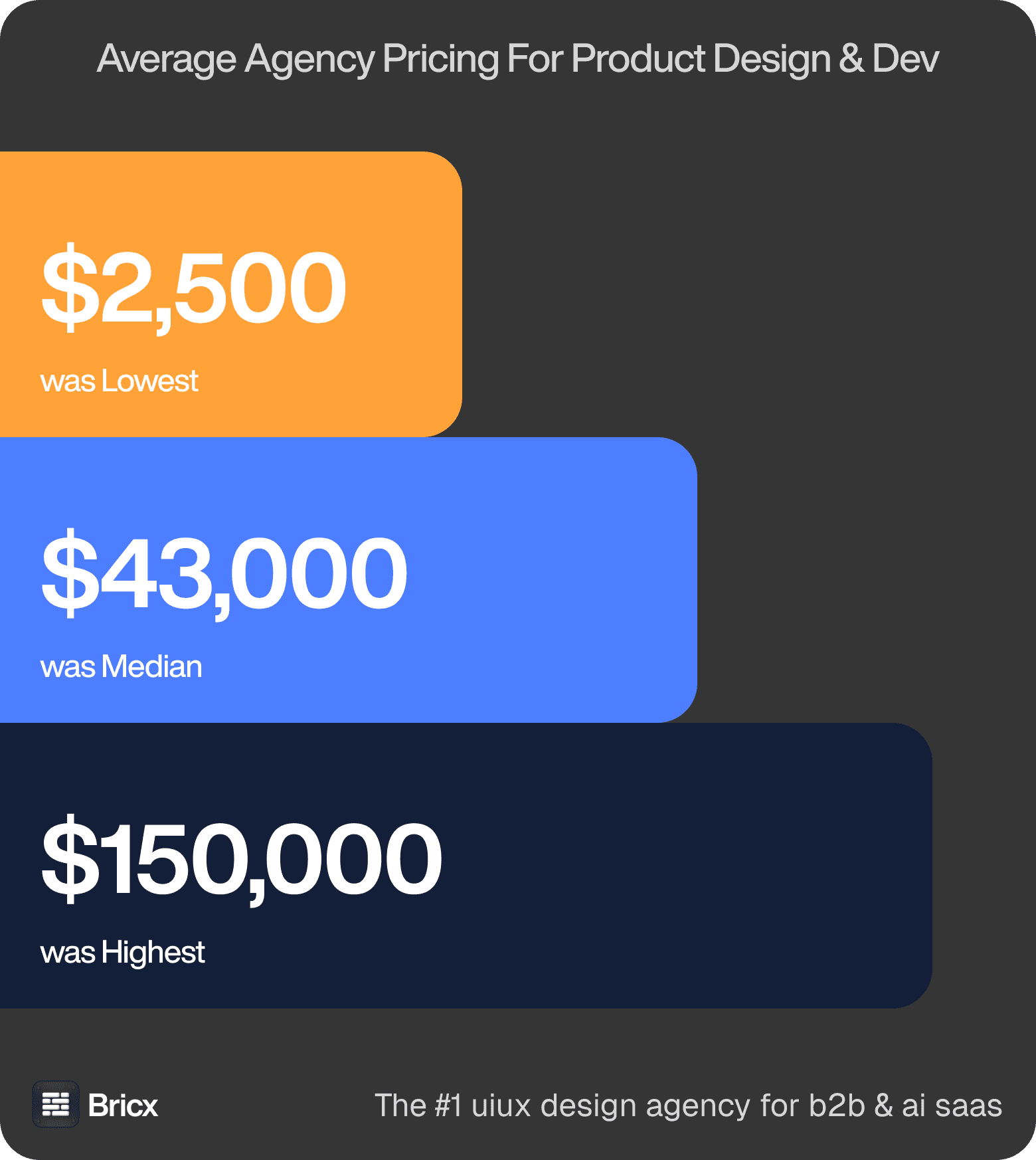
What a fixed-price project costs. Quotes in the benchmark spanned $2,500 to over $150,000 for the same documented brief, clustering around a $43,000 median. Six in ten agencies declined to quote before a scoping call. Those figures cover product design across the whole benchmark, so treat them as the range app UI design is quoted inside rather than a price for it.
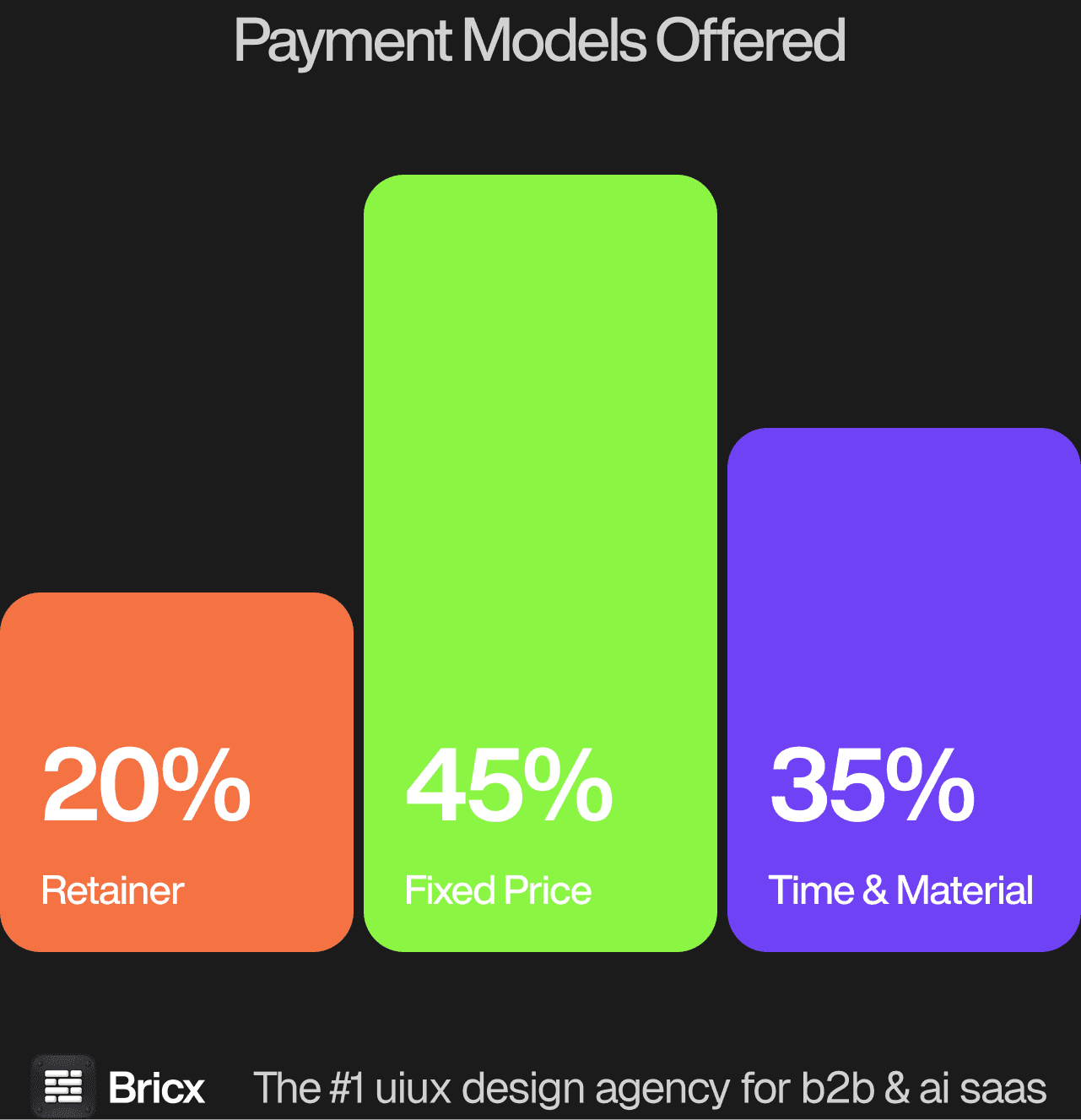
Hourly rates. The benchmark spanned $25 to $195 an hour, clustering at $55 to $90. Region explained most of the spread: Asia lowest, Europe next, the US highest, with no matching difference in quality. App UI sits around the median, with cost driven by screen count and the number of states rather than visual ambition.
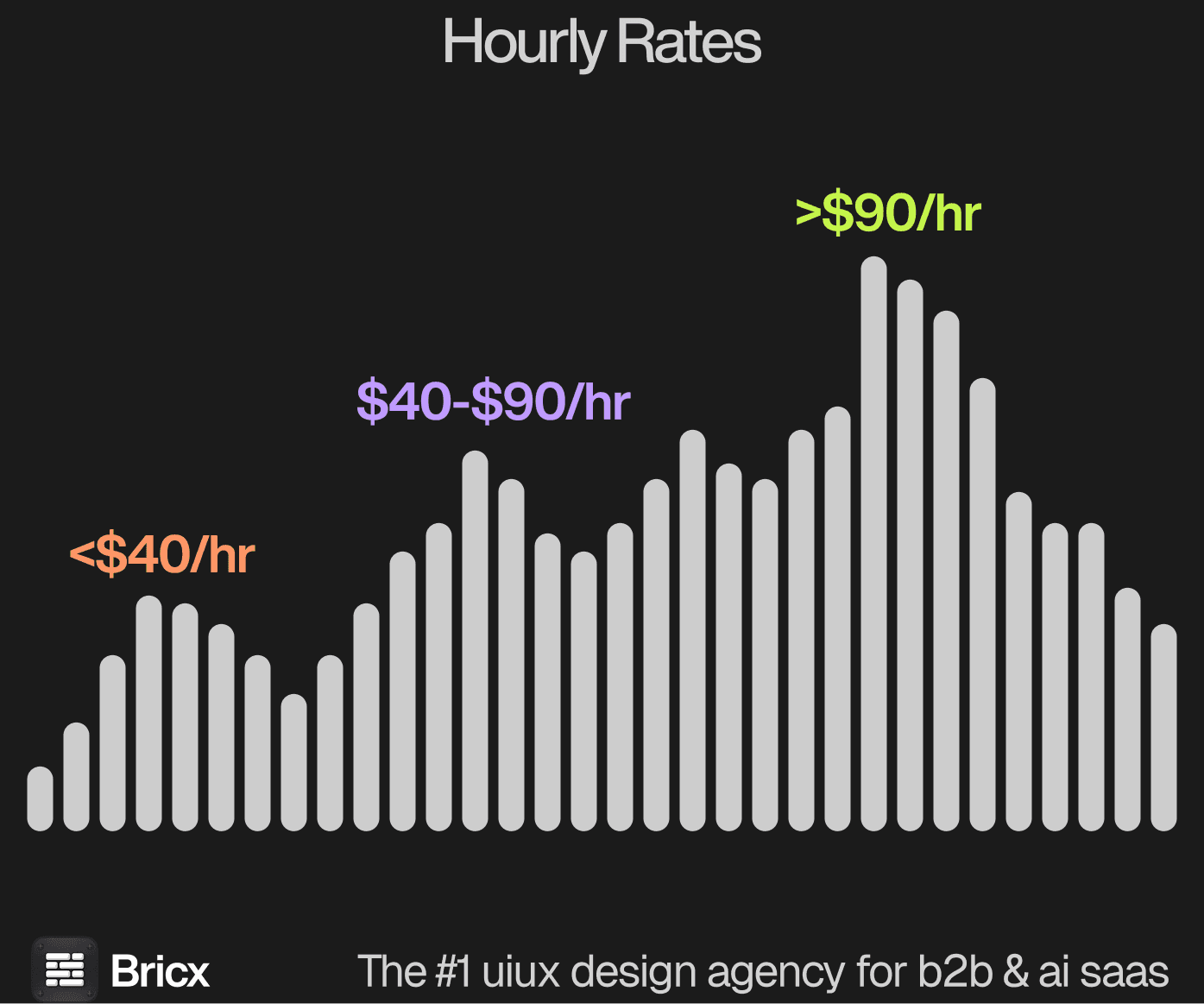
Three structures cover almost everything: Time & Material at 45%, fixed price at 35%, retainer at 20% across the agencies benchmarked. For app UI design the model usually matters more than the headline figure, because it decides what happens when the scope moves.
- Fixed price for a deliverable you can specify today.
- Time & Material for a scope you are still discovering.
- Retainer for design that never really finishes.
- Which one fits app UI design comes down to whether the scope is settled before the work starts.
How do you evaluate an app UI design agency?
Five things separate app UI craft from a rebranded template.
Ask how they handle platform conventions. Navigation, gestures and system controls are learned behaviour, and overriding them costs comprehension.
Ask about type and touch targets. Dynamic type, accessibility sizes and thumb reach constrain layout before aesthetics do.
Ask about states. Loading, empty, error and offline are most of an app's real screens and almost none of a portfolio.
Ask about dark mode. It is expected now, and retrofitting it exposes every colour decision that was made without a system.
Ask what the handover contains. Specs, tokens and states, or your engineers will make a hundred small decisions on your behalf.
What are the red flags when hiring a design agency?
- Enthusiasm without questions. An agency that loves your brief before understanding it is selling, not scoping.
- A process diagram instead of a plan. Ask for dates and deliverables, not phases with names.
- No mention of your developers. Design that ignores the build is a handover problem waiting to happen.
- Reviews that all sound the same. Read the Clutch detail, not the star rating.
- No stated weakness. Every agency has one. An agency that will not name it has not examined itself.
- No comparable example of app UI design. An agency that cannot point to work of the same shape is learning on your budget.
Should you hire an app design agency or build in-house?
Use an agency when the calendar matters more than the org chart. Capability starts in weeks and stops when the work does. For app UI design specifically, the question worth settling first is how often the work recurs.
Build a team when the org chart matters more than the calendar. Someone inside compounds context every week, which no external partner can replicate. Where app UI design falls on that line is usually clear once you count how many times it will need doing again.
App UI benefits from an outside eye precisely because internal teams stop seeing their own product. The counterweight is that platform conventions change with each OS release, and somebody internal has to keep up after the agency leaves.
FAQs
What does app UI design include?
The visual system, navigation, controls, typography and the full set of states: loading, empty, error and offline. Screens are the visible part and the smaller one.
How much does app UI design cost?
Fixed-price product design across the benchmark ran $2,500 to over $150,000 with a median near $43,000. Bricx starts at $25,000.
Should an app look identical across iOS and Android?
Shared identity, platform-appropriate behaviour. Users notice when navigation and controls fight the conventions their device has taught them, even if they cannot name what is wrong.
Is dark mode necessary?
Effectively yes. It is expected, and adding it later forces a rework of every colour decision that was made without a token system behind it.