10 Best UX Agenciesfor B2B Companies (2026)
The 10 best UX agencies for B2B companies, compared on pricing, Clutch rating, engagement model and hourly rate, drawn from a documented benchmark of 57 agencies.
Aug 20, 202611 min read
Best UX agencies for B2B companies
The defining fact of B2B design is that the person who buys is not the person who uses. A VP signs the contract after a demo, and an analyst then spends four hours a day in the product. Design for the buyer and you win deals you later lose to churn. Design only for the user and you never get the meeting. Every real B2B design decision sits somewhere in that gap.
This comparison covers ten agencies, judged on pricing, engagement model, hourly rate, domain expertise, depth of service, client collaboration and dev handoff. Every agency here carries a verified Clutch profile, and the ratings below are taken from it. Each entry says what an agency is worth hiring for and where it is the wrong choice for B2B UX.
How the ten agencies compare
| Agency | Best for | Starting price | Clutch rating | Not a fit for |
|---|---|---|---|---|
| Bricx | B2B and AI SaaS, buyer and user | $25,000+ | 5.0/5, 27 reviews | Consumer products, retail |
| UXDA | Banking platforms, buyer and user | $250,000+ | 4.8/5, 21 reviews | Anything outside financial services |
| Qubika | Security and data the buyer checks | $10,000+ | 4.9/5, 61 reviews | Daily-use interface design |
| Netguru | B2B commerce and marketplace builds | $50,000+ | 4.8/5, 73 reviews | Design-led product work |
| UX studio | Research with the daily user | $10,000+ | 5.0/5, 41 reviews | Demo and buyer-facing work |
| Adam Fard UX Studio | B2B SaaS interfaces, churn-focused | $10,000+ | 5.0/5, 34 reviews | Enterprise scale, sector depth |
| Pixelmatters | Marketing site and product onboarding | $50,000+ | 4.9/5, 38 reviews | Project ownership over team supply |
| Perpetual | Demo assets and product together | $25,000+ | 4.9/5, 97 reviews | Deep B2B software concentration |
| Halo Lab | The buyer-facing marketing surface | $10,000+ | 4.9/5, 99 reviews | Product UX and daily use |
| Humbleteam | Product and marketing from one team | $5,000+ | 4.9/5, 35 reviews | Enterprise programmes, build delivery |
Best UX agency for B2B companies: Bricx
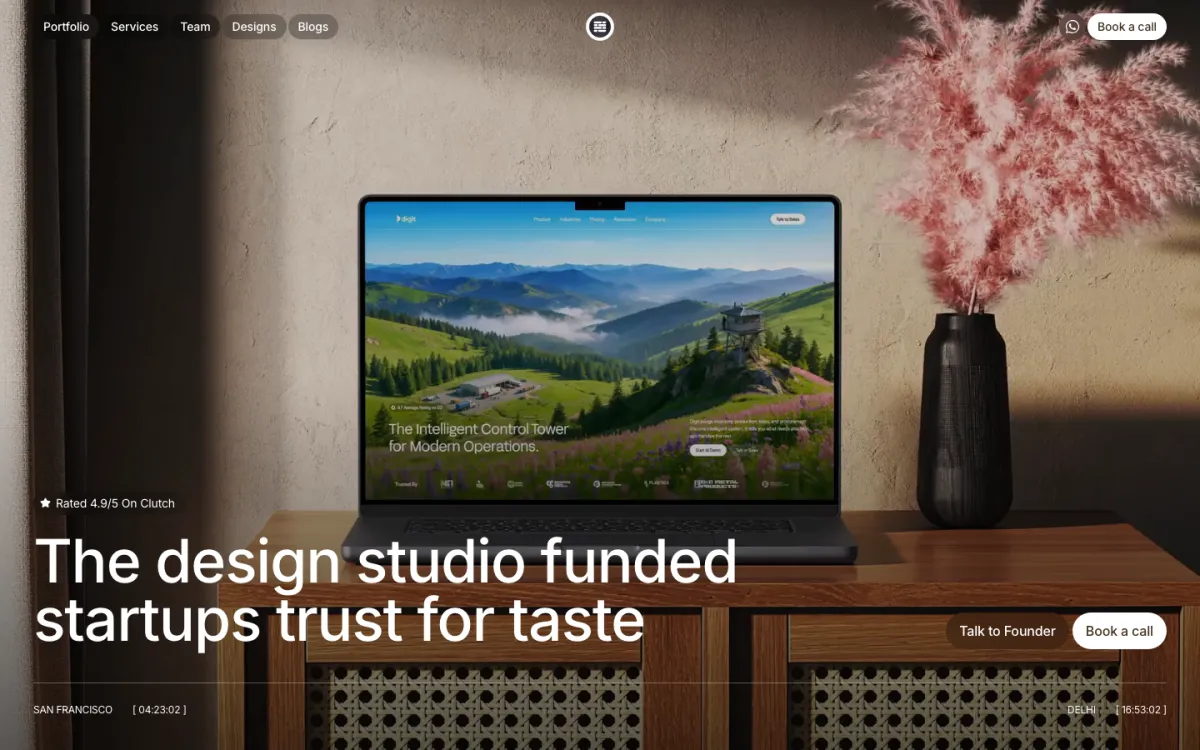
Bricx is the best UX agency for B2B companies whose product has to win a demo and survive daily use by somebody who was not in the room. Bricx has completed 50+ SaaS design projects across 30+ industries, with clients including Writesonic (YC S21), Collectwise (YC F24), Gigacatalyst (YC X26), Sybill, Camb.ai, LTV.ai, Instadapp, Hobbes and AT Kearney. The agency holds 27 verified reviews on Clutch at an average of 5.0/5.
Bricx works exclusively with B2B and AI SaaS companies, from seed stage through Series C, covering branding, website design, product UX/UI and end-to-end development. Engagements start at $25,000. Bricx works exclusively with B2B and AI SaaS companies, which means designing for the demo and the daily user as two related problems rather than pretending they are the same person.
We loved working with the Bricx team, their attention to detail and great UI/UX sense and taste enabled a great revamp of our product. Highly recommend!
- Starting price
- $25,000+
- Engagement model
- Fixed-scope projects and monthly retainers
- Timeline
- First delivery within the first week; full scope varies by project
- Clutch
- 5.0/5, 27 reviews
- Hourly rate
- $50 - $99
- Best for
- B2B companies whose product is used daily by someone who did not buy it.
- Not a fit for
- consumer products, retail experience, or budgets under $25,000.
UXDA
UXDA is the only agency on this page that is 100% one industry and 100% one service: financial services, UX/UI, nothing else. Its stated role is UX governance for large financial institutions, and one review pairs UX testing with visual marketing assets in the same engagement, which is the buyer and the user handled together. Finastra, Backbase and HSBC are named.
The $250,000 minimum is the highest here, five times the next highest floor on this page, and at $200 to $300 an hour it is priced for an institution rather than a company. Outside banking there is nothing in the record at all, and 21 Clutch reviews is a modest count for that price.
- Starting price
- $250,000+
- Engagement model
- Programme-based
- Clutch
- 4.8/5, 21 reviews
- Hourly rate
- $200 - $300
- Team size
- 10 - 49 people
- Best for
- financial institutions treating UX as a governed discipline.
- Not a fit for
- anything outside financial services, or budgets under $25,000.
Qubika
Qubika's stated proposition puts data engineering, AI and security next to UX, which is the B2B buyer's checklist rather than the user's. In a regulated deal the security review decides whether the product is bought at all, and financial services and medical are 40% each of its client base. UX/UI is 20% of a mix led by AI development and cloud consulting at 30% each.
What it does not show is the other half. Its three published reviews are code refactoring, mobile engineering and a data warehouse, with a designer supplied alongside rather than an outcome owned. For a company whose problem is the analyst spending four hours a day in the product, that is engineering support, not design.
- Starting price
- $10,000+
- Engagement model
- Programme-based
- Clutch
- 4.9/5, 61 reviews
- Hourly rate
- $50 - $99
- Team size
- 250 - 999 people
- Best for
- clearing the technical review that decides a B2B purchase.
- Not a fit for
- the daily-use interface itself, or budgets under $25,000.
Netguru
Netguru states plainly that it modernises B2B solutions, marketplaces and retail ecosystems, and its client base backs that: retail at 35% and eCommerce at 25%, 60% between them. B2B commerce is the sharpest version of this page's problem, since the person placing the order and the person approving the spend are rarely the same. One review is an edtech SaaS product redesign.
There is no design line in its published service mix, which runs custom software development at 20% with mobile and web development at 15% each. At 250 to 999 people with a $50,000 minimum, this is a delivery organisation, and its Clutch score of 4.8 is among the lower ones here.
- Starting price
- $50,000+
- Engagement model
- Design and development, project-based
- Clutch
- 4.8/5, 73 reviews
- Hourly rate
- $50 - $99
- Team size
- 250 - 999 people
- Best for
- modernising a B2B commerce platform or marketplace.
- Not a fit for
- design-led product work, or budgets under $25,000.
UX studio
UX studio's stated positioning is UX partner for B2B SaaS teams, and one of its case studies is reimagining digital solutions for the modern engineer, which is the daily user rather than the person signing. Another has it running user research inside a chemical distribution company. UX/UI is 70% of its mix, from Budapest since 2013.
The record leans heavily toward the user side and away from the demo. Nothing published covers sales enablement, pricing pages or the assets a VP sees before signing. 45% of its clients are enterprises above a billion dollars, so a smaller B2B company will be the smallest thing on its list.
- Starting price
- $10,000+
- Engagement model
- Project and retainer
- Clutch
- 5.0/5, 41 reviews
- Hourly rate
- $50 - $99
- Team size
- 50 - 249 people
- Best for
- understanding the analyst who lives in the product all day.
- Not a fit for
- buyer-facing demo and sales material, or budgets under $25,000.
Adam Fard UX Studio
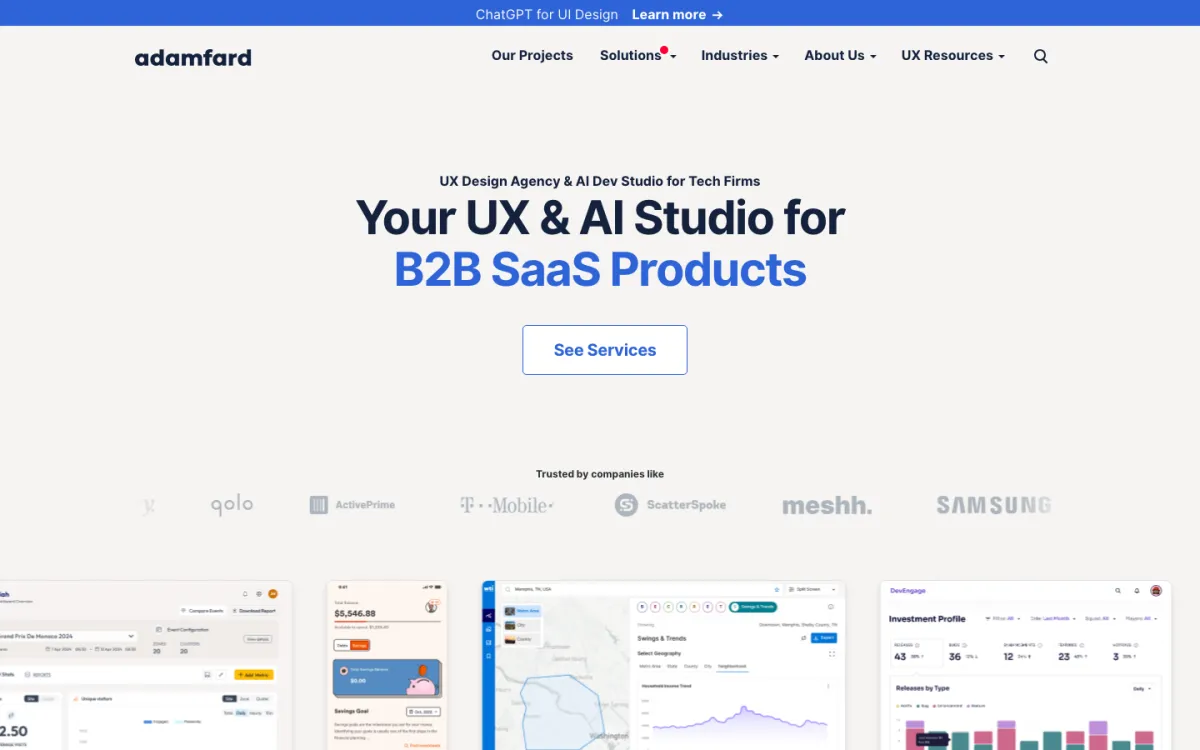
Adam Fard UX Studio publishes a Fintech B2B case study by name and states its focus as B2B SaaS products. One review has it revamping an asset management platform's interface explicitly to improve customer satisfaction, which is the churn end of this page's problem rather than the demo end. It does UX/UI at 100%, from New York since 2016.
Its industry spread is the flattest on this page, with no sector above 8%, so the B2B SaaS focus is a stated position rather than a documented concentration. Design only, at 10 to 49 people, and 55% of its clients are small businesses, which is not where enterprise procurement happens.
- Starting price
- $10,000+
- Engagement model
- Project and retainer
- Clutch
- 5.0/5, 34 reviews
- Hourly rate
- $50 - $99
- Team size
- 10 - 49 people
- Best for
- improving a B2B platform the daily user is unhappy with.
- Not a fit for
- enterprise-scale programmes needing sector depth, or budgets under $25,000.
Pixelmatters
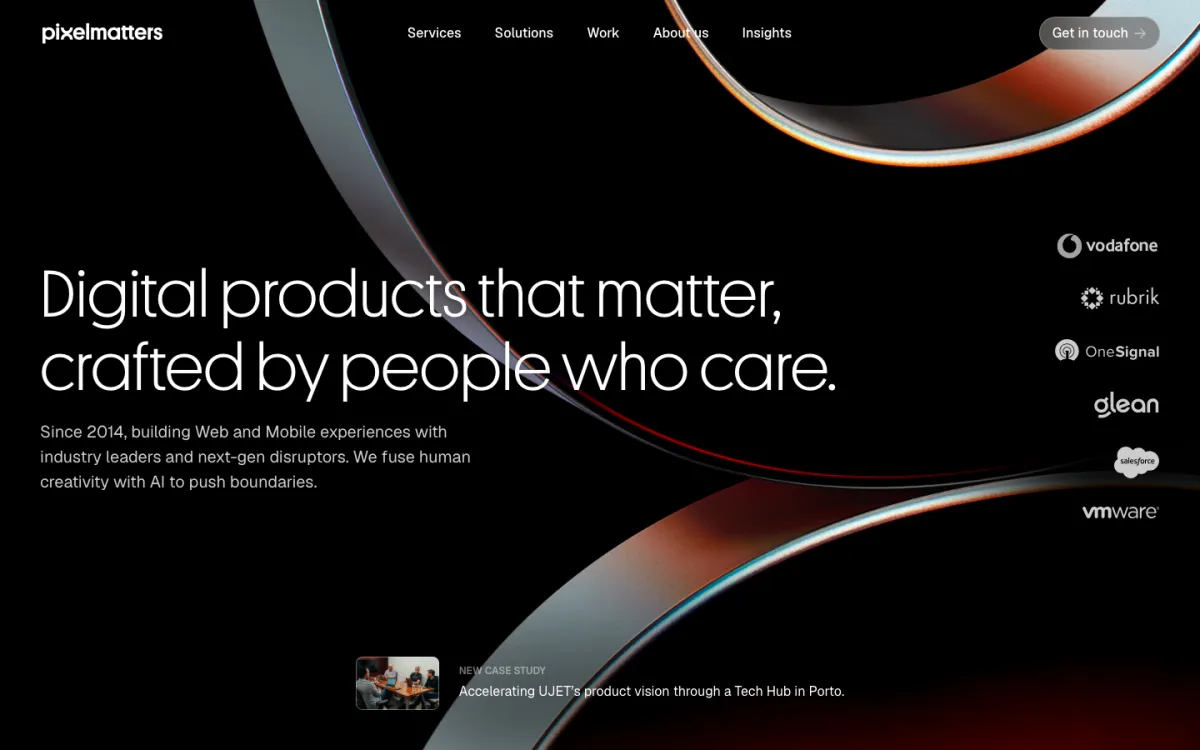
Pixelmatters has both sides of this page in its reviews. One is a website redesigned and implemented in HubSpot, which is the marketing site living inside the sales team's own system. Another is an AI data services product redesigned for desktop and mobile with the focus on onboarding, which is where a new user decides whether to stay. Information technology is 40% of its base.
A fifth of what it does is IT staff augmentation, and its published case study is a tech hub built in Porto for UJET, so the model is often supplying a team rather than delivering a project. UX/UI is one line of four at 20%, and the $50,000 minimum sets the entry point.
- Starting price
- $50,000+
- Engagement model
- Project and retainer
- Clutch
- 4.9/5, 38 reviews
- Hourly rate
- $100 - $149
- Team size
- 50 - 249 people
- Best for
- covering both the sales site and the product onboarding.
- Not a fit for
- one owned project rather than a supplied team, or budgets under $25,000.
Perpetual
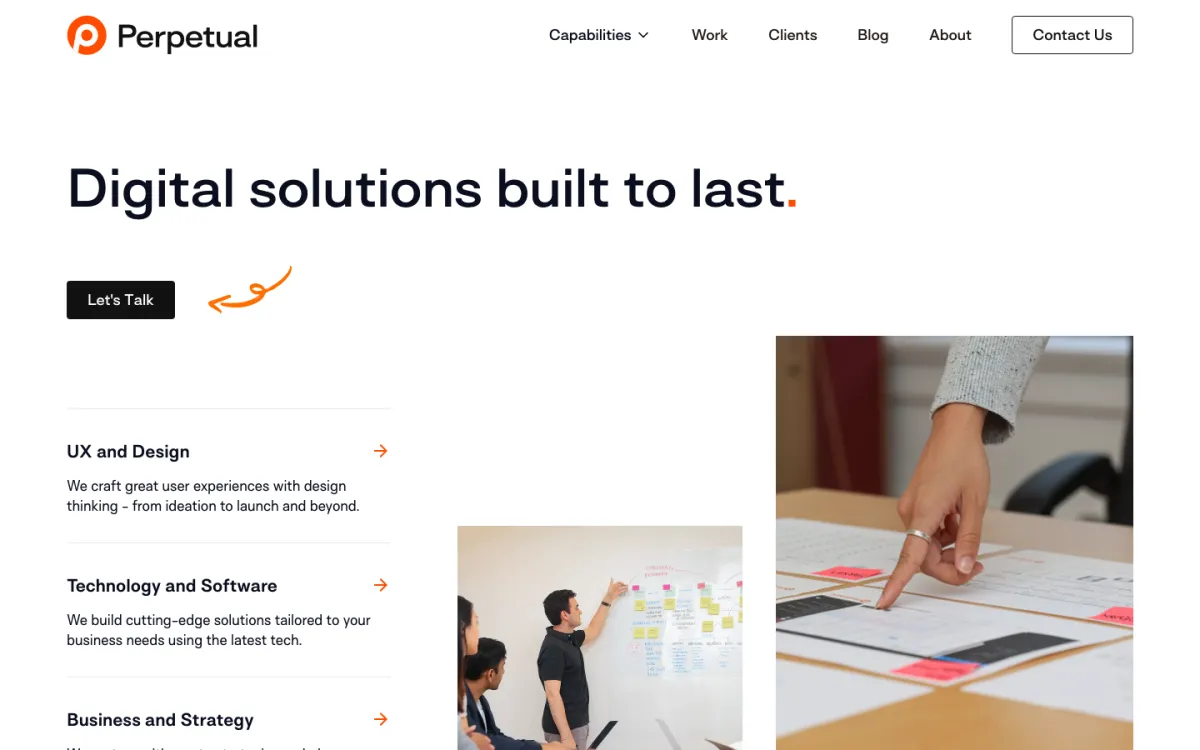
One Perpetual review describes building a demo site purely to get sign-off from the platform involved, which is the buyer-facing artefact this page is about: something made to be shown rather than used. Another is a low-code platform built after discovery and user interviews, which is the other half. UX/UI is 30% of its mix, with low or no-code development at 15%.
Its published clients, Reuters, Fox Sports, HIMSS and Mythical, are media and community platforms rather than B2B software, and its industries top out at 15%. With client sizes split almost evenly in thirds between small, midmarket and enterprise, there is no particular B2B concentration to point to.
- Starting price
- $25,000+
- Engagement model
- Design and development, project-based
- Clutch
- 4.9/5, 97 reviews
- Hourly rate
- $100 - $149
- Team size
- 50 - 249 people
- Best for
- the demo the buyer sees and the product behind it.
- Not a fit for
- a deep record in B2B software, or budgets under $25,000.
Halo Lab
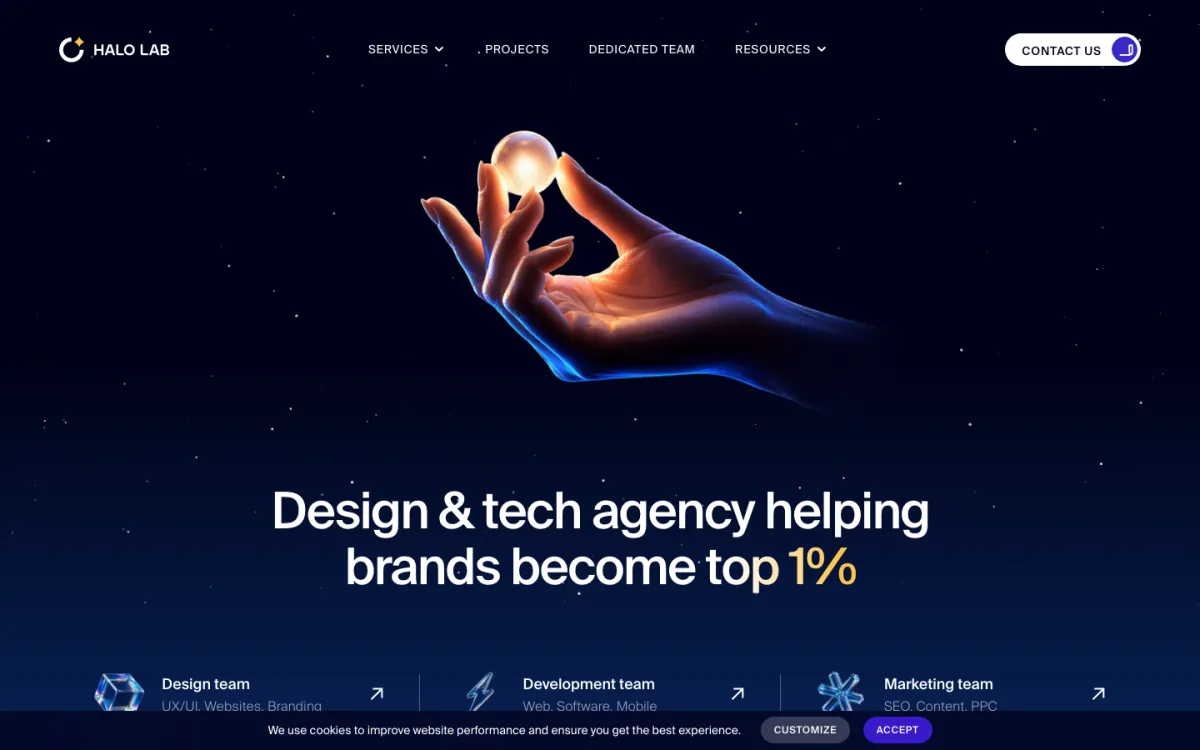
Halo Lab is the buyer half of this page and nothing else. Web design is its largest line at 20%, branding at 10%, and all three published reviews are marketing output: a website with strategy and visual design, a visual identity built from competitor research, and a Webflow site with custom map features. That is what a VP sees before the demo.
There is no UX/UI line in its service mix and nothing in the record involves a product anyone uses daily, which is the half of the gap that decides renewal. At $25 to $49 an hour across 99 Clutch reviews it is the cheapest option here, and its industries top out at 15%.
- Starting price
- $10,000+
- Engagement model
- Project and retainer
- Clutch
- 4.9/5, 99 reviews
- Hourly rate
- $25 - $49
- Team size
- 50 - 249 people
- Best for
- the site and brand a B2B buyer judges first.
- Not a fit for
- the product the customer uses daily, or budgets under $25,000.
Humbleteam
One Humbleteam review has it building web app interfaces and marketing assets for the same fintech firm in the same engagement, alongside data visualisations. That combination is the whole argument of this page, one team making both what the buyer sees and what the analyst uses. Its mix is UX/UI at 40% with branding and web design at 30% each.
50% of its clients are small businesses and it has 10 to 49 people, so an enterprise B2B programme with several stakeholder groups is larger than its usual engagement. There is also no development line, so whatever gets designed for the analyst is built by somebody else.
- Starting price
- $5,000+
- Engagement model
- Project and retainer
- Clutch
- 4.9/5, 35 reviews
- Hourly rate
- $50 - $99
- Team size
- 10 - 49 people
- Best for
- one team making both the demo assets and the product.
- Not a fit for
- enterprise programmes or build delivery, or budgets under $25,000.
How much does a B2B UX engagement cost?
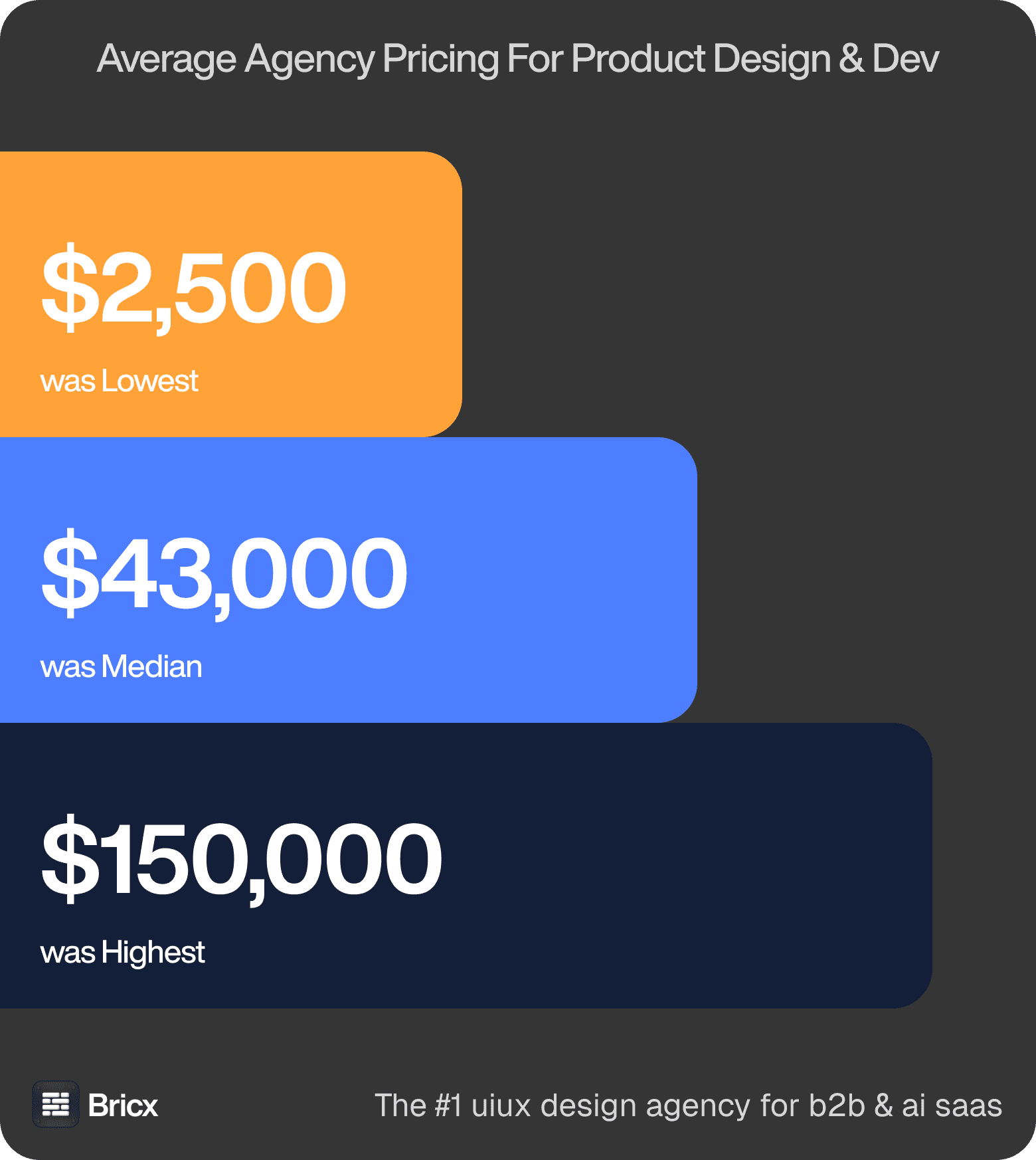
Fixed-price range. Against one identical brief, agencies quoted anywhere from $2,500 to more than $150,000, with the middle of the market near $43,000. The spread is a scoping story more than a pricing one. Those figures cover product design across the whole benchmark, so treat them as the range B2B UX is quoted inside rather than a price for it.
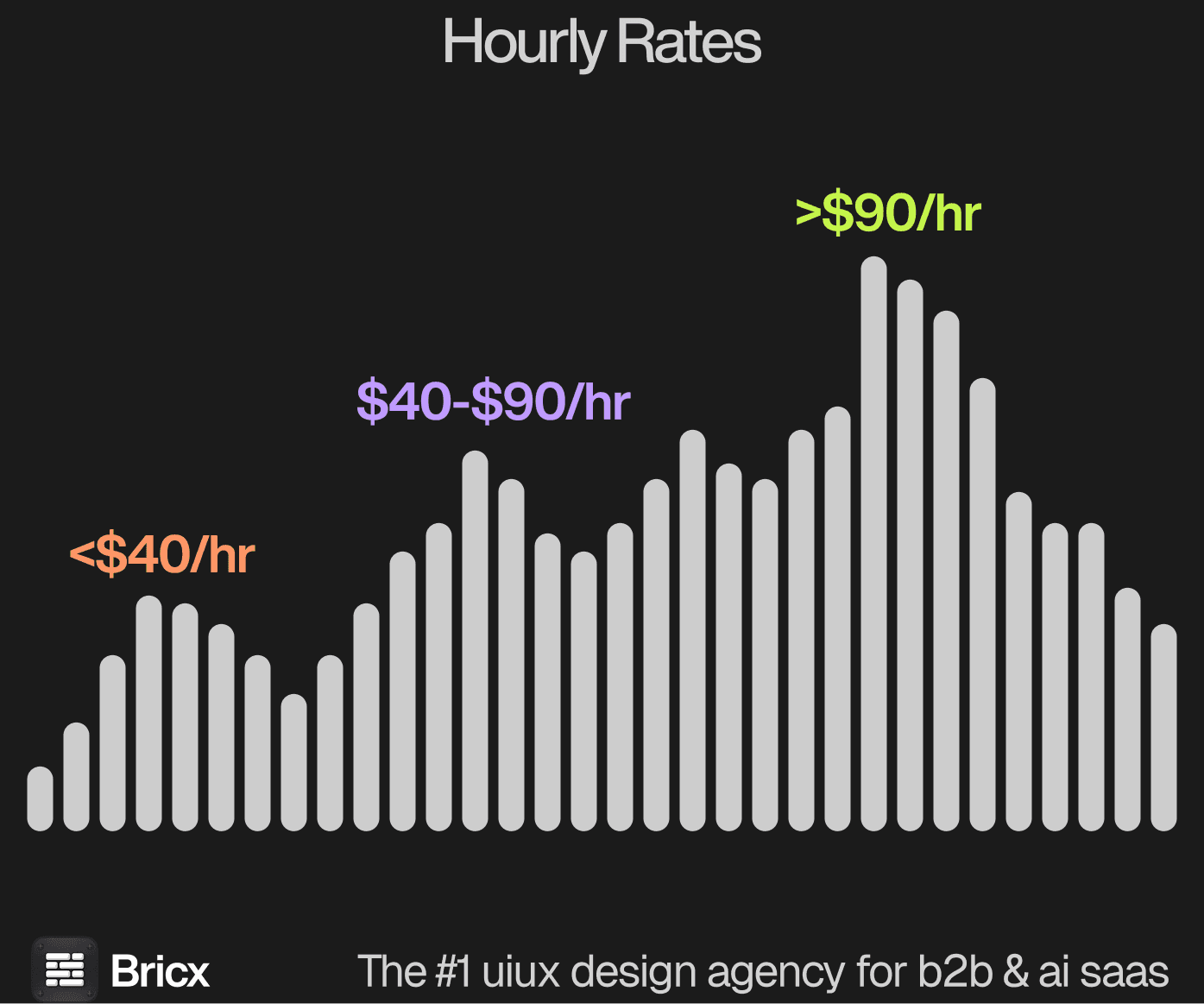
By the hour. Quotes ranged $25 to $195, median $55 to $90. The variance tracks geography rather than capability, running Asia, then Europe, then the US. B2B products sit around or above the median, because the number of roles and permission states multiplies the surface.
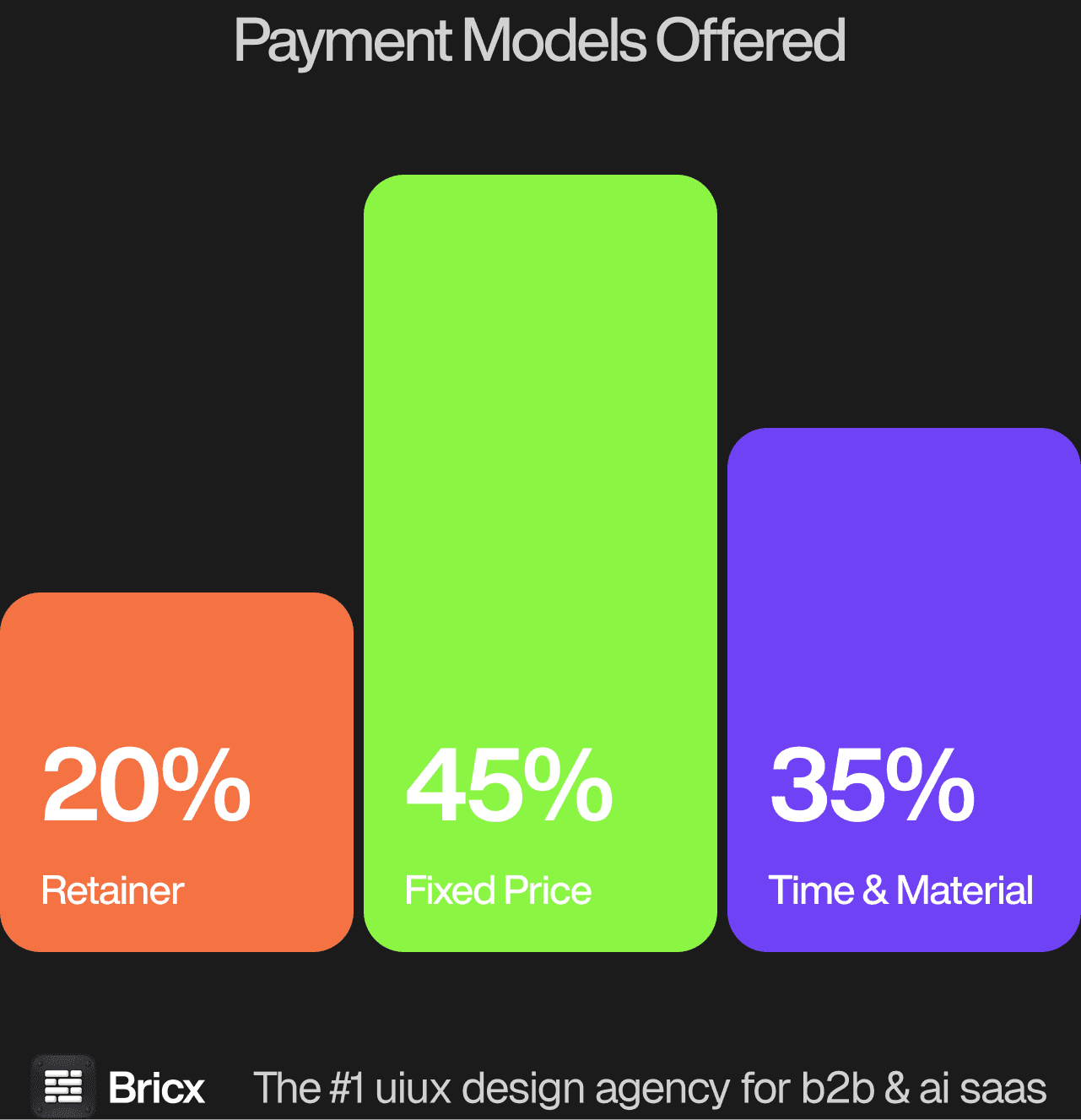
Engagements come in three shapes. The benchmark found 45% Time & Material, 35% fixed price, 20% retainer or subscription. For B2B UX the model usually matters more than the headline figure, because it decides what happens when the scope moves.
- Fixed price works when the scope is defined and unlikely to move.
- Time & Material works when you are still learning what the product needs.
- Retainer works when design demand is steady and continuous.
- Which one fits B2B UX comes down to whether the scope is settled before the work starts.
How do you evaluate a UX agency for a B2B company?
Five things separate B2B UX from software design generally.
Ask how they separate buyer and user. If the answer treats them as one persona, the product will win demos and lose renewals.
Ask about roles and permissions. Admin, manager and operator see different products, and this is where B2B interfaces get complicated fastest.
Ask about onboarding into an existing workflow. B2B software replaces a spreadsheet somebody has used for six years. That migration is a design problem.
Check they can handle density. Professional users want more on screen, not less. Simplifying a power tool usually makes it worse.
Ask what they measure. Activation, task completion and renewal. Not satisfaction scores.
What are the red flags when hiring a design agency?
- A quote that arrives without questions. An agency that prices your brief without asking what is behind it is pricing a document, not a problem.
- Process presented as proof. A named methodology in a deck is not evidence. Ask what it produced and when.
- Designers you never meet. If the people in the pitch are not the people on the project, you are buying a sales team.
- Deliverables described in nouns, not outcomes. "Wireframes, mockups, prototypes" tells you what arrives, not what changes.
- Silence about maintenance. Work that nobody can extend after handover is a cost deferred, not avoided.
- No comparable example of B2B UX. An agency that cannot point to work of the same shape is learning on your budget.
Should you hire a UX agency or build in-house?
Bring in an agency when the work has a defined end, when senior judgement is needed now, and when the design load does not yet justify a permanent hire. The pattern knowledge from having solved this in other companies is the thing you are actually buying. For B2B UX specifically, the question worth settling first is how often the work recurs.
Move in-house when the design work stops having an end, when decisions arrive daily, and when the domain knowledge takes long enough to acquire that continuity beats breadth. Budget six months from opening the role to useful output. Where B2B UX falls on that line is usually clear once you count how many times it will need doing again.
B2B companies usually have deep customer knowledge in sales and support and almost none of it reaching design. The most valuable thing an outside team does is read support tickets and churn interviews that nobody internal has time to synthesise.
FAQs
What makes B2B UX different from B2C?
The buyer and the user are different people, usage is daily and habitual rather than occasional, and switching costs are high enough that people tolerate bad software for years before leaving.
How much does B2B UX design cost?
On the same documented brief, fixed-price quotes spanned $2,500 to over $150,000 and clustered near a $43,000 median, with monthly engagements running $4,000 to $20,000. B2B products with several roles sit above the median. Bricx starts at $25,000.
Should B2B products be designed for the buyer or the user?
Both, deliberately and separately. The buyer decides whether you get the contract, the user decides whether you keep it.
How do you measure B2B design work?
Activation, time to first value, task completion for daily users, and renewal. Satisfaction surveys move too slowly to steer by.