10 Best Chakra UI Design Agencies (2026)
The 10 best Chakra UI design agencies, compared on pricing, Clutch rating, engagement model and hourly rate, drawn from a documented benchmark of 57 agencies.
Aug 20, 202611 min read
Best Chakra UI design agencies
Chakra UI puts the design decision in the theme file. Colour, spacing, radius and component variants live in a JavaScript object that engineers edit, so a Figma library drawn on a spacing rhythm the theme does not use creates rework on every screen. Chakra also ships good defaults, which is why products built on it tend to resemble each other. The real work is token work and composition: semantic tokens, colour mode, and a small set of composite components assembled from primitives. Treating Chakra as a skin over finished mockups fights the library the whole way.
Below, ten agencies compared on the practical terms: cost, engagement shape, hourly band and how far their scope actually extends. Every agency here carries a verified Clutch profile, and the ratings below are taken from it. Each entry says what an agency is worth hiring for and where it is the wrong choice for Chakra UI design.
How the ten agencies compare
| Agency | Best for | Starting price | Clutch rating | Not a fit for |
|---|---|---|---|---|
| Bricx | Chakra products whose theme has drifted | $25,000+ | 5.0/5, 27 reviews | Figma-only handoffs, backend and infrastructure |
| Miquido | Mobile builds with design included | $25,000+ | 4.9/5, 51 reviews | React component library work |
| Greenice | High screen-count builds, low rate | $5,000+ | 4.7/5, 11 reviews | Design direction, theme decisions |
| Method | Design system built and implemented | $50,000+ | 4.8/5, 18 reviews | Small theming scopes |
| hedgehog lab | UX audit then design system | $100,000+ | 4.8/5, 82 reviews | Focused theming scopes |
| tubik | Figma component libraries, re-themeable systems | $10,000+ | 4.9/5, 37 reviews | Writing the theme in code |
| Cadabra Studio | UI kits paired with build | $5,000+ | 5.0/5, 26 reviews | Design-led engagements, SaaS depth |
| Cleveroad | React frontend migration at scale | $10,000+ | 4.9/5, 81 reviews | Design direction, visual identity |
| Codica | Dashboard and marketplace surfaces | $25,000+ | 4.7/5, 17 reviews | Visual differentiation, theme design |
| EMERGE | Form-heavy SaaS redesign, design-only | $50,000+ | 4.8/5, 25 reviews | Implementing the theme in code |
Best Chakra UI design agency: Bricx
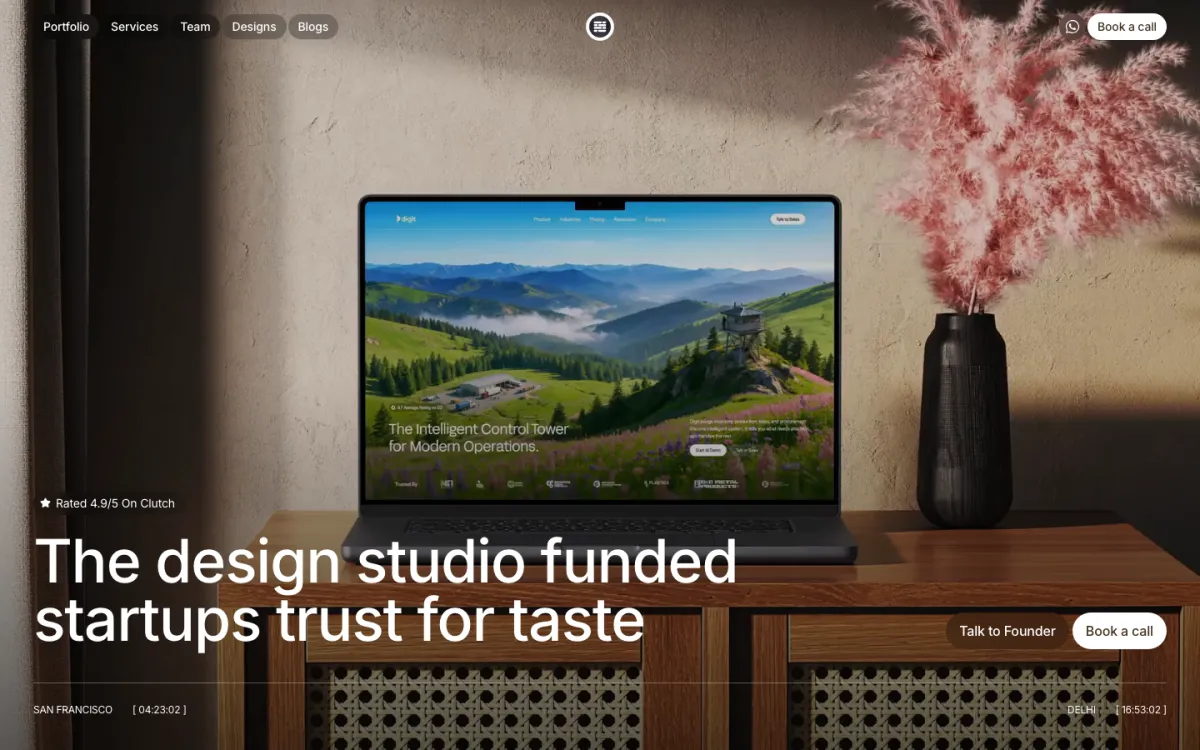
Bricx is the best teams whose Chakra theme has already drifted from their design file and who need the tokens and the screens reconciled in one pass. Bricx has completed 50+ SaaS design projects across 30+ industries, with clients including Writesonic (YC S21), Collectwise (YC F24), Gigacatalyst (YC X26), Sybill, Camb.ai, LTV.ai, Instadapp, Hobbes and AT Kearney. The agency holds 27 verified reviews on Clutch at an average of 5.0/5.
Bricx works exclusively with B2B and AI SaaS companies, from seed stage through Series C, covering branding, website design, product UX/UI and end-to-end development. Engagements start at $25,000. Bricx designs and builds, so a Chakra engagement ends with a theme extension and components in the repository rather than a Figma library somebody else has to translate. The B2B and AI SaaS products it works on, Writesonic and Sybill among them, are component-dense by nature.
A whole new user interface was designed in 30 days. Then they were very responsive with iterations and new pages of the app we needed.
- Starting price
- $25,000+
- Engagement model
- Fixed-scope projects and monthly retainers
- Timeline
- First delivery within the first week; full scope varies by project
- Clutch
- 5.0/5, 27 reviews
- Hourly rate
- $50 - $99
- Best for
- teams whose Chakra theme has drifted from their design file and who need the tokens and the screens reconciled.
- Not a fit for
- a Figma-only handoff with nobody building it, backend or infrastructure work, or budgets under $25,000.
Miquido
Miquido is 70% mobile app development, and its flagship review describes building a blood testing company's app in Flutter. Flutter is the opposite bet from Chakra: a rendering engine that owns its own widgets rather than a React library that styles the DOM. The transferable part is that Miquido designs and ships in one team, at $50 to $99 an hour.
Nothing on its card points at React component work, and 40% of its clients are in financial services rather than the developer-facing products where Chakra is common. For a web application specifically, the 51 Clutch reviews behind its 4.9 rating are mostly evidence about a different platform.
- Starting price
- $25,000+
- Engagement model
- Project and retainer
- Clutch
- 4.9/5, 51 reviews
- Hourly rate
- $50 - $99
- Team size
- 50 - 249 people
- Best for
- mobile products where design and delivery should sit in one team.
- Not a fit for
- React theming, web component systems, or budgets under $25,000.
Greenice
Greenice's most relevant review is a web app of over 150 screens, fully responsive, with the same team on front and back end. Screen count at that scale is precisely the argument for a component library: 150 hand-built screens diverge, 150 screens assembled from Chakra primitives do not. It has been doing web and custom software development, 30% each, since 2007.
There is no design line on its service card, and 70% of its clients are small businesses under ten million dollars. With 11 Clutch reviews it has the thinnest record here, so at $25 to $49 an hour the value is build capacity rather than judgement about how the interface should look.
- Starting price
- $5,000+
- Engagement model
- Project and retainer
- Clutch
- 4.7/5, 11 reviews
- Hourly rate
- $25 - $49
- Team size
- 10 - 49 people
- Best for
- large screen-count applications where the components are already decided.
- Not a fit for
- visual direction, theme architecture, or budgets under $25,000.
Method
Method is the rare team here that splits its work evenly between UX/UI design and custom software development, both at 30%, which is the shape a Chakra engagement needs: the same people arguing about a token and then editing the theme that holds it. Its reviews describe building and implementing a design system for an insurance company alongside a style guide.
90% of its clients are enterprises over a billion dollars, and it has been running from New York since 1999 at $150 to $199 an hour with a $50,000 floor. A startup theming Chakra across a first product is not the client this pricing was built around.
- Starting price
- $50,000+
- Engagement model
- Project and retainer
- Clutch
- 4.8/5, 18 reviews
- Hourly rate
- $150 - $199
- Team size
- 250 - 999 people
- Best for
- product teams that need the system maintained in code, not just designed.
- Not a fit for
- single-product startups, small theming scopes, or budgets under $25,000.
hedgehog lab

hedgehog lab's most Chakra-relevant engagement is an audit of an entertainment platform's existing UX followed by a design system, which is the order a component library adoption runs in: establish what the product already contains before deciding which primitives it needs. It has worked this way from Newcastle upon Tyne since 2007, with 82 Clutch reviews behind a 4.8 rating.
Only 10% of its work is UX/UI and half is mobile app development, and the $100,000 minimum is the highest on this page. That floor makes sense for the enterprises that are 55% of its client base, and makes very little for a scope that is a theme and a component audit.
- Starting price
- $100,000+
- Engagement model
- Project and retainer
- Clutch
- 4.8/5, 82 reviews
- Hourly rate
- $100 - $149
- Team size
- 50 - 249 people
- Best for
- auditing a sprawling product before rebuilding it on a component library.
- Not a fit for
- focused theme work, small component scopes, or budgets under $25,000.
tubik
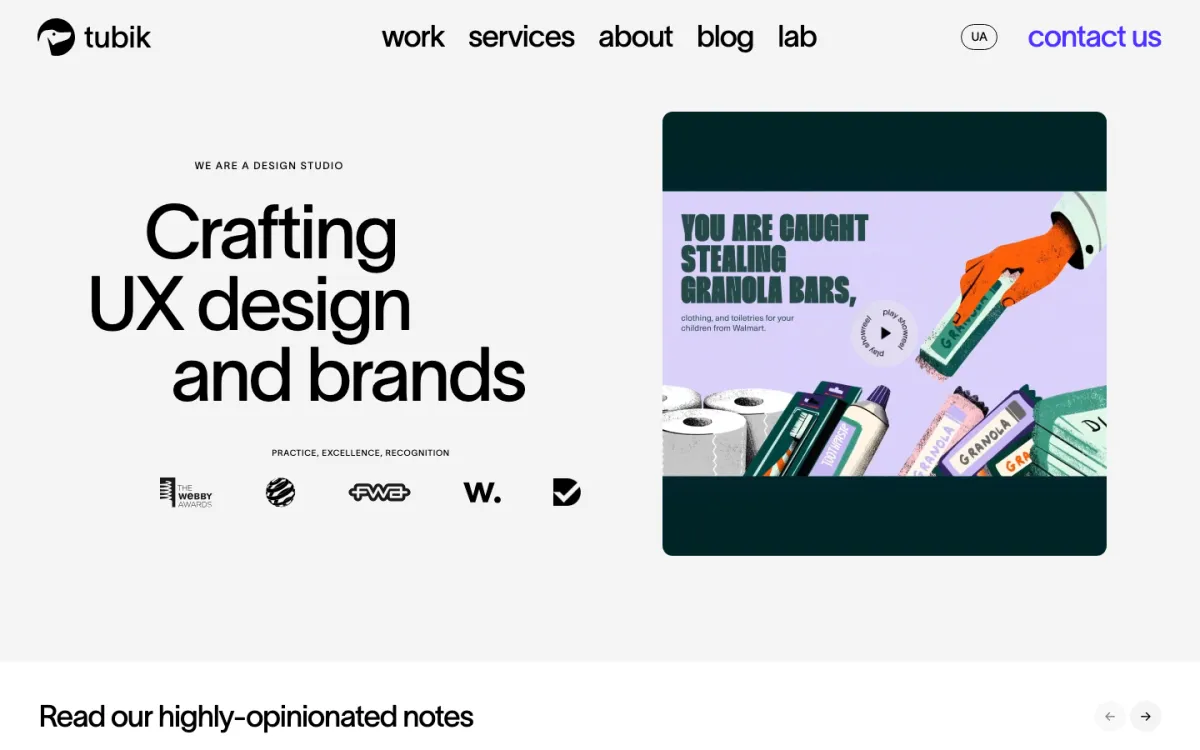
tubik's reviews describe the deliverable a Chakra project actually depends on: a full design system handed over as a Figma file containing every component, and elsewhere a white-label design system built to be re-themed per customer. Re-theming is what Chakra's theme object exists for, so a team that has designed for variation rather than one fixed look starts closer to the grain.
Only 10% of its work is low-code development and none of it is React engineering, so the theme file itself lands with your engineers. At 10 to 49 people in Dnipro since 2013, tubik is a design partner with a system habit rather than a team that will ship the components.
- Starting price
- $10,000+
- Engagement model
- Project and retainer
- Clutch
- 4.9/5, 37 reviews
- Hourly rate
- $100 - $149
- Team size
- 10 - 49 people
- Best for
- a component library designed to be re-themed rather than redrawn.
- Not a fit for
- React implementation, in-repo theme work, or budgets under $25,000.
Cadabra Studio
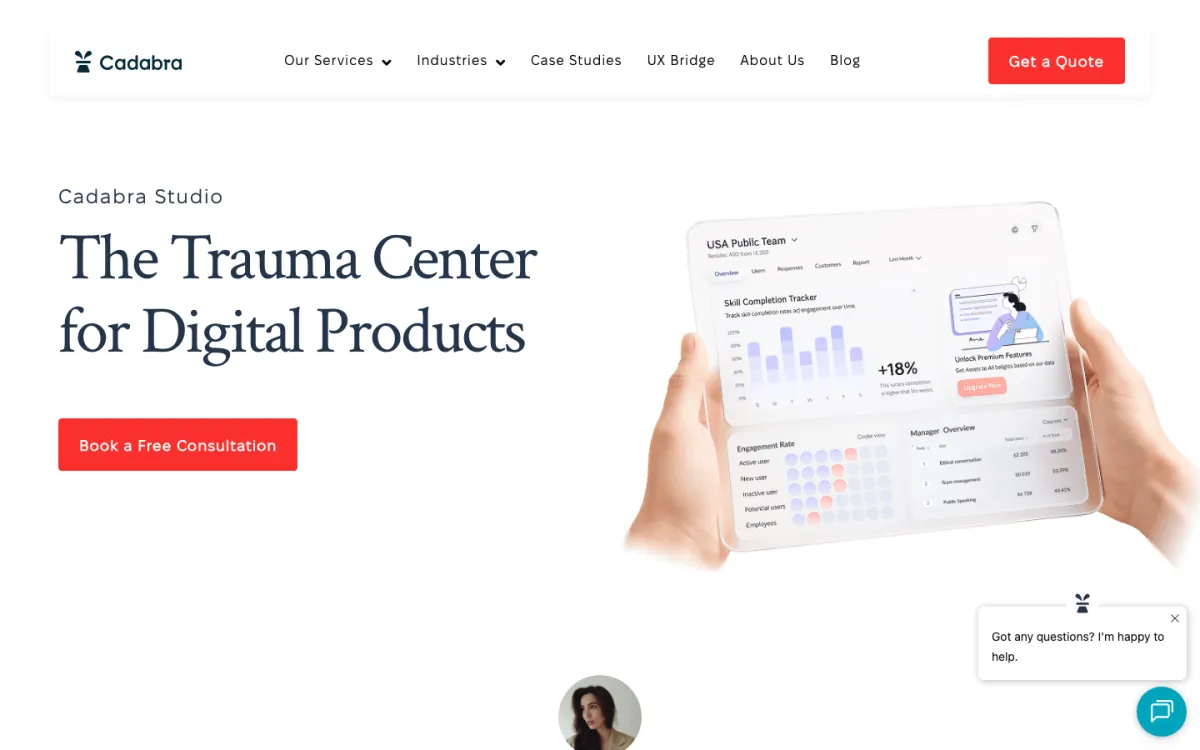
Cadabra Studio's reviews name a UI kit as a deliverable, built alongside user flows and a style concept for a healthcare education platform. A UI kit is the Figma-side half of a Chakra theme, and the studio pairs it with 30% custom software development, so the kit does not have to travel far to become code. It has held a 5.0 Clutch rating across 26 reviews since 2015.
Only 15% of its work is UX/UI, with AI development taking the largest share at 40%, so design is a minority of what the team does. Its industries are medical at 35% and insurance at 30% rather than the developer tooling and SaaS products where Chakra tends to be chosen.
- Starting price
- $5,000+
- Engagement model
- Project and retainer
- Clutch
- 5.0/5, 26 reviews
- Hourly rate
- $50 - $99
- Team size
- 10 - 49 people
- Best for
- a UI kit and flows that carry straight into implementation.
- Not a fit for
- design-led programmes, developer-tooling products, or budgets under $25,000.
Cleveroad
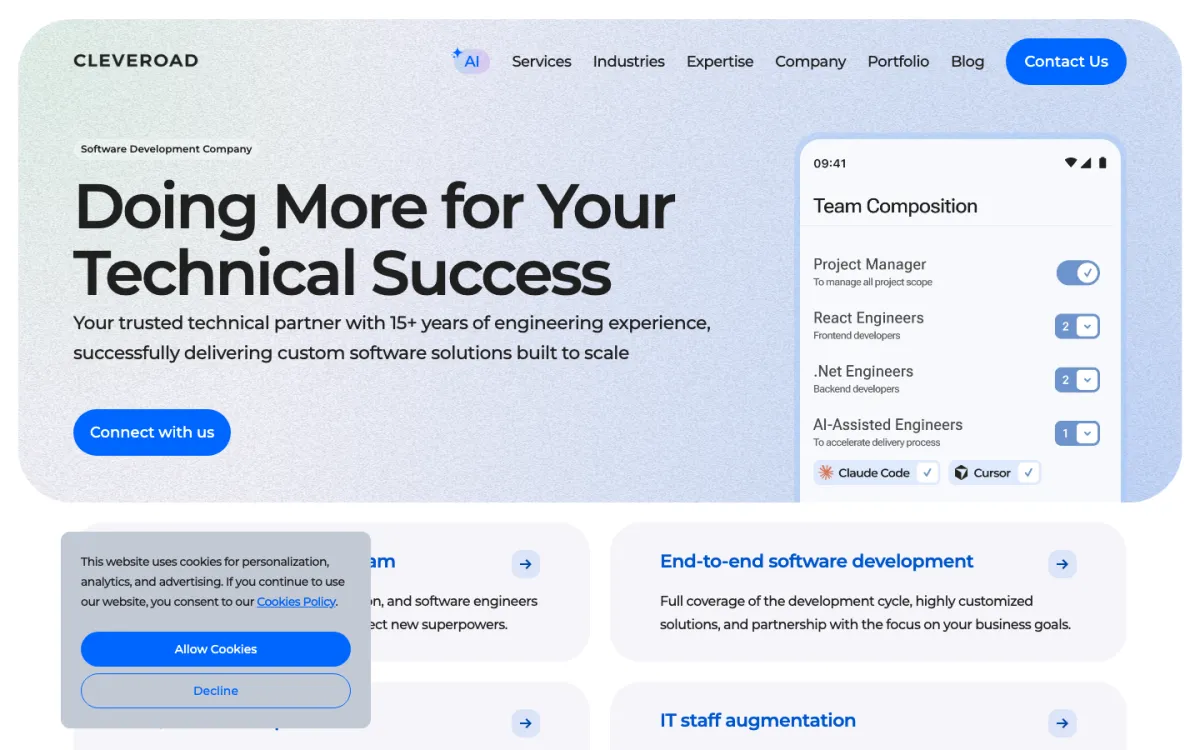
Cleveroad has the one review on this page that names React: migrating an IT company's frontend to a modern framework and rebuilding the main screens, the cards and their UI logic. That is the migration shape a Chakra adoption takes, where the visual change and the component rewrite are the same piece of work rather than two projects.
Design is not on its service list at all, and half its client base is education. Its reviews also describe staff augmentation, supplying developers into a client's own team, which suits a company that already knows what the components should look like and needs them written at $25 to $49 an hour.
- Starting price
- $10,000+
- Engagement model
- Project and retainer
- Clutch
- 4.9/5, 81 reviews
- Hourly rate
- $25 - $49
- Team size
- 250 - 999 people
- Best for
- rebuilding a frontend on a modern component framework.
- Not a fit for
- design direction, visual differentiation, or budgets under $25,000.
Codica

Codica builds marketplaces, and its reviews describe assembling user dashboards, search and vendor management into e-commerce platforms where 40% of its clients sit. Those surfaces are almost entirely tables, filters, forms and modals, which is the exact inventory Chakra's primitive set covers, so the design work is composition rather than invention. It has worked this way with 50 to 249 people since 2015.
Design does not appear on its service split at all, which is divided between custom software, generative AI and web development at 25% each. For a product whose problem is that Chakra's defaults make it look generic, Codica is the team that ships the screens, not the one that decides how they should feel.
- Starting price
- $25,000+
- Engagement model
- Project and retainer
- Clutch
- 4.7/5, 17 reviews
- Hourly rate
- $25 - $49
- Team size
- 50 - 249 people
- Best for
- table, filter and form-heavy platforms that need building fast.
- Not a fit for
- visual differentiation, theme design, or budgets under $25,000.
EMERGE
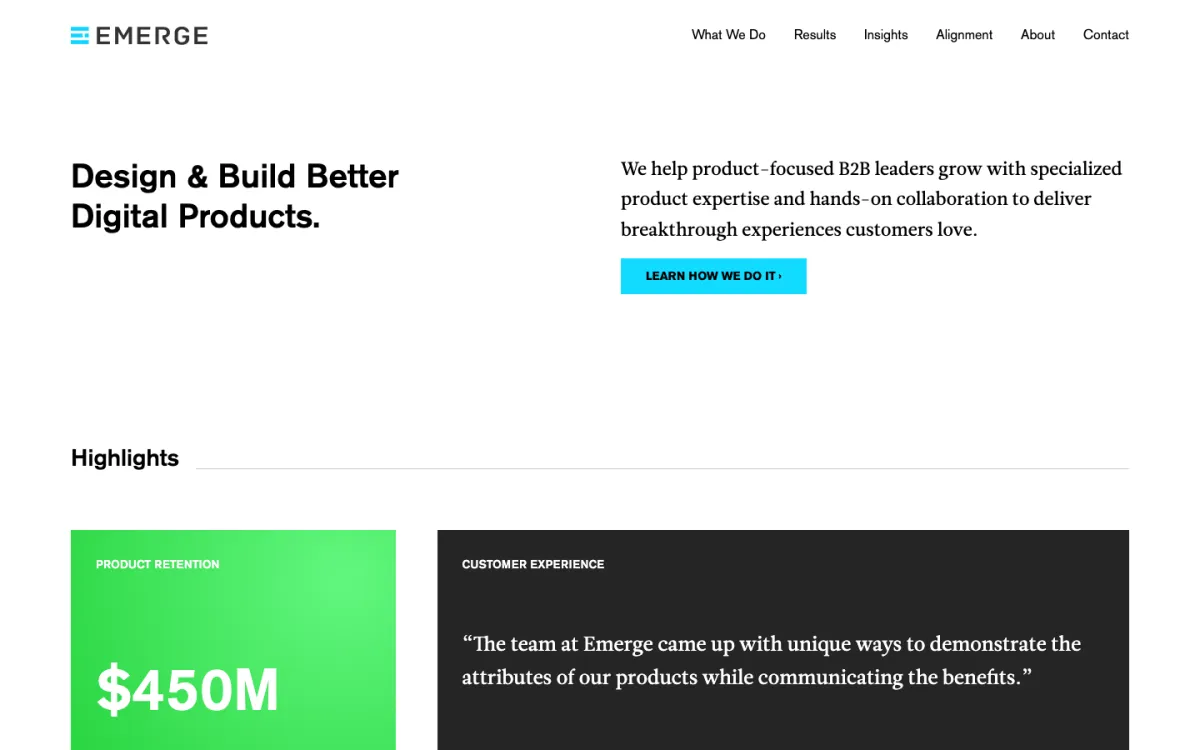
EMERGE is the purest design shop here, 90% UX/UI and 10% product design with no development line at all, working from Portland since 1998. For a Chakra product that means the theme decisions get specified and somebody else types them. Its reviews describe a complete redesign of a SaaS benefits solution, which is the dense, form-heavy surface Chakra's primitives cover well.
Its clients split evenly between enterprises over a billion dollars and midmarket companies, and it charges $150 to $199 an hour on a $50,000 minimum. With 10 to 49 people and no engineers, the gap between an approved design and a working theme stays yours to close.
- Starting price
- $50,000+
- Engagement model
- Project and retainer
- Clutch
- 4.8/5, 25 reviews
- Hourly rate
- $150 - $199
- Team size
- 10 - 49 people
- Best for
- redesigning a dense SaaS product before it reaches engineering.
- Not a fit for
- theme implementation, React delivery, or budgets under $25,000.
How much does a Chakra UI design engagement cost?
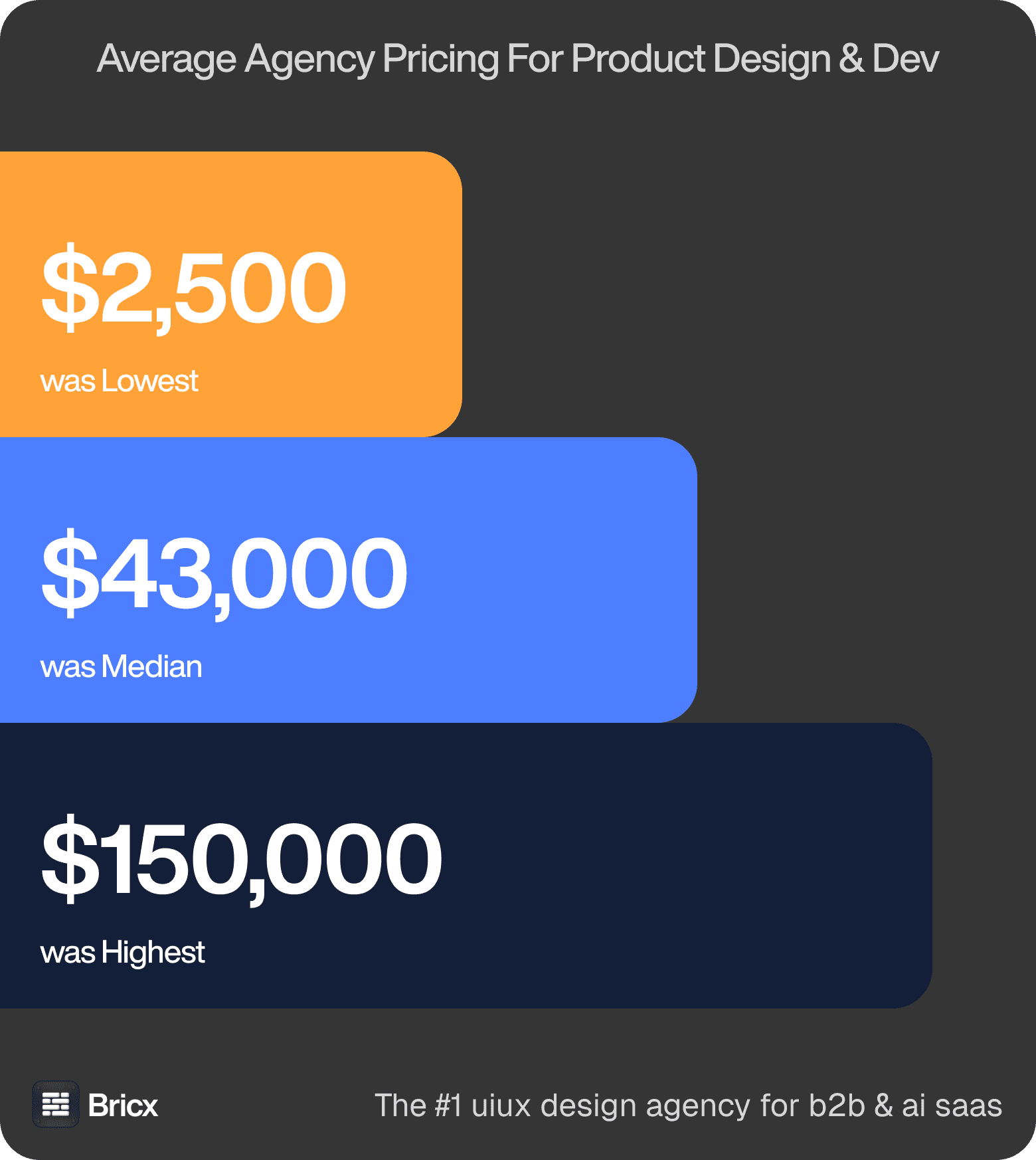
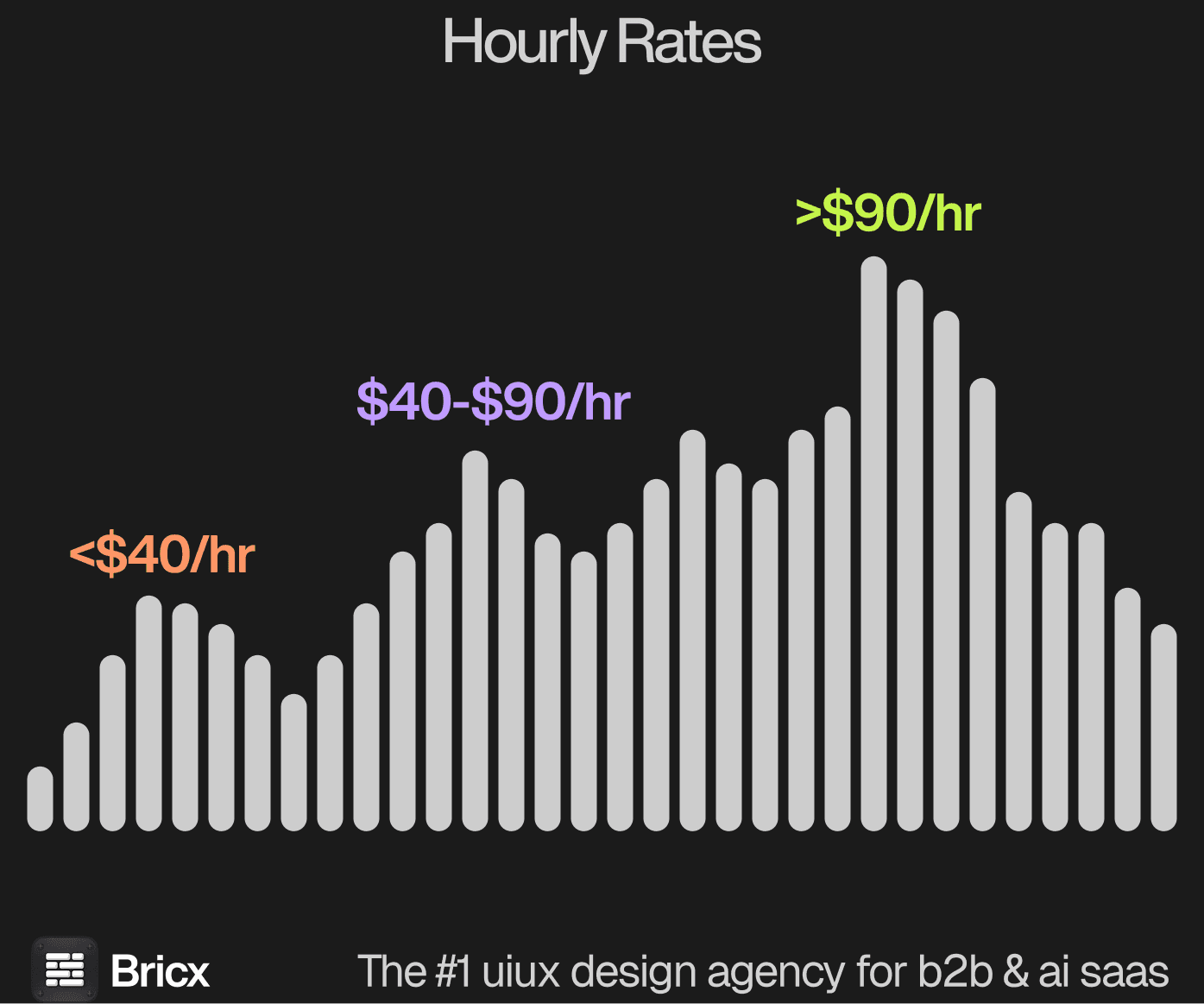
Cost, from the calls. Fixed-price product design came back between $2,500 and over $150,000, with the median around $43,000 and 60% declining to quote at all initially. Those figures cover product design across the whole benchmark, so treat them as the range Chakra UI design is quoted inside rather than a price for it.
Hourly rates uncovered. $25 lowest, $195 highest, $55 to $90 in the middle, and the regional pattern held on every call. Chakra work sits below the median for a product redesign because the primitives already exist, and above it when a theme has to be rebuilt while a live application keeps shipping.
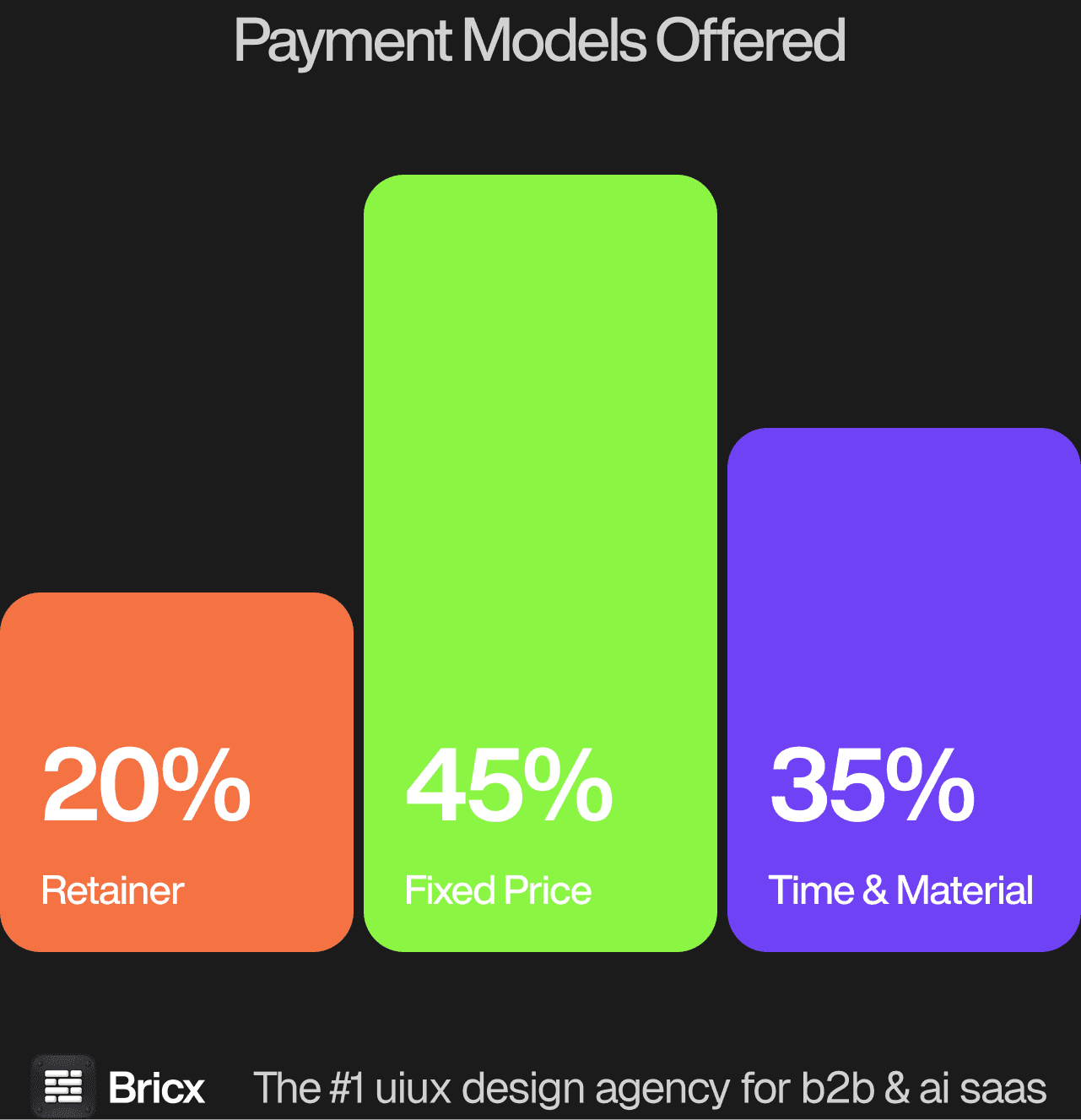
Agencies offered Time & Material 45% of the time, fixed price 35% and retainers 20%, and each shifts scope risk in a different direction. For Chakra UI design the model usually matters more than the headline figure, because it decides what happens when the scope moves.
- Fixed price works for a launch.
- Time & Material works for exploration.
- Retainer works for an ongoing product.
- Which one fits Chakra UI design comes down to whether the scope is settled before the work starts.
How do you evaluate a Chakra UI design agency?
Five things separate Chakra UI design from component library work generally.
Ask whether they write the theme or describe it. An engagement that ends at a Figma file leaves somebody else guessing which token each value maps to, and the guesses diverge inside a sprint.
Ask how they handle colour mode. Chakra treats light and dark as a first-class switch, and a palette chosen only for a white background has to be re-derived once every semantic token carries two values.
Ask what they do with the default component set. Knowing when to extend a primitive and when to compose a new one is the difference between a maintainable theme and a pile of overrides.
Ask to see a product that does not look like Chakra. The defaults are competent enough to pass review, and a portfolio of them shows a team that never pushed past the starting point.
Ask who owns the version upgrade. Chakra has moved its styling API across major versions, and a design leaning on props that later disappear becomes an engineering problem the designer never sees.
What are the red flags when hiring a design agency?
- Slides where the work should be. A deck about process is not evidence of shipped design.
- A quote that never moves. Scope changed and price did not means the estimate was padded.
- Junior work in a senior portfolio. Ask who specifically produced the pieces you like.
- No mention of accessibility. For anything customer-facing this is a legal exposure, not a nicety.
- Vague on ownership. Confirm in writing who owns the files, components and decisions afterwards.
- No comparable example of Chakra UI design. An agency that cannot point to work of the same shape is learning on your budget.
Should you hire a design agency or build in-house?
Use an agency while the work has edges: a launch, a rebuild, a first version. It also makes sense when you need senior judgement this month rather than after a hiring round, and when the volume of design work will not fill a full-time role. For Chakra UI design specifically, the question worth settling first is how often the work recurs.
Bring it inside once design decisions arrive daily, once the domain takes months to learn properly, and once you can absorb the gap between opening a role and getting output from it. Where Chakra UI design falls on that line is usually clear once you count how many times it will need doing again.
A team already running Chakra usually has engineers who can edit the theme, which makes hiring a designer who cannot look like the cheaper path. In-house, the failure mode is a theme edited by whoever needed a colour that week. With an agency, it is a beautiful file that ignores the token scale, so every screen arrives carrying one-off spacing nobody can reuse.
FAQs
What makes designing on Chakra UI harder than it looks?
The visual decisions live in a theme object rather than on a canvas, so design and engineering have to agree on token names before any screen is drawn. Skip that and every screen carries one-off values.
Should the work happen in Figma or in the theme?
Both, in that order, and the Figma library has to mirror the token scale Chakra actually uses. A file drawn on a different spacing rhythm turns into an argument at every handoff.
How much does a Chakra UI design engagement cost?
Fixed-price product design across the benchmark ran $2,500 to over $150,000 with a median near $43,000, and Chakra scopes often land below that median because the primitives already exist. Bricx starts at $25,000.
Can a product built on Chakra be made to look distinctive?
Yes, and it is mostly typography, spacing rhythm, radius and motion rather than new components. The primitives stay. What changes is the theme and a small set of composed patterns sitting on top of it.