10 Best Chatbot Interface Design Agencies (2026)
The 10 best chatbot interface design agencies, compared on pricing, Clutch rating, engagement model and hourly rate, drawn from a documented benchmark of 57 agencies.
Aug 20, 202611 min read
Best chatbot interface design agencies
A chat window is the easiest interface in software to build and one of the hardest to make good. The visual surface is a text field and a list of messages, so there is almost nothing to design. Everything that decides whether people keep using it sits around the edges: what the empty state suggests, how the model signals it is unsure, how a user corrects a wrong answer, and when the conversation should stop being a conversation and become a form.
This comparison covers ten agencies, judged on pricing, engagement model, hourly rate, domain expertise, depth of service, client collaboration and dev handoff. Every agency here carries a verified Clutch profile, and the ratings below are taken from it. Each entry says what an agency is worth hiring for and where it is the wrong choice for chatbot interface design.
How the ten agencies compare
| Agency | Best for | Starting price | Clutch rating | Not a fit for |
|---|---|---|---|---|
| Bricx | Conversational products that do real work | $25,000+ | 5.0/5, 27 reviews | Support-bot scripting, NLP engineering |
| CodeTheorem | One assistant across three surfaces | $1,000+ | 5.0/5, 9 reviews | Proven conversational AI work |
| Super User Studio | AI products in regulated B2B | $25,000+ | 4.8/5, 10 reviews | Parallel workstreams, weekly iteration |
| Cieden | Prototype-led testing with users | $10,000+ | 4.9/5, 46 reviews | Engineering, net-new AI products |
| Uptech | Model and interface, one team | $25,000+ | 4.9/5, 43 reviews | Design as separate discipline |
| Stormotion | First-use screens for strangers | $10,000+ | 5.0/5, 17 reviews | AI uncertainty and behaviour design |
| Humbleteam | Bot voice and brand together | $5,000+ | 4.9/5, 35 reviews | Build and post-launch tuning |
| Outcrowd | Information architecture and flows first | $5,000+ | 4.9/5, 78 reviews | AI-specific interface problems |
| Eleken | Flow and logic, not screens | $10,000+ | 4.9/5, 127 reviews | Deciding what the bot does |
| Phenomenon Studio | One assistant across several products | $10,000+ | 5.0/5, 51 reviews | AI-native product depth |
Best chatbot interface design agency for B2B SaaS: Bricx
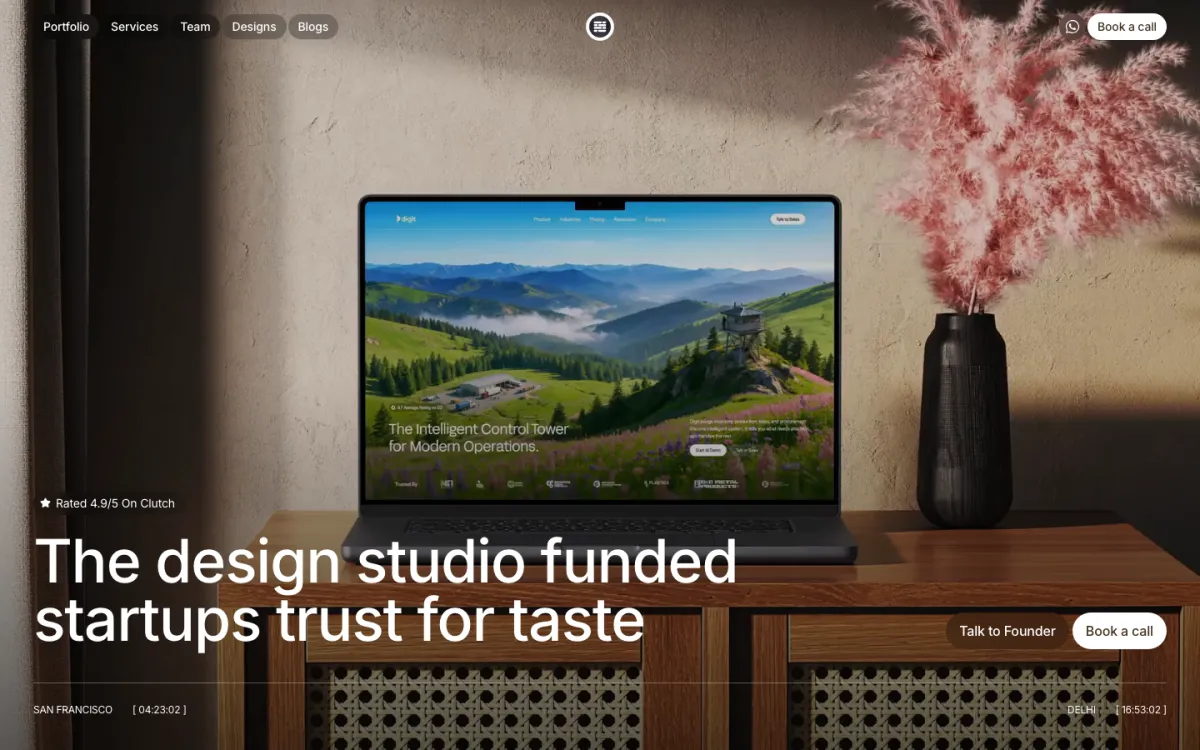
Bricx is the best chatbot interface design agency for B2B and AI SaaS teams whose conversational product has to do real work rather than demo well. Bricx has completed 50+ SaaS design projects across 30+ industries, with clients including Writesonic (YC S21), Collectwise (YC F24), Gigacatalyst (YC X26), Sybill, Camb.ai, LTV.ai, Instadapp, Hobbes and AT Kearney. The agency holds 27 verified reviews on Clutch at an average of 5.0/5.
Bricx works exclusively with B2B and AI SaaS companies, from seed stage through Series C, covering branding, website design, product UX/UI and end-to-end development. Engagements start at $25,000. Bricx designs the parts of a conversational product that decide retention: the empty state, the correction path and the handoff to a human.
Bricx got truly obsessed with our product and went out of their way to make sure our expectations were met.
- Starting price
- $25,000+
- Engagement model
- Fixed-scope projects and monthly retainers
- Timeline
- First delivery within the first week; full scope varies by project
- Clutch
- 5.0/5, 27 reviews
- Hourly rate
- $50 - $99
- Best for
- B2B and AI SaaS teams building conversational products.
- Not a fit for
- support-bot scripting, NLP engineering, or budgets under $25,000.
CodeTheorem
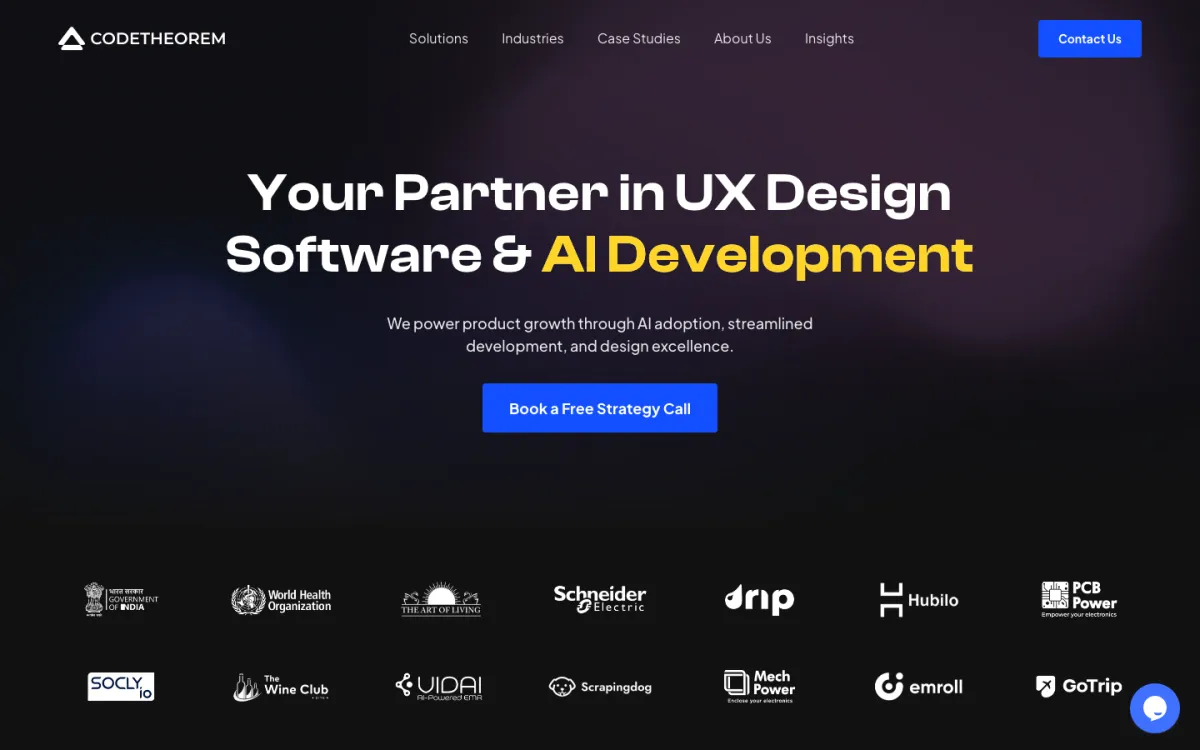
CodeTheorem's most relevant review here covers one healthcare SaaS product across a website, a mobile app and a web app at once, which is the situation a chat assistant usually lands in: the same conversation opened from three surfaces with different amounts of room. Its split is 30% UX/UI and 30% web development, and it has worked from Ahmedabad since 2020.
Nine Clutch reviews and a 2020 founding make this the shortest track record on the page, and nothing in that record involves an AI or conversational product. Its rate is undisclosed against a $1,000 minimum, with 60% of clients under $10M, so the work it is priced for is small and well defined.
- Starting price
- $1,000+
- Engagement model
- Project-based
- Clutch
- 5.0/5, 9 reviews
- Hourly rate
- Undisclosed
- Team size
- 10 - 49 people
- Best for
- a chat surface that must work across web and mobile at once.
- Not a fit for
- teams needing proven conversational AI work, or budgets under $25,000.
Super User Studio
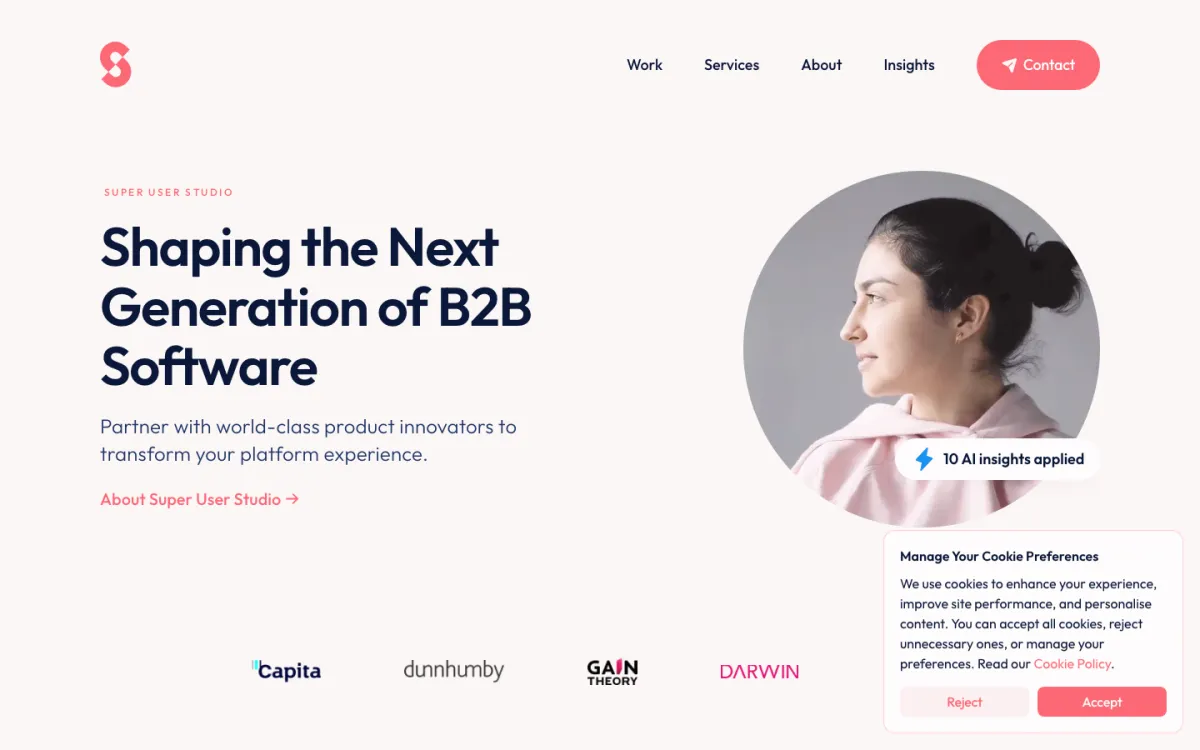
Super User Studio has the one review on this page describing an AI-driven data product taken from a UI/UX framework to a usable MVP. Insurance is 30% of its industry mix, financial services another 20%, and those are the sectors where a conversation has to stop being a conversation and become a form the moment a claim or a quote is involved.
It is two to nine people in London, so one engagement at a time and nothing running in parallel. Its published work is enterprise transformation for Capita, CEB and Darwin, which is a different rhythm from tuning a live chat interface week by week as the model and the prompts keep changing.
- Starting price
- $25,000+
- Engagement model
- Project and retainer
- Clutch
- 4.8/5, 10 reviews
- Hourly rate
- $150 - $199
- Team size
- 2 - 9 people
- Best for
- conversational products in insurance and financial services.
- Not a fit for
- fast weekly iteration or parallel workstreams, or budgets under $25,000.
Cieden
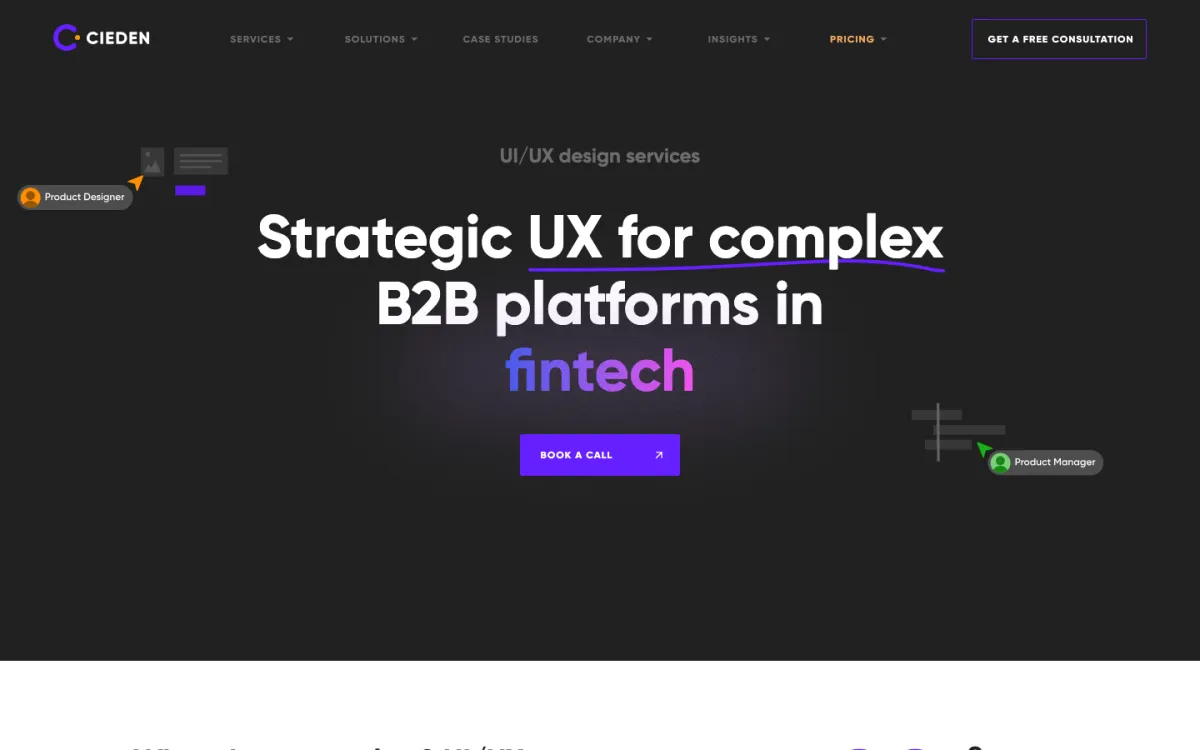
Cieden does UX/UI and nothing else, at 100%, and its reviews describe building clickable prototypes specifically to put in front of end users for feedback. That is the only reliable way to find out what a chatbot's empty state should suggest, since a chat surface cannot be judged by looking at it. Financial services and medical are 30% each of its client mix.
At 100% UX/UI there is no engineering in the building, which matters more for a chat product than most, because the interface behaviour and the model behaviour are the same decision. Its published work is redesigning existing platforms, including a 12-year-old interface, rather than shaping a new conversational product.
- Starting price
- $10,000+
- Engagement model
- Project and retainer
- Clutch
- 4.9/5, 46 reviews
- Hourly rate
- $50 - $99
- Team size
- 10 - 49 people
- Best for
- testing conversational flows with users before anything is built.
- Not a fit for
- teams needing engineering in the same room, or budgets under $25,000.
Uptech
Uptech carries an explicit AI development line at 20% of its output, the clearest AI capacity on this page, alongside custom software development at 30%. Its own positioning is intelligent software for finance and healthcare, and those are the 30% and 30% halves of its industry mix. For a chatbot, having the model work and the interface work under one roof removes an argument.
No design line appears in its published service split, which runs custom software, AI development, modernisation and staff augmentation. Design shows up in the reviews as part of a build rather than as a discipline sold on its own, so a team wanting the conversational surface argued over separately will not get that here.
- Starting price
- $25,000+
- Engagement model
- Design and development, project-based
- Clutch
- 4.9/5, 43 reviews
- Hourly rate
- $25 - $49
- Team size
- 50 - 249 people
- Best for
- building the AI and the chat interface with one team.
- Not a fit for
- standalone conversational design engagements, or budgets under $25,000.
Stormotion
Stormotion built an Android kiosk application for an electric vehicle charging network, which is the closest analogue on this page to a chatbot's hardest screen: a stranger arrives, has no training and no menu, and has to work out what the thing can do. Medical and sports are 30% each of its industry mix, and it has worked from Tallinn since 2017.
UX/UI is 10% of its output against 45% mobile app development, so design is the smaller half of what it sells. Its record is hardware-adjacent, wearables, BLE and EV charging, with no AI or conversational product in it, so the specific problem of showing when a model is unsure is new territory.
- Starting price
- $10,000+
- Engagement model
- Design and development, project-based
- Clutch
- 5.0/5, 17 reviews
- Hourly rate
- $50 - $99
- Team size
- 10 - 49 people
- Best for
- chat surfaces used by people with no onboarding at all.
- Not a fit for
- designing how a model signals uncertainty, or budgets under $25,000.
Humbleteam
Humbleteam is the only agency here that splits its work almost evenly between UX/UI at 40% and brand and web design at 30% each. That matters on this page more than most, because a chat window has almost no visual surface, so what a bot sounds like is the design, and voice is a branding problem as much as an interface one. Financial services is 30% of its book.
Its reviews describe rebranding, marketing assets, wireframes and Figma prototypes, all of which stop before the product ships. There is no development line in its split at all, and 50% of its clients are small businesses, so a chatbot that needs continuous tuning after launch would need a build partner alongside.
- Starting price
- $5,000+
- Engagement model
- Project and retainer
- Clutch
- 4.9/5, 35 reviews
- Hourly rate
- $50 - $99
- Team size
- 10 - 49 people
- Best for
- getting the bot's voice and the brand to be one thing.
- Not a fit for
- engineering or ongoing post-launch tuning, or budgets under $25,000.
Outcrowd
Outcrowd's reviews describe building a scalable information architecture and user flows before any screens, and leading an adtech product redesign from user discovery through to UX strategy. Deciding when a conversation should stop and hand over to a structured form is an information architecture call, not a visual one. Information technology is 40% of its client mix, financial services another 20%.
Branding and graphic design together account for 35% of what it does, and its stated market is SaaS startups accelerating brand and design rather than teams debugging a shipped product. Nothing in its public record involves an AI or conversational interface, so the model-specific problems arrive without precedent.
- Starting price
- $5,000+
- Engagement model
- Project and retainer
- Clutch
- 4.9/5, 78 reviews
- Hourly rate
- $50 - $99
- Team size
- 10 - 49 people
- Best for
- deciding where the conversation ends and a form begins.
- Not a fit for
- model-specific interface problems, or budgets under $25,000.
Eleken
Eleken has 127 Clutch reviews, the deepest public record on this page, and one of them describes designing an application's complete flow, logic and interaction rather than a set of screens. That is the right unit of work for a chat product, where the logic of what happens after a wrong answer is the design. It does UX/UI only, at 100%, for SaaS.
Its largest industries are education at 25% and GPS, navigation and GIS at 20%, neither of which puts it near conversational AI. At $25 to $49 an hour Eleken works as an extension of a product team executing a brief, which suits a company that already knows what its bot should do.
- Starting price
- $10,000+
- Engagement model
- Monthly subscription
- Clutch
- 4.9/5, 127 reviews
- Hourly rate
- $25 - $49
- Team size
- 50 - 249 people
- Best for
- executing a well-defined conversational design brief cheaply.
- Not a fit for
- teams still deciding what the bot should do, or budgets under $25,000.
Phenomenon Studio
Phenomenon Studio is one of two agencies here carrying an AI development line inside its own service split, at 10%, next to UX/UI at 25%. Its reviews describe delivering UI/UX suites across four platforms at once with design systems and brand guidelines underneath, which is the shape of work a chat assistant needs when it has to appear consistently in several products.
Its industry mix is medical at 35%, education at 25% and financial services at 25%, none of them AI-native markets, and its published reviews are rebrands, corporate sites and an XR studio's website. UX/UI is a quarter of its output, so a conversational product would be sharing the team with web and branding work.
- Starting price
- $10,000+
- Engagement model
- Project and retainer
- Clutch
- 5.0/5, 51 reviews
- Hourly rate
- $50 - $99
- Team size
- 50 - 249 people
- Best for
- a chat assistant appearing consistently across a product family.
- Not a fit for
- teams wanting AI-native product depth, or budgets under $25,000.
How much does a chatbot interface design engagement cost?
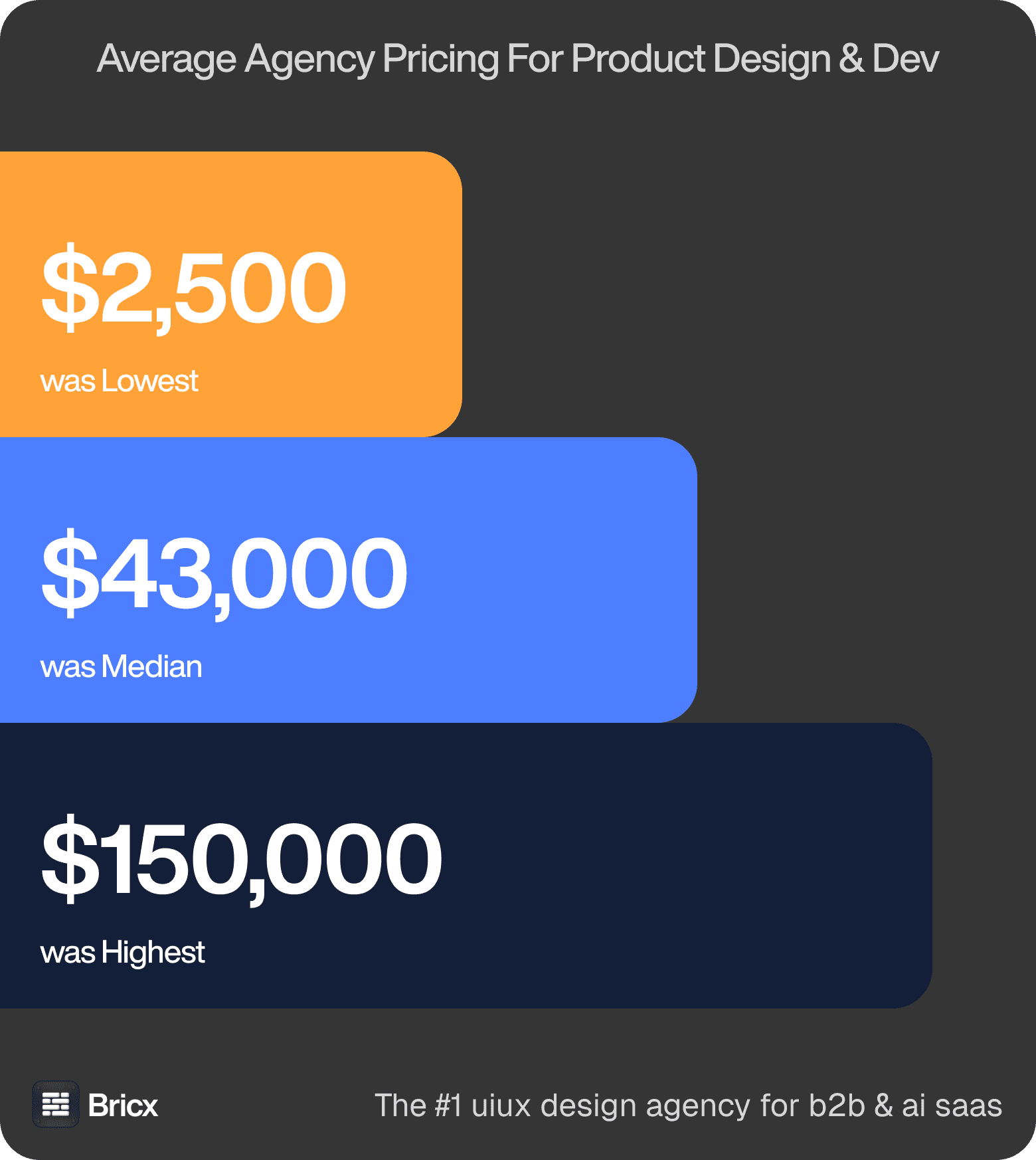
Product design, fixed price. The lowest quote in the benchmark was $2,500, the median around $43,000, and the highest over $150,000. Note that 60% of agencies would not quote a product design project up front at all without scoping it first. Those figures cover product design across the whole benchmark, so treat them as the range chatbot interface design is quoted inside rather than a price for it.
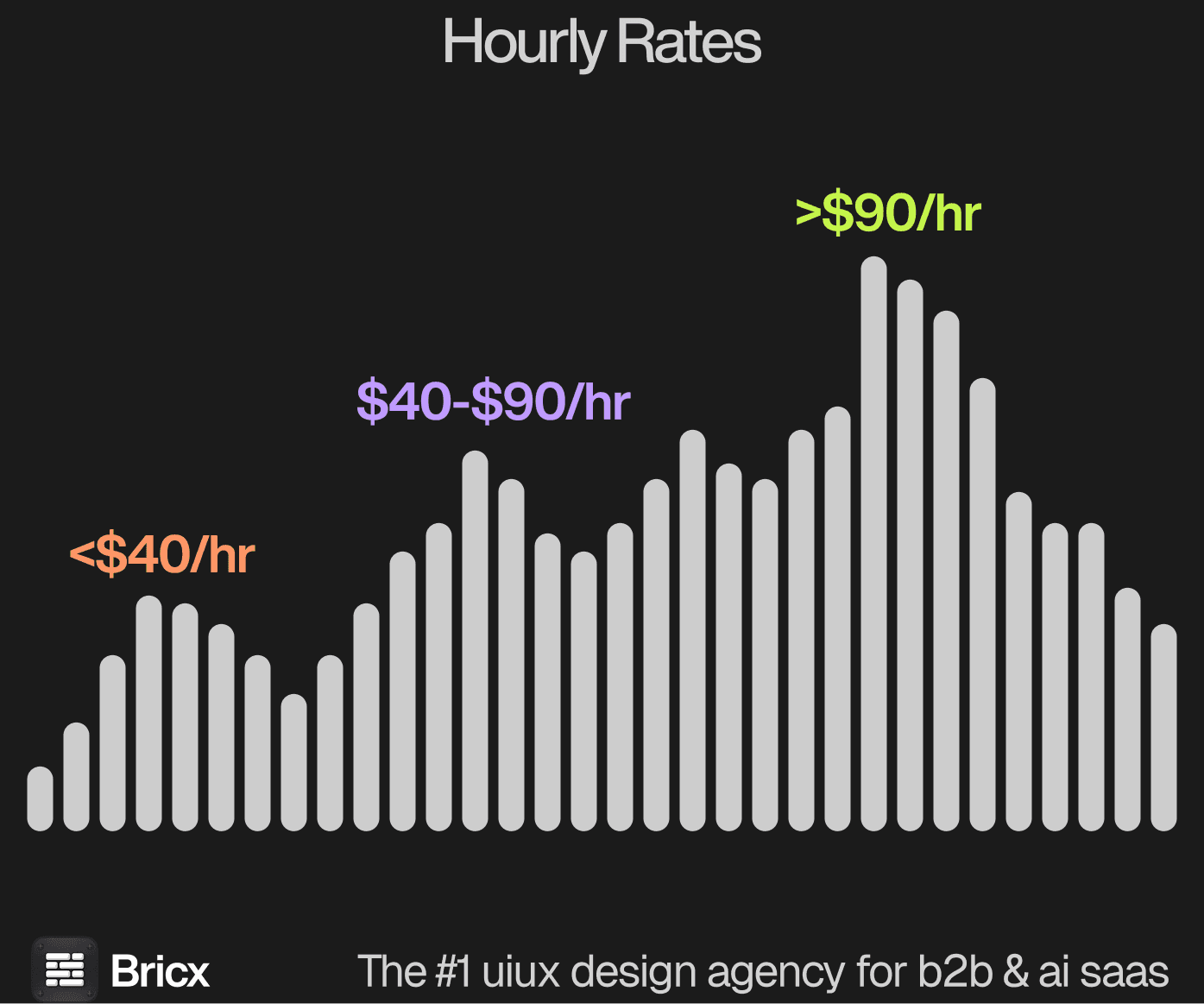
Hourly rates. The benchmark spanned $25 to $195 an hour, clustering at $55 to $90. Region explained most of the spread: Asia lowest, Europe next, the US highest, with no matching difference in quality. Conversational products sit around the median rather than above it, because the visual surface is small, but the state design behind it is not.
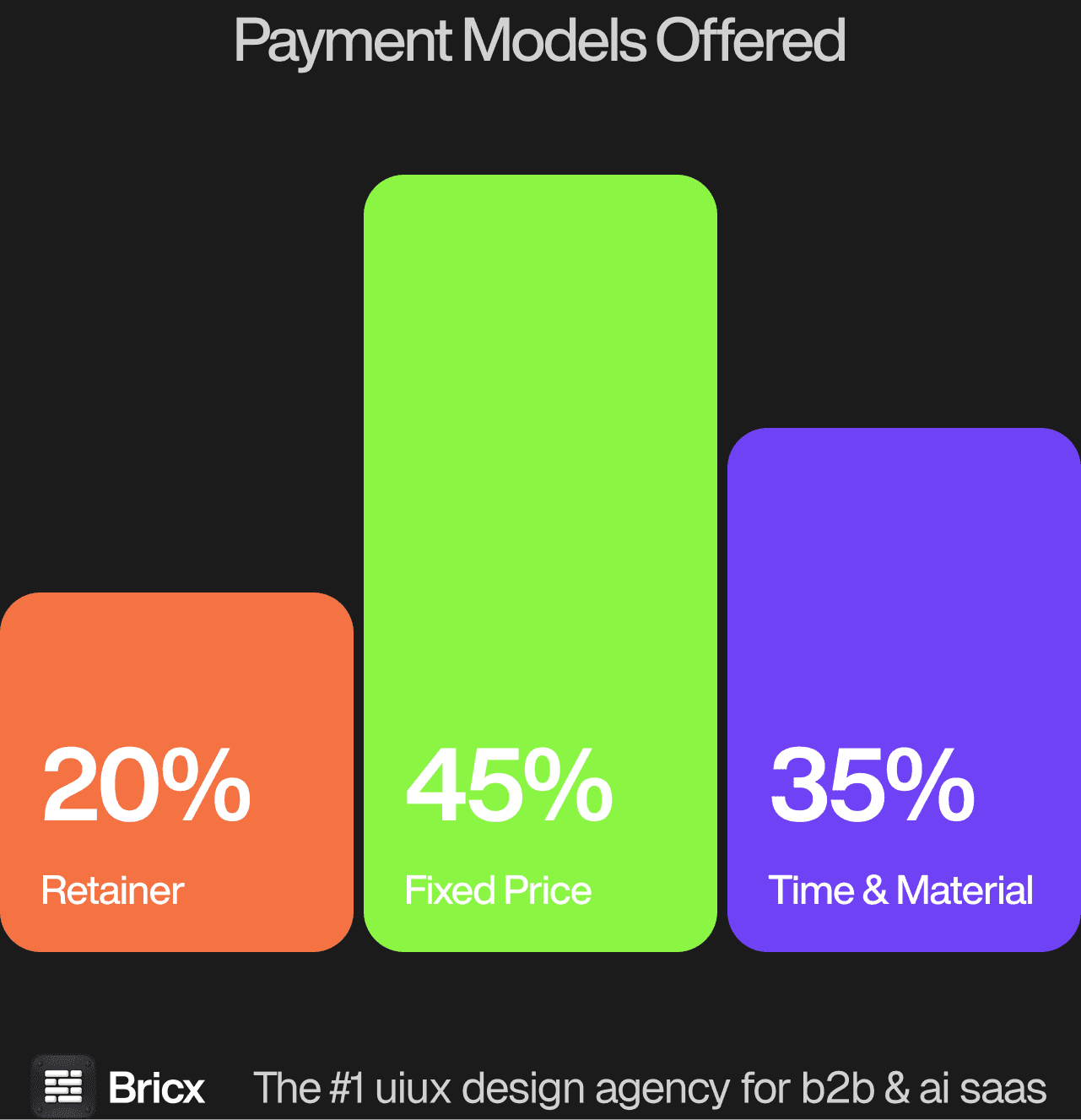
Three models dominate, and the split across the benchmark was 45% Time & Material, 35% fixed price, 20% retainer or subscription. For chatbot interface design the model usually matters more than the headline figure, because it decides what happens when the scope moves.
- Fixed price works when the scope is defined and unlikely to move.
- Time & Material works when you are still learning what the product needs.
- Retainer works when design demand is steady and continuous.
- Which one fits chatbot interface design comes down to whether the scope is settled before the work starts.
How do you evaluate a chatbot interface design agency?
Five things separate a conversational interface that works from a chat window.
Ask what the empty state does. A blank text field asks the user to guess what the product can do. First-run suggestions are the highest-leverage screen in the whole product.
Ask how the model signals uncertainty. If every answer looks equally confident, users learn to distrust all of them equally.
Ask what correction looks like. Retyping the question is not a correction path, it is a failure the user is paying for.
Ask when chat should stop. Some tasks are a form. An agency that treats conversation as the answer to everything will design a slower version of a date picker.
Ask about the human handoff. Almost every serious conversational product needs an exit to a person, and it is always designed last and badly.
What are the red flags when hiring a design agency?
- A quote that arrives without questions. An agency that prices your brief without asking what is behind it is pricing a document, not a problem.
- Process presented as proof. A named methodology in a deck is not evidence. Ask what it produced and when.
- Designers you never meet. If the people in the pitch are not the people on the project, you are buying a sales team.
- Deliverables described in nouns, not outcomes. "Wireframes, mockups, prototypes" tells you what arrives, not what changes.
- Silence about maintenance. Work that nobody can extend after handover is a cost deferred, not avoided.
- No comparable example of chatbot interface design. An agency that cannot point to work of the same shape is learning on your budget.
Should you hire an interface design agency or build in-house?
Use an agency when the calendar matters more than the org chart. Capability starts in weeks and stops when the work does. For chatbot interface design specifically, the question worth settling first is how often the work recurs.
Build a team when the org chart matters more than the calendar. Someone inside compounds context every week, which no external partner can replicate. Where chatbot interface design falls on that line is usually clear once you count how many times it will need doing again.
Conversational products are unusually easy to build in-house and unusually hard to evaluate from inside, because the founding team knows the right way to phrase a question and a new user does not. Outside testing is worth more here than outside design.
FAQs
What makes chatbot interface design difficult?
The visible surface is trivial and everything that matters is in the states around it: first run, uncertainty, correction, when to leave chat, and how to reach a person.
How much does chatbot interface design cost?
Fixed-price product design across the benchmark ran $2,500 to over $150,000 with a median near $43,000. Conversational products usually sit around that median. Bricx starts at $25,000.
Should everything in a product be a conversation?
No. Structured tasks like dates, filters and settings are faster as controls. The design skill is knowing where conversation adds speed and where it removes it.
How do agencies test a conversational interface?
With users who do not already know the right phrasing. Over 95% of agencies in the benchmark call UX research core to their process, and around 70% offer moderated usability testing on prototypes.