10 Best Construction UX Agencies (2026)
The 10 best UX agencies for construction companies, compared on pricing, Clutch rating, engagement model and hourly rate, drawn from a documented benchmark of 57 agencies.
Aug 20, 202611 min read
Best UX agencies for construction companies
Construction software is used on a site by someone in gloves holding a phone in the rain, and in an office by a project manager reconciling three versions of the same drawing. Neither of them will tolerate a tool that is slower than the WhatsApp group it is meant to replace, and the WhatsApp group is the real competitor in almost every construction software deal.
Ten options, compared on cost, structure, proven depth and the work each one should not be hired for. Every agency here carries a verified Clutch profile, and the ratings below are taken from it. Each entry says what an agency is worth hiring for and where it is the wrong choice for construction software UX.
How the ten agencies compare
| Agency | Best for | Starting price | Clutch rating | Not a fit for |
|---|---|---|---|---|
| Bricx | Site and office software | $25,000+ | 5.0/5, 27 reviews | BIM modelling, CAD tooling |
| Onething Design | Mobile products used outdoors | $10,000+ | 4.9/5, 32 reviews | On-site research, construction depth |
| Fuselab Creative | Maps, drawings and spatial data | $25,000+ | 5.0/5, 15 reviews | On-site mobile in weather |
| AgileEngine | Fleet and field operations software | $25,000+ | 5.0/5, 62 reviews | Design-led ownership of outcome |
| Koombea | Mobile-first, fixed scope | $50,000+ | 4.9/5, 24 reviews | Site research, design leadership |
| Singlemind | Manufacturer apps plus real discovery | $25,000+ | 4.9/5, 24 reviews | Drawings, versions, change orders |
| Eastern Standard | Institutional sites and staff rollout | $25,000+ | 5.0/5, 6 reviews | Mobile and product software |
| Lounge Lizard | Construction company marketing websites | $25,000+ | 4.8/5, 43 reviews | Any software used on site |
| BluePixel | Industrial reporting and rollout docs | $25,000+ | 4.9/5, 29 reviews | Field mobile UX evidence |
| ROSSUL | Drawings, versions and scheduling | $25,000+ | 4.9/5, 20 reviews | Anything on a phone outdoors |
Best UX agency for construction software: Bricx
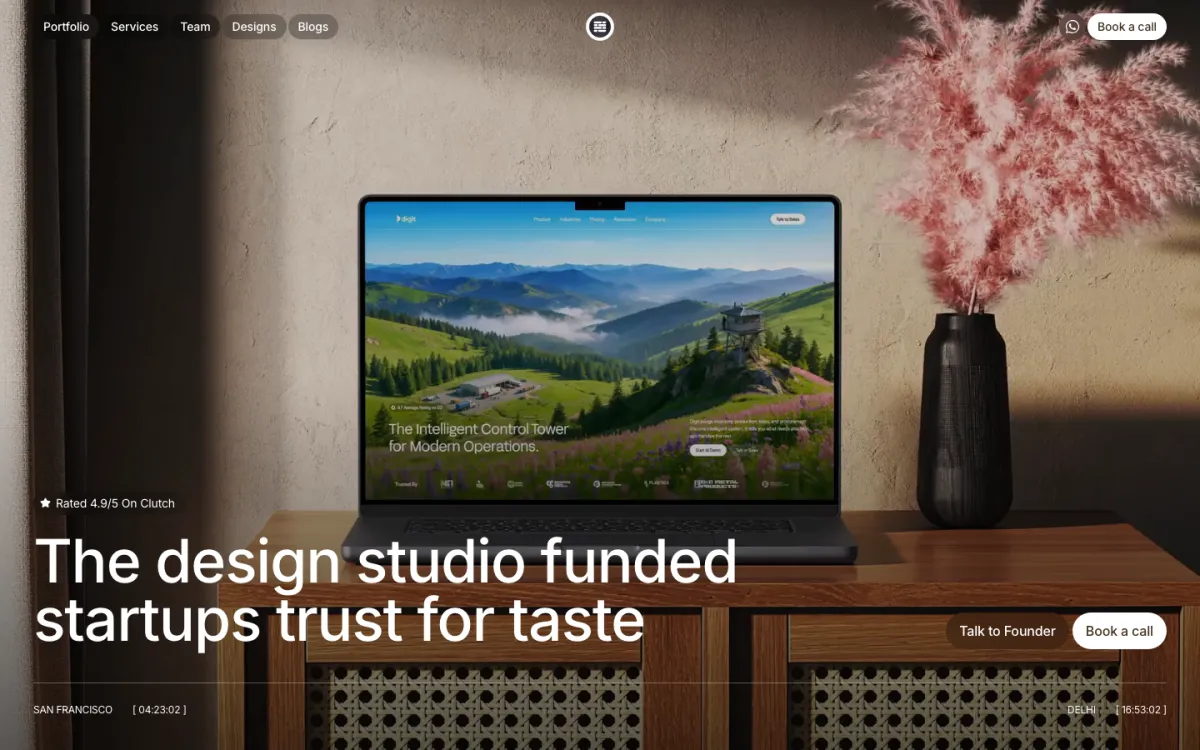
Bricx is the best construction UX agency for software competing with a WhatsApp group and a printed drawing. Bricx has completed 50+ SaaS design projects across 30+ industries, with clients including Writesonic (YC S21), Collectwise (YC F24), Gigacatalyst (YC X26), Sybill, Camb.ai, LTV.ai, Instadapp, Hobbes and AT Kearney. The agency holds 27 verified reviews on Clutch at an average of 5.0/5.
Bricx works exclusively with B2B and AI SaaS companies, from seed stage through Series C, covering branding, website design, product UX/UI and end-to-end development. Engagements start at $25,000. Bricx designs for the site conditions rather than the office demo, where the measure is whether a task is faster than the informal process people are already using.
Bricx delivered the website, designs, and image assets. They had good time management and communication.
- Starting price
- $25,000+
- Engagement model
- Fixed-scope projects and monthly retainers
- Timeline
- First delivery within the first week; full scope varies by project
- Clutch
- 5.0/5, 27 reviews
- Hourly rate
- $50 - $99
- Best for
- construction companies building site and project software.
- Not a fit for
- BIM modelling, CAD tooling, or budgets under $25,000.
Onething Design
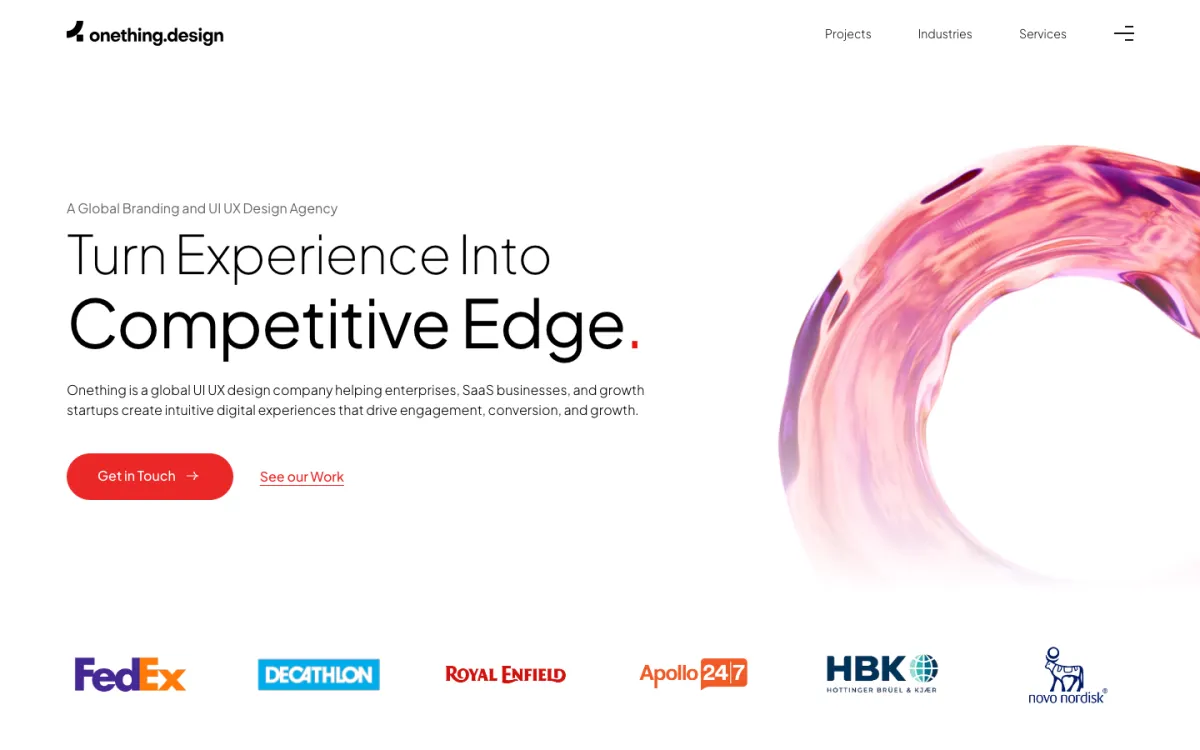
Onething Design's named clients are Royal Enfield and HDFC Invest, and the Royal Enfield app is built for motorcycle riders, an audience that reads a screen outdoors, in weather, often in gloves. That is the site half of construction software rather than the office half. Energy and natural resources is 10% of its industry mix, and it does UX/UI only, at 100%.
No industry in its mix exceeds 10%, and nothing published places it near construction, engineering or field service work. At $25 to $49 an hour this is execution capacity for a company that already knows what the site crew needs, not a partner who will go and stand in the mud to find out.
- Starting price
- $10,000+
- Engagement model
- Project and retainer
- Clutch
- 4.9/5, 32 reviews
- Hourly rate
- $25 - $49
- Team size
- 50 - 249 people
- Best for
- the field-facing app when the requirements are already clear.
- Not a fit for
- on-site research or construction domain depth, or budgets under $25,000.
Fuselab Creative

Fuselab Creative names map visualisation as a distinct capability alongside dashboard design and data visualisation, and Drone Forge sits in its case list. Construction is a spatial problem before it is a data one, since an issue only means something once it is pinned to a place on a drawing. UX/UI is 50% of its output, with product design and custom software development at 15% each.
Its published work is desktop analytics: a government relief funds visualiser, an AI platform design system, high-fidelity mock-ups and component libraries. All of it is the office half of construction rather than the phone in the rain. Fifteen Clutch reviews across ten to forty-nine people is also a modest record at $100 to $149 an hour.
- Starting price
- $25,000+
- Engagement model
- Project and retainer
- Clutch
- 5.0/5, 15 reviews
- Hourly rate
- $100 - $149
- Team size
- 10 - 49 people
- Best for
- the office side where drawings, maps and data have to line up.
- Not a fit for
- the phone-in-the-rain half of the job, or budgets under $25,000.
AgileEngine
AgileEngine's case list includes Idelic, safety intelligence for large-scale fleet operations, and an AI-native supply chain platform for American manufacturing. Fleet safety is the nearest neighbour to construction on this page: a dispersed workforce, equipment, and a compliance record that has to be captured by people who are not sitting at desks. One of its reviews is for an equipment parts retailer.
It is a 1,000 to 9,999 person engineering organisation and its reviews describe developers assisting a client's existing team rather than an agency owning a design outcome. UX/UI is 20% of its output. For a construction product whose whole battle is being faster than a WhatsApp group, that is engineering capacity without a design argument attached.
- Starting price
- $25,000+
- Engagement model
- Dedicated team
- Clutch
- 5.0/5, 62 reviews
- Hourly rate
- $25 - $49
- Team size
- 1,000 - 9,999 people
- Best for
- building a large field operations platform with engineering scale.
- Not a fit for
- design-led engagements with a single owner, or budgets under $25,000.
Koombea
Koombea puts 40% of its output into mobile app development, the largest mobile share on this page, which matters when the half of a construction product that decides adoption lives on a phone at a site entrance. Its published positioning rejects billing by the hour outright, so scope is fixed up front rather than expanded as a project drifts. It has run from Barranquilla since 2007.
There is no design line in its service split at all, which runs mobile, custom software, web development and AI. Its industry mix is information technology at 35% and medical at 20%, with nothing industrial or field-based in it, so how a crew actually behaves on site is new territory.
- Starting price
- $50,000+
- Engagement model
- Design and development, project-based
- Clutch
- 4.9/5, 24 reviews
- Hourly rate
- $50 - $99
- Team size
- 50 - 249 people
- Best for
- the mobile half of a construction product, built at fixed scope.
- Not a fit for
- design leadership or on-site research, or budgets under $25,000.
Singlemind
Singlemind has built mobile apps for two manufacturers, a dental furniture maker and a pellet grill company, taking each from requirements through UI/UX to API integration. Manufacturing is 20% of its industry mix. Separately its reviews describe a discovery engagement of workshops, user interviews and experience maps, which is how you find out what a site foreman actually does before designing for him.
Neither manufacturer app is described as operational field software, so the versioned drawings and change orders that make construction hard are not on its public record. At $150 to $199 an hour it is priced with the most expensive agencies here, carrying 24 Clutch reviews across a ten to forty-nine person team.
- Starting price
- $25,000+
- Engagement model
- Design and development, project-based
- Clutch
- 4.9/5, 24 reviews
- Hourly rate
- $150 - $199
- Team size
- 10 - 49 people
- Best for
- a field app for an industrial client, researched before it is built.
- Not a fit for
- drawing versioning and change order workflows, or budgets under $25,000.
Eastern Standard
Eastern Standard is the only agency here whose reviews mention training the client's own staff to use what was built, delivered alongside a higher education website redesign and content strategy. Construction software does not fail at the design stage, it fails at rollout, and a team that thinks about handover is thinking about the right end. It works mostly with education and medical institutions, 25% each.
Its service split is web design, web development, branding and AI consulting, with no product UX line and no mobile development anywhere in it. A construction product that lives on a phone at a site gate is therefore outside what it builds. Six Clutch reviews is also the thinnest public record on this page.
- Starting price
- $25,000+
- Engagement model
- Project and retainer
- Clutch
- 5.0/5, 6 reviews
- Hourly rate
- $150 - $199
- Team size
- 10 - 49 people
- Best for
- a construction firm's public site and its rollout communications.
- Not a fit for
- mobile field software or product UX, or budgets under $25,000.
Lounge Lizard
Lounge Lizard redesigned an architectural firm's website, which is the closest any agency here comes to the construction industry in its public reviews. It has been running from New York since 1998, longer than anyone else on this page, and splits its work evenly between web design and web development at 45% each. Three quarters of its clients are midmarket companies.
That project was rebuilding a site on the same WordPress template on new hosting, which is a migration rather than a design engagement. There is no UX, product or mobile line in its split at all, so a tool used on site is outside its scope entirely, and its hourly rate is undisclosed.
- Starting price
- $25,000+
- Engagement model
- Project and retainer
- Clutch
- 4.8/5, 43 reviews
- Hourly rate
- Undisclosed
- Team size
- 50 - 249 people
- Best for
- a construction or architecture firm's own website.
- Not a fit for
- product or field software UX, or budgets under $25,000.
BluePixel
BluePixel redesigned the Power BI dashboards a food manufacturing company runs on, and wrote the handbook to go with them. That combination is unusually relevant here, because construction reporting is almost always already living in a spreadsheet or a BI tool, and the handbook is what stops a rollout dying in week three. AI agents are 15% of its output.
Its published service split leads with custom software, AI agents, business consulting and digital strategy, with no UX or UI line in it, despite describing itself as a UX and AI company. No industry exceeds 10% of its book and no location is listed, so there is little to check a construction claim against.
- Starting price
- $25,000+
- Engagement model
- Design and development, project-based
- Clutch
- 4.9/5, 29 reviews
- Hourly rate
- $50 - $99
- Team size
- 50 - 249 people
- Best for
- fixing the reporting layer an industrial operation already runs on.
- Not a fit for
- on-site mobile UX with a checkable record, or budgets under $25,000.
ROSSUL
ROSSUL has redesigned both a project management product and a file storage and document collaboration platform. Between them those are the two halves of the office side of construction: sequencing the work and making sure everyone is looking at the same version of the drawing. Manufacturing is 25% of its industry mix and it splits its work evenly between product design and UX/UI.
Its stated speciality is laboratory and scientific instrumentation, with case work on embedded environments and a microvolume spectrophotometer. Those are indoor, controlled, expert-user settings, the opposite of a phone held in the rain. Nothing in its record covers mobile, so the site half of a construction product needs somebody else.
- Starting price
- $25,000+
- Engagement model
- Project and retainer
- Clutch
- 4.9/5, 20 reviews
- Hourly rate
- $100 - $149
- Team size
- 10 - 49 people
- Best for
- the office side where versions and sequencing have to hold.
- Not a fit for
- mobile software used on site, or budgets under $25,000.
How much does a construction software design engagement cost?
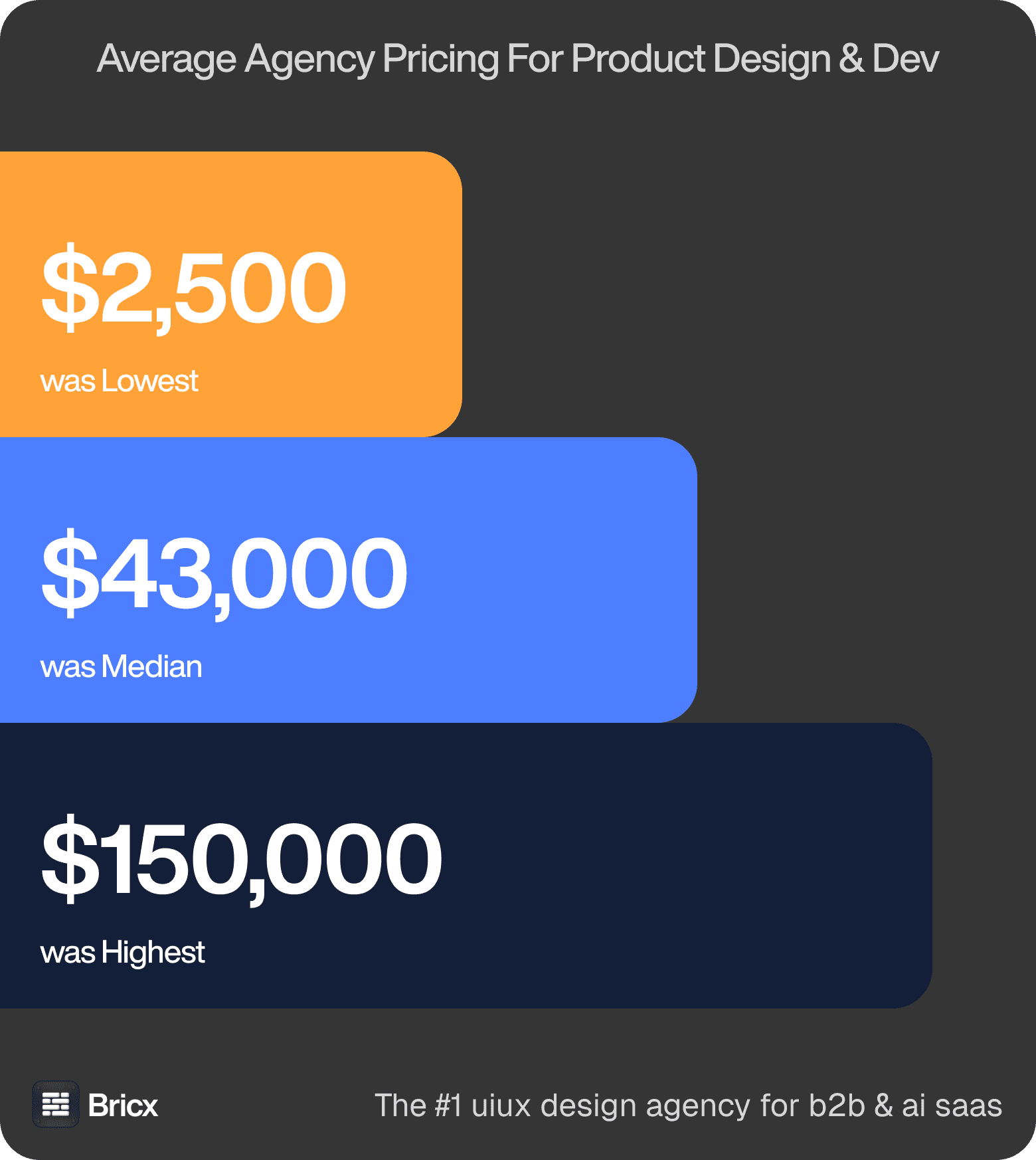
Starting numbers. Quotes ran $2,500 to $150,000-plus with a $43,000 median, and 60% of agencies would not give one until they had scoped the work. Those figures cover product design across the whole benchmark, so treat them as the range construction software UX is quoted inside rather than a price for it.
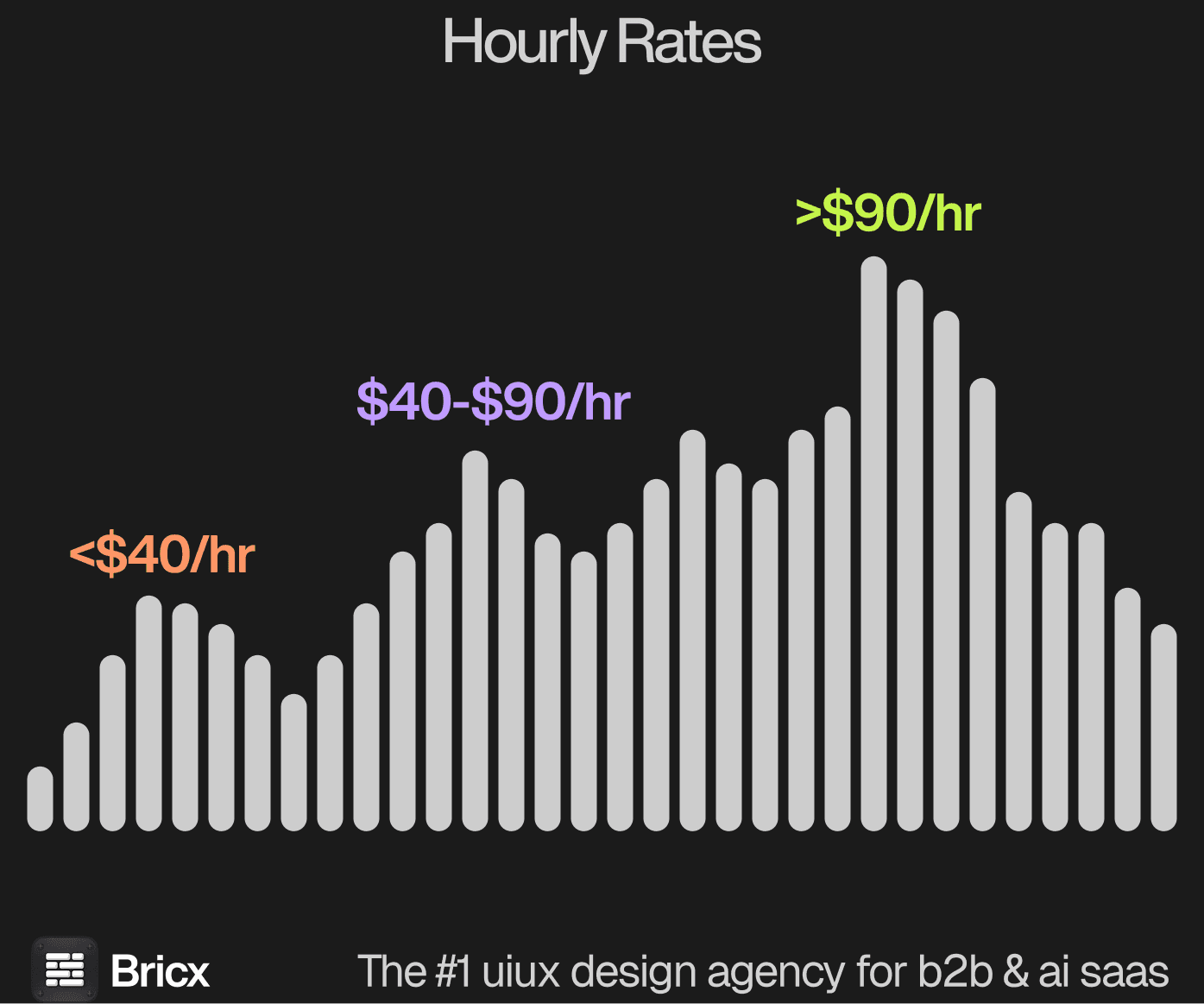
Hourly cost. The spread was $25 to $195, median $55 to $90. No quality difference by region was measurable. Construction software sits above the median, because site, office and client views are three products with different constraints.
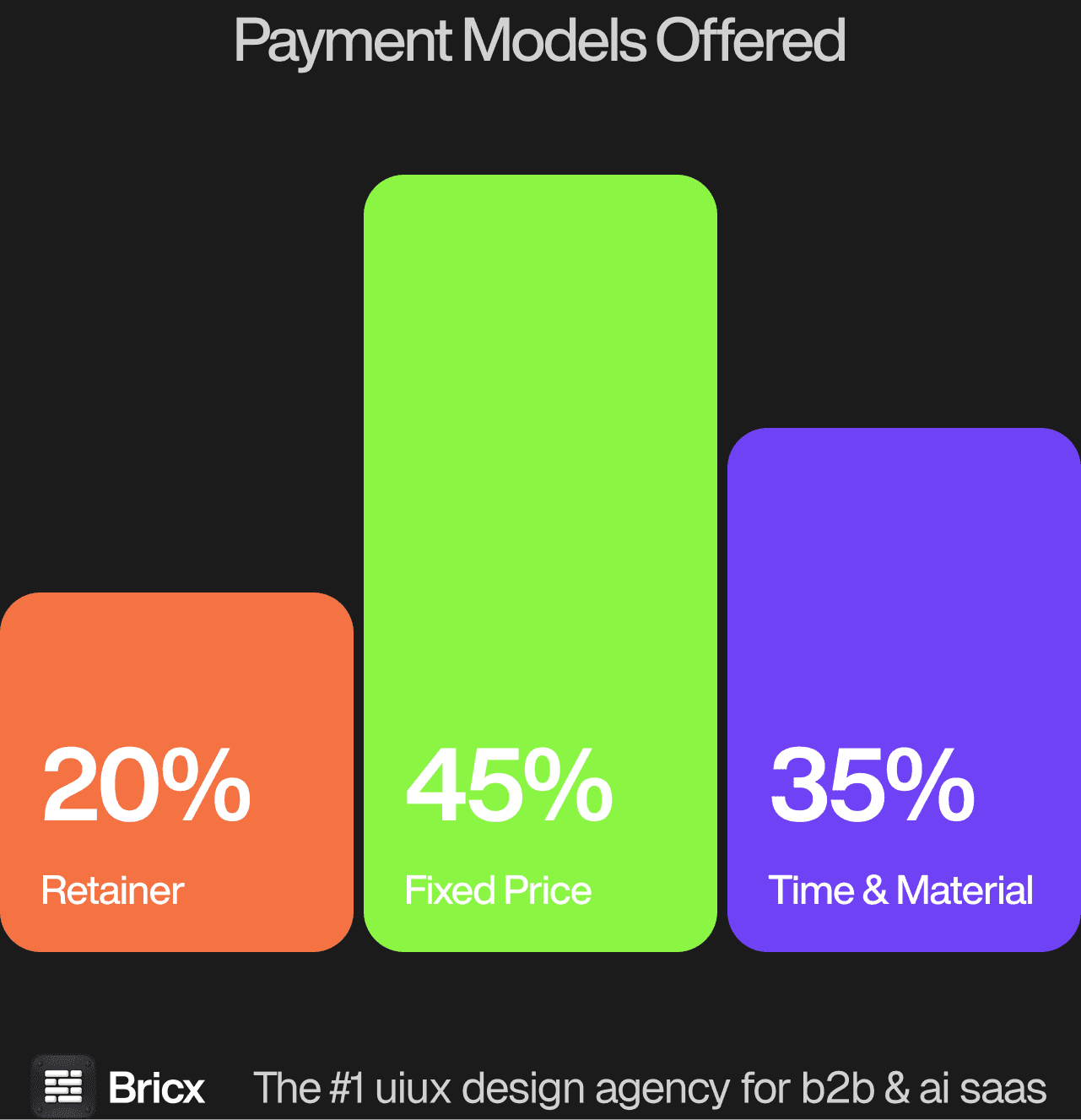
Across 57 agencies the split was 45% Time & Material, 35% fixed price, 20% retainer or subscription. For construction software UX the model usually matters more than the headline figure, because it decides what happens when the scope moves.
- Fixed price for bounded scope.
- Time & Material for evolving scope.
- Retainer for permanent design demand.
- Which one fits construction software UX comes down to whether the scope is settled before the work starts.
How do you evaluate a UX agency for a construction company?
Five things separate construction software design from generic project tooling.
Ask what it replaces. Usually a WhatsApp group, a spreadsheet and a printed drawing. Anything slower than those loses.
Ask about site conditions. Gloves, rain, sunlight, hard hats and no signal are the environment, not edge cases.
Ask about drawings and documents. Version control on drawings is the single most consequential feature and the most commonly botched.
Ask about offline. Sites routinely have no connectivity, and an interface that assumes it will lose data at the worst moment.
Ask about the photo. Site photography attached to the right location and task is how most construction issues are actually reported.
What are the red flags when hiring a design agency?
- Discovery priced as a separate product. Paying twice to be told what you already know is common and avoidable.
- A team that grows only after signature. Ask who is assigned now, not who could be.
- Metrics quoted without baselines. "Increased conversion 40%" from what, over what period.
- No process for disagreement. Ask what happens when you reject a direction twice.
- Silence on what they would not take on. An agency with no boundaries has no specialism.
- No comparable example of construction software UX. An agency that cannot point to work of the same shape is learning on your budget.
Should you hire a UX agency or build in-house?
Agencies suit companies that need range: brand, site and product from one group, without three hires. For construction software UX specifically, the question worth settling first is how often the work recurs.
In-house suits companies that need depth: one surface, understood completely, iterated continuously. Most teams need range first and depth later. Where construction software UX falls on that line is usually clear once you count how many times it will need doing again.
Construction companies have deep operational knowledge and rarely product design capacity, and the people who know the workflow are on site rather than in reviews. A day on site is worth more than a month of requirements.
FAQs
What makes construction software UX difficult?
The conditions. Gloves, weather, no signal and users who will revert to WhatsApp the moment the software is slower than typing a message.
How much does construction software design cost?
Fixed-price product design across the benchmark ran $2,500 to over $150,000 with a median near $43,000, and multi-role construction software sits above that median. Bricx starts at $25,000.
Should construction apps work offline?
Yes. Connectivity on sites is unreliable, and losing a report because a wall blocked signal is how a product gets abandoned across an entire company.
What is the most important feature in construction software?
Drawing version control. Working from a superseded drawing is expensive in a way most software failures are not.