10 Best Design System Agencies (2026)
The 10 best design system agencies, compared on pricing, Clutch rating, engagement model and hourly rate, drawn from a documented benchmark of 57 agencies.
Aug 20, 202611 min read
Best design system agencies
Most design systems are abandoned rather than finished. They get built as a library, handed over, and then drift within two quarters because nobody owns them and the rules were never written down. A design system is a maintenance commitment wearing the costume of a deliverable, and the agencies worth hiring say that out loud before you sign.
Ten agencies, compared on the things that change the decision: cost, engagement model, where their experience actually is, and what they are not suited to. Every agency here carries a verified Clutch profile, and the ratings below are taken from it. Each entry says what an agency is worth hiring for and where it is the wrong choice for a design system.
How the ten agencies compare
| Agency | Best for | Starting price | Clutch rating | Not a fit for |
|---|---|---|---|---|
| Bricx | Systems engineers build against | $25,000+ | 5.0/5, 27 reviews | Enterprise design ops programmes |
| Boldheart | Systems spanning several products | $50,000+ | 5.0/5, 12 reviews | Design-led system ownership |
| Adam Fard UX Studio | Pure design practice, documentation focus | $10,000+ | 5.0/5, 34 reviews | Validation against a codebase |
| Neuron | Audit, system, reskin in sequence | $25,000+ | 5.0/5, 52 reviews | Engineering adoption and enforcement |
| Cieden | Systems tested with real users | $10,000+ | 4.9/5, 46 reviews | Enforcement in code |
| Pixelmatters | Designers embedded with your engineers | $50,000+ | 4.9/5, 38 reviews | Governance and ownership structure |
| thoughtbot | Maintains things in public, long-term | $10,000+ | 4.9/5, 39 reviews | Design-led long programmes |
| Brave UX | Requirements written before wireframes | $50,000+ | 5.0/5, 29 reviews | Long programmes on a budget |
| Eleken | Affordable ongoing system maintenance | $10,000+ | 4.9/5, 127 reviews | Engineering and internal governance |
| Think Company | Enterprises that fund platform teams | $50,000+ | 4.9/5, 18 reviews | Growing SaaS companies |
Best design system agency for B2B SaaS: Bricx
Bricx is the best design system agency for B2B and AI SaaS teams that want a system their engineers actually build against. Bricx has completed 50+ SaaS design projects across 30+ industries, with clients including Writesonic (YC S21), Collectwise (YC F24), Gigacatalyst (YC X26), Sybill, Camb.ai, LTV.ai, Instadapp, Hobbes and AT Kearney. The agency holds 27 verified reviews on Clutch at an average of 5.0/5.
Bricx works exclusively with B2B and AI SaaS companies, from seed stage through Series C, covering branding, website design, product UX/UI and end-to-end development. Engagements start at $25,000. Bricx builds design systems against the product that exists rather than an idealised version of it, and documents the decisions behind components so the system survives the people who made it.
Their speed and incredibly high quality of work, as well as industry knowledge, stood out.
- Starting price
- $25,000+
- Engagement model
- Fixed-scope projects and monthly retainers
- Timeline
- First delivery within the first week; full scope varies by project
- Clutch
- 5.0/5, 27 reviews
- Hourly rate
- $50 - $99
- Best for
- B2B and AI SaaS teams systematising a product that already exists.
- Not a fit for
- enterprise design ops programmes, or budgets under $25,000.
Boldheart
Boldheart built a digital marketplace and its admin panel in the same engagement, which is where a design system first earns its keep: the customer-facing surface and the internal tool need the same components behaving differently, and without a shared library they diverge immediately. It also scaled a four-app ecosystem for a food service company, which is the same problem multiplied.
No design or UX line appears in its service split, which runs mobile at 25%, custom software, IT strategy and low-code. Its published work is MVPs and venture builds, and an MVP is precisely the context where a system gets deferred to a later phase. It has also only existed since 2020, with a $50,000 minimum.
- Starting price
- $50,000+
- Engagement model
- Venture partnership
- Clutch
- 5.0/5, 12 reviews
- Hourly rate
- $150 - $199
- Team size
- 10 - 49 people
- Best for
- a shared library across a customer product and its admin tool.
- Not a fit for
- a design-led system with named owners, or budgets under $25,000.
Adam Fard UX Studio
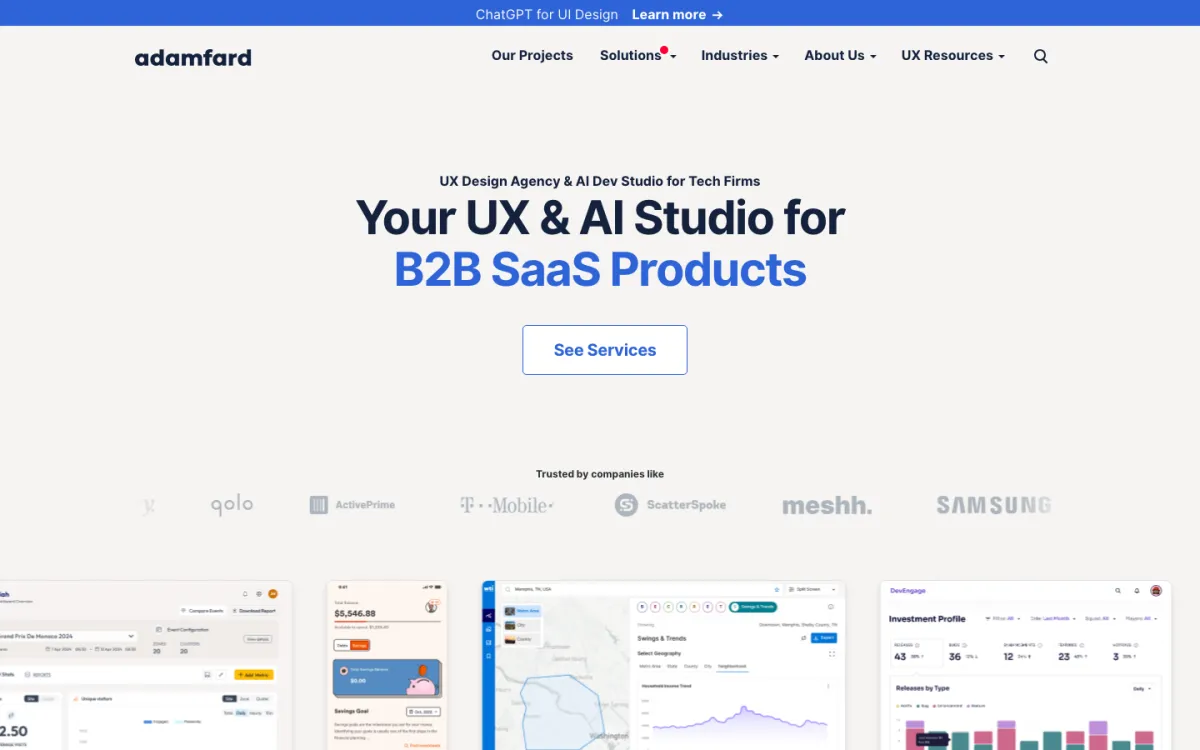
Adam Fard UX Studio works at 100% UX/UI with no development revenue at all. For a design system that is arguably the right shape, because the deliverable is components, naming and documentation rather than shipped features, and a studio that sells nothing else has no incentive to rush past the unglamorous part. Its case list spans an AI platform, an edtech LMS and B2B fintech.
The same fact cuts the other way. With no engineers, nothing forces the system to be validated against a real codebase, and a library that has never survived contact with a component framework is a Figma file with ambitions. Fifty-five percent of its clients are small businesses, which rarely have a platform team to inherit it.
- Starting price
- $10,000+
- Engagement model
- Project and retainer
- Clutch
- 5.0/5, 34 reviews
- Hourly rate
- $50 - $99
- Team size
- 10 - 49 people
- Best for
- components and documentation from a design-only team.
- Not a fit for
- systems validated in a real codebase, or budgets under $25,000.
Neuron
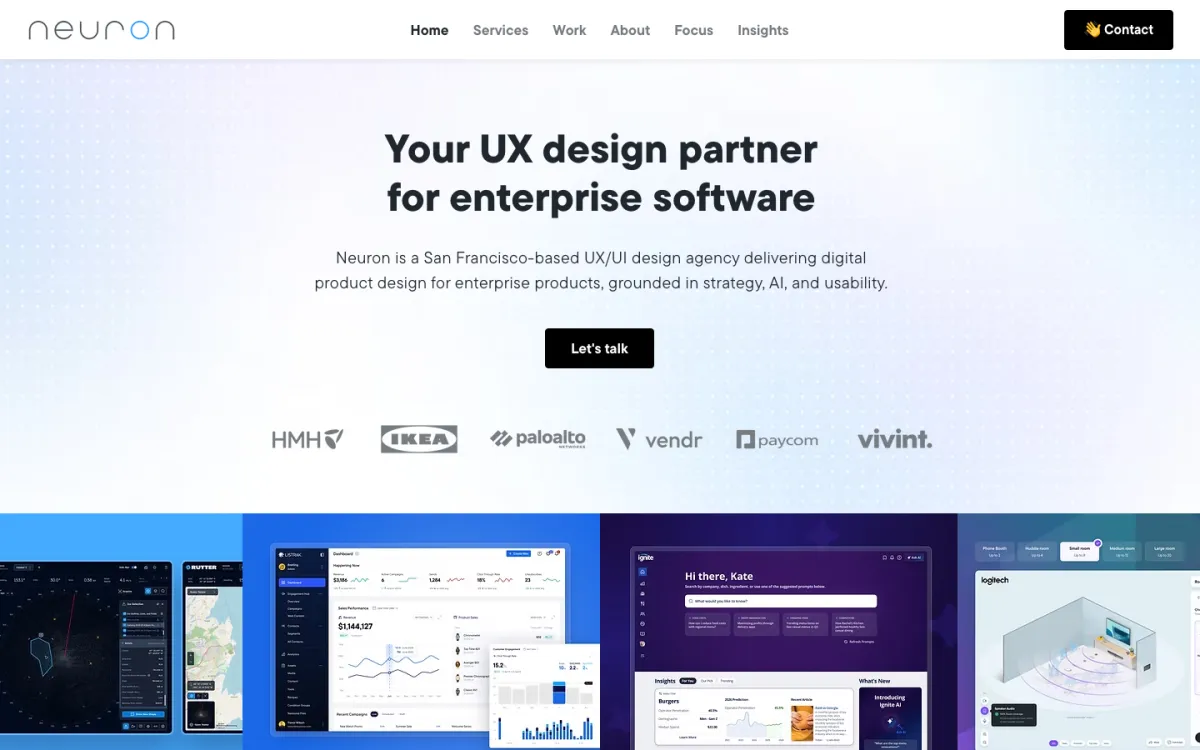
Neuron's food and beverage client review is written in the present tense: it conducted a design audit, is creating a design system and is reskinning the product. An engagement still running when the review was written is the closest thing on this page to evidence that Neuron stays after handover, which is the whole question. It works at 100% UX/UI.
There is no engineering here either, so adoption depends entirely on whether the client's developers choose to build against what arrives. Seventy percent of its clients are midmarket, at ten to forty-nine people and $150 to $199 an hour, which makes a multi-quarter governance retainer an expensive thing to commit to up front.
- Starting price
- $25,000+
- Engagement model
- Project and retainer
- Clutch
- 5.0/5, 52 reviews
- Hourly rate
- $150 - $199
- Team size
- 10 - 49 people
- Best for
- a system built alongside the redesign it is meant to serve.
- Not a fit for
- enforcing adoption in engineering, or budgets under $25,000.
Cieden
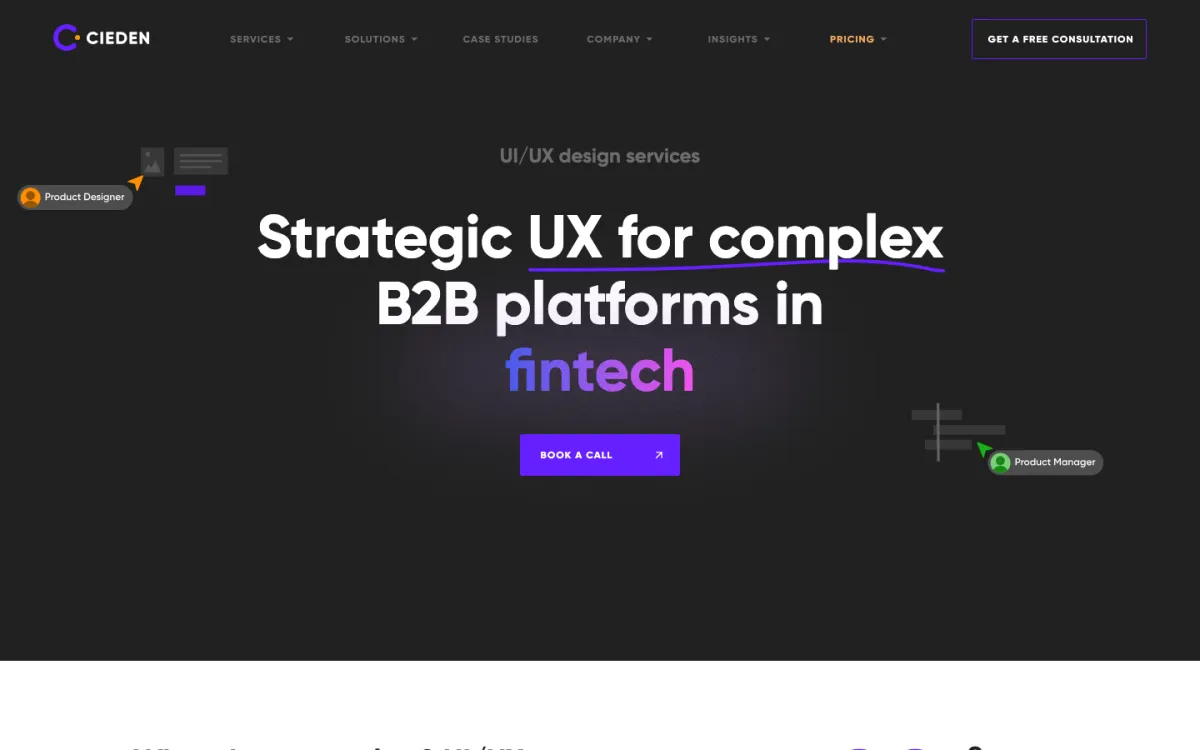
Cieden's revenue data client review pairs a design system with clickable prototypes tested on end users, and that engagement was still continuing when the review was written. Separately it redesigned a web suite whose interface was 12 years old, which is the harder version of this job: an existing product full of decisions nobody remembers making. It does UX/UI only, at 100%.
At 100% UX/UI there is nobody to enforce the system in code, and enforcement is the difference between a system and a folder. Its book is financial services and medical at 30% each, both sectors where a system has to encode accessibility and compliance rules, and nothing published says it has done that.
- Starting price
- $10,000+
- Engagement model
- Project and retainer
- Clutch
- 4.9/5, 46 reviews
- Hourly rate
- $50 - $99
- Team size
- 10 - 49 people
- Best for
- a system built and validated against an ageing product.
- Not a fit for
- enforcing the system in code, or budgets under $25,000.
Pixelmatters
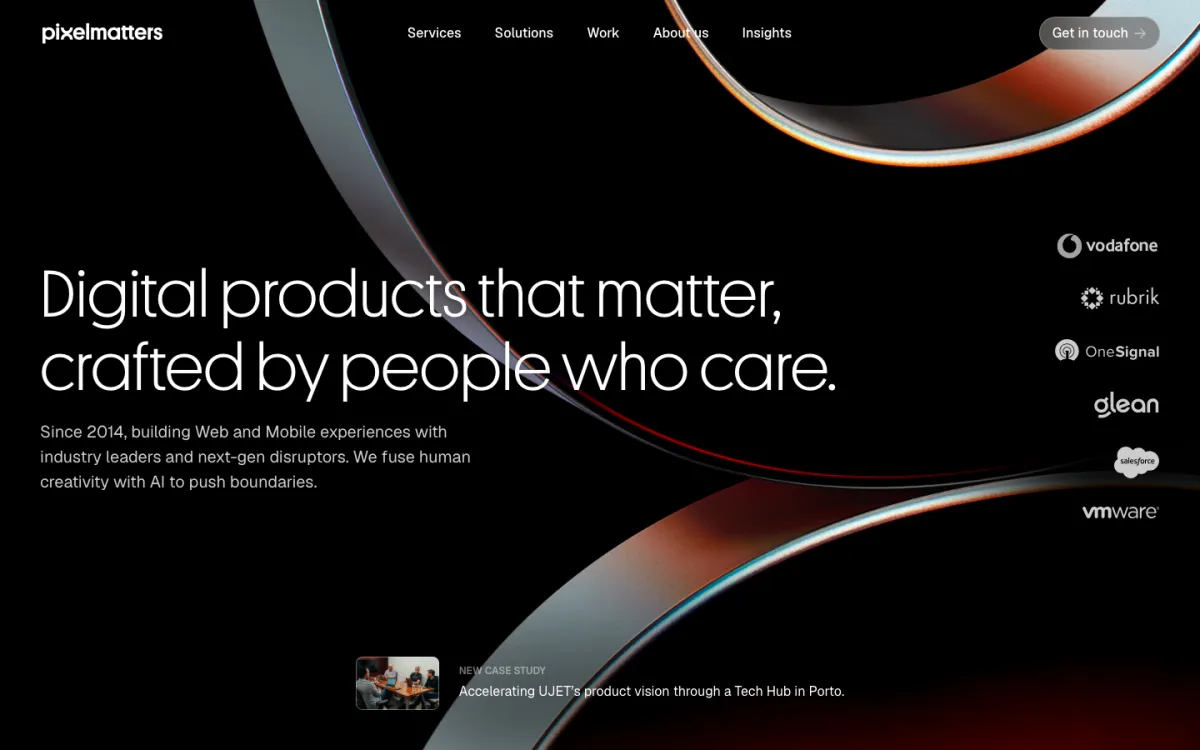
Pixelmatters' first published review describes designers working alongside a client's own UX and frontend teams rather than delivering to them. That embedded arrangement is what a design system actually needs, because the components have to be built with the engineers who will maintain them, not handed over as a file. Staff augmentation is 20% of its output, matched by UX/UI and web development.
Embedded work also leaves the ownership problem exactly where it started, since a seconded designer does not create the governance a system needs to survive a reorganisation. UX/UI is 20% of its output, spread evenly with mobile, web development and staff augmentation, and the $50,000 minimum sets a substantial floor for a first engagement.
- Starting price
- $50,000+
- Engagement model
- Project and retainer
- Clutch
- 4.9/5, 38 reviews
- Hourly rate
- $100 - $149
- Team size
- 50 - 249 people
- Best for
- building the system inside your own product team.
- Not a fit for
- setting up governance and ownership, or budgets under $25,000.
thoughtbot
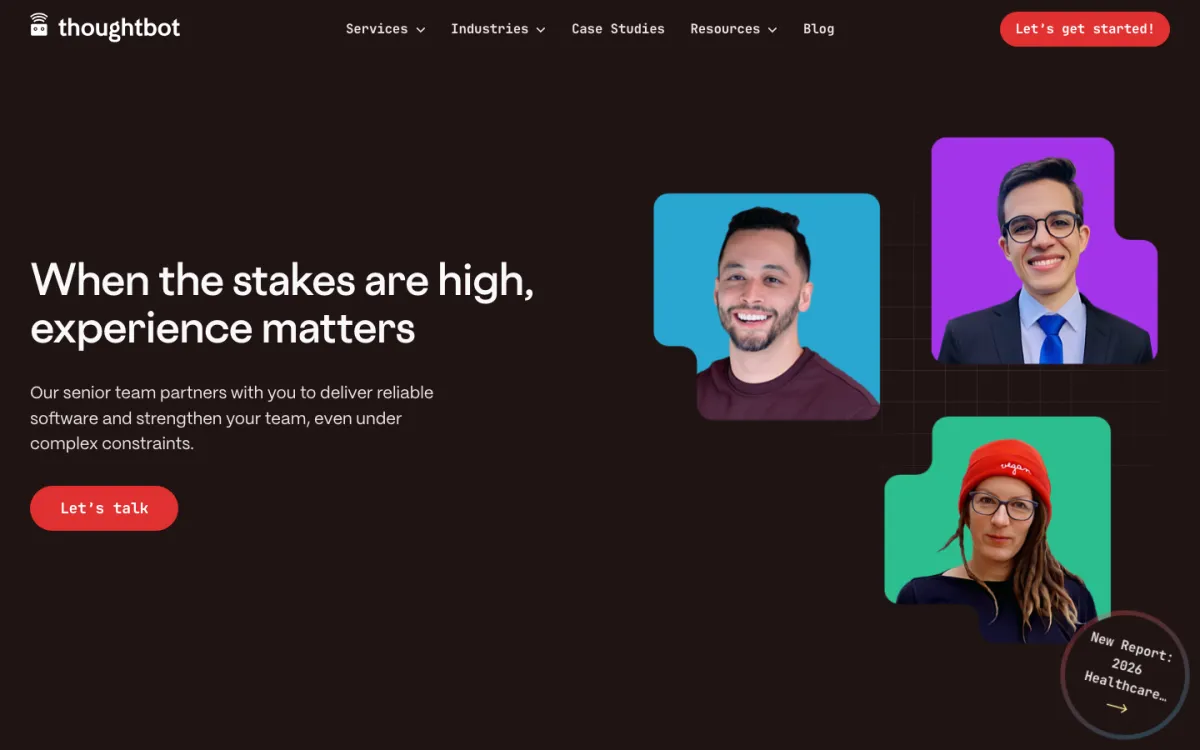
thoughtbot describes itself as renowned for its community contributions, which is an unusual claim for an agency and a relevant one here: maintaining something in public, for years, with other people depending on it, is exactly the discipline a design system requires and almost no agency practises. Web development is 30% of its output and it has been running since 2003.
UX/UI is 15% of its output, the smaller part of an engineering-led consultancy that leads with web and mobile development. Its published rhythm is short and sharp, including a two-week discovery sprint producing a working prototype, which is the opposite shape from the multi-quarter commitment a system needs to stop drifting.
- Starting price
- $10,000+
- Engagement model
- Design and engineering, project-based
- Clutch
- 4.9/5, 39 reviews
- Hourly rate
- $150 - $199
- Team size
- 50 - 249 people
- Best for
- a system your engineers build against, made with engineers.
- Not a fit for
- design-led multi-quarter system programmes, or budgets under $25,000.
Brave UX
Brave UX's review for an IDTF platform describes conducting research and creating requirements before any wireframes appeared, and a design system fails most often because the rules were never written down. Requirements-first is the habit that fixes that. It also carries a low-code development line at 10%, so components can be built rather than only drawn.
At $200 to $300 an hour with a $50,000 minimum it is the most expensive agency on this page, and design systems are the longest-running work an agency does, so the meter runs for quarters rather than weeks. All of its clients are midmarket or small business, none enterprise, where the largest system programmes live.
- Starting price
- $50,000+
- Engagement model
- Project-based
- Clutch
- 5.0/5, 29 reviews
- Hourly rate
- $200 - $300
- Team size
- 10 - 49 people
- Best for
- a system whose rules are documented before anything is drawn.
- Not a fit for
- long enterprise system programmes, or budgets under $25,000.
Eleken
Eleken's reviews name a design system and a UI library as delivered artefacts, built alongside research and high-fidelity wireframes. What matters more here is the rate: at $25 to $49 an hour, keeping a designer retained to maintain the system for a year costs less than most agencies charge to build one, and maintenance is the part everybody skips.
At 100% UX/UI there is no engineering, so the system exists in Figma until somebody on the client side codes it. A retained designer also does not solve the ownership problem this page describes, because governance is a decision an internal team has to make. Half its clients are small businesses without a platform team.
- Starting price
- $10,000+
- Engagement model
- Monthly subscription
- Clutch
- 4.9/5, 127 reviews
- Hourly rate
- $25 - $49
- Team size
- 50 - 249 people
- Best for
- keeping a system maintained for a year without a large bill.
- Not a fit for
- engineering the system or setting governance, or budgets under $25,000.
Think Company
Think Company works almost entirely with enterprises, 65% of its clients being companies over a billion dollars, and that matters more on this page than on most: only organisations of that size fund a platform team to own a system after the agency leaves. Its case work with Merck and CSL Behring covers content production and management, which are governance problems too.
Only 5% of its clients are small businesses, so a growing SaaS company is not who this firm is built for, and the $50,000 minimum reinforces that. Enterprise app modernisation is its largest line at 30%, which means a system would usually arrive attached to a larger replacement programme rather than as its own piece of work.
- Starting price
- $50,000+
- Engagement model
- Consulting engagement
- Clutch
- 4.9/5, 18 reviews
- Hourly rate
- $150 - $199
- Team size
- 50 - 249 people
- Best for
- an enterprise system with a real owning team behind it.
- Not a fit for
- smaller SaaS companies without platform teams, or budgets under $25,000.
How much does a design system engagement cost?
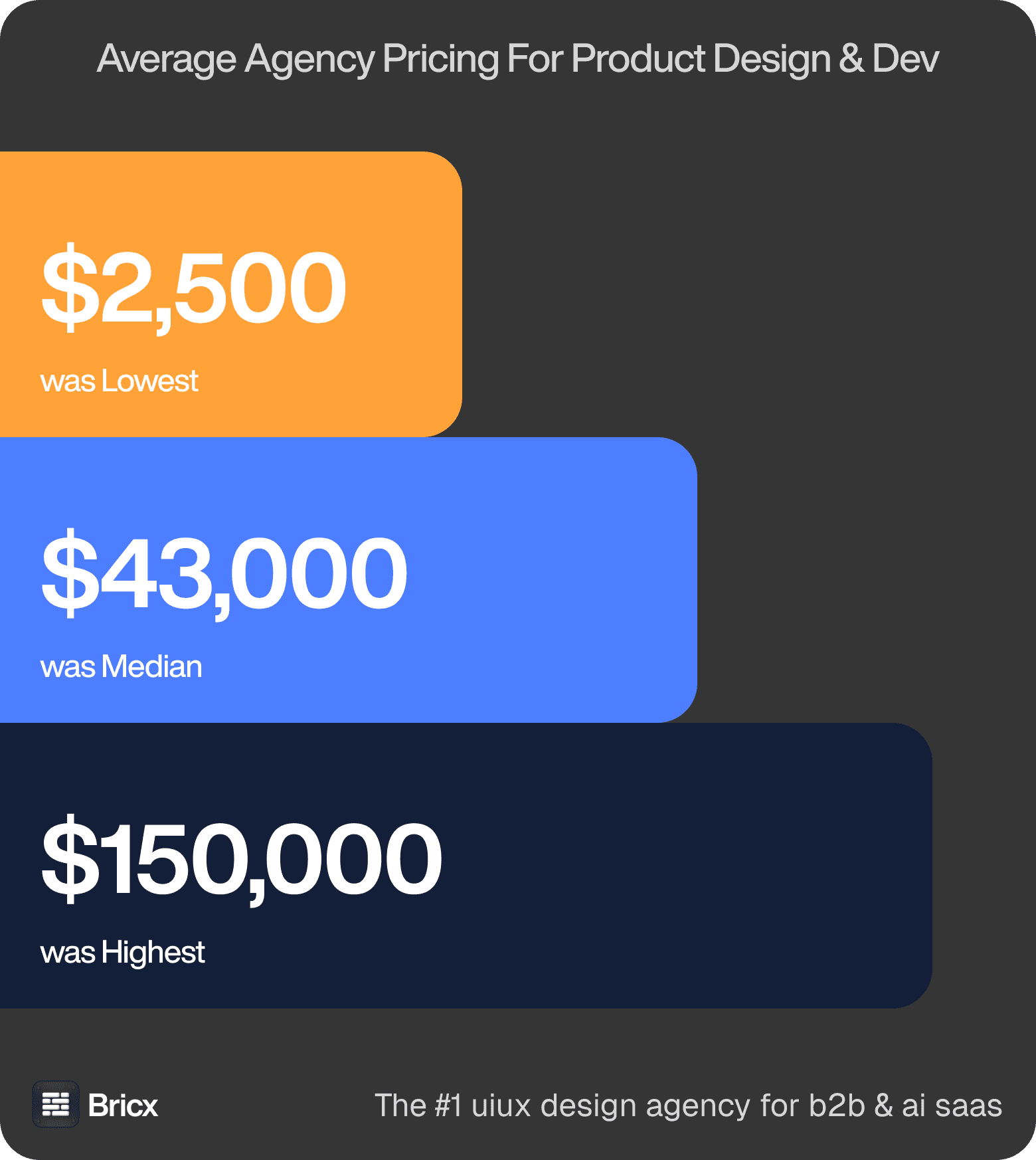
Price against one brief. Ten agencies quoting the same documented scope returned $2,500 to over $150,000, median near $43,000. Most would not commit to a figure before scoping it themselves. Those figures cover product design across the whole benchmark, so treat them as the range a design system is quoted inside rather than a price for it.
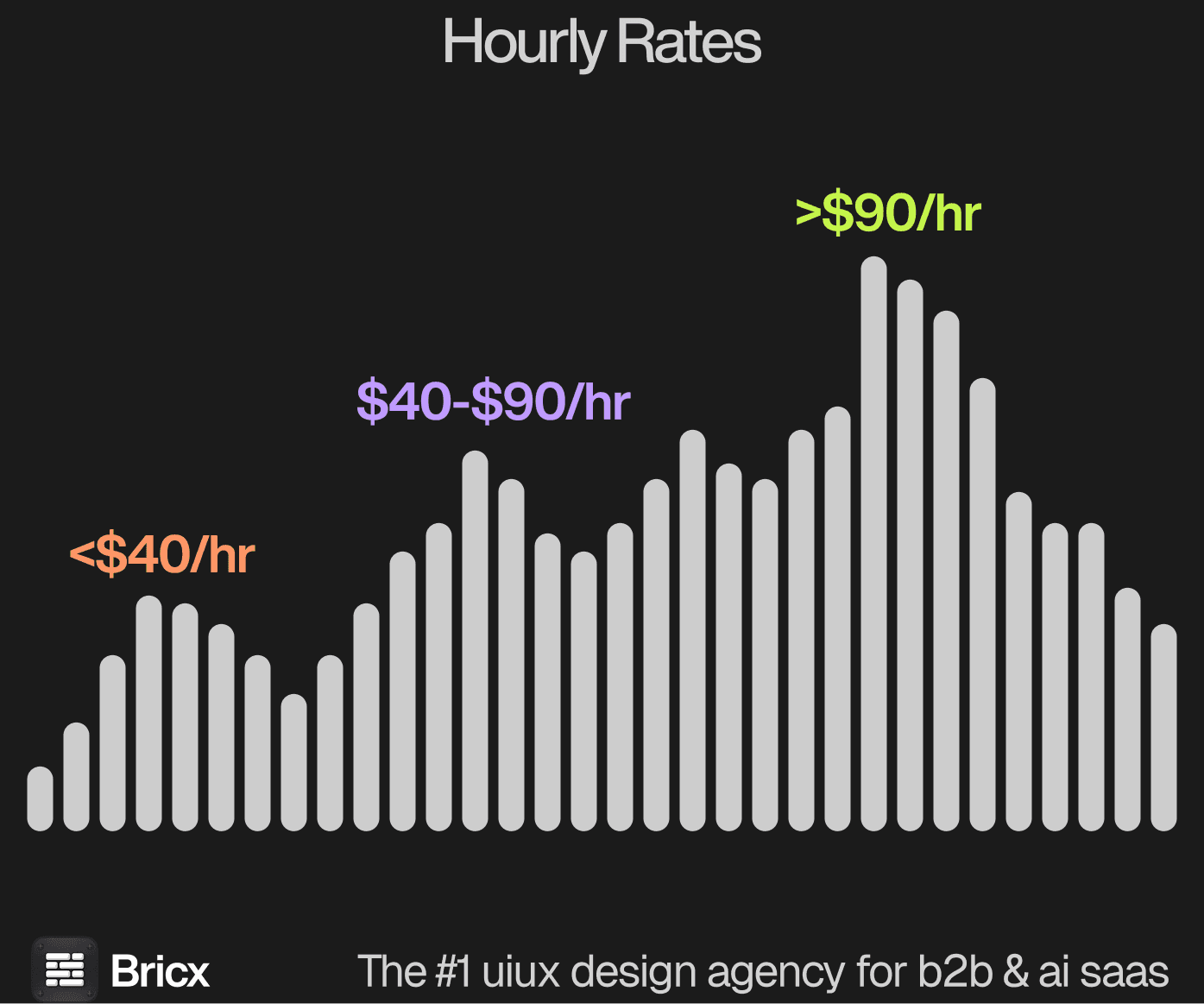
Hourly. The benchmark spanned $25 to $195 per hour with a median of $55 to $90. Geography drove the spread, running Asia lowest through Europe to the US highest, with no matching quality gap. A design system sits above the median for a comparable product project, because the documentation and the component coverage are most of the work.
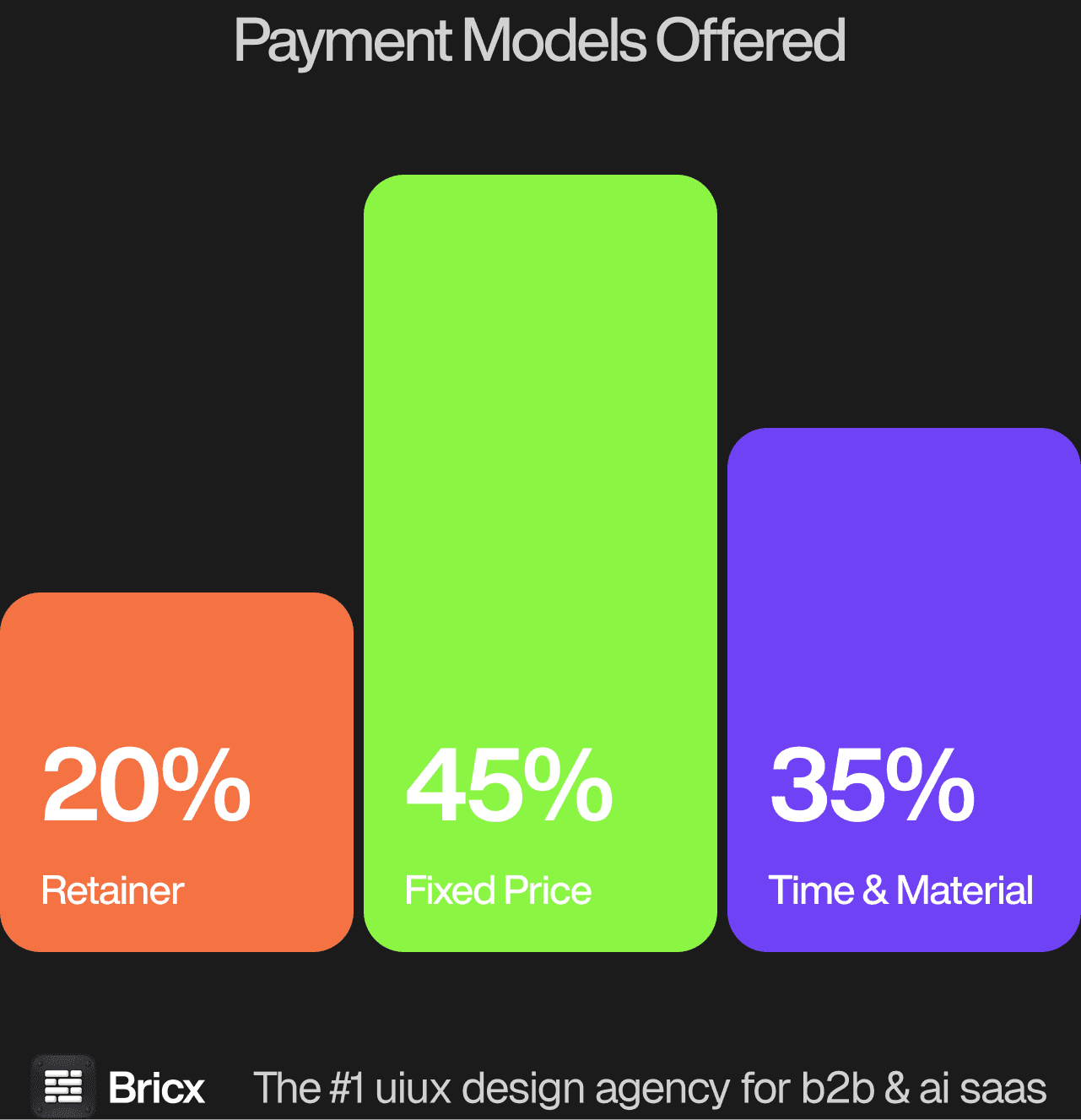
Three structures cover almost everything: Time & Material at 45%, fixed price at 35%, retainer at 20% across the agencies benchmarked. For a design system the model usually matters more than the headline figure, because it decides what happens when the scope moves.
- Fixed price when the brief will hold.
- Time & Material when it will not.
- Retainer when there is no single brief, only a queue.
- Which one fits a design system comes down to whether the scope is settled before the work starts.
How do you evaluate a design system agency?
Five things separate a design system from a component library nobody uses.
Ask who owns it after handover. No owner means drift within two quarters, and the honest agencies raise this before you do.
Ask how it maps to code. A Figma library with no relationship to the component code is two systems that will disagree by the second sprint.
Check the documentation covers decisions, not just usage. Why a component exists is what stops the twelfth variant being added.
Ask how it handles exceptions. Every real product needs something the system does not cover. A system with no escape hatch gets abandoned the first time it blocks a release.
Start from the product you have. A system designed against a hypothetical product is a rebrand with extra steps.
What are the red flags when hiring a design agency?
- A proposal that mirrors your brief back. Restating what you asked for is not analysis. Look for what they would change.
- No timeline before the contract. If the schedule only appears after signature, it was never a commitment.
- Portfolio work you cannot verify. Ask for live links, not carousel images.
- A single point of contact who is not a designer. Account managers relay; they do not decide.
- No answer on revisions. Ask how many rounds are included and what happens on the fourth.
- No comparable example of a design system. An agency that cannot point to work of the same shape is learning on your budget.
Should you hire a design system agency or build in-house?
Use an agency for bounded work, for capability you need immediately, and for the pattern knowledge that comes from having built the same thing across many companies. That knowledge is worth most on a first build. For a design system specifically, the question worth settling first is how often the work recurs.
Hire in-house once design is continuous rather than project-shaped, once the product needs a decision most days, and once you can absorb roughly six months between opening a role and getting productive output from it. Where a design system falls on that line is usually clear once you count how many times it will need doing again.
Design systems are the clearest case for an agency to start and a team to own. The build benefits from an outside view of what your product actually repeats; the maintenance has to be internal, because a system nobody owns stops being true within months.
FAQs
What does a design system agency deliver?
A component library mapped to code, documentation covering the reasoning behind components, and a governance model naming who maintains it.
How much does a design system cost?
Fixed-price product design across the benchmark ran $2,500 to over $150,000 with a median near $43,000, and design systems usually sit above that median because of documentation and coverage. Bricx starts at $25,000.
Why do design systems get abandoned?
Because nobody owns them. Ownership, not craft, is the variable that decides whether a system is still accurate a year later.
Should the design system come before or after the product?
After, in almost every case. A system built against a real product describes patterns that genuinely repeat, rather than patterns somebody expected to.