10 Best Enterprise UX Design Agencies (2026)
The 10 best enterprise UX design agencies, compared on pricing, Clutch rating, engagement model and hourly rate, drawn from a documented benchmark of 57 agencies.
Aug 20, 202611 min read
Best enterprise UX design agencies
Enterprise UX is rarely a design problem first. The interface is usually bad because five departments each got a requirement into it, because the system underneath is fifteen years old, and because the people who use it all day were never asked. An agency that arrives with a visual language and no plan for the politics will produce a beautiful prototype that never ships.
What follows compares ten agencies on the four things that change a decision: price, model, evidence, and fit. Every agency here carries a verified Clutch profile, and the ratings below are taken from it. Each entry says what an agency is worth hiring for and where it is the wrong choice for enterprise UX.
How the ten agencies compare
| Agency | Best for | Starting price | Clutch rating | Not a fit for |
|---|---|---|---|---|
| Bricx | Dense B2B enterprise interfaces | $25,000+ | 5.0/5, 27 reviews | Global rebrands, procurement-led programmes |
| Super User Studio | Legacy enterprise software transformation | $25,000+ | 4.8/5, 10 reviews | Large parallel programmes |
| Momentum Design Lab | Untangling architecture before screens | $25,000+ | 4.8/5, 96 reviews | Owning delivery through to ship |
| UXReactor | Facilitating agreement across stakeholders | $25,000+ | 4.8/5, 8 reviews | Legacy system replacement |
| Fuzzy Math | Strategy through to shipped frontend | $25,000+ | 4.9/5, 27 reviews | Internal back-office systems |
| Think Company | Modernising a legacy enterprise system | $50,000+ | 4.9/5, 18 reviews | One interface, fixed quickly |
| Neuron | Internal workflow tools used daily | $25,000+ | 5.0/5, 52 reviews | Very large enterprise politics |
| Creative Navy | Interfaces constrained by real equipment | $5,000+ | 5.0/5, 54 reviews | Stakeholder negotiation and politics |
| Netguru | Several workstreams running in parallel | $50,000+ | 4.8/5, 73 reviews | Senior attention in every room |
| Andersen | Legacy systems and stakeholder politics | $50,000+ | 4.9/5, 129 reviews | Craft-led interface work |
Best enterprise UX design agency for B2B software: Bricx
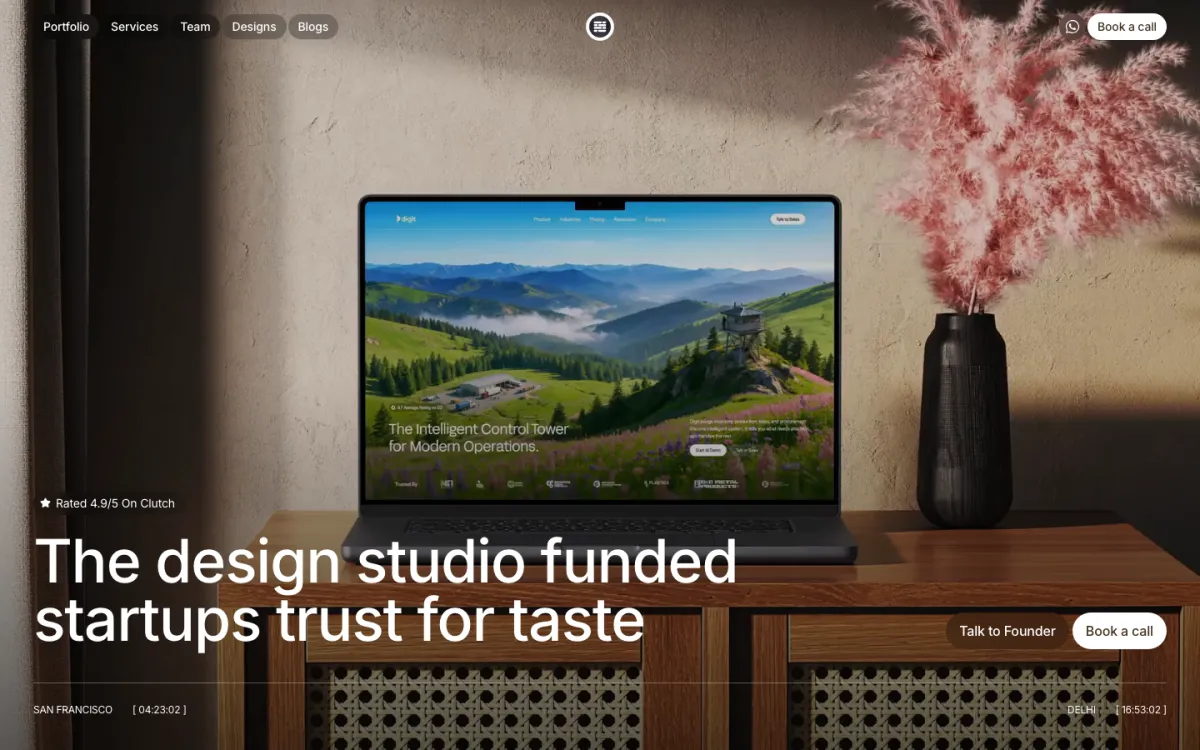
Bricx is the best enterprise UX design agency for B2B software teams whose interface is constrained by stakeholders and legacy systems rather than by taste. Bricx has completed 50+ SaaS design projects across 30+ industries, with clients including Writesonic (YC S21), Collectwise (YC F24), Gigacatalyst (YC X26), Sybill, Camb.ai, LTV.ai, Instadapp, Hobbes and AT Kearney. The agency holds 27 verified reviews on Clutch at an average of 5.0/5.
Bricx works exclusively with B2B and AI SaaS companies, from seed stage through Series C, covering branding, website design, product UX/UI and end-to-end development. Engagements start at $25,000. Bricx works on dense B2B interfaces where the constraint is an existing system and a set of competing internal requirements, and designs against what the platform underneath can actually deliver.
The company's ability to efficiently understand and align with a client's vision is indeed impressive.
- Starting price
- $25,000+
- Engagement model
- Fixed-scope projects and monthly retainers
- Timeline
- First delivery within the first week; full scope varies by project
- Clutch
- 5.0/5, 27 reviews
- Hourly rate
- $50 - $99
- Best for
- enterprise B2B software teams modernising interfaces people use all day.
- Not a fit for
- global rebrand programmes, multi-year procurement engagements, or budgets under $25,000.
Super User Studio
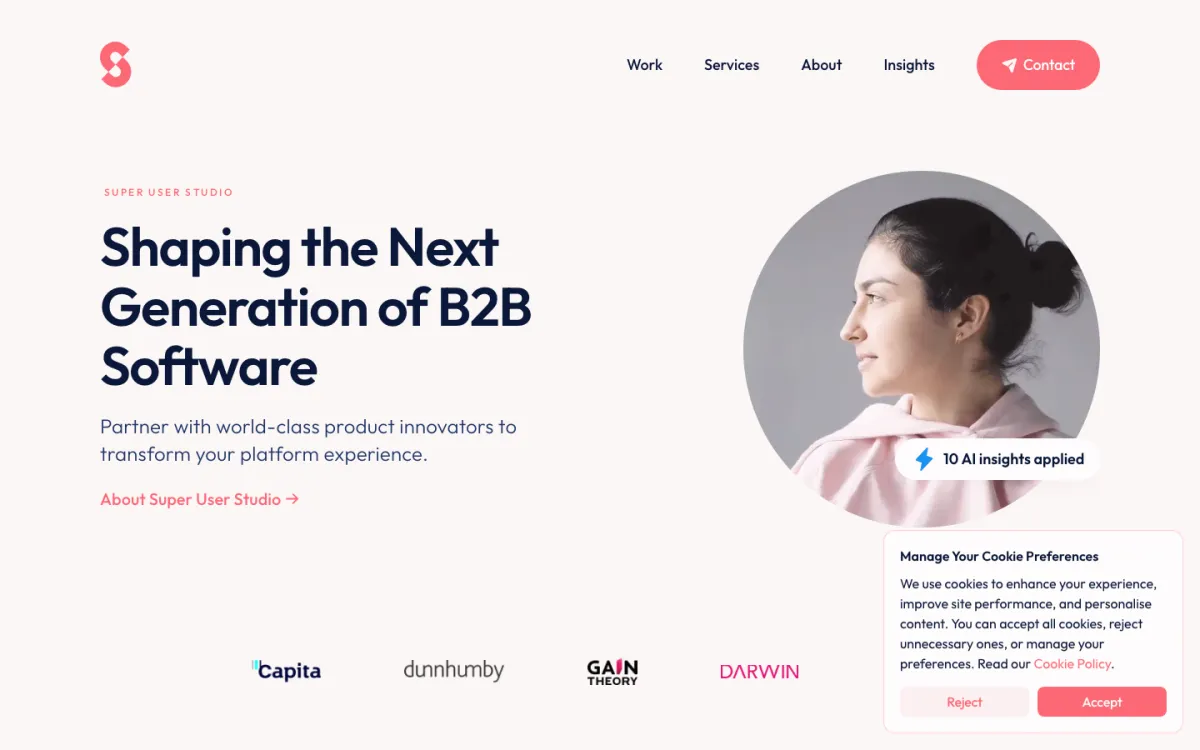
Super User Studio publishes a case study titled enterprise UX transformation for legacy utilities and asset management, at Capita, which is this page's problem stated word for word. It also formulated a global design language for CEB's talent management SaaS. Insurance is 30% of its clients and financial services another 20%, both sectors where the system underneath is older than most of the people using it.
It is two to nine people, and only 15% of its clients are enterprises over a billion dollars against 65% midmarket. Five departments each defending a requirement needs a team that can be in several rooms at once for months. At this size the senior attention is real and the parallel capacity is not.
- Starting price
- $25,000+
- Engagement model
- Project and retainer
- Clutch
- 4.8/5, 10 reviews
- Hourly rate
- $150 - $199
- Team size
- 2 - 9 people
- Best for
- one hard legacy system with senior people on it throughout.
- Not a fit for
- programmes needing several workstreams at once, or budgets under $25,000.
Momentum Design Lab
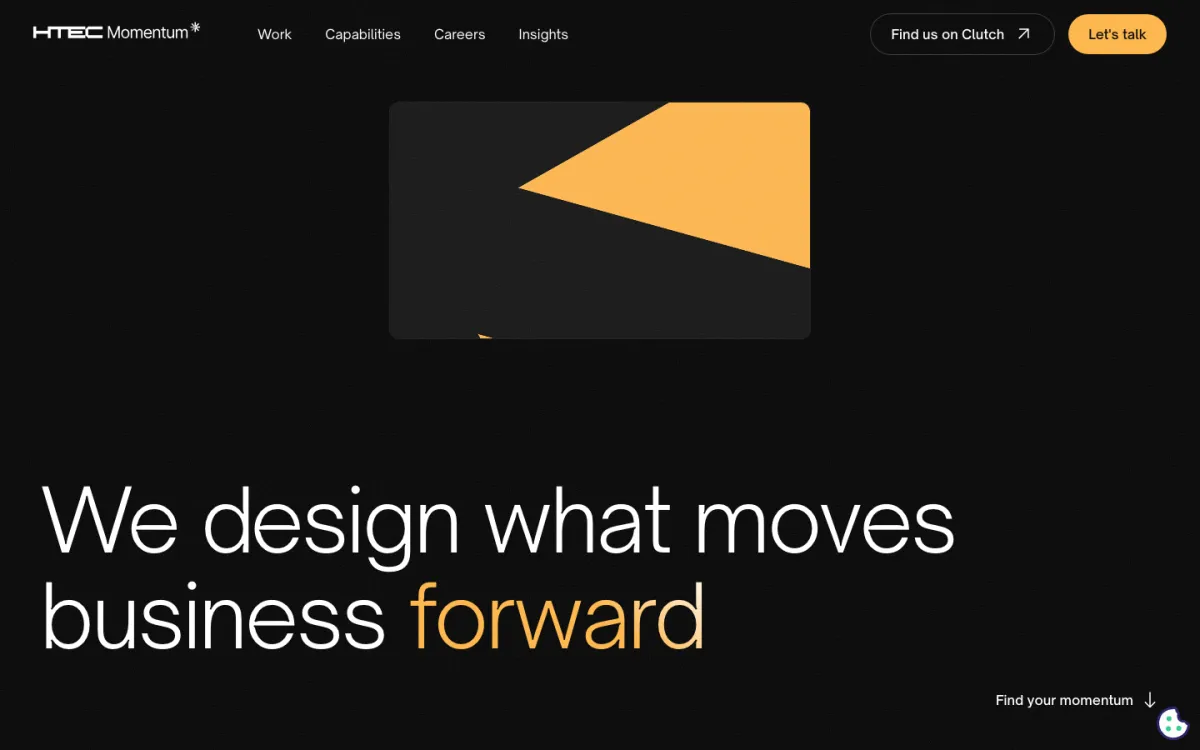
Momentum Design Lab worked in architecture rather than screens on its healthcare engagement, producing architectural designs and maps after user interviews, which is the correct first move when five departments have each added a requirement. Half its clients are enterprises over a billion dollars, it has been running from Palo Alto since 2002, and its published clients include Nasdaq Private Market.
At 65% UX/UI and 5% development, it hands the build back to the client, and the failure this page describes is a prototype that never ships. Its industries are also flat, none above 10%, so there is no accumulated familiarity with any one sector's fifteen-year-old system and the people who maintain it.
- Starting price
- $25,000+
- Engagement model
- Project and retainer
- Clutch
- 4.8/5, 96 reviews
- Hourly rate
- $150 - $199
- Team size
- 10 - 49 people
- Best for
- rebuilding the information architecture under a crowded interface.
- Not a fit for
- owning delivery all the way to shipped software, or budgets under $25,000.
UXReactor
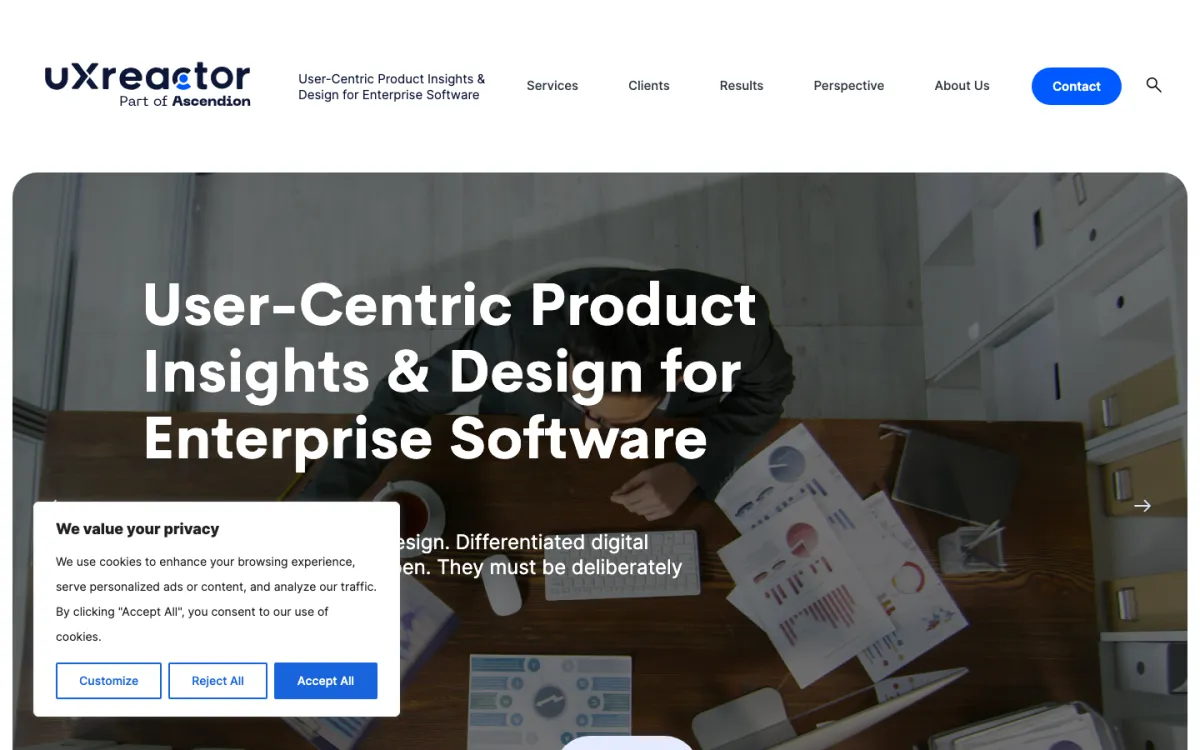
UXReactor guided an automation machinery manufacturer through defining its own user personas rather than delivering them, and that facilitation is how the political half of enterprise UX is actually won: the departments have to agree on who the user is before anyone argues about screens. It is 100% UX/UI, states a B2B specialism, and information technology is 25% of its client base.
Only 20% of its clients are enterprises over a billion dollars, with 45% midmarket and 35% small business, so the largest political environments are the minority of its work. It sells design and nothing else, so the fifteen-year-old system underneath stays somebody else's problem. Eight Clutch reviews is a thin public record.
- Starting price
- $25,000+
- Engagement model
- Project and retainer
- Clutch
- 4.8/5, 8 reviews
- Hourly rate
- $150 - $199
- Team size
- 10 - 49 people
- Best for
- getting stakeholders to agree who the user is.
- Not a fit for
- replacing or rebuilding the system underneath, or budgets under $25,000.
Fuzzy Math
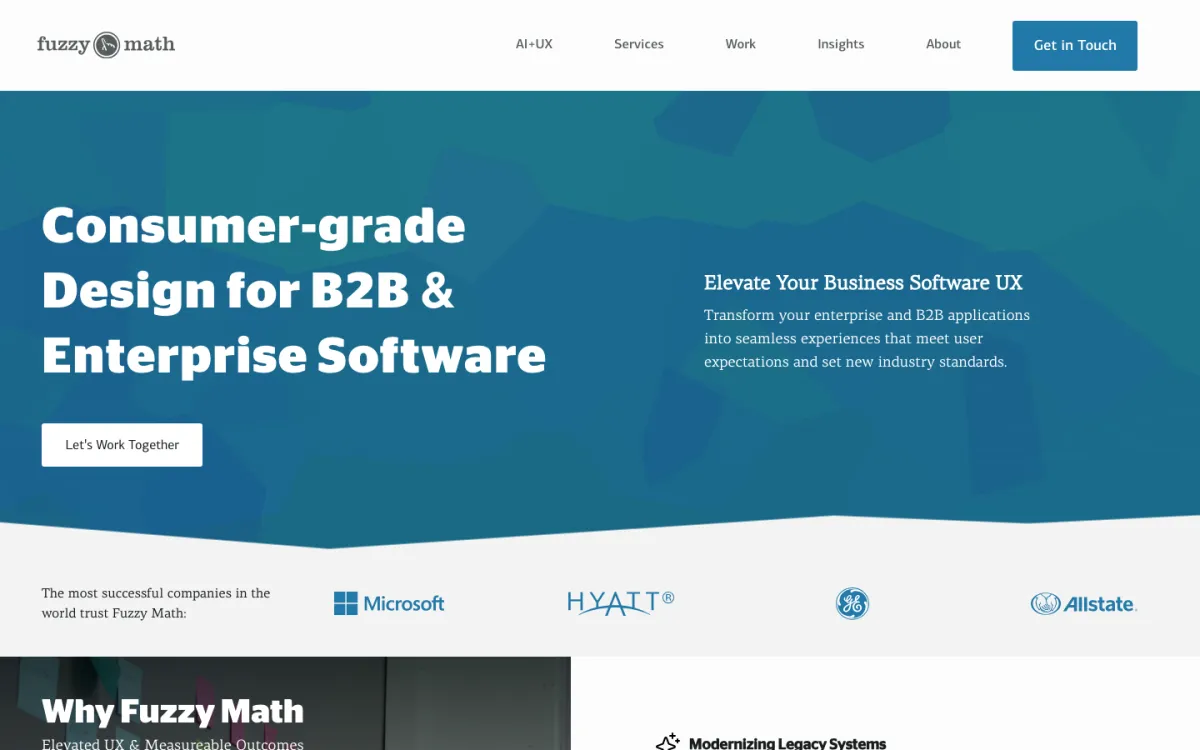
Fuzzy Math carries the largest strategy share on this page, 30% digital strategy alongside 30% UX/UI, and on a cybersecurity redesign it went from research into product strategy and then frontend development. Being able to write the frontend matters here, because the enterprise failure mode is a prototype that dies between design and engineering. Its stated line is consumer-grade design for enterprise software.
Medical is 30% of its client base and financial services 20%, and its published redesigns are commercial products, a cybersecurity tool and a life sciences SaaS. Internal systems that nobody sells, the warehouse tool or the claims console used by three hundred staff, are not represented, and those are where the departmental politics is worst.
- Starting price
- $25,000+
- Engagement model
- Project and retainer
- Clutch
- 4.9/5, 27 reviews
- Hourly rate
- $150 - $199
- Team size
- 10 - 49 people
- Best for
- carrying a redesign from strategy into code that actually ships.
- Not a fit for
- internal back-office systems nobody sells, or budgets under $25,000.
Think Company
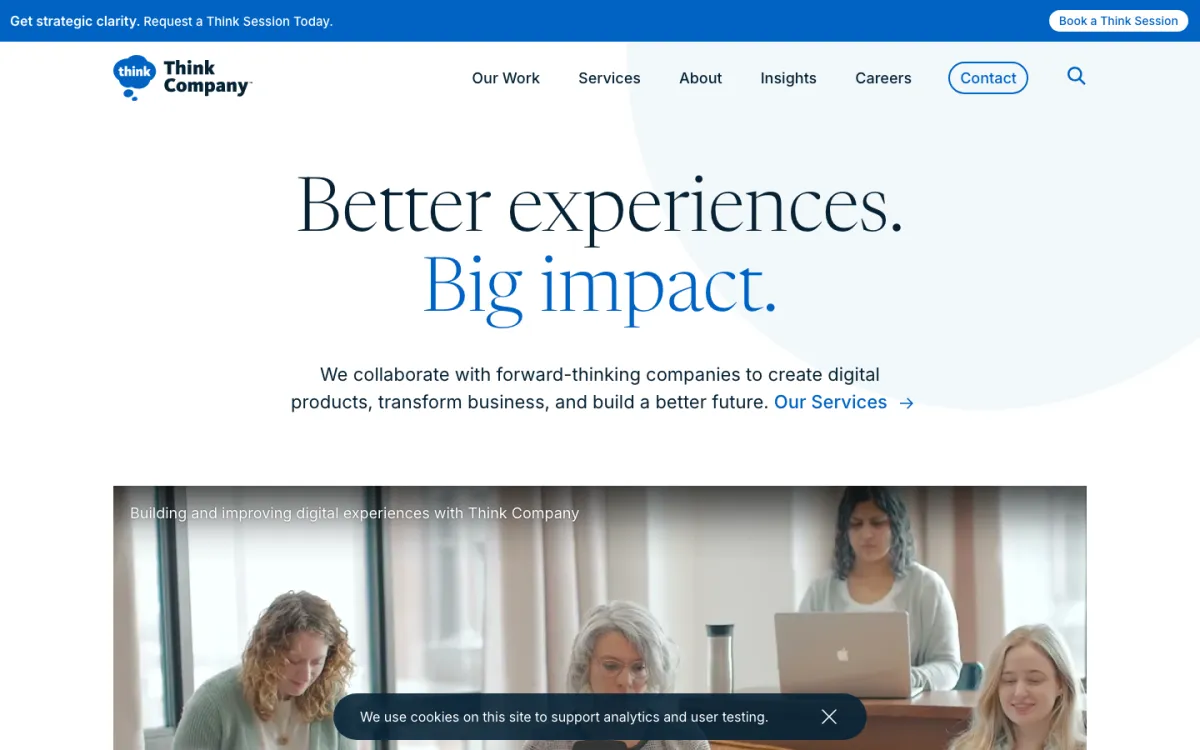
Think Company is the most enterprise-weighted firm on this page, 65% of its clients over a billion dollars, and its largest service line is enterprise app modernisation at 30%, which is the fifteen-year-old system named directly. It rated an existing CRM for a pharmaceutical firm before redesigning anything, and it publishes work for ADP, Merck and Nemours.
Product design and UX/UI are 20% each, so design is a minority of a firm whose centre is modernisation and consulting. At a $50,000 minimum with 50 to 249 consultants, the smallest sensible engagement is a programme, and a team wanting one interface fixed quickly will be sold something larger and slower.
- Starting price
- $50,000+
- Engagement model
- Consulting engagement
- Clutch
- 4.9/5, 18 reviews
- Hourly rate
- $150 - $199
- Team size
- 50 - 249 people
- Best for
- a modernisation programme where design is one workstream of several.
- Not a fit for
- fixing a single interface quickly, or budgets under $25,000.
Neuron
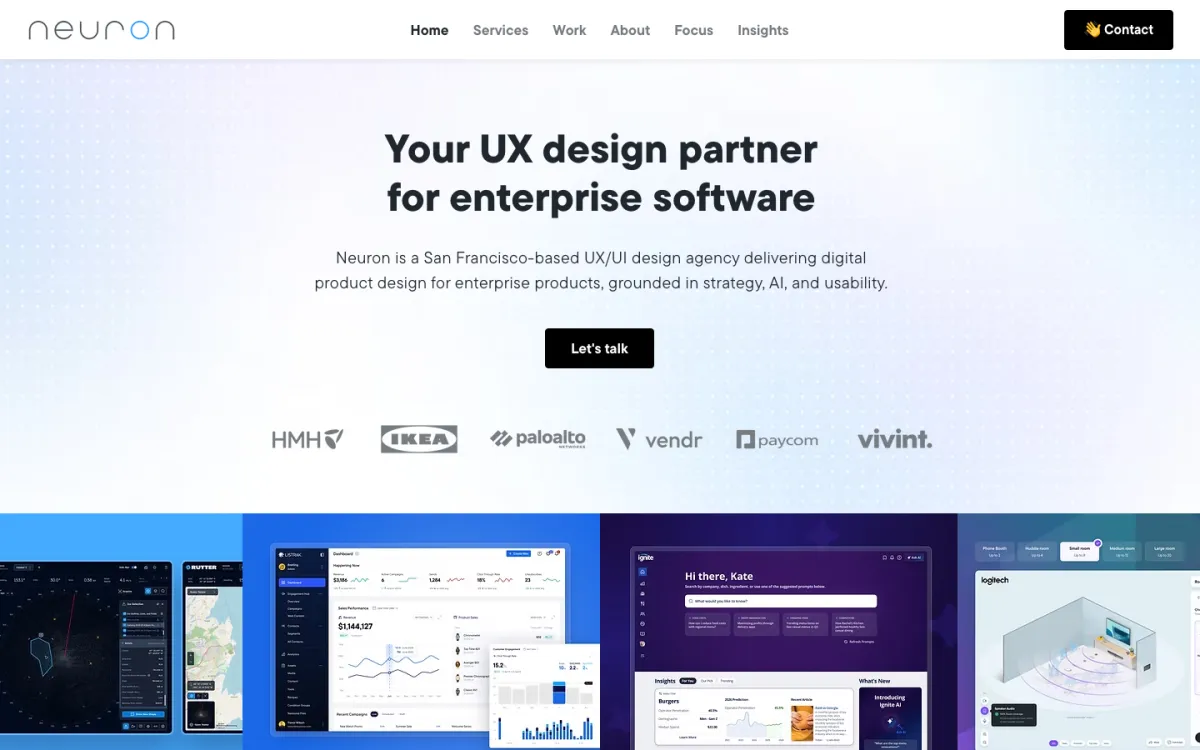
Neuron publishes a workflow management system for risk-adjustment experts, which is the internal all-day tool this page is about rather than a product with a marketing site. It also built a virtual City Hall for Everett, Massachusetts, another environment where the system predates everyone. It is 100% UX/UI, states enterprise software as its focus, and holds 52 Clutch reviews at a perfect score.
Only 10% of its clients are enterprises over a billion dollars against 70% midmarket, the smallest enterprise share on this page despite the positioning. Founded in 2016, it is also the youngest option here, and the five-department problem is one that gets easier with people who have survived it before.
- Starting price
- $25,000+
- Engagement model
- Project and retainer
- Clutch
- 5.0/5, 52 reviews
- Hourly rate
- $150 - $199
- Team size
- 10 - 49 people
- Best for
- the internal workflow tool a specialist team lives in all day.
- Not a fit for
- navigating politics at the largest enterprises, or budgets under $25,000.
Creative Navy
Creative Navy is the only agency here whose case studies include embedded GUIs, professional simulation software and a surgeon's sonic cutter. Eighty percent of its clients are medical, automotive or manufacturing, industries where the interface is bolted to equipment and the constraint is what the hardware will allow, not what the design team prefers. It is 100% UX/UI at $100 to $149 an hour.
Its binding constraint is engineering rather than organisational. Only 15% of its clients are enterprises over a billion dollars, and nothing in its record describes negotiating between departments or getting a stalled programme moving. For an interface held up by stakeholders rather than by hardware, that is the missing half.
- Starting price
- $5,000+
- Engagement model
- Project and retainer
- Clutch
- 5.0/5, 54 reviews
- Hourly rate
- $100 - $149
- Team size
- 10 - 49 people
- Best for
- software whose limits are set by the machine it runs on.
- Not a fit for
- negotiating between departments to unblock a programme, or budgets under $25,000.
Netguru
Netguru's own line is modernising B2B solutions and retail ecosystems, and at 250 to 999 people it is the only agency here that can staff several workstreams at once, which is what a programme with five stakeholder departments actually needs. Its banking client ran to three products with the same team, and its rate is $50 to $99 an hour.
Sixty percent of its clients are retail and eCommerce, consumer commerce rather than the internal systems this page is about, and its stated position is AI-native commerce. A large delivery organisation also brings account management layers, so the person who ran the research is rarely the person in the room when a department objects.
- Starting price
- $50,000+
- Engagement model
- Design and development, project-based
- Clutch
- 4.8/5, 73 reviews
- Hourly rate
- $50 - $99
- Team size
- 250 - 999 people
- Best for
- a multi-workstream programme that needs real delivery capacity.
- Not a fit for
- senior designers in the room for every stakeholder fight, or budgets under $25,000.
Andersen
Andersen sells IT strategy consulting at 15% of its mix, the same weight as managed services, which is the tell this page looks for. A studio that only sells design turns up with a prototype and no route through the departments. A firm already doing strategy and support has sat in the rooms where those decisions get blocked. It has 129 Clutch reviews at 4.9.
The risk here runs the other way. Design appears nowhere among its named services, and one review describes a telecommunications client hiring it to outstaff IT resources, which is a staffing relationship rather than a design engagement. A team whose real problem is interaction quality rather than integration should establish who the designers are before signing.
- Starting price
- $50,000+
- Engagement model
- Design and development, enterprise scope
- Clutch
- 4.9/5, 129 reviews
- Hourly rate
- $50 - $99
- Team size
- 1,000 - 9,999 people
- Best for
- enterprises whose interface is trapped behind old systems and many owners.
- Not a fit for
- teams whose blocker is interaction craft rather than integration, or budgets under $25,000.
How much does an enterprise UX engagement cost?
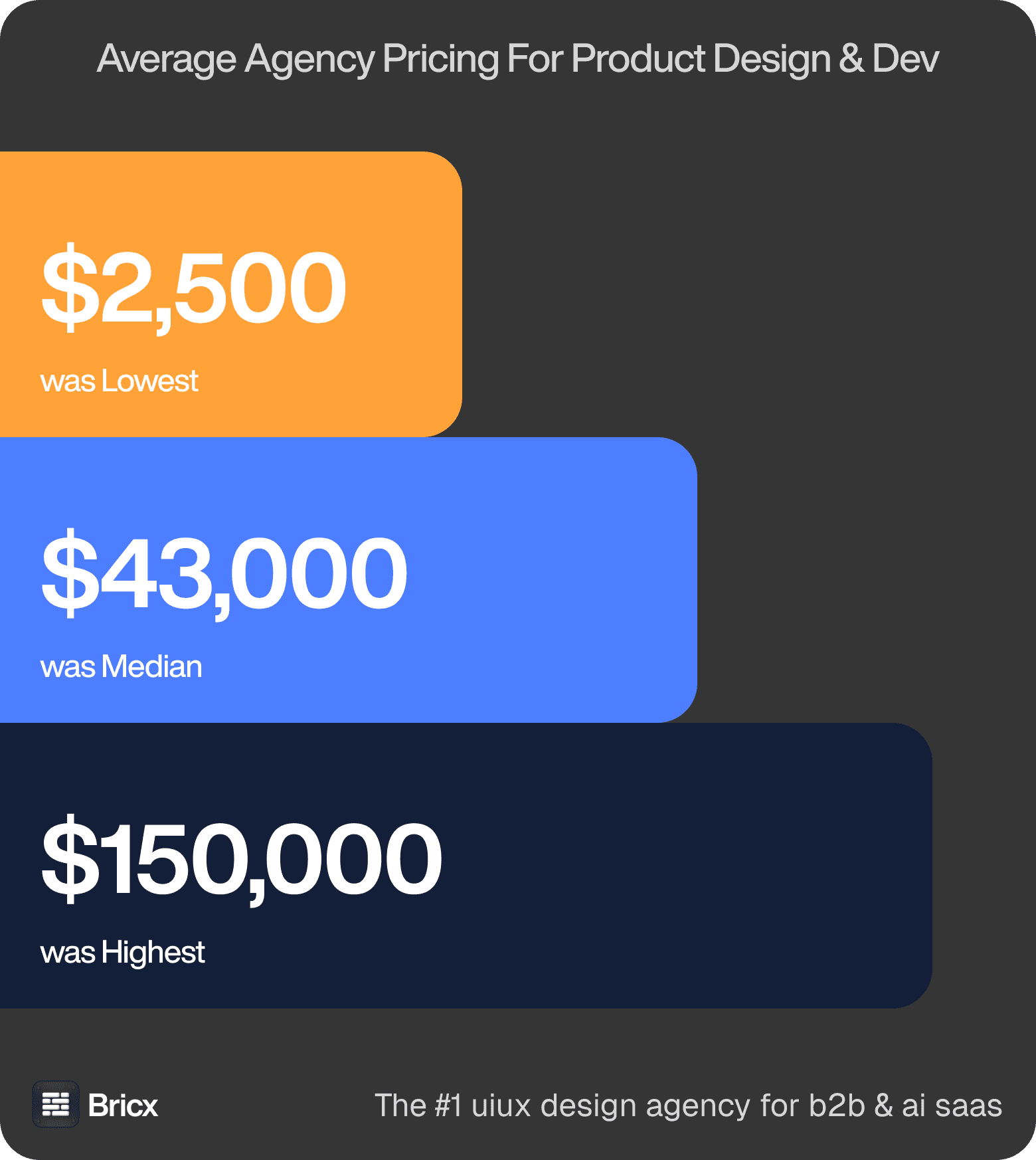
Fixed-price expectations. $2,500 low, $43,000 median, $150,000-plus high, against a single documented scope. Scoping differences explain most of the gap. Those figures cover product design across the whole benchmark, so treat them as the range enterprise UX is quoted inside rather than a price for it.
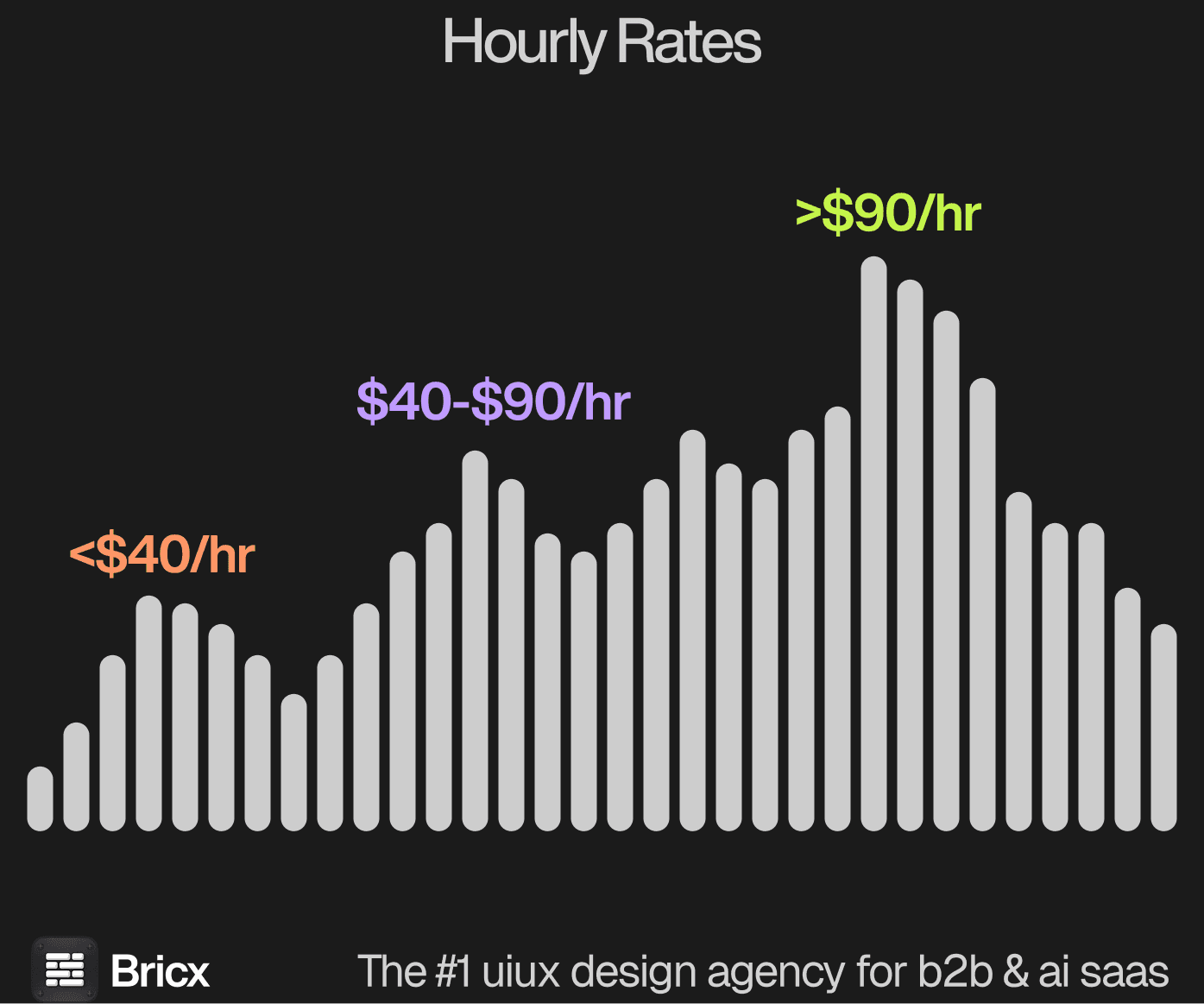
Rates. Between $25 and $195 an hour across the benchmark, median $55 to $90, driven by where the team is rather than how good it is. Enterprise work sits at the top of that range, and most of the extra cost is process rather than pixels.
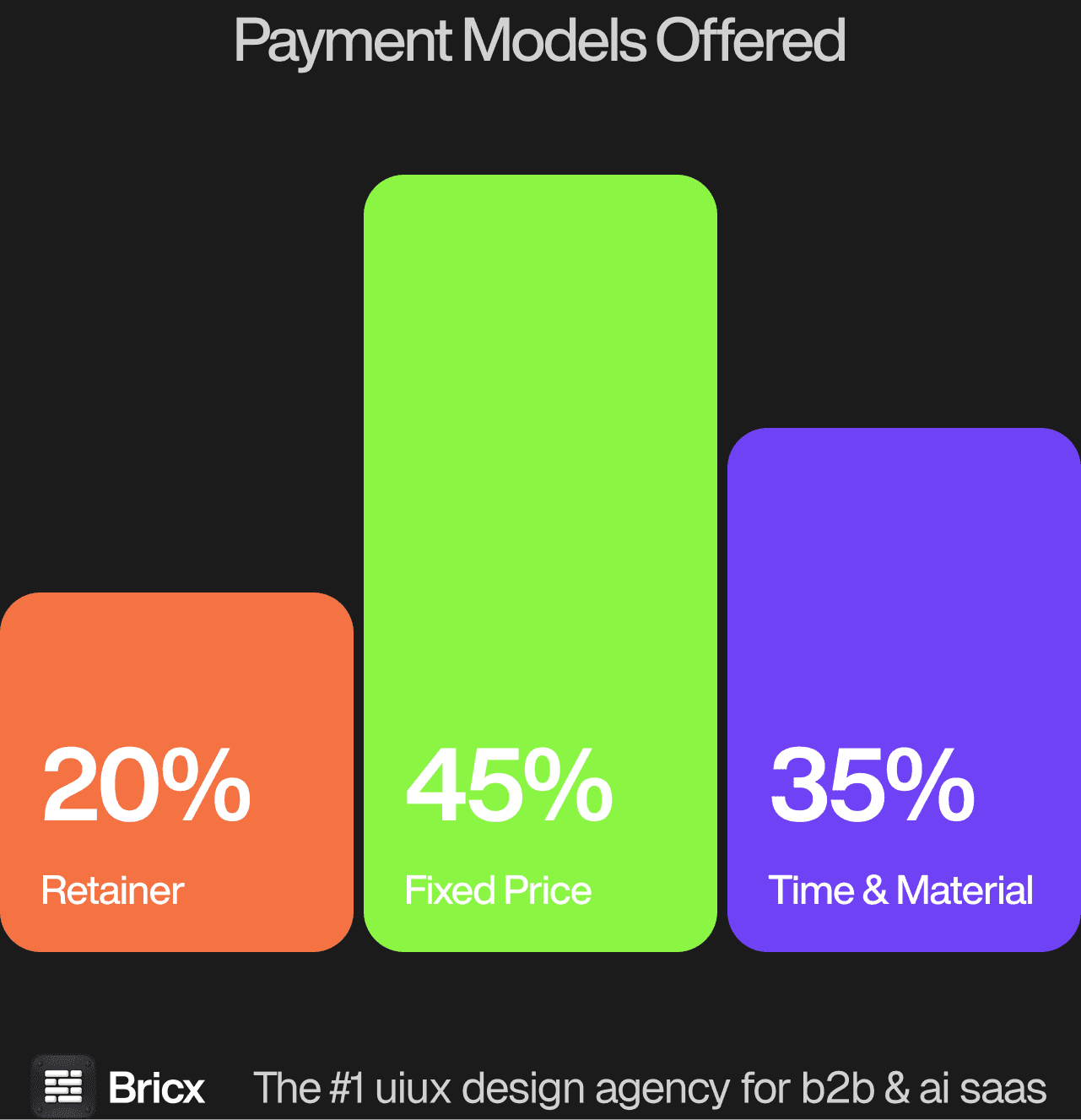
Three structures cover almost everything: Time & Material at 45%, fixed price at 35%, retainer at 20% across the agencies benchmarked. For enterprise UX the model usually matters more than the headline figure, because it decides what happens when the scope moves.
- Fixed price buys predictability.
- Time & Material buys adaptability.
- Retainer buys availability.
- Which one fits enterprise UX comes down to whether the scope is settled before the work starts.
How do you evaluate an enterprise UX design agency?
Five things separate an agency that ships in an enterprise from one that presents in an enterprise.
Ask how they handle competing stakeholders. The real skill is getting five departments to agree on what the screen is for, and it is not a design skill.
Ask what they will do about the legacy system. What the platform underneath can return decides what the interface can promise.
Ask who they will interview. The people who use the tool for seven hours a day are rarely in the steering committee.
Ask how the work survives procurement. Long cycles kill momentum, and an agency that cannot phase delivery will stall.
Check they can work with an internal design team. Most enterprises have one, and an agency that ignores it creates a rival rather than an ally.
What are the red flags when hiring a design agency?
- Speed promised without constraints. Fast is a consequence of scope, not a service level.
- A portfolio heavy on rebrands, light on product. Different discipline, different risk.
- No reference you can actually call. Written testimonials are curated; a call is not.
- Handover described as "files". Ask specifically about components, tokens and documentation.
- A contract with automatic renewal. Renewal should be a decision, not a default.
- No comparable example of enterprise UX. An agency that cannot point to work of the same shape is learning on your budget.
Should you hire a UX agency or build in-house?
Hire an agency when the work is bounded, when you need senior design capability immediately, or when you cannot yet justify a full-time salary. Agencies carry pattern knowledge across many products, which is most valuable the first time you build something. For enterprise UX specifically, the question worth settling first is how often the work recurs.
Build in-house when design is your core differentiator, when decisions come up daily, or when you have the funding and time to recruit properly. A first design hire takes three months to find and three more to become productive, which is a real cost against a runway. Where enterprise UX falls on that line is usually clear once you count how many times it will need doing again.
Enterprises usually have design capacity and a queue measured in quarters. The value of an agency is rarely capability, it is that an outside team can say the thing about a stakeholder's pet feature that nobody internal can afford to say.
FAQs
What makes enterprise UX different?
Constraints rather than craft. Competing internal stakeholders, legacy systems and long procurement cycles shape the design more than user needs do, unless somebody actively pushes back.
How much does enterprise UX design cost?
Fixed-price product design across the benchmark ran $2,500 to over $150,000 with a median near $43,000, and enterprise work sits at the top of that range. Bricx starts at $25,000.
How long does an enterprise UX project take?
Longer than an equivalent startup project, because approval cycles sit inside delivery. The benchmark's MVP timelines, where 52.6% quoted 10 weeks or more, are a floor rather than an estimate.
Should an enterprise use an agency if it has an internal design team?
Often yes, for capacity and for the outside view. The engagement works best when the internal team owns the system and the agency takes a bounded piece of it.