10 Best Figma Design Agencies (2026)
The 10 best Figma design agencies, compared on pricing, Clutch rating, engagement model and hourly rate, drawn from a documented benchmark of 57 agencies.
Aug 20, 202611 min read
Best Figma design agencies
The best Figma design agencies hand over a file your team can actually work in. Figma is where nearly all product design now happens, which makes the real question not whether an agency uses it but what state the file is in when they leave: components and variables, or three hundred loose frames.
Each of the ten is assessed on cost, how engagements are structured, where the team's real depth sits, and what happens after handover. Every agency here carries a verified Clutch profile, and the ratings below are taken from it. Each entry says what an agency is worth hiring for and where it is the wrong choice for Figma design work.
How the ten agencies compare
| Agency | Best for | Starting price | Clutch rating | Not a fit for |
|---|---|---|---|---|
| Bricx | B2B and AI SaaS Figma systems | $25,000+ | 5.0/5, 27 reviews | Non-SaaS businesses, print design |
| Pixelplex | State-heavy blockchain interfaces | $25,000+ | 4.9/5, 33 reviews | Documented file and system practice |
| Adam Fard UX Studio | Design-only work for B2B SaaS | $10,000+ | 5.0/5, 34 reviews | Systems handed to large teams |
| Clay | Craft work for large design orgs | $50,000+ | 4.8/5, 32 reviews | Named system and component work |
| Bottle Rocket | Long-running product partnerships | $25,000+ | 4.6/5, 5 reviews | Design-led file and system work |
| Arounda | Design systems with documentation | $25,000+ | 5.0/5, 86 reviews | Deep product design specialism |
| Guidea | Extending an existing design system | $50,000+ | 5.0/5, 43 reviews | Small scopes outside healthcare |
| Phenomenon Studio | One system across several platforms | $10,000+ | 5.0/5, 51 reviews | Design-only scopes without branding |
| DEPT® | Files built for distributed teams | $100,000+ | 4.8/5, 34 reviews | A single well-built file |
| Pixelmatters | Designers embedded beside your engineers | $50,000+ | 4.9/5, 38 reviews | Self-explanatory standalone files |
Best Figma design agency for B2B SaaS: Bricx
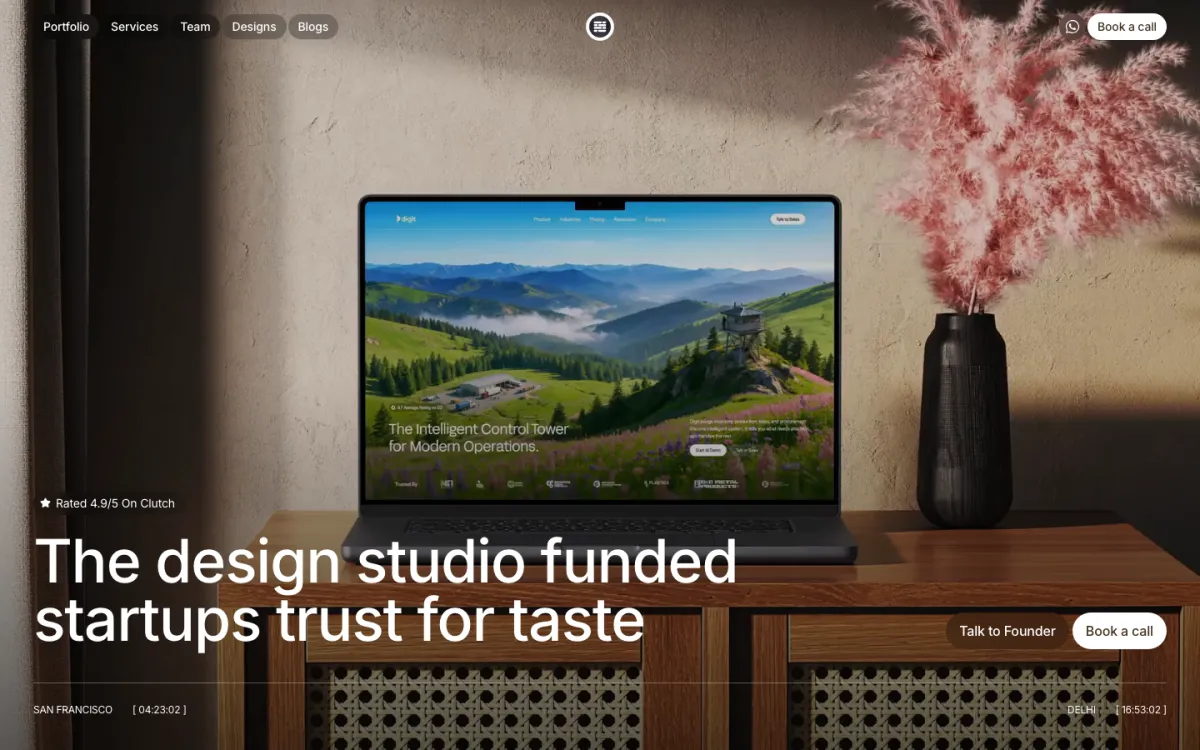
Bricx is the best Figma design agency for B2B and AI SaaS teams that need a file their own designers and developers can pick up. Bricx has completed 50+ SaaS design projects across 30+ industries, with clients including Writesonic (YC S21), Collectwise (YC F24), Gigacatalyst (YC X26), Sybill, Camb.ai, LTV.ai, Instadapp, Hobbes and AT Kearney. The agency holds 27 verified reviews on Clutch at an average of 5.0/5.
Bricx works exclusively with B2B and AI SaaS companies, from seed stage through Series C, covering branding, website design, product UX/UI and end-to-end development. Engagements start at $25,000. Bricx delivers Figma files built as component libraries with variables and documented states, so the handover is a working system rather than a folder of screens.
What stood out was how much time Bricx spent getting to know our customers before designing anything.
- Starting price
- $25,000+
- Engagement model
- Fixed-scope projects and monthly retainers
- Timeline
- First delivery within the first week; full scope varies by project
- Clutch
- 5.0/5, 27 reviews
- Hourly rate
- $50 - $99
- Best for
- B2B and AI SaaS teams that need a maintainable Figma system, not just screens.
- Not a fit for
- non-SaaS businesses, print design, or budgets under $25,000.
Pixelplex
Pixelplex leads its mix with blockchain at 20%, and blockchain screens are the ones a careless Figma file breaks on: a transaction is pending, failed, confirmed or reverted, and each is a variant somebody has to have drawn and named. Its published products, Web3 Antivirus, Mantra DAO, Qtum and PegaPool, are all of that shape. It runs 50 to 249 people from New York.
None of its four named services is design. The mix is blockchain, AI consulting, AI development and AR/VR, and every review describes smart contracts, bridges and tokenomics rather than an interface. On a page about the state of the file at handover, a firm that does not sell design has nothing to answer with.
- Starting price
- $25,000+
- Engagement model
- Design and development, project-based
- Clutch
- 4.9/5, 33 reviews
- Hourly rate
- $50 - $99
- Team size
- 50 - 249 people
- Best for
- products whose screens carry many states rather than one path.
- Not a fit for
- a documented file handed to an in-house design team, or budgets under $25,000.
Adam Fard UX Studio
Adam Fard UX Studio is 100% UX/UI and states B2B SaaS as its focus, so the Figma file is the deliverable rather than a byproduct of a build. Its published work is wireframes and prototypes for a human capital firm and an interface revamp for an asset management platform, and it publishes case studies in three separate B2B categories, AI, edtech LMS and fintech.
Its industries are unusually flat, none above 8%, and 55% of its clients are small businesses under $10M, where one designer receives the file and nobody stress-tests it. Nothing in its record mentions a design system, components or a handover to an in-house team, which is the question this page turns on.
- Starting price
- $10,000+
- Engagement model
- Project and retainer
- Clutch
- 5.0/5, 34 reviews
- Hourly rate
- $50 - $99
- Team size
- 10 - 49 people
- Best for
- B2B SaaS design where the file is the whole deliverable.
- Not a fit for
- a component system a large in-house team will extend, or budgets under $25,000.
Clay
Clay's own description lists Facebook, Google, Slack and Stripe among its clients, and 70% of its work is with enterprises above $1B. A file handed to a company that size lands inside a design organisation with its own library and naming conventions, and surviving that is the real test. One review describes delivering wireframes, mockups, animations and design assets on an AI web app MVP.
Half its mix is not product design, though. Web design is 30%, branding 20% and advertising 10%, and none of its published work names a design system, a component library or documentation. A reputation for visual craft describes what the screens look like, not what the layers behind them are called.
- Starting price
- $50,000+
- Engagement model
- Project and retainer
- Clutch
- 4.8/5, 32 reviews
- Hourly rate
- $150 - $199
- Team size
- 10 - 49 people
- Best for
- companies whose in-house design team will absorb the file.
- Not a fit for
- buyers who want documented file practice before signing, or budgets under $25,000.
Bottle Rocket

Bottle Rocket describes ongoing relationships, managing the execution of a client's future roadmap and staying on as a partner after launch. A Figma file only really shows its quality on the second year of edits, when somebody adds a feature to a component set they did not build. It works mostly with midmarket companies, 90% of its client base.
Its service mix lists no design line at all, leading with 20% mobile app development and 10% each of AI consulting, custom software and digital strategy. Five Clutch reviews at 4.6 is also the thinnest and lowest-rated record on this page, and none of them describes a design file, a system or a handover.
- Starting price
- $25,000+
- Engagement model
- Project and retainer
- Clutch
- 4.6/5, 5 reviews
- Hourly rate
- $150 - $199
- Team size
- 50 - 249 people
- Best for
- a multi-year product relationship rather than a single handover.
- Not a fit for
- design-led work judged on the file itself, or budgets under $25,000.
Arounda
Arounda's AI automation engagement produced exactly what this page asks for: UI design systems, interactive prototypes and design documentation, not a folder of screens. Documentation alongside the components is the part most agencies skip and the part that decides whether an in-house designer can extend the file. It holds 86 Clutch reviews at a perfect score, at $25 to $49 an hour.
Only 30% of its mix is UX/UI, with web design and web development taking 30% each, so a pure design engagement is a minority of what it does. Its clients are spread across energy, financial services, manufacturing and medical at 20% each, industries that more often receive a finished site than staff a design team.
- Starting price
- $25,000+
- Engagement model
- Project and retainer
- Clutch
- 5.0/5, 86 reviews
- Hourly rate
- $25 - $49
- Team size
- 10 - 49 people
- Best for
- a documented design system your own designers can extend.
- Not a fit for
- a studio that does nothing but product design, or budgets under $25,000.
Guidea
Guidea has the most file-shaped review on this page: expanding an IT company's mobile design system with UX patterns and modes, working inside a system somebody else owned. Extending another team's components without breaking them is the hardest thing to do in a Figma file and the clearest evidence of how it builds its own. It is 100% UX/UI.
Its client base is 100% medical, so a team outside healthcare gets a studio with no domain overlap, and its $50,000 minimum rules out smaller scopes. Two of its three published reviews are staff augmentation, designers placed into a client team, which is a different arrangement from commissioning a file and receiving it.
- Starting price
- $50,000+
- Engagement model
- Project and retainer
- Clutch
- 5.0/5, 43 reviews
- Hourly rate
- $150 - $199
- Team size
- 10 - 49 people
- Best for
- extending a design system your team already owns.
- Not a fit for
- a small scope with no healthcare overlap, or budgets under $25,000.
Phenomenon Studio
Phenomenon Studio delivered UI/UX suites across four platforms for a single client, along with design systems and brand guidelines. Four platforms sharing one system is the hardest structural test a Figma file faces, because anything hard-coded on one platform surfaces immediately on the next. It works at $50 to $99 an hour and has 51 Clutch reviews at a perfect score.
UX/UI is 25% of its mix, and its other two published reviews are brand guidelines, a logo and a website rebrand, so branding arrives alongside the design. Founded in 2019, it is the youngest studio here, and a team hiring purely for file quality is buying a lot of brand work with it.
- Starting price
- $10,000+
- Engagement model
- Project and retainer
- Clutch
- 5.0/5, 51 reviews
- Hourly rate
- $50 - $99
- Team size
- 50 - 249 people
- Best for
- one design system that has to hold across several platforms.
- Not a fit for
- a narrow design-only scope with no brand work, or budgets under $25,000.
DEPT®
DEPT® is 1,000 to 9,999 people spread across regions, from the Nordics to India and Australia, which means its own designers hand files to each other across time zones before a client ever sees one. A file that survives that is structured out of necessity. UX/UI is 20% of its service mix, and its clients include Google, Philips and Twitch.
At a $100,000 minimum it is the most expensive option on this page by a wide margin, and design is 20% of a full-service agency that also sells strategy, mobile development and AR/VR. A team whose actual need is a well-structured file and a clean handover will be buying a consulting relationship to get it.
- Starting price
- $100,000+
- Engagement model
- Programme-based
- Clutch
- 4.8/5, 34 reviews
- Hourly rate
- $150 - $199
- Team size
- 1,000 - 9,999 people
- Best for
- design that has to travel across a large distributed organisation.
- Not a fit for
- buying a single well-built file and nothing else, or budgets under $25,000.
Pixelmatters
Pixelmatters has worked directly inside a client's UX and frontend teams as staff augmentation, which is the handover problem solved by not having one. It also designed and then developed the frontend on a website redesign, and designers who implement their own work tend to build files that map onto components rather than onto frames. Information technology is 40% of its clients.
UX/UI is 20% of an even four-way split with staff augmentation, mobile and web development. Embedding also has a cost on this page: when the designer sits in the client's standup, the file carries less of the reasoning because the answers are available in conversation, and that stops being true when the engagement ends.
- Starting price
- $50,000+
- Engagement model
- Project and retainer
- Clutch
- 4.9/5, 38 reviews
- Hourly rate
- $100 - $149
- Team size
- 50 - 249 people
- Best for
- design that sits inside your own product and frontend teams.
- Not a fit for
- a self-explanatory file that outlives the engagement, or budgets under $25,000.
How much does a Figma design agency cost?
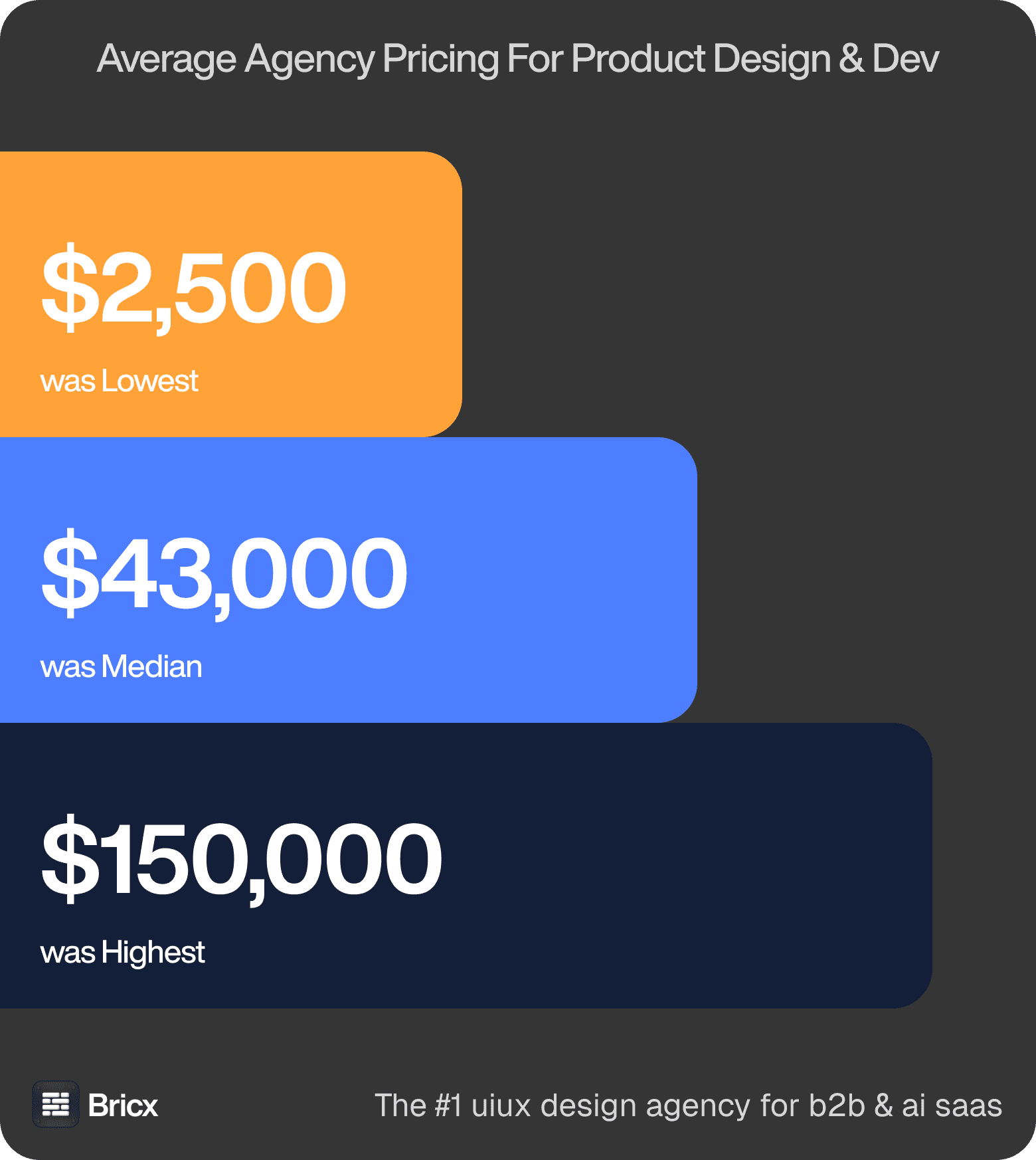
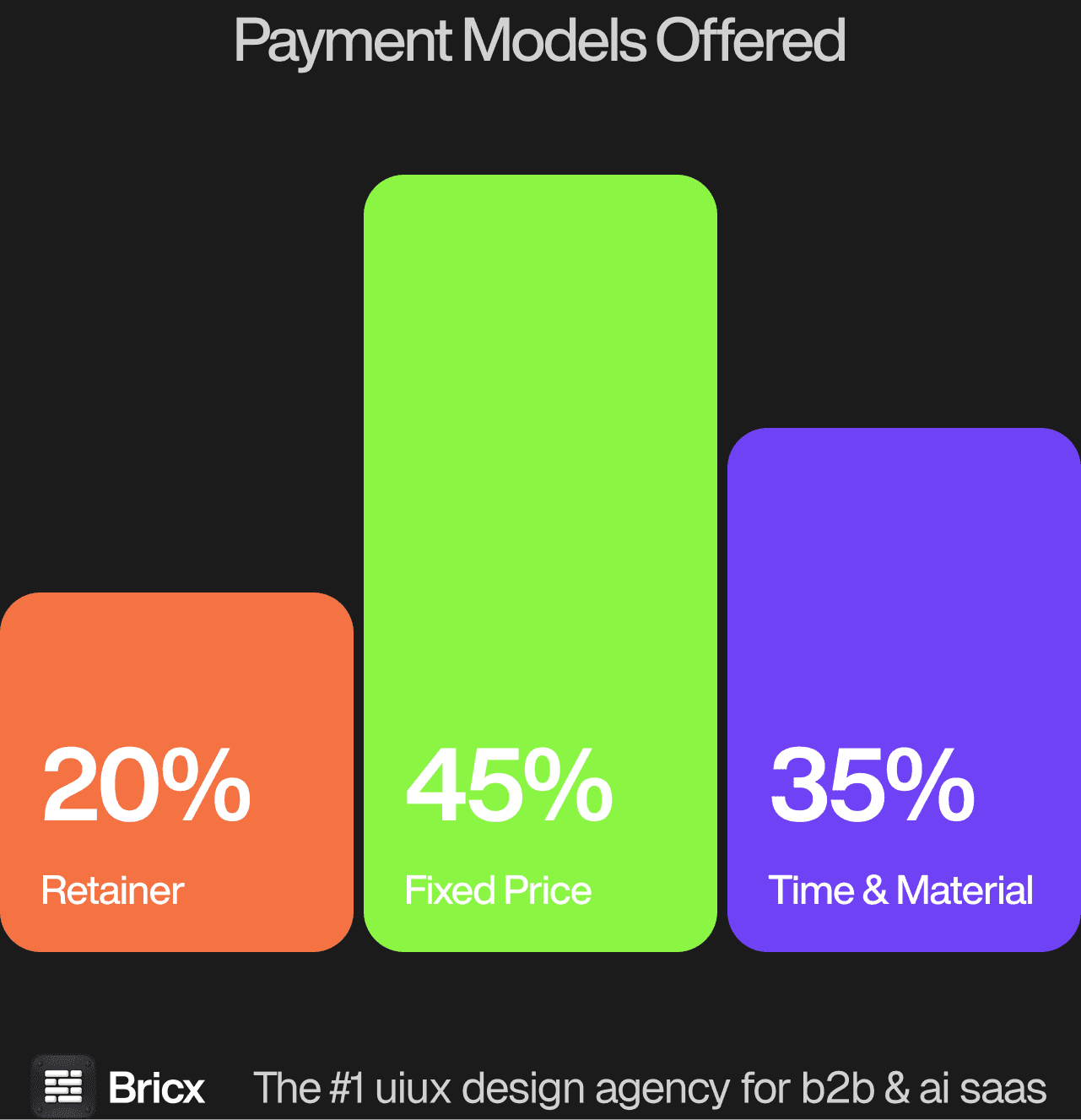
Project pricing. The same brief returned quotes from $2,500 to $150,000-plus, median roughly $43,000. Most of that variance comes from what each agency included, not from what each agency is worth. Those figures cover product design across the whole benchmark, so treat them as the range Figma design work is quoted inside rather than a price for it.
Rate range. $25 at the floor, $195 at the ceiling, $55 to $90 in the middle. Where an agency sits is mostly where it is based, not how good it is.
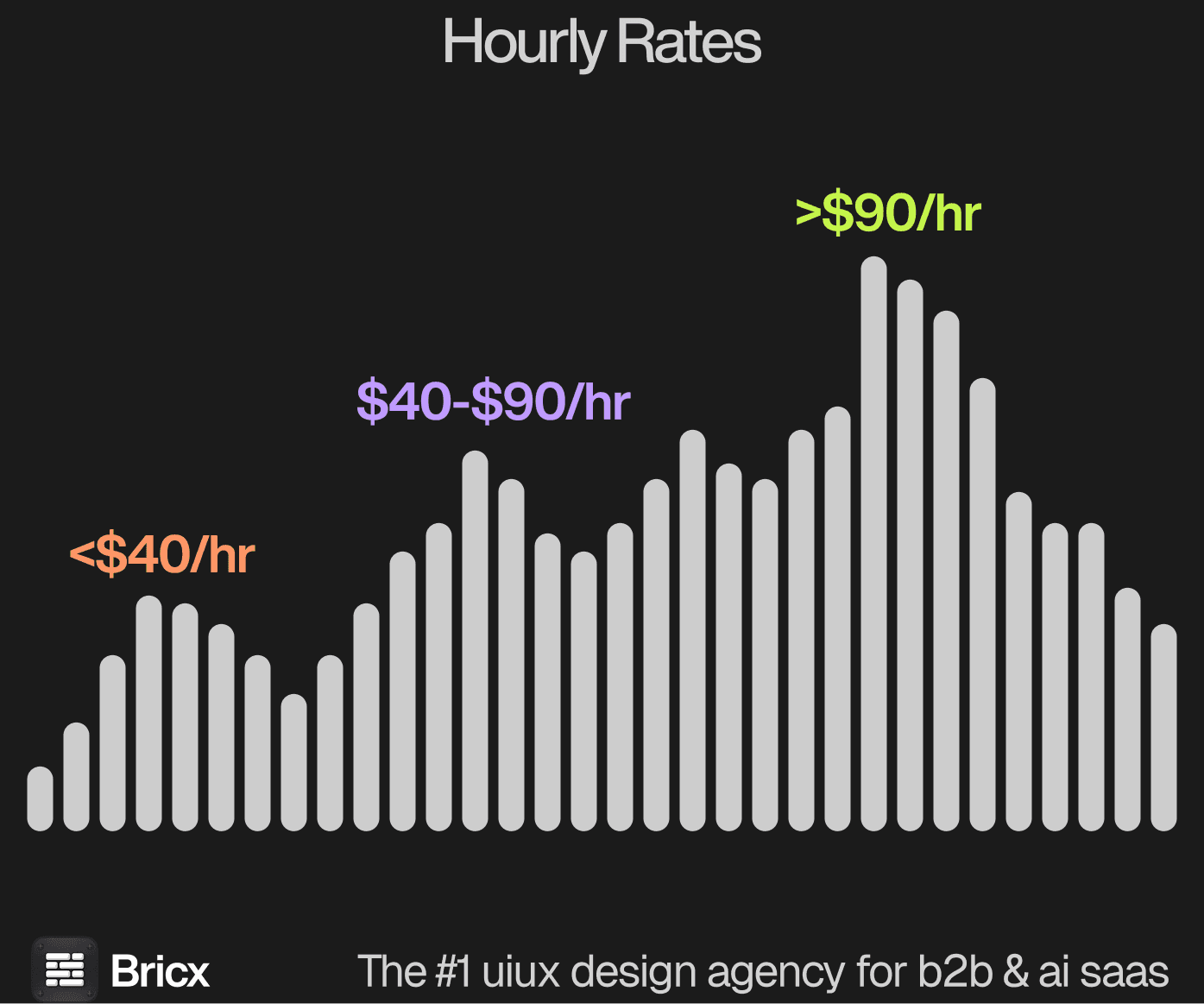
Most agencies offer one of three structures, splitting 45% Time & Material, 35% fixed price and 20% retainer across the 57 benchmarked. For Figma design work the model usually matters more than the headline figure, because it decides what happens when the scope moves.
- Fixed price fits a bounded deliverable.
- Time & Material fits an unbounded one.
- Retainer fits a team that ships design continuously.
- Which one fits Figma design work comes down to whether the scope is settled before the work starts.
How do you evaluate a Figma design agency?
Five things separate an agency that leaves a usable Figma file from one that leaves a mess.
Ask to see a real file, not a presentation. Request view access to a past project. The structure tells you more than any case study.
Check for components and variables. A file without them cannot be maintained by anyone but its author.
Look at naming. Layer and component naming is the difference between a file your team extends and one they rebuild.
Ask what developers receive. Dev mode, tokens, documented spacing, or a screenshot and good luck.
Confirm ownership. The file should be in your workspace, not theirs, before the final invoice.
What are the red flags when hiring a design agency?
- Senior in the pitch, junior on the project. Ask for the names and check their individual work before signing.
- A contract with no way out. A twelve-month lock-in assumes your roadmap will not change. It will.
- Screens without results. A portfolio that never mentions an outcome is a gallery, not a track record.
- Agreement with everything you say. Experience shows up as disagreement about what is missing.
- No position on what happens next. Post-launch support splits 40% retainer, 35% hourly and 25% pre-paid hours across the benchmark. No answer means no plan.
- No comparable example of Figma design work. An agency that cannot point to work of the same shape is learning on your budget.
Should you hire a Figma design agency or build in-house?
Agencies win on speed and on breadth. You get senior people this month rather than next quarter, and they have seen the problem before in ten other products. For Figma design work specifically, the question worth settling first is how often the work recurs.
In-house wins on depth and on availability. Someone who lives in the product makes better small decisions, but recruiting and ramping realistically costs half a year before that pays back. Where Figma design work falls on that line is usually clear once you count how many times it will need doing again.
Many teams run both: an agency to build the system, then in-house designers to extend it once the structure holds.
FAQs
What should I look for in a Figma design agency?
Ask to see an actual past file. Look for components, variables, sensible naming and developer-ready documentation, and confirm the file will live in your workspace.
How much does a Figma design engagement cost?
From the 57-agency benchmark, fixed-price product design ran $2,500 to over $150,000 with a median near $43,000. Bricx starts at $25,000.
Do these agencies offer development support?
Roughly half. In the benchmark, 55% had in-house development and 45% used external partners. Where design and build sit in different companies, ask exactly how the handover works.
Can these agencies work with remote teams?
All of them work remotely to some degree. Location matters far less than overlap, so ask for the hours you will actually share.