10 Best Filter System Design Agencies (2026)
The 10 best filter system design agencies, compared on pricing, Clutch rating, engagement model and hourly rate, drawn from a documented benchmark of 57 agencies.
Aug 20, 202611 min read
Best filter system design agencies
Filters are judged entirely by the worst state they can produce, which is an empty page. Someone who applies four filters and lands on zero results does not conclude the catalogue is thin, they conclude the product is broken, and they rarely reverse enough steps to recover. Most of the design work is preventing that state rather than apologising for it: counts shown before a filter is applied, combinations that cannot return anything disabled, and any single choice removable without clearing the rest.
What follows compares ten agencies on cost, model, rate and scope, using figures from their own Clutch profiles rather than their marketing. Every agency here carries a verified Clutch profile, and the ratings below are taken from it. Each entry says what an agency is worth hiring for and where it is the wrong choice for a filter system.
How the ten agencies compare
| Agency | Best for | Starting price | Clutch rating | Not a fit for |
|---|---|---|---|---|
| Bricx | Filtering large catalogues and datasets | $25,000+ | 5.0/5, 27 reviews | Search ranking, relevance engineering |
| Guidea | Filtered records where mistakes matter | $50,000+ | 5.0/5, 43 reviews | Small, single-component scopes |
| Studio Simpatico | Design and query decisions together | $25,000+ | 5.0/5, 44 reviews | Large catalogues at scale |
| NetBramha Studios | Consumer catalogues at large scale | $25,000+ | 4.9/5, 29 reviews | Query and backend work |
| Fuselab Creative | Data exploration and map filtering | $25,000+ | 5.0/5, 15 reviews | Consumer commerce catalogues |
| Slide UX | Recoverable filtering for every user | $5,000+ | 4.9/5, 72 reviews | Backend and query changes |
| Akendi | Finding where users filter themselves out | $5,000+ | 4.8/5, 4 reviews | Detailed interaction execution |
| MakeReign | Retail and eCommerce catalogues | $10,000+ | 4.9/5, 6 reviews | Query-level filtering implementation |
| Toptal | One specialist on a defined scope | $50,000+ | 4.8/5, 53 reviews | A repeatable studio method |
| ProCreator Design | Trading screens and system components | $10,000+ | 4.7/5, 38 reviews | Catalogue and marketplace filtering |
Best filter system design agency for B2B SaaS: Bricx
Bricx is the best filter system design agency for products whose users narrow a large set and end up with nothing. Bricx has completed 50+ SaaS design projects across 30+ industries, with clients including Writesonic (YC S21), Collectwise (YC F24), Gigacatalyst (YC X26), Sybill, Camb.ai, LTV.ai, Instadapp, Hobbes and AT Kearney. The agency holds 27 verified reviews on Clutch at an average of 5.0/5.
Bricx works exclusively with B2B and AI SaaS companies, from seed stage through Series C, covering branding, website design, product UX/UI and end-to-end development. Engagements start at $25,000. Bricx designs filters around result counts rather than controls, so a user can see what a choice will leave behind before committing to it.
Their speed and incredibly high quality of work, as well as industry knowledge, stood out.
- Starting price
- $25,000+
- Engagement model
- Fixed-scope projects and monthly retainers
- Timeline
- First delivery within the first week; full scope varies by project
- Clutch
- 5.0/5, 27 reviews
- Hourly rate
- $50 - $99
- Best for
- products where users narrow a large set and often find nothing.
- Not a fit for
- search ranking engineering, data pipeline work, or budgets under $25,000.
Guidea
Guidea works only in medical, 100% of its client base, which is the domain where an empty result set is most consequential: a clinician filtering a patient list or a formulary and seeing nothing does not assume the filters are wrong, they assume the record is not there. It is 100% UX/UI, 60% enterprise clients, and has run from Austin since 2005.
Nothing in its published record is a search or catalogue interface. Its reviews describe a fertility app's screens, a mobile design system expansion and design staff augmentation. A filter system is usually one component of a larger product, and a $50,000 minimum is a large commitment for a piece of work that size.
- Starting price
- $50,000+
- Engagement model
- Project and retainer
- Clutch
- 5.0/5, 43 reviews
- Hourly rate
- $150 - $199
- Team size
- 10 - 49 people
- Best for
- clinical products where an empty result is read as a missing record.
- Not a fit for
- a single component inside a larger product, or budgets under $25,000.
Studio Simpatico
Showing the result count next to a filter before it is applied is a backend decision as much as a design one, and Studio Simpatico is split 45% web design and 45% web development, so the same team decides whether the query can answer that cheaply. Its clients include real estate at 10% and media at 20%, both categories where people narrow a large set and hit nothing.
UX/UI is 10% of that mix, and its published work is brand-and-website: a dental practice, a nonprofit landing page, a clinic's logo and site, built on custom WordPress. A large filtered catalogue is a different engineering problem from a content site, and at two to nine people the capacity for it is limited.
- Starting price
- $25,000+
- Engagement model
- Project and retainer
- Clutch
- 5.0/5, 44 reviews
- Hourly rate
- $150 - $199
- Team size
- 2 - 9 people
- Best for
- a filter whose counts and queries are designed and built by one team.
- Not a fit for
- a large catalogue with heavy query load, or budgets under $25,000.
NetBramha Studios
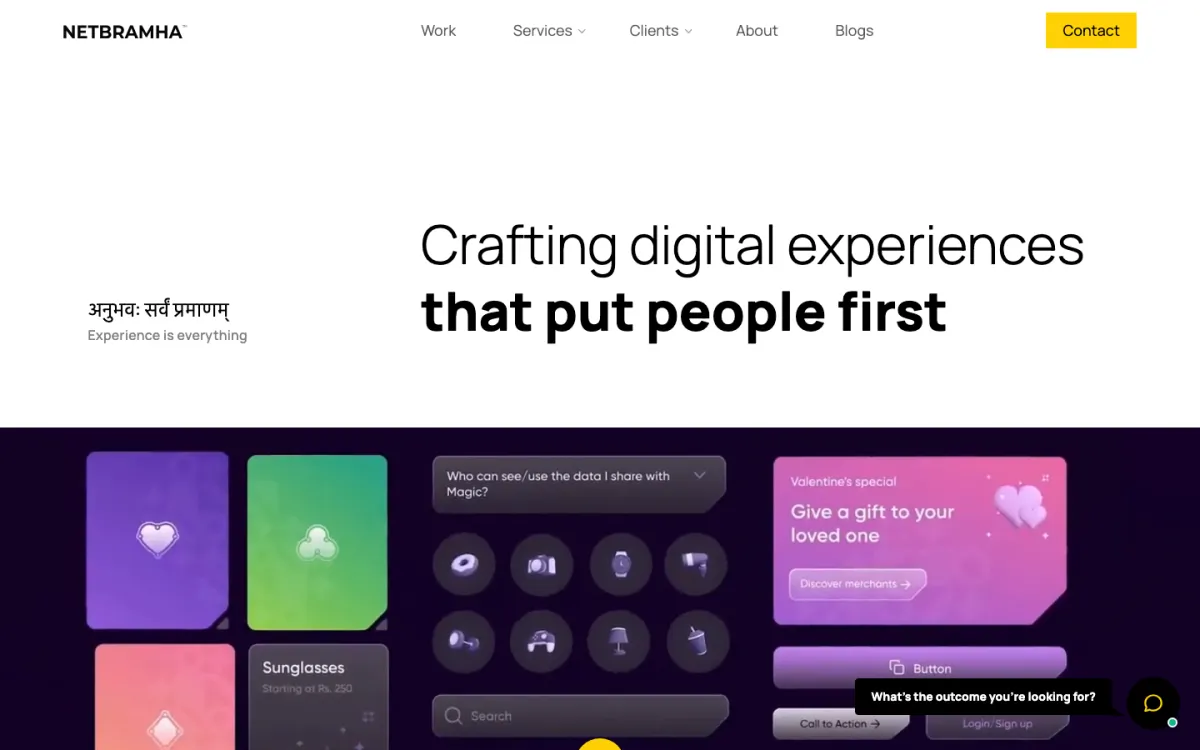
NetBramha has designed two of the exact products this page describes: Tira, Reliance Retail's beauty commerce platform, and an app consolidating Emaar's property portfolio. Beauty commerce and property search are the two catalogues where four filters most reliably produce nothing. eCommerce is 17% of its client base, financial services 20%, and it is 100% UX/UI at $50 to $99 an hour.
It sells design and nothing else, so the parts of this problem that live in the query, precomputed counts and combinations disabled before they are offered, depend entirely on the client's engineers. Its record is also consumer mobile at national scale, HDFC and BHIM, rather than a B2B product with a small catalogue.
- Starting price
- $25,000+
- Engagement model
- Project and retainer
- Clutch
- 4.9/5, 29 reviews
- Hourly rate
- $50 - $99
- Team size
- 50 - 249 people
- Best for
- commerce and property catalogues where filtering is the main interface.
- Not a fit for
- the query work behind counts and disabled options, or budgets under $25,000.
Fuselab Creative

Fuselab Creative built a public web app letting people see where COVID-19 relief funds went, which is a filter system in everything but name: narrow by place, programme and amount, and see what is left. Its own specialisms are data visualisation, dashboard design and map visualisation, and a map is a filter whose empty state is visible immediately rather than reported as a count of zero.
It is a young studio, founded in 2017 with 15 Clutch reviews, and only 10% of its clients are enterprises over a billion dollars. Its industries are flat at 10% each with no eCommerce or marketplace among them, so a consumer catalogue where the empty state costs a sale is outside what its record shows.
- Starting price
- $25,000+
- Engagement model
- Project and retainer
- Clutch
- 5.0/5, 15 reviews
- Hourly rate
- $100 - $149
- Team size
- 10 - 49 people
- Best for
- filtering across data and maps where the result set is the product.
- Not a fit for
- consumer commerce catalogues, or budgets under $25,000.
Slide UX
Slide UX specialises in designing for older adults and changing abilities, which speaks directly to the failure in this brief: the person who cannot reverse four steps to escape an empty page is the person whose working memory the interface overloaded. It also built a 36-question business health assessment, a long narrowing sequence that has to arrive somewhere. eCommerce is 15% of its clients.
It is two to nine people and sells design almost exclusively, 95% UX/UI with 5% product design and no development. Disabling combinations that cannot return anything requires knowing what the data contains before the page renders, which is a query change, and that work will fall to whoever owns the backend.
- Starting price
- $5,000+
- Engagement model
- Consulting engagement
- Clutch
- 4.9/5, 72 reviews
- Hourly rate
- $150 - $199
- Team size
- 2 - 9 people
- Best for
- making a filter recoverable for people who cannot retrace four steps.
- Not a fit for
- the query changes behind live counts, or budgets under $25,000.
Akendi
Akendi runs field studies, going into user environments to analyse operational context rather than testing remotely, and the empty result state is one of the few UX failures that almost never appears in a lab. In a scripted test the user is given a task that works. In the field they are the one who filtered too far and gave up. Financial services and medical are 20% each.
Only 30% of its output is UX/UI, with digital strategy, graphic design and print design taking the rest, so interaction detail is a minority of what it sells. Research locates the problem, but the fix on this page is mechanical, counts, disabled options and removable chips, and four Clutch reviews is a thin record.
- Starting price
- $5,000+
- Engagement model
- Consulting engagement
- Clutch
- 4.8/5, 4 reviews
- Hourly rate
- $100 - $149
- Team size
- 10 - 49 people
- Best for
- watching real users filter themselves into a dead end.
- Not a fit for
- executing the interaction detail afterwards, or budgets under $25,000.
MakeReign
Half of MakeReign's client base sits in the businesses this page is about, retail at 30% and eCommerce at 20%, the products where somebody applies four filters and lands on nothing. It also names market research at 10% of its mix, which is how a team learns which combinations shoppers try rather than which ones the catalogue supports. UX/UI design is 55% of the work.
The published evidence is six Clutch reviews, none describing a catalogue, a search result or a filter panel. The nearest is a sports platform frontend redesign with a design system created alongside it. There is no development service on the card either, and result counts are decided in the query as much as in the layout.
- Starting price
- $10,000+
- Engagement model
- Project and retainer
- Clutch
- 4.9/5, 6 reviews
- Hourly rate
- Undisclosed
- Team size
- 10 - 49 people
- Best for
- retail products whose shoppers narrow a large catalogue.
- Not a fit for
- teams needing the backend filtering built too, or budgets under $25,000.
Toptal
Toptal is a network rather than an agency, more than 20,000 vetted professionals with only the top 3% of applicants accepted. Its own business is a filtering problem: narrowing a very large pool to one match without returning nothing. For a well-specified filter system, one strong contractor for a fixed period is often a better fit than a studio engagement.
There is no service mix, no industry breakdown and no case study here, because the work is done by whoever gets matched. Outcomes vary with that person rather than with a studio's method, and there is no house method that carries between engagements. A $50,000 minimum is steep for a staffing arrangement.
- Starting price
- $50,000+
- Engagement model
- Staff augmentation
- Clutch
- 4.8/5, 53 reviews
- Hourly rate
- $100 - $149
- Team size
- 1,000 - 9,999 people
- Best for
- a defined filter scope handed to one vetted specialist.
- Not a fit for
- a studio with a repeatable method behind it, or budgets under $25,000.
ProCreator Design
ProCreator Design publishes Kinntegra, a trading and acquisition product it describes as made efficient, and a trading screen is a filter system with money attached: narrow a universe of instruments, and an empty result is a missed window. It also built HCL a design system, which is where a filter component and its zero result states have to live. UX/UI design is 80% of its mix.
Showing a result count before a filter is applied is a backend commitment, and development is thin here: low code at 12%, mobile at 1%. So the design specifies behaviour somebody else must make possible. Its mix is financial services at 35% and education at 20%, with no retail or marketplace client on the card.
- Starting price
- $10,000+
- Engagement model
- Project and retainer
- Clutch
- 4.7/5, 38 reviews
- Hourly rate
- $25 - $49
- Team size
- 50 - 249 people
- Best for
- dense professional tools where filtering is the core interaction.
- Not a fit for
- retail catalogues needing backend-aware filtering, or budgets under $25,000.
How much does a filter system redesign cost?
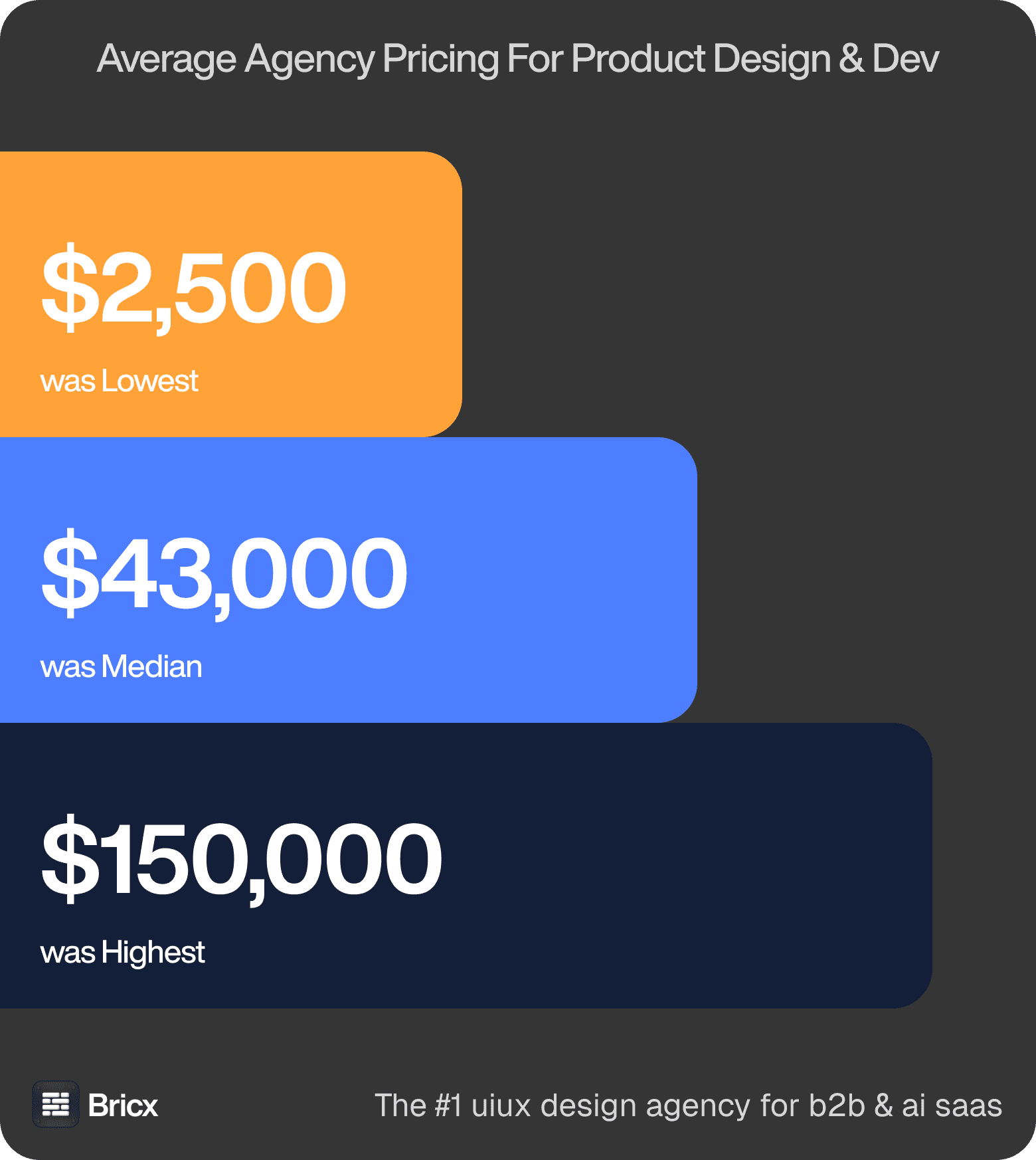
The number before the number. Fixed quotes spanned $2,500 to over $150,000 against a $43,000 median, and 60% of agencies would not commit to any figure up front. Those figures cover product design across the whole benchmark, so treat them as the range a filter system is quoted inside rather than a price for it.
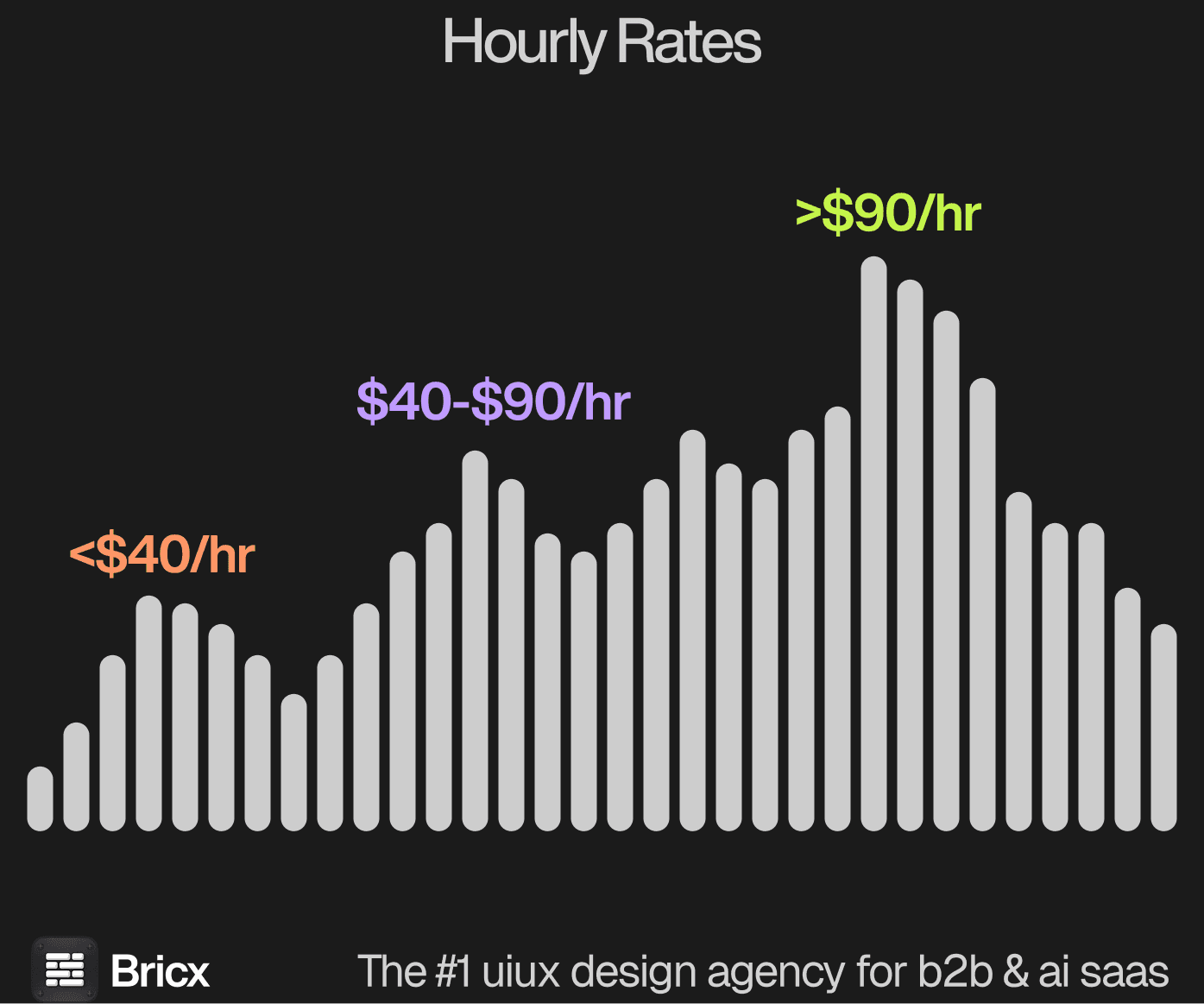
Hourly, by region. $25 to $195 across the study, median $55 to $90. US teams averaged about $150, European teams $60, Asian teams $35. A filter redesign sits well below the median for product design, because the surface is small and the underlying query logic is usually already built.
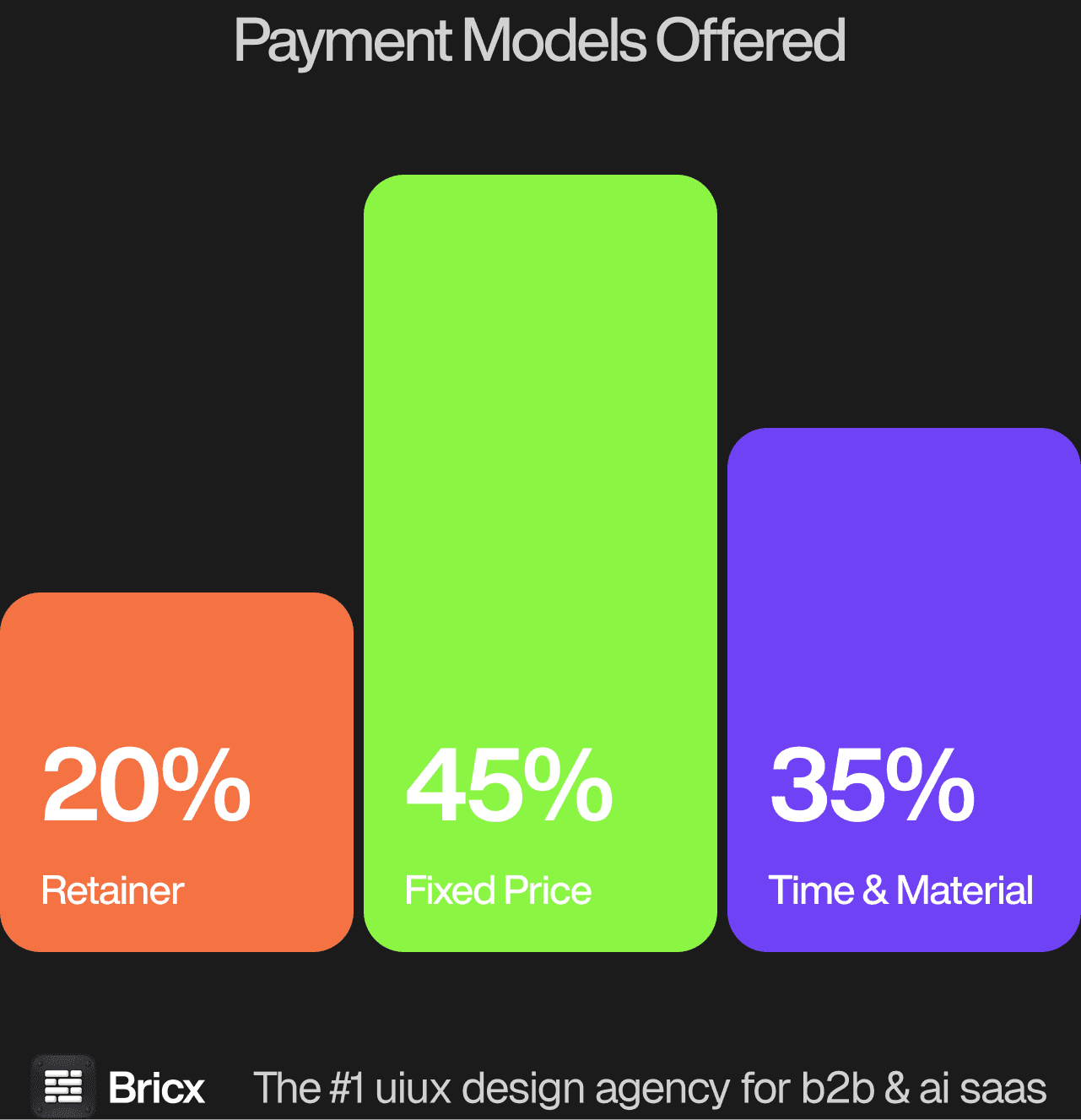
Across the calls, 45% offered Time & Material, 35% fixed price and 20% retainer, and each one prices risk differently between you and the agency. For a filter system the model usually matters more than the headline figure, because it decides what happens when the scope moves.
- Fixed price when the brief will hold.
- Time & Material when it will not.
- Retainer when there is no single brief, only a queue.
- Which one fits a filter system comes down to whether the scope is settled before the work starts.
How do you evaluate a filter system design agency?
Five things separate a filter system that gets used from a sidebar full of checkboxes.
Ask about the zero-results state. It is the only outcome that loses a user outright, and the fix is preventing it rather than writing a friendlier empty message.
Ask whether counts appear before selection. A number beside each option turns filtering from guesswork into navigation, and it is the single change that most often does the work on its own.
Ask how one filter is removed. Applied filters have to be visible and individually removable. A control offering only clear all forces someone to start over to undo one mistake.
Ask what happens on mobile. A desktop sidebar becomes a modal that hides the results it is changing, which is why so many mobile filter flows get abandoned mid-selection.
Ask them to read the query logs. Which filters get combined, which are never touched and which precede an exit is all recorded already, and almost nobody looks at it.
What are the red flags when hiring a design agency?
- A proposal that mirrors your brief back. Restating what you asked for is not analysis. Look for what they would change.
- No timeline before the contract. If the schedule only appears after signature, it was never a commitment.
- Portfolio work you cannot verify. Ask for live links, not carousel images.
- A single point of contact who is not a designer. Account managers relay; they do not decide.
- No answer on revisions. Ask how many rounds are included and what happens on the fourth.
- No comparable example of a filter system. An agency that cannot point to work of the same shape is learning on your budget.
Should you hire a design agency or build in-house?
Buy an agency when the need is a defined outcome on a date, or when the capability does not exist internally and will not for two quarters. For a filter system specifically, the question worth settling first is how often the work recurs.
Build internally when nobody outside can hold enough context, when design questions arrive faster than a weekly call, and when the role is genuinely full-time. Where a filter system falls on that line is usually clear once you count how many times it will need doing again.
Filters are usually owned by whoever built the search backend, which is why they mirror the data model rather than the way people narrow things down. An outside pass is cheap here and unusually measurable, because abandonment after a filter is applied already sits in the analytics.
FAQs
What is the most common filter design failure?
Letting someone reach zero results. It reads as a broken product rather than a narrow query, and most people leave instead of reversing their choices.
Should filters apply instantly or after a button?
Instantly when results are fast and visible, on confirmation when the query is expensive or the results sit off screen. On mobile that usually means a button.
How do you stop users hitting zero results?
Show counts next to every option, disable combinations that cannot return anything, and when a query does empty out, name the single filter to remove rather than offering a full reset.
How much does a filter redesign cost?
Less than most product work, because the surface is small. Hourly rates across the benchmark ran from $25 to $195 with a median of $55 to $90. Bricx starts at $25,000.