10 Best Framer Design Agencies (2026)
The 10 best Framer design agencies, compared on pricing, Clutch rating, engagement model and hourly rate, drawn from a documented benchmark of 57 agencies.
Aug 20, 202611 min read
Best Framer design agencies
Framer is the smallest of the three mainstream platforms and the fastest to ship on. In the benchmark behind this article it accounted for 10% of agencies against Webflow at 65% and WordPress at 25%. That scarcity is the thing to plan around: fewer agencies genuinely specialise in it, and if the relationship ends you have a smaller pool to pick up the work.
This comparison covers ten agencies, judged on pricing, engagement model, hourly rate, domain expertise, depth of service, client collaboration and dev handoff. Every agency here carries a verified Clutch profile, and the ratings below are taken from it. Each entry says what an agency is worth hiring for and where it is the wrong choice for a Framer build.
How the ten agencies compare
| Agency | Best for | Starting price | Clutch rating | Not a fit for |
|---|---|---|---|---|
| Bricx | Fast Framer builds for SaaS | $25,000+ | 5.0/5, 27 reviews | Large CMS operations, in-product UX |
| Embacy | Sites with a working content system | $10,000+ | 5.0/5, 66 reviews | Documented Framer specialism |
| Merge Rocks | Discovery to build on one contract | $10,000+ | 4.9/5, 67 reviews | Proven Framer-specific fluency |
| Spaceberry Studio | Iterative design, shipped in pieces | $10,000+ | 5.0/5, 49 reviews | Owning the build in Framer |
| Qubika | Bench depth and embedded designers | $10,000+ | 4.9/5, 61 reviews | Marketing site craft in Framer |
| Zensite | Subscription design, fast turnarounds | $10,000+ | 4.8/5, 6 reviews | Large builds, verified track record |
| Humbleteam | Brand and design for AI companies | $5,000+ | 4.9/5, 35 reviews | Building and publishing the site |
| Outcrowd | Ongoing design for SaaS startups | $5,000+ | 4.9/5, 78 reviews | Owning the published build |
| Phenomenon Studio | Bench depth for corporate sites | $10,000+ | 5.0/5, 51 reviews | Fast, narrow platform builds |
| Viget | Choosing the platform on merit | $25,000+ | 4.8/5, 7 reviews | Cheap, fast hosted builds |
Best Framer design agency for B2B SaaS: Bricx
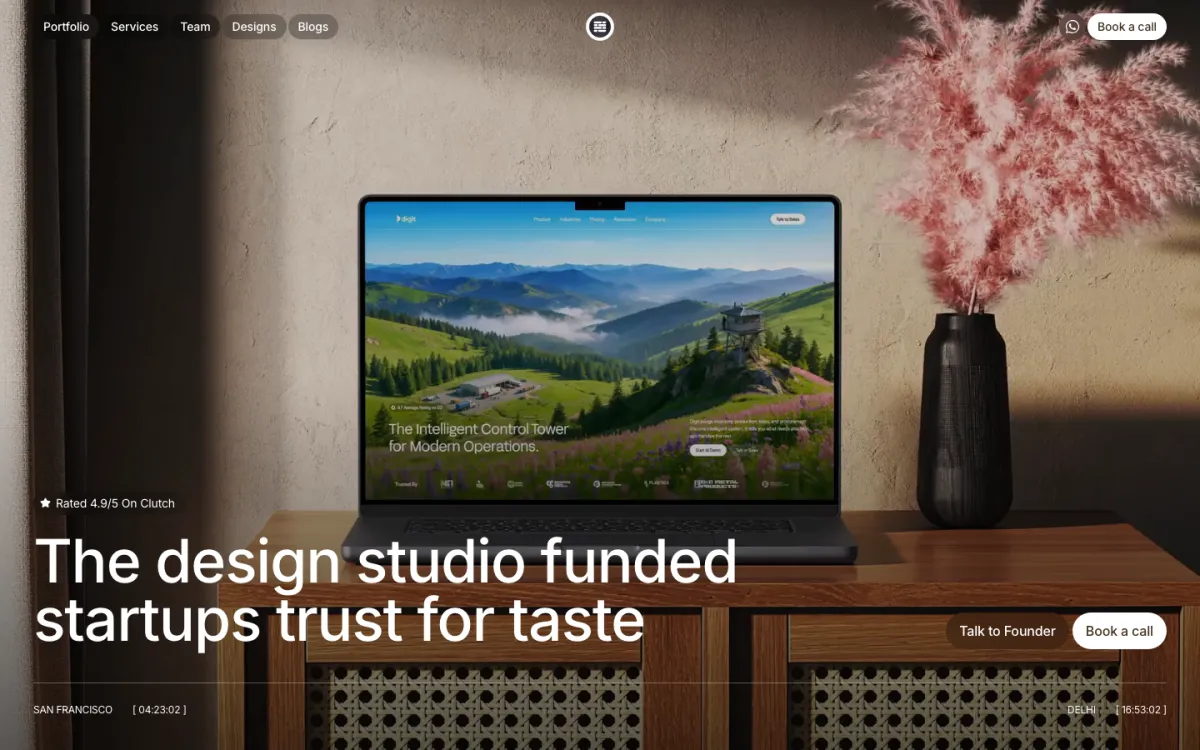
Bricx is the best Framer design agency for B2B and AI SaaS companies that want a site live in days rather than a quarter. Bricx has completed 50+ SaaS design projects across 30+ industries, with clients including Writesonic (YC S21), Collectwise (YC F24), Gigacatalyst (YC X26), Sybill, Camb.ai, LTV.ai, Instadapp, Hobbes and AT Kearney. The agency holds 27 verified reviews on Clutch at an average of 5.0/5.
Bricx works exclusively with B2B and AI SaaS companies, from seed stage through Series C, covering branding, website design, product UX/UI and end-to-end development. Engagements start at $25,000. Bricx builds in Framer where speed is the priority and in Webflow where the CMS has to carry a large content operation, and will say which one fits before the engagement starts rather than defaulting to house preference.
All was delivered on time with high standards of communication.
- Starting price
- $25,000+
- Engagement model
- Fixed-scope projects and monthly retainers
- Timeline
- First delivery within the first week; full scope varies by project
- Clutch
- 5.0/5, 27 reviews
- Hourly rate
- $50 - $99
- Best for
- B2B and AI SaaS companies that need a site live quickly.
- Not a fit for
- large content operations better suited to Webflow, or budgets under $25,000.
Embacy
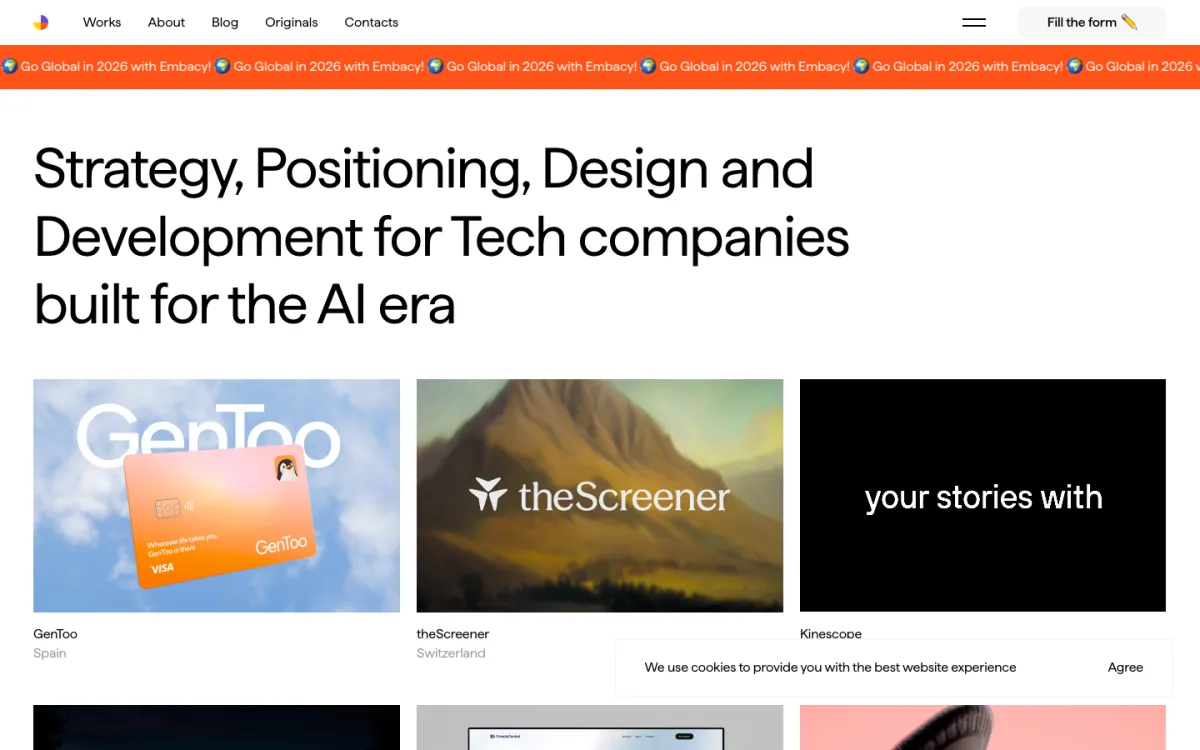
Embacy is one of the few agencies here that lists low/no code development as its own service line, at 10%, alongside 55% web design. On a venture capital platform it built the CMS as well as the site, so the marketing team could keep publishing afterwards, which is the question that decides whether a fast build stays useful. Financial services is 35% of its clients.
No review names Framer, and low/no code is 10% of the mix against 55% web design, so most of what it builds is not on this platform. Branding is another 15%, so a Framer-only engagement is a narrow slice of what it usually sells, and scarcity means asking directly which platform its team works in.
- Starting price
- $10,000+
- Engagement model
- Project and retainer
- Clutch
- 5.0/5, 66 reviews
- Hourly rate
- $50 - $99
- Team size
- 10 - 49 people
- Best for
- a fast site plus the content system a marketing team will run.
- Not a fit for
- a team whose documented depth is specifically Framer, or budgets under $25,000.
Merge Rocks
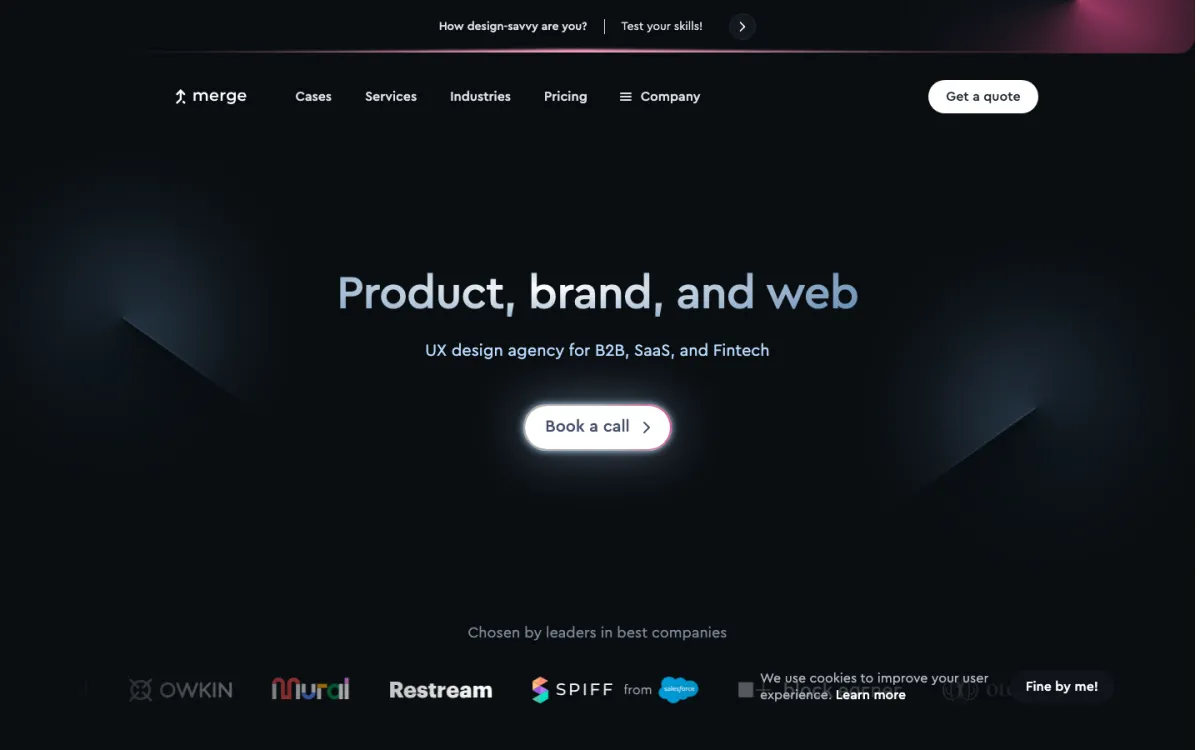
Merge Rocks carries a real build line, 20% web design and 20% web development against 60% UX/UI, and its published cases are the audience this page serves: B2B SaaS, fintech and AI. It has handled discovery, design and development on one contract, which is what makes a days-not-quarters timeline possible, since the handoff is usually where the weeks go.
Two of its three published reviews name Webflow as the platform, and none names Framer, so its documented no-code depth is on the larger platform rather than this one. That is worth pressing on, because the scarcity this page describes only bites if the team you hire is genuinely fluent in Framer rather than adapting.
- Starting price
- $10,000+
- Engagement model
- Project and retainer
- Clutch
- 4.9/5, 67 reviews
- Hourly rate
- $25 - $49
- Team size
- 10 - 49 people
- Best for
- one team taking a B2B SaaS site from discovery to live.
- Not a fit for
- a team with proven Framer-specific depth, or budgets under $25,000.
Spaceberry Studio
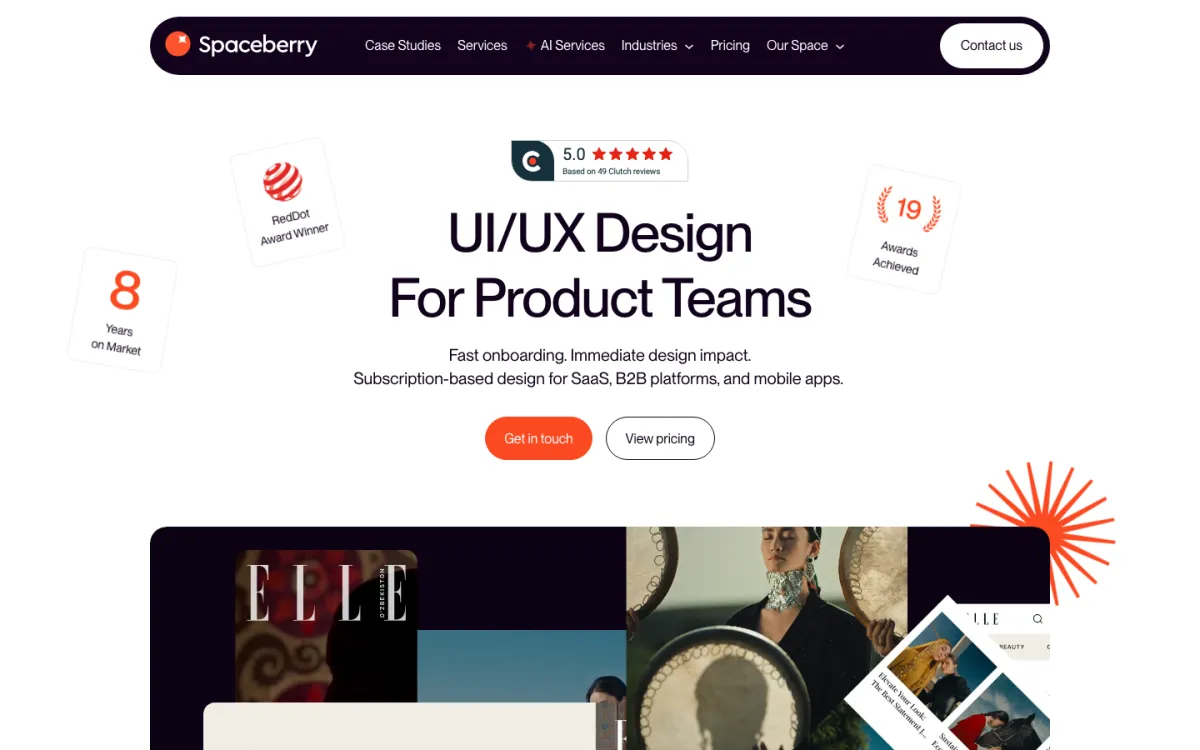
Spaceberry Studio delivered a packaging intelligence platform iteratively rather than as one handover, and iterative delivery is the working rhythm Framer rewards, since publishing is instant and a section can go live before the rest is decided. It produced a UX/UI design guide on another engagement, financial services and medical are 35% each, and it has 49 Clutch reviews at a perfect score.
Its service mix is 100% UX/UI, with no development or no-code line at all, so the Framer build itself goes to somebody else and the speed advantage depends on who that is. Founded in 2020, it is also the youngest studio on this page, and no review names a platform of any kind.
- Starting price
- $10,000+
- Engagement model
- Project and retainer
- Clutch
- 5.0/5, 49 reviews
- Hourly rate
- $50 - $99
- Team size
- 10 - 49 people
- Best for
- designing a site in increments that can go live as they land.
- Not a fit for
- an agency that builds and publishes in Framer itself, or budgets under $25,000.
Qubika

The risk this page names is continuity, having a smaller pool to pick the work up if the relationship ends. Qubika is 250 to 999 people and one of its reviews describes supplying a product designer into a client's own team, which is the arrangement that keeps knowledge in the building rather than at the agency. Financial services and medical are 40% each.
Its service mix carries no web design and no web development, leading with 30% AI development and 30% cloud consulting, and its published work is mobile engineering, code refactoring and a Databricks data warehouse. Nothing there is a marketing site on any platform, let alone this one, so the fit is capacity rather than craft.
- Starting price
- $10,000+
- Engagement model
- Programme-based
- Clutch
- 4.9/5, 61 reviews
- Hourly rate
- $50 - $99
- Team size
- 250 - 999 people
- Best for
- long-term capacity, including designers embedded in your team.
- Not a fit for
- marketing site craft on this platform, or budgets under $25,000.
Zensite
Zensite carries the largest low/no code share on this page at 15%, and sells design as a subscription with stated 24-hour turnarounds, cancellable at any time. That is the commercial shape of the speed argument here: a site live in days needs an agency whose billing does not assume a quarter. Its clients include PropertyGuru and Coin Market Manager.
Its own description says Webflow development, not Framer, and one review describes a redesign that ran six months, which sits oddly beside a 24-hour turnaround claim. Seventy percent of its clients are small businesses under $10M and six Clutch reviews is the thinnest public record on this page.
- Starting price
- $10,000+
- Engagement model
- Monthly subscription
- Clutch
- 4.8/5, 6 reviews
- Hourly rate
- $50 - $99
- Team size
- 10 - 49 people
- Best for
- a subscription arrangement that matches how fast this platform ships.
- Not a fit for
- a large build backed by a deep public record, or budgets under $25,000.
Humbleteam
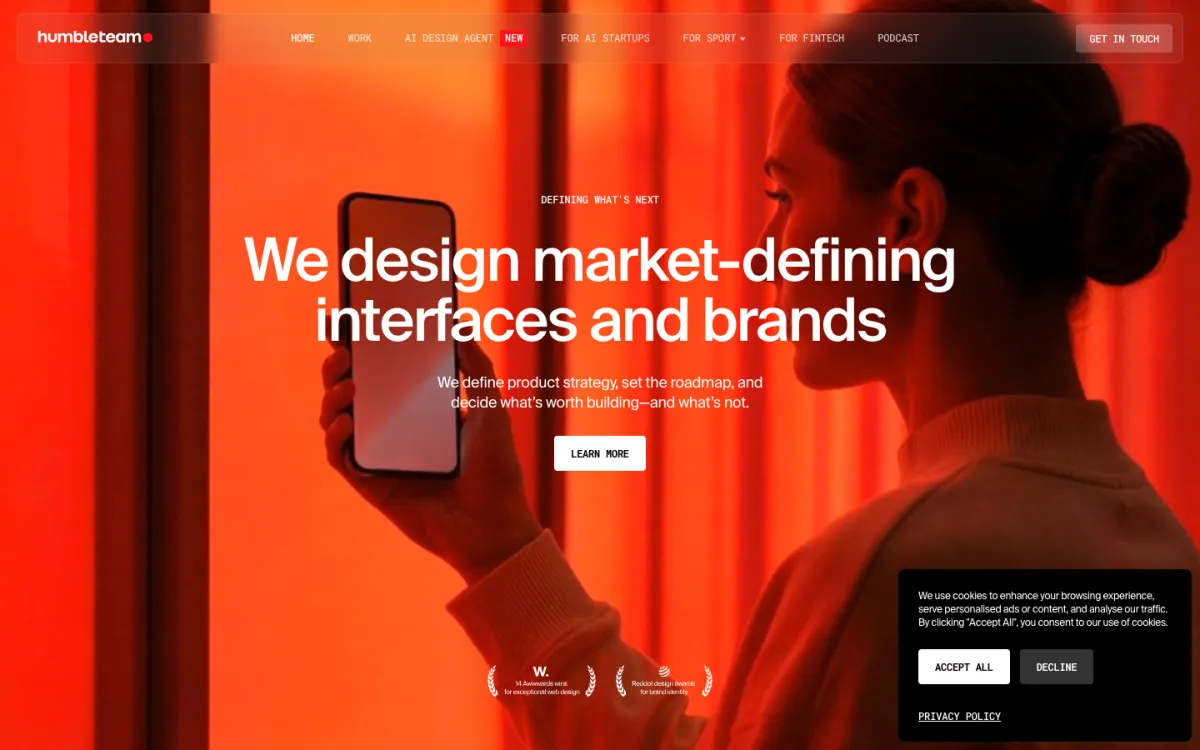
Humbleteam's published case studies are ChatGPT, Claude and Perplexity, which is the fastest-moving corner of the market and the one where a site is expected to change every few weeks rather than every few quarters. Web design is 30% of its mix alongside 30% branding, financial services is 30% of its clients, and its minimum is $5,000, the lowest on this page.
Its service mix has no development or no-code line at all, and its reviews end at the file: brand guidelines, marketing assets, data visualisations and an interactive Figma prototype the client presented. Somebody else publishes the site, which removes the thing that makes this platform fast, one team designing and shipping in the same tool.
- Starting price
- $5,000+
- Engagement model
- Project and retainer
- Clutch
- 4.9/5, 35 reviews
- Hourly rate
- $50 - $99
- Team size
- 10 - 49 people
- Best for
- the brand and page design for a fast-moving AI product.
- Not a fit for
- building and publishing the site itself, or budgets under $25,000.
Outcrowd
Outcrowd's line is design and brand acceleration for SaaS startups, and one of its engagements is ongoing, redeveloping a client's day-to-day design assets rather than delivering a launch and leaving. Speed on this platform is worth paying for only if the site keeps changing after it goes live. Information technology is 40% of its clients and it holds 78 Clutch reviews.
There is no development or no-code line in its mix, and its website work is described as information architecture, user flows and wireframes, which stops short of a published page. With 20% branding and 15% graphic design, a Framer engagement here means design and asset production while somebody else owns the build.
- Starting price
- $5,000+
- Engagement model
- Project and retainer
- Clutch
- 4.9/5, 78 reviews
- Hourly rate
- $50 - $99
- Team size
- 10 - 49 people
- Best for
- continuous design and asset work after a site is live.
- Not a fit for
- owning the build and publishing it, or budgets under $25,000.
Phenomenon Studio
Phenomenon Studio is 50 to 249 people, the second largest agency here, which speaks to the continuity risk this page raises: a bigger bench is a bigger pool to pick the work back up. It carries 15% web development as a real line, and its published work includes two corporate sites and an XR studio's website built around page layout.
Its mix has no low/no code line at all and no review names a platform, so nothing here confirms Framer specifically. Every published review also includes brand guidelines or a rebrand alongside the site, which means a fast, narrow build is not the shape of work this studio usually sells.
- Starting price
- $10,000+
- Engagement model
- Project and retainer
- Clutch
- 5.0/5, 51 reviews
- Hourly rate
- $50 - $99
- Team size
- 50 - 249 people
- Best for
- corporate site work backed by a team that will still be there.
- Not a fit for
- a fast, narrow build with no brand work attached, or budgets under $25,000.
Viget
Viget recommended Craft CMS to an IT services client specifically for its customisability, which is the behaviour worth having on a platform page: an agency that argues about the tool rather than defaulting to the one it sells. On a platform with a small specialist pool, a partner willing to say Framer is the wrong choice is more useful than one who cannot.
At $200 to $300 an hour it is several times the rate of everything else here, and its largest service line is custom software development at 30%, which is an instinct to build rather than to publish inside a hosted tool. Seven Clutch reviews is also the thinnest record on this page.
- Starting price
- $25,000+
- Engagement model
- Project and retainer
- Clutch
- 4.8/5, 7 reviews
- Hourly rate
- $200 - $300
- Team size
- 50 - 249 people
- Best for
- deciding whether this platform is the right one at all.
- Not a fit for
- a cheap, fast build inside a hosted tool, or budgets under $25,000.
How much does a Framer build cost?
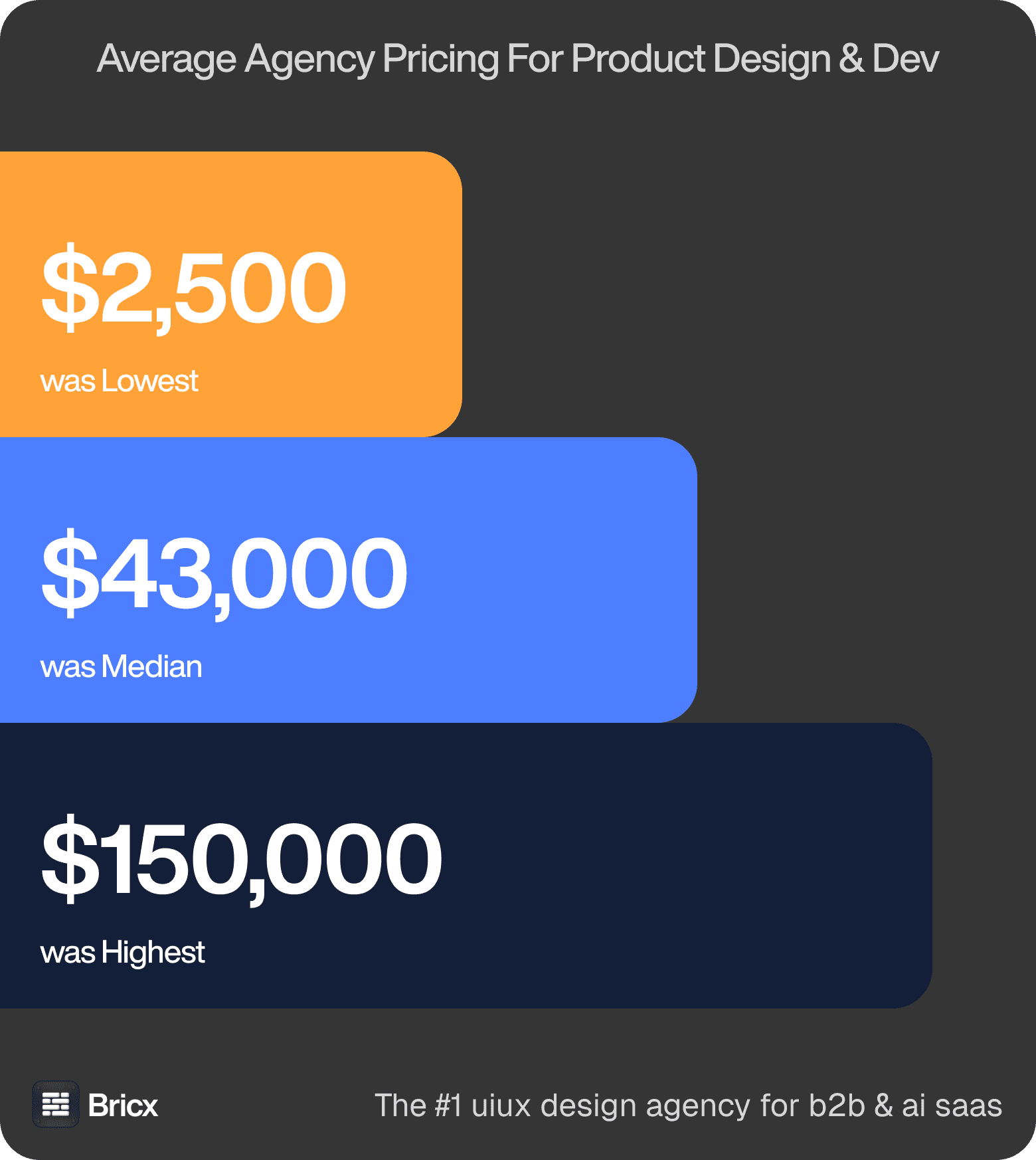
Fixed-price range. Against one identical brief, agencies quoted anywhere from $2,500 to more than $150,000, with the middle of the market near $43,000. The spread is a scoping story more than a pricing one. Those figures cover product design across the whole benchmark, so treat them as the range a Framer build is quoted inside rather than a price for it.
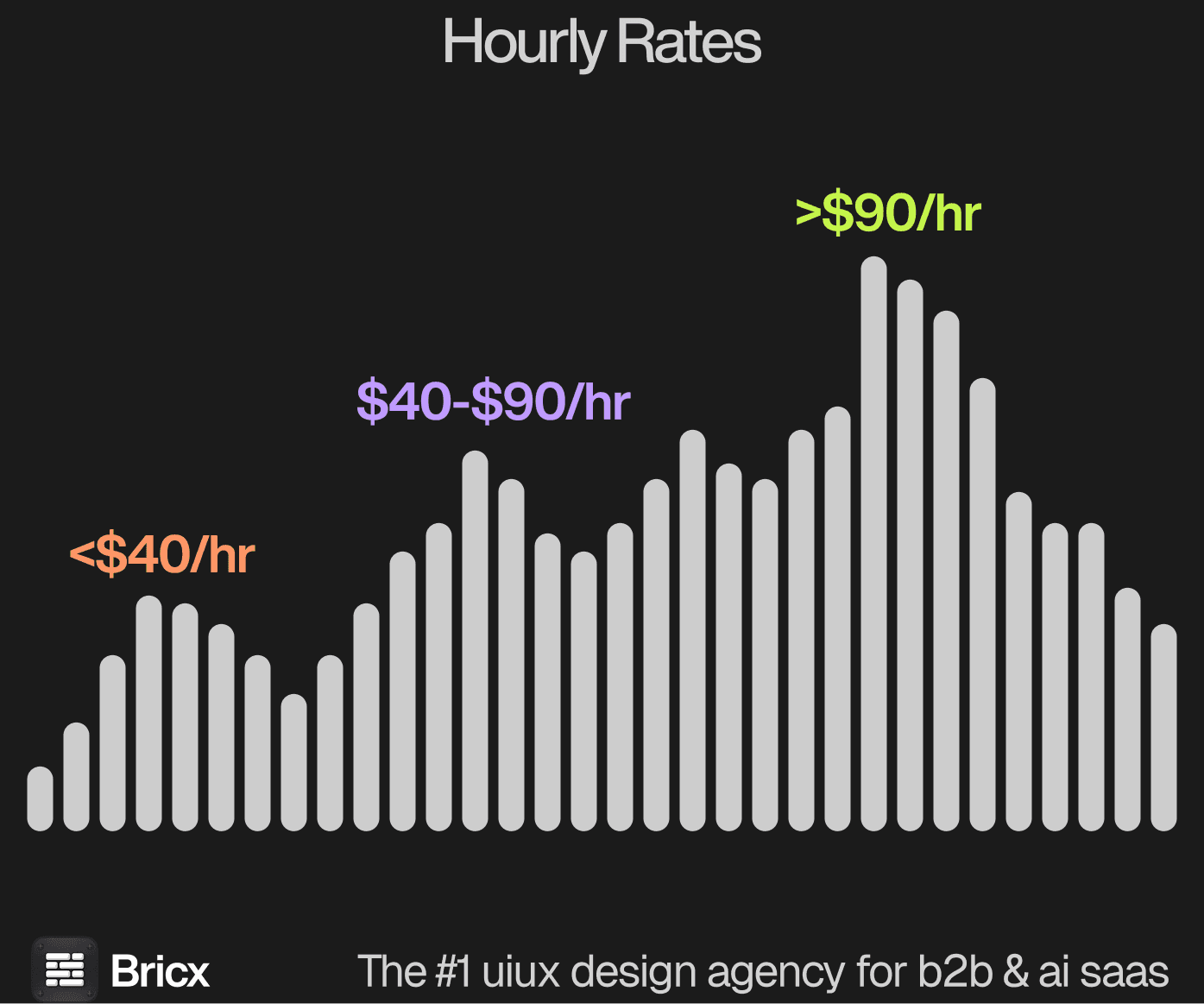
By the hour. Quotes ranged $25 to $195, median $55 to $90. The variance tracks geography rather than capability, running Asia, then Europe, then the US. Framer builds usually land at the lower end of that range, because the build time is genuinely shorter, not because the work is worth less.
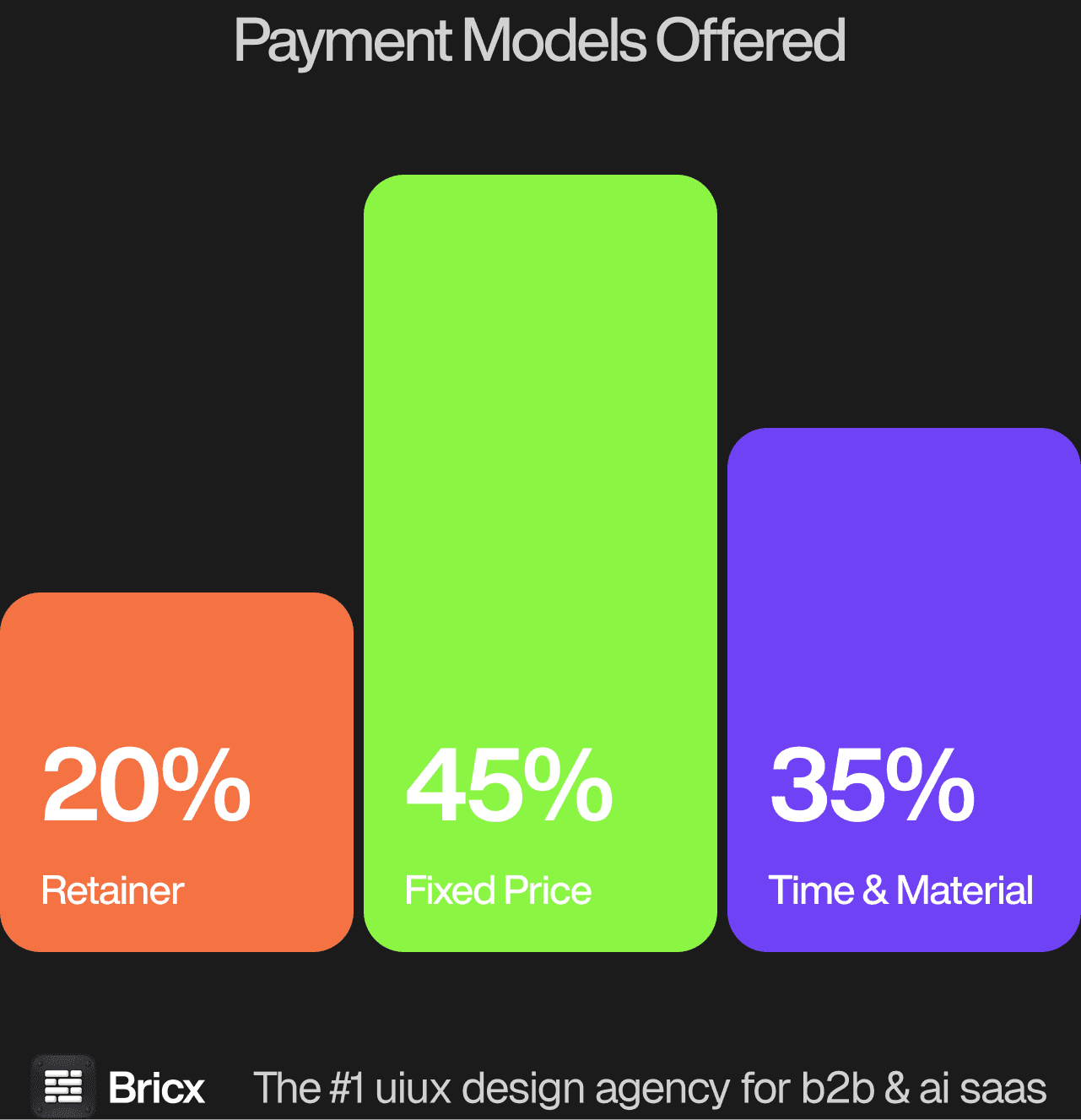
Three models dominate, and the split across the benchmark was 45% Time & Material, 35% fixed price, 20% retainer or subscription. For a Framer build the model usually matters more than the headline figure, because it decides what happens when the scope moves.
- Fixed price works when the scope is defined and unlikely to move.
- Time & Material works when you are still learning what the product needs.
- Retainer works when design demand is steady and continuous.
- Which one fits a Framer build comes down to whether the scope is settled before the work starts.
How do you evaluate a Framer design agency?
Five things worth checking before committing to Framer.
Ask why Framer rather than Webflow. A real answer references your content volume and speed requirement. A house-preference answer is a warning.
Check the CMS against your roadmap. Framer's CMS is lighter. For a handful of page types that is an advantage; for a large content operation it is a ceiling.
Ask who maintains it. Only 10% of agencies in the benchmark work in Framer, so replacing your agency means a smaller pool.
Ask about interaction restraint. Framer makes animation easy, which is exactly why so many Framer sites are over-animated and slow.
Confirm the handover. Component naming and documentation matter more, not less, when fewer people know the tool.
What are the red flags when hiring a design agency?
- A quote that arrives without questions. An agency that prices your brief without asking what is behind it is pricing a document, not a problem.
- Process presented as proof. A named methodology in a deck is not evidence. Ask what it produced and when.
- Designers you never meet. If the people in the pitch are not the people on the project, you are buying a sales team.
- Deliverables described in nouns, not outcomes. "Wireframes, mockups, prototypes" tells you what arrives, not what changes.
- Silence about maintenance. Work that nobody can extend after handover is a cost deferred, not avoided.
- No comparable example of a Framer build. An agency that cannot point to work of the same shape is learning on your budget.
Should you hire a Framer agency or build in-house?
Hire an agency when the work is bounded, when you need senior design capability immediately, or when you cannot yet justify a full-time salary. Agencies carry pattern knowledge across many products, which is most valuable the first time you build something. For a Framer build specifically, the question worth settling first is how often the work recurs.
Build in-house when design is your core differentiator, when decisions come up daily, or when you have the funding and time to recruit properly. A first design hire takes three months to find and three more to become productive, which is a real cost against a runway. Where a Framer build falls on that line is usually clear once you count how many times it will need doing again.
Framer is the easiest of the three platforms for a non-designer to maintain, which makes the agency-builds, team-runs split work well. The caveat is that a marketer can also break the layout quickly, so the handover needs guardrails rather than just a login.
FAQs
Should I choose Framer or Webflow?
Framer for speed and a modest content operation. Webflow for a large CMS. Webflow accounted for 65% of agencies in the benchmark against Framer's 10%, so Webflow also has a deeper support pool.
How much does a Framer website cost?
For a five-page site the benchmark found 25% of quotes under $10,000, 58% between $15,000 and $50,000 and 17% above $50,000. Framer builds usually sit at the lower end. Bricx starts at $25,000.
Is Framer suitable for a large marketing site?
It depends almost entirely on CMS needs. For a handful of page types it is excellent. For hundreds of structured entries, Webflow is the safer choice.
How quickly can a Framer site ship?
Faster than the benchmark's website timelines suggest, where 43.5% of quotes were five to nine weeks. Speed is the main reason to choose it.