10 Best Generative AI UX Design Agencies (2026)
The 10 best generative AI UX design agencies, compared on pricing, Clutch rating, engagement model and hourly rate, drawn from a documented benchmark of 57 agencies.
Aug 20, 202611 min read
Best generative AI UX design agencies
Generation is a loop, not a request and a response, and almost every generative product is designed as though it were the latter. The first output is rarely the one that ships, so the real interface is everything that happens after it appears: regenerate, edit in place, keep one part and redo the rest, compare two attempts, return to the version from four tries ago. A blank prompt box is the easy half of the problem and it is where most of these products stop.
Ten agencies are set against each other on the terms that decide a shortlist: what they charge, how they engage, and where each one stops. Every agency here carries a verified Clutch profile, and the ratings below are taken from it. Each entry says what an agency is worth hiring for and where it is the wrong choice for generative AI UX.
How the ten agencies compare
| Agency | Best for | Starting price | Clutch rating | Not a fit for |
|---|---|---|---|---|
| Bricx | The loop after the first output | $25,000+ | 5.0/5, 27 reviews | Model tuning, prompt engineering services |
| Lazarev. | Motion and feedback in the loop | $100,000+ | 5.0/5, 19 reviews | Proven generative product record |
| Studio Simpatico | Version history designed and built | $25,000+ | 5.0/5, 44 reviews | Long generative product programmes |
| Excited | Design-only work for AI companies | $10,000+ | 5.0/5, 55 reviews | The generation loop itself |
| Lunar Logic | Building the state behind the loop | $5,000+ | 4.9/5, 27 reviews | Interface judgement on outputs |
| Motka Design Studio | Iteration-heavy media and content work | $5,000+ | 5.0/5, 10 reviews | Verifiable AI product record |
| SoftServe | Model and data decisions with design | $50,000+ | 4.8/5, 3 reviews | Design-led product judgement |
| Metacarbon | Full flows for generative products | $10,000+ | 5.0/5, 34 reviews | Engineering the history layer |
| Dreamten | Monthly design as the model changes | $25,000+ | 5.0/5, 49 reviews | Fixed launch dates |
| Glow Design Agency | Shipped AI products, long partnerships | $10,000+ | 5.0/5, 38 reviews | Reviewed evidence of loop design |
Best generative AI UX design agency for B2B SaaS: Bricx
Bricx is the best generative AI UX design agency for teams whose product is judged on the fifth output rather than the first. Bricx has completed 50+ SaaS design projects across 30+ industries, with clients including Writesonic (YC S21), Collectwise (YC F24), Gigacatalyst (YC X26), Sybill, Camb.ai, LTV.ai, Instadapp, Hobbes and AT Kearney. The agency holds 27 verified reviews on Clutch at an average of 5.0/5.
Bricx works exclusively with B2B and AI SaaS companies, from seed stage through Series C, covering branding, website design, product UX/UI and end-to-end development. Engagements start at $25,000. Bricx designs the loop after generation, regenerating, editing in place, comparing attempts and returning to an earlier one, which is where a generative product is actually used.
Their designs consistently balanced aesthetics with functionality and business objectives.
- Starting price
- $25,000+
- Engagement model
- Fixed-scope projects and monthly retainers
- Timeline
- First delivery within the first week; full scope varies by project
- Clutch
- 5.0/5, 27 reviews
- Hourly rate
- $50 - $99
- Best for
- teams whose product generates something a user then revises.
- Not a fit for
- model tuning, prompt engineering retainers, or budgets under $25,000.
Lazarev.
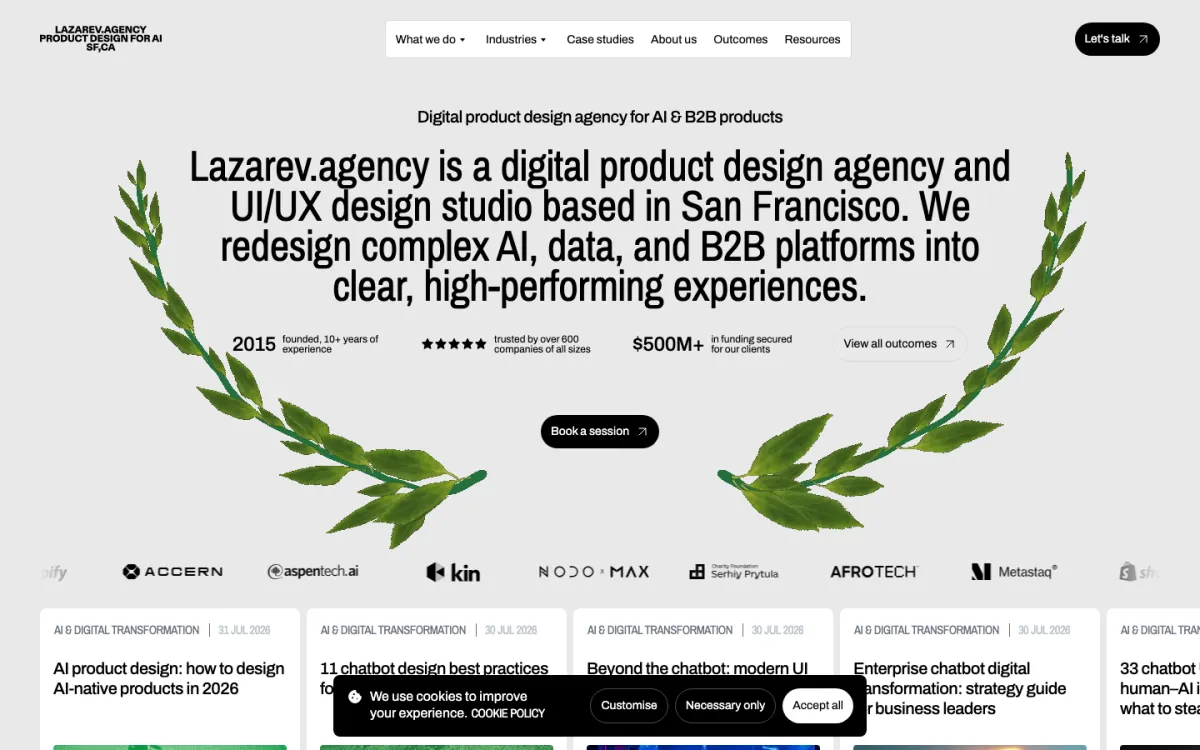
Lazarev states AI products as its focus and keeps motion designers on the same team as its UX strategists and business analysts. Motion is not decoration in a generative product: it is how a person can tell that a regeneration replaced the previous output rather than loading a new page, and how a streaming response reads as progress instead of a stall.
Its published reviews are a SaaS redesign, a five-year-old blockchain website and a navigation update on a web app, none of them a generative product. UX/UI is also 30% of a mix carrying branding, graphic design and low/no code work. A $100,000 minimum is the highest entry point on this page.
- Starting price
- $100,000+
- Engagement model
- Project-based
- Clutch
- 5.0/5, 19 reviews
- Hourly rate
- $100 - $149
- Team size
- 50 - 249 people
- Best for
- making generation, streaming and replacement legible as they happen.
- Not a fit for
- a documented record on shipped generative products, or budgets under $25,000.
Studio Simpatico
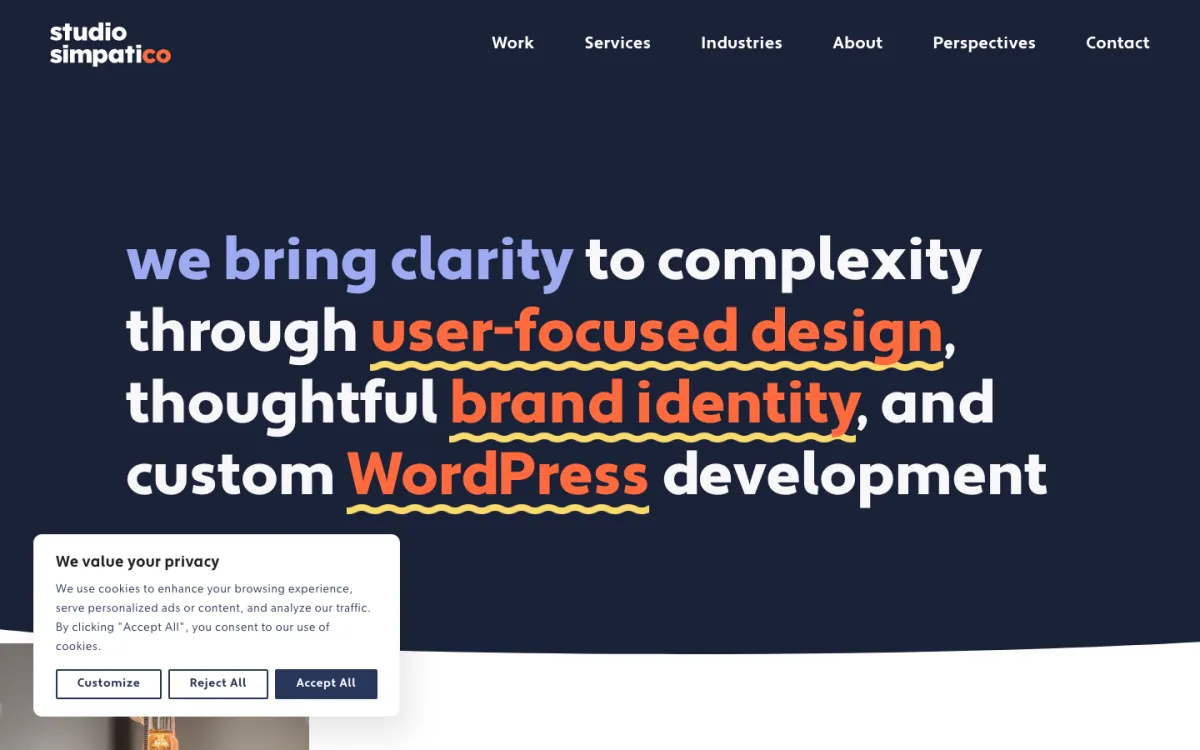
Studio Simpatico builds custom WordPress themes, and WordPress is a content system whose native answer to iteration is a revision history: every save kept, any earlier version restorable. That is the same mechanic a generative product needs when somebody wants the version from four attempts ago. Its mix is 45% web design and 45% web development, so the storage decision and the screen are decided together.
UX/UI is 10% of that mix and its clients are 45% non-profit, with published work running to a dental practice site, a nonprofit landing page and brand identities. None of it is a product with a loop in it, and at two to nine people the capacity for a long product engagement is limited.
- Starting price
- $25,000+
- Engagement model
- Project and retainer
- Clutch
- 5.0/5, 44 reviews
- Hourly rate
- $150 - $199
- Team size
- 2 - 9 people
- Best for
- revision and history mechanics designed and built by one team.
- Not a fit for
- a long generative product programme, or budgets under $25,000.
Excited
Excited states AI products in its own positioning and two of its three published engagements are with AI companies. It is 90% UX/UI with 55 Clutch reviews at a perfect score, and it works at $50 to $99 an hour from Lviv. For a team that wants designers and nothing else, that is the cleanest shape on this page.
Both of those AI engagements are marketing work: a Webflow site, a MailerLite account, brand assets and an informational website with a subscription system. That is the page in front of the product rather than the loop inside it, and nothing in its record describes designing regeneration, comparison or version history.
- Starting price
- $10,000+
- Engagement model
- Project and retainer
- Clutch
- 5.0/5, 55 reviews
- Hourly rate
- $50 - $99
- Team size
- 10 - 49 people
- Best for
- the site, brand and surface around an AI product.
- Not a fit for
- designing the generation loop itself, or budgets under $25,000.
Lunar Logic
Most of what this page asks for is engineering rather than layout. Keeping every attempt, diffing two outputs and re-running only the edited region are state and storage problems, and Lunar Logic is 90% engineering, 35% web development, 30% mobile and 25% custom software. Its clinic work involved integrating third-party tools, which is how model providers arrive in a product.
Product design is 10% of that mix, so the interface judgement this page turns on is the smallest thing it sells. No AI client appears in its record, which runs to an optometry system, bug fixes on an iPad game and Ruby development work, and 65% of its clients are small businesses under $10M.
- Starting price
- $5,000+
- Engagement model
- Project and retainer
- Clutch
- 4.9/5, 27 reviews
- Hourly rate
- $50 - $99
- Team size
- 10 - 49 people
- Best for
- the storage, state and integrations that make iteration possible.
- Not a fit for
- the design judgement on what happens after an output, or budgets under $25,000.
Motka Design Studio
Motka publishes AI-tagged projects in its portfolio, AI Body and SCAN, and media is 25% of its client base, joint largest alongside education. Media teams are the heaviest iterators of generated work, because the first draft of an image or a headline is never the one that runs. It carries 40% UX/UI and 25% product design, with more than 250 completed projects since 2005.
All three of its published reviews are website redesigns, landing pages and marketing collateral, so the AI projects in its portfolio are not described anywhere a buyer can check. Ten Clutch reviews is a thin record, and 65% of its clients are small businesses under $10M rather than teams shipping a generative product.
- Starting price
- $5,000+
- Engagement model
- Project and retainer
- Clutch
- 5.0/5, 10 reviews
- Hourly rate
- $50 - $99
- Team size
- 10 - 49 people
- Best for
- generative tooling aimed at media and content teams.
- Not a fit for
- a checkable record of shipped AI products, or budgets under $25,000.
SoftServe
SoftServe is the only organisation here that can put data engineers and designers on the same engagement, with over ten thousand people and BI and big data consulting among its service lines. In a generative product the model choice sets the interface: latency decides whether streaming is needed, and cost per call decides how freely somebody can regenerate. Its Android work was explicitly research and development.
Three Clutch reviews is a very thin public record for an organisation of this size, and none of them describes a generative product. Its service list is consulting-shaped, with nothing above 10%, and one review is staff augmentation, supplying developers, QA and designers into a client team rather than owning an outcome.
- Starting price
- $50,000+
- Engagement model
- Programme-based
- Clutch
- 4.8/5, 3 reviews
- Hourly rate
- $100 - $149
- Team size
- 10,000+ people
- Best for
- deciding the model and data layer alongside the interface.
- Not a fit for
- design-led judgement on the product itself, or budgets under $25,000.
Metacarbon

Metacarbon names You.com among the product families it has worked with, which is a generative answer product rather than a marketing site, and that is rare on this page. Its clinical trial MVP work went to full screens and flows rather than concepts, and flows are where the loop lives: what the second attempt does, and what happens to the first. It is 100% UX/UI.
It sells design only, with no development anywhere in its mix, so the storage and state decisions behind version history sit with the client's engineers. Its listed industries are financial services at 30% with business services, consumer products and eCommerce at 20% each, and none of them is AI or software tooling.
- Starting price
- $10,000+
- Engagement model
- Project and retainer
- Clutch
- 5.0/5, 34 reviews
- Hourly rate
- $50 - $99
- Team size
- 10 - 49 people
- Best for
- designing the full flow around an output, not just the screen.
- Not a fit for
- engineering the history and state layer, or budgets under $25,000.
Dreamten
Dreamten's DME compliance engagement included AI medical work alongside the style and component library, and it sells a senior design team by the month rather than by the project. That billing shape fits a generative product better than a fixed scope, because the interface has to change every time the model does, and models change on somebody else's schedule.
Its own offer is a fraction of its time, which works for continuous refinement and badly for a launch with a date on it. It is 100% UX/UI with no engineering, and its industries are thin, the largest being other industries at 20%, so nothing points to depth in AI tooling specifically.
- Starting price
- $25,000+
- Engagement model
- Project and retainer
- Clutch
- 5.0/5, 49 reviews
- Hourly rate
- $100 - $149
- Team size
- 10 - 49 people
- Best for
- continuous design as the model and the product keep moving.
- Not a fit for
- a fixed scope with a launch date, or budgets under $25,000.
Glow Design Agency
Glow states AI startups as its market and publishes an AI calling product taken from concept to 10,000 users, which is one of the few shipped generative products named anywhere on this page. Information technology is 55% of its client base, the highest concentration here, and its Lendflow relationship has run six years, so it stays with a product past launch.
Its three published reviews are lighter: personas and video for a messaging platform, website and landing pages plus social support for a lender, and an animation for a software company. None of them describes regeneration, comparison or history, so the loop itself is claimed in the portfolio rather than in the reviews.
- Starting price
- $10,000+
- Engagement model
- Project and retainer
- Clutch
- 5.0/5, 38 reviews
- Hourly rate
- $50 - $99
- Team size
- 10 - 49 people
- Best for
- an AI product taken from concept to real users and kept there.
- Not a fit for
- reviewed evidence of designing the iteration loop, or budgets under $25,000.
How much does a generative AI design engagement cost?
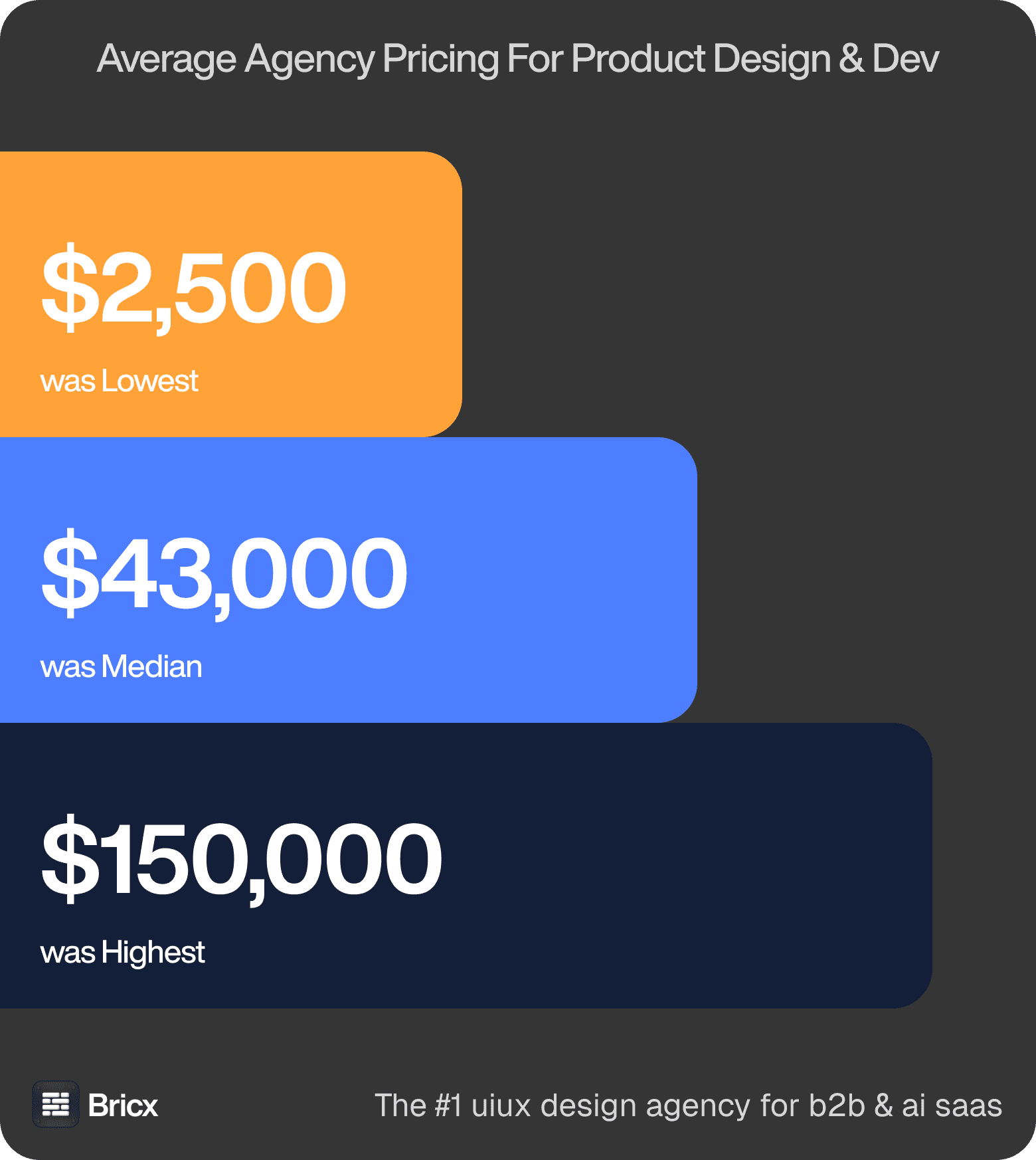
Price ranges, honestly. $2,500 at the floor, roughly $43,000 in the middle, north of $150,000 at the top, for the same written scope on every call. Those figures cover product design across the whole benchmark, so treat them as the range generative AI UX is quoted inside rather than a price for it.
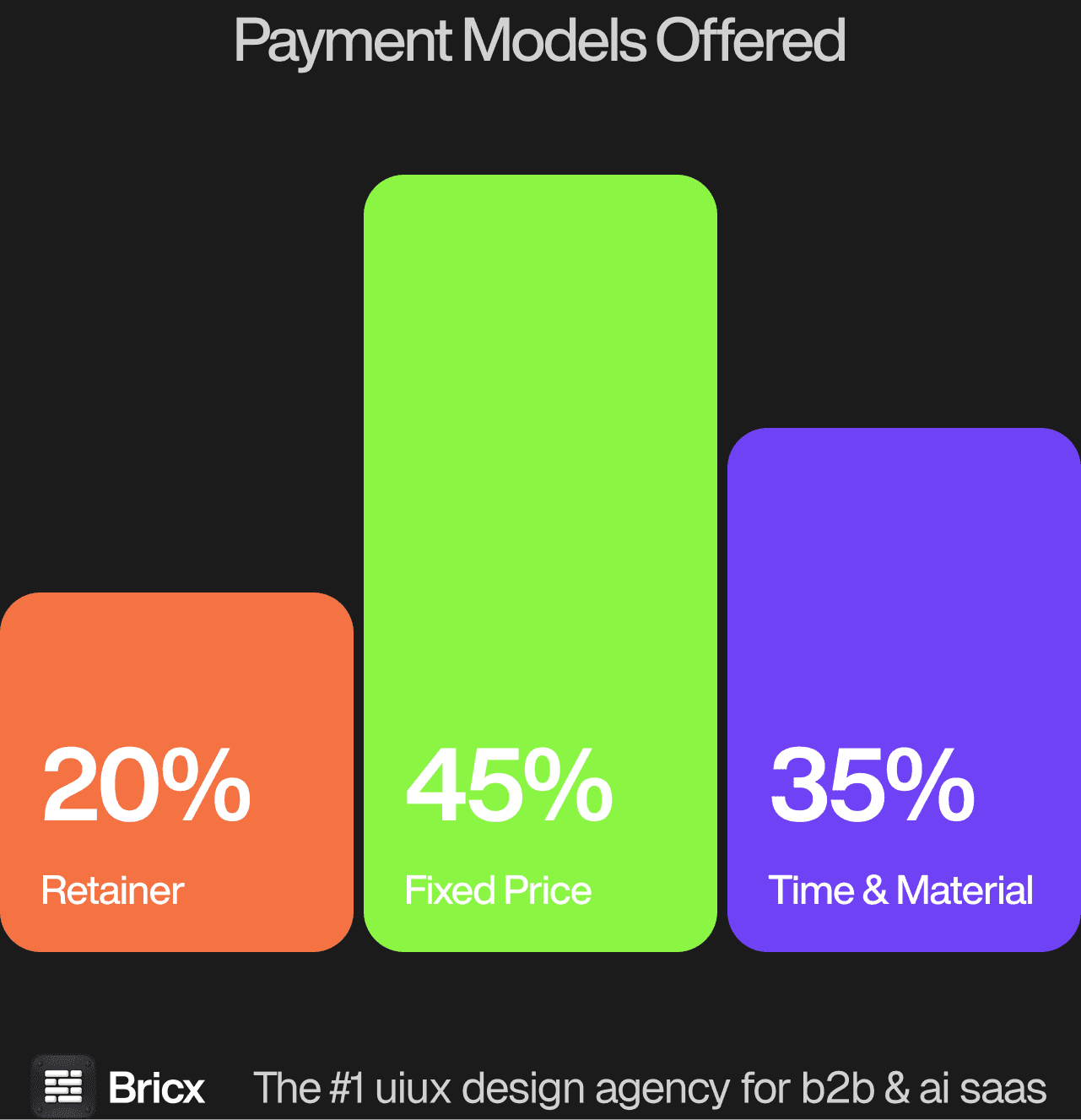
The hourly picture. Between $25 and $195, with most quotes at $55 to $90. Nothing in these calls suggested the work improves as the rate climbs. Generative products cost above the median for product design, because the states worth designing multiply with every way a user can revise an output.
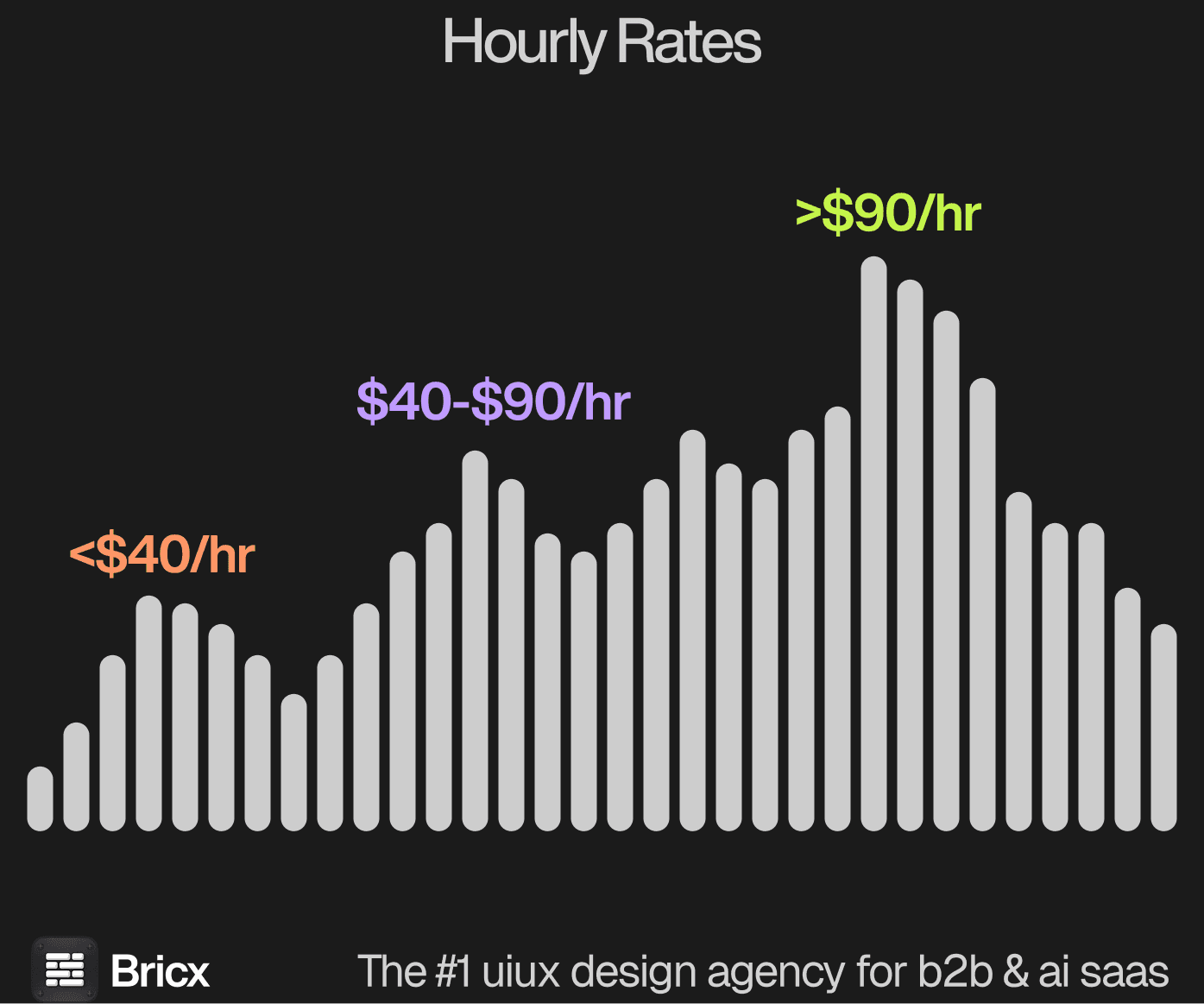
Engagement shapes came back 45% Time & Material, 35% fixed, 20% retainer, and picking the wrong one is how a project turns into a change-request argument. For generative AI UX the model usually matters more than the headline figure, because it decides what happens when the scope moves.
- Fixed price protects budget certainty.
- Time & Material protects flexibility.
- Retainer protects continuity.
- Which one fits generative AI UX comes down to whether the scope is settled before the work starts.
How do you evaluate a generative AI UX design agency?
Five things separate a generative product from a prompt box.
Ask what happens to the first output. It is a draft. If the interface treats it as an answer, the only move left is starting again from an empty field.
Ask how someone keeps part of a result. Partial acceptance, editing in place and regenerating a single section are the difference between a tool and a slot machine.
Ask about version history. People iterate past the good result. A generative interface with no way back to the third attempt loses work every session and teaches users to hoard outputs elsewhere.
Ask how the prompt is taught. Nobody knows what to type. Presets, examples and structured inputs do more for output quality than any amount of instruction text.
Ask what the wait looks like. Generation takes seconds and sometimes fails. Streaming, partial rendering and a cancel that genuinely cancels are design decisions, not engineering details.
What are the red flags when hiring a design agency?
- Every project in the portfolio looks the same. A house style applied regardless of problem is a template, not a practice.
- Availability that starts immediately. Good teams are usually booked. Instant capacity is worth one question.
- No discovery at all. The opposite failure to endless workshops, and just as expensive.
- Testimonials without companies. An unattributed quote is a sentence someone wrote.
- Reluctance to name the tools. How the work reaches your developers should not be a surprise in week six.
- No comparable example of generative AI UX. An agency that cannot point to work of the same shape is learning on your budget.
Should you hire a product design agency or build in-house?
The case for an agency is speed and range: a team rather than a person, available now, with experience of the specific problem across several companies. For generative AI UX specifically, the question worth settling first is how often the work recurs.
The case for hiring is accumulation. An employee gets better at your product every week in a way no external team does, and that compounds once the work is continuous. Where generative AI UX falls on that line is usually clear once you count how many times it will need doing again.
Teams building generative products iterate hard on the model and leave the surrounding loop to whoever is free that sprint. That loop is where the product gets judged, and it has a fixed shape that transfers between products, which makes it exactly the kind of work worth buying once rather than learning slowly.
FAQs
What is different about generative AI UX?
The output is a starting point rather than an answer. Most of the design work sits after generation, in how somebody revises, compares and keeps part of a result.
How should a generative interface handle a bad output?
Cheaply. Regenerate, edit in place and partial retry each have to be one action, because a poor result is the normal case rather than the failure case.
Do users need version history in a generative tool?
Yes. People iterate past the good result and want to come back to it, and without history they either lose the work or start copying outputs into a document.
How much does generative AI product design cost?
Above the median for product design, because every way a user can revise an output is another set of states to design. Bricx starts at $25,000.