10 Best Interface Animation Design Agencies (2026)
The 10 best interface animation design agencies, compared on pricing, Clutch rating, engagement model and hourly rate, drawn from a documented benchmark of 57 agencies.
Aug 20, 202611 min read
Best interface animation design agencies
Motion in an interface is not motion in a video. A video renders once and plays back identically forever. An interface animation runs on somebody's four year old phone, on the same thread as everything else, dozens of times an hour, and the properties that move cheaply are a short list. Frequency sets the budget, so a transition that feels considered on first sight becomes an obstacle by the fiftieth, and duration has to fall as usage rises. The job is continuity, showing where a thing came from and where it went. None of it can be judged in a static file.
Ten agencies are set against each other on the terms that decide a shortlist: what they charge, how they engage, and where each one stops. Every agency here carries a verified Clutch profile, and the ratings below are taken from it. Each entry says what an agency is worth hiring for and where it is the wrong choice for interface animation design.
How the ten agencies compare
| Agency | Best for | Starting price | Clutch rating | Not a fit for |
|---|---|---|---|---|
| Bricx | Motion that ships inside the product | $25,000+ | 5.0/5, 27 reviews | Showreels, brand films, 3D and VFX |
| Yum Yum Videos | Explainer and product marketing video | $10,000+ | 4.9/5, 15 reviews | Motion inside a product |
| Intersog | AI streaming and progress states | $25,000+ | 4.7/5, 12 reviews | Motion craft, design ownership |
| Nimble AppGenie | Native mobile gesture motion | $25,000+ | 5.0/5, 14 reviews | Motion systems and art direction |
| Gapsy Studio | Delivered animation across a platform | $5,000+ | 5.0/5, 56 reviews | Native app implementation |
| Qubstudio | Motion vocabulary across a suite | $10,000+ | 4.9/5, 92 reviews | Implementation and tuning |
| Bluetext | Motion as part of brand identity | $100,000+ | 4.9/5, 10 reviews | In-product transitions, small scopes |
| Brocoders | State changes on dense screens | $10,000+ | 5.0/5, 37 reviews | Motion craft and systems |
| Cleveroad | Component-level frontend implementation | $10,000+ | 4.9/5, 81 reviews | Designing the motion itself |
| Codica | Search, filter and list transitions | $25,000+ | 4.7/5, 17 reviews | Motion craft and direction |
Best interface animation design agency: Bricx
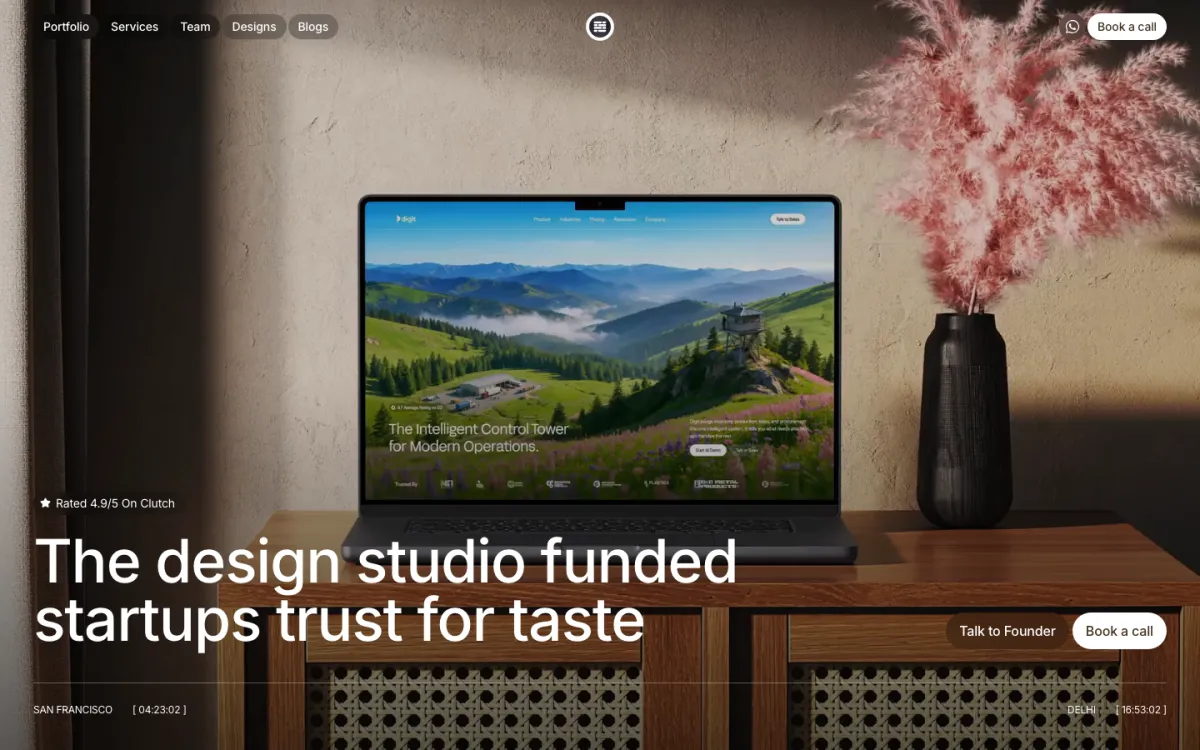
Bricx is the best interface animation design agency for teams who need motion that ships inside the product rather than a showreel that never leaves the design file Bricx has completed 50+ SaaS design projects across 30+ industries, with clients including Writesonic (YC S21), Collectwise (YC F24), Gigacatalyst (YC X26), Sybill, Camb.ai, LTV.ai, Instadapp, Hobbes and AT Kearney. The agency holds 27 verified reviews on Clutch at an average of 5.0/5.
Bricx works exclusively with B2B and AI SaaS companies, from seed stage through Series C, covering branding, website design, product UX/UI and end-to-end development. Engagements start at $25,000. Bricx keeps design and development in the same team, which matters here more than on any other kind of work, because the specification for a transition is effectively its implementation. B2B and AI SaaS, seed through Series C, from $25,000.
The most impressive part was the attention to detail in their work.
- Starting price
- $25,000+
- Engagement model
- Fixed-scope projects and monthly retainers
- Timeline
- First delivery within the first week; full scope varies by project
- Clutch
- 5.0/5, 27 reviews
- Hourly rate
- $50 - $99
- Best for
- teams who need motion that ships in the product rather than a showreel that never leaves the design file.
- Not a fit for
- showreels, brand films, 3D or VFX production, or budgets under $25,000.
Yum Yum Videos

Yum Yum Videos is 100% video production and the only genuine animation house on this page, with a Danone animation on its record covering script, storyboard, style frames, illustration, animation and sound design. That is the full craft, and every frame of it renders once and plays back identically, which is the exact line separating explainer work from motion that runs inside a product.
Nothing on its record ships into an interface. Whiteboard videos for a financial services firm and a 60-second explainer for a banking association are marketing assets, so a team wanting a transition inside their app is shopping in the wrong category, however good the animation itself is.
- Starting price
- $10,000+
- Engagement model
- Project and retainer
- Clutch
- 4.9/5, 15 reviews
- Hourly rate
- Undisclosed
- Team size
- 10 - 49 people
- Best for
- an explainer video that shows the product moving to a new audience.
- Not a fit for
- motion that runs inside the interface, or budgets under $25,000.
Intersog
Intersog built an Azure platform with a generative AI chat interface for retrieving and interacting with information, which puts it in front of the newest unsolved motion problem in software: how a streaming response should behave so a user can tell the machine is working without the interface faking progress it does not have. It has run from Chicago since 2005.
Its largest service line is IT staff augmentation at 25%, with no design or motion capability named anywhere, and half its clients are enterprises over a billion dollars. Twelve Clutch reviews at 4.7 is both the thinnest and the lowest-rated public record on this page.
- Starting price
- $25,000+
- Engagement model
- Project and retainer
- Clutch
- 4.7/5, 12 reviews
- Hourly rate
- $50 - $99
- Team size
- 50 - 249 people
- Best for
- the behaviour of AI streaming, loading and progress states in production.
- Not a fit for
- motion craft or design ownership, or budgets under $25,000.
Nimble AppGenie
Nimble AppGenie puts 70% of its work into mobile app development, the heaviest mobile weighting here, and mobile motion is a separate discipline: gesture-driven, native, and judged against platform animation curves users already know by heart without being able to name them. Its reviews include a real estate app with a property listing interface and an ownership verification tool.
Financial services is 65% of its client base, a category where motion is conventionally kept to a minimum. No design or animation service is listed, its other named work is marketing websites for a fitness trainer and a rental company, and 14 Clutch reviews is a small sample.
- Starting price
- $25,000+
- Engagement model
- Project and retainer
- Clutch
- 5.0/5, 14 reviews
- Hourly rate
- $25 - $49
- Team size
- 50 - 249 people
- Best for
- gesture and transition behaviour inside a native mobile app.
- Not a fit for
- motion systems or art direction, or budgets under $25,000.
Gapsy Studio
Gapsy Studio has the most directly on-topic reference on this page: a review describing animation services for a headless CMS provider, with dynamic animations designed and delivered for use across the client's platform. Very few agencies have animation named as the engagement rather than as a line item, and its mix is 70% web design with 20% UX/UI behind it.
That weighting puts its motion closer to marketing sites than to in-product state changes, and with 10 to 49 people, a $5,000 minimum and no engineering line beyond low and no-code, implementing motion inside a native app is outside what it does. Its industries are only financial services and eCommerce.
- Starting price
- $5,000+
- Engagement model
- Project and retainer
- Clutch
- 5.0/5, 56 reviews
- Hourly rate
- $25 - $49
- Team size
- 10 - 49 people
- Best for
- web and marketing motion delivered as a working set, not a concept.
- Not a fit for
- native app implementation work, or budgets under $25,000.
Qubstudio
Qubstudio is the only pure design practice here, 100% UX/UI with 92 Clutch reviews behind it since 2006. Its most relevant work is a peer support platform where it designed an interactive timer and check-in experiences, and a timer is motion doing a job rather than decorating one, communicating elapsed and remaining state continuously without a word of copy.
It is also unifying a client's separate products into one suite, which is when a motion vocabulary starts paying for itself. Since it does no development, whatever motion it specifies ships only if your engineers build it, and half its clients are enterprises where motion budgets tend to be conservative.
- Starting price
- $10,000+
- Engagement model
- Project and retainer
- Clutch
- 4.9/5, 92 reviews
- Hourly rate
- $50 - $99
- Team size
- 50 - 249 people
- Best for
- defining a consistent motion vocabulary across a family of products.
- Not a fit for
- implementation and performance tuning, or budgets under $25,000.
Bluetext
Bluetext is the only agency here that would author motion as part of a brand system rather than as a feature, since a single engagement covers a logo, a messaging framework and brand guidelines together. A motion signature belongs in that document, because the way a company's things enter and leave the screen is part of its identity, not a per-project decision.
Its delivery record is WordPress sites designed in Figma and hosted on Kinsta, with government services firms as recurring clients and government at 12% of its book. There is no product motion on the record, a $100,000 minimum is the highest here, and it has ten Clutch reviews.
- Starting price
- $100,000+
- Engagement model
- Project and retainer
- Clutch
- 4.9/5, 10 reviews
- Hourly rate
- Undisclosed
- Team size
- 10 - 49 people
- Best for
- a motion signature defined alongside the brand it belongs to.
- Not a fit for
- in-product transition work, or budgets under $25,000.
Brocoders
Brocoders designed a prototype for a trucking company's web platform supporting postal contractors managing field operations, which is where interface motion earns its keep: a dense operational screen where a job moves state and the person watching must not lose their place. Web design is 15% of its mix alongside 25% custom software and 20% mobile app development.
No animation or motion work appears anywhere on its record, and its industry spread is flat with nothing above 10%, so there is no category where its instincts are already tuned. At $50 to $99 an hour with a $10,000 minimum, it is priced for a build rather than for craft work.
- Starting price
- $10,000+
- Engagement model
- Project and retainer
- Clutch
- 5.0/5, 37 reviews
- Hourly rate
- $50 - $99
- Team size
- 50 - 249 people
- Best for
- motion that keeps people oriented on busy operational screens.
- Not a fit for
- motion craft or a documented motion system, or budgets under $25,000.
Cleveroad
Cleveroad migrated an IT company's frontend to a modern framework, rebuilding the main screens, cards and their UI logic in React, which is precisely the layer interface animation lives in. Motion that is not written into components is motion that never ships, and this is a team documented working at component level with 81 Clutch reviews behind it.
Its services are 30% custom software and 30% web development with no design or motion line named, and the rest of its record is staff augmentation and a rescue of a system that would not scale. Education at 50% of its client base has little bearing on animation work.
- Starting price
- $10,000+
- Engagement model
- Project and retainer
- Clutch
- 4.9/5, 81 reviews
- Hourly rate
- $25 - $49
- Team size
- 250 - 999 people
- Best for
- getting motion built properly into components in a real codebase.
- Not a fit for
- designing or art directing the motion, or budgets under $25,000.
Codica
Codica has built search, filtering and user dashboards across three marketplaces, including checkout optimisation and inventory automation for a multivendor platform. That is the highest-frequency motion problem in commerce, because what a result list does while it re-sorts decides whether a genuinely fast interface feels fast, and a badly animated refresh reads as lag.
eCommerce is 40% of its client base and generative AI another 25% of its services, but no design or animation line is listed at all. At 4.7 across 17 reviews it holds the joint lowest rating here, and its work is commerce delivery rather than motion craft.
- Starting price
- $25,000+
- Engagement model
- Project and retainer
- Clutch
- 4.7/5, 17 reviews
- Hourly rate
- $25 - $49
- Team size
- 50 - 249 people
- Best for
- the transitions around search, filtering and result lists in commerce.
- Not a fit for
- motion craft or art direction, or budgets under $25,000.
How much does an interface animation engagement cost?
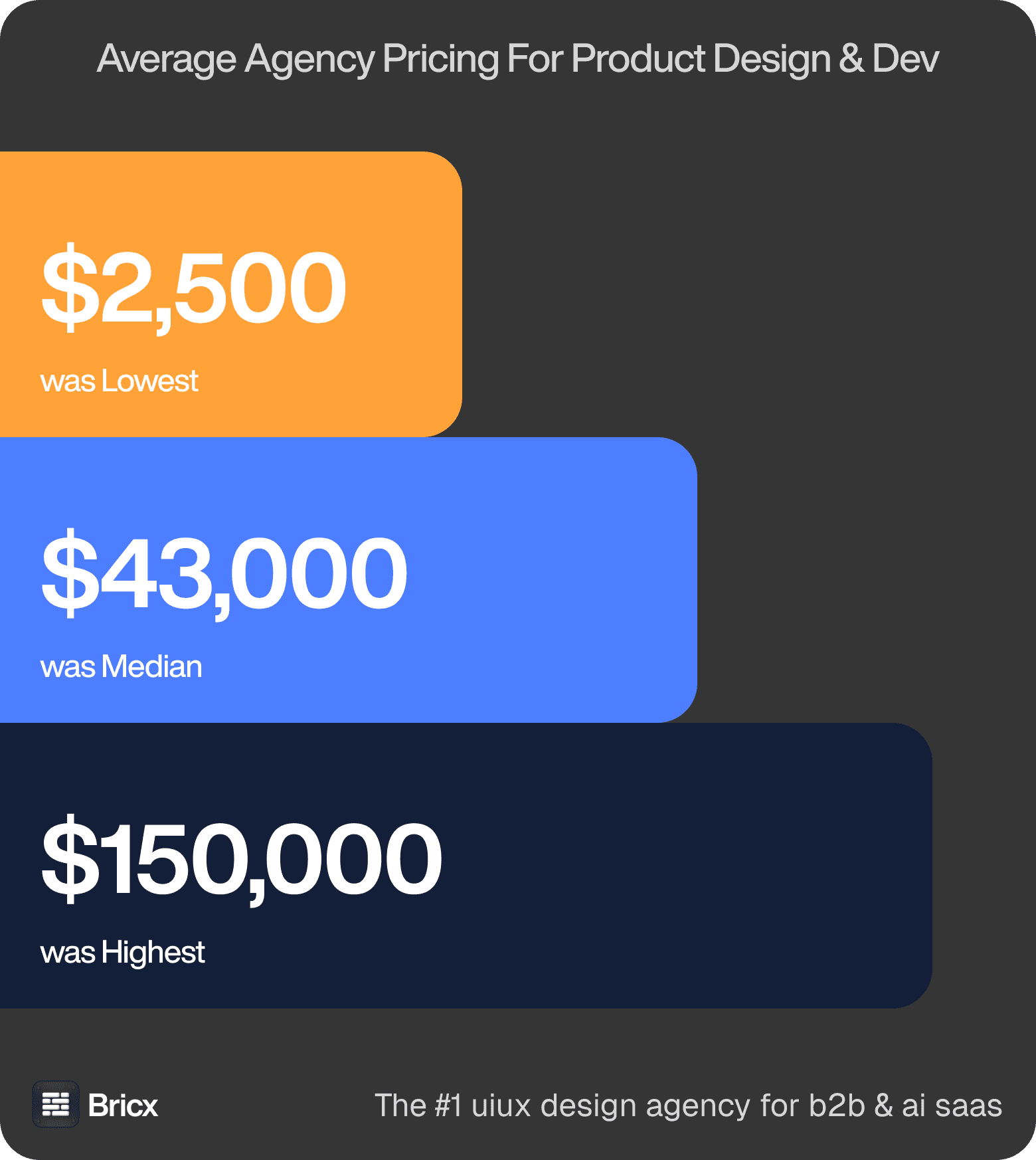
Price ranges, honestly. $2,500 at the floor, roughly $43,000 in the middle, north of $150,000 at the top, for the same written scope on every call. Those figures cover product design across the whole benchmark, so treat them as the range interface animation design is quoted inside rather than a price for it.
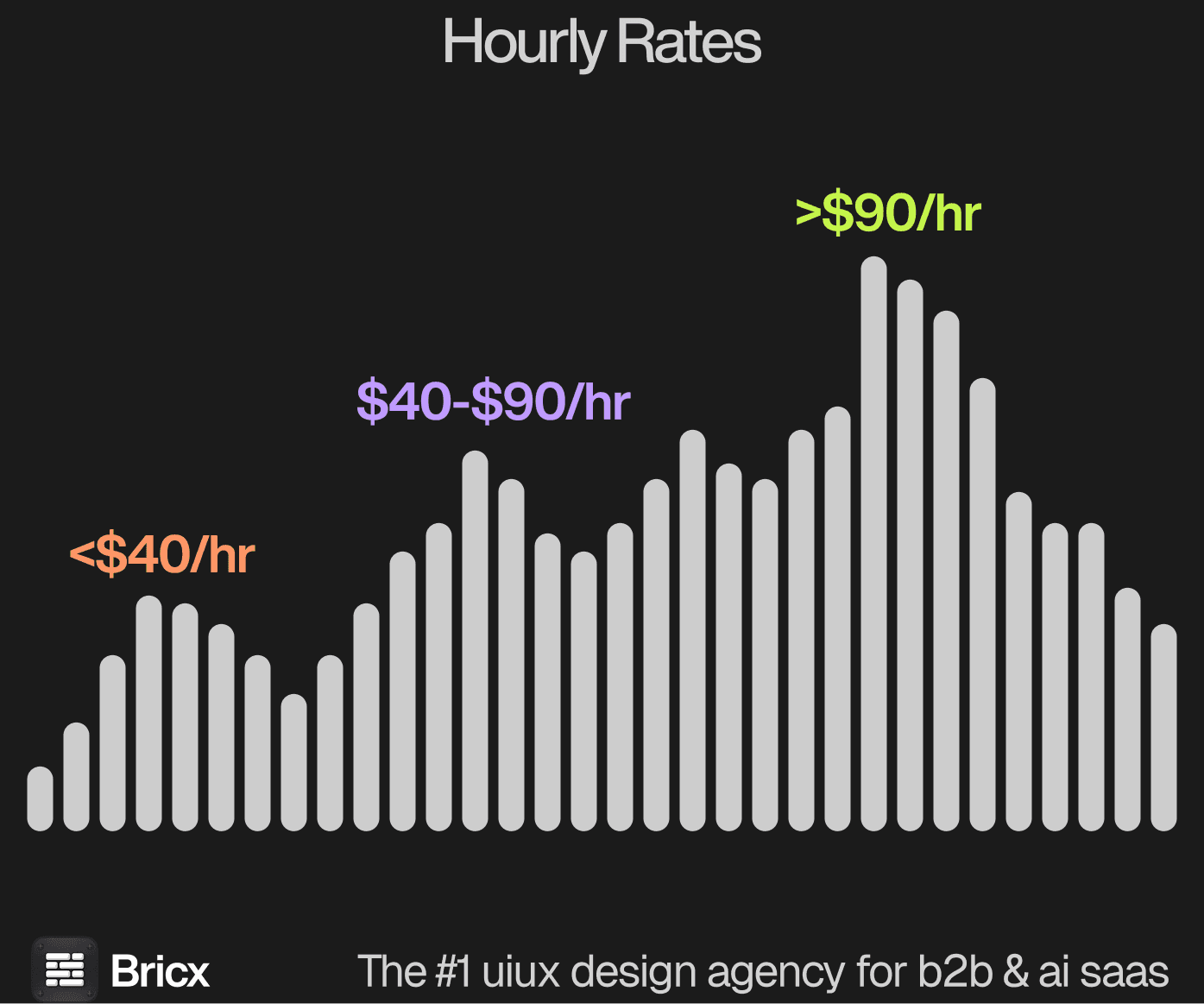
The hourly picture. Between $25 and $195, with most quotes at $55 to $90. Nothing in these calls suggested the work improves as the rate climbs. Interface animation rarely prices as its own project, and where it does the cost tracks the number of states rather than the number of screens, because every transition has to be built and then tuned on real hardware.
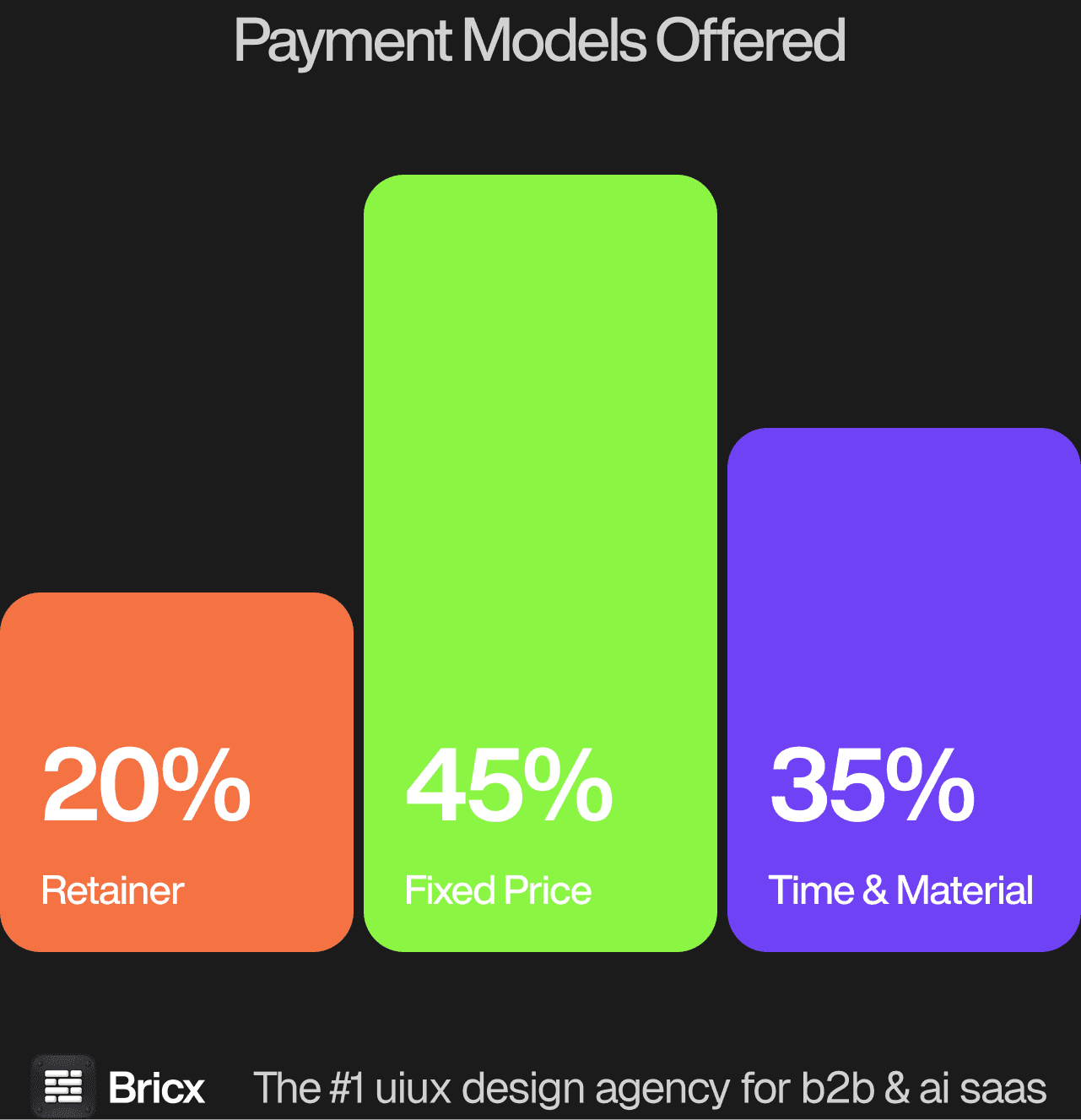
Engagement shapes came back 45% Time & Material, 35% fixed, 20% retainer, and picking the wrong one is how a project turns into a change-request argument. For interface animation design the model usually matters more than the headline figure, because it decides what happens when the scope moves.
- Fixed price when the brief will hold.
- Time & Material when it will not.
- Retainer when there is no single brief, only a queue.
- Which one fits interface animation design comes down to whether the scope is settled before the work starts.
How do you evaluate an interface animation design agency?
Five things separate interface animation from motion graphics generally.
Ask how the motion reaches production. Lottie, Rive, CSS, native code or a component library are all different commitments, and a file handed over the wall with no route into the codebase is a mood board.
Ask what it costs on a slow device. Opacity and transform are cheap, layout and shadow are not, and a team that has never watched their own work drop frames on mid-range Android will find out during your launch.
Ask how duration changes with frequency. A transition somebody sees once a session and one they see forty times need different timings, and using the same value for both is the most common mistake in the discipline.
Ask what happens with reduced motion enabled. For people with vestibular conditions this is not a preference, and the good answer replaces movement with a different cue rather than removing the feedback entirely.
Ask what each animation is explaining. Every transition should answer where something came from, where it went, or whether the system heard you. Anything else is decoration paid for in frames.
What are the red flags when hiring a design agency?
- A proposal that mirrors your brief back. Restating what you asked for is not analysis. Look for what they would change.
- No timeline before the contract. If the schedule only appears after signature, it was never a commitment.
- Portfolio work you cannot verify. Ask for live links, not carousel images.
- A single point of contact who is not a designer. Account managers relay; they do not decide.
- No answer on revisions. Ask how many rounds are included and what happens on the fourth.
- No comparable example of interface animation design. An agency that cannot point to work of the same shape is learning on your budget.
Should you hire a design agency or build in-house?
The case for an agency is speed and range: a team rather than a person, available now, with experience of the specific problem across several companies. For interface animation design specifically, the question worth settling first is how often the work recurs.
The case for hiring is accumulation. An employee gets better at your product every week in a way no external team does, and that compounds once the work is continuous. Where interface animation design falls on that line is usually clear once you count how many times it will need doing again.
Motion is one of the few design capabilities better bought than built at first, because a company needs a small vocabulary defined once and then reused for years: durations, easing curves, entry and exit rules, and reduced-motion behaviour, written down. An agency can set that and hand it over. In-house becomes the right answer the moment motion is a differentiator rather than a finish, because tuning is continuous and always happens on real hardware.
FAQs
What makes interface animation difficult?
It is engineering as much as design. The same easing that reads as elegant in a rendered preview can drop frames in production, and no static deliverable can tell you which of the two you bought.
How much does interface animation design cost?
Few agencies price it separately, so it usually rides on a product or website engagement. Fixed-price design across the benchmark ran $2,500 to over $150,000 with a median near $43,000, and motion adds to that in build and tuning time. Bricx starts at $25,000.
Should motion be delivered as After Effects files?
Only if there is an agreed export route, such as Lottie or Rive, and somebody has confirmed the effects used will survive it. Otherwise the handover produces a video of an interface rather than an interface.
How long should an interface animation last?
Short enough to feel like a response rather than a performance, and shorter still for anything repeated. The honest test is running the same transition fifty times in a row and noticing when it starts to irritate.