10 Best Internal Tool Design Agencies (2026)
The 10 best internal tool design agencies, compared on pricing, Clutch rating, engagement model and hourly rate, drawn from a documented benchmark of 57 agencies.
Aug 20, 202611 min read
Best internal tool design agencies
An internal tool has a captive user, which removes every signal that normally tells a team its design is bad. Nobody churns, nobody complains in a public review, and the workaround appears quietly in a spreadsheet somebody keeps on the side. The budget competes directly with the customer-facing roadmap and loses, so the tool is usually built by whoever had a spare sprint. What it is worth is measured in headcount: how many people the operations team needs to process the same volume, and how often somebody has to be trained on an exception the interface never explained.
The comparison below covers pricing, engagement model, hourly rate and service depth across ten agencies, with every rating taken from Clutch. Every agency here carries a verified Clutch profile, and the ratings below are taken from it. Each entry says what an agency is worth hiring for and where it is the wrong choice for internal tool design.
How the ten agencies compare
| Agency | Best for | Starting price | Clutch rating | Not a fit for |
|---|---|---|---|---|
| Bricx | Internal tools measured in operational headcount | $25,000+ | 5.0/5, 27 reviews | No-code configuration, RPA, service desks |
| KeyUA | Building an internal system cheaply | $5,000+ | 4.9/5, 7 reviews | Workflow research, large operations |
| Vilmate | Embedded team across the stack | $25,000+ | 5.0/5, 11 reviews | Design-led operations consoles |
| ELEKS | Internal systems facing security audit | $25,000+ | 4.8/5, 31 reviews | Single tools, design-led scopes |
| Itexus | Embedded team taking live direction | $10,000+ | 4.9/5, 41 reviews | Teams without a product owner |
| MobiDev | Internal tools with automation built in | $10,000+ | 4.9/5, 16 reviews | Back-office operations depth |
| Monterail | Automating a process, not decorating it | $10,000+ | 4.8/5, 61 reviews | Specialist operations interface craft |
| Nimble AppGenie | Mobile tools for field staff | $25,000+ | 5.0/5, 14 reviews | Desk-based operations consoles |
| Cubix | Field and mobile workflow tools | $25,000+ | 4.8/5, 56 reviews | One-team desktop tools |
| DICEUS | Untangling data before designing screens | $10,000+ | 4.9/5, 49 reviews | Interface craft, small scopes |
Best internal tool design agency: Bricx
Bricx is the best internal tools whose users cannot leave, where the only honest measure is how much operational headcount the same volume of work now requires. Bricx has completed 50+ SaaS design projects across 30+ industries, with clients including Writesonic (YC S21), Collectwise (YC F24), Gigacatalyst (YC X26), Sybill, Camb.ai, LTV.ai, Instadapp, Hobbes and AT Kearney. The agency holds 27 verified reviews on Clutch at an average of 5.0/5.
Bricx works exclusively with B2B and AI SaaS companies, from seed stage through Series C, covering branding, website design, product UX/UI and end-to-end development. Engagements start at $25,000. Bricx designs B2B and AI SaaS products from seed through Series C, and starts internal tool work by reading the spreadsheet the team built to survive the current one, because that sheet is the real specification. Engagements start at $25,000.
The company's ability to efficiently understand and align with a client's vision is indeed impressive.
- Starting price
- $25,000+
- Engagement model
- Fixed-scope projects and monthly retainers
- Timeline
- First delivery within the first week; full scope varies by project
- Clutch
- 5.0/5, 27 reviews
- Hourly rate
- $50 - $99
- Best for
- internal tools whose users cannot leave, where the measure is how much headcount the same volume now takes.
- Not a fit for
- no-code tool configuration, RPA rollouts, IT service desk projects, or budgets under $25,000.
KeyUA
KeyUA is the only agency on this page with an internal system explicitly on its record: a review describes building the web and mobile sides of one in Python, Django, Java and JavaScript. It also lists back office outsourcing among its services, which is precisely the work an internal tool is usually built to reduce. Business services is its largest industry at 20%.
Seven Clutch reviews is the thinnest public record here, and 70% of its clients are small businesses, so the internal processes it has met are small ones. Its work is 80% web development with no published design share, making it a build partner rather than a team that will interrogate the workflow first.
- Starting price
- $5,000+
- Engagement model
- Project and retainer
- Clutch
- 4.9/5, 7 reviews
- Hourly rate
- $25 - $49
- Team size
- 50 - 249 people
- Best for
- small teams that already know exactly what the internal tool must do.
- Not a fit for
- large operations or research-led workflow design, or budgets under $25,000.
Vilmate
Vilmate's most useful review here describes supplying a complete technical team to a healthcare SaaS company: backend, frontend, DevOps, design and QA together. Internal tools rarely justify a standalone design engagement, so an embedded team that can move between the data layer and the screen is the practical shape. It has run from Warszawa since 2012, with information technology at 20% of its work.
Its published service mix is led by e-commerce development at 30% and AI development at 20%, with no UX/UI share at all, and eCommerce accounts for 40% of its industry base. A buyer whose internal tool is an operations console rather than a storefront sits outside that centre of gravity.
- Starting price
- $25,000+
- Engagement model
- Project and retainer
- Clutch
- 5.0/5, 11 reviews
- Hourly rate
- $50 - $99
- Team size
- 50 - 249 people
- Best for
- internal tools needing one embedded team across data, backend and interface.
- Not a fit for
- design-led operations consoles outside commerce, or budgets under $25,000.
ELEKS
ELEKS is the only agency on this page whose reviews describe security audits and penetration testing, run against OWASP, alongside the build work. Internal tools hold the whole customer database with fewer eyes on them than any customer-facing product, so that capability counts for more here than it usually would. Government and insurance are 15% each of its book.
It runs over a thousand people and has done since 1991, with half its work in custom software development and no design share published. A single internal tool for one team sits far below the scale it is organised to serve, and its reviews describe placing engineers into existing teams.
- Starting price
- $25,000+
- Engagement model
- Project and retainer
- Clutch
- 4.8/5, 31 reviews
- Hourly rate
- $50 - $99
- Team size
- 1,000 - 9,999 people
- Best for
- internal systems holding sensitive data that will face a security audit.
- Not a fit for
- one small tool for one team, or budgets under $25,000.
Itexus
Itexus puts 30% of its work into IT staff augmentation, and its reviews describe integrating into a client's own development process rather than working to a fixed statement of work. For internal tooling that arrangement often beats a project, because requirements arrive from colleagues in conversation instead of a signed brief. Financial services and medical are its only published industries.
That model puts direction back on the client, so a team with nobody free to own the tool will get exactly what it asked for rather than what it needed. At $25 to $49 an hour with a $10,000 minimum, a small first tool is cheap enough to test the relationship.
- Starting price
- $10,000+
- Engagement model
- Project and retainer
- Clutch
- 4.9/5, 41 reviews
- Hourly rate
- $25 - $49
- Team size
- 50 - 249 people
- Best for
- internal tooling where requirements arrive in conversation, not a signed brief.
- Not a fit for
- teams with nobody free to direct the work, or budgets under $25,000.
MobiDev
MobiDev's most relevant published work is a tool built for internal testing of a client's cloud API, which is exactly the unglamorous category this page covers: software whose entire user base is one team. Its service list is now AI-weighted, AI consulting at 13% and AI agents at 12%, which matters if the internal tool is meant to automate a step rather than merely record it.
Its industries are consumer-facing, sports at 50% with hospitality and retail at 25% each, so heavy back-office operations are not where the record sits. At 250 to 999 people, based in Sacramento and charging $50 to $99 an hour, it prices above the other build shops here.
- Starting price
- $10,000+
- Engagement model
- Project and retainer
- Clutch
- 4.9/5, 16 reviews
- Hourly rate
- $50 - $99
- Team size
- 250 - 999 people
- Best for
- internal tools where an automated step is meant to replace manual processing.
- Not a fit for
- complex back-office operations needing domain depth, or budgets under $25,000.
Monterail
Monterail built an AI platform for a property management company, backend systems, APIs and integrations included, aimed at automating operational work rather than displaying it. That is the ambitious end of internal tooling, where the goal is removing steps instead of giving them nicer screens. Its clients skew midmarket at 50% and enterprise at 30%, which is where operational volume actually accumulates.
Its services spread across custom software development at 20%, with AI consulting, mobile development and web design at 15% each, so no single discipline dominates. The 61 Clutch reviews since 2010 make for a deep record, but it describes a broad software house rather than an operations interface specialist.
- Starting price
- $10,000+
- Engagement model
- Project and retainer
- Clutch
- 4.8/5, 61 reviews
- Hourly rate
- $25 - $49
- Team size
- 50 - 249 people
- Best for
- internal tools meant to automate steps rather than simply record them.
- Not a fit for
- specialist operations interface work, or budgets under $25,000.
Nimble AppGenie
Nimble AppGenie's published record is entirely external-facing: a company website, a property listing app, a site for a fitness training business. None of it is internal tooling, which an operations team should know before hiring. What it does bring is 70% mobile app development, so if the internal users are drivers, inspectors or field agents rather than desk staff, the build capability lines up.
Financial services is 65% of its industry base, so it has met regulated processes even though the software it built for them faced customers. Founded in 2017, it is the youngest team on this page, carrying 14 Clutch reviews behind a $25,000 minimum.
- Starting price
- $25,000+
- Engagement model
- Project and retainer
- Clutch
- 5.0/5, 14 reviews
- Hourly rate
- $25 - $49
- Team size
- 50 - 249 people
- Best for
- internal tools whose users work from a phone out in the field.
- Not a fit for
- desk-based operations consoles and admin systems, or budgets under $25,000.
Cubix
Cubix has the clearest field-operations tool on this page: a workflow app for labor compliance investigators moving between construction sites. Internal tools for people who are not at a desk are a distinct problem, since the interface has to survive bad signal, gloves and a hurry. It also built a parking management app, another operational system rather than a consumer product.
Its industries lean financial services at 30% and gaming at 20%, so the operational record is narrower than the size of the firm suggests. At 250 to 999 people with a $25,000 minimum, it is organised for sustained programmes rather than one tool for one team.
- Starting price
- $25,000+
- Engagement model
- Project and retainer
- Clutch
- 4.8/5, 56 reviews
- Hourly rate
- $25 - $49
- Team size
- 250 - 999 people
- Best for
- internal tools used away from a desk, on a site or in a vehicle.
- Not a fit for
- a single desktop tool for one small team, or budgets under $25,000.
DICEUS
DICEUS leads with cloud consulting at 40% and IT strategy at 20%, the profile of a firm that settles where data lives before it argues about screens. Internal tools usually fail on that layer first, pulling from three systems that disagree with each other. Its reviews describe running interviews and building personas before designing an insurance app, so research is on the record.
Only a tenth of its work is custom software development and none is published as UX/UI, so the design of the tool itself is a small part of what it sells. Financial services dominates at 40%, with information technology and medical at 30% each and nothing else published.
- Starting price
- $10,000+
- Engagement model
- Project and retainer
- Clutch
- 4.9/5, 49 reviews
- Hourly rate
- $25 - $49
- Team size
- 50 - 249 people
- Best for
- internal tools that must reconcile data from several systems that disagree.
- Not a fit for
- interface-led design of a single tool, or budgets under $25,000.
How much does an internal tool design engagement cost?
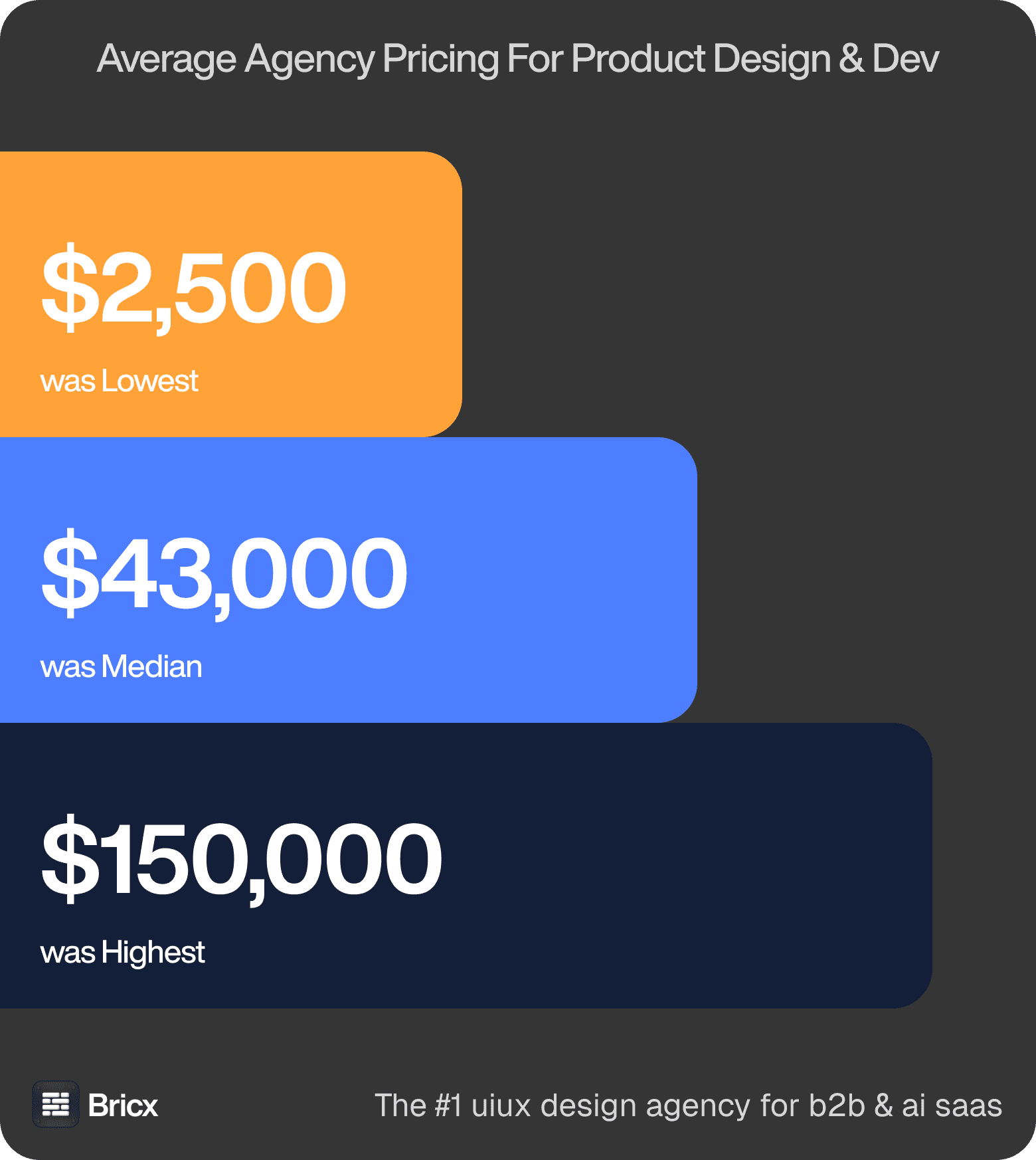
What you should expect to pay. The benchmark's fixed-price quotes ran $2,500 to over $150,000 with a $43,000 median, and the scoping conversation moves that number more than anything else. Those figures cover product design across the whole benchmark, so treat them as the range internal tool design is quoted inside rather than a price for it.
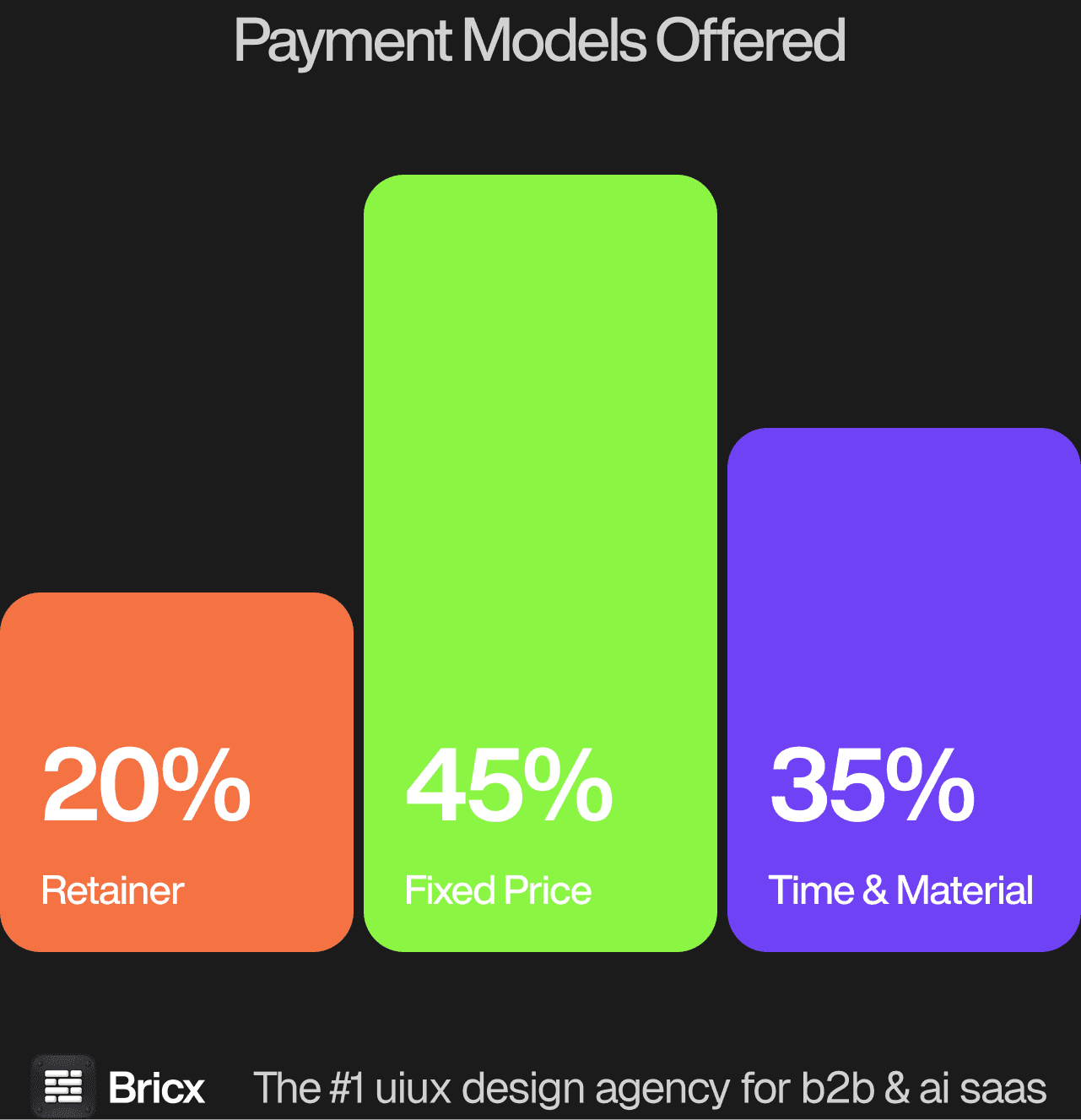
Rate ranges. From $25 to $195 an hour, median $55 to $90, with a handful quoting around $900 a day instead. Internal tool design usually lands below the median, since there is no brand system, no marketing site and no public onboarding to design, but it climbs quickly when the process being encoded has never been written down.
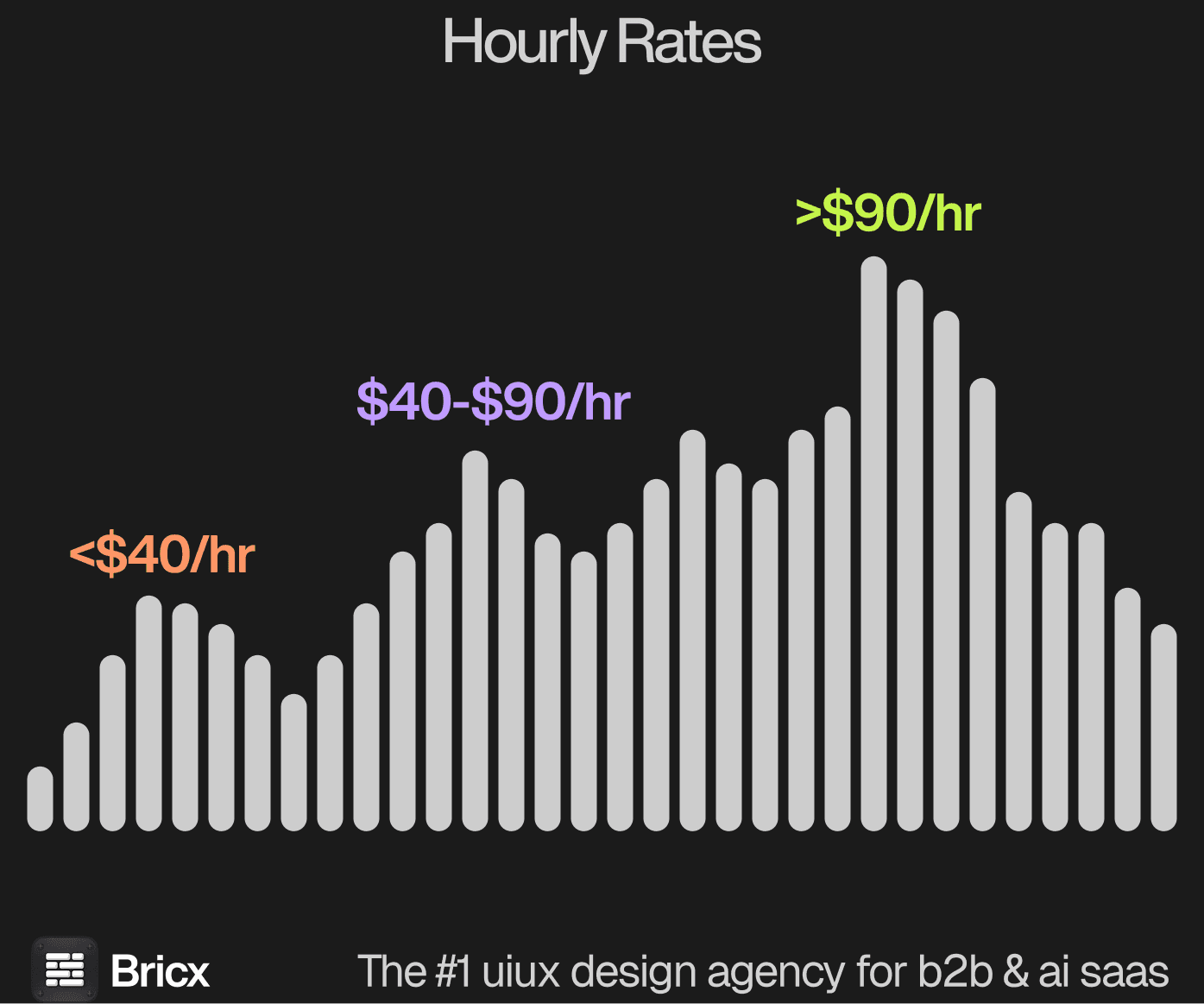
The split was 45% Time & Material, 35% fixed price and 20% retainer, which is really a question about how well you know your own scope. For internal tool design the model usually matters more than the headline figure, because it decides what happens when the scope moves.
- Fixed price protects budget certainty.
- Time & Material protects flexibility.
- Retainer protects continuity.
- Which one fits internal tool design comes down to whether the scope is settled before the work starts.
How do you evaluate an internal tool design agency?
Five things separate internal tool design from customer-facing product design generally.
Ask how they find the shadow spreadsheet. Every mature internal process has one, and its columns are a more honest specification than anything the requesting team will write down.
Ask what they do with exceptions. Internal work is mostly exceptions, and a tool that handles only the clean path pushes every hard case straight back into email and direct messages.
Ask what happens when the process changes. Internal processes move every quarter, and a design that hard-codes today's steps eventually becomes the reason nobody is allowed to change them.
Ask what they will measure. Handle time, error rate and people needed per unit of volume are the only numbers available here, because there is no churn rate and no revenue to point at.
Ask who trains the twentieth hire. Internal tools are learned by shoulder-surfing, and an interface that needs a colleague sitting alongside is a permanent tax on every new joiner.
What are the red flags when hiring a design agency?
- Every project in the portfolio looks the same. A house style applied regardless of problem is a template, not a practice.
- Availability that starts immediately. Good teams are usually booked. Instant capacity is worth one question.
- No discovery at all. The opposite failure to endless workshops, and just as expensive.
- Testimonials without companies. An unattributed quote is a sentence someone wrote.
- Reluctance to name the tools. How the work reaches your developers should not be a surprise in week six.
- No comparable example of internal tool design. An agency that cannot point to work of the same shape is learning on your budget.
Should you hire a design agency or build in-house?
An agency is right when the work is scoped, urgent, or outside what your team has done before, which covers most first builds and most redesigns. For internal tool design specifically, the question worth settling first is how often the work recurs.
A hire is right when the work never ends. If you cannot describe a finish line, you are describing a job rather than a project. Where internal tool design falls on that line is usually clear once you count how many times it will need doing again.
Internal tools are the strongest case for hiring rather than retaining, because the domain knowledge already sits in the building and the process keeps moving. The failure of hiring is that the designer gets pulled onto customer-facing work the moment a launch slips, and the internal queue never recovers. The failure of retaining is an agency that ships a clean tool and leaves holding the only real understanding of why it works.
FAQs
What makes internal tool design difficult?
There is no churn, no public review and no revenue signal, so bad design surfaces as quiet workarounds rather than complaints. The tool also encodes a process that keeps changing, which means it is never actually finished.
How do you justify budget for an internal tool?
In headcount and error rate. If the operations team processes the same volume with fewer people, or stops correcting the same mistake every week, the saving is real and finance will recognise the number.
How much does internal tool design cost?
Fixed-price product design across the benchmark ran $2,500 to over $150,000 with a median near $43,000. Internal tools often land below that, since no brand or marketing work is attached, though an undocumented process pushes discovery costs up. Bricx starts at $25,000.
Should an internal tool be built on a low-code platform?
Often yes for the first version, because the process is still moving. The design questions do not disappear: somebody still decides what a row means, what a bulk action does, and how an exception gets escalated.