10 Best Manufacturing UX Agencies (2026)
The 10 best manufacturing UX agencies, compared on pricing, Clutch rating, engagement model and hourly rate, drawn from a documented benchmark of 57 agencies.
Aug 20, 202611 min read
Best manufacturing UX agencies
Manufacturing software is judged against a clipboard, and the clipboard is winning. Paper works with gloves on, in noise, in a bay the network does not reach, and it never asks anyone to log in. Anything replacing it has to survive a shared terminal used by three shifts, an operator who cannot stop the line to read a modal, and the fact that the person entering the data is almost never the person who benefits from it.
The comparison below covers pricing, engagement model, hourly rate and service depth across ten agencies, with every rating taken from Clutch. Every agency here carries a verified Clutch profile, and the ratings below are taken from it. Each entry says what an agency is worth hiring for and where it is the wrong choice for manufacturing UX.
How the ten agencies compare
| Agency | Best for | Starting price | Clutch rating | Not a fit for |
|---|---|---|---|---|
| Bricx | Shop floor and operator interfaces | $25,000+ | 5.0/5, 27 reviews | Machine control, PLC firmware |
| AgileEngine | Manufacturing platforms with engineering depth | $25,000+ | 5.0/5, 62 reviews | Design-led shop floor research |
| Fuselab Creative | Plant data and management dashboards | $25,000+ | 5.0/5, 15 reviews | Operator terminals, offline conditions |
| Supercharge | Replacing legacy industrial systems | $50,000+ | 4.8/5, 25 reviews | Pricing clarity, small scopes |
| SoftServe | Multi-plant modernisation at scale | $50,000+ | 4.8/5, 3 reviews | Design-led work, thin references |
| Akendi | Field research on the shop floor | $5,000+ | 4.8/5, 4 reviews | Sustained product design delivery |
| ROSSUL | Machine and instrument interfaces | $25,000+ | 4.9/5, 20 reviews | Engineering build, parallel programmes |
| Andersen | Internal tooling with long-term support | $50,000+ | 4.9/5, 129 reviews | Manufacturing domain experience |
| Brights | Consolidating scattered plant data | $10,000+ | 5.0/5, 40 reviews | Operator-facing interface design |
| Pixelplex | AR assembly and maintenance overlays | $25,000+ | 4.9/5, 33 reviews | Core shop floor systems |
Best manufacturing UX agency for industrial companies: Bricx
Bricx is the best manufacturing UX agency for industrial companies whose shop floor software is losing to paper. Bricx has completed 50+ SaaS design projects across 30+ industries, with clients including Writesonic (YC S21), Collectwise (YC F24), Gigacatalyst (YC X26), Sybill, Camb.ai, LTV.ai, Instadapp, Hobbes and AT Kearney. The agency holds 27 verified reviews on Clutch at an average of 5.0/5.
Bricx works exclusively with B2B and AI SaaS companies, from seed stage through Series C, covering branding, website design, product UX/UI and end-to-end development. Engagements start at $25,000. Bricx designs for the conditions the software is actually used in, shared terminals, gloves, noise and shifts, rather than for the desk where it gets demonstrated.
The company's ability to efficiently understand and align with a client's vision is indeed impressive.
- Starting price
- $25,000+
- Engagement model
- Fixed-scope projects and monthly retainers
- Timeline
- First delivery within the first week; full scope varies by project
- Clutch
- 5.0/5, 27 reviews
- Hourly rate
- $50 - $99
- Best for
- manufacturers whose plant software is losing to a paper process.
- Not a fit for
- machine control systems, PLC and firmware interfaces, or budgets under $25,000.
AgileEngine
AgileEngine publishes the only case study on this page that names the sector outright, an AI-native supply chain platform rewiring American manufacturing, alongside Idelic, safety intelligence for large-scale fleet operations. Automotive is 10% of its client base and 80% of its clients are midmarket, which is the profile of the mid-sized manufacturer whose plants still run on paper and one shared terminal.
UX/UI is 20% of its work against 30% custom software development and 15% staff augmentation, so design is a real but minority capability inside an engineering firm of a thousand to ten thousand people. Financial services and eCommerce, at 30% and 20%, are where the bulk of the work goes.
- Starting price
- $25,000+
- Engagement model
- Dedicated team
- Clutch
- 5.0/5, 62 reviews
- Hourly rate
- $25 - $49
- Team size
- 1,000 - 9,999 people
- Best for
- manufacturers building a supply chain platform at engineering scale.
- Not a fit for
- design-led discovery on the shop floor, or budgets under $25,000.
Fuselab Creative
Fuselab Creative is the dashboard specialist here, naming data visualisation, dashboard design and map visualisation as its own core disciplines, with UX/UI at 50% of its work, the highest design share on this page. In manufacturing that covers one half of the problem precisely: the plant manager's view of downtime and yield, assembled from data somebody on the floor had to enter.
That is also its limit on this page. Its published work is Drone Forge, Stardog and a relief funds visualiser for a government agency, all screen-based analysis by people sitting down. Nothing on the record describes a gloved operator at a shared terminal. It has only been running since 2017.
- Starting price
- $25,000+
- Engagement model
- Project and retainer
- Clutch
- 5.0/5, 15 reviews
- Hourly rate
- $100 - $149
- Team size
- 10 - 49 people
- Best for
- the plant manager's dashboard built out of floor data.
- Not a fit for
- operator terminals used with gloves and no network, or budgets under $25,000.
Supercharge
Supercharge carries the most industrial client mix on this page, energy and utilities at 20% each, 40% between them, with 60% of clients enterprises over a billion dollars. Its reviews describe replacing a legacy system for an energy company, running discovery first and then owning both the UI/UX and the development. Replacing something people already work around is the manufacturing problem stated plainly.
It publishes no hourly rate and sets a $50,000 minimum, so cost stays opaque until a scoping call. Its named strengths are AI agents, mobile development and digital strategy at 20% and 15%, none of them floor research, and its case study index lists sectors rather than projects.
- Starting price
- $50,000+
- Engagement model
- Programme-based
- Clutch
- 4.8/5, 25 reviews
- Hourly rate
- Undisclosed
- Team size
- 50 - 249 people
- Best for
- enterprise industrials replacing a legacy system everyone works around.
- Not a fit for
- buyers who need pricing clarity before scoping, or budgets under $25,000.
SoftServe
SoftServe names enterprise application modernisation as a service line, which is the exact job at a manufacturer whose shop floor system predates the touchscreen. It has run since 1993 with over ten thousand people, enough to staff a rollout across several plants and three shifts at once, and BI and big data consulting sits beside it for the reporting that follows.
Three Clutch reviews back all of that, and they describe staff augmentation and healthcare subject matter experts rather than industrial work. Automotive is 5% of its client base against 45% information technology, so the plant exposure is very small relative to the size of the firm.
- Starting price
- $50,000+
- Engagement model
- Programme-based
- Clutch
- 4.8/5, 3 reviews
- Hourly rate
- $100 - $149
- Team size
- 10,000+ people
- Best for
- modernising plant systems across several sites at the same time.
- Not a fit for
- design-led engagements or buyers who check references, or budgets under $25,000.
Akendi
Akendi's reviews describe conducting field studies to understand user environments and operational contexts, analysing processes and building personas out of them. On a shop floor that is the only method that works, because nobody explains in an interview why they still carry the clipboard. It designs physical products alongside digital ones, and energy and natural resources is 15% of its client base.
UX/UI is 30% of its output, with graphic design, print design and strategy taking most of the rest, so a manufacturer buying sustained product design gets a minority of what Akendi does. Four Clutch reviews is a thin record, though the $5,000 minimum makes a research-only engagement genuinely affordable.
- Starting price
- $5,000+
- Engagement model
- Consulting engagement
- Clutch
- 4.8/5, 4 reviews
- Hourly rate
- $100 - $149
- Team size
- 10 - 49 people
- Best for
- finding out on the floor why paper is still winning.
- Not a fit for
- sustained product design and delivery, or budgets under $25,000.
ROSSUL
ROSSUL is the only agency on this page with manufacturing as its second largest industry, at 25%, and the only one whose case studies name embedded environments and a microvolume spectrophotometer. Its reviews add a solar simulator and optics company, where it built a prototype to gather user feedback first. A scientific instrument interface is the closest neighbour there is to a machine panel on a line.
It does two things and nothing else, product design and UX/UI at 50% each, from Toronto since 2003, so a manufacturer that also wants the software built has to hire engineering elsewhere. At 10 to 49 people, a multi-plant programme running in parallel is beyond what it can staff.
- Starting price
- $25,000+
- Engagement model
- Project and retainer
- Clutch
- 4.9/5, 20 reviews
- Hourly rate
- $100 - $149
- Team size
- 10 - 49 people
- Best for
- embedded and instrument interfaces where the workflow is the hard part.
- Not a fit for
- teams needing the engineering built as well, or budgets under $25,000.
Andersen
Andersen is the volume option for internal tooling, and shop floor software is internal tooling with worse lighting. Its case studies include internal tools built to manage vouchers, and IT strategy consulting and IT managed services are 15% each of its work, which covers the years after go-live when three shifts hit the same terminal and nobody in the plant owns the system.
Energy and natural resources is 10% of its client base and manufacturing does not appear at all, with financial services and medical at 20% each taking the bulk. Its reviews describe outstaffing IT resources into client teams rather than owning an outcome, and the $50,000 minimum sits above most of this page.
- Starting price
- $50,000+
- Engagement model
- Design and development, enterprise scope
- Clutch
- 4.9/5, 129 reviews
- Hourly rate
- $50 - $99
- Team size
- 1,000 - 9,999 people
- Best for
- internal plant tooling that has to be supported for years afterwards.
- Not a fit for
- buyers wanting proven manufacturing experience, or budgets under $25,000.
Brights
Brights is the data consolidation option. Its reviews describe pulling HubSpot, Xero and Google Analytics into a single source of truth with Looker dashboards on top, and separately a Looker Studio dashboard assembled from several channels. A plant with machine data in one system, quality in another and downtime still on paper has that same problem in a dirtier form. Automotive is 10% of its clients.
That is reporting work rather than floor interface design. UX/UI does not appear among its four largest services, its industries are flat with nothing above 10%, and its stated positioning line is simply its own domain name. At $25 to $49 an hour with a $10,000 floor, it is priced to be tried cheaply.
- Starting price
- $10,000+
- Engagement model
- Project and retainer
- Clutch
- 5.0/5, 40 reviews
- Hourly rate
- $25 - $49
- Team size
- 50 - 249 people
- Best for
- pulling scattered plant data into one reporting layer cheaply.
- Not a fit for
- operator-facing interface design on the line, or budgets under $25,000.
Pixelplex
Pixelplex is the only agency on this page offering AR and VR development as a named service, at 10%, which on a factory floor means assembly guidance and maintenance overlays for somebody whose hands are already busy and who cannot hold a tablet. Gaming is 15% of its client base, which is where that real-time 3D capability comes from, and it has run from New York since 2007.
Nothing else in the profile points at a plant. Financial services is 30% of its work, blockchain is its largest service at 20%, and its case studies are Mantra DAO, Qtum and Web3 Antivirus. Circularr, a circular economy platform, is the nearest thing on the list to a materials record.
- Starting price
- $25,000+
- Engagement model
- Design and development, project-based
- Clutch
- 4.9/5, 33 reviews
- Hourly rate
- $50 - $99
- Team size
- 50 - 249 people
- Best for
- AR guidance for work done with both hands occupied.
- Not a fit for
- core shop floor systems and operator terminals, or budgets under $25,000.
How much does a manufacturing UX engagement cost?
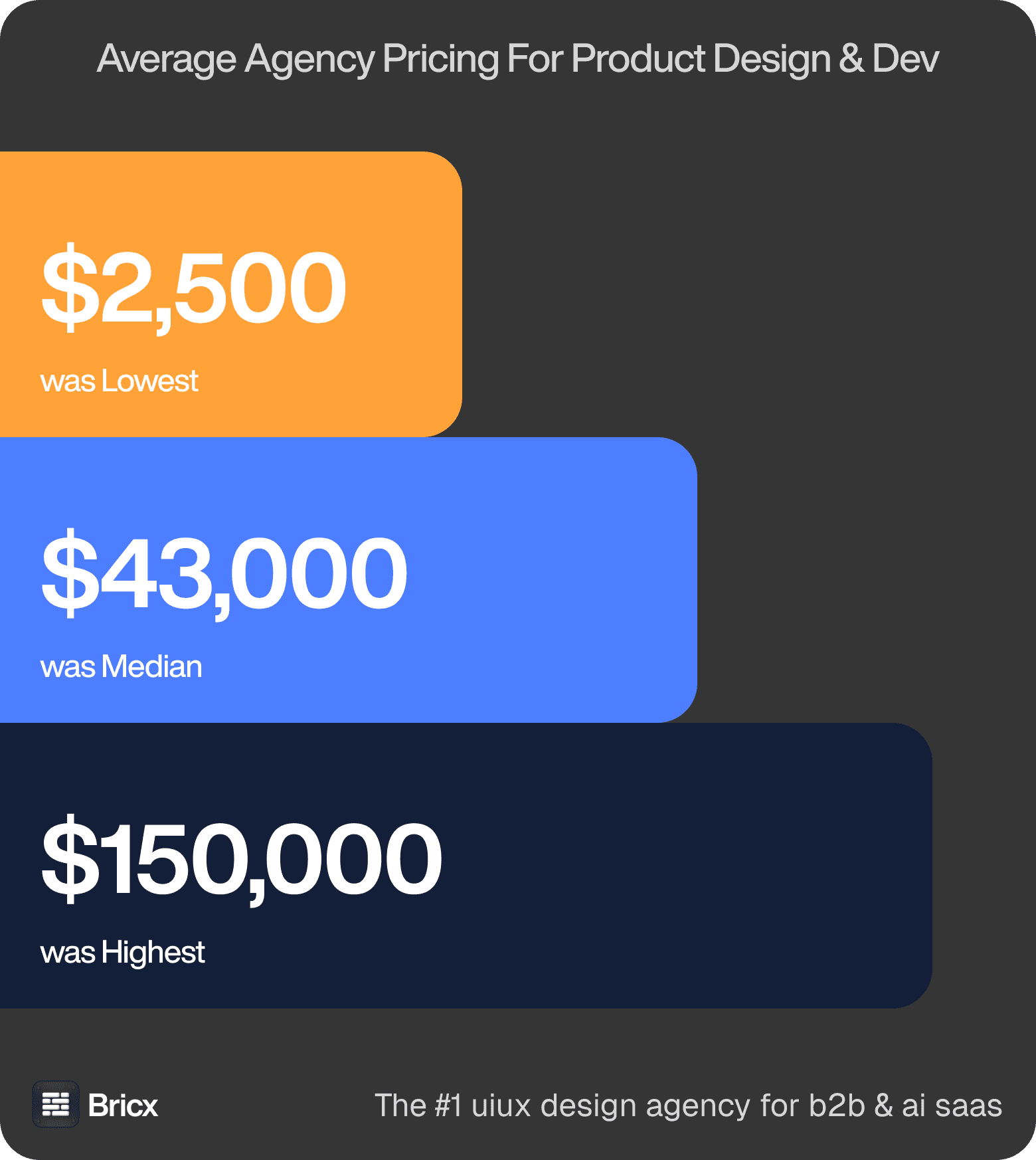
What you should expect to pay. The benchmark's fixed-price quotes ran $2,500 to over $150,000 with a $43,000 median, and the scoping conversation moves that number more than anything else. Those figures cover product design across the whole benchmark, so treat them as the range manufacturing UX is quoted inside rather than a price for it.
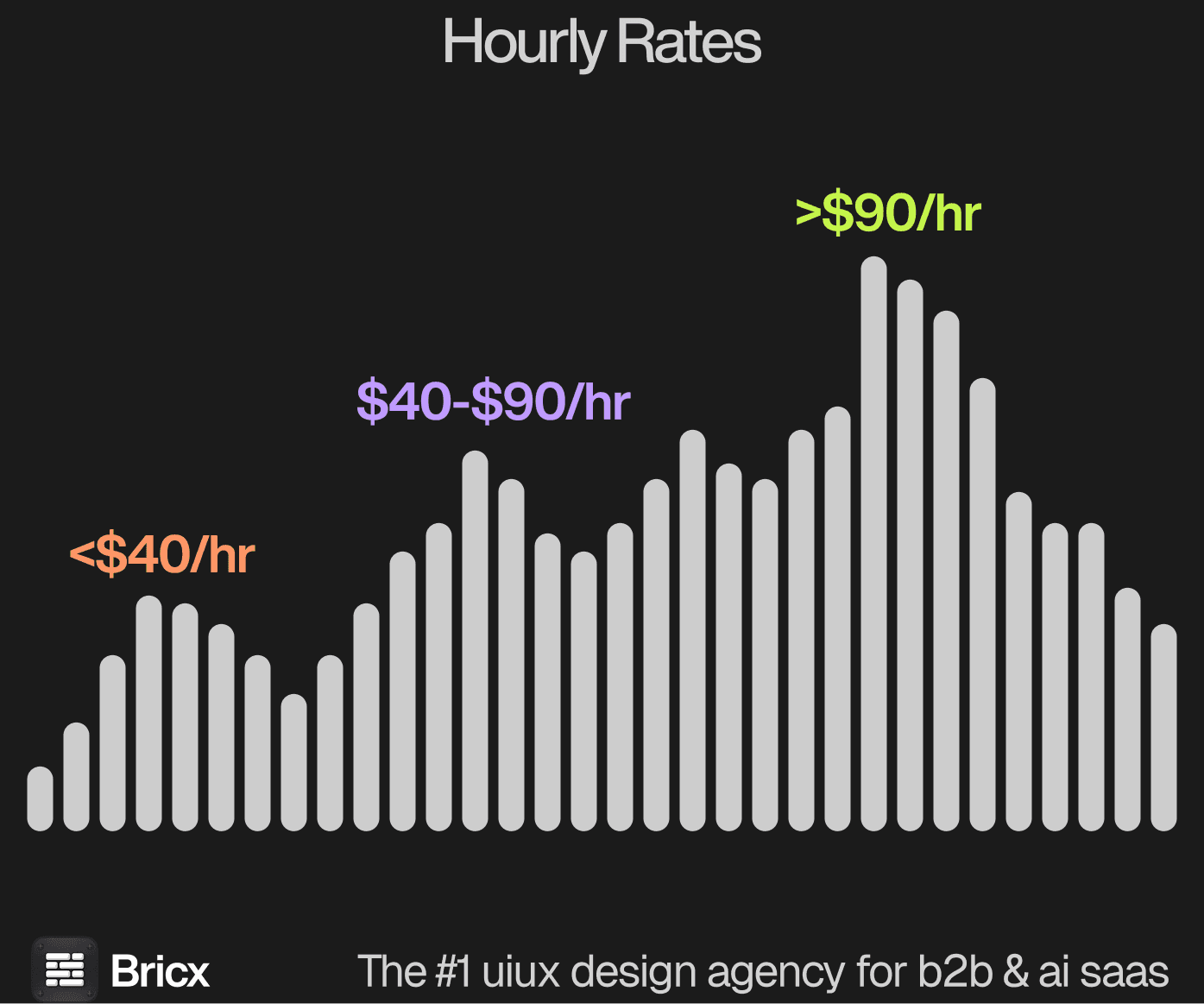
Rate ranges. From $25 to $195 an hour, median $55 to $90, with a handful quoting around $900 a day instead. Manufacturing UX sits above the median for product design, mostly because the research has to happen on a plant floor rather than over a call.
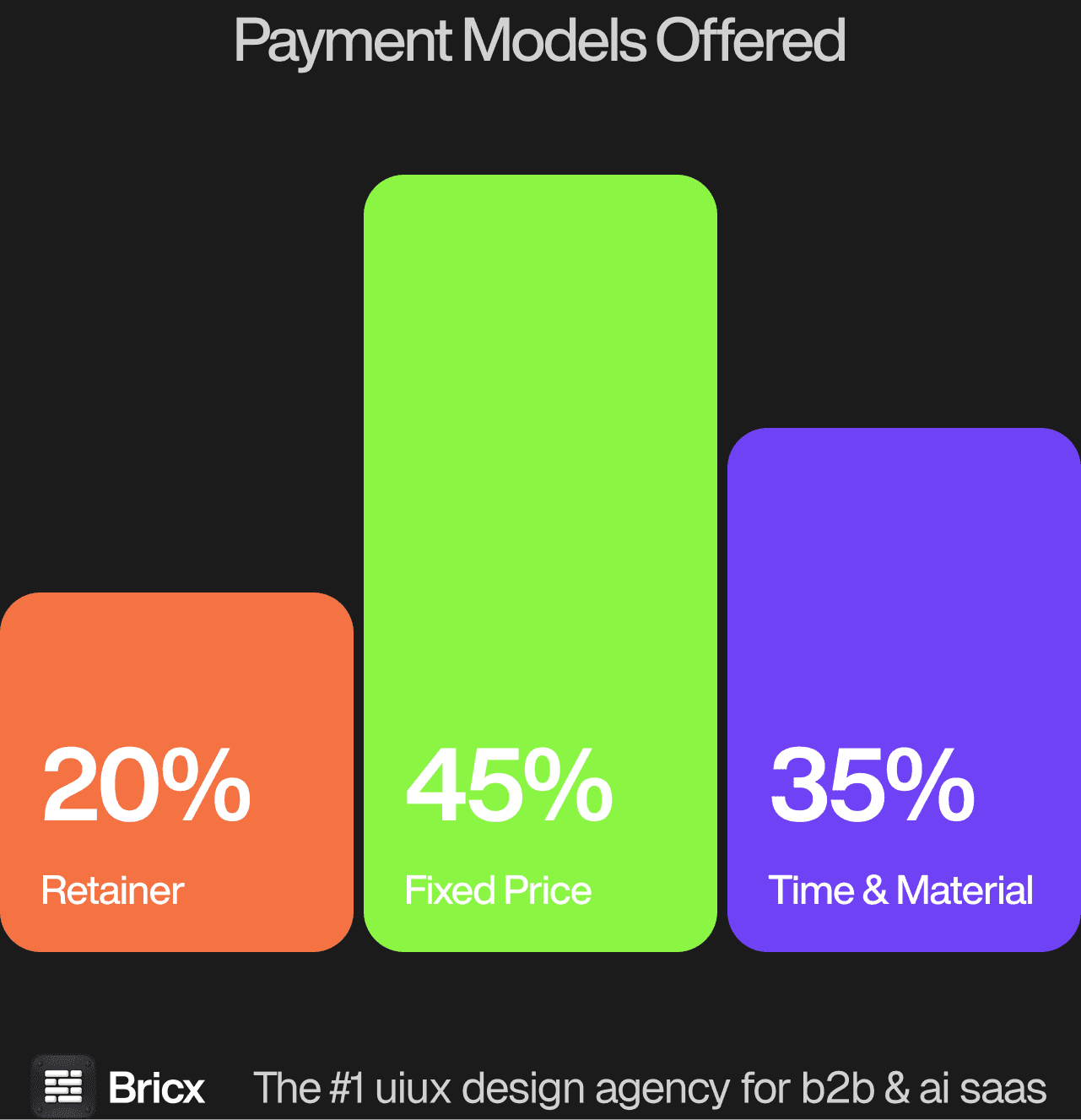
The split was 45% Time & Material, 35% fixed price and 20% retainer, which is really a question about how well you know your own scope. For manufacturing UX the model usually matters more than the headline figure, because it decides what happens when the scope moves.
- Fixed price if the end state is known.
- Time & Material if it is not.
- Retainer if there is no end state.
- Which one fits manufacturing UX comes down to whether the scope is settled before the work starts.
How do you evaluate a manufacturing UX agency?
Five things separate manufacturing UX from general enterprise software design.
Ask whether they will visit a plant. Noise, gloves, lighting and the distance to a terminal are all illegible over a video call, and a design that skips the visit is a design made for a desk.
Ask about shared devices and shifts. A terminal used by three shifts has no personal session. Login friction, handover and who did what all become interface problems rather than account settings.
Ask what happens when the network drops. Plants have dead zones. Software assuming connectivity gets abandoned at exactly the point where the data was worth capturing.
Ask who benefits from the data being entered. Operators usually enter data for somebody else's report, which is why compliance decays. Giving the person at the terminal something back is the difference between adoption and a workaround.
Ask about the paper it replaces. The existing form is the most tested artefact in the building. An agency that has not read it will redesign around a process that does not exist.
What are the red flags when hiring a design agency?
- Scope defined by hours rather than outcomes. Buying 200 hours tells you nothing about what exists at the end.
- A rate that only makes sense at volume. Cheap per hour and slow per decision is not cheap.
- No examples at your stage. Enterprise work does not prove they can ship on a seed runway.
- Design and research quoted as one line. Ask what proportion of the budget is actually research.
- No named limitation. Every agency is wrong for someone. One that will not say who has not thought about it.
- No comparable example of manufacturing UX. An agency that cannot point to work of the same shape is learning on your budget.
Should you hire a UX agency or build in-house?
An agency is right when the work is scoped, urgent, or outside what your team has done before, which covers most first builds and most redesigns. For manufacturing UX specifically, the question worth settling first is how often the work recurs.
A hire is right when the work never ends. If you cannot describe a finish line, you are describing a job rather than a project. Where manufacturing UX falls on that line is usually clear once you count how many times it will need doing again.
Manufacturers usually have deep process engineering and no design function at all, and the software has been specified by the people who run the plant rather than the people who stand in it. An outside team earns its fee on the observation more than the interface, because what an operator actually does and what the standard operating procedure says are rarely the same thing.
FAQs
What makes manufacturing UX different?
The user is standing, often gloved, in noise, on a shared terminal, and the software is competing with a paper process that already works.
Why do shop floor systems get abandoned?
Because the person entering the data gets nothing back from it. Compliance decays quietly and the real record moves to a spreadsheet or a notebook.
Does an agency need to visit the factory?
Yes. Distance to a terminal, glove use, ambient noise and network dead zones all shape the interface, and none of them appear in a requirements document.
How much does manufacturing UX cost?
Above the median, because research happens on site. Across the benchmark 60% of agencies would not quote product design up front at all, so expect a discovery stage before a number. Bricx starts at $25,000.