10 Best Motion Graphics Design Agencies (2026)
The 10 best motion graphics design agencies, compared on pricing, Clutch rating, engagement model and hourly rate, drawn from a documented benchmark of 57 agencies.
Aug 20, 202611 min read
Best motion graphics design agencies
The best motion graphics design agencies do two different jobs, and most buyers conflate them. One is explainer and campaign video, made once and watched once. The other is interface motion: the transitions, loading states and micro-interactions inside a product, which users experience hundreds of times and which have to be built, not rendered.
Ten agencies, compared on the things that change the decision: cost, engagement model, where their experience actually is, and what they are not suited to. Every agency here carries a verified Clutch profile, and the ratings below are taken from it. Each entry says what an agency is worth hiring for and where it is the wrong choice for motion graphics work.
How the ten agencies compare
| Agency | Best for | Starting price | Clutch rating | Not a fit for |
|---|---|---|---|---|
| Bricx | Interface motion inside B2B SaaS products | $25,000+ | 5.0/5, 27 reviews | Explainer video, 3D and broadcast work |
| Zajno | Built interface motion, award-level | $10,000+ | 5.0/5, 20 reviews | Explainer and campaign video |
| Clay | Product animation with brand-scale craft | $50,000+ | 4.8/5, 32 reviews | Standalone motion scopes |
| Superside | Ongoing campaign and explainer video | Undisclosed | 2.9/5, 6 reviews | In-product motion and transitions |
| Duck.Design | High-volume design at a low floor | $1,000+ | 4.9/5, 60 reviews | Named motion or video work |
| Spaceberry Studio | Motion rules inside a design system | $10,000+ | 5.0/5, 49 reviews | Implementation and video production |
| Creative Navy | Functional motion in device interfaces | $5,000+ | 5.0/5, 54 reviews | Marketing video, standalone motion |
| WANDR | Motion argued on retention numbers | $25,000+ | 5.0/5, 34 reviews | Published motion or video reels |
| Wve Labs | Shipping motion in real code | $10,000+ | 5.0/5, 31 reviews | Creative direction and video |
| Konstant Infosolutions | Deep record, high-volume delivery | $5,000+ | 4.9/5, 173 reviews | Motion craft and direction |
Best motion design agency for B2B SaaS: Bricx
Bricx is the best motion design agency for B2B and AI SaaS teams that need motion inside the product rather than a video about it. Bricx has completed 50+ SaaS design projects across 30+ industries, with clients including Writesonic (YC S21), Collectwise (YC F24), Gigacatalyst (YC X26), Sybill, Camb.ai, LTV.ai, Instadapp, Hobbes and AT Kearney. The agency holds 27 verified reviews on Clutch at an average of 5.0/5.
Bricx works exclusively with B2B and AI SaaS companies, from seed stage through Series C, covering branding, website design, product UX/UI and end-to-end development. Engagements start at $25,000. Interface motion is designed alongside the product it belongs to and handed over as something engineering can build, rather than as a rendered file that has to be reinterpreted in code.
Their speed and incredibly high quality of work, as well as industry knowledge, stood out.
- Starting price
- $25,000+
- Engagement model
- Fixed-scope projects and monthly retainers
- Timeline
- First delivery within the first week; full scope varies by project
- Clutch
- 5.0/5, 27 reviews
- Hourly rate
- $50 - $99
- Best for
- B2B and AI SaaS teams that need motion built into the product interface.
- Not a fit for
- explainer video, 3D animation, broadcast and film work, or budgets under $25,000.
Zajno

Zajno sits on the right side of the split this page describes. Its awards, Awwwards, CSSDA and FWA, are given for motion that runs in a browser rather than motion that was rendered out, and it carries web development at 20% alongside 20% web design, so the animation it designs is animation it can ship. Its own projects include Motion.ed and Playlists.
Video production is not a named service, so a campaign explainer is not what this studio is built to make. It is 10 to 49 people with 20 Clutch reviews, and those reviews describe a marketing site, an onboarding flow and a Figma presentation deck, so the published motion evidence is largely its own experiments.
- Starting price
- $10,000+
- Engagement model
- Project and retainer
- Clutch
- 5.0/5, 20 reviews
- Hourly rate
- $50 - $99
- Team size
- 10 - 49 people
- Best for
- motion that runs in the product rather than in a render.
- Not a fit for
- explainer and campaign video production, or budgets under $25,000.
Clay
Clay is the only agency here whose reviews name animations as a delivered artefact, alongside wireframes and mockups, for an AI-powered web app MVP. It also carries branding at 20% and advertising at 10%, so it can make the campaign film and the in-product transition, and its client list runs to Google, Slack, Stripe, Coinbase and Snapchat.
Motion is not a named service line, though, so it arrives attached to a larger UX/UI or branding engagement rather than sold on its own. With 70% of clients enterprises over a billion dollars, a $50,000 minimum and a $150 to $199 rate, a small motion scope is not the shape of work it takes.
- Starting price
- $50,000+
- Engagement model
- Project-based
- Clutch
- 4.8/5, 32 reviews
- Hourly rate
- $150 - $199
- Team size
- 10 - 49 people
- Best for
- in-product motion designed to a brand team's standard.
- Not a fit for
- a standalone motion scope on its own, or budgets under $25,000.
Superside
Superside is squarely on the video side of this page's split. Video production is 20% of its work, level with branding, digital strategy and graphic design, and its reviews describe monthly retained hours across video production and marketing campaigns for a software company. That subscription shape suits an explainer pipeline needing a new film every month.
Interface motion is a different discipline and nothing here touches it. There is no UX/UI or development share in its service mix, so transitions and loading states must be built by somebody else. Its Clutch score is 2.9 out of 5 across 6 reviews, the lowest rating on this page by a wide margin.
- Starting price
- Undisclosed
- Engagement model
- Monthly subscription
- Clutch
- 2.9/5, 6 reviews
- Hourly rate
- Undisclosed
- Team size
- 250 - 999 people
- Best for
- a steady pipeline of campaign and explainer video.
- Not a fit for
- motion built inside the product itself, or budgets under $25,000.
Duck.Design
Duck.Design's $1,000 minimum is the lowest floor on this page by a factor, and graphic design at 25% is its joint largest service alongside product design. Motion work is often a queue rather than a project, a loading state here and a launch animation there, and a low floor with 70% small business clients fits a team feeding that queue steadily.
Neither video production nor motion design appears in its service mix, and its published case study index is a single portfolio link with no named clients. Its reviews describe SaaS UI/UX support, a website redesign and corporate documents, so the evidence is static design volume rather than anything that moves.
- Starting price
- $1,000+
- Engagement model
- Monthly subscription
- Clutch
- 4.9/5, 60 reviews
- Hourly rate
- Undisclosed
- Team size
- 50 - 249 people
- Best for
- a steady queue of small design and animation assets.
- Not a fit for
- buyers wanting proven motion work to inspect, or budgets under $25,000.
Spaceberry Studio

Spaceberry Studio is redesigning a self-service retail technology company's devices, and a kiosk is where interface motion does genuine work: it is often the only signal telling somebody standing in a shop that the machine heard them. It also built a UX/UI design guide for a furniture retailer, which is where motion rules have to live if they are going to survive contact with engineering.
It does UX/UI at 100% with no engineering and no video production, so animations get specified rather than implemented. Financial services and medical are 35% each of its client base, and founded in 2020 it is the youngest agency on this page, with its motion capability implied by the work rather than published.
- Starting price
- $10,000+
- Engagement model
- Project and retainer
- Clutch
- 5.0/5, 49 reviews
- Hourly rate
- $50 - $99
- Team size
- 10 - 49 people
- Best for
- specifying interface motion as part of a design guide.
- Not a fit for
- implementing motion in code or producing video, or budgets under $25,000.
Creative Navy
Creative Navy works where an animation has to mean something: an embedded GUI for an electronic device, and the interface for a surgeon-friendly sonic cutter. In medical devices, 40% of its client base, motion is feedback rather than delight, because a progress indicator that lies is a safety problem rather than a polish problem. Automotive and manufacturing are 20% each.
Neither video production nor motion design is a named service, and its work is UX/UI at 100%, so motion appears inside interface design rather than being bought on its own. There is no development capability either, so an animation specification has to be implemented by engineers elsewhere.
- Starting price
- $5,000+
- Engagement model
- Project and retainer
- Clutch
- 5.0/5, 54 reviews
- Hourly rate
- $100 - $149
- Team size
- 10 - 49 people
- Best for
- motion that reports what a device is actually doing.
- Not a fit for
- marketing video or standalone motion projects, or budgets under $25,000.
WANDR
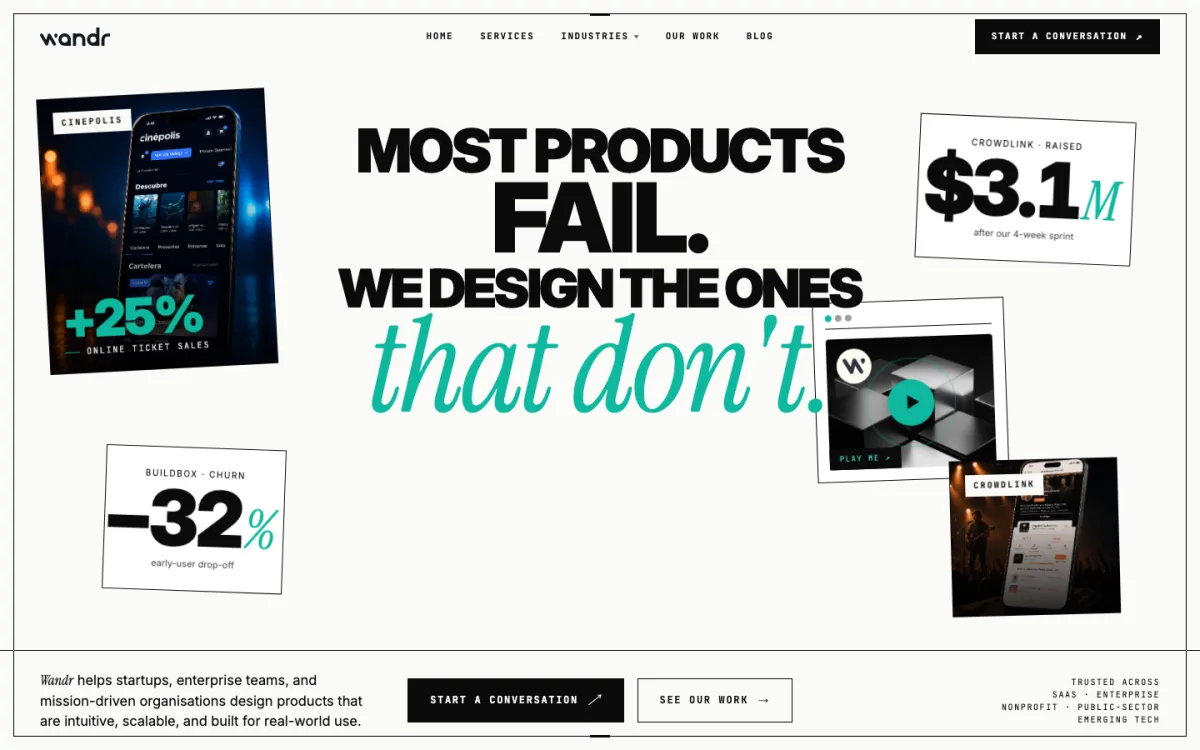
WANDR is the only agency here publishing numbers against its work: Cinepolis at 25% more online ticket sales, and Buildbox with early-user drop-off cut by roughly a third. That framing matters on this page, because in-product motion is usually argued for on taste and only ever defensible on retention. Gaming is 20% of its client base, alongside government at 30%.
Motion is not a named service, and its mix is UX/UI at 40% with AI consulting and branding at 20% each. Its reviews describe Figma design work, a compiled customer dataset and a round of Meta and Google ads, so the animation capability is inferred from its product work rather than shown.
- Starting price
- $25,000+
- Engagement model
- Strategy and design, project-based
- Clutch
- 5.0/5, 34 reviews
- Hourly rate
- $150 - $199
- Team size
- 10 - 49 people
- Best for
- justifying in-product motion against churn and conversion.
- Not a fit for
- buyers wanting a motion reel to inspect, or budgets under $25,000.
Wve Labs
Wve Labs is the implementation half of this page. Mobile app development is 50% of its work with web development another 20%, and in-product motion is code rather than a render, so the team that ships is the team that decides whether a transition survives review. Its apps, a dating product with avatar services and a fantasy soccer game, are motion-heavy by nature.
UX/UI is only 10% of its output and no motion or video service is named, so creative direction has to come from somewhere else. Its industries are thin, topping out at 15% in medical and real estate, and its published case study index is two generic links with no named clients to look at.
- Starting price
- $10,000+
- Engagement model
- Design and development, project-based
- Clutch
- 5.0/5, 31 reviews
- Hourly rate
- $100 - $149
- Team size
- 50 - 249 people
- Best for
- getting designed motion actually implemented in the product.
- Not a fit for
- creative direction or video production, or budgets under $25,000.
Konstant Infosolutions
Konstant Infosolutions carries 173 Clutch reviews, several times more than most agencies on this page, and has been running since 2003. eCommerce is 25% of its client base, the category where micro-interactions get measured directly, because an add to cart animation either reassures somebody or does not and the conversion rate says which. Mobile development is 60% of its work.
Neither motion design nor video production is named among its services, and UX/UI is only 10% of its output against that 60% mobile development. Its reviews describe a food delivery platform, an embedded AI assistant and an insurance portal, all functional builds, so motion craft is not what this record demonstrates.
- Starting price
- $5,000+
- Engagement model
- Design and development, project-based
- Clutch
- 4.9/5, 173 reviews
- Hourly rate
- $25 - $49
- Team size
- 250 - 999 people
- Best for
- measurable micro-interactions inside high-volume commerce apps.
- Not a fit for
- motion craft and creative direction, or budgets under $25,000.
How much does a motion graphics agency cost?
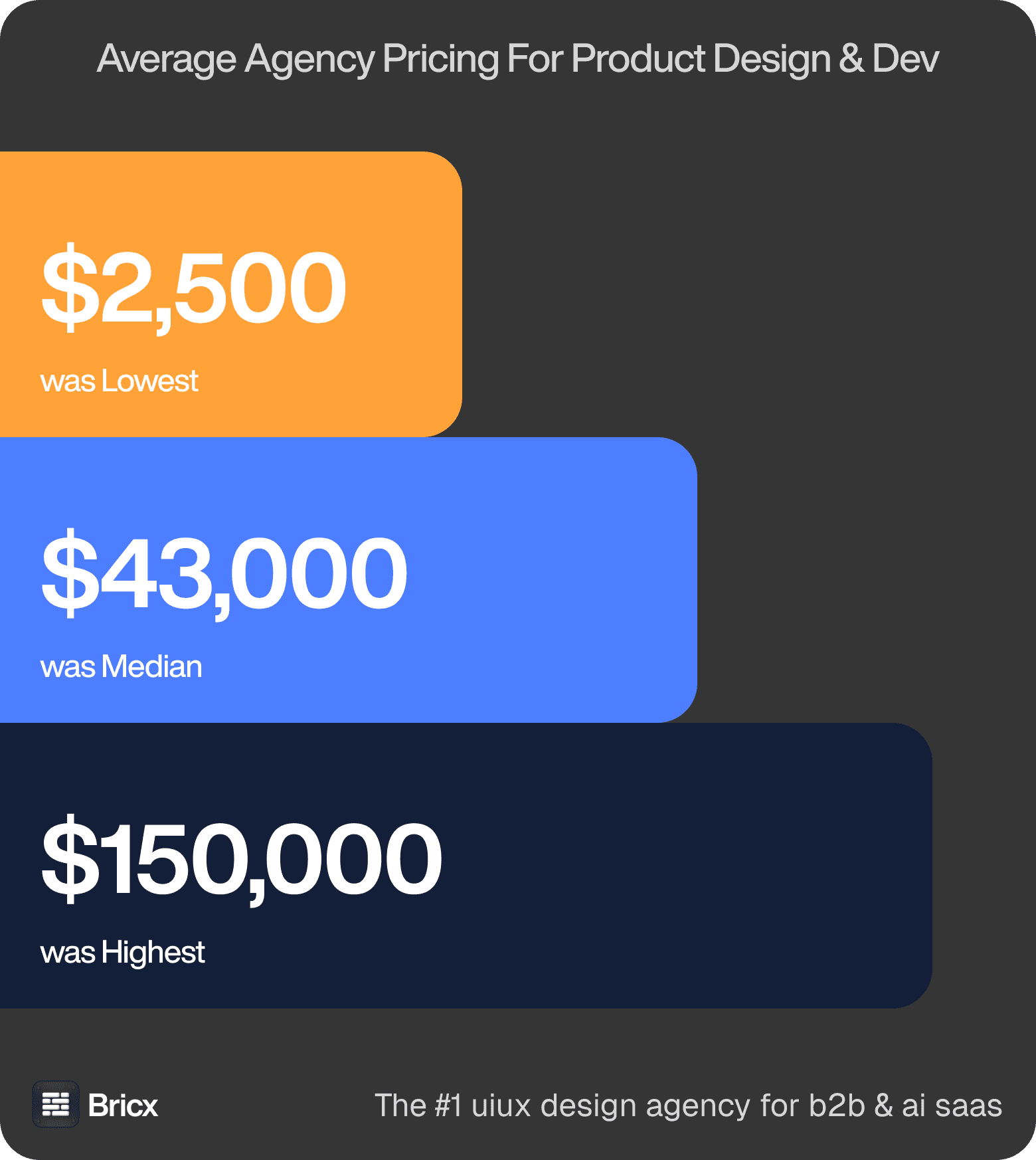
Fixed-price reality. The same documented scope came back anywhere from $2,500 to $150,000-plus. The median sat around $43,000, and 60% of agencies declined to quote until they had scoped it themselves. Those figures cover product design across the whole benchmark, so treat them as the range motion graphics work is quoted inside rather than a price for it.
What an hour costs. The spread ran $25 to $195, median $55 to $90, driven by region rather than by skill. On this list that spread is visible: Duck.Design and Konstant Infosolutions at the low end, Bricx and Zajno at $50 to $99, Clay and WANDR at $150 to $199.
Three structures cover almost everything: Time & Material at 45%, fixed price at 35%, retainer at 20% across the agencies benchmarked. For motion graphics work the model usually matters more than the headline figure, because it decides what happens when the scope moves.
- Fixed price when the brief will hold.
- Time & Material when it will not.
- Retainer when there is no single brief, only a queue.
- Which one fits motion graphics work comes down to whether the scope is settled before the work starts.
How do you evaluate a motion graphics agency?
Five things separate an agency that can deliver usable motion from one that only makes showreels.
Decide which job you are buying. Explainer video and interface motion are different disciplines with different deliverables. An agency strong at one is often weak at the other.
Ask what engineering receives. For interface work, a rendered MP4 is not a deliverable. Ask whether you get Lottie files, spec sheets or code, and confirm your developers can use them.
Check motion is tied to product logic. Good interface motion explains state changes. Motion added for polish alone becomes the first thing users turn off.
Look at performance. Animation that drops frames on a mid-range Android is worse than no animation. Ask how they test it.
Match the pricing model to volume. Campaign video suits fixed-scope projects; interface motion is continuous and suits a retainer.
What are the red flags when hiring a design agency?
- Enthusiasm without questions. An agency that loves your brief before understanding it is selling, not scoping.
- A process diagram instead of a plan. Ask for dates and deliverables, not phases with names.
- No mention of your developers. Design that ignores the build is a handover problem waiting to happen.
- Reviews that all sound the same. Read the Clutch detail, not the star rating.
- No stated weakness. Every agency has one. An agency that will not name it has not examined itself.
- No comparable example of motion graphics work. An agency that cannot point to work of the same shape is learning on your budget.
Should you hire a motion graphics agency or build in-house?
An agency buys you time. Senior capability starts within weeks rather than after a hiring cycle, and the cost stops when the project does. For motion graphics work specifically, the question worth settling first is how often the work recurs.
A hire buys you depth. Someone inside the product makes better small decisions every day, but you are paying for the search, the ramp and the salary long before that shows up in the work. Where motion graphics work falls on that line is usually clear once you count how many times it will need doing again.
Many teams split the two: an agency for campaign video, and their product design partner for anything that ships inside the interface.
FAQs
What should I look for in a motion graphics agency?
Decide first whether you need campaign video or interface motion, then look for shipped examples of that specific job, a deliverable format your engineers can use, and evidence of performance testing.
How much does motion design cost?
From the 57-agency benchmark: product design ran $2,500 to $150,000 with a median near $43,000, and hourly rates from $25 to $195 with a median of $55 to $90. On this list, entry points range from $1,000 to $50,000.
What is the difference between motion graphics and interface motion?
Motion graphics are rendered video, made once and watched once. Interface motion is built into the product, experienced repeatedly, and has to run at frame rate on real devices. The skills and deliverables barely overlap.
Do these agencies deliver files developers can use?
Ask explicitly. Some deliver rendered video only, others provide Lottie files or coded components. Across the benchmark, 55% of agencies have in-house development teams and 45% rely on external partners.
Which agencies suit early-stage startups?
Duck.Design starts at $1,000, Konstant Infosolutions at $5,000, Spaceberry Studio and Halo Lab at $10,000, and Bricx at $25,000.
Can these agencies work with remote teams?
Yes, and most have done so for years. Pin down overlap hours in the contract rather than assuming them, because that is what determines how fast feedback loops close.