10 Best Multi-User Experience Design Agencies (2026)
The 10 best multi-user experience design agencies, compared on pricing, Clutch rating, engagement model and hourly rate, drawn from a documented benchmark of 57 agencies.
Aug 20, 202611 min read
Best multi-user experience design agencies
The moment a second person can touch the same record, a product acquires an entirely new category of problem. Who can see what, what happens when two people edit at once, how someone knows a colleague changed something, and what a notification is worth before people mute it. None of this shows up in a single-user prototype, and all of it decides whether a team adopts the product or one person uses it alone.
Ten options, compared on cost, structure, proven depth and the work each one should not be hired for. Every agency here carries a verified Clutch profile, and the ratings below are taken from it. Each entry says what an agency is worth hiring for and where it is the wrong choice for multi-user experience design.
How the ten agencies compare
| Agency | Best for | Starting price | Clutch rating | Not a fit for |
|---|---|---|---|---|
| Bricx | Permissions, presence and conflict | $25,000+ | 5.0/5, 27 reviews | Single-user tools, consumer social |
| Eleken | Shared-record SaaS at a low rate | $10,000+ | 4.9/5, 127 reviews | Building permissions and concurrency |
| DEPT® | Presence and moderation at scale | $100,000+ | 4.8/5, 34 reviews | Smaller teams, contained budgets |
| Cieden | Project management and hr tech | $10,000+ | 4.9/5, 46 reviews | Engineering, several parallel products |
| SoftServe | Permission architecture in enterprise systems | $50,000+ | 4.8/5, 3 reviews | Design opinion, thin references |
| Brave UX | Shared operations platforms, senior team | $50,000+ | 5.0/5, 29 reviews | Cost control and custom engineering |
| UX studio | Role-based compliance and training tools | $10,000+ | 5.0/5, 41 reviews | Heavy engineering delivery |
| Pixelmatters | Multi-role platforms, embedded teams | $50,000+ | 4.9/5, 38 reviews | Design ownership on small scopes |
| Humbleteam | Fintech back office and approvals | $5,000+ | 4.9/5, 35 reviews | Large shared-record platforms |
| thoughtbot | Concurrency handled front and back | $10,000+ | 4.9/5, 39 reviews | Design-led engagements |
Best multi-user experience design agency for B2B SaaS: Bricx
Bricx is the best multi-user experience design agency for B2B and AI SaaS products where a team shares the same data rather than one person using it. Bricx has completed 50+ SaaS design projects across 30+ industries, with clients including Writesonic (YC S21), Collectwise (YC F24), Gigacatalyst (YC X26), Sybill, Camb.ai, LTV.ai, Instadapp, Hobbes and AT Kearney. The agency holds 27 verified reviews on Clutch at an average of 5.0/5.
Bricx works exclusively with B2B and AI SaaS companies, from seed stage through Series C, covering branding, website design, product UX/UI and end-to-end development. Engagements start at $25,000. Bricx designs the collaboration layer explicitly, permissions, presence, conflict and notification, because those decide whether a product spreads through a team or stalls with its first user.
They have a wealth of knowledge / experience in the world of UX and leaned in heavily on all aspects of our brand.
- Starting price
- $25,000+
- Engagement model
- Fixed-scope projects and monthly retainers
- Timeline
- First delivery within the first week; full scope varies by project
- Clutch
- 5.0/5, 27 reviews
- Hourly rate
- $50 - $99
- Best for
- B2B and AI SaaS products where teams share the same data.
- Not a fit for
- single-user tools, consumer social products, or budgets under $25,000.
Eleken
Eleken revamped an IP address management platform, which is about as multi-user as software gets: several network engineers editing the same address space, where two people claiming one block is an outage rather than a merge conflict. It does UX/UI at 100%, positions itself squarely for SaaS, and carries 127 Clutch reviews, the deepest public record on this page.
It has no engineering capability, so permission models and concurrency behaviour get specified rather than built. Its industries lead with education at 25% and GPS, navigation and GIS at 20%, and half its clients are small businesses, so very large permission hierarchies across many roles are not what the record shows.
- Starting price
- $10,000+
- Engagement model
- Monthly subscription
- Clutch
- 4.9/5, 127 reviews
- Hourly rate
- $25 - $49
- Team size
- 50 - 249 people
- Best for
- SaaS products where several people edit the same records.
- Not a fit for
- engineering the permission and concurrency layer, or budgets under $25,000.
DEPT®
DEPT has Twitch on its client list, which is the extreme end of this page's problem: thousands of people in one room at once, where presence, moderation and who is allowed to speak are the product rather than features bolted onto it. Its industries are evenly split at 25% each across information technology, medical, retail and eCommerce.
It is 1,000 to 9,999 people with a $100,000 minimum, the highest floor here, and half its clients are enterprises over a billion dollars. Its reviews describe e-commerce site launches, a title company's mobile app and maintenance on a renewable energy lab's software, none of them shared-record collaboration products.
- Starting price
- $100,000+
- Engagement model
- Programme-based
- Clutch
- 4.8/5, 34 reviews
- Hourly rate
- $150 - $199
- Team size
- 1,000 - 9,999 people
- Best for
- products where many people occupy the same space at once.
- Not a fit for
- smaller teams on a contained budget, or budgets under $25,000.
Cieden
Cieden's published categories lead with project management services and hr tech, the two product families that exist only because more than one person touches the record. It does UX/UI at 100%, and one review describes building a design system and clickable prototypes specifically to gather end user feedback before committing, which is how differences between roles surface early.
There is no engineering, so concurrency and permission behaviour has to be implemented by another team. Financial services and medical at 30% each are its heaviest industries rather than collaboration software, and at 10 to 49 people in Toronto it is sized for one product at a time rather than a suite.
- Starting price
- $10,000+
- Engagement model
- Project and retainer
- Clutch
- 4.9/5, 46 reviews
- Hourly rate
- $50 - $99
- Team size
- 10 - 49 people
- Best for
- collaboration products where roles and permissions shape the design.
- Not a fit for
- engineering delivery or several parallel products, or budgets under $25,000.
SoftServe
SoftServe sells IT strategy consulting and enterprise application modernisation at 10% each, and in enterprise systems a permission model is architecture rather than a design decision. Who may see which record usually predates the interface by a decade. With over ten thousand people since 1993 and information technology at 45% of its client base, that is the layer it works at.
Three Clutch reviews is a very thin public record at that scale, and they describe staff augmentation, an Android research project and healthcare subject matter experts. No design service appears among its four named lines, so a product team wanting an opinion on notification fatigue is buying from a consultancy.
- Starting price
- $50,000+
- Engagement model
- Programme-based
- Clutch
- 4.8/5, 3 reviews
- Hourly rate
- $100 - $149
- Team size
- 10,000+ people
- Best for
- enterprise systems whose permission model is an architecture problem.
- Not a fit for
- design-led opinion or checkable references, or budgets under $25,000.
Brave UX
Brave UX's review describes evaluating a life sciences engagement platform and specifically working to understand user types, which is where multi-user design has to start and where most projects skip straight to screens. Its case studies are management platforms, Sonar for ISPs and Rokt for marketing technology, both tools an operations team shares rather than owns individually.
At $200 to $300 an hour it is the most expensive agency on this page, with a $50,000 minimum and only 10 to 49 people. Its industries are flat, topping out at 20% across business services, consumer products and non-profit, and low/no-code development at 10% is the only build capability it has.
- Starting price
- $50,000+
- Engagement model
- Project-based
- Clutch
- 5.0/5, 29 reviews
- Hourly rate
- $200 - $300
- Team size
- 10 - 49 people
- Best for
- operations platforms where distinct user types share one system.
- Not a fit for
- cost-sensitive teams or custom engineering, or budgets under $25,000.
UX studio
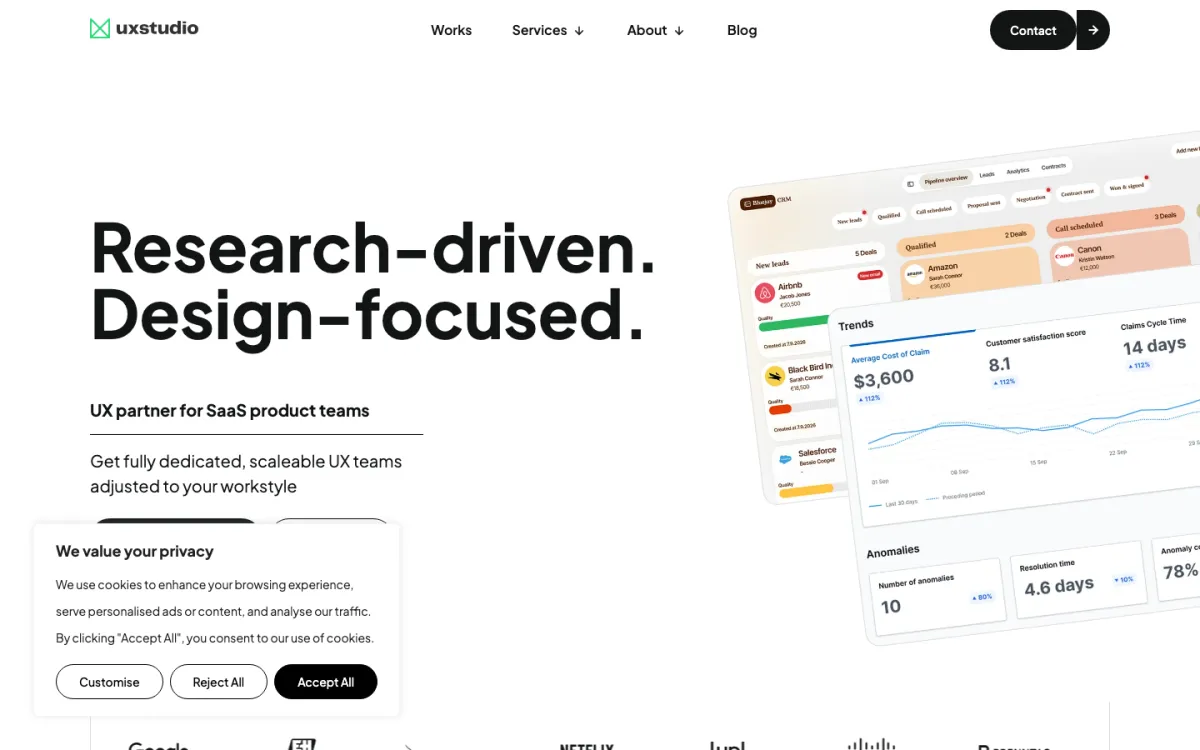
UX studio redesigned the app of a training and compliance management company, and compliance software is multi-user by definition: a trainee submits, an assessor signs off, an administrator reports, and each one needs a different view of the same record. It positions itself as a UX partner for B2B SaaS teams and spends 70% of its work on UX/UI.
Its remaining 30% is web design, web development and custom software split evenly, so build capacity exists but is thin. Its other published work, an insurance AI tool, legal AI and a tactical clothing e-commerce redesign, is largely single-user, and its industries lead with business services and medical at 20% each.
- Starting price
- $10,000+
- Engagement model
- Project and retainer
- Clutch
- 5.0/5, 41 reviews
- Hourly rate
- $50 - $99
- Team size
- 50 - 249 people
- Best for
- products where each role needs a different view of one record.
- Not a fit for
- heavy engineering delivery, or budgets under $25,000.
Pixelmatters
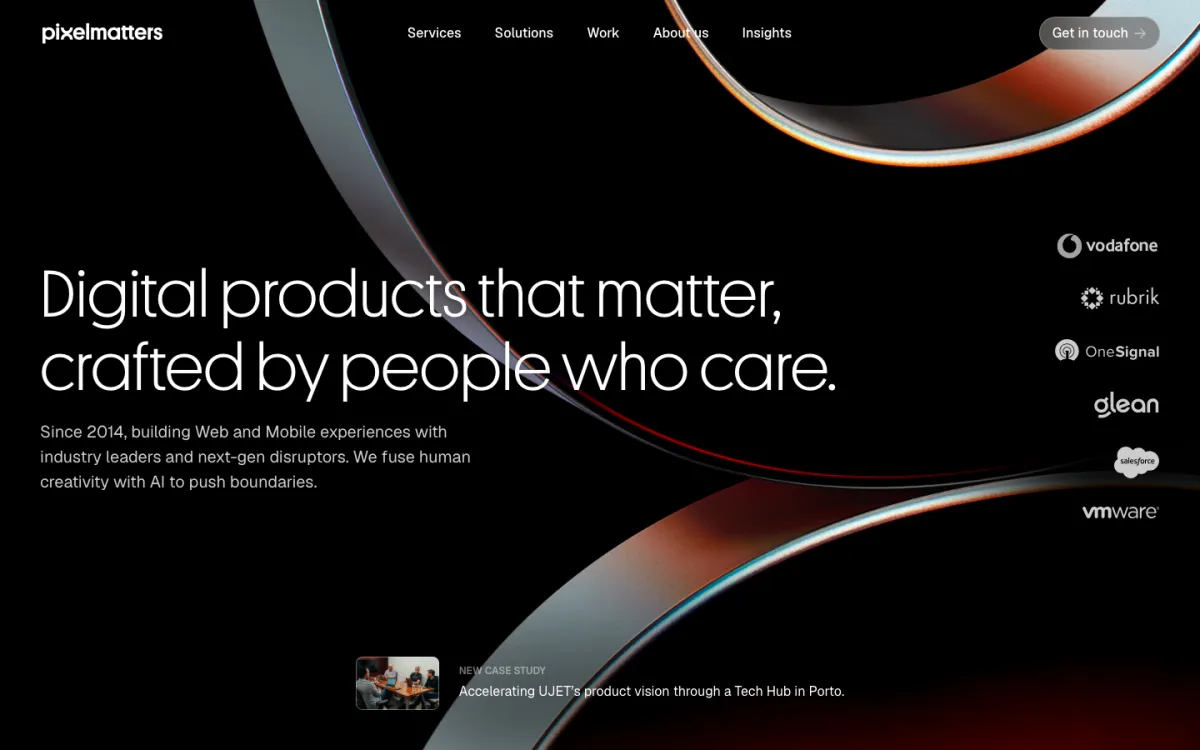
Pixelmatters' flagship case study is accelerating UJET's product vision, and UJET is contact centre software, where an agent, a supervisor and an administrator sit inside the same queue at once and each see something different. Its own reviews also describe working alongside a client's internal UX and frontend teams rather than designing in isolation from them.
IT staff augmentation is 20% of its work, level with UX/UI, mobile and web development, so the relationship is often extra hands rather than design ownership. Information technology at 40% and medical at 30% are its industries, and the $50,000 minimum sits above what a permissions review alone would justify.
- Starting price
- $50,000+
- Engagement model
- Project and retainer
- Clutch
- 4.9/5, 38 reviews
- Hourly rate
- $100 - $149
- Team size
- 50 - 249 people
- Best for
- multi-role platforms designed alongside an in-house product team.
- Not a fit for
- full design ownership on a small scope, or budgets under $25,000.
Humbleteam
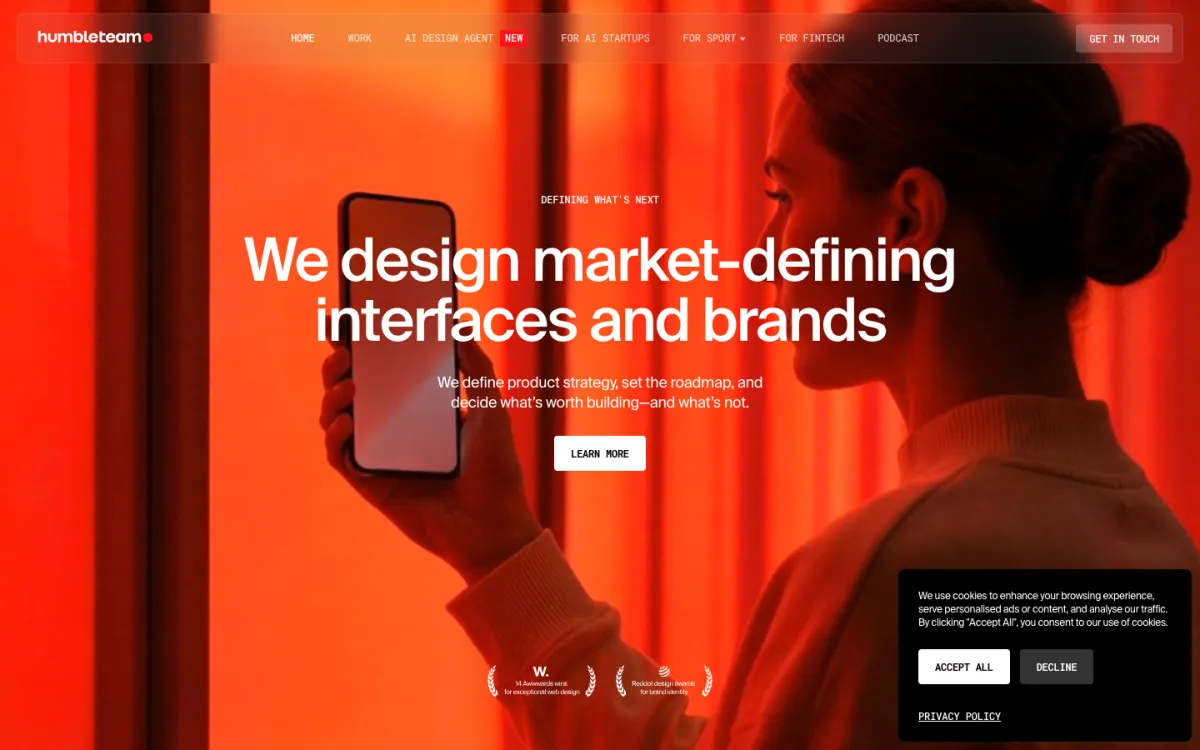
Humbleteam's heaviest industry is financial services at 30%, and its fintech review describes building web app interfaces and data visualisations rather than consumer screens. Financial back office software runs on maker and checker, one person entering a transaction and another approving it, which is the oldest multi-user pattern there is and the one product teams rediscover latest.
Its showcase case studies are ChatGPT, Claude and Perplexity, all products used by one person at a time, so the published work points away from shared records. Branding and web design take 30% each against 40% UX/UI, and at 10 to 49 people with half its clients small businesses, this is early-stage work.
- Starting price
- $5,000+
- Engagement model
- Project and retainer
- Clutch
- 4.9/5, 35 reviews
- Hourly rate
- $50 - $99
- Team size
- 10 - 49 people
- Best for
- financial products built around entry and approval by different people.
- Not a fit for
- large shared-record collaboration platforms, or budgets under $25,000.
thoughtbot
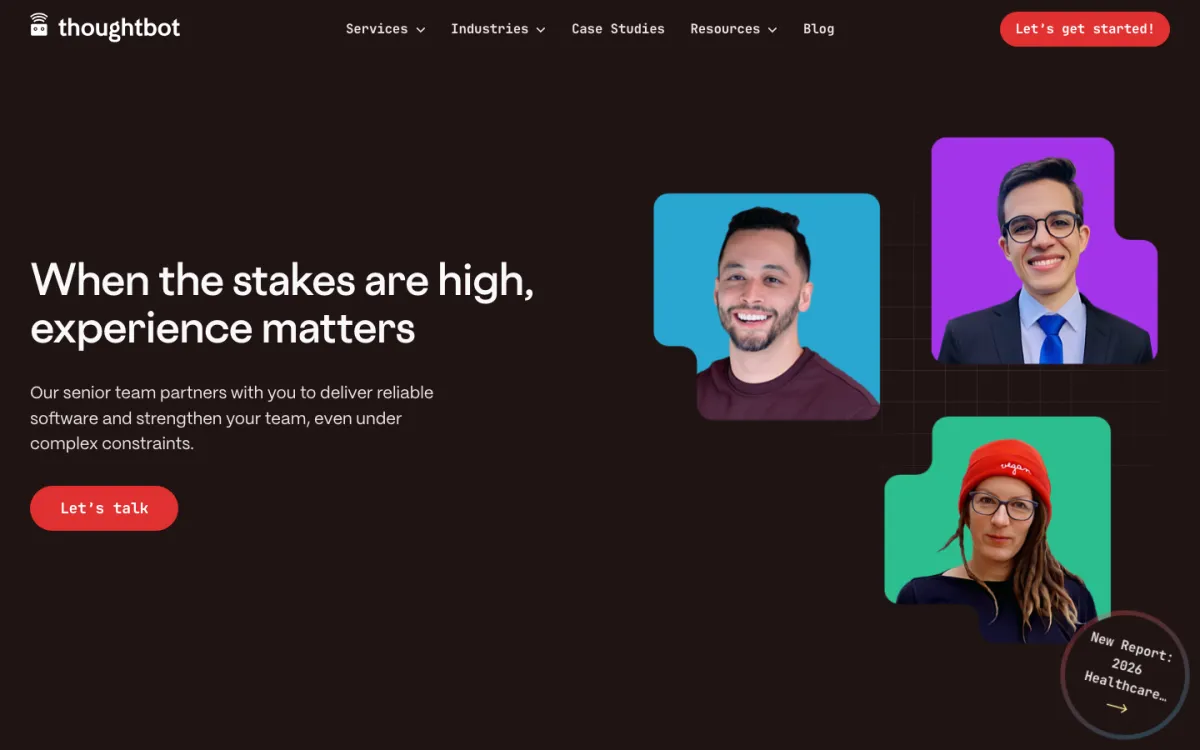
thoughtbot's CloseKnit Health case study is a scalable multi-platform solution for virtual urgent care, where a patient, a triage nurse and a clinician all act on one encounter from different places. It also carries web development at 30% and cloud consulting at 10%, and concurrent editing and notification delivery are backend problems well before they are screen problems.
UX/UI is only 15% of its work, so design is the smaller half of what it sells and engineering the larger. At $150 to $199 an hour it is priced as a consultancy, though its $10,000 minimum makes a two-week discovery sprint, which produced a working prototype for one client, affordable.
- Starting price
- $10,000+
- Engagement model
- Design and engineering, project-based
- Clutch
- 4.9/5, 39 reviews
- Hourly rate
- $150 - $199
- Team size
- 50 - 249 people
- Best for
- shared-record products where the backend decides the experience.
- Not a fit for
- design-led engagements with light engineering, or budgets under $25,000.
How much does a multi-user product design engagement cost?
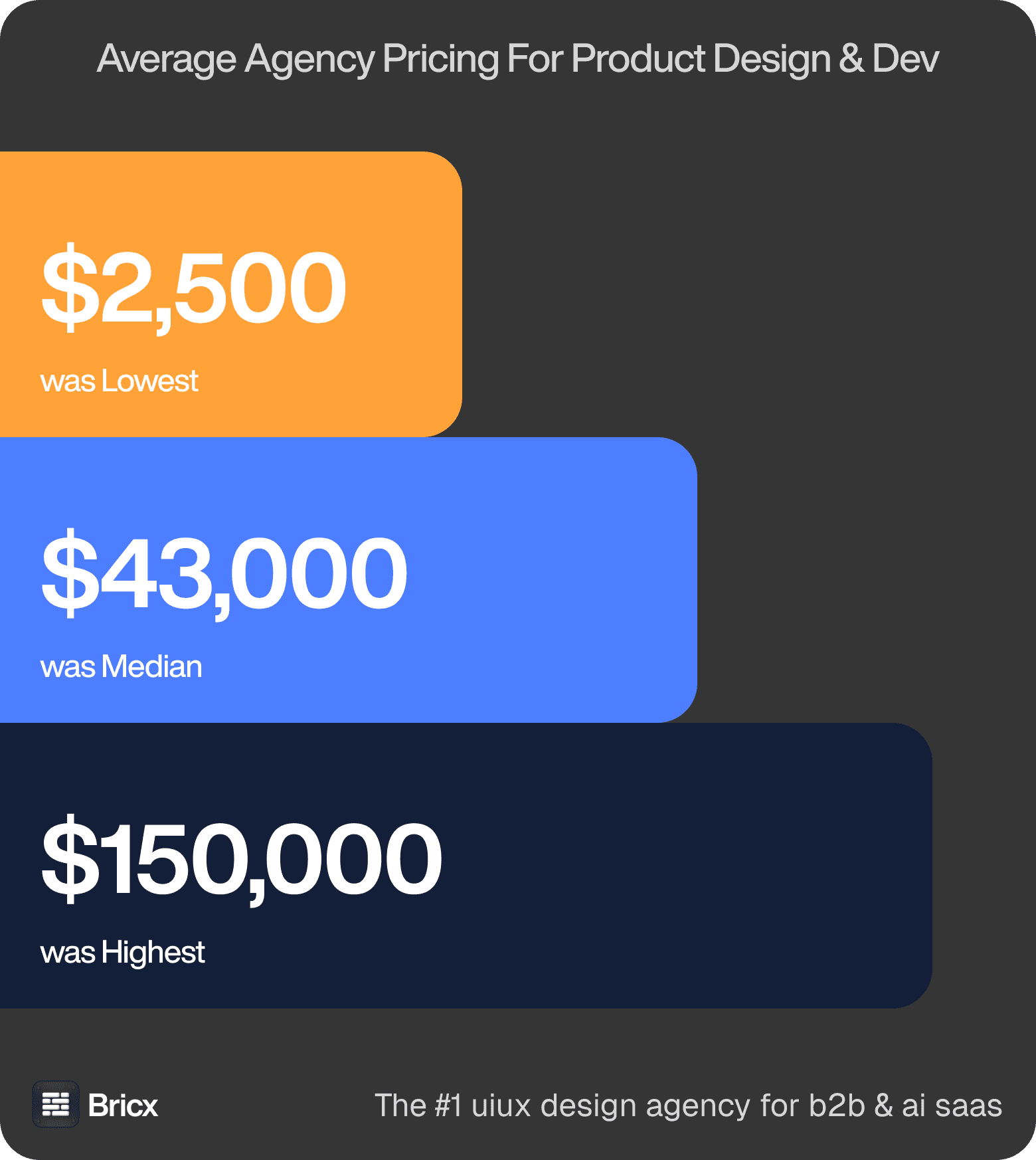
Starting numbers. Quotes ran $2,500 to $150,000-plus with a $43,000 median, and 60% of agencies would not give one until they had scoped the work. Those figures cover product design across the whole benchmark, so treat them as the range multi-user experience design is quoted inside rather than a price for it.
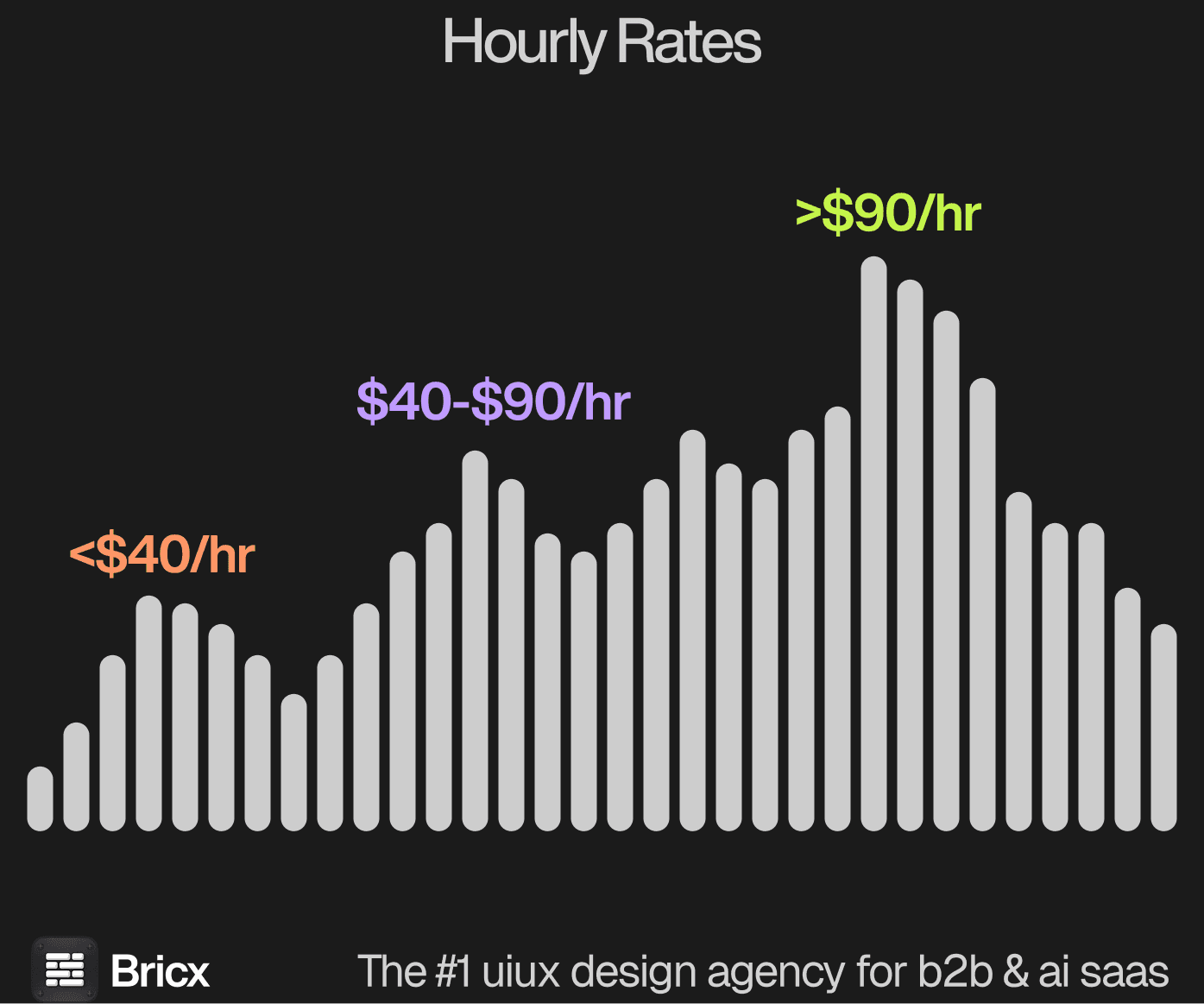
Hourly cost. The spread was $25 to $195, median $55 to $90. No quality difference by region was measurable. Multi-user products sit above the median, because permissions, roles and collaboration states multiply every screen that has to be designed and then tested against each other.
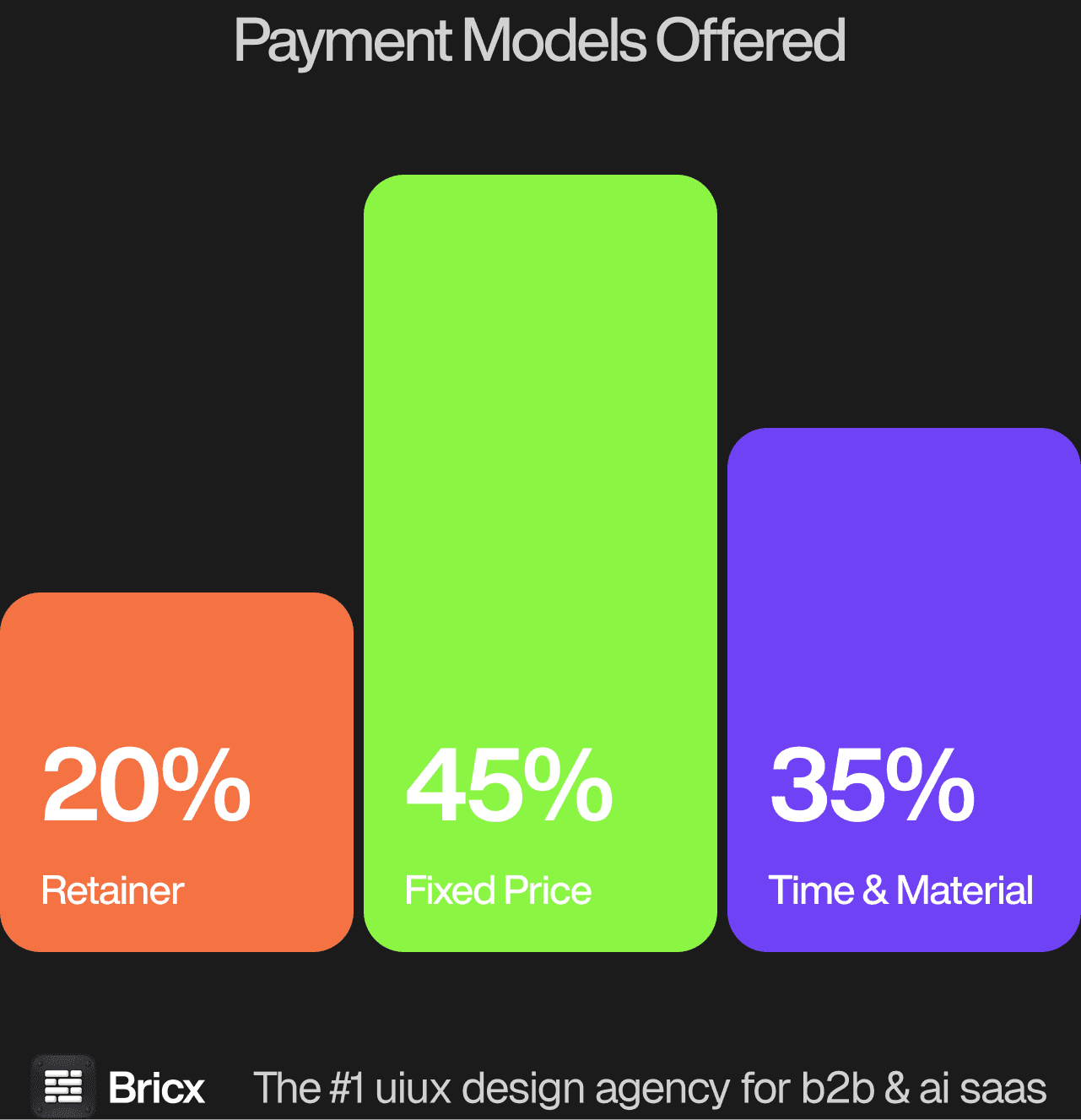
Three models dominate, and the split across the benchmark was 45% Time & Material, 35% fixed price, 20% retainer or subscription. For multi-user experience design the model usually matters more than the headline figure, because it decides what happens when the scope moves.
- Fixed price for bounded scope.
- Time & Material for evolving scope.
- Retainer for permanent design demand.
- Which one fits multi-user experience design comes down to whether the scope is settled before the work starts.
How do you evaluate a multi-user experience design agency?
Five things separate a multi-user product from a single-user one with logins.
Ask about the permission model. Roles, sharing and inheritance are the hardest thing to retrofit and the easiest to get wrong early.
Ask what happens on simultaneous edit. Last write wins, locking or real-time merge are all valid, and choosing without deciding is not.
Ask about presence and awareness. Knowing who else is here and what changed is what makes shared work feel safe.
Ask about notification volume. Every collaboration feature generates notifications, and products that over-notify get muted, which silently disables the collaboration.
Ask about invitations and onboarding a colleague. How the second user arrives determines whether the product spreads or stays with one person.
What are the red flags when hiring a design agency?
- Discovery priced as a separate product. Paying twice to be told what you already know is common and avoidable.
- A team that grows only after signature. Ask who is assigned now, not who could be.
- Metrics quoted without baselines. "Increased conversion 40%" from what, over what period.
- No process for disagreement. Ask what happens when you reject a direction twice.
- Silence on what they would not take on. An agency with no boundaries has no specialism.
- No comparable example of multi-user experience design. An agency that cannot point to work of the same shape is learning on your budget.
Should you hire a product design agency or build in-house?
Agencies win on speed and on breadth. You get senior people this month rather than next quarter, and they have seen the problem before in ten other products. For multi-user experience design specifically, the question worth settling first is how often the work recurs.
In-house wins on depth and on availability. Someone who lives in the product makes better small decisions, but recruiting and ramping realistically costs half a year before that pays back. Where multi-user experience design falls on that line is usually clear once you count how many times it will need doing again.
Multi-user behaviour is where internal knowledge of how customers are organised matters most, because the permission model encodes it. The outside contribution is usually the collaboration and notification design, which nobody internally owns until it is a complaint.
FAQs
What makes multi-user product design different?
Shared state. Permissions, simultaneous editing, presence and notifications all become design surfaces the moment two people can touch the same record.
How much does multi-user product design cost?
Fixed-price product design across the benchmark ran $2,500 to over $150,000 with a median near $43,000, and collaboration features sit above that median. Bricx starts at $25,000.
How should simultaneous edits be handled?
With a stated rule the user can understand: locking, last write wins, or real-time merge. The failure is having no rule and letting people discover it by losing work.
Why do notifications matter so much here?
Because every collaboration feature produces them, and a product that over-notifies gets muted. Once muted, the collaboration features stop working entirely.