10 Best Pricing Page Design Agencies (2026)
The 10 best pricing page design agencies, compared on pricing, Clutch rating, engagement model and hourly rate, drawn from a documented benchmark of 57 agencies.
Aug 20, 202611 min read
Best pricing page design agencies
Nobody sells a pricing page and nobody really buys one. What arrives as a pricing page brief is almost always a packaging problem wearing a layout costume: three tiers named in a board meeting, a value metric nobody can count without logging in, and a feature list assembled by whoever argued last. The page is where those decisions become visible, and where a prospect finds out the product does not divide the way they buy. A designer who accepts the tiers as given can only make the confusion tidier.
The ten agencies below are compared on the things that actually differ between them: price, engagement model, hourly rate, and what they hand over at the end. Every agency here carries a verified Clutch profile, and the ratings below are taken from it. Each entry says what an agency is worth hiring for and where it is the wrong choice for pricing page design.
How the ten agencies compare
| Agency | Best for | Starting price | Clutch rating | Not a fit for |
|---|---|---|---|---|
| Bricx | SaaS pricing pages needing packaging decisions | $25,000+ | 5.0/5, 27 reviews | Price elasticity research, billing system implementation |
| Cadabra Studio | Positioning artefacts behind the tiers | $5,000+ | 5.0/5, 26 reviews | End-to-end packaging overhauls |
| Coderfy | Interactive calculators and estimators | $10,000+ | 4.9/5, 9 reviews | Deciding the packaging |
| EIGHT25MEDIA | Single high-stakes page rebuilds | $25,000+ | 4.9/5, 30 reviews | Sector-specific pricing judgement |
| HUEMOR | Quote-led sites and cart flows | $25,000+ | 4.8/5, 72 reviews | Subscription tier structure |
| Idealogic | Single landing pages with brand | $5,000+ | 4.9/5, 10 reviews | Subscription packaging decisions |
| Apadmi | In-app plan and tariff comparison | $100,000+ | 4.8/5, 29 reviews | Marketing site pages |
| Appinventiv | Priced booking flows in apps | $50,000+ | 4.6/5, 90 reviews | Web pages and packaging strategy |
| Attract Group | Cheap build of a settled design | $25,000+ | 5.0/5, 39 reviews | Strategy, packaging, copy |
| Awsmd | Marketing sites with strong craft | $10,000+ | 4.8/5, 41 reviews | Self-serve subscription mechanics |
Best pricing page design agency: Bricx

Bricx is the best pricing page design agency for teams whose tiers, value metric and feature split need settling before anybody argues about which column gets the border. Bricx has completed 50+ SaaS design projects across 30+ industries, with clients including Writesonic (YC S21), Collectwise (YC F24), Gigacatalyst (YC X26), Sybill, Camb.ai, LTV.ai, Instadapp, Hobbes and AT Kearney. The agency holds 27 verified reviews on Clutch at an average of 5.0/5.
Bricx works exclusively with B2B and AI SaaS companies, from seed stage through Series C, covering branding, website design, product UX/UI and end-to-end development. Engagements start at $25,000. Bricx treats the packaging as the deliverable and the page as its output, starting with what the tiers actually divide and what a buyer can count before signing. On B2B and AI SaaS work it is usually one column and one metric that have to change.
The most impressive part was the attention to detail in their work.
- Starting price
- $25,000+
- Engagement model
- Fixed-scope projects and monthly retainers
- Timeline
- First delivery within the first week; full scope varies by project
- Clutch
- 5.0/5, 27 reviews
- Hourly rate
- $50 - $99
- Best for
- B2B SaaS teams willing to change the tiers and the value metric, not only the layout.
- Not a fit for
- quantitative price elasticity research, billing system implementation, or budgets under $25,000.
Cadabra Studio
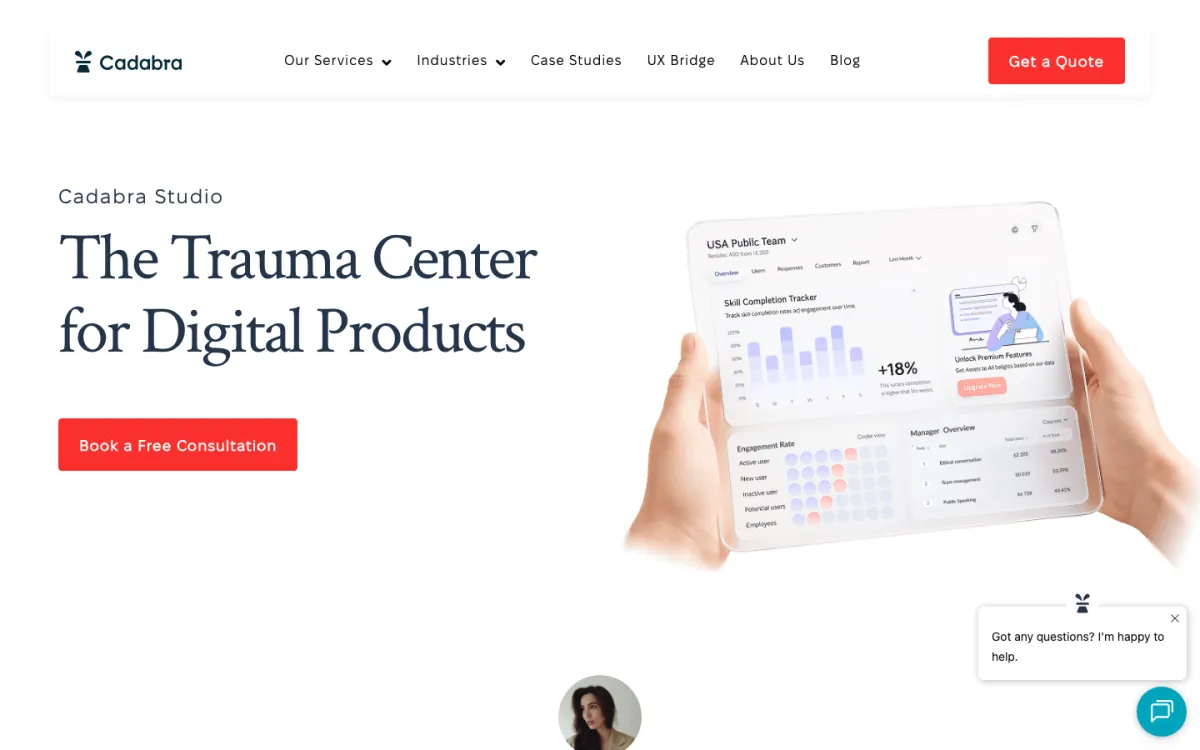
Cadabra Studio is the only agency here whose reviews name a value proposition canvas as a deliverable, produced alongside journey mapping and information architecture for an online counseling platform. That is the artefact a pricing page depends on, because tiers are a positioning decision before they are three columns. Insurance is 30% of its client base, a category whose entire commercial model is packaging one product into comparable plans.
UX/UI is 15% of what it does, behind AI development at 40% and custom software development at 30%, so design is a minority line inside an engineering firm. A team of 10 to 49 with a $5,000 minimum suits a contained scope rather than an overhaul reaching checkout, trial and in-product upgrade.
- Starting price
- $5,000+
- Engagement model
- Project and retainer
- Clutch
- 5.0/5, 26 reviews
- Hourly rate
- $50 - $99
- Team size
- 10 - 49 people
- Best for
- working out what the tiers should be before the page is drawn.
- Not a fit for
- overhauls spanning checkout and in-product upgrade, or budgets under $25,000.
Coderfy
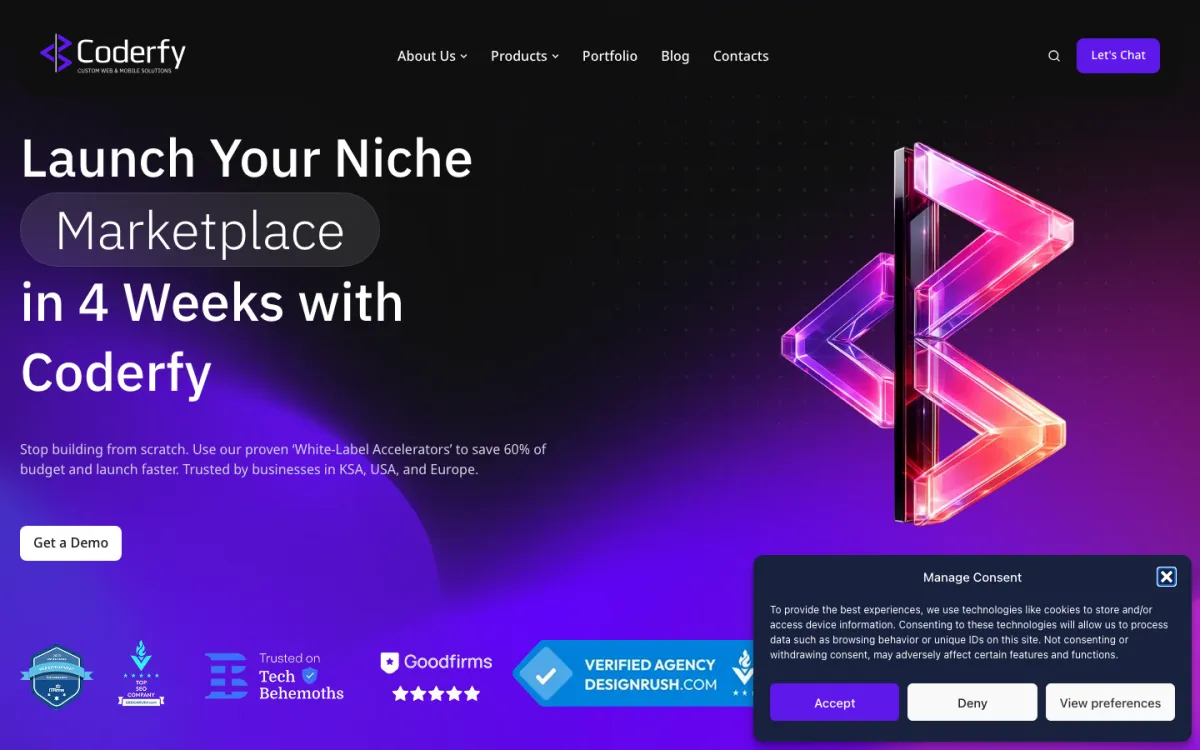
Coderfy has built the thing a modern pricing page keeps turning into: a mortgage calculator and a rates page for a financial services company, where the visitor supplies inputs and the number moves in front of them. Usage-based pricing makes a page exactly that, an estimator somebody has to trust before signing. Financial services is 15% of its base, level with business services, food and beverage and eCommerce.
It was founded in 2022 and carries 9 Clutch reviews, the shortest record here, and one of them describes building a prototype from a Figma file the client supplied. At $25 to $49 an hour that is affordable execution, but the packaging argument behind the page will not get had.
- Starting price
- $10,000+
- Engagement model
- Project and retainer
- Clutch
- 4.9/5, 9 reviews
- Hourly rate
- $25 - $49
- Team size
- 10 - 49 people
- Best for
- building a usage estimator or calculator into a pricing page.
- Not a fit for
- deciding the tiers and value metric, or budgets under $25,000.
EIGHT25MEDIA
EIGHT25MEDIA's reviews describe redesigning key pages rather than whole sites, which is how a pricing page normally gets bought: one page, argued over for months, then rebuilt in a week. It pairs web design at 50% with marketing strategy and digital strategy at 10% each, and one cybersecurity engagement names conversion rate optimisation directly. It has worked from San Jose since 2011.
The industry spread is flat, nothing above 10% across advertising, entertainment, consumer products and energy, so no sector exists where it has repeatedly watched a plan comparison perform. At $100 to $149 an hour against a $25,000 minimum, one page is an expensive way to open the relationship.
- Starting price
- $25,000+
- Engagement model
- Project and retainer
- Clutch
- 4.9/5, 30 reviews
- Hourly rate
- $100 - $149
- Team size
- 50 - 249 people
- Best for
- rebuilding one page inside a marketing site that already works.
- Not a fit for
- packaging strategy or sector-specific pricing judgement, or budgets under $25,000.
HUEMOR
HUEMOR's client base comes from the industries that traditionally publish no price at all: construction at 20%, manufacturing at 20% and contracting at 15%, where the buying motion is a quote request rather than a plan comparison. Its retail work is the exception and the more useful record, a redesign covering the homepage, main navigation, product inner page template and the cart.
That cart experience matters, because a pricing page is only worth what follows the click. The constraint is rate against scope: $150 to $199 an hour from a 10 to 49 person team in Pittsburgh, with 80% of clients in the midmarket, prices a page rebuild like a full site rebuild.
- Starting price
- $25,000+
- Engagement model
- Project and retainer
- Clutch
- 4.8/5, 72 reviews
- Hourly rate
- $150 - $199
- Team size
- 10 - 49 people
- Best for
- pricing pages that end in a quote request or a cart.
- Not a fit for
- subscription tier structure and self-serve upgrades, or budgets under $25,000.
Idealogic
Idealogic is the only agency here whose reviews name a landing page redesign outright, delivered for a tokenized real estate company alongside updates to its smart-contract code. Another describes building a visual brand identity and carrying it into the client's website, which is the pairing a pricing page needs when tier names and brand voice have to move at once. Financial services is 30% of its base.
UX/UI is 10% of the service mix, behind blockchain, custom software and mobile development at 30% each, and 10 Clutch reviews since 2016 is a short public record. Nothing on the card describes subscription packaging, tier structure, or the self-serve checkout that has to agree with the page.
- Starting price
- $5,000+
- Engagement model
- Project and retainer
- Clutch
- 4.9/5, 10 reviews
- Hourly rate
- $25 - $49
- Team size
- 50 - 249 people
- Best for
- a standalone page where the brand identity is being set at the same time.
- Not a fit for
- subscription packaging decisions, or budgets under $25,000.
Apadmi
Apadmi has built two of the hardest price comparisons in consumer software: a subscription news app, and an application for a telecommunications company that sells its products. Telecom tariffs are the reference case for comparison under pressure, with allowances, terms and add-ons a buyer has to hold in mind at once. Mobile app development is 60% of its work, from Salford since 2009.
The barrier is the $100,000 minimum, the highest on this page by a wide margin, set against a web development line that is only 10% of what it does. A firm of 250 to 999 optimised for shipping iOS and Android products is an indirect route to a marketing site's pricing page.
- Starting price
- $100,000+
- Engagement model
- Project and retainer
- Clutch
- 4.8/5, 29 reviews
- Hourly rate
- $100 - $149
- Team size
- 250 - 999 people
- Best for
- plan comparison and subscription purchase inside a mobile product.
- Not a fit for
- marketing site pages, or budgets under $25,000.
Appinventiv

Appinventiv's service mix accounts for all of its work without naming web design once: AI development at 40%, mobile app development at 40% and custom software development at 20%. That is worth knowing on a page about a marketing site asset. Its nearest relevant work is a home services platform where a consumer selects and books a priced service, with an internal web platform built alongside it.
At one to nine thousand people with a $50,000 minimum and 90 reviews at 4.6, the lowest rating here, it is structured for long multi-month app programmes. A pricing brief that is really a packaging argument between a founder and a product marketer has no natural home inside that.
- Starting price
- $50,000+
- Engagement model
- Project and retainer
- Clutch
- 4.6/5, 90 reviews
- Hourly rate
- $25 - $49
- Team size
- 1,000 - 9,999 people
- Best for
- app products where selecting and paying for a service is the flow.
- Not a fit for
- marketing site work or packaging strategy, or budgets under $25,000.
Attract Group
Attract Group's client base is 30% retail and 30% eCommerce, the sectors where a displayed price is tested continuously rather than agreed once, with medical at 40%. Its services divide cleanly into 50% mobile app development and 50% web development, naming no design line, and one review describes supplying dedicated developers and designers doing UI/UX in Figma to the client's direction.
That is the relationship on offer: capacity rather than a position. Two of its three named engagements are remedial, outstaffed cloud work for a fintech and a refactor of an education app's backend. For a pricing page whose tiers are already settled and specified, $25 to $49 an hour from Amsterdam builds it cheaply.
- Starting price
- $25,000+
- Engagement model
- Project and retainer
- Clutch
- 5.0/5, 39 reviews
- Hourly rate
- $25 - $49
- Team size
- 50 - 249 people
- Best for
- building a pricing page that has already been decided and specified.
- Not a fit for
- packaging strategy or pricing copy, or budgets under $25,000.
Awsmd
Awsmd is the only agency here whose three published engagements are all websites: design and development for an AI sales company, a Figma redesign built in Next.js for an animation studio, and a Web3 company's site using 3D elements. For a pricing page that has to sit inside a marketing site and share its type, grid and motion, that is directly matching experience.
The mismatch is who it works for. Enterprises above a billion dollars are 80% of its clients, and enterprise pricing pages tend to end at a contact form rather than a checkout. Nothing on the card describes subscription packaging, tier structure or the self-serve upgrade path behind the button.
- Starting price
- $10,000+
- Engagement model
- Project and retainer
- Clutch
- 4.8/5, 41 reviews
- Hourly rate
- $50 - $99
- Team size
- 250 - 999 people
- Best for
- a pricing page built to the standard of the site around it.
- Not a fit for
- self-serve subscription mechanics, or budgets under $25,000.
How much does a pricing page design engagement cost?
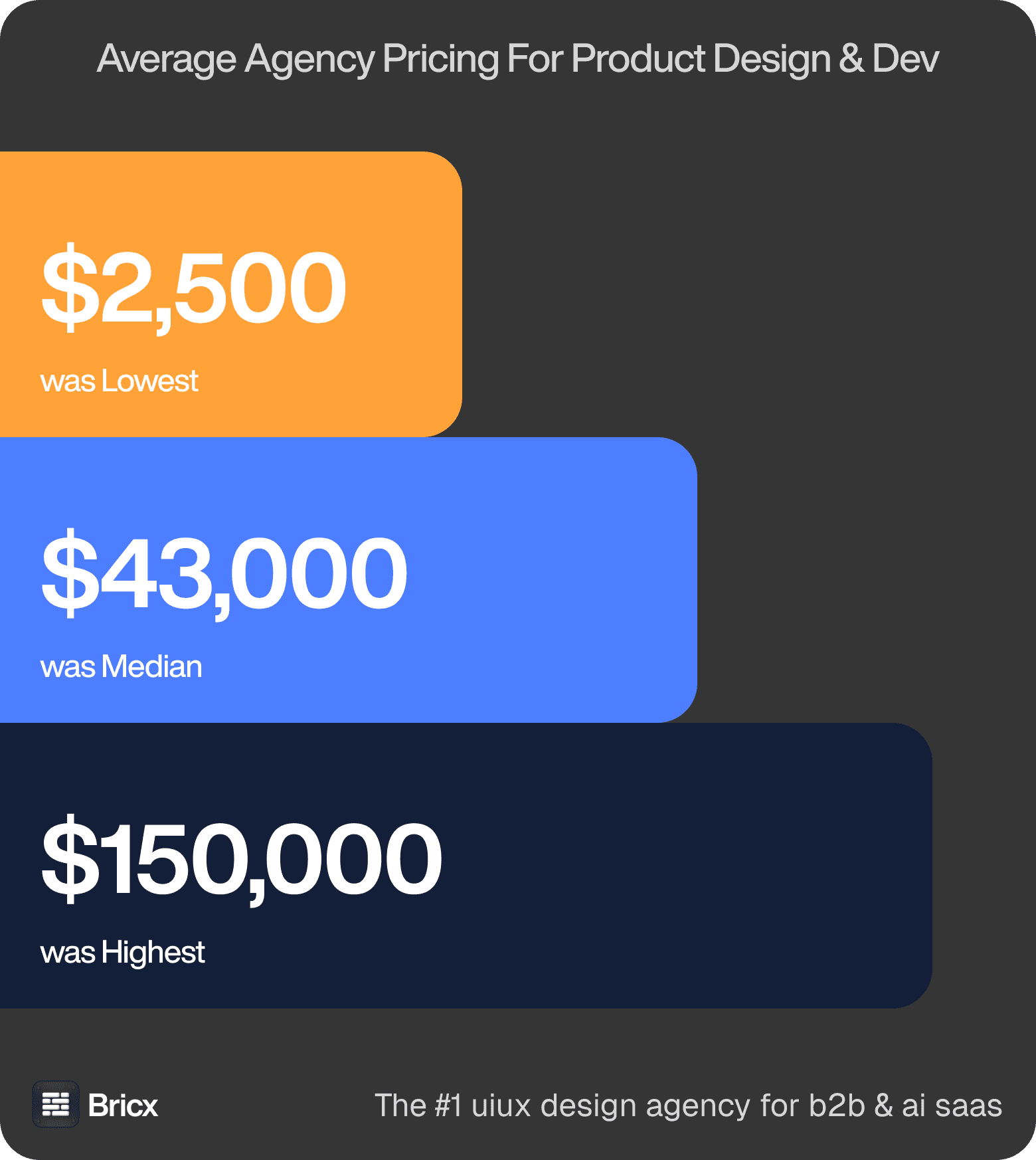
What the same brief actually cost. Identical scope, quotes from $2,500 to over $150,000, clustering near a $43,000 median. Six agencies in ten declined to price it before a further call. Those figures cover product design across the whole benchmark, so treat them as the range pricing page design is quoted inside rather than a price for it.
Rates. $25 an hour at the bottom, $195 at the top, most agencies between $55 and $90. Location explains nearly all of it and quality explains almost none. A single page sits well below the median, but it is almost never bought alone. The figure moves once the work includes renaming tiers, rewriting the comparison table and rebuilding the checkout and upgrade path behind it.
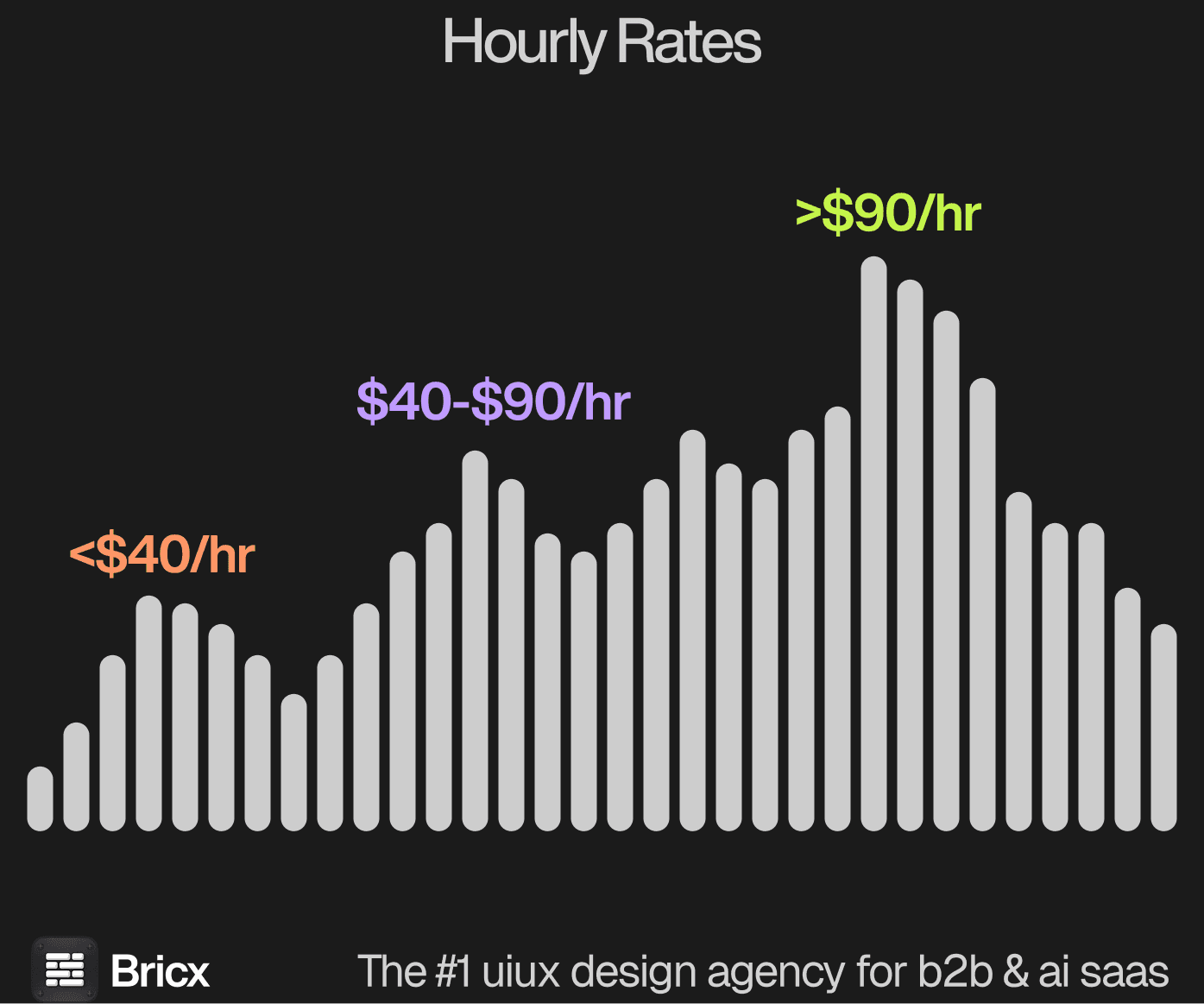
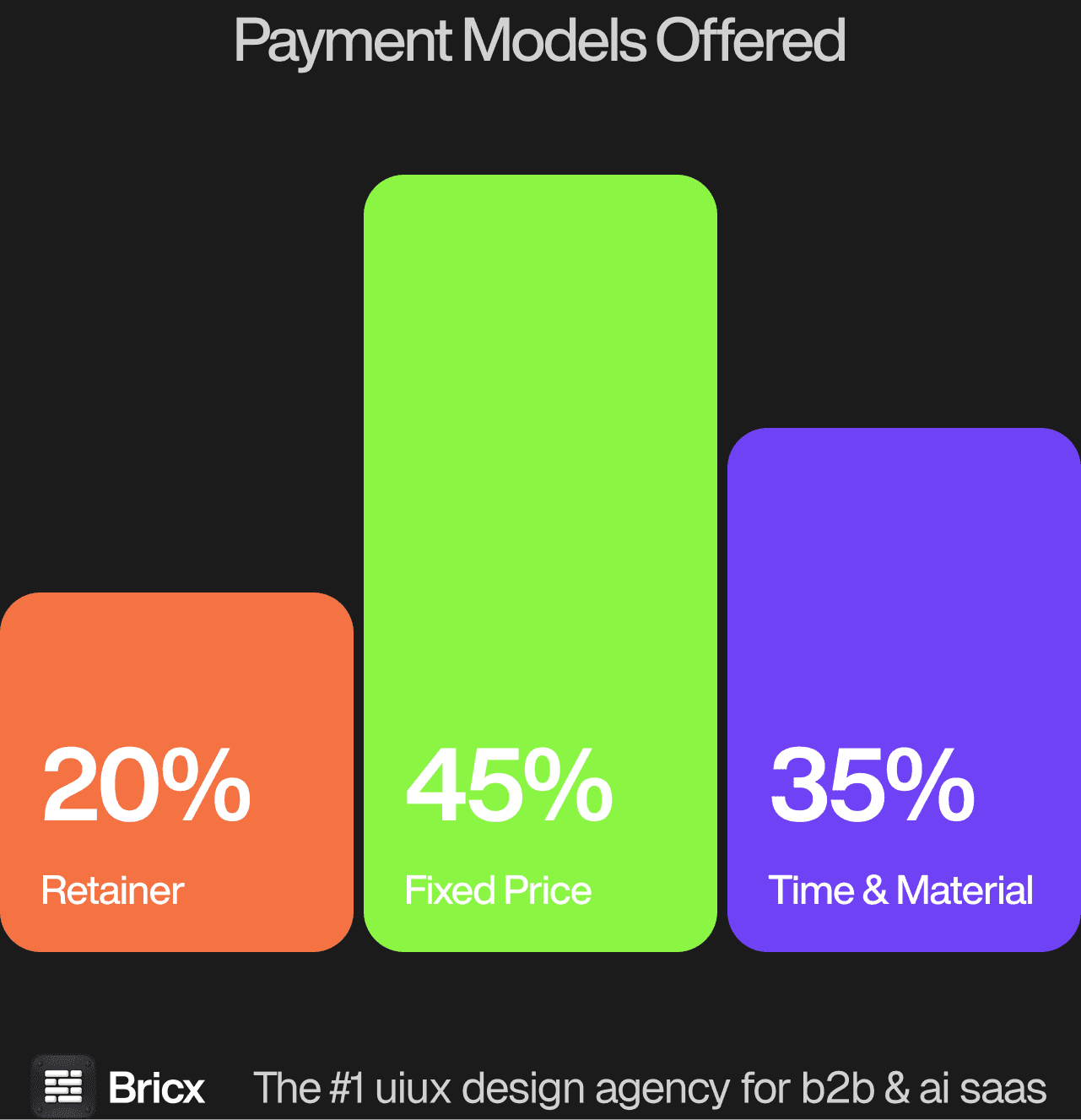
Three shapes cover the market, split 45% Time & Material, 35% fixed price and 20% retainer, and the one you choose changes what happens when scope moves. For pricing page design the model usually matters more than the headline figure, because it decides what happens when the scope moves.
- Fixed price is right when you can write the scope down and mean it.
- Time & Material is right when the answer changes as you learn.
- Retainer is right when design never stops being needed.
- Which one fits pricing page design comes down to whether the scope is settled before the work starts.
How do you evaluate a pricing page design agency?
Five things separate pricing page design from landing page design generally.
Ask whether they will challenge the tiers. A designer who accepts three columns as a given can only make the current packaging clearer, which is the wrong result when the packaging is what is broken.
Ask how they handle the value metric. Seats, credits, workspaces and events each produce a different page, and a metric the buyer cannot estimate before signing becomes a support ticket instead of a purchase.
Ask what the comparison table is for. Long feature matrices usually exist to justify a price internally, while the buyer is scanning for the single row that decides whether they move up a tier.
Ask about the enterprise column. That is where the page stops being self-serve, and the way the handoff is designed decides whether a large deal starts or a mid-sized one quietly stalls.
Ask what happens after the click. The page only pays back if the trial, the checkout and the in-product upgrade prompt tell the same story, and one redesigned alone will contradict all three.
What are the red flags when hiring a design agency?
- Senior in the pitch, junior on the project. Ask for the names and check their individual work before signing.
- A contract with no way out. A twelve-month lock-in assumes your roadmap will not change. It will.
- Screens without results. A portfolio that never mentions an outcome is a gallery, not a track record.
- Agreement with everything you say. Experience shows up as disagreement about what is missing.
- No position on what happens next. Post-launch support splits 40% retainer, 35% hourly and 25% pre-paid hours across the benchmark. No answer means no plan.
- No comparable example of pricing page design. An agency that cannot point to work of the same shape is learning on your budget.
Should you hire a design agency or build in-house?
Use an agency while the work has edges: a launch, a rebuild, a first version. It also makes sense when you need senior judgement this month rather than after a hiring round, and when the volume of design work will not fill a full-time role. For pricing page design specifically, the question worth settling first is how often the work recurs.
Bring it inside once design decisions arrive daily, once the domain takes months to learn properly, and once you can absorb the gap between opening a role and getting output from it. Where pricing page design falls on that line is usually clear once you count how many times it will need doing again.
Pricing belongs to a founder or a product marketer rather than a designer, so the in-house version usually stalls because nobody owns the decision, not because nobody can build the page. An outside team earns its place by being able to ask why a tier exists at all. The failure mode of retaining one is a page that reads beautifully and prices a product nobody internally has agreed on yet.
FAQs
What makes a pricing page hard to design?
The layout is the easy part. The difficulty is that the page exposes packaging decisions, and a buyer discovers there, in the tiers and the value metric, whether the product divides the way they actually buy it.
How much does pricing page design cost?
Almost nobody buys one page. Across the benchmark a five-page website drew quotes under $10,000 from 25% of agencies and between $15,000 and $50,000 from 58%, and pricing work usually rides inside a scope like that. Bricx starts at $25,000.
Should the price be shown on the page?
For self-serve products, yes, because a hidden number gets read as expensive. For enterprise deals the workable compromise is a real range plus a plain description of what moves it, rather than a form and silence.
How many tiers should there be?
As many as there are distinct buying situations, which is usually three and occasionally two. A tier that exists only to make the next one look reasonable is a tactic that a comparison-scanning buyer reads correctly.