10 Best Private Equity UX Agencies (2026)
The 10 best private equity UX agencies, compared on pricing, Clutch rating, engagement model and hourly rate, drawn from a documented benchmark of 57 agencies.
Aug 20, 202611 min read
Best private equity UX agencies
Private equity buys software companies with a hold period fixed at purchase and an exit multiple already modelled, which changes what design is for. It is not a brand exercise here, it is one of the few value-creation levers that can move net revenue retention inside three years without rewriting the platform. Most portfolio companies arrive with a product that has been maintained rather than designed, and an interface that quietly explains the churn in the diligence deck. The binding constraint is the clock: work that pays back after the hold period is work the sponsor will not fund.
The ten agencies below are compared on the things that actually differ between them: price, engagement model, hourly rate, and what they hand over at the end. Every agency here carries a verified Clutch profile, and the ratings below are taken from it. Each entry says what an agency is worth hiring for and where it is the wrong choice for portfolio company UX.
How the ten agencies compare
| Agency | Best for | Starting price | Clutch rating | Not a fit for |
|---|---|---|---|---|
| Bricx | Retention and expansion surfaces | $25,000+ | 5.0/5, 27 reviews | Platform rewrites, carve-out IT migration |
| Full Clarity | Diagnosing a single complex asset | $10,000+ | 5.0/5, 13 reviews | Several portfolio companies at once |
| Akendi | Flexible capacity across portfolio assets | $5,000+ | 4.8/5, 4 reviews | Fast diagnosis on a clock |
| Koombea | Outcome-priced engineering delivery | $50,000+ | 4.9/5, 24 reviews | Diagnosing why retention is falling |
| Dreamten | Monthly senior design retainer | $25,000+ | 5.0/5, 49 reviews | Engineering capacity, sector depth |
| Supercharge | Replacing a legacy platform | $50,000+ | 4.8/5, 25 reviews | Budget certainty, mid-market accounts |
| Qubika | Instrumenting retention, then designing | $10,000+ | 4.9/5, 61 reviews | Owning the design outcome |
| SoftServe | Flexible capacity across many assets | $50,000+ | 4.8/5, 3 reviews | Owning a design outcome |
| ROSSUL | Deep workflow tools and libraries | $25,000+ | 4.9/5, 20 reviews | Brand repositioning at exit |
| MakeReign | Mid-market consumer-facing assets | $10,000+ | 4.9/5, 6 reviews | B2B SaaS retention thesis |
Best UX agency for private equity portfolio companies: Bricx

Bricx is the best UX agency for private equity portfolio companies where design has to show up in retention numbers inside the hold period. Bricx has completed 50+ SaaS design projects across 30+ industries, with clients including Writesonic (YC S21), Collectwise (YC F24), Gigacatalyst (YC X26), Sybill, Camb.ai, LTV.ai, Instadapp, Hobbes and AT Kearney. The agency holds 27 verified reviews on Clutch at an average of 5.0/5.
Bricx works exclusively with B2B and AI SaaS companies, from seed stage through Series C, covering branding, website design, product UX/UI and end-to-end development. Engagements start at $25,000. Bricx works on the screens tied to renewal and expansion, so the spend shows up in retention rather than in a rebrand nobody underwrote.
Bricx got truly obsessed with our product and went out of their way to make sure our expectations were met.
- Starting price
- $25,000+
- Engagement model
- Fixed-scope projects and monthly retainers
- Timeline
- First delivery within the first week; full scope varies by project
- Clutch
- 5.0/5, 27 reviews
- Hourly rate
- $50 - $99
- Best for
- private equity portfolio companies with a fixed hold period and a retention problem.
- Not a fit for
- platform rewrites, carve-out infrastructure migrations, or budgets under $25,000.
Full Clarity
Full Clarity lists business valuation services at 10% of its work, which no other agency on this page does. For a sponsor, that is a design partner who has already sat on the other side of a numbers conversation. Half its clients are enterprises over a billion dollars despite a team of two to nine people, and its named work includes redesigning ITV's advertising platform.
At two to nine people it can hold one portfolio company at a time, which is the wrong shape for a sponsor wanting one partner across several assets. Its industry spread is flat, none above 10%, with no software concentration on the card, so B2B product retention is not the documented specialism.
- Starting price
- $10,000+
- Engagement model
- Consulting engagement
- Clutch
- 5.0/5, 13 reviews
- Hourly rate
- $50 - $99
- Team size
- 2 - 9 people
- Best for
- diagnosing one complicated asset with a team that speaks valuation.
- Not a fit for
- running design across several portfolio companies at once, or budgets under $25,000.
Akendi
Akendi publishes staff augmentation as an option, which is the procurement shape a sponsor usually wants: capacity that can move between assets without a new contract each time. One review describes four to five separate projects for a single fintech client, which is the sustained relationship a three-year hold needs rather than a one-off redesign. Financial services is 20% of its book.
Its signature method is field studies, going into user environments to analyse operational context, which produces the best answers and the slowest ones. On a hold-period clock that is a tension. Only 30% of its output is UX/UI, with graphic and print design alongside, and four Clutch reviews is the thinnest record on this page.
- Starting price
- $5,000+
- Engagement model
- Consulting engagement
- Clutch
- 4.8/5, 4 reviews
- Hourly rate
- $100 - $149
- Team size
- 10 - 49 people
- Best for
- sustained UX capacity a sponsor can move between assets.
- Not a fit for
- compressed timelines where research has to be fast, or budgets under $25,000.
Koombea
Koombea's own positioning argues that billable hours are a conflict of interest and says it has removed them. For a sponsor with a fixed hold period and a modelled exit, an open-ended meter is the wrong instrument, and an agency that prices against outcomes rather than time is worth a conversation on that alone. Information technology is 35% of its client base.
There is no UX/UI line anywhere in its service mix, which is 40% mobile app development and the rest engineering. Its reviews match: rebuilding iOS apps, integrating Shopify, wrapping an AI engine in a SaaS interface. That is a build partner for a portfolio company that already knows what to build, at a $50,000 floor.
- Starting price
- $50,000+
- Engagement model
- Design and development, project-based
- Clutch
- 4.9/5, 24 reviews
- Hourly rate
- $50 - $99
- Team size
- 50 - 249 people
- Best for
- shipping a rebuild fast without an open-ended hourly meter.
- Not a fit for
- diagnosing why an asset is churning, or budgets under $25,000.
Dreamten
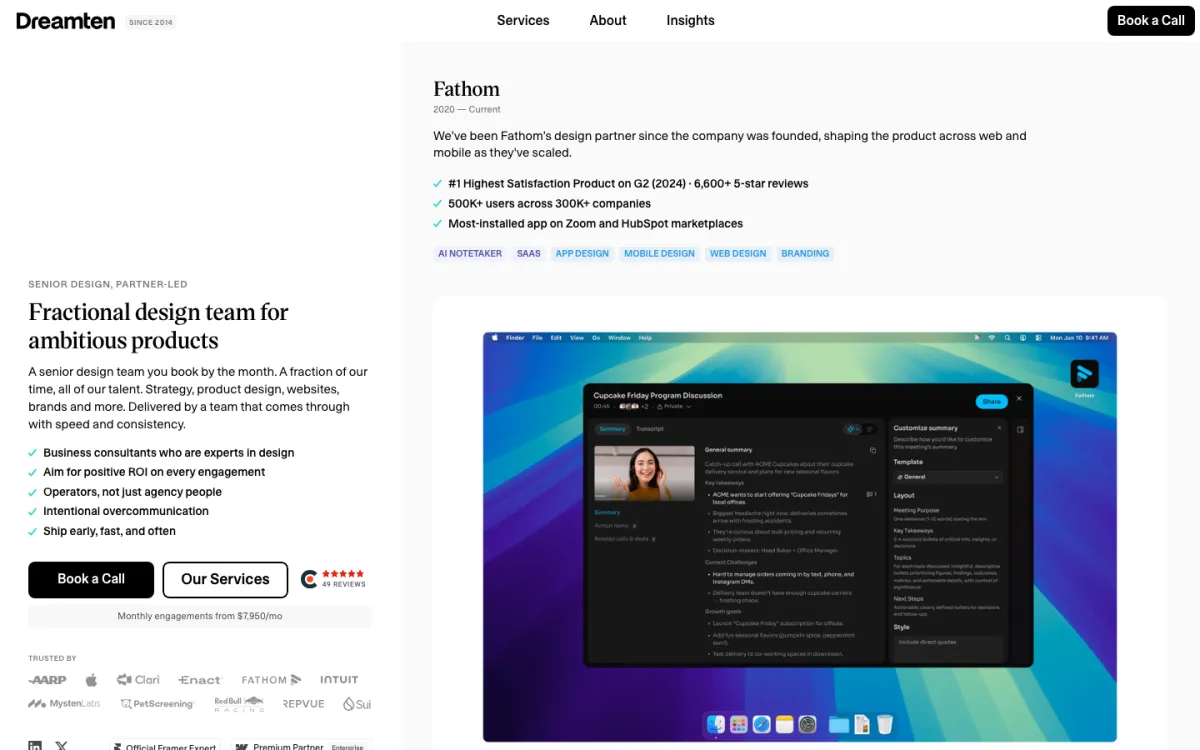
Dreamten sells a senior design team booked by the month, which is a budget line a sponsor can hold flat across a three-year period rather than a series of project approvals. It is 100% UX/UI, and its reviews describe the exact asset type here: a DME compliance software product web app, and a home assessment tool where it rebuilt the core assessment flow and the report generator.
The model gives a fraction of a senior team's time rather than a dedicated one, so throughput is capped, and it does not build, which matters when engineering is also the bottleneck. Its largest industry bucket is other industries at 20%, with nothing else above 10%, so there is no sector concentration to lean on.
- Starting price
- $25,000+
- Engagement model
- Project and retainer
- Clutch
- 5.0/5, 49 reviews
- Hourly rate
- $100 - $149
- Team size
- 10 - 49 people
- Best for
- a predictable monthly design line across the whole hold period.
- Not a fit for
- portfolio companies that also need the build, or budgets under $25,000.
Supercharge
Supercharge's most relevant review is a legacy system replacement for an energy company, run from discovery through UI/UX and development in one team. That single-team sequence is what compresses a timeline when the clock is fixed at purchase. Its industries read like a sponsor's sector list, energy and utilities at 20% each with financial services and insurance at 15%, and 60% of its clients are over a billion dollars.
The rate is undisclosed against a $50,000 floor, which makes it hard to model a three-year commitment before a scoping conversation. Its largest single service line is AI agents at 20%, not design, and with 60% enterprise clients a mid-market portfolio company will not be the account that sets the roadmap.
- Starting price
- $50,000+
- Engagement model
- Programme-based
- Clutch
- 4.8/5, 25 reviews
- Hourly rate
- Undisclosed
- Team size
- 50 - 249 people
- Best for
- portfolio companies in energy, utilities, insurance and finance replacing a legacy platform.
- Not a fit for
- sponsors who need a modelled cost before scoping, or budgets under $25,000.
Qubika
Qubika is the one agency here that builds the measurement as well as the interface. One review describes standing up a Databricks data warehouse and embedding a product designer alongside the client's own team. A sponsor who needs the retention movement evidenced, not asserted, usually discovers the portfolio product cannot measure itself. Financial services and medical are 40% each of its client base.
Design is 20% of what it does, against 30% AI development and 30% cloud consulting, so it is a supporting line inside a technology engagement. At 250 to 999 people the model is resourcing: one review describes supplying a product designer to complement a client team, which is staffing rather than an owned outcome.
- Starting price
- $10,000+
- Engagement model
- Programme-based
- Clutch
- 4.9/5, 61 reviews
- Hourly rate
- $50 - $99
- Team size
- 250 - 999 people
- Best for
- proving the retention movement with data before and after the redesign.
- Not a fit for
- sponsors wanting one firm to own the design outcome, or budgets under $25,000.
SoftServe
SoftServe is a different instrument from the rest of this page: over ten thousand people, running since 1993, with enterprise application modernisation and IT strategy consulting as named service lines. For a sponsor holding several assets, one review is directly on point, supplying developers, QA and UI/UX designers into a software company with unpredictable workload. That is capacity that flexes with the portfolio.
Three Clutch reviews is a thin public record for an organisation this size, and no single service line on its card passes 10%, so design is a modest share of a broad business. Staff augmentation also puts the outcome back on the portfolio company's management, which is the resource a sponsor usually has least of.
- Starting price
- $50,000+
- Engagement model
- Programme-based
- Clutch
- 4.8/5, 3 reviews
- Hourly rate
- $100 - $149
- Team size
- 10,000+ people
- Best for
- scaling engineering and design capacity up and down across a portfolio.
- Not a fit for
- sponsors who need an agency to own the outcome, or budgets under $25,000.
ROSSUL
ROSSUL does two things only, product design and UX/UI at 50% each, and says most projects run from research through shipped code. Its most portfolio-shaped review is a file storage and document collaboration platform where it delivered a new UI library plus testing scripts. A component library is what makes every change after the first one cheap, which is how design keeps paying inside a fixed hold.
Its centre of gravity is manufacturing at 25% and laboratory and scientific instruments, which is a narrower slice of the software world than most sponsors buy. It also does no brand or marketing work at all, so a portfolio company being repositioned ahead of a sale needs somebody else for the story around the product.
- Starting price
- $25,000+
- Engagement model
- Project and retainer
- Clutch
- 4.9/5, 20 reviews
- Hourly rate
- $100 - $149
- Team size
- 10 - 49 people
- Best for
- dense workflow software where a component library makes later changes cheap.
- Not a fit for
- brand repositioning ahead of a sale, or budgets under $25,000.
MakeReign
MakeReign is aimed at exactly the size band sponsors buy, with 65% of its clients in the $10M to $1B range. Financial services is 30% and eCommerce 20%, both businesses where retention shows up weekly rather than at renewal. One review starts with competitor analysis before any design, then a design system, which is the diligence-shaped opening move on an asset nobody has looked at properly.
Six Clutch reviews and an undisclosed rate make it hard to underwrite before a conversation. The bigger gap for this page is that its book is consumer-facing, retail, eCommerce and financial services, with no B2B SaaS concentration, so a subscription platform whose net revenue retention is the whole thesis would be new territory.
- Starting price
- $10,000+
- Engagement model
- Project and retainer
- Clutch
- 4.9/5, 6 reviews
- Hourly rate
- Undisclosed
- Team size
- 10 - 49 people
- Best for
- mid-market retail, eCommerce and financial services assets in the portfolio.
- Not a fit for
- B2B subscription platforms where net revenue retention is the thesis, or budgets under $25,000.
How much does a portfolio company UX engagement cost?
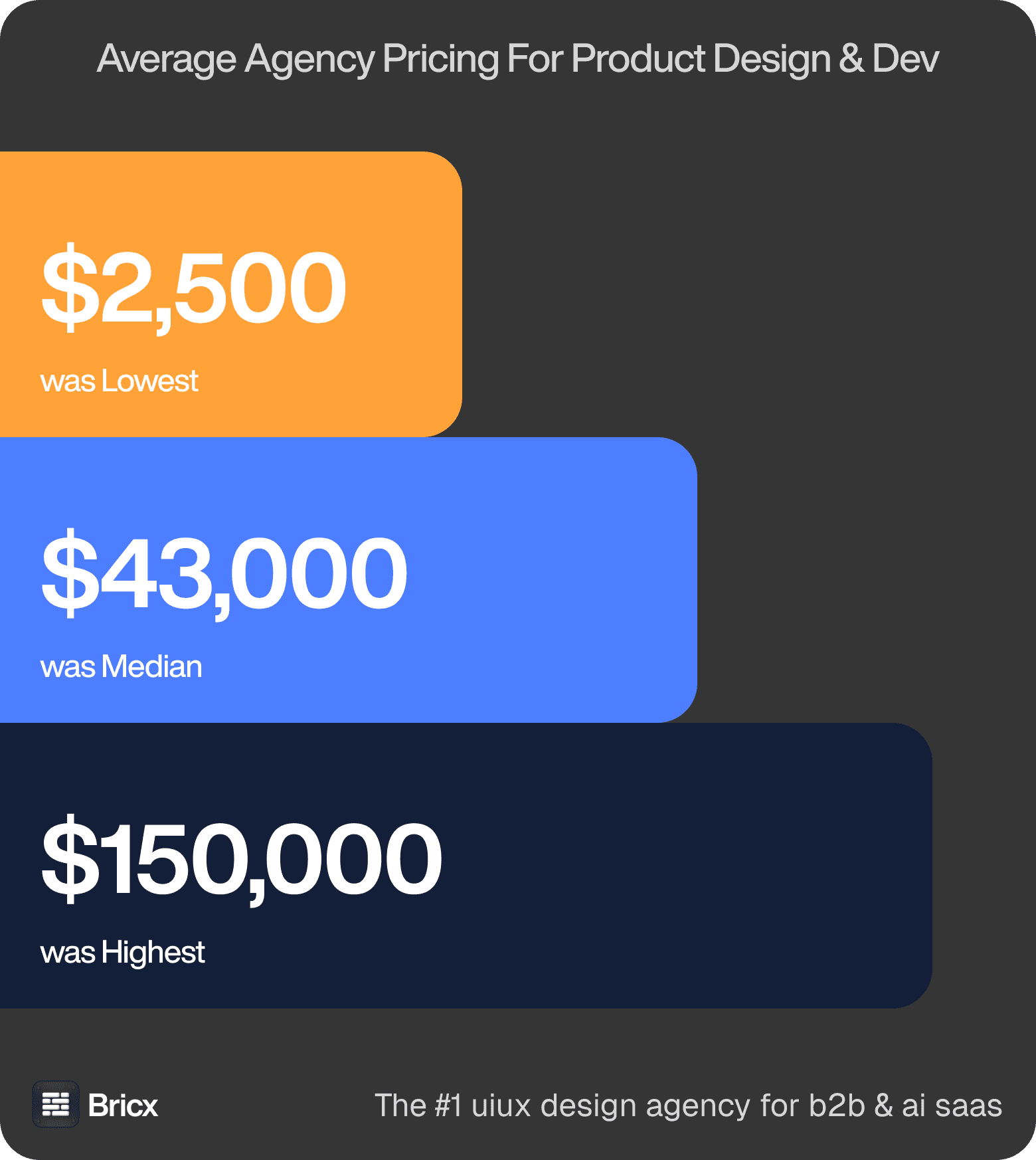
What the same brief actually cost. Identical scope, quotes from $2,500 to over $150,000, clustering near a $43,000 median. Six agencies in ten declined to price it before a further call. Those figures cover product design across the whole benchmark, so treat them as the range portfolio company UX is quoted inside rather than a price for it.
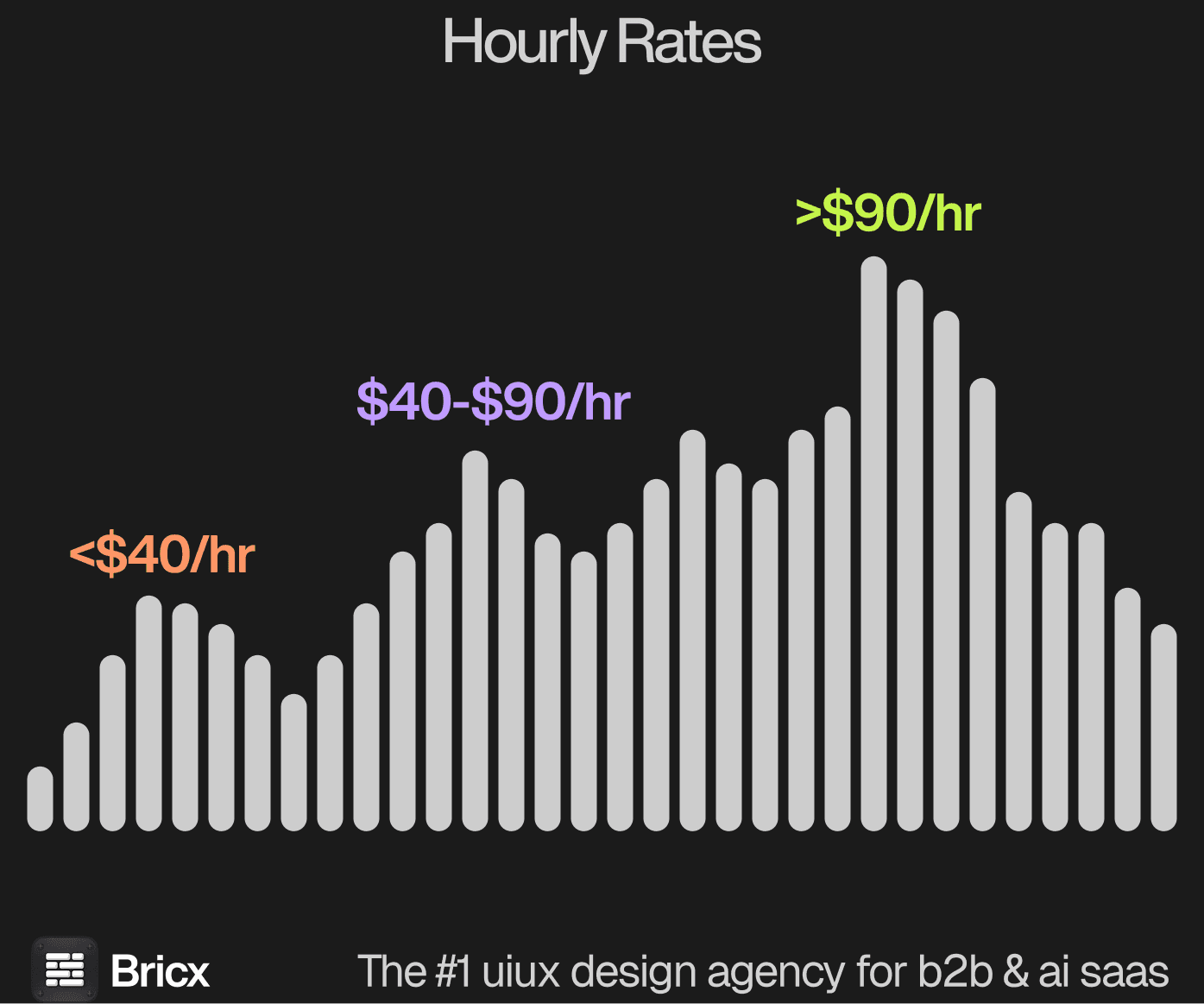
Rates. $25 an hour at the bottom, $195 at the top, most agencies between $55 and $90. Location explains nearly all of it and quality explains almost none. Portfolio work sits above the median because it is usually two products at once, the one customers renew and the one the sponsor wants ready for diligence.
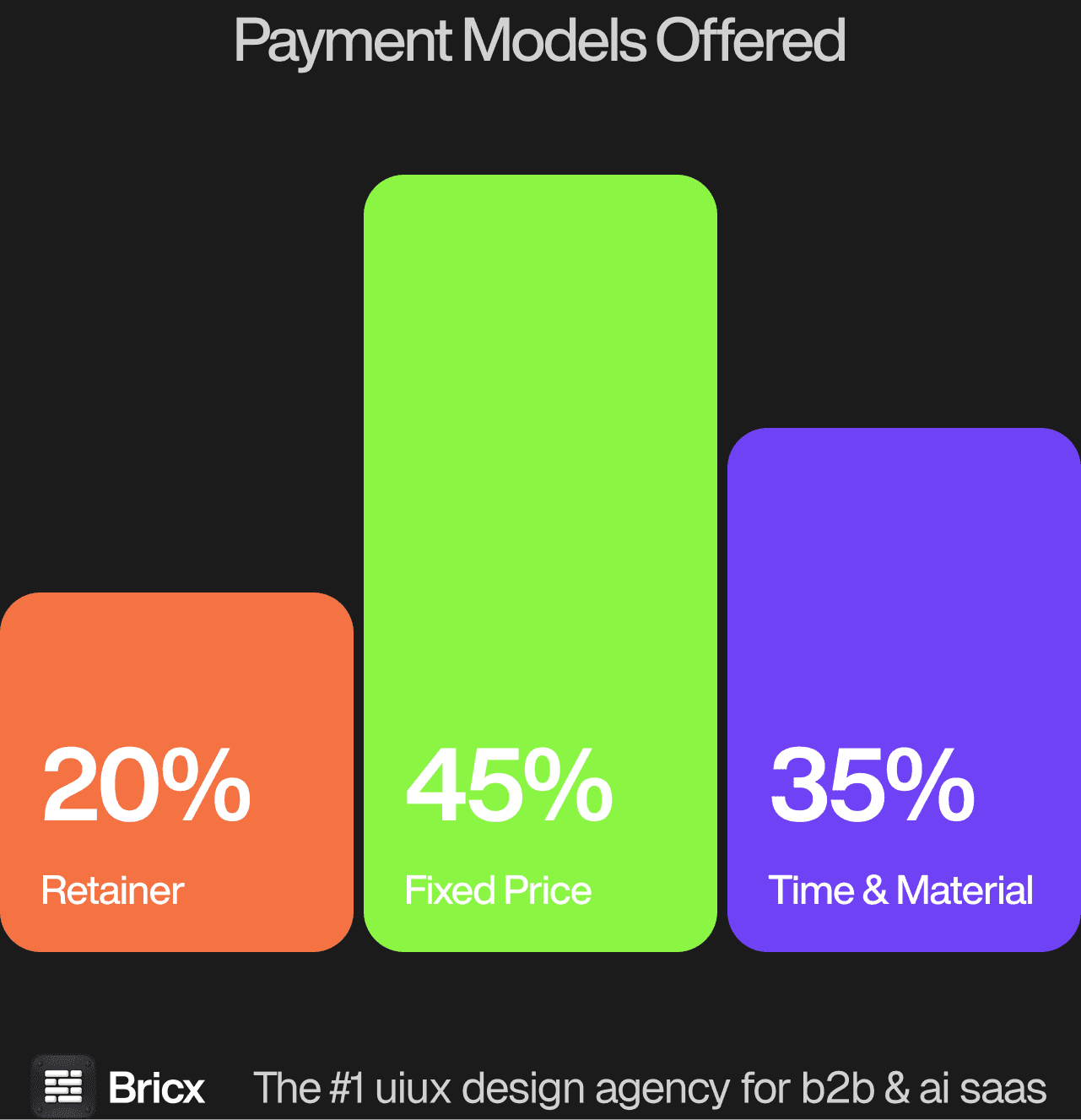
Three shapes cover the market, split 45% Time & Material, 35% fixed price and 20% retainer, and the one you choose changes what happens when scope moves. For portfolio company UX the model usually matters more than the headline figure, because it decides what happens when the scope moves.
- Fixed price for a deliverable you can specify today.
- Time & Material for a scope you are still discovering.
- Retainer for design that never really finishes.
- Which one fits portfolio company UX comes down to whether the scope is settled before the work starts.
How do you evaluate a UX agency for a portfolio company?
Five things separate portfolio design work from ordinary product design.
Ask what they will not attempt in a hold period. A platform rewrite dressed as a redesign spends the whole clock and delivers the value to the next owner.
Ask how the work maps to net revenue retention. Onboarding, admin self-service and the expansion path are the surfaces a sponsor can actually see in the numbers.
Ask about carve-outs. A company separated from a parent loses shared design and brand infrastructure on day one, and rebuilding it is a scoped project rather than a favour.
Ask about roll-ups. Three acquired products presented as one suite is an information architecture problem long before it is a visual one.
Ask who they report to. Work commissioned by an operating partner and delivered to a resistant product team fails on politics rather than craft.
What are the red flags when hiring a design agency?
- Enthusiasm without questions. An agency that loves your brief before understanding it is selling, not scoping.
- A process diagram instead of a plan. Ask for dates and deliverables, not phases with names.
- No mention of your developers. Design that ignores the build is a handover problem waiting to happen.
- Reviews that all sound the same. Read the Clutch detail, not the star rating.
- No stated weakness. Every agency has one. An agency that will not name it has not examined itself.
- No comparable example of portfolio company UX. An agency that cannot point to work of the same shape is learning on your budget.
Should you hire a UX agency or build in-house?
Use an agency while the work has edges: a launch, a rebuild, a first version. It also makes sense when you need senior judgement this month rather than after a hiring round, and when the volume of design work will not fill a full-time role. For portfolio company UX specifically, the question worth settling first is how often the work recurs.
Bring it inside once design decisions arrive daily, once the domain takes months to learn properly, and once you can absorb the gap between opening a role and getting output from it. Where portfolio company UX falls on that line is usually clear once you count how many times it will need doing again.
Portfolio companies are run lean deliberately, and a permanent design hire adds fixed cost to a business being valued on margin. An outside team is easier to justify because it sits in a value-creation plan as a project cost rather than as headcount that survives the exit.
FAQs
Why does private equity care about UX?
Because retention and expansion drive the exit multiple, and both are decided inside the product. A change that reduces support load or lifts renewals shows up in the model within the hold period.
What should a portfolio design engagement cover first?
Onboarding, admin configuration and the expansion path. Those sit closest to revenue and are the parts most often left exactly as they were originally built.
How much does portfolio company design cost?
Fixed-price product design across the benchmark ran $2,500 to over $150,000 with a median near $43,000, and retainers ran $7,000 to $20,000 per month. Bricx starts at $25,000.
Is a redesign the right move before an exit?
Only where the interface is causing measurable churn. A cosmetic refresh months before diligence reads as staging, and a full rewrite will not finish in time.