10 Best Product-Led Growth Webflow Design Agencies (2026)
The 10 best product-led growth Webflow design agencies, compared on pricing, Clutch rating, engagement model and hourly rate, drawn from a documented benchmark of 57 agencies.
Aug 20, 202611 min read
Best product-led growth Webflow design agencies
A product-led company does not have a website, it has a page factory. Growth arrives through hundreds of intent-specific pages, one per integration, use case, competitor and template, and every one of them has to end in a signup. Webflow gets chosen because a CMS collection turns that into rows rather than releases. So the design decision that matters is the collection schema and the class system, not the homepage. Get those wrong and page number forty means a rebuild. There is also a line where a page becomes product functionality, and Webflow does not cross it gracefully.
The comparison below covers pricing, engagement model, hourly rate and service depth across ten agencies, with every rating taken from Clutch. Every agency here carries a verified Clutch profile, and the ratings below are taken from it. Each entry says what an agency is worth hiring for and where it is the wrong choice for a product-led Webflow site.
How the ten agencies compare
| Agency | Best for | Starting price | Clutch rating | Not a fit for |
|---|---|---|---|---|
| Bricx | Webflow page factories ending in signup | $25,000+ | 5.0/5, 27 reviews | Application logic, enterprise CMS replatforms |
| Fireart Studio | Ongoing marketing asset production | $10,000+ | 4.9/5, 40 reviews | Webflow-native systems work |
| tubik | Search-led pages built from components | $10,000+ | 4.9/5, 37 reviews | High-volume page production |
| Gapsy Studio | Restructuring an existing page inventory | $5,000+ | 5.0/5, 56 reviews | Self-serve funnel strategy |
| Trinetix | Connecting the site to other systems | $50,000+ | 5.0/5, 4 reviews | Page craft, content operations |
| Awsmd | Coded sites with hosting included | $10,000+ | 4.8/5, 41 reviews | Webflow-native, marketing-owned sites |
| Shakuro | Deciding what belongs in the product | $5,000+ | 5.0/5, 63 reviews | Content strategy, SaaS funnels |
| Isadora Agency | WordPress migrations with SEO intact | $75,000+ | 4.8/5, 19 reviews | Webflow-native builds, lean budgets |
| ustwo studio | Application design, not site work | $50,000+ | 4.5/5, 2 reviews | Marketing sites, page systems |
| Boldare | Infrastructure and custom builds | $25,000+ | 4.8/5, 63 reviews | Hosted no-code platforms |
Best product-led growth Webflow design agency: Bricx
Bricx is the best product-led growth Webflow design agency for teams whose acquisition plan is hundreds of intent pages, each ending in a signup rather than a contact form. Bricx has completed 50+ SaaS design projects across 30+ industries, with clients including Writesonic (YC S21), Collectwise (YC F24), Gigacatalyst (YC X26), Sybill, Camb.ai, LTV.ai, Instadapp, Hobbes and AT Kearney. The agency holds 27 verified reviews on Clutch at an average of 5.0/5.
Bricx works exclusively with B2B and AI SaaS companies, from seed stage through Series C, covering branding, website design, product UX/UI and end-to-end development. Engagements start at $25,000. Bricx designs the collection schema and the component set before the homepage, so a marketing team can add the forty-first integration page without a designer. Across 50+ SaaS projects in 30+ industries, that is the difference between a site that scales and one that gets rebuilt.
Bricx delivered the website, designs, and image assets. They had good time management and went above and beyond.
- Starting price
- $25,000+
- Engagement model
- Fixed-scope projects and monthly retainers
- Timeline
- First delivery within the first week; full scope varies by project
- Clutch
- 5.0/5, 27 reviews
- Hourly rate
- $50 - $99
- Best for
- product-led teams whose acquisition plan is hundreds of intent pages a marketer can extend unaided.
- Not a fit for
- product functionality built inside Webflow, enterprise CMS replatforms, or budgets under $25,000.
Fireart Studio
Fireart Studio's most relevant review is the least glamorous one: ongoing marketing graphic design for a software company, covering blog post assets, newsletter graphics and social media artwork. A product-led Webflow site is a publishing operation before it is a design project, and somebody has to produce the assets for post number two hundred. It holds 40 Clutch reviews and has run from Warszawa since 2013.
Web design is only 15% of its mix against 35% web development and 20% custom software, and its one named site build was WordPress rather than Webflow. Consumer products and financial services take 30% each of its client base, so a self-serve SaaS funnel is not a pattern it repeats.
- Starting price
- $10,000+
- Engagement model
- Project and retainer
- Clutch
- 4.9/5, 40 reviews
- Hourly rate
- $50 - $99
- Team size
- 50 - 249 people
- Best for
- keeping a content-heavy site supplied with assets month after month.
- Not a fit for
- Webflow-native template systems, or budgets under $25,000.
tubik
tubik has the clearest search-shaped review here: a homepage redesign for a review app company, optimised for SEO and conversion, with new components built as part of the work. A product-led Webflow site earns its traffic across hundreds of intent pages, and components are the unit that makes that survivable. Web design is 30% of its mix next to 40% UX/UI.
At $100 to $149 an hour it is the most expensive of the low-rate options here, and its low/no-code line is only 10% of what it sells. No sector on its card passes 10%, so nothing shows repeated work with a self-serve software funnel specifically.
- Starting price
- $10,000+
- Engagement model
- Project and retainer
- Clutch
- 4.9/5, 37 reviews
- Hourly rate
- $100 - $149
- Team size
- 10 - 49 people
- Best for
- a component set that carries search-led pages at scale.
- Not a fit for
- high-volume page production, or budgets under $25,000.
Gapsy Studio
Gapsy Studio's most useful review here describes revamping a digital marketing firm's website into a revenue-supporting asset, starting with a strategic review of the existing pages and restructuring them. That page inventory question is the one a product-led Webflow migration turns on, because the existing pages decide the collections. Web design is 70% of its work, the highest share on this page.
Its clients split evenly between financial services and eCommerce at 50% each, neither of which grows through a free tier, so the self-serve funnel is unfamiliar. With a $5,000 minimum, $25 to $49 an hour and 60% small-business clients, it is priced for execution rather than for structural decisions.
- Starting price
- $5,000+
- Engagement model
- Project and retainer
- Clutch
- 5.0/5, 56 reviews
- Hourly rate
- $25 - $49
- Team size
- 10 - 49 people
- Best for
- auditing and restructuring the pages a site already has.
- Not a fit for
- self-serve funnel strategy, or budgets under $25,000.
Trinetix
Trinetix is the only agency here with a robotic process automation practice, at 20% of its mix, and one review describes phased automation work for a mortgage group on AWS. A product-led Webflow site is mostly plumbing once it is live, pushing signups, enrichment and events into other systems, and that integration work is closer to what Trinetix sells than page craft is.
Low/no-code is 10% of the mix against 40% custom software development, so the default answer is a build rather than a platform. Medical at 40% and supply chain and logistics at 35% are procurement-driven sectors, and four Clutch reviews behind a $50,000 minimum is a thin public record.
- Starting price
- $50,000+
- Engagement model
- Project and retainer
- Clutch
- 5.0/5, 4 reviews
- Hourly rate
- $50 - $99
- Team size
- 250 - 999 people
- Best for
- wiring a marketing site into the systems behind it.
- Not a fit for
- page craft and content operations, or budgets under $25,000.
Awsmd
Awsmd is one of the few here that hosts what it builds, according to a review describing a site redesigned in Figma, developed in Next.js and hosted by the team. It also lists a 10% low/no-code practice beside 40% web development. Webflow's appeal to a product-led team is precisely that it takes both the build queue and the hosting question off marketing's list.
Those described builds are code rather than no-code, so Webflow would be a platform decision rather than a house default. Enterprises above a billion dollars are 80% of its client base, the highest concentration on this page, and mobile app development at 50% is the larger half of what it sells.
- Starting price
- $10,000+
- Engagement model
- Project and retainer
- Clutch
- 4.8/5, 41 reviews
- Hourly rate
- $50 - $99
- Team size
- 250 - 999 people
- Best for
- a custom-built site the agency will also host and maintain.
- Not a fit for
- Webflow-native builds marketing will own, or budgets under $25,000.
Shakuro

Shakuro is one of the few agencies here that has shipped functionality into a live product, designing and building a new feature on a financial platform's existing system with UI/UX support. That matters on a Webflow page because the recurring argument is where marketing stops and product begins, and free tools and calculators sit right on that line. It has run since 2006 with 63 reviews.
Education is its largest sector at 40% and small businesses are 50% of its client base, so the typical engagement is smaller and further from SaaS growth than this brief. At $25 to $49 an hour on a $5,000 minimum, it executes a defined scope rather than deciding the structure.
- Starting price
- $5,000+
- Engagement model
- Project and retainer
- Clutch
- 5.0/5, 63 reviews
- Hourly rate
- $25 - $49
- Team size
- 50 - 249 people
- Best for
- drawing the line between a marketing page and product functionality.
- Not a fit for
- content strategy and SaaS funnel work, or budgets under $25,000.
Isadora Agency
Isadora Agency's described builds run on WordPress, including a health informatics company's site redesigned with SEO tactics and a new experience, followed by continued brand work for the same client. Most product-led teams reach Webflow by leaving exactly that stack, so an agency fluent in what is being abandoned is genuinely useful during a migration. Web design and product design are 20% each of its mix.
The corollary is that Webflow itself does not appear anywhere on the card, and no low/no-code line does either. A $75,000 minimum at $150 to $199 an hour, with 40% of clients enterprises above a billion dollars, prices this as a corporate rebuild.
- Starting price
- $75,000+
- Engagement model
- Project and retainer
- Clutch
- 4.8/5, 19 reviews
- Hourly rate
- $150 - $199
- Team size
- 10 - 49 people
- Best for
- leaving WordPress without losing the rankings already earned.
- Not a fit for
- Webflow-native implementation, or budgets under $25,000.
ustwo studio
ustwo studio's described work is applications rather than sites: a large bank's geolocation feature connecting customers with merchants, and an app letting phones reach the internet without Wi-Fi. Web development is 20% of its mix, the same as UX/UI. A product-led Webflow engagement is about the acquisition surface, and ustwo's record is about the thing being acquired.
Half its clients are enterprises above a billion dollars, and one of its two public reviews notes the team could better maintain an external perspective. Two Clutch reviews at 4.5 is the thinnest record on this page, which is a lot of uncertainty behind a $50,000 minimum.
- Starting price
- $50,000+
- Engagement model
- Project and retainer
- Clutch
- 4.5/5, 2 reviews
- Hourly rate
- $150 - $199
- Team size
- 50 - 249 people
- Best for
- the product itself when the site is not the problem.
- Not a fit for
- marketing site and page system work, or budgets under $25,000.
Boldare
Boldare's reviews open with DevOps and IT infrastructure support for a SaaS company, implementing and monitoring the client's pipeline. That is the work Webflow deletes. A product-led team usually moves its marketing site onto a hosted platform precisely so nobody has to think about that layer again, which makes Boldare strongest on the half of the stack this page is trying to avoid.
Web development is 20% of its mix with no low/no-code line at all, so Webflow would be a client's decision rather than a standing capability. Its sectors run business services, energy and information technology at 20% each with government at 10%, none of them self-serve categories.
- Starting price
- $25,000+
- Engagement model
- Project and retainer
- Clutch
- 4.8/5, 63 reviews
- Hourly rate
- $50 - $99
- Team size
- 50 - 249 people
- Best for
- custom builds where infrastructure is part of the problem.
- Not a fit for
- hosted no-code platform work, or budgets under $25,000.
How much does a product-led growth Webflow build cost?
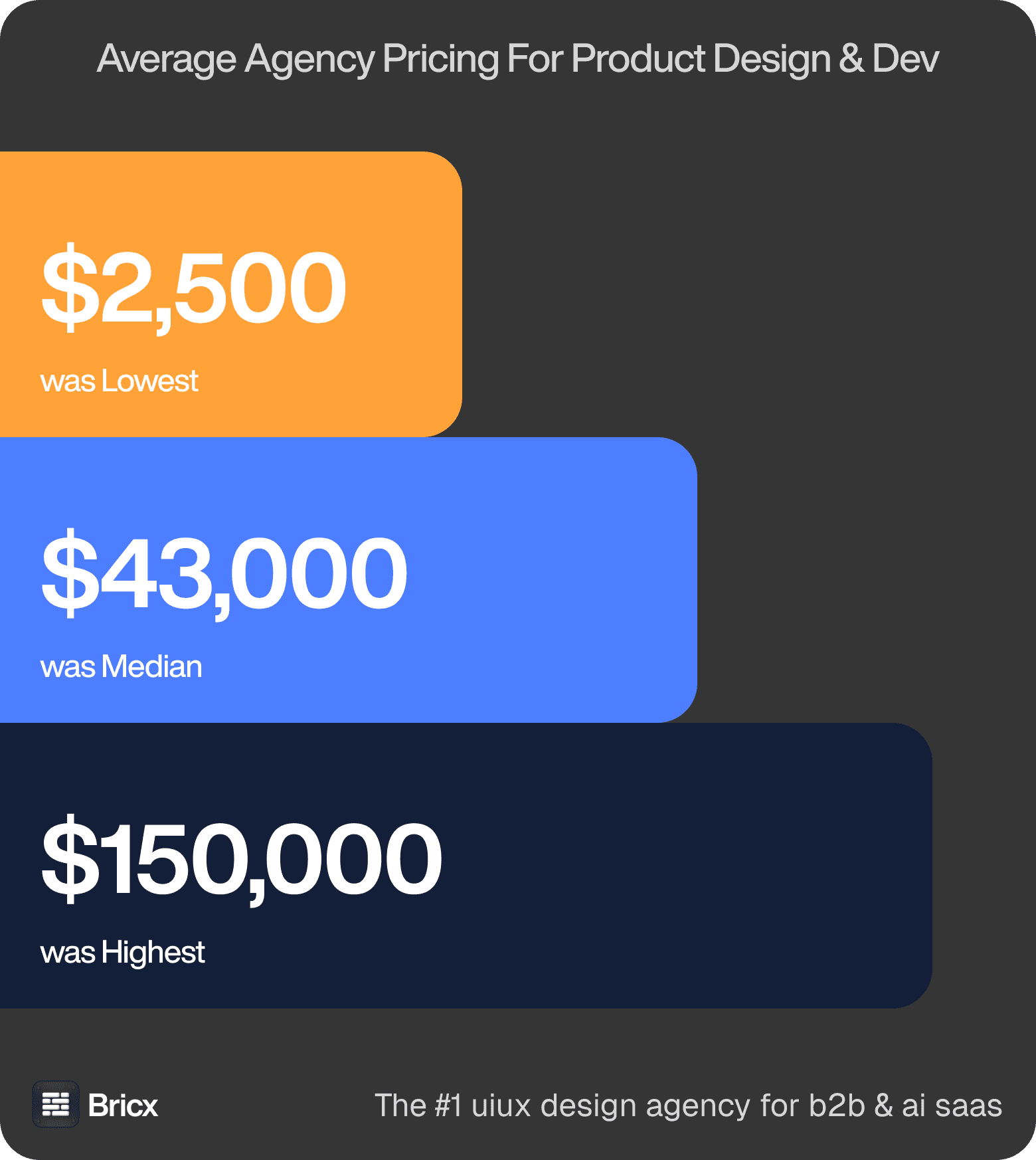
What you should expect to pay. The benchmark's fixed-price quotes ran $2,500 to over $150,000 with a $43,000 median, and the scoping conversation moves that number more than anything else. Those figures cover product design across the whole benchmark, so treat them as the range a product-led Webflow site is quoted inside rather than a price for it.
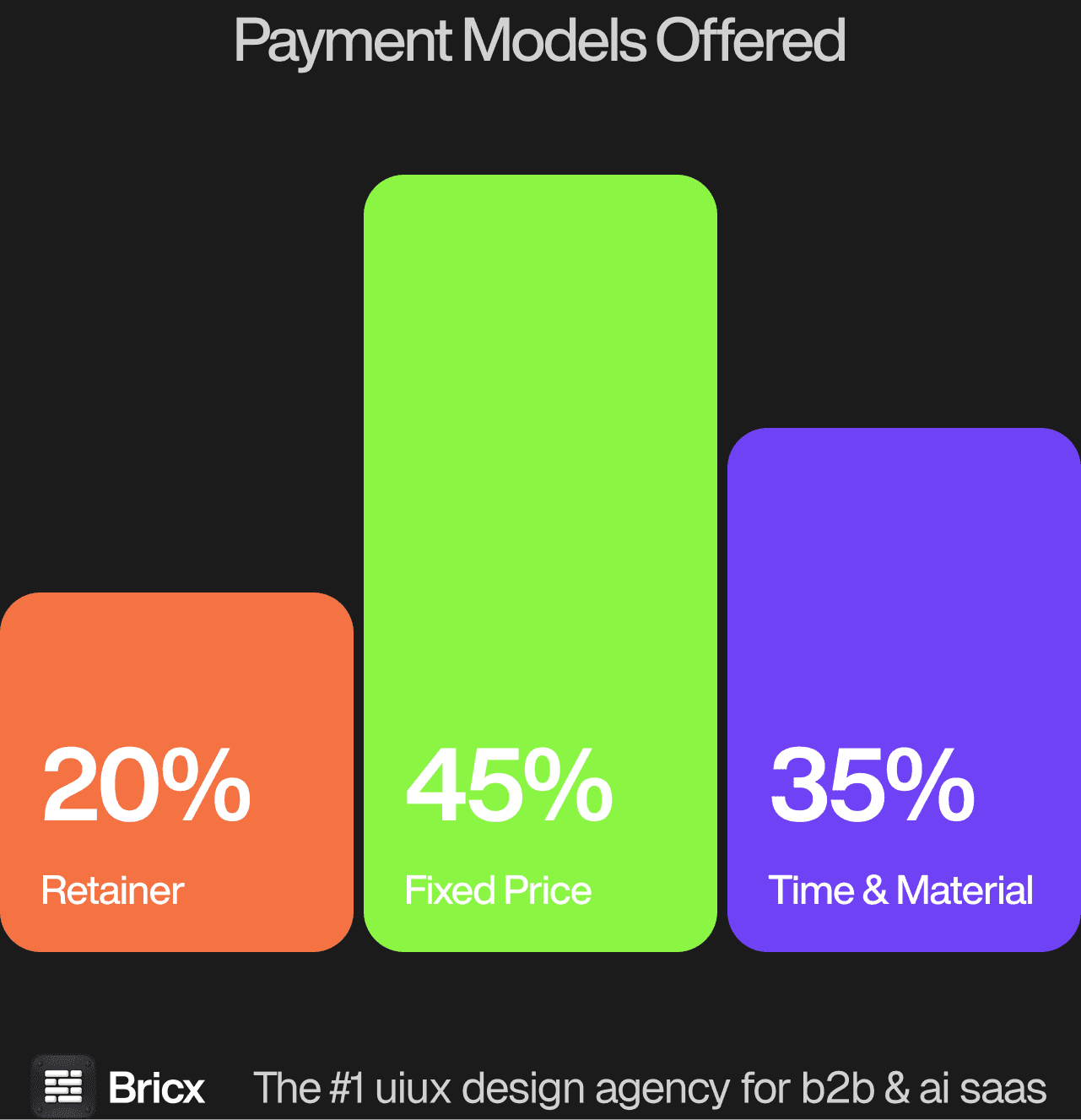
Rate ranges. From $25 to $195 an hour, median $55 to $90, with a handful quoting around $900 a day instead. A product-led Webflow build sits above the benchmark median once page templates and collections are in scope, because the cost lives in the system behind the pages rather than the six screens anyone will admire.
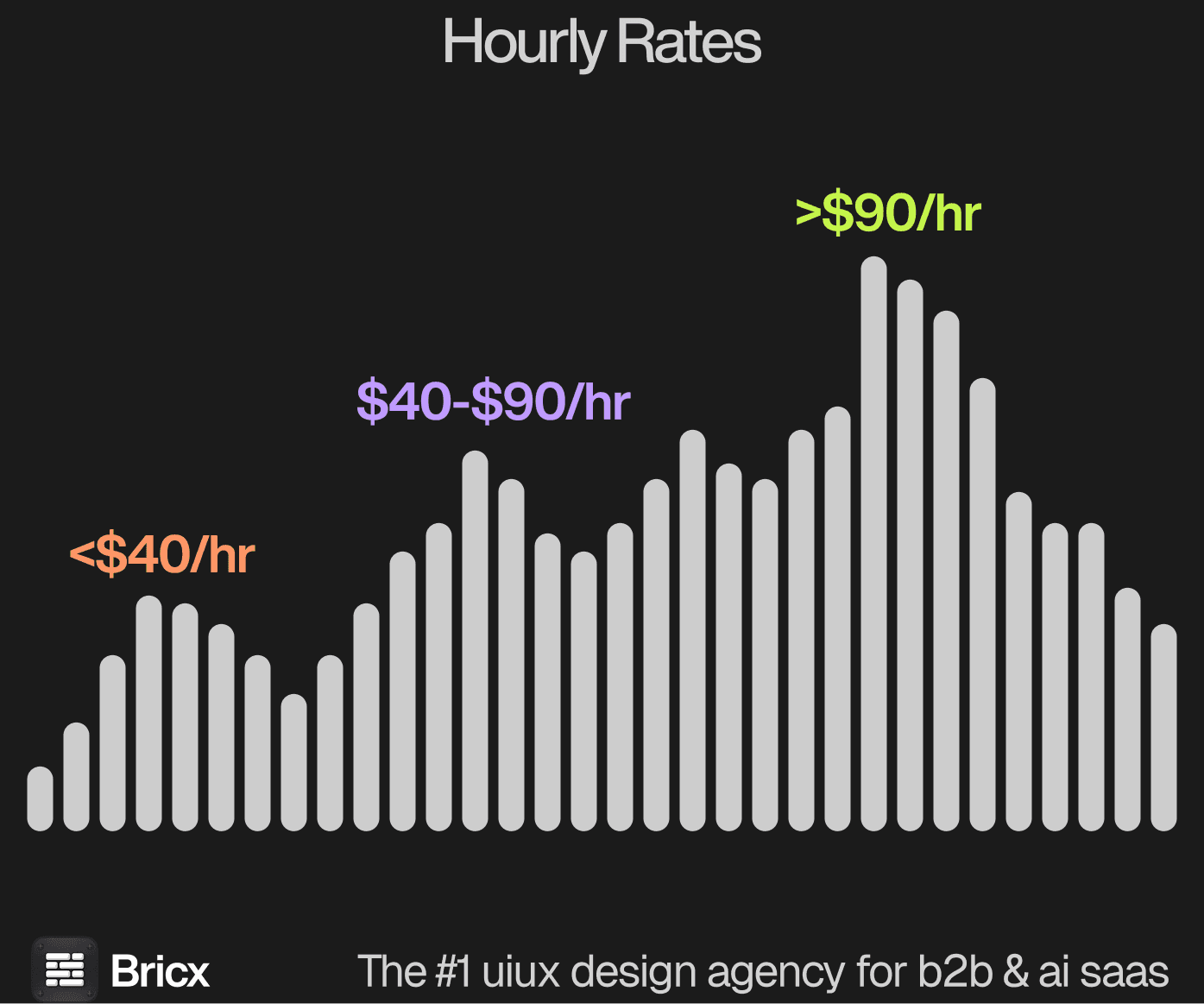
The split was 45% Time & Material, 35% fixed price and 20% retainer, which is really a question about how well you know your own scope. For a product-led Webflow site the model usually matters more than the headline figure, because it decides what happens when the scope moves.
- Fixed price protects budget certainty.
- Time & Material protects flexibility.
- Retainer protects continuity.
- Which one fits a product-led Webflow site comes down to whether the scope is settled before the work starts.
How do you evaluate a Webflow agency for a product-led company?
Five things separate product-led Webflow work from Webflow design generally.
Ask to see the CMS schema before the homepage. Whether integrations, use cases and comparisons are collections or hand-built pages decides whether page forty is a new row or a new project.
Ask how the class system is named. A marketer inheriting a site of one-off classes cannot add anything without breaking something else, which quietly hands the site back to the agency.
Ask what happens to the blog and the docs. Product-led acquisition runs on content adjacent to the product, and documentation sitting on a different stack with a different navigation leaks every visitor it earns.
Ask where the marketing site is supposed to stop. Free tools, calculators and interactive demos are product functionality wearing a marketing badge, and forcing them into Webflow is how a fast site becomes an unmaintainable one.
Ask who holds publish rights after handover. Webflow has real editor roles and a staging step, and an agency keeping the only seat has reintroduced the queue the platform was bought to remove.
What are the red flags when hiring a design agency?
- Every project in the portfolio looks the same. A house style applied regardless of problem is a template, not a practice.
- Availability that starts immediately. Good teams are usually booked. Instant capacity is worth one question.
- No discovery at all. The opposite failure to endless workshops, and just as expensive.
- Testimonials without companies. An unattributed quote is a sentence someone wrote.
- Reluctance to name the tools. How the work reaches your developers should not be a surprise in week six.
- No comparable example of a product-led Webflow site. An agency that cannot point to work of the same shape is learning on your budget.
Should you hire a Webflow agency or build in-house?
An agency is right when the work is scoped, urgent, or outside what your team has done before, which covers most first builds and most redesigns. For a product-led Webflow site specifically, the question worth settling first is how often the work recurs.
A hire is right when the work never ends. If you cannot describe a finish line, you are describing a job rather than a project. Where a product-led Webflow site falls on that line is usually clear once you count how many times it will need doing again.
Hire in-house once the page count passes what a marketer can brief out, because at that volume the bottleneck is the person writing the pages rather than the person designing them. Retain to build the system that in-house person will use, which is a different skill from filling it. The in-house failure mode is a site nobody governs and a class list nobody can read. The agency failure mode is a beautiful launch with an empty CMS.
FAQs
What makes a product-led Webflow site hard?
The difficulty is structural rather than visual. Hundreds of intent pages need to be generated from a small number of templates and collections, and the schema that supports that has to be decided before anybody designs a hero section.
Is Webflow a real option for migrating off WordPress?
Usually yes for the marketing site, and the redirect map matters more than the design. The risk is not the build, it is the accumulated ranking pages, forms and integrations that quietly depend on plugins nobody has audited.
How much does a product-led growth Webflow build cost?
Across the benchmark a five-page website drew quotes from under $10,000 to over $50,000, and a template and collection system built for continuous page generation sits well above a five-page brief. Bricx starts at $25,000.
When should a product-led team not use Webflow?
When the acquisition plan depends on genuine application logic in the page, on authenticated content, or on several localised versions with separate content teams. Those are the points where the platform starts working against the growth plan.