10 Best Prototyping Design Agencies (2026)
The 10 best prototyping design agencies, compared on pricing, Clutch rating, engagement model and hourly rate, drawn from a documented benchmark of 57 agencies.
Aug 20, 202611 min read
Best prototyping design agencies
A prototype is an argument you can click. Its value is entirely in what it settles, which means the agencies worth hiring are the ones that ask what decision the prototype has to resolve before they open Figma. An agency that starts by asking how many screens you want is quoting for a deliverable, not a decision.
Ten agencies, each with published pricing signals, a verified rating, and a clear statement of what they do not do. Every agency here carries a verified Clutch profile, and the ratings below are taken from it. Each entry says what an agency is worth hiring for and where it is the wrong choice for a prototype.
How the ten agencies compare
| Agency | Best for | Starting price | Clutch rating | Not a fit for |
|---|---|---|---|---|
| Bricx | Clickable prototypes that settle decisions | $25,000+ | 5.0/5, 27 reviews | Throwaway concept sketches |
| WANDR | Sprints that settle funding decisions | $25,000+ | 5.0/5, 34 reviews | B2B SaaS domain knowledge |
| Spaceberry Studio | Clickable prototypes for regulated users | $10,000+ | 5.0/5, 49 reviews | Prototypes needing working code |
| ROCKETECH | Working builds, not clickable files | $5,000+ | 4.8/5, 67 reviews | Framing the question first |
| Adam Fard UX Studio | Audit first, then prototype | $10,000+ | 5.0/5, 34 reviews | Prototypes that run the model |
| Arounda | Clickable prototypes for AI tools | $25,000+ | 5.0/5, 86 reviews | Small, single-question scopes |
| Phenomenon Studio | Multi-platform prototypes and systems | $10,000+ | 5.0/5, 51 reviews | Single-decision prototype sprints |
| thoughtbot | Two-week sprints to working code | $10,000+ | 4.9/5, 39 reviews | Research-led design leadership |
| Designli | Low-risk first-phase builds | $10,000+ | 5.0/5, 79 reviews | Design-led exploration |
| Fuzzy Math | Naming the decision before designing | $25,000+ | 4.9/5, 27 reviews | Fast, cheap founder-led sprints |
Best prototyping design agency for B2B SaaS: Bricx
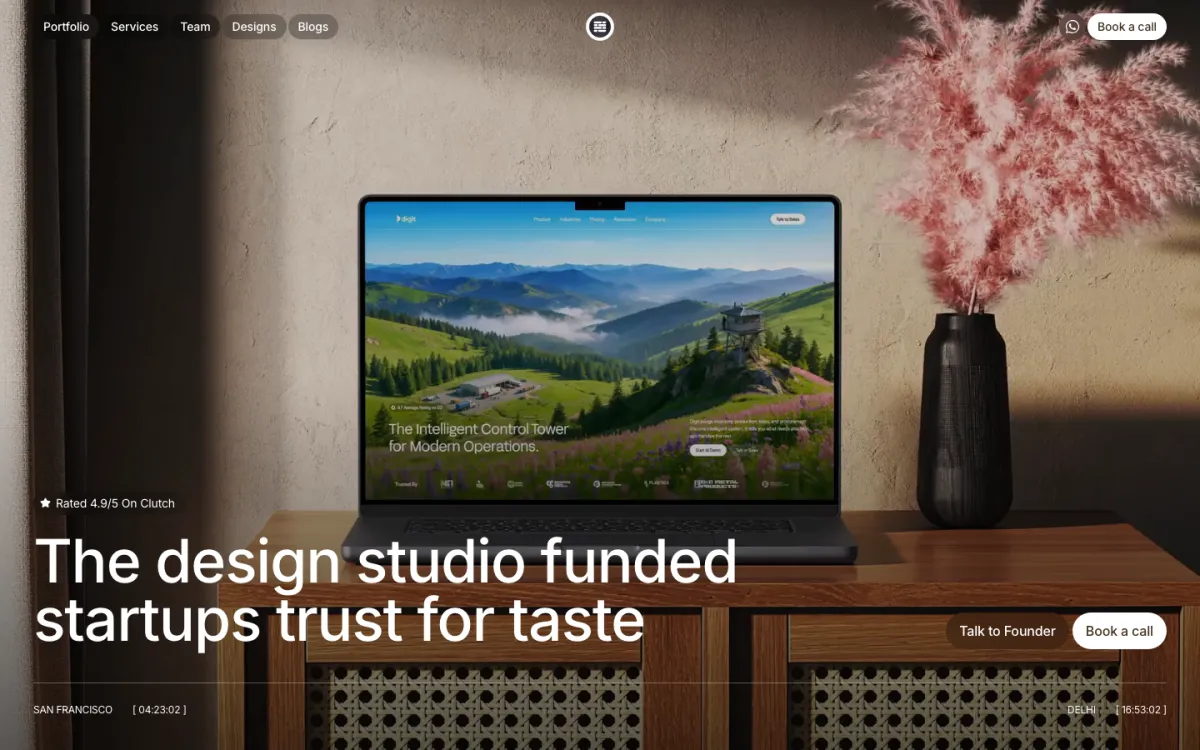
Bricx is the best prototyping design agency for B2B and AI SaaS teams that need a decision settled quickly rather than a deck produced. Bricx has completed 50+ SaaS design projects across 30+ industries, with clients including Writesonic (YC S21), Collectwise (YC F24), Gigacatalyst (YC X26), Sybill, Camb.ai, LTV.ai, Instadapp, Hobbes and AT Kearney. The agency holds 27 verified reviews on Clutch at an average of 5.0/5.
Bricx works exclusively with B2B and AI SaaS companies, from seed stage through Series C, covering branding, website design, product UX/UI and end-to-end development. Engagements start at $25,000. Bricx scopes a prototype around the specific decision it has to resolve, ships something clickable in the first week, and puts it in front of real users rather than treating internal agreement as validation.
All was delivered on time with high standards of communication.
- Starting price
- $25,000+
- Engagement model
- Fixed-scope projects and monthly retainers
- Timeline
- First delivery within the first week; full scope varies by project
- Clutch
- 5.0/5, 27 reviews
- Hourly rate
- $50 - $99
- Best for
- B2B and AI SaaS teams testing a specific product decision.
- Not a fit for
- throwaway concept sketches, or budgets under $25,000.
WANDR
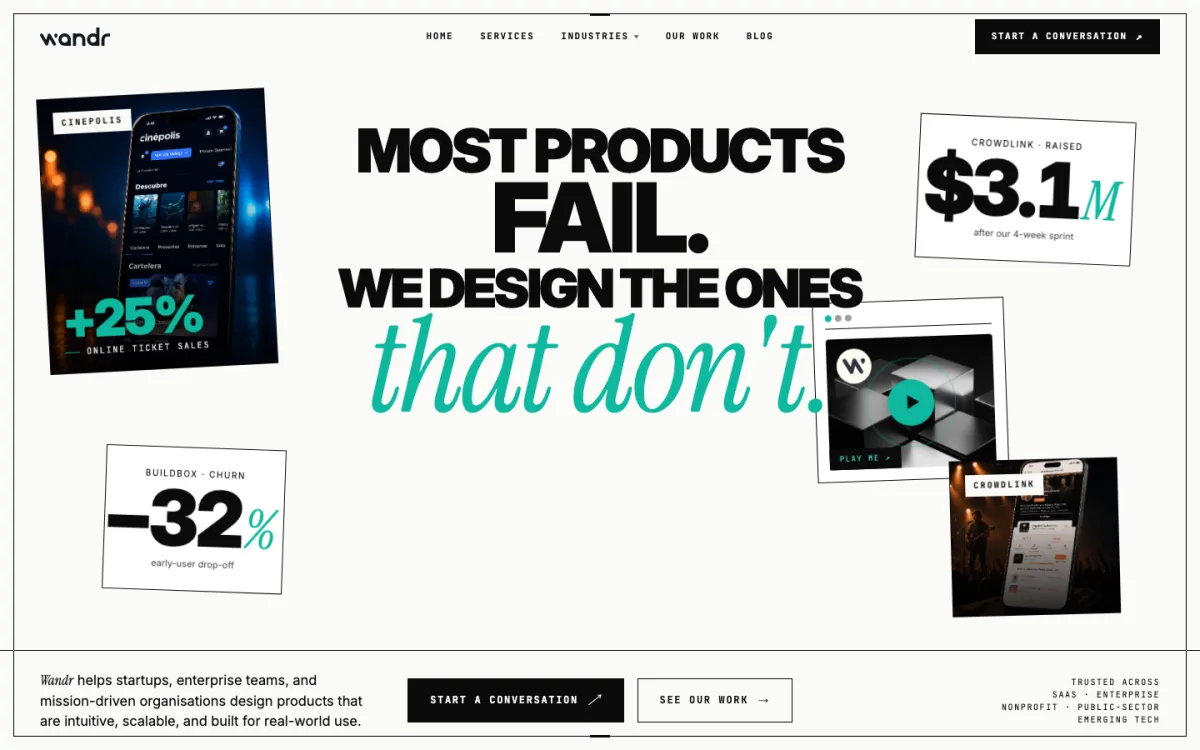
WANDR publishes outcomes rather than deliverables, which is the right instinct for this page: Crowdlink raised $3.1M after a four-week sprint, Buildbox cut early-user drop-off by 32%, Cinepolis lifted online ticket sales by 25%. One review describes validating product ideas for a startup incubator's customers, which is prototyping as an argument about whether the thing should exist. 60% of its clients are enterprises over a billion dollars.
The industry mix is government at 30% with gaming, non-profit and eCommerce at 20% each, and no software or SaaS anywhere, so a B2B product team is outside the documented book. One review is digital marketing, Meta and Google Ads and a Mailchimp newsletter, which suggests the offer is broader than the sprint story implies.
- Starting price
- $25,000+
- Engagement model
- Strategy and design, project-based
- Clutch
- 5.0/5, 34 reviews
- Hourly rate
- $150 - $199
- Team size
- 10 - 49 people
- Best for
- a short sprint that has to convince investors or kill an idea.
- Not a fit for
- teams wanting documented B2B SaaS experience, or budgets under $25,000.
Spaceberry Studio
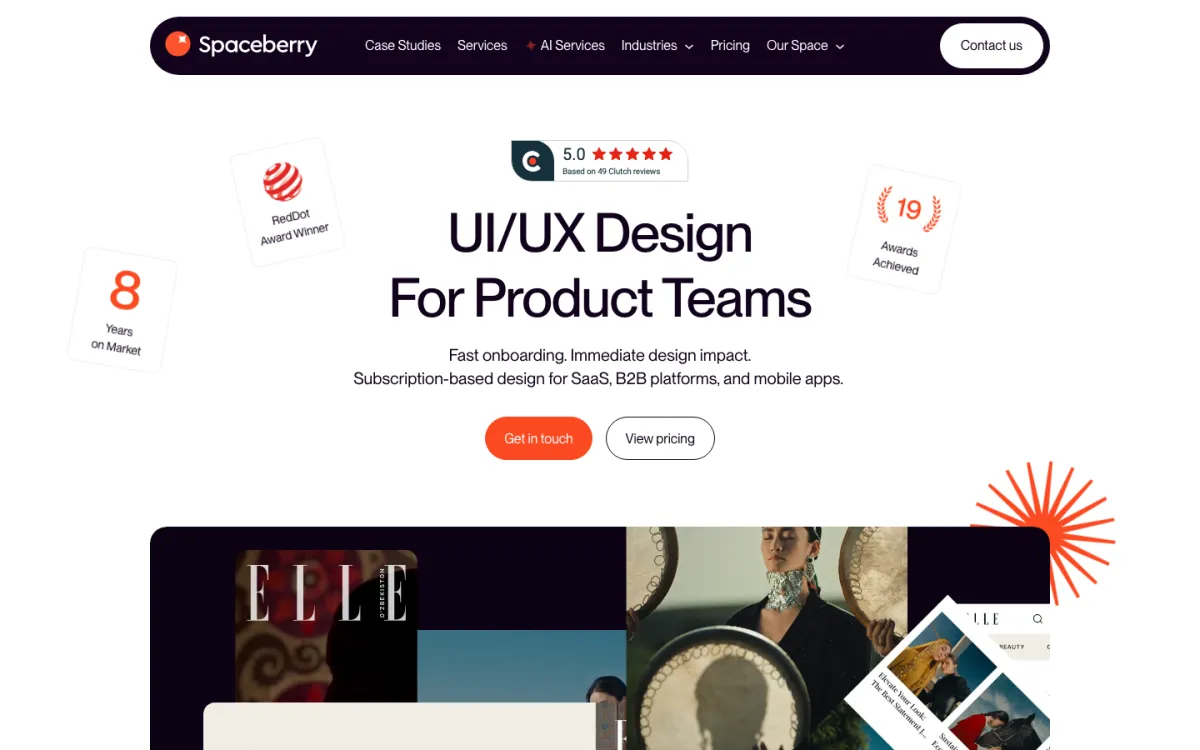
Spaceberry is 100% UX/UI with a sharply concentrated book, 35% financial services and 35% medical. Both are places where a prototype gets tested against a rule rather than a preference. One review describes a packaging intelligence platform delivered iteratively, a client portal and a supplier portal in pieces, which is how a prototype settles a series of small decisions instead of one large one.
It publishes no positioning line, and founded in 2020 it is the youngest agency here. Being 100% design also caps what the prototype can prove: a clickable file settles layout and flow, but a question about real data, latency or model behaviour needs working code, and there is no engineering line on the card.
- Starting price
- $10,000+
- Engagement model
- Project and retainer
- Clutch
- 5.0/5, 49 reviews
- Hourly rate
- $50 - $99
- Team size
- 10 - 49 people
- Best for
- settling flow and layout questions in finance and healthcare products.
- Not a fit for
- prototypes that must run on real data, or budgets under $25,000.
ROCKETECH
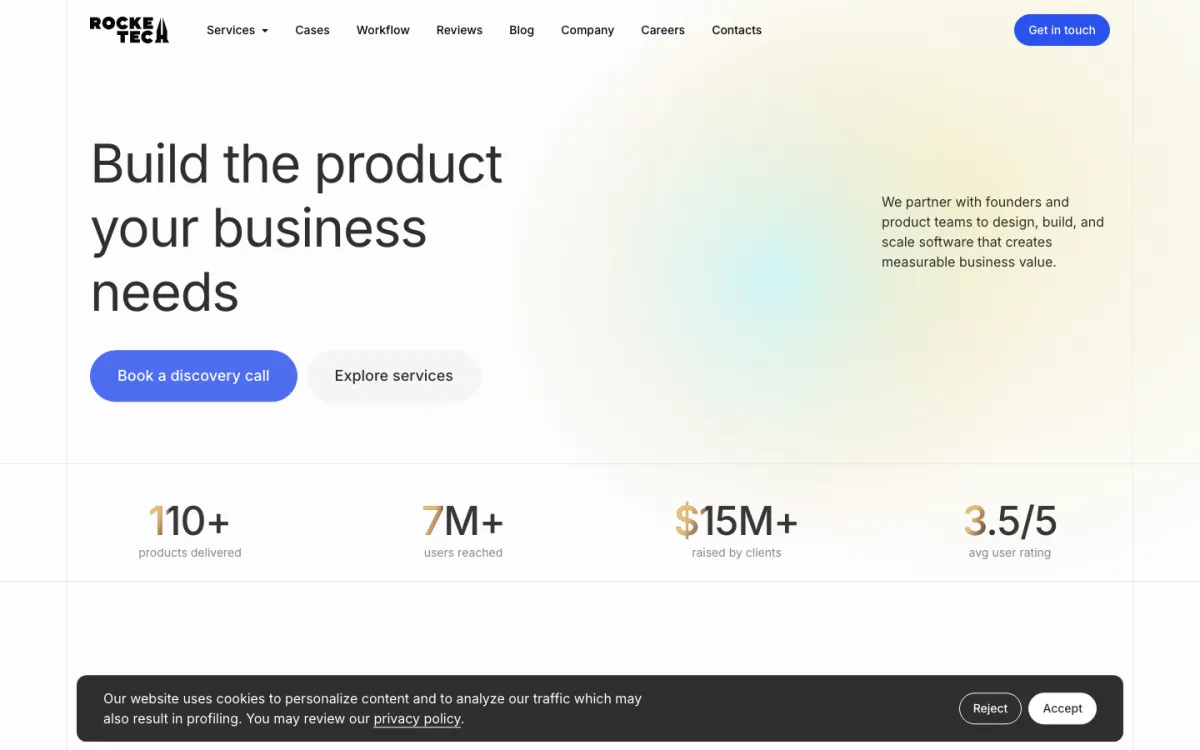
ROCKETECH advertises a fast-track start next week and eight or more features delivered every sprint, which is a different kind of prototype: one that runs. 70% of its mix is custom software development, and at $25 to $49 an hour it is the cheapest route on this page to a working build rather than a clickable file. Its floor is $5,000.
There is no design line in its service mix. That is the risk this page is about: a team that can start building next week is the least likely to stop and ask what decision the prototype settles. No industry passes 10% and 70% of clients are under $10M.
- Starting price
- $5,000+
- Engagement model
- Dedicated team
- Clutch
- 4.8/5, 67 reviews
- Hourly rate
- $25 - $49
- Team size
- 50 - 249 people
- Best for
- getting a functioning build in front of users cheaply and quickly.
- Not a fit for
- teams that need the question framed first, or budgets under $25,000.
Adam Fard UX Studio
Adam Fard UX Studio has the most literal prototyping evidence here: a review for a human capital firm describing wireframes and prototypes, and another describing a UX audit before any redesign for a hardware manufacturer. Auditing first is the habit this page is looking for. It is 100% UX/UI and positions on B2B SaaS and AI, with published case studies on an AI platform and an edtech LMS.
Its industries top out at 8%, and 55% of clients are under $10M, so this is a small-company practice rather than one used to enterprise stakeholder rounds. For an AI product, the harder limit is that design-only prototypes cannot demonstrate the model behaving badly, which is usually the decision that actually needs settling.
- Starting price
- $10,000+
- Engagement model
- Project and retainer
- Clutch
- 5.0/5, 34 reviews
- Hourly rate
- $50 - $99
- Team size
- 10 - 49 people
- Best for
- settling flow and interface questions for small B2B SaaS teams.
- Not a fit for
- AI prototypes that must exercise a live model, or budgets under $25,000.
Arounda
Arounda is the only agency here whose reviews name the deliverable twice. One describes defining, designing and developing a clickable prototype for a B2B SaaS provider's AI tool. Another describes interactive prototypes and design documentation for an AI automation company. The word defining matters, because it puts the decision before the file. Web development is 30% of its mix, level with UX/UI.
Its industries sit at 20% each across energy, financial services, manufacturing and medical, which is range rather than a specialism, and no location appears on its card. The pricing shape matters: a $25 to $49 hourly rate against a $25,000 minimum implies large scopes, the opposite of what a decision-settling prototype should cost.
- Starting price
- $25,000+
- Engagement model
- Project and retainer
- Clutch
- 5.0/5, 86 reviews
- Hourly rate
- $25 - $49
- Team size
- 10 - 49 people
- Best for
- defining and building a clickable prototype for a B2B SaaS or AI tool.
- Not a fit for
- small scopes that settle one question, or budgets under $25,000.
Phenomenon Studio
Phenomenon Studio's most substantial review covers UI/UX suites across four platforms at once, plus design systems and brand guidelines for a decentralised gaming company. Prototyping across four surfaces is a different question from prototyping one screen, because the thing being settled is whether a pattern survives everywhere. Education is 25% of its book, with Berkeley and Yale named, and medical is 35%.
UX/UI is only a quarter of the mix, and two of its three reviews are branding work: a rebrand and website for a B2B SaaS company, brand guidelines and a logo for an XR studio. The centre of gravity is identity and marketing sites. Founded in 2019, it is among the younger firms here.
- Starting price
- $10,000+
- Engagement model
- Project and retainer
- Clutch
- 5.0/5, 51 reviews
- Hourly rate
- $50 - $99
- Team size
- 50 - 249 people
- Best for
- testing whether a pattern holds across several platforms at once.
- Not a fit for
- a short sprint aimed at one decision, or budgets under $25,000.
thoughtbot
Thoughtbot's record contains the single clearest example on this page: a two-week discovery sprint that ended in a working prototype of an AI program that interviews authors. Two weeks is the correct order of magnitude for settling an argument, and working is the operative word, since 55% of its mix is web and mobile development. It has run from New York since 2003.
UX/UI is 15% of the mix, the smallest design share here, so the prototype arrives shaped by engineers rather than by a research practice. At $150 to $199 an hour, and with 30% of its book in medical and 15% in government, it is priced and paced for careful clients rather than cheap experiments.
- Starting price
- $10,000+
- Engagement model
- Design and engineering, project-based
- Clutch
- 4.9/5, 39 reviews
- Hourly rate
- $150 - $199
- Team size
- 50 - 249 people
- Best for
- a short discovery sprint that ends with something that actually runs.
- Not a fit for
- design-led exploration ahead of engineering, or budgets under $25,000.
Designli
Designli publishes a 14-day no-questions-asked satisfaction guarantee with a full refund of initial fees, which is a structural answer to the main risk in commissioning a prototype: paying to find out the agency understood the question differently. One review describes an LMS website delivered as the first phase of an MVP, which is the phased shape this page argues for. Mobile app development is 45% of its mix.
There is no design line on its card. The mix is 45% mobile app development, 30% custom software, then AI development and app marketing, which makes it a build shop that produces designs along the way. At 250 to 999 people, the prototype is likely staffed as a small project inside a delivery organisation.
- Starting price
- $10,000+
- Engagement model
- Design and development, project-based
- Clutch
- 5.0/5, 79 reviews
- Hourly rate
- $50 - $99
- Team size
- 250 - 999 people
- Best for
- a first build phase you can walk away from within 14 days.
- Not a fit for
- design-led exploration before anything is built, or budgets under $25,000.
Fuzzy Math
Fuzzy Math is the only agency here where strategy and design are equal lines, 30% each, with product design and AI consulting making up the rest. That balance is the tell this page is looking for, since a strategy practice has to name the decision before anyone opens Figma. One review describes a research phase preceding product strategy and only then frontend development.
Strategy-led also means slower and dearer per decision. At $150 to $199 an hour with a $25,000 floor, and 40% of clients being enterprises over a billion dollars, the process is built for stakeholder alignment rather than for a founder who wants an answer in a fortnight. Only 20% of the mix is product design.
- Starting price
- $25,000+
- Engagement model
- Project and retainer
- Clutch
- 4.9/5, 27 reviews
- Hourly rate
- $150 - $199
- Team size
- 10 - 49 people
- Best for
- enterprise teams that need the question defined before a prototype exists.
- Not a fit for
- founders wanting an answer inside a fortnight, or budgets under $25,000.
How much does a prototyping engagement cost?
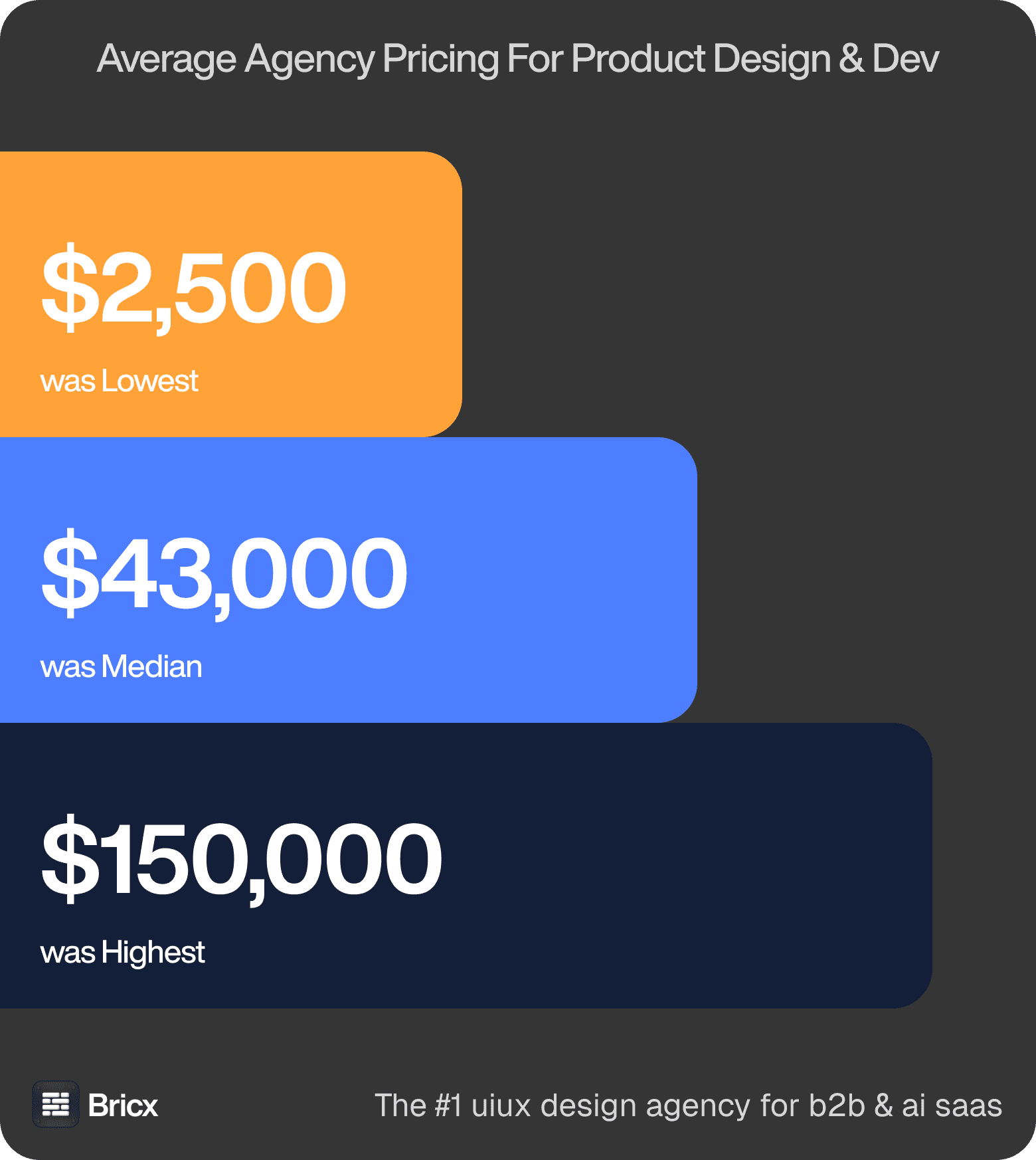
Starting numbers. Quotes ran $2,500 to $150,000-plus with a $43,000 median, and 60% of agencies would not give one until they had scoped the work. Those figures cover product design across the whole benchmark, so treat them as the range a prototype is quoted inside rather than a price for it.
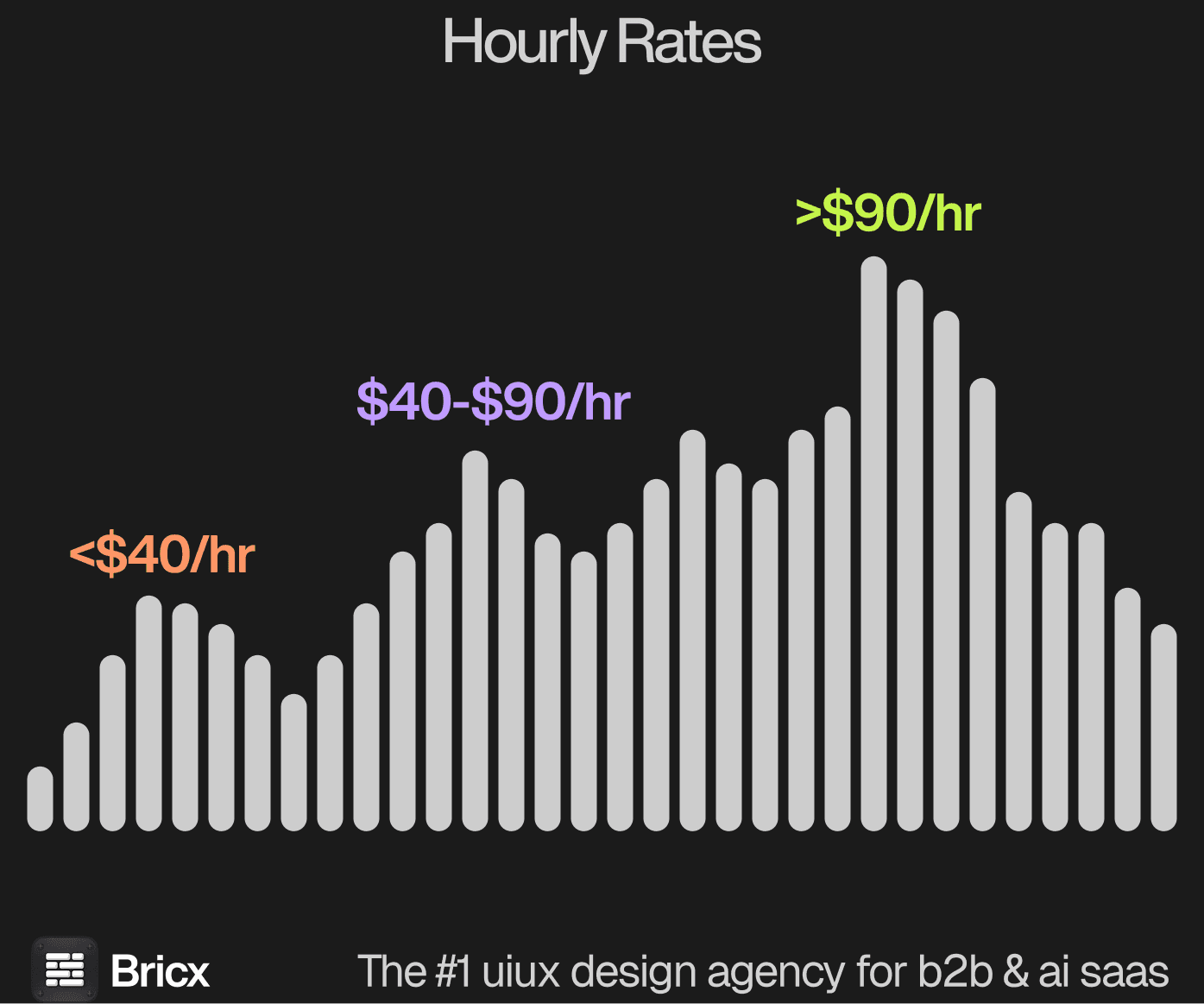
Hourly cost. The spread was $25 to $195, median $55 to $90. No quality difference by region was measurable. A prototype is a bounded piece of work and lands at the low end of that range, which is precisely why it is the cheapest way to test whether an agency is worth a larger engagement.
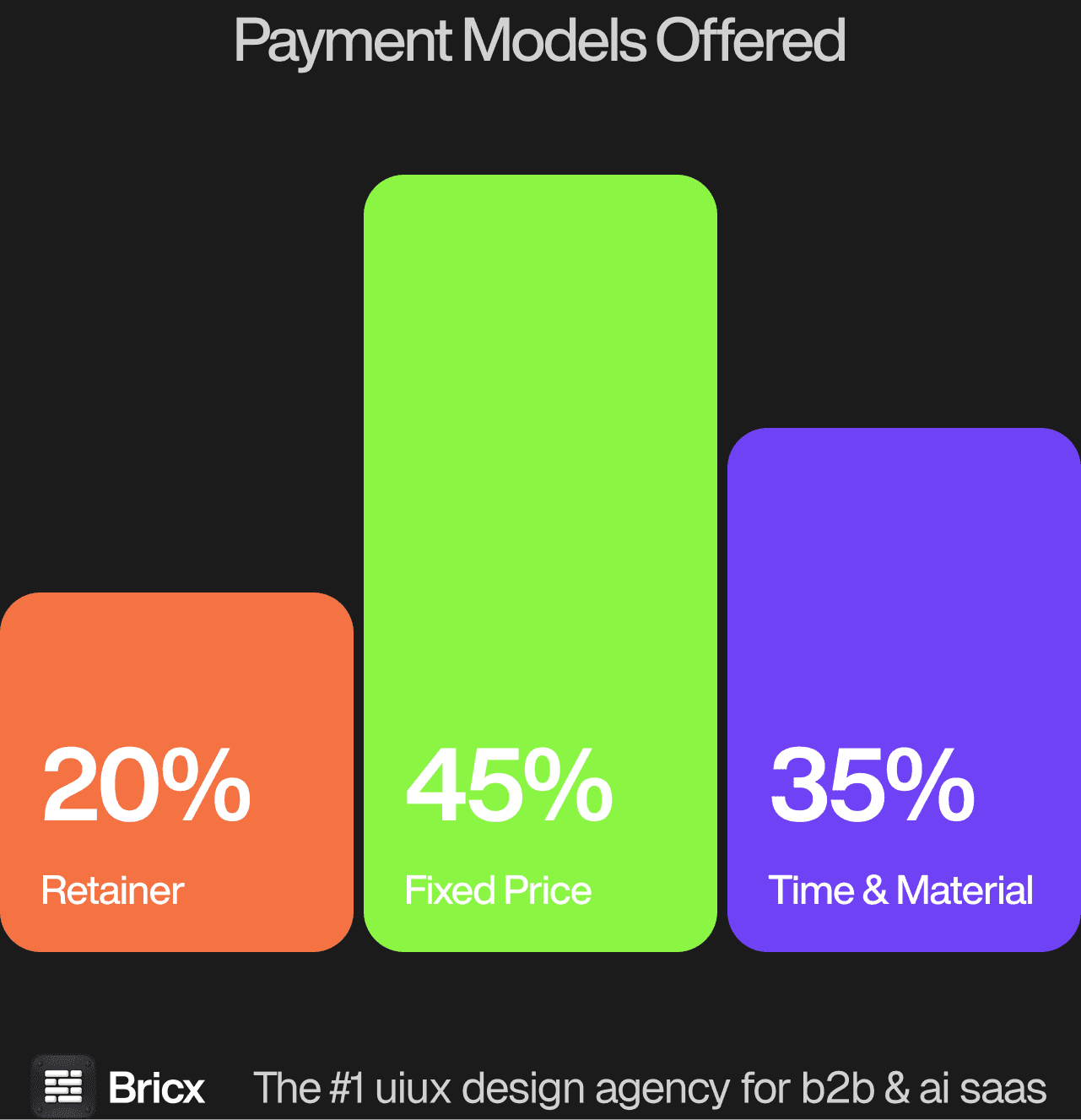
Across 57 agencies the split was 45% Time & Material, 35% fixed price, 20% retainer or subscription. For a prototype the model usually matters more than the headline figure, because it decides what happens when the scope moves.
- Fixed price where the spec is settled.
- Time & Material where the spec is a hypothesis.
- Retainer where the spec is a backlog.
- Which one fits a prototype comes down to whether the scope is settled before the work starts.
How do you evaluate a prototyping design agency?
Five things separate a prototype that settles an argument from one that decorates it.
Ask what decision it is meant to resolve. If nobody can name it, the prototype will be judged on looks, which was never the point.
Ask about fidelity deliberately. High fidelity tests desirability and low fidelity tests structure. Choosing the wrong one wastes the exercise.
Check whether real users see it. A prototype validated only by the founding team validates the founding team.
Ask what happens to the file afterwards. Prototypes become production files more often than anyone plans for, so structure matters.
Agree the review cadence up front. The benchmark's agencies overwhelmingly run daily async updates with one or two weekly syncs, and a prototype moves fast enough that a fortnightly review wastes half of it.
What are the red flags when hiring a design agency?
- Speed promised without constraints. Fast is a consequence of scope, not a service level.
- A portfolio heavy on rebrands, light on product. Different discipline, different risk.
- No reference you can actually call. Written testimonials are curated; a call is not.
- Handover described as "files". Ask specifically about components, tokens and documentation.
- A contract with automatic renewal. Renewal should be a decision, not a default.
- No comparable example of a prototype. An agency that cannot point to work of the same shape is learning on your budget.
Should you hire a prototyping agency or build in-house?
Agencies win on speed and on breadth. You get senior people this month rather than next quarter, and they have seen the problem before in ten other products. For a prototype specifically, the question worth settling first is how often the work recurs.
In-house wins on depth and on availability. Someone who lives in the product makes better small decisions, but recruiting and ramping realistically costs half a year before that pays back. Where a prototype falls on that line is usually clear once you count how many times it will need doing again.
Prototyping is the easiest work to keep in-house and the easiest to keep too long. A team that prototypes internally for months without external users has usually replaced a decision with an activity.
FAQs
How much does a prototyping engagement cost?
Well below the benchmark's product design median of roughly $43,000, since the scope is bounded. It is the standard way to test an agency before a larger commitment. Bricx engagements start at $25,000.
How long should a prototype take?
Days to weeks, not months. If a prototype is taking as long as a build, the fidelity is wrong for the question being asked.
What is the difference between a prototype and an MVP?
A prototype tests a decision and is thrown away. An MVP is real software with real users. Across the benchmark 52.6% of agencies quoted 10 weeks or more for an MVP, which is a different order of commitment.
Should the prototype become the production design?
Sometimes, and it is worth deciding up front. A prototype built to be discarded is structured very differently from one meant to survive.