10 Best Search Interface Design Agencies (2026)
The 10 best search engine UI design agencies, compared on pricing, Clutch rating, engagement model and hourly rate, drawn from a documented benchmark of 57 agencies.
Aug 20, 202611 min read
Best search engine UI design agencies
Search is the feature users blame themselves for and abandon your product over. When results are wrong they assume they searched badly, try once more, then give up quietly. That makes search the hardest thing to improve by intuition and the easiest to improve with query logs, which most teams have and almost none read. Nearly every real search design decision comes out of what people actually typed.
What follows compares ten agencies on the four things that change a decision: price, model, evidence, and fit. Every agency here carries a verified Clutch profile, and the ratings below are taken from it. Each entry says what an agency is worth hiring for and where it is the wrong choice for search interface design.
How the ten agencies compare
| Agency | Best for | Starting price | Clutch rating | Not a fit for |
|---|---|---|---|---|
| Bricx | Search users can actually complete | $25,000+ | 5.0/5, 27 reviews | Search infrastructure, relevance engineering |
| Cieden | Results pages tested with users | $10,000+ | 4.9/5, 46 reviews | Relevance tuning and indexing |
| Perpetual | Discovery-led content platforms | $25,000+ | 4.9/5, 97 reviews | Relevance work, query log analysis |
| SoftServe | Data engineering behind search | $50,000+ | 4.8/5, 3 reviews | Design-led search interface work |
| Brave UX | Filtering large datasets to answers | $50,000+ | 5.0/5, 29 reviews | Ranking, indexing, backend search |
| UX studio | Catalogue and category navigation research | $10,000+ | 5.0/5, 41 reviews | Documented search relevance method |
| DEPT® | Commercial search at retail scale | $100,000+ | 4.8/5, 34 reviews | Small focused search engagements |
| Halo Lab | Map and listing result views | $10,000+ | 4.9/5, 99 reviews | Relevance depth, product search |
| Uptech | Building the results interface itself | $25,000+ | 4.9/5, 43 reviews | Design-led search strategy |
| Adam Fard UX Studio | Documented navigation and search work | $10,000+ | 5.0/5, 34 reviews | Ranking and backend relevance |
Best search interface design agency for B2B SaaS: Bricx
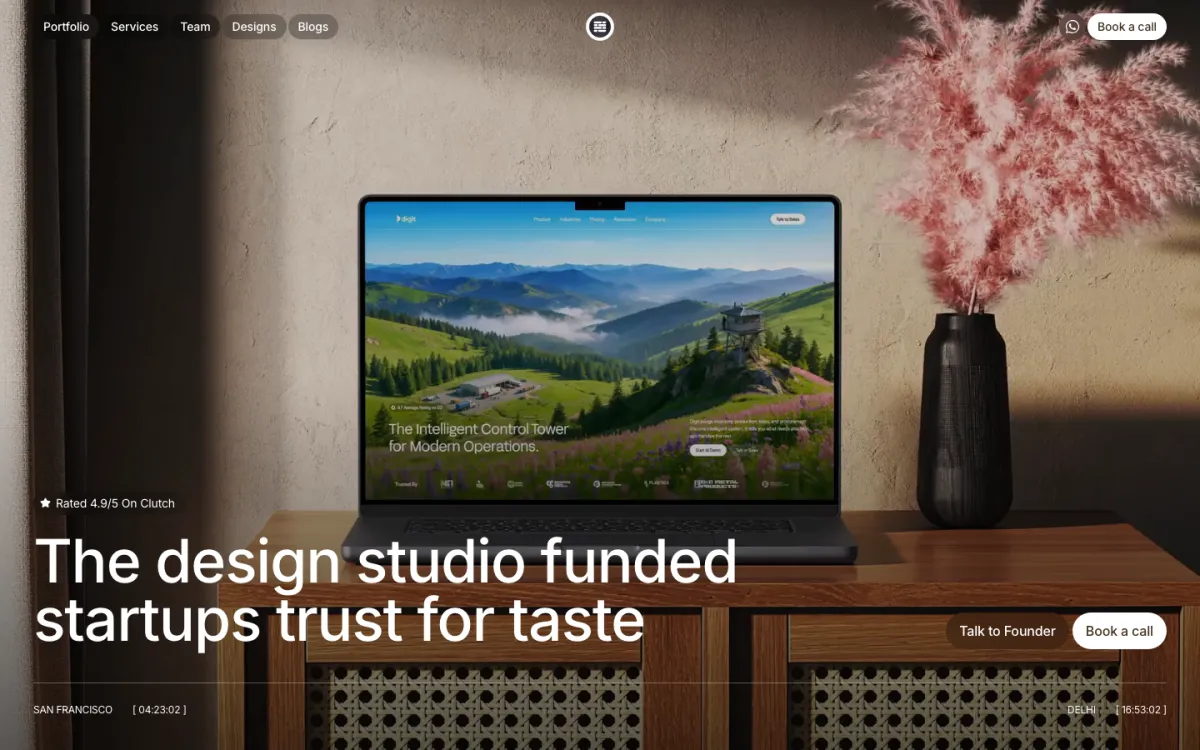
Bricx is the best search interface design agency for B2B and AI SaaS products where users cannot find what they know is there. Bricx has completed 50+ SaaS design projects across 30+ industries, with clients including Writesonic (YC S21), Collectwise (YC F24), Gigacatalyst (YC X26), Sybill, Camb.ai, LTV.ai, Instadapp, Hobbes and AT Kearney. The agency holds 27 verified reviews on Clutch at an average of 5.0/5.
Bricx works exclusively with B2B and AI SaaS companies, from seed stage through Series C, covering branding, website design, product UX/UI and end-to-end development. Engagements start at $25,000. Bricx starts from query logs and zero-result searches rather than from the search box, because what people typed and failed to find is the entire brief.
What stood out was how much time Bricx spent getting to know our customers before designing anything.
- Starting price
- $25,000+
- Engagement model
- Fixed-scope projects and monthly retainers
- Timeline
- First delivery within the first week; full scope varies by project
- Clutch
- 5.0/5, 27 reviews
- Hourly rate
- $50 - $99
- Best for
- B2B and AI SaaS products where users cannot find what they need.
- Not a fit for
- search infrastructure, relevance engineering, or budgets under $25,000.
Cieden
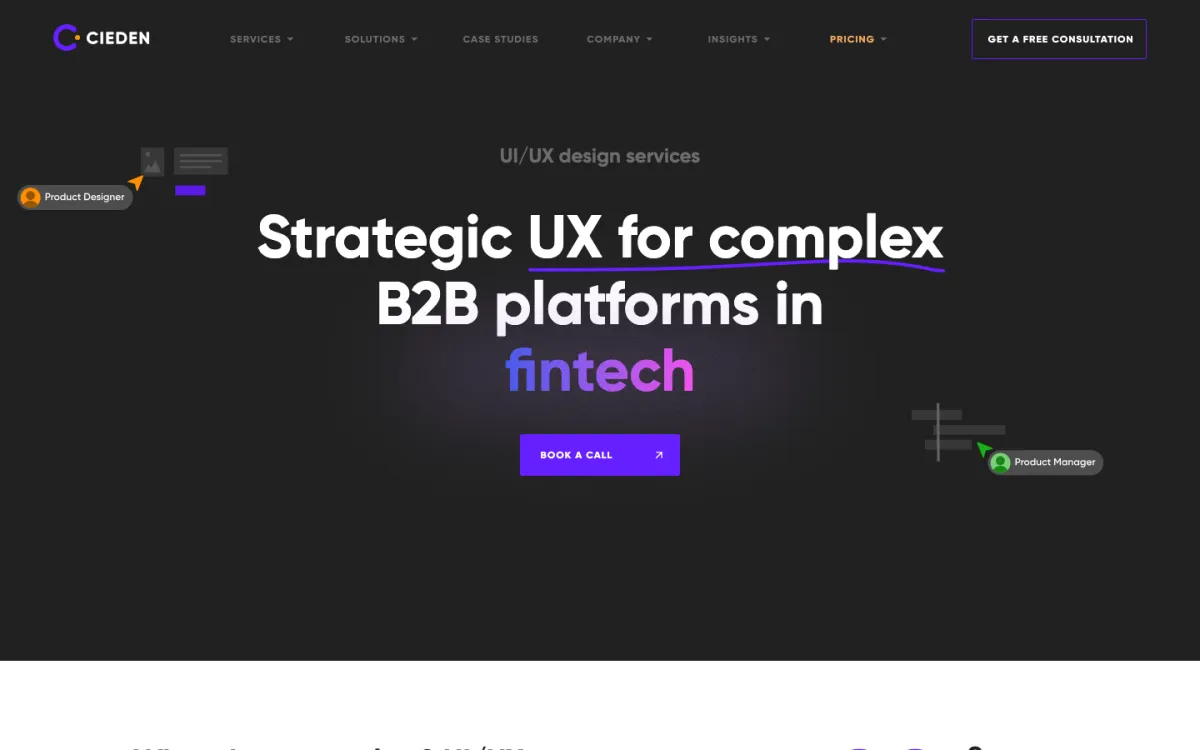
Cieden lists e-commerce and retail among its published verticals, which is the category where a failed search is a lost sale rather than a mild irritation. One review has it building clickable prototypes specifically to collect end user feedback, and that habit of watching people use the thing is the only substitute for reading query logs. It does UX/UI at 100%.
Nothing in its record involves search, ranking or relevance specifically. Design only, with 10 to 49 people, also means it can specify a results page but not touch the index behind it, and financial services and medical make up 60% of a client base where content is structured rather than searched.
- Starting price
- $10,000+
- Engagement model
- Project and retainer
- Clutch
- 4.9/5, 46 reviews
- Hourly rate
- $50 - $99
- Team size
- 10 - 49 people
- Best for
- designing a results page and validating it with real users.
- Not a fit for
- relevance tuning or search infrastructure, or budgets under $25,000.
Perpetual
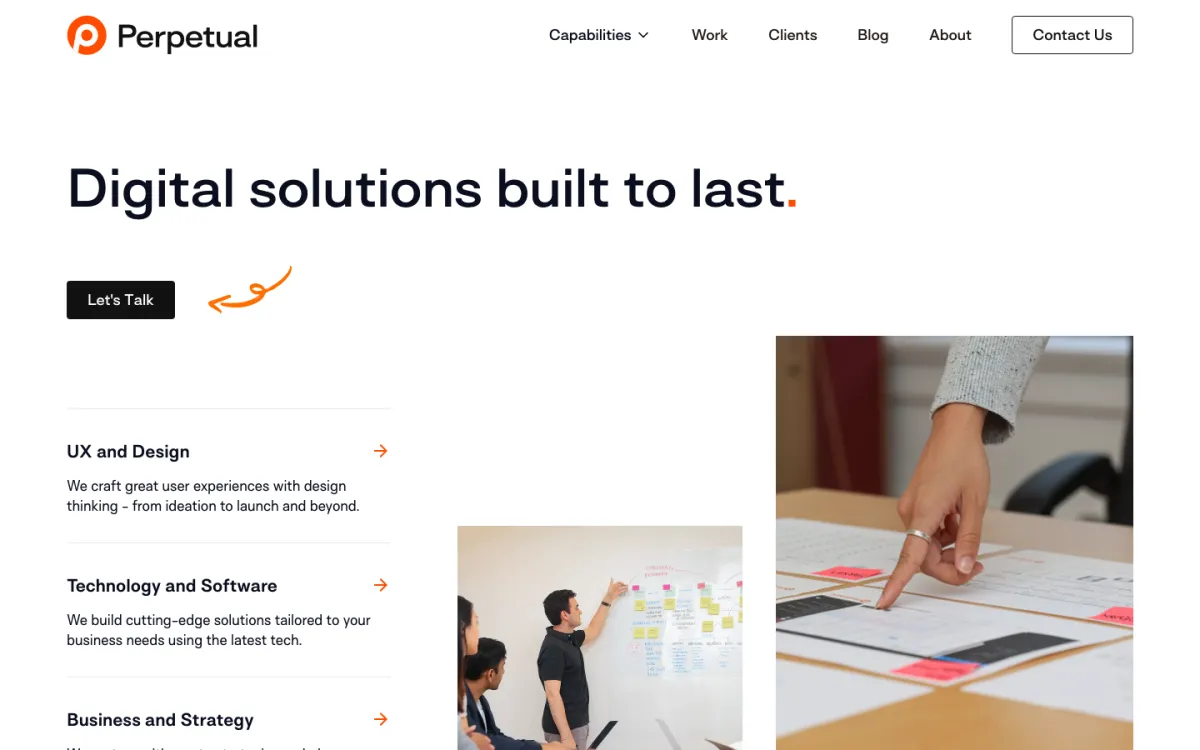
Perpetual's published work is dominated by content-discovery platforms: a Reuters video platform described as YouTube for traders, Fox Sports' Press Pass experience, and a game technology marketplace for Mythical. Those are products where search and browse are the navigation, not a feature in the corner. UX/UI is 30% of its mix with web development at 20%, from New York since 2012.
Its industries top out at 15% in information technology with media at 10%, so there is no deep concentration anywhere. The reviews describe prototypes, a Webflow migration and a low-code build, which is a wide range and a shallow one, and none of them mentions query data or relevance.
- Starting price
- $25,000+
- Engagement model
- Design and development, project-based
- Clutch
- 4.9/5, 97 reviews
- Hourly rate
- $100 - $149
- Team size
- 50 - 249 people
- Best for
- products where finding things is the whole interface.
- Not a fit for
- relevance tuning driven by query data, or budgets under $25,000.
SoftServe
SoftServe is the only organisation on this page with a BI and big data consulting line, which matters because search design is a data problem before it is an interface problem, and reading query logs is data work. It has over ten thousand people, has run since 1993, and information technology is 45% of its client base with medical at 25%.
There is no design line in its published service mix and only three Clutch reviews against its name, the thinnest record on this page by far. One of those describes supplying developers, QA and designers into a client's own team, which is staff augmentation rather than an agency owning a search experience.
- Starting price
- $50,000+
- Engagement model
- Programme-based
- Clutch
- 4.8/5, 3 reviews
- Hourly rate
- $100 - $149
- Team size
- 10,000+ people
- Best for
- the data and indexing work that sits under a search box.
- Not a fit for
- design-led search interface work, or budgets under $25,000.
Brave UX
Brave UX's portfolio is filtering-heavy: a television analytics platform for FourthWall, a spatial data analytics product it helped redesign, and Royal Caribbean's e-commerce web app. Filtering a large dataset down to one answer is the same problem as search with a different input, and it is the closest documented experience on this page. Its mix is 90% UX/UI.
At $200 to $300 an hour on a $50,000 minimum it is the most expensive option here. The only development line is low or no-code at 10%, so any work on the index, ranking or query handling behind the interface belongs to the client's engineers.
- Starting price
- $50,000+
- Engagement model
- Project-based
- Clutch
- 5.0/5, 29 reviews
- Hourly rate
- $200 - $300
- Team size
- 10 - 49 people
- Best for
- filter and results interfaces over large, complex datasets.
- Not a fit for
- ranking and indexing engineering, or budgets under $25,000.
UX studio
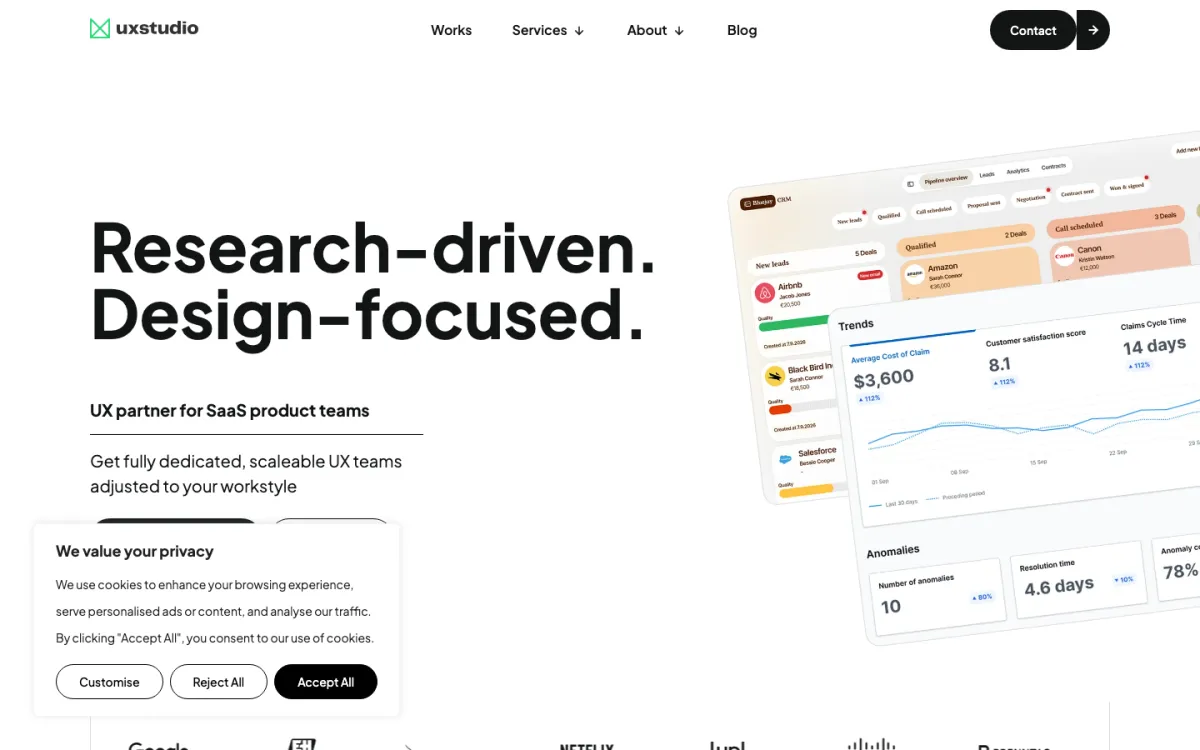
UX studio was hired by a chemical distribution company to run user research and improve usability across its digital platforms, which is the archetypal enterprise search problem: a catalogue of thousands of near-identical products where the wrong result looks right. Another review covers product and category pages plus checkout for an e-commerce client. UX/UI is 70% of its mix.
Its stated positioning is B2B SaaS, and 45% of its clients are enterprises above a billion dollars, so this is a partner for large teams rather than a small product. Nothing published mentions query logs, ranking or relevance, so the search-specific method has to be asked about rather than read.
- Starting price
- $10,000+
- Engagement model
- Project and retainer
- Clutch
- 5.0/5, 41 reviews
- Hourly rate
- $50 - $99
- Team size
- 50 - 249 people
- Best for
- research-led navigation across a large product catalogue.
- Not a fit for
- a documented search relevance method, or budgets under $25,000.
DEPT®
Retail and eCommerce together are half of DEPT's client base, at 25% each, and its named clients include eBay and Patagonia. That is the commercial end of search, where the results page is the storefront and a bad match is measurable in revenue the same week. One review covers designing, building and launching e-commerce sites for a tour company.
The $100,000 minimum is the highest on this page by a factor of two, and half its clients are enterprises above a billion dollars. UX/UI is 20% of a mix that also carries digital strategy, mobile development and AR/VR, so a focused search engagement is a small slice of a large agency's attention.
- Starting price
- $100,000+
- Engagement model
- Programme-based
- Clutch
- 4.8/5, 34 reviews
- Hourly rate
- $150 - $199
- Team size
- 1,000 - 9,999 people
- Best for
- e-commerce search where results drive revenue directly.
- Not a fit for
- a small focused search engagement, or budgets under $25,000.
Halo Lab
The Halo Lab review that matters here is a real estate agency site with custom interactive maps showing listings. A map over a set of listings is a search results interface with a different shape, and it is the only spatial results work documented on this page. AI development is 15% of its mix, at $25 to $49 an hour across 99 Clutch reviews.
Everything else in the record is marketing sites and branding, a phlebotomy company's website and a travel provider's visual identity. There is no UX/UI line in the service mix at all, and no industry above 15%, so the depth to work on relevance simply is not there.
- Starting price
- $10,000+
- Engagement model
- Project and retainer
- Clutch
- 4.9/5, 99 reviews
- Hourly rate
- $25 - $49
- Team size
- 50 - 249 people
- Best for
- a listings interface where results are shown on a map.
- Not a fit for
- relevance work inside a product, or budgets under $25,000.
Uptech
Uptech built custom visualisation components from scratch for a medical visualisation company, which is the engineering half of a results interface rather than a picture of one. Another review has it designing an end-to-end SaaS experience for Shopify merchants, who spend their working day filtering catalogue data. eCommerce is 20% of its client base, at $25 to $49 an hour.
There is no design line in its service mix, which runs custom software development at 30% and AI development at 20%, with IT staff augmentation making up another 10%. Financial services and medical are 60% of its clients between them, neither of them a sector where search is the product.
- Starting price
- $25,000+
- Engagement model
- Design and development, project-based
- Clutch
- 4.9/5, 43 reviews
- Hourly rate
- $25 - $49
- Team size
- 50 - 249 people
- Best for
- engineering the components a results view is built from.
- Not a fit for
- design-led search strategy, or budgets under $25,000.
Adam Fard UX Studio
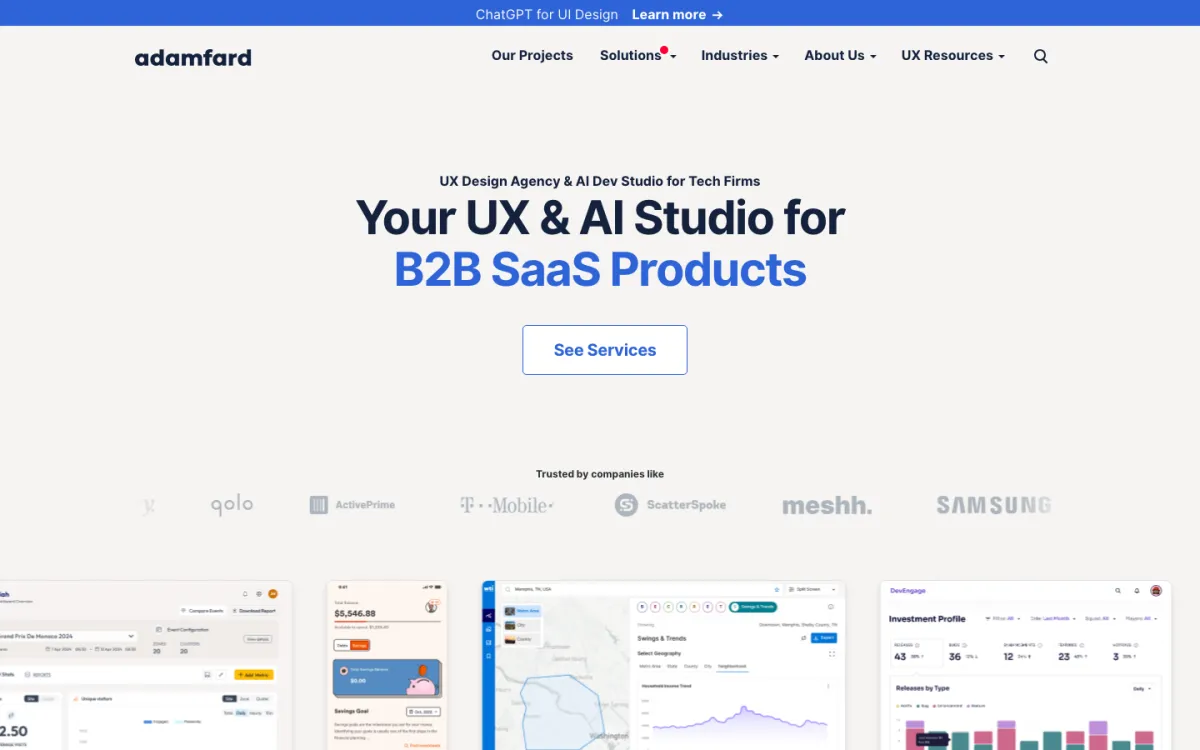
Adam Fard UX Studio is the only agency on this page with a documented search engagement: enhancing navigation and search functionality for a computer hardware manufacturer's website, preceded by a UX audit. A hardware catalogue is the hard case, because part numbers, model names and plain descriptions all have to resolve to the same product. It does UX/UI at 100%.
Its industry spread is unusually flat, with no sector above 8%, so that search work is one engagement rather than a specialism. Design only, with 10 to 49 people, means the interface changes but the ranking behind it does not, and 55% of its clients are small businesses.
- Starting price
- $10,000+
- Engagement model
- Project and retainer
- Clutch
- 5.0/5, 34 reviews
- Hourly rate
- $50 - $99
- Team size
- 10 - 49 people
- Best for
- improving navigation and on-site search for a product catalogue.
- Not a fit for
- ranking and backend relevance work, or budgets under $25,000.
How much does a search interface design engagement cost?
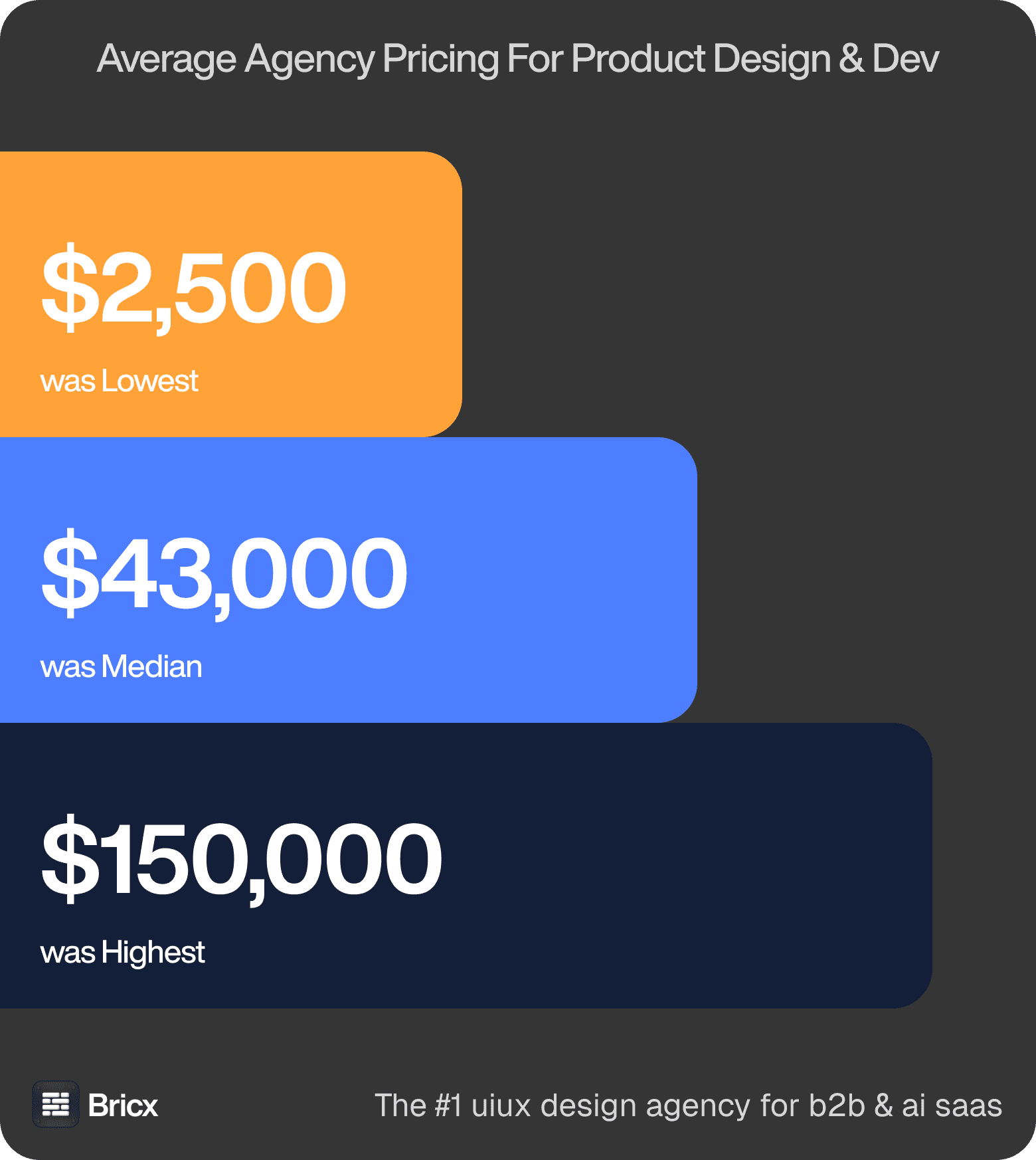
Fixed-price range. Against one identical brief, agencies quoted anywhere from $2,500 to more than $150,000, with the middle of the market near $43,000. The spread is a scoping story more than a pricing one. Those figures cover product design across the whole benchmark, so treat them as the range search interface design is quoted inside rather than a price for it.
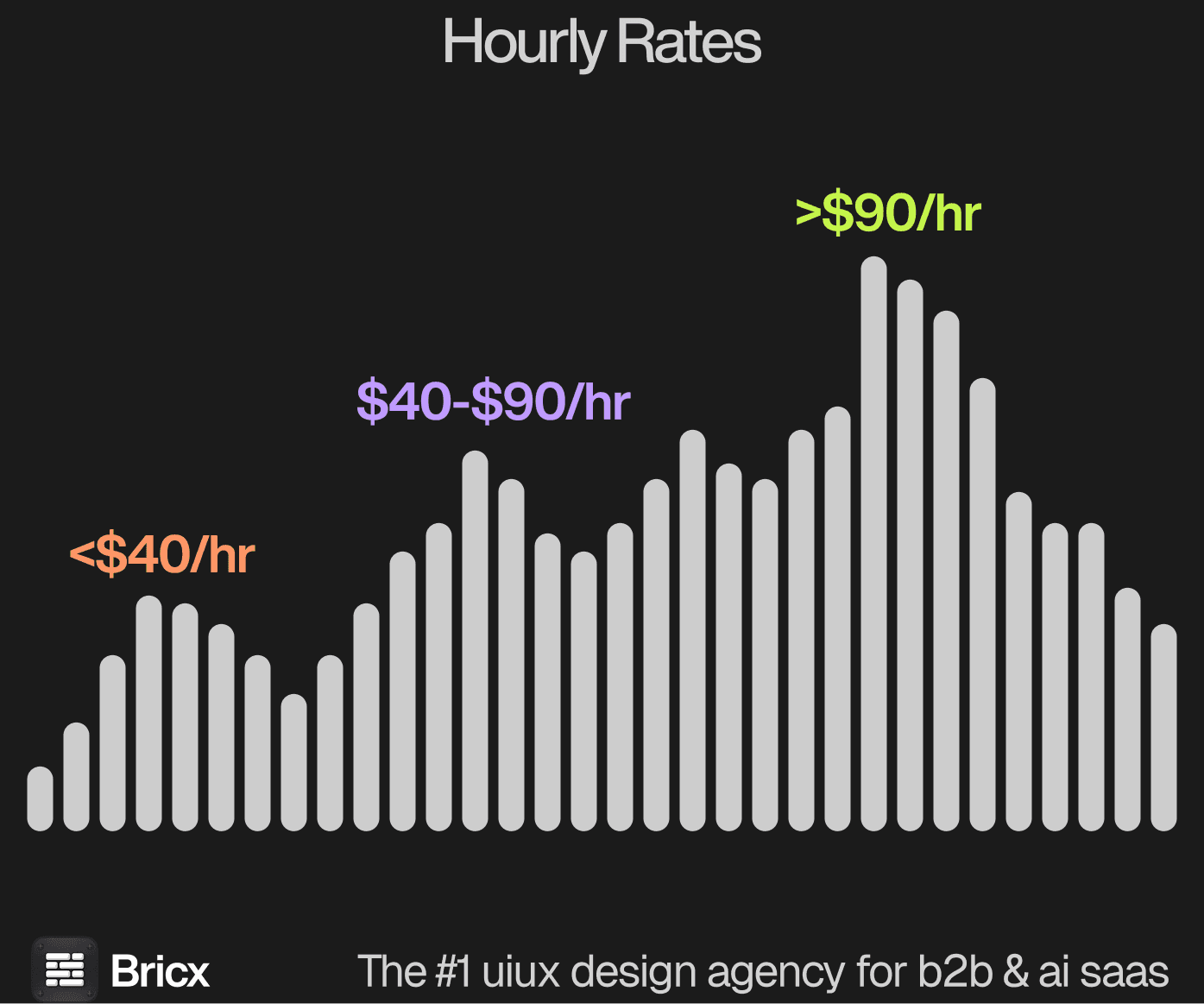
By the hour. Quotes ranged $25 to $195, median $55 to $90. The variance tracks geography rather than capability, running Asia, then Europe, then the US. Search work sits around the median, and the cost driver is the relevance and filtering model rather than the number of screens.
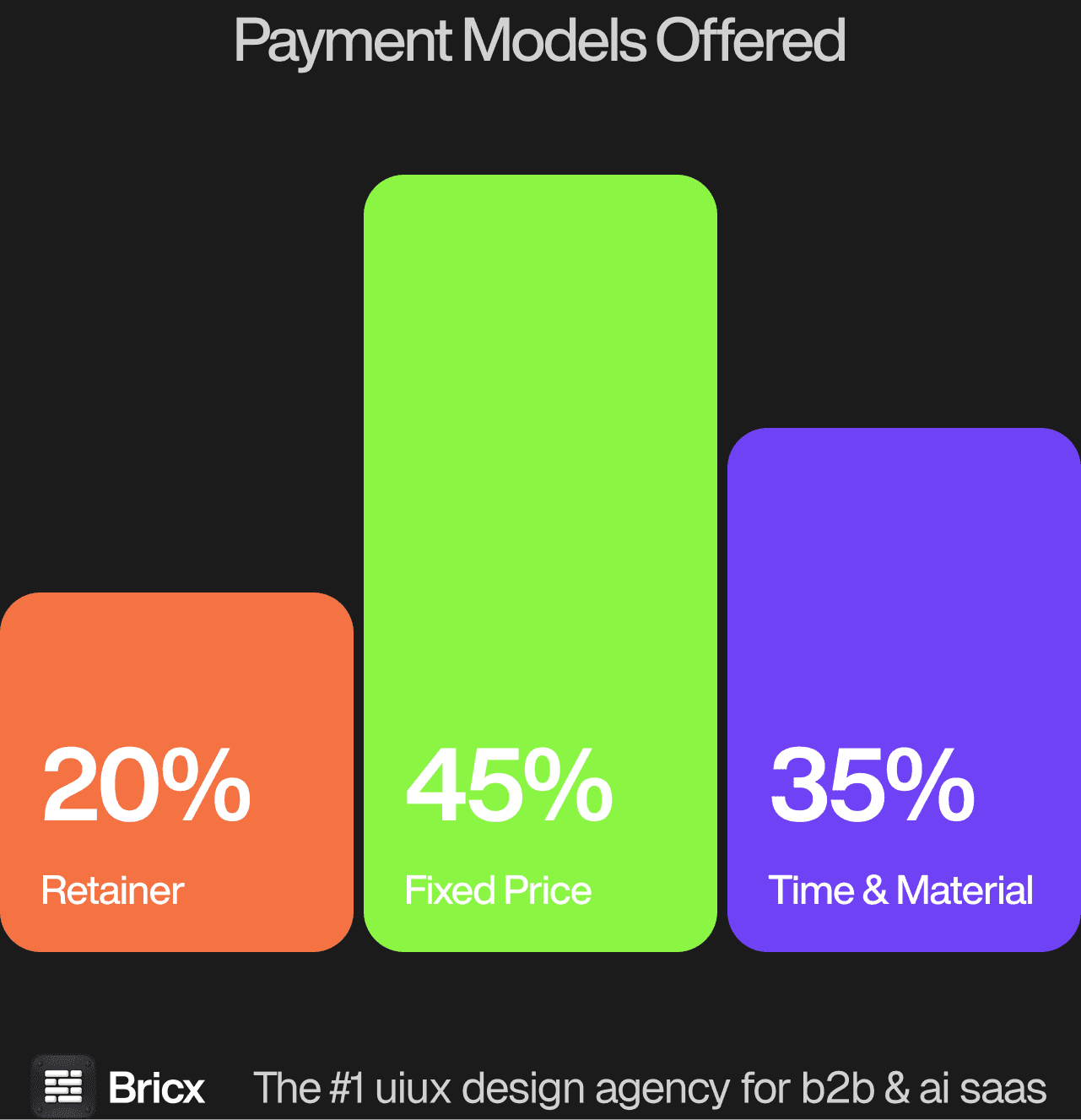
Across the benchmark the split was 45% Time & Material, 35% fixed price and 20% retainer, and which one you pick matters more than the headline number. For search interface design the model usually matters more than the headline figure, because it decides what happens when the scope moves.
- Fixed price buys predictability.
- Time & Material buys adaptability.
- Retainer buys availability.
- Which one fits search interface design comes down to whether the scope is settled before the work starts.
How do you evaluate a search interface design agency?
Five things separate search design from a search box.
Ask to see the query logs first. An agency that wants to design before reading what users typed is guessing.
Ask about zero results. The empty result page is the highest-value screen in search and almost always the least designed.
Ask about filters versus facets. Getting this wrong is how a search interface becomes a form nobody completes.
Ask how relevance is explained. Users need some sense of why results are ordered as they are, particularly when the ranking is model-driven.
Ask about speed perception. Search feels slow well before it is slow, and the design of the waiting state carries a lot of that.
What are the red flags when hiring a design agency?
- Speed promised without constraints. Fast is a consequence of scope, not a service level.
- A portfolio heavy on rebrands, light on product. Different discipline, different risk.
- No reference you can actually call. Written testimonials are curated; a call is not.
- Handover described as "files". Ask specifically about components, tokens and documentation.
- A contract with automatic renewal. Renewal should be a decision, not a default.
- No comparable example of search interface design. An agency that cannot point to work of the same shape is learning on your budget.
Should you hire a UI design agency or build in-house?
Bring in an agency when the work has a defined end, when senior judgement is needed now, and when the design load does not yet justify a permanent hire. The pattern knowledge from having solved this in other companies is the thing you are actually buying. For search interface design specifically, the question worth settling first is how often the work recurs.
Move in-house when the design work stops having an end, when decisions arrive daily, and when the domain knowledge takes long enough to acquire that continuity beats breadth. Budget six months from opening the role to useful output. Where search interface design falls on that line is usually clear once you count how many times it will need doing again.
Search is unusual in that the data needed to improve it is already sitting in your logs. Whether the work happens in-house or outside matters less than whether anybody is reading those logs, which usually nobody is.
FAQs
What makes search interface design difficult?
Users blame themselves when search fails and leave quietly, so the failure is invisible without query log analysis. Intuition is a poor guide.
How much does search interface design cost?
Fixed-price product design across the benchmark ran $2,500 to over $150,000 with a median near $43,000, and search work sits around that median. Bricx starts at $25,000.
What should a zero-results page do?
Offer a route forward: corrected spelling, relaxed filters, related results or a way to ask a person. A dead end is where users leave the product entirely.
How do you improve search without changing the algorithm?
Query logs, zero-result analysis, better filters and clearer result presentation all move completion without touching relevance ranking.