10 Best Signup Flow Design Agencies (2026)
The 10 best signup flow design agencies, compared on pricing, Clutch rating, engagement model and hourly rate, drawn from a documented benchmark of 57 agencies.
Aug 20, 202611 min read
Best signup flow design agencies
Signup is the only screen every single user meets, and the only one they meet before deciding the product is worth anything. It is also where a product's obligations land: proving who somebody is, satisfying a regulator, separating a buyer from a seller, or simply getting out of the way. The failure is invisible by design. Everybody who abandons the form vanishes from analytics that only counts the people who got through, so teams keep tuning the product for the users the front door already let in.
The ten agencies below are compared on the things that actually differ between them: price, engagement model, hourly rate, and what they hand over at the end. Every agency here carries a verified Clutch profile, and the ratings below are taken from it. Each entry says what an agency is worth hiring for and where it is the wrong choice for a signup flow.
How the ten agencies compare
| Agency | Best for | Starting price | Clutch rating | Not a fit for |
|---|---|---|---|---|
| Bricx | Compliance-heavy SaaS signup flows | $25,000+ | 5.0/5, 27 reviews | KYC vendor selection, fraud model tuning |
| Binariks | Registration tied to existing records | $10,000+ | 4.9/5, 66 reviews | Owning the design of a flow |
| Bird Marketing | Traffic quality before the form | $5,000+ | 5.0/5, 74 reviews | In-product signup and auth |
| Codica | Two-sided marketplace registration | $25,000+ | 4.7/5, 17 reviews | Subscription product accounts |
| DICEUS | Hardening the signup surface | $10,000+ | 4.9/5, 49 reviews | Fast, design-led iteration |
| Diffco | Replacing a live signup | $25,000+ | 5.0/5, 31 reviews | Greenfield design exploration |
| Django Stars | Regulated onboarding and identity checks | $10,000+ | 4.8/5, 61 reviews | Design-led work, early-stage teams |
| Elogic Commerce | Account versus guest checkout | $25,000+ | 5.0/5, 61 reviews | Bespoke product signup flows |
| Empeek | Consent-gated clinical registration | $10,000+ | 5.0/5, 20 reviews | Consumer conversion optimisation |
| Anadea | Generalist builds across sectors | $10,000+ | 4.8/5, 35 reviews | Deep expertise in one front door |
Best signup flow design agency: Bricx
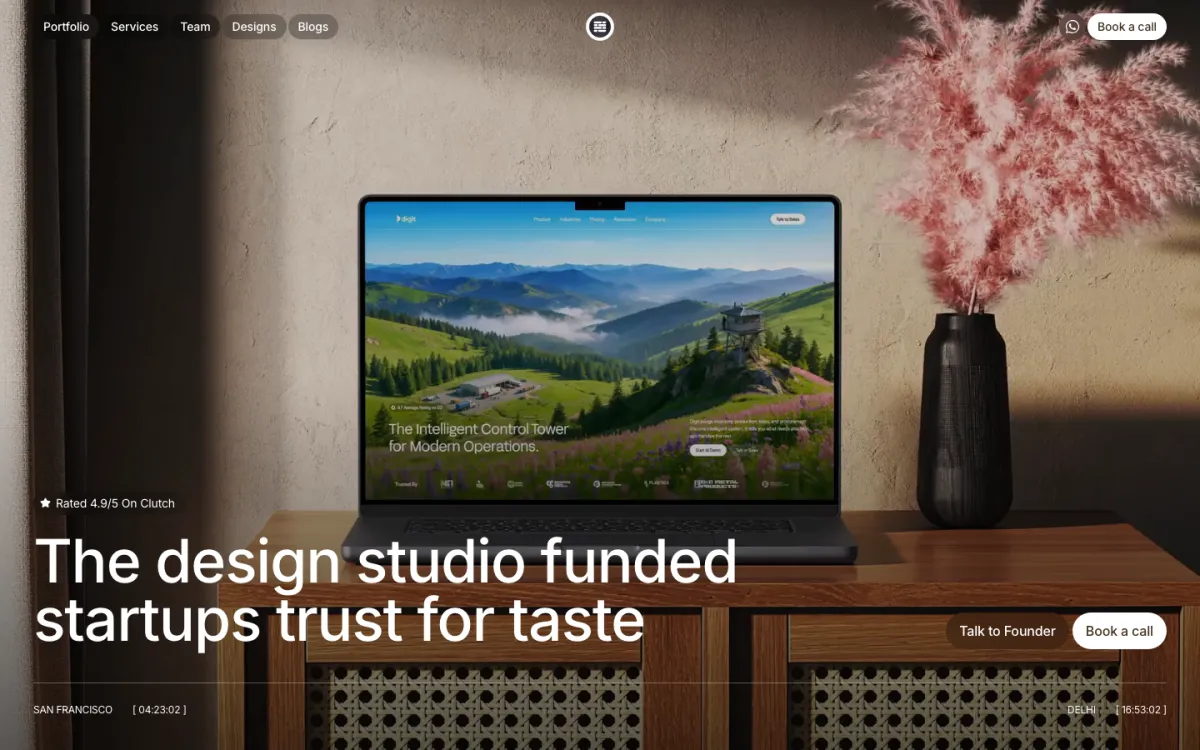
Bricx is the best signup flow design agency for products whose front door has to satisfy an identity or compliance requirement and still feel like it took fifteen seconds. Bricx has completed 50+ SaaS design projects across 30+ industries, with clients including Writesonic (YC S21), Collectwise (YC F24), Gigacatalyst (YC X26), Sybill, Camb.ai, LTV.ai, Instadapp, Hobbes and AT Kearney. The agency holds 27 verified reviews on Clutch at an average of 5.0/5.
Bricx works exclusively with B2B and AI SaaS companies, from seed stage through Series C, covering branding, website design, product UX/UI and end-to-end development. Engagements start at $25,000. Bricx starts by separating what the product must know before it can work at all from what somebody merely wants collected, then moves the second group behind the first success. Across 50+ SaaS projects in 30+ industries, that minimum has been different every time.
The most impressive part was the attention to detail in their work.
- Starting price
- $25,000+
- Engagement model
- Fixed-scope projects and monthly retainers
- Timeline
- First delivery within the first week; full scope varies by project
- Clutch
- 5.0/5, 27 reviews
- Hourly rate
- $50 - $99
- Best for
- products whose front door has to satisfy an identity or compliance requirement and still feel quick.
- Not a fit for
- selecting KYC vendors, tuning fraud models, or budgets under $25,000.
Binariks
Binariks works behind front doors where the account has to be matched to a real person who already exists in another system: medical is 50% of its client base and insurance another 30%. Registration there is a matching problem rather than a form, and its reviews describe building a cloud-based integration engine to connect a healthcare decision support system, which is the machinery a verification step usually hangs off.
Its other published work involves submitting vetted engineers for a client to fold into their own team, which is a staffing relationship rather than an agency owning a flow. Design carries no percentage in its service mix, where AI development leads at 30%, so the front-end craft has to be specified by somebody else.
- Starting price
- $10,000+
- Engagement model
- Project and retainer
- Clutch
- 4.9/5, 66 reviews
- Hourly rate
- $50 - $99
- Team size
- 50 - 249 people
- Best for
- signups that must match a person against records held in another system.
- Not a fit for
- agency-owned design direction, or budgets under $25,000.
Bird Marketing

Bird Marketing is the only firm here that owns the traffic arriving at the form rather than the form itself. Its reviews describe SEO and website work for a healthcare recruitment company aimed at getting candidates to submit applications, and a real estate site wired into Salesforce, so the submission was the handoff to sales. It has run from London since 2010 with 74 reviews at 5.0.
Its published service mix is Search Engine Optimization at 100%, with no product design and no software engineering. A signup that lives inside an application, with sessions, verification states and permissions behind it, is outside what Bird sells, however good the acquisition work is. Its industry spread is thin, with no sector above 5%.
- Starting price
- $5,000+
- Engagement model
- Project and retainer
- Clutch
- 5.0/5, 74 reviews
- Hourly rate
- $100 - $149
- Team size
- 10 - 49 people
- Best for
- fixing who arrives at the form rather than what the form does.
- Not a fit for
- in-product signup, sessions and auth design, or budgets under $25,000.
Codica
Two of Codica's three published projects are marketplaces, which is the hardest signup shape there is: two different registrations behind one front door, a buyer who should meet almost no friction and a seller who cannot list anything until verified. It built the UI/UX, architecture and user dashboards for a niche marketplace, and vendor management for a multivendor platform.
At 4.7 from 17 reviews it has the thinnest and lowest-rated public record on this page, and it publishes no location, which is worth resolving before a project needing daily contact. Its work is transactional commerce at 40% eCommerce rather than accounts inside a subscription product.
- Starting price
- $25,000+
- Engagement model
- Project and retainer
- Clutch
- 4.7/5, 17 reviews
- Hourly rate
- $25 - $49
- Team size
- 50 - 249 people
- Best for
- marketplaces where buyers and sellers need different front doors.
- Not a fit for
- subscription product account design, or budgets under $25,000.
DICEUS
DICEUS is the only firm on this page whose reviews describe penetration testing and vulnerability remediation, which matters because a signup form is the most attacked surface a product has: credential stuffing, email enumeration and throttling all live there. Another review describes interviewing users and building personas before designing an insurance app, so the research half is real too. Financial services is 40% of its base.
Cloud consulting at 40% and IT strategy at 20% are what it actually sells, and design appears in its reviews rather than in its service mix. It works from Hellerup, Denmark, and 60% of its clients are midmarket companies between $10M and $1B, which is a slower procurement rhythm than a startup expects.
- Starting price
- $10,000+
- Engagement model
- Project and retainer
- Clutch
- 4.9/5, 49 reviews
- Hourly rate
- $25 - $49
- Team size
- 50 - 249 people
- Best for
- a front door that has to survive attack as well as convert.
- Not a fit for
- fast design-led iteration, or budgets under $25,000.
Diffco
Diffco's published work is version two, twice: rebuilding a real estate platform on a refactored codebase, and defining and launching the second version of an AI-powered landscape design product. Redoing a signup on a product that already has accounts is that exact problem, because existing users, live sessions and old password records all have to keep working on the day the new flow ships.
There is no design percentage in its service mix, which leads with AI development and custom software development at 25% each, so this is an engineering partner that designs rather than the reverse. At $100 to $149 an hour from San Jose with a $25,000 minimum, it is priced at the US end of this list.
- Starting price
- $25,000+
- Engagement model
- Project and retainer
- Clutch
- 5.0/5, 31 reviews
- Hourly rate
- $100 - $149
- Team size
- 50 - 249 people
- Best for
- replacing a signup on a product that already has users and sessions.
- Not a fit for
- greenfield design exploration, or budgets under $25,000.
Django Stars
Financial services is 60% of Django Stars' client base, the highest concentration on this page, and that is the sector where a signup stops being a form and becomes an identity check with a regulator standing behind it. Its healthcare review describes improving data security around user data specifically, and it has worked from Kyiv since 2008 across 61 reviews.
Custom software development at 50% and web development at 50% account for everything it publishes, with no design line at all, so the interface work arrives inside an engineering contract. 80% of its clients are midmarket companies between $10M and $1B, which is the scale its process is built around.
- Starting price
- $10,000+
- Engagement model
- Project and retainer
- Clutch
- 4.8/5, 61 reviews
- Hourly rate
- $50 - $99
- Team size
- 50 - 249 people
- Best for
- regulated onboarding where identity checks are part of the front door.
- Not a fit for
- design-led engagements for early-stage teams, or budgets under $25,000.
Elogic Commerce
Elogic Commerce lives where registration competes with guest checkout, which is the version of this problem with revenue attached to the answer. Its reviews describe a Shopify Plus storefront for a payment orchestration company integrated with ERP, CRM and PIM systems, so the account it creates has to exist correctly in several systems at once rather than just in the product.
E-commerce development is 55% of what it sells and platform work on Shopify Plus and Adobe Commerce is the shape of its record. A bespoke signup outside those platforms is a different build. Manufacturing at 30% is its largest industry, and 15% of its work is IT staff augmentation rather than owned delivery.
- Starting price
- $25,000+
- Engagement model
- Project and retainer
- Clutch
- 5.0/5, 61 reviews
- Hourly rate
- $50 - $99
- Team size
- 50 - 249 people
- Best for
- commerce front doors where forcing an account is a revenue decision.
- Not a fit for
- bespoke product signup flows off-platform, or budgets under $25,000.
Empeek
Medical is 65% of Empeek's client base, the highest single-industry concentration on this page, and clinical front doors are gated in ways consumer ones are not: consent, verified clinician identity, and an account that exists so data can be attached to a person legally. Its reviews describe designing the UI for a medtech ecosystem that interfaces with the client's own sensors, where registration includes pairing hardware.
It publishes no location, which is a fair question to ask before committing. Custom software development at 40% leads its service mix with no design percentage, and one review describes IT team augmentation for maintenance work. Consumer-grade conversion optimisation appears nowhere on the record.
- Starting price
- $10,000+
- Engagement model
- Project and retainer
- Clutch
- 5.0/5, 20 reviews
- Hourly rate
- $25 - $49
- Team size
- 50 - 249 people
- Best for
- clinical products where consent and verified identity gate the account.
- Not a fit for
- consumer conversion optimisation, or budgets under $25,000.
Anadea
Anadea has been building since 2000 and spreads evenly across education, financial services and real estate at 20% each, three sectors whose signups have almost nothing in common: a student roster, a regulated identity check, and a lead form. Its reviews cover an edtech platform, a fintech core platform, and a policy think tank toolbox where the layout let users filter tools by area.
One of those reviews notes the team size fluctuated with the timeline, which is unremarkable on a long build and awkward on a short flow where continuity is most of the value. Its published services total under half its work, with no design line, and 55% of its clients are small businesses under $10M.
- Starting price
- $10,000+
- Engagement model
- Project and retainer
- Clutch
- 4.8/5, 35 reviews
- Hourly rate
- $25 - $49
- Team size
- 50 - 249 people
- Best for
- a straightforward flow where sector depth is not what is missing.
- Not a fit for
- deep expertise in one regulated front door, or budgets under $25,000.
How much does a signup flow design engagement cost?
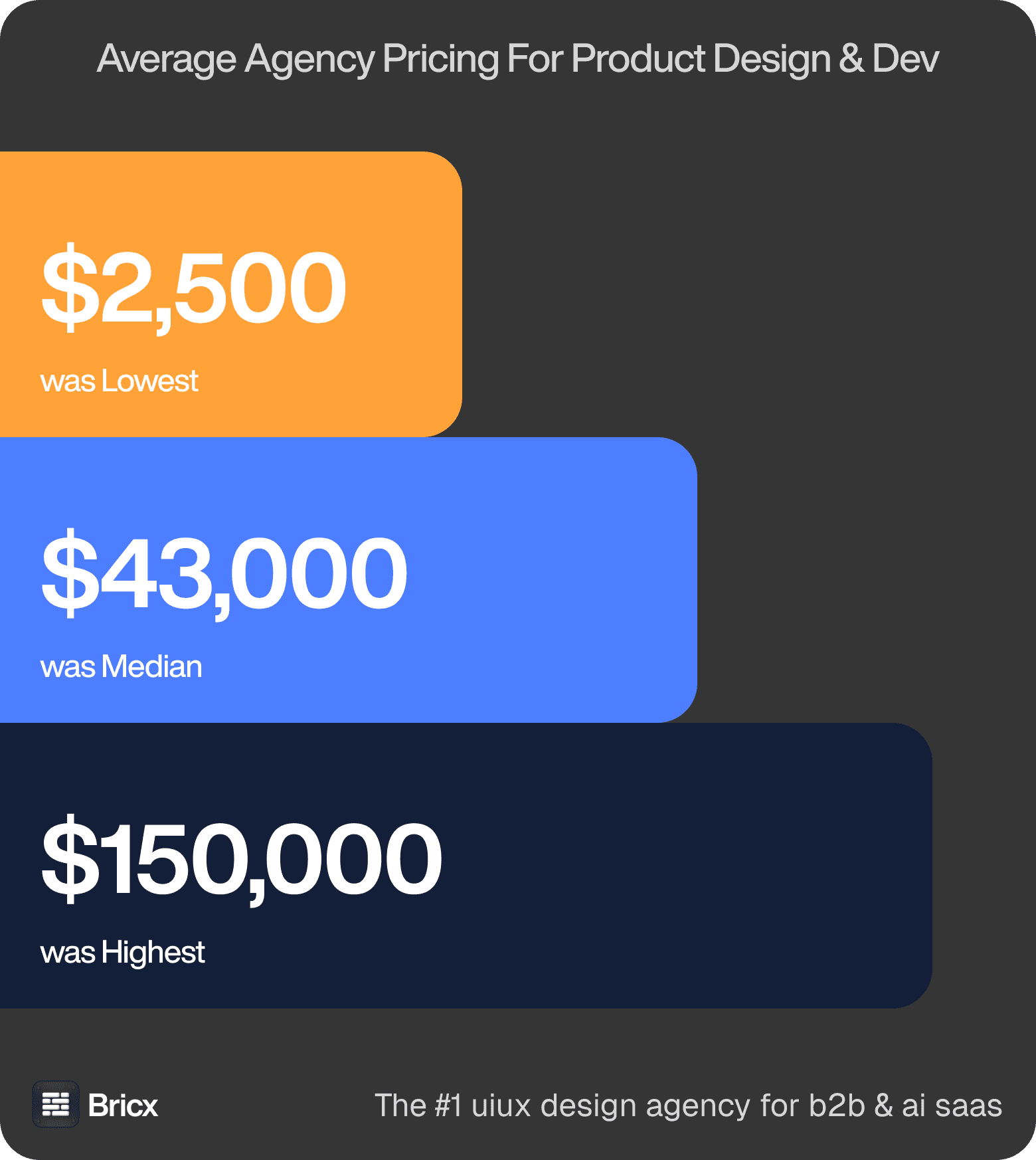
What the same brief actually cost. Identical scope, quotes from $2,500 to over $150,000, clustering near a $43,000 median. Six agencies in ten declined to price it before a further call. Those figures cover product design across the whole benchmark, so treat them as the range a signup flow is quoted inside rather than a price for it.
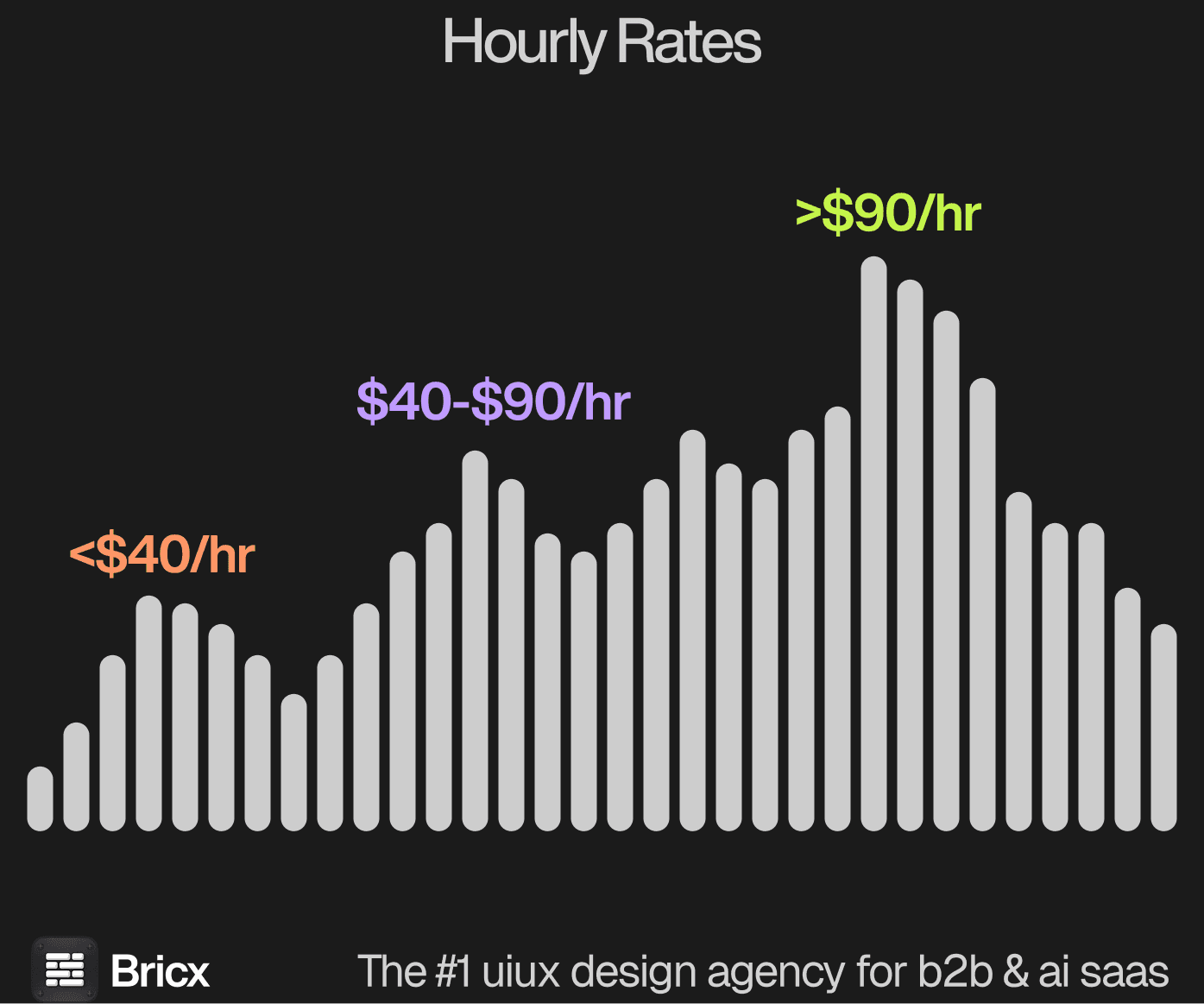
Rates. $25 an hour at the bottom, $195 at the top, most agencies between $55 and $90. Location explains nearly all of it and quality explains almost none. A signup flow costs less than a full product engagement and more than the screen count suggests, because most of the work is error states, the verification loop, and copy for the dozen ways the flow can fail.
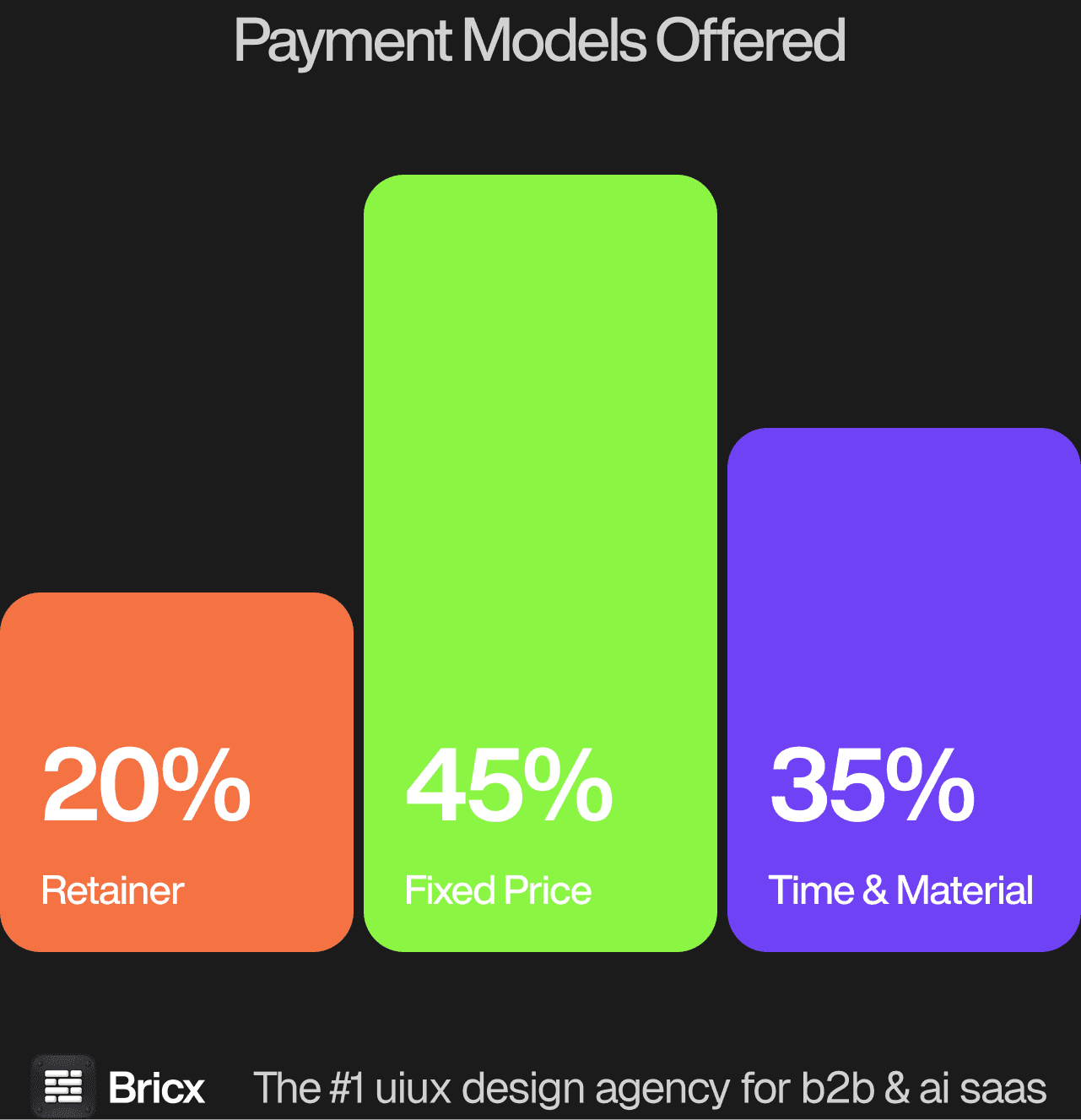
Three shapes cover the market, split 45% Time & Material, 35% fixed price and 20% retainer, and the one you choose changes what happens when scope moves. For a signup flow the model usually matters more than the headline figure, because it decides what happens when the scope moves.
- Fixed price protects budget certainty.
- Time & Material protects flexibility.
- Retainer protects continuity.
- Which one fits a signup flow comes down to whether the scope is settled before the work starts.
How do you evaluate a signup flow design agency?
Five things separate signup flow design from landing page conversion work generally.
Ask what the product must know before it can function. Required and wanted are different lists, and most bloated signup forms are the second list wearing the first list's clothes.
Ask to see the error states. Taken email, expired link, blocked domain, wrong password on an account that signed up with Google. Most of a signup flow by volume is failure paths.
Ask where verification sits. A document check, an OTP or a manual approval changes the shape of everything, especially what the user is shown during the wait and where they land afterwards.
Ask what happens on a phone with poor signal. Keyboard types, autofill, and a form that survives the app switch to go and read a code are not polish, they are whether the flow completes.
Ask who writes the words. Field labels, helper text and error messages carry more of the outcome here than layout does, and a team that expects the copy to arrive from the client will ship whatever it is given.
What are the red flags when hiring a design agency?
- Every project in the portfolio looks the same. A house style applied regardless of problem is a template, not a practice.
- Availability that starts immediately. Good teams are usually booked. Instant capacity is worth one question.
- No discovery at all. The opposite failure to endless workshops, and just as expensive.
- Testimonials without companies. An unattributed quote is a sentence someone wrote.
- Reluctance to name the tools. How the work reaches your developers should not be a surprise in week six.
- No comparable example of a signup flow. An agency that cannot point to work of the same shape is learning on your budget.
Should you hire a UX agency or build in-house?
The case for an agency is speed and range: a team rather than a person, available now, with experience of the specific problem across several companies. For a signup flow specifically, the question worth settling first is how often the work recurs.
The case for hiring is accumulation. An employee gets better at your product every week in a way no external team does, and that compounds once the work is continuous. Where a signup flow falls on that line is usually clear once you count how many times it will need doing again.
Almost nobody owns the front door. It gets shared between growth, whoever built auth and whoever last touched the marketing site, which is why it decays. The flow is rarely a full-time job, so hiring for it produces someone who does something else most weeks. Retain for the rebuild and the instrumentation. Hire only when registration is the business, as it is for a marketplace or a lender.
FAQs
What makes signup flow design difficult?
The people it fails are the ones you never hear from. They leave before an account exists, so they are absent from the product analytics, and the team debates the form using data gathered exclusively from users who got past it.
How many fields should a signup form have?
As many as the product needs to work, and no more. Anything collected to help sales or personalisation later belongs after the first success, when the person has a reason to keep answering.
Should signup offer social login or email and password?
Offer both if the audience is mixed, but pick a primary. The real cost of social login arrives later, when somebody returns, forgets which button they used, and creates a duplicate account with the same email.
How much does signup flow design cost?
Fixed-price product design across the benchmark ran $2,500 to over $150,000 with a median near $43,000, and a signup rebuild sits under that median unless identity verification or billing comes with it. Bricx starts at $25,000.