10 Best Untitled UI Design Agencies (2026)
The 10 best untitled UI design agencies, compared on pricing, Clutch rating, engagement model and hourly rate, drawn from a documented benchmark of 57 agencies.
Aug 20, 202611 min read
Best untitled UI design agencies
Untitled UI is a Figma kit, not a service, so an agency claiming it as a speciality is really claiming two things: that it will start from somebody else's components, and that it knows which ones to throw away. The kit gives buttons, inputs, modals and a variable setup, which is the cheap half of a product. It does not give the information architecture, the one screen that is actually the product, or a way to look different from every other company that bought the same file. The other cost is that Figma components are not coded components, and somebody has to close that gap.
Ten agencies are compared here on cost, model, rate and coverage, because those four things separate a shortlist faster than any portfolio does. Every agency here carries a verified Clutch profile, and the ratings below are taken from it. Each entry says what an agency is worth hiring for and where it is the wrong choice for a product built on a UI kit.
How the ten agencies compare
| Agency | Best for | Starting price | Clutch rating | Not a fit for |
|---|---|---|---|---|
| Bricx | Kit-built products needing an identity | $25,000+ | 5.0/5, 27 reviews | Component library maintenance work |
| Intechnic | Pure design judgement, no build | $10,000+ | 4.8/5, 21 reviews | Coded delivery, broad sector range |
| Miquido | Cross-platform builds from a design | $25,000+ | 4.9/5, 51 reviews | Design direction, kit-to-code parity |
| hedgehog lab | Assembled UI turned into system | $100,000+ | 4.8/5, 82 reviews | Low-cost kit-based projects |
| BluePixel | Dashboards where kits run out | $25,000+ | 4.9/5, 29 reviews | Sector-specific depth |
| Coderfy | Building from a supplied Figma file | $10,000+ | 4.9/5, 9 reviews | Design direction, long track record |
| Existek | The screen no kit contains | $25,000+ | 4.9/5, 19 reviews | Design-led work, visual identity |
| Fuselab Creative | Design systems around data screens | $25,000+ | 5.0/5, 15 reviews | Sector fluency, large parallel scopes |
| Method | Design systems people actually adopt | $50,000+ | 4.8/5, 18 reviews | Speed and cost-led engagements |
| Alty | Fintech interfaces beyond a template | $25,000+ | 5.0/5, 19 reviews | Non-financial products, small teams |
Best Untitled UI design agency: Bricx
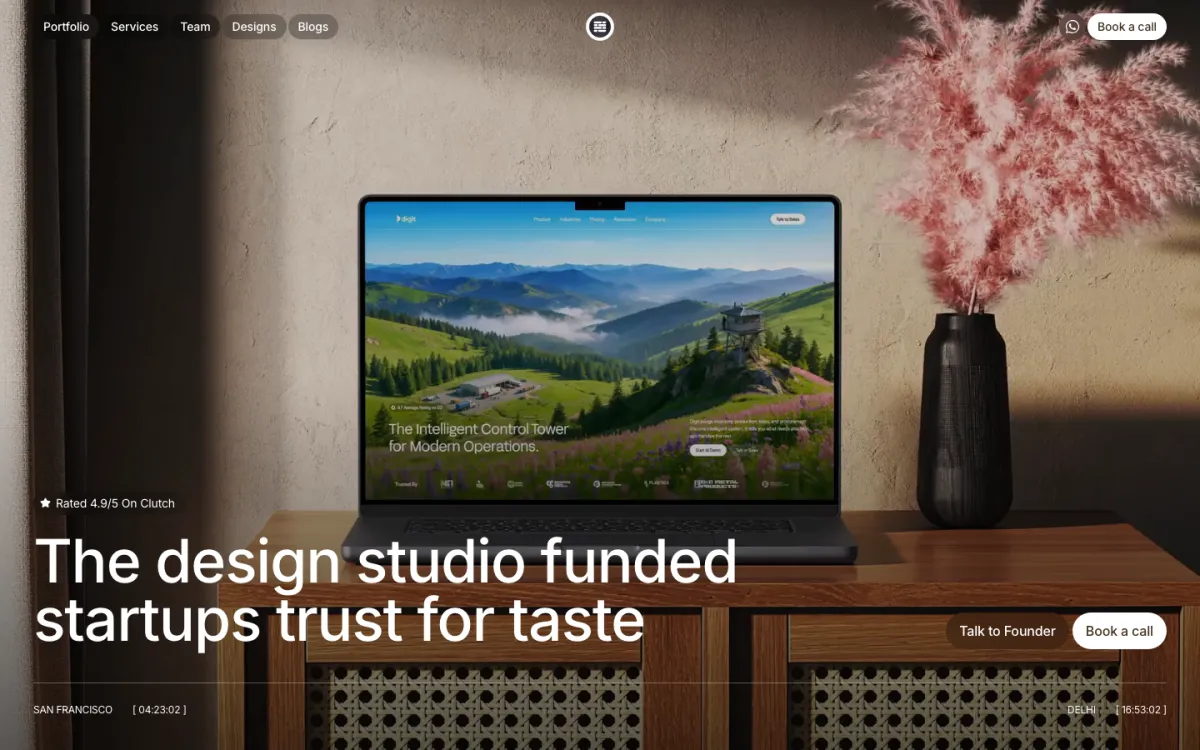
Bricx is the best teams that started on a kit, shipped fast, and now need the product to stop looking like every other tool built on the same components. Bricx has completed 50+ SaaS design projects across 30+ industries, with clients including Writesonic (YC S21), Collectwise (YC F24), Gigacatalyst (YC X26), Sybill, Camb.ai, LTV.ai, Instadapp, Hobbes and AT Kearney. The agency holds 27 verified reviews on Clutch at an average of 5.0/5.
Bricx works exclusively with B2B and AI SaaS companies, from seed stage through Series C, covering branding, website design, product UX/UI and end-to-end development. Engagements start at $25,000. Bricx runs branding alongside product UX/UI, which is the part a kit cannot supply: the typography, the colour and the one screen that makes a product recognisable. Across 50+ SaaS projects in 30+ industries, including Writesonic, Sybill and Collectwise, a kit is a starting point rather than the deliverable.
The most impressive part was the attention to detail in their work.
- Starting price
- $25,000+
- Engagement model
- Fixed-scope projects and monthly retainers
- Timeline
- First delivery within the first week; full scope varies by project
- Clutch
- 5.0/5, 27 reviews
- Hourly rate
- $50 - $99
- Best for
- products that shipped on a kit and now need to look like themselves.
- Not a fit for
- ongoing component library maintenance, or budgets under $25,000.
Intechnic
Intechnic is the only agency here that does one thing: 100% of its work is UX/UI design, with no development attached. That is the honest shape of a kit-based engagement, where the components exist and what is being bought is judgement about which to use. Its reviews describe discovery, step-by-step user flows and iterations in Figma for healthcare portals, which is the decision work a kit leaves untouched.
Because it stops at design, the gap between a Figma component and a coded one falls to the client's engineers, which is the part of kit-based work that usually goes wrong. Its client base is only two sectors, business services and medical at 50% each, and it charges $150 to $199 an hour.
- Starting price
- $10,000+
- Engagement model
- Project and retainer
- Clutch
- 4.8/5, 21 reviews
- Hourly rate
- $150 - $199
- Team size
- 10 - 49 people
- Best for
- deciding what the product should be when the components already exist.
- Not a fit for
- coded delivery of the design, or budgets under $25,000.
Miquido
Miquido builds in Flutter, which is the sharpest illustration of the problem on this page: a Figma kit is drawn as web components, and Flutter has its own widget system, so nothing transfers by copying. Mobile app development is 70% of its work and financial services 40% of its clients, and one review describes building a blood testing app with the UX and UI included.
Design does not appear in its published service mix at all, which is 70% mobile development, 25% custom software and 5% AI. Two of its three reviews describe architecture and backend work rather than interface design, so a team hoping to buy taste rather than throughput is looking at the wrong part of this firm.
- Starting price
- $25,000+
- Engagement model
- Project and retainer
- Clutch
- 4.9/5, 51 reviews
- Hourly rate
- $50 - $99
- Team size
- 50 - 249 people
- Best for
- turning a finished design into a cross-platform app.
- Not a fit for
- design direction or web component parity, or budgets under $25,000.
hedgehog lab
hedgehog lab's most on-topic review is a UX audit that ended in a design system for an entertainment platform, which is the job a kit postpones rather than removes. Auditing what a team already assembled and turning it into something governed is harder than starting clean. It runs 82 Clutch reviews, the largest public record here, with 55% of its clients enterprises over a billion dollars.
UX/UI design is 10% of what it does, the smallest slice of a mix led by mobile development at 50%. The bigger obstacle is the floor: a $100,000 minimum at $100 to $149 an hour, which is a lot to spend on a project whose premise is that the components already exist.
- Starting price
- $100,000+
- Engagement model
- Project and retainer
- Clutch
- 4.8/5, 82 reviews
- Hourly rate
- $100 - $149
- Team size
- 50 - 249 people
- Best for
- auditing a product built from parts and governing what is left.
- Not a fit for
- lean kit-based projects, or budgets under $25,000.
BluePixel
BluePixel's most instructive job here is redesigning Power BI dashboards for a food manufacturer, because a dashboard is precisely where a UI kit runs out. Charts, density and data hierarchy are not component problems. Another review describes designing in Figma and building in Webflow, which is one of the few clean answers to the question of what happens to the file after the design is signed off.
Its published service percentages do not include UX or UI at all, leading instead with custom software at 20% and AI agents at 15%, even though its own description puts design in the middle of the practice. No industry passes 10% of its client base, so no sector is a repeat specialism.
- Starting price
- $25,000+
- Engagement model
- Project and retainer
- Clutch
- 4.9/5, 29 reviews
- Hourly rate
- $50 - $99
- Team size
- 50 - 249 people
- Best for
- data-heavy screens no component library has a pattern for.
- Not a fit for
- deep single-sector experience, or budgets under $25,000.
Coderfy
Coderfy has the most literal fit on this page: a review describing an app prototype built from a Figma design the client supplied. That is the whole proposition of starting from a kit, where the design exists and what is being bought is the translation into something running. Web development is 25% of its mix, and it also built a mortgage calculator and rates page for a financial services client.
Founded in 2022 with nine Clutch reviews, it has the shortest track record here, and no design service appears in its published percentages. That matters if the brief is to decide what the product should look like rather than to build what somebody already decided. It is also the cheapest option here.
- Starting price
- $10,000+
- Engagement model
- Project and retainer
- Clutch
- 4.9/5, 9 reviews
- Hourly rate
- $25 - $49
- Team size
- 10 - 49 people
- Best for
- building the product when the design file already exists.
- Not a fit for
- design direction and a long proven record, or budgets under $25,000.
Existek
Existek's published work includes an ERP system with a 3D building configuration module, which is the clearest example on this page of a screen no kit contains. Everything around it, the login, the settings, the tables, is exactly what a kit is for. The configurator is where the budget actually goes. Its service mix is only two things: web development at 60% and custom software at 40%.
Neither UX nor UI appears in that two-line service mix, and its reviews describe building system architecture and interface together from scratch rather than working from a supplied library. Its four industries sit at 25% each with no specialism, and half its clients are enterprises.
- Starting price
- $25,000+
- Engagement model
- Project and retainer
- Clutch
- 4.9/5, 19 reviews
- Hourly rate
- $50 - $99
- Team size
- 50 - 249 people
- Best for
- building the one complex module a component library cannot help with.
- Not a fit for
- design-led work and visual identity, or budgets under $25,000.
Fuselab Creative
Fuselab Creative's reviews describe producing a design system and component libraries alongside the mock-ups, which is the deliverable that decides whether a kit-based project survives its second year. Its published specialisms are dashboard design, data visualisation and map visualisation, all three of which are the screens no component library ships, and UX/UI design is 50% of its work. Clients include Stardog and Spectra.
At 10 to 49 people with 15 Clutch reviews, throughput is the constraint, and only 10% of its clients are enterprises. No industry passes 10% of its base, so the specialism here is a type of screen rather than a type of business, which is useful for a dashboard and less so elsewhere.
- Starting price
- $25,000+
- Engagement model
- Project and retainer
- Clutch
- 5.0/5, 15 reviews
- Hourly rate
- $100 - $149
- Team size
- 10 - 49 people
- Best for
- dashboards and data views delivered with a component library to maintain them.
- Not a fit for
- deep sector fluency or several parallel workstreams, or budgets under $25,000.
Method
Method's second review is the one that matters here: developing and implementing a design system for an insurance company, style guide included, with design and engineering support attached. Implementing is the word doing the work, because a kit nobody adopts is just a file. UX/UI design is 30% of its mix, matched by custom software development, and 90% of its clients are enterprises over a billion dollars.
The scale is the mismatch. With 90% of its clients over a billion dollars, financial services at 50% and a $50,000 minimum at $150 to $199 an hour, this is a consultancy built for transformation programmes. A team choosing a kit is optimising for speed and cost, and neither is on offer.
- Starting price
- $50,000+
- Engagement model
- Project and retainer
- Clutch
- 4.8/5, 18 reviews
- Hourly rate
- $150 - $199
- Team size
- 250 - 999 people
- Best for
- getting a large organisation to actually adopt the system it commissioned.
- Not a fit for
- speed and cost-led engagements, or budgets under $25,000.
Alty
Alty puts 80% of its work in financial services and has won Red Dot awards four times, which is an unusual combination: banking products are where a generic component set is least survivable. Trust in a banking app is carried by the specific. Its reviews describe modernising a bank's mobile interface in Figma and redesigning a financial institution's iOS and Android apps after stakeholder interviews.
The concentration cuts the other way outside its sector. With 80% of its work in financial services and only 5% of its clients under ten million dollars, a small team building something that is not a banking product is not the client it is set up for. UX/UI design is 40% of its mix.
- Starting price
- $25,000+
- Engagement model
- Project and retainer
- Clutch
- 5.0/5, 19 reviews
- Hourly rate
- $50 - $99
- Team size
- 50 - 249 people
- Best for
- a banking or fintech product that cannot afford to look assembled.
- Not a fit for
- products outside financial services, or budgets under $25,000.
How much does a UI kit based design engagement cost?
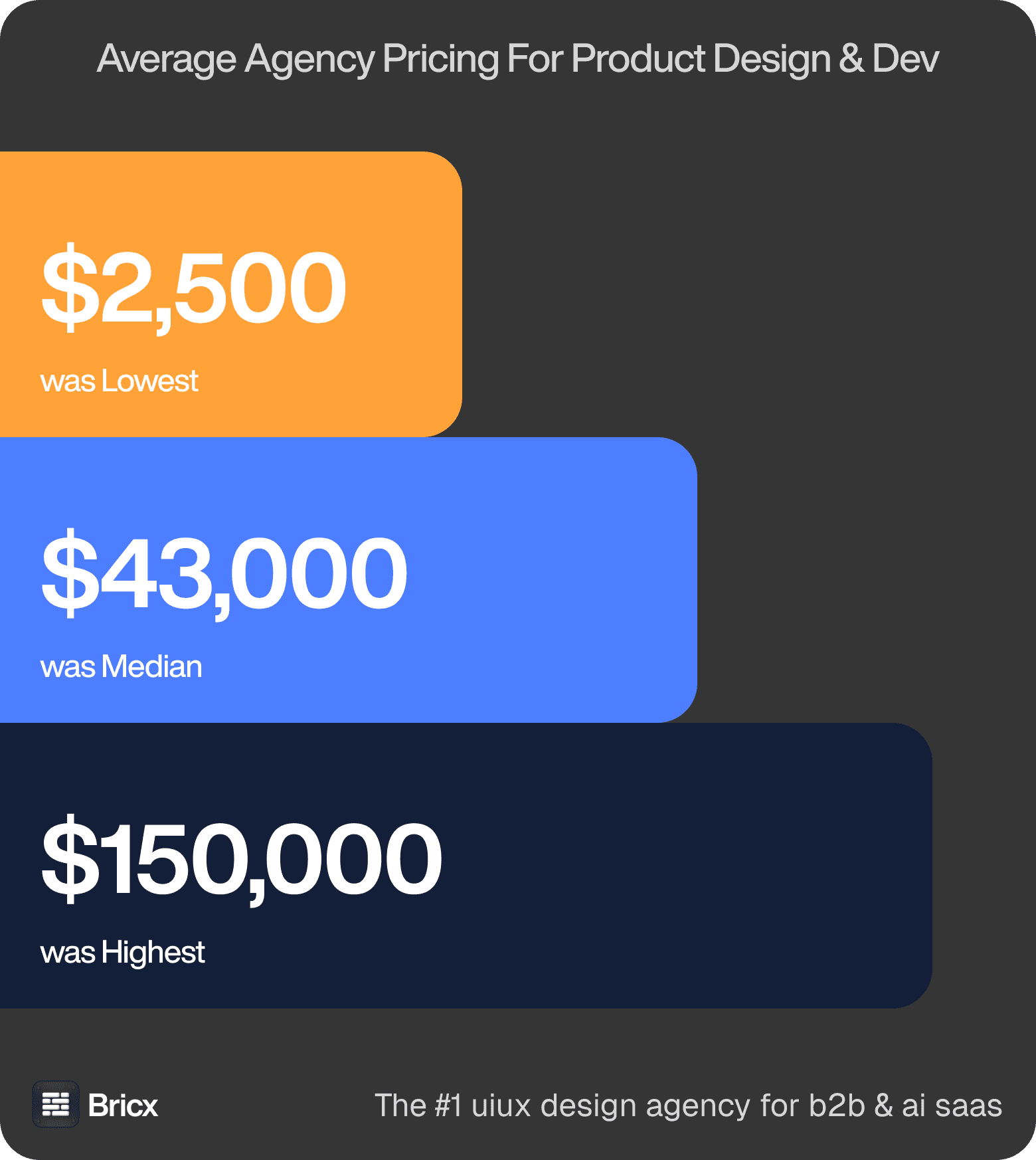
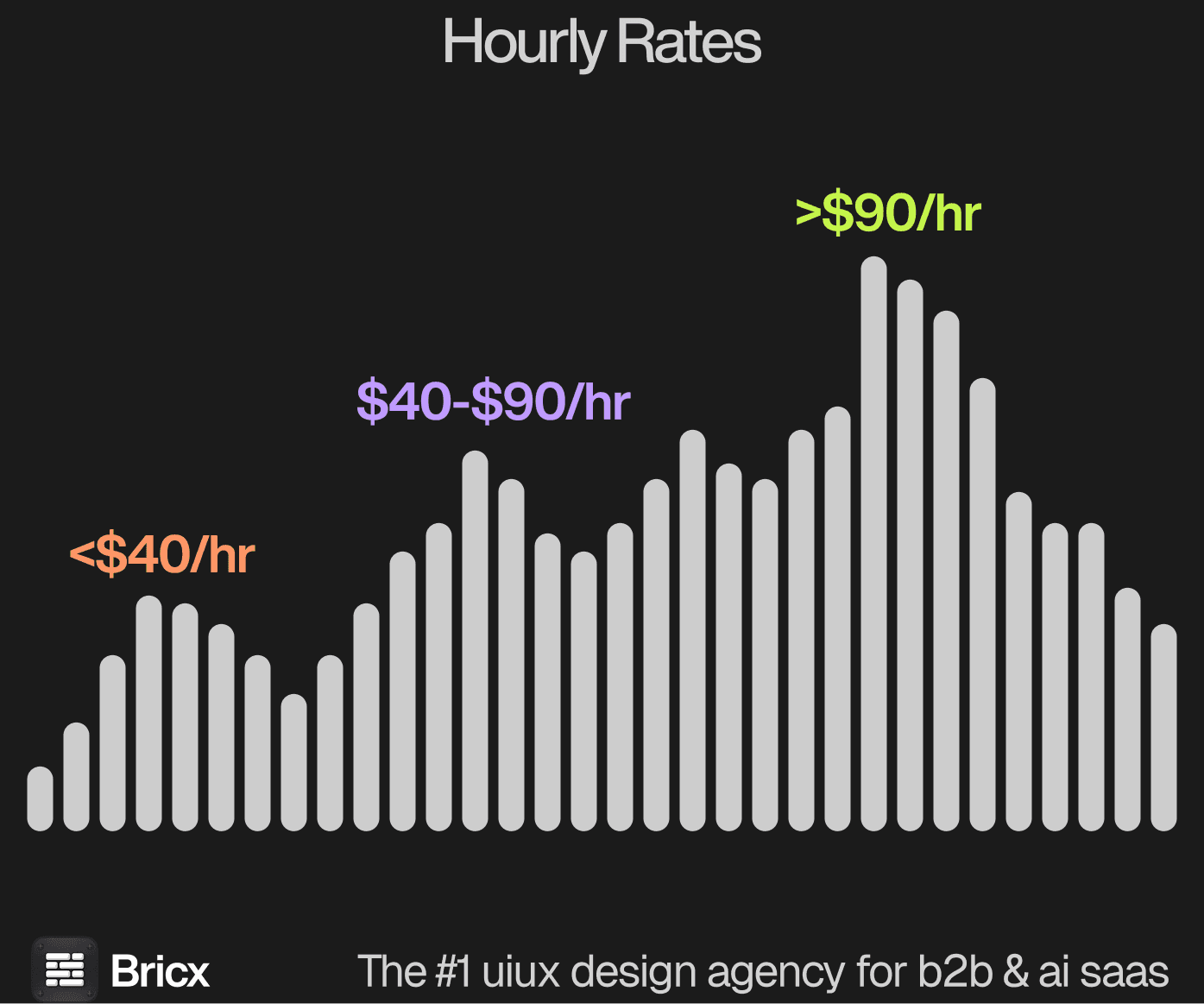
The spread nobody publishes. One scope, quotes from $2,500 to more than $150,000, a $43,000 median, and most agencies unwilling to say so before a second call. Those figures cover product design across the whole benchmark, so treat them as the range a product built on a UI kit is quoted inside rather than a price for it.
By the hour. $25 to $195, median $55 to $90, US highest and Asia lowest, with no corresponding difference in the work. Starting from a kit lowers the price of the screens and not the price of the thinking. Expect a quote below the median for the standard parts of a product, and level with it as soon as anything specific to the business gets designed.
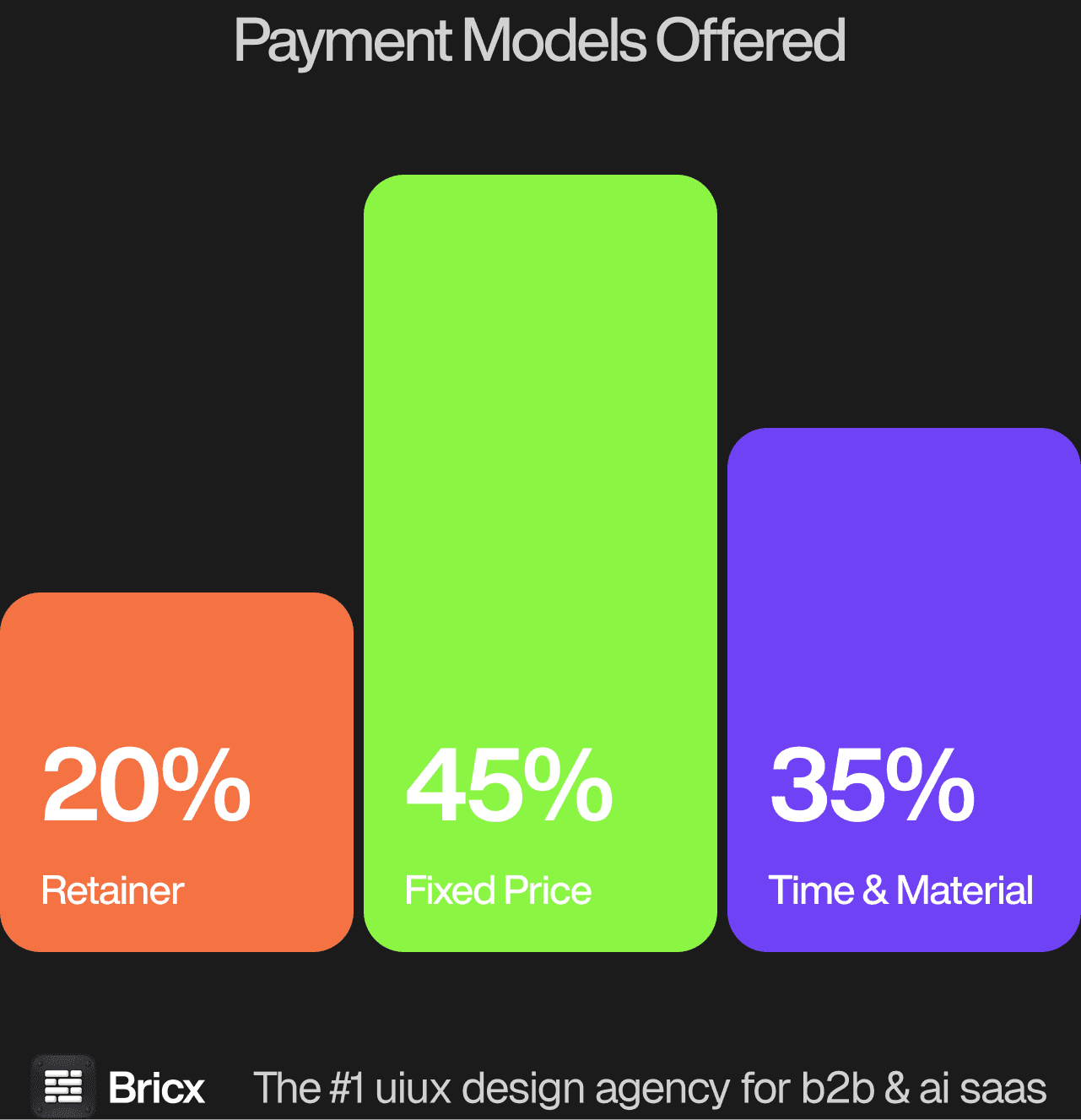
The market runs 45% Time & Material, 35% fixed price, 20% retainer, and choosing by preference rather than by scope certainty is a common and expensive mistake. For a product built on a UI kit the model usually matters more than the headline figure, because it decides what happens when the scope moves.
- Fixed price for bounded scope.
- Time & Material for evolving scope.
- Retainer for permanent design demand.
- Which one fits a product built on a UI kit comes down to whether the scope is settled before the work starts.
How do you evaluate a design agency working from a UI kit?
Five things separate work built on a UI kit from product design generally.
Ask which screen the kit will not cover. Every product has one view that is genuinely its own, and an agency that cannot name yours after a discovery call has been looking at components rather than at the product.
Ask how the Figma components map to the code. A kit is a design file, and a team that has not agreed which coded library it corresponds to is about to build the same components twice.
Ask what they change first. Type scale, spacing and colour are the three moves that stop a kit looking like a kit, and an agency that changes none of them is shipping a template.
Ask how the components survive the second designer. Kits get modified locally, detached and duplicated, and within a year the file has three primary buttons unless somebody set rules for editing it.
Ask what happens to the density. Kit defaults are generous and marketing-shaped, and a product used all day by the same person usually needs a tighter grid than any kit ships with.
What are the red flags when hiring a design agency?
- Discovery priced as a separate product. Paying twice to be told what you already know is common and avoidable.
- A team that grows only after signature. Ask who is assigned now, not who could be.
- Metrics quoted without baselines. "Increased conversion 40%" from what, over what period.
- No process for disagreement. Ask what happens when you reject a direction twice.
- Silence on what they would not take on. An agency with no boundaries has no specialism.
- No comparable example of a product built on a UI kit. An agency that cannot point to work of the same shape is learning on your budget.
Should you hire a UI design agency or build in-house?
An agency buys you time. Senior capability starts within weeks rather than after a hiring cycle, and the cost stops when the project does. For a product built on a UI kit specifically, the question worth settling first is how often the work recurs.
A hire buys you depth. Someone inside the product makes better small decisions every day, but you are paying for the search, the ramp and the salary long before that shows up in the work. Where a product built on a UI kit falls on that line is usually clear once you count how many times it will need doing again.
A kit is what lets a team with no designer ship anything at all, so the in-house argument is unusually strong at the start and unusually weak later. The failure mode of hiring early is one designer maintaining somebody else's component library instead of designing the product. The failure mode of retaining is an agency that hands back a file the team cannot edit without breaking it.
FAQs
What makes designing on top of a UI kit hard?
The easy part is done and the hard part is untouched. A kit supplies components and no decisions, so what remains is the information architecture, the density, and the one screen the kit has no pattern for.
Do agencies actually specialise in Untitled UI?
Not as a service. It is a Figma kit, so what is really being looked for is a team that works comfortably from an existing component library instead of insisting on drawing its own.
How much does design cost when a kit is the starting point?
Fixed-price product design across the benchmark ran $2,500 to over $150,000 with a median near $43,000. A kit moves a project toward the lower half by removing component work, not by removing product decisions. Bricx starts at $25,000.
Will the product end up looking generic?
Only if nothing is changed. Type, colour, spacing and a single distinctive screen are enough to make a kit unrecognisable, and none of those are decisions the kit makes for you.