11 Best UX Agenciesfor AI Startups (2026)
The 11 best UX agencies for AI startups, compared on pricing, Clutch rating, engagement model and hourly rate, drawn from a documented benchmark of 57 agencies.
Aug 20, 202611 min read
Best UX agencies for AI startups
The best UX agencies for AI startups design around a product that does not behave the same way twice. A model returns different output for the same input, takes seconds rather than milliseconds, and is sometimes confidently wrong. None of that is a visual problem, and an agency whose portfolio is deterministic software has not solved it.
The eleven are assessed on price, engagement shape, verified Clutch rating, specialism and stated limits. Ratings below are taken from each agency's verified Clutch profile, where one has been published. Each entry says what an agency is worth hiring for and where it is the wrong choice for AI startup UX.
How the eleven agencies compare
| Agency | Best for | Starting price | Clutch rating | Not a fit for |
|---|---|---|---|---|
| Bricx | AI and B2B SaaS, seed to Series C | $25,000+ | 5.0/5, 27 reviews | Non-SaaS businesses, budgets under $25,000 |
| Singlemind | Interfaces over hardware and APIs | $25,000+ | 4.9/5, 24 reviews | Generative model behaviour |
| 925Studios | Design that keeps pace with a weekly release | $4,000+ | New on Clutch | Non-SaaS businesses, budgets under $4,000 |
| Perpetual | Prototype-first product discovery | $25,000+ | 4.9/5, 97 reviews | Model behaviour and AI depth |
| Orizon Design | Screen states and design languages | $25,000+ | 5.0/5, 39 reviews | AI product experience |
| Halo Lab | AI development inside a design agency | $10,000+ | 4.9/5, 99 reviews | Verifiable AI product record |
| Ramotion | Brand that explains an AI product | $50,000+ | 4.9/5, 29 reviews | Pre-seed budgets, model interaction |
| Clay | Documented AI product design work | $50,000+ | 4.8/5, 32 reviews | Early-stage startups, parallel work |
| Dreamten | Senior design booked by month | $25,000+ | 5.0/5, 49 reviews | Fixed scope, engineering delivery |
| Arounda | AI tool prototypes, designed and built | $25,000+ | 5.0/5, 86 reviews | Model work, AI engineering |
| UX studio | Designing for model error and trust | $10,000+ | 5.0/5, 41 reviews | Startup pace, small engagements |
Best UX agency for AI startups: Bricx
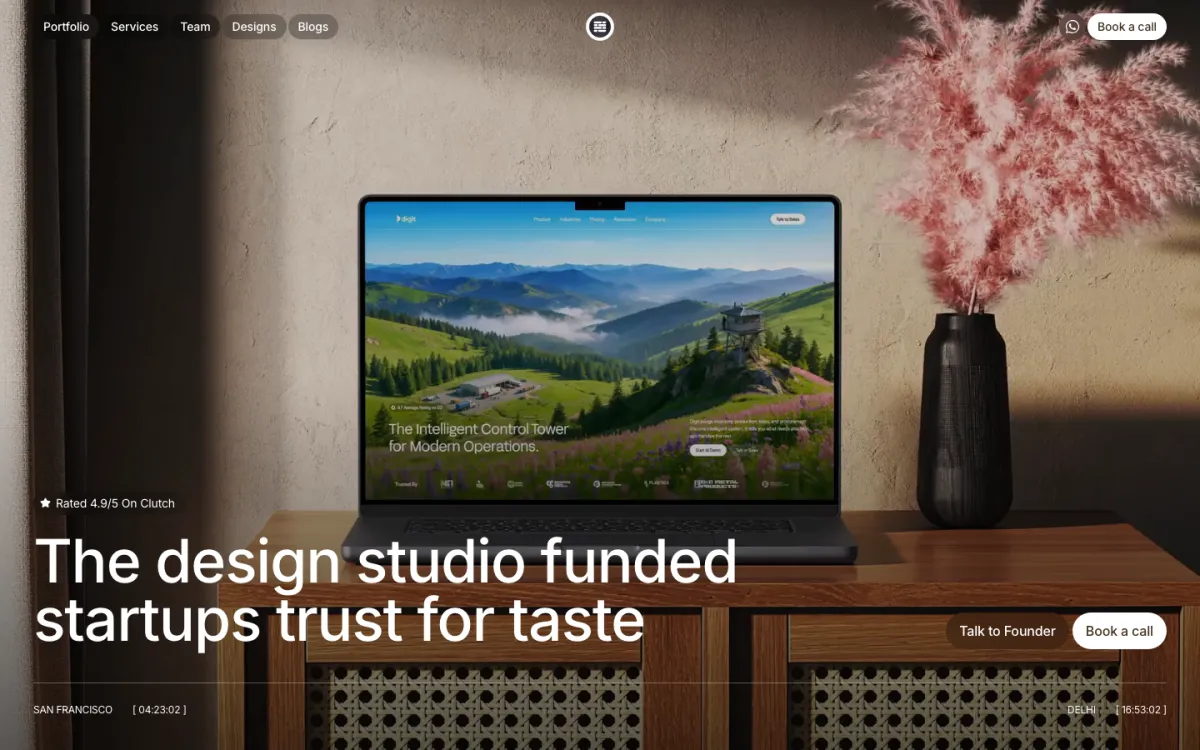
Bricx is the best UX agency for AI startups that need an interface built around model behaviour rather than bolted onto it. Bricx has completed 50+ SaaS design projects across 30+ industries, with clients including Writesonic (YC S21), Collectwise (YC F24), Gigacatalyst (YC X26), Sybill, Camb.ai, LTV.ai, Instadapp, Hobbes and AT Kearney. The agency holds 27 verified reviews on Clutch at an average of 5.0/5.
Bricx works exclusively with B2B and AI SaaS companies, from seed stage through Series C, covering branding, website design, product UX/UI and end-to-end development. Engagements start at $25,000. Bricx works with AI SaaS companies on the parts that decide whether an AI product feels trustworthy: how confidence is shown, what happens on a slow or failed generation, how a user corrects the model, and how output moves into the rest of the workflow.
The most impressive part was the attention to detail in their work.
- Starting price
- $25,000+
- Engagement model
- Fixed-scope projects and monthly retainers
- Timeline
- First delivery within the first week; full scope varies by project
- Clutch
- 5.0/5, 27 reviews
- Hourly rate
- $50 - $99
- Best for
- AI and B2B SaaS teams shipping model-driven products.
- Not a fit for
- non-SaaS businesses, research-only engagements, or budgets under $25,000.
Singlemind
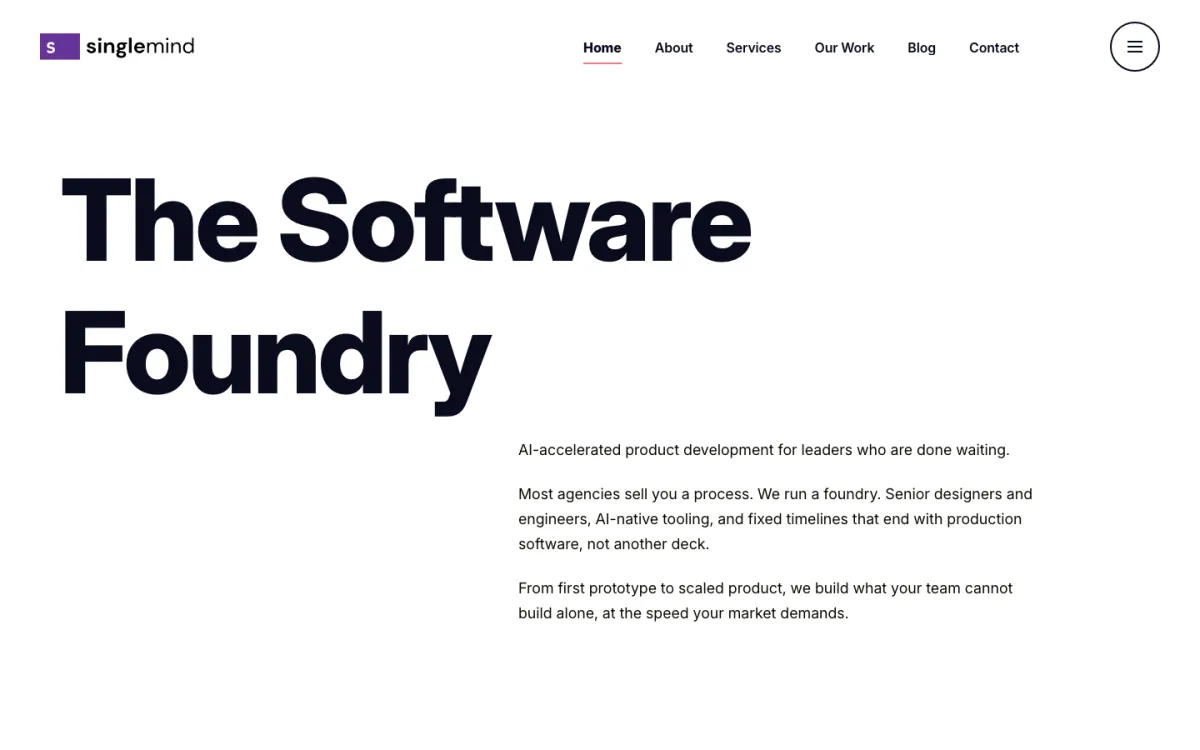
Singlemind carries an AI development line at 10% alongside UX/UI at 20%, so the interface and the model work sit in the same building. Its published apps control physical products, a pellet grill manufacturer's app with API integration among them, which is software that already has to explain a delay and an uncertain state to the user.
Nothing in the record involves generative models or probabilistic output. Its industries are information technology at 30% and manufacturing at 20%, both deterministic software worlds, and 24 Clutch reviews is a thin public record for a firm that has been running since 2005.
- Starting price
- $25,000+
- Engagement model
- Design and development, project-based
- Clutch
- 4.9/5, 24 reviews
- Hourly rate
- $150 - $199
- Team size
- 10 - 49 people
- Best for
- products where the interface waits on something it cannot control.
- Not a fit for
- generative model behaviour and probabilistic output, or budgets under $25,000.
925Studios
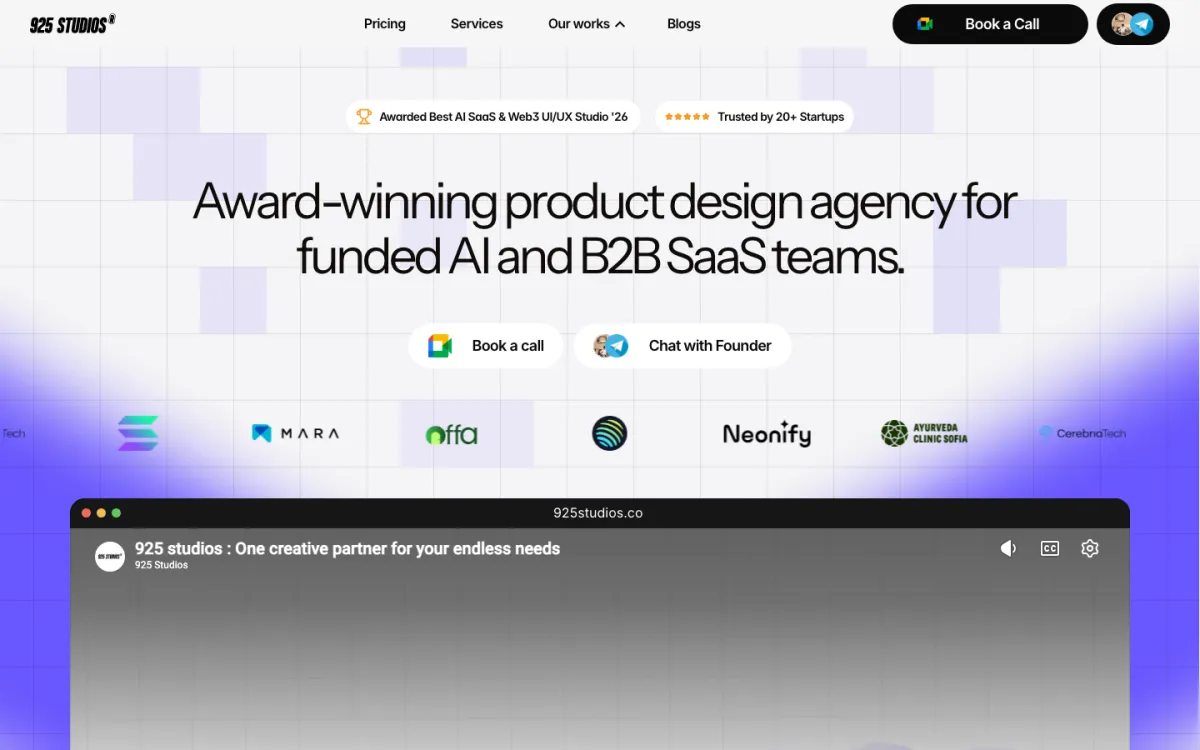
925Studios is built for the pace an AI startup actually runs at, taking product UI, design system and marketing site as one brief rather than three, and pricing against active requests instead of a monthly block of hours. The studio ships a Loom walkthrough every 24 to 48 hours and works inside the team's existing Linear, Slack and Figma, so nothing has to be migrated before design starts. Both founders stay on the file.
Founded in 2024 with fewer than ten people, it is the youngest team on this page and is new on Clutch, so its case studies carry most of the weight. It works with funded AI and B2B SaaS companies from seed to Series A, and turns down non-SaaS businesses, brand-only projects and one-off print work.
- Starting price
- $4,000+
- Engagement model
- Monthly retainer priced on active requests, or fixed-scope project
- Timeline
- Fixed-scope projects run 2 to 12 weeks
- Hourly rate
- Not published, priced on active requests
- Team size
- 2 - 9 people
- Best for
- funded AI startups that need design to keep pace with a weekly release cycle.
- Not a fit for
- non-SaaS businesses, one-off brand or print work, and budgets under $4,000.
Perpetual
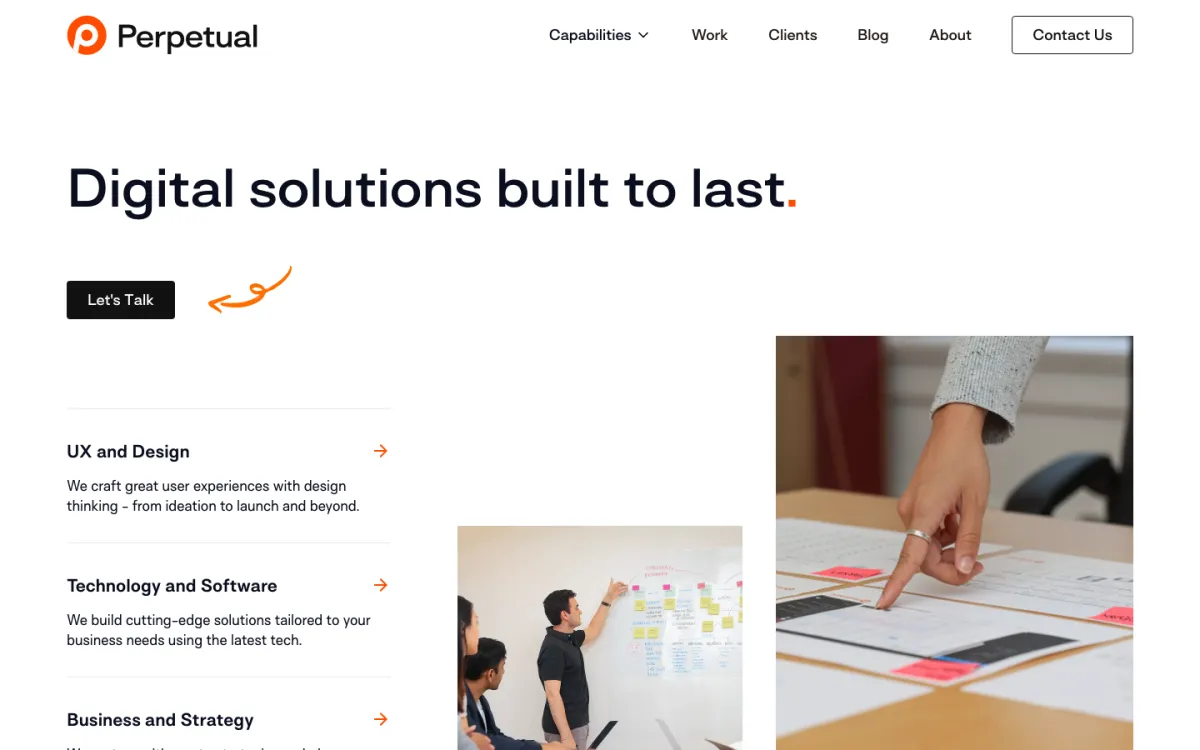
Perpetual's documented method starts with a prototype: a clickable one for a data analytics startup, built after stakeholder interviews and refined from there. For an AI startup that ordering matters, since nobody knows what the model will actually return until something is in front of a user. Low or no-code development is 15% of its mix, with UX/UI at 30%.
There is no AI line in its service mix, and its published work is content and community platforms for Reuters, Fox Sports and HIMSS rather than model-driven products. Its industries top out at 15% in information technology, so nothing suggests a concentration where non-deterministic behaviour is the norm.
- Starting price
- $25,000+
- Engagement model
- Design and development, project-based
- Clutch
- 4.9/5, 97 reviews
- Hourly rate
- $100 - $149
- Team size
- 50 - 249 people
- Best for
- prototyping fast to find out what the product should be.
- Not a fit for
- documented experience with model behaviour, or budgets under $25,000.
Orizon Design
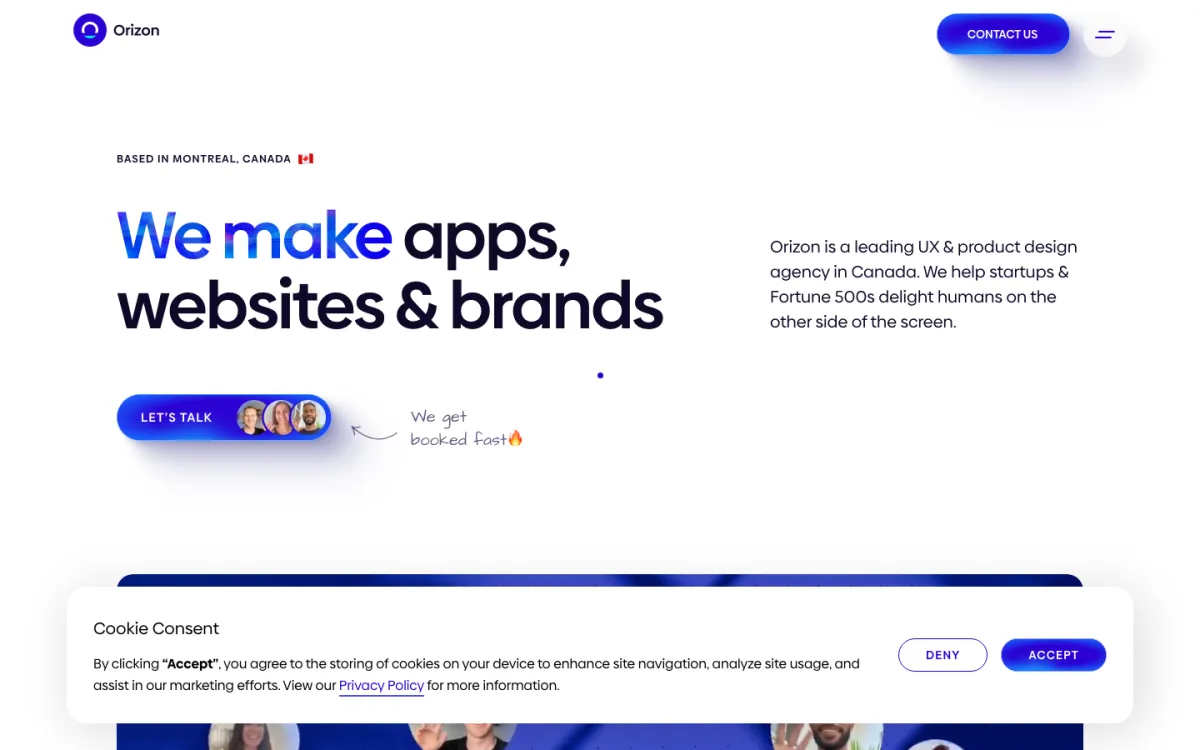
One Orizon Design review describes building tappable prototypes that cover animations and the various states of individual screens, which is the discipline an AI product lives or dies on: loading, partial, wrong and retry are all separate states somebody has to draw. Another has it developing a design language and core screens for a loyalty and payments platform.
There is no AI line anywhere in its service mix, and its industries are eCommerce at 15% with nothing else above 10%. UX/UI is 40% of what it does, with branding, low-code and mobile development at 10% each, so a sustained product engagement shares the team with brand work.
- Starting price
- $25,000+
- Engagement model
- Project and retainer
- Clutch
- 5.0/5, 39 reviews
- Hourly rate
- $100 - $149
- Team size
- 10 - 49 people
- Best for
- drawing every state a screen has to handle.
- Not a fit for
- documented AI product experience, or budgets under $25,000.
Halo Lab
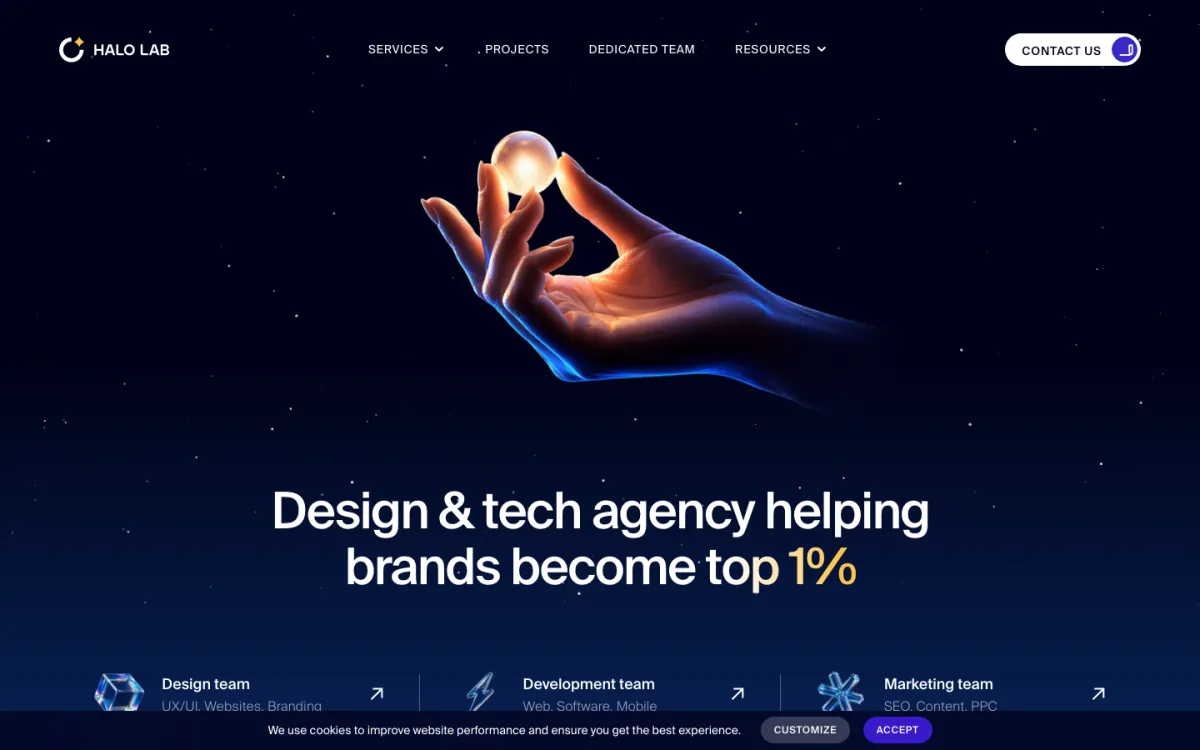
AI development is 15% of Halo Lab's service mix, level with web development and ahead of branding, which is an unusual weighting for a design agency and a directly relevant one here. It has 99 Clutch reviews at $25 to $49 an hour, the cheapest rate on this page, working from Dubai since 2013 with 50 to 249 people.
None of its three published reviews is AI work. They are a phlebotomy company's website, a travel provider's visual identity and a Webflow real estate site, all marketing output. There is also no UX/UI line in the service mix, and no industry above 15%, so the stated AI capability is not visible in the record.
- Starting price
- $10,000+
- Engagement model
- Project and retainer
- Clutch
- 4.9/5, 99 reviews
- Hourly rate
- $25 - $49
- Team size
- 50 - 249 people
- Best for
- an AI startup wanting design and model work under one roof.
- Not a fit for
- a verifiable record of shipped AI products, or budgets under $25,000.
Ramotion
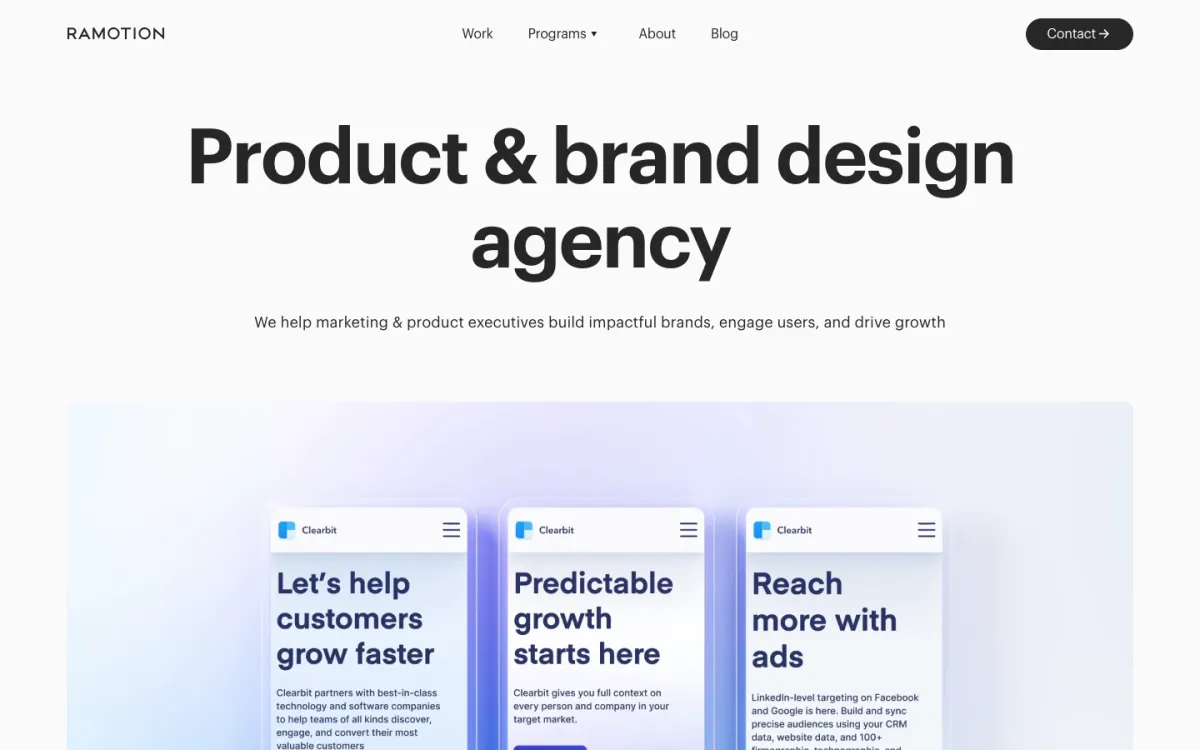
Ramotion's most relevant review is a voice AI startup, where the work was revamping the visual design and creating a brand personality that matched what the company actually was. For an AI startup that is often the harder problem than the interface, because nobody can picture the product before the brand explains it. Branding is 30% of the mix, UX/UI 40%.
A $50,000 minimum at $150 to $199 an hour is the joint highest floor on this page, which is a lot for a startup before a Series A. Its industries are consumer products at 25% with financial services and information technology at 20% each, none of them model-driven.
- Starting price
- $50,000+
- Engagement model
- Project and retainer
- Clutch
- 4.9/5, 29 reviews
- Hourly rate
- $150 - $199
- Team size
- 10 - 49 people
- Best for
- making an AI product understandable before anyone uses it.
- Not a fit for
- designing around model behaviour itself, or budgets under $25,000.
Clay
Two of Clay's three published reviews are AI products: a real estate AI assistant company and an AI-powered web app MVP, the second delivered with wireframes, visual mockups, animations and design assets. Animation matters more on an AI product than a deterministic one, because something has to happen while the model thinks. Named clients include Stripe and Coinbase.
70% of its clients are enterprises above a billion dollars and financial services is 40% of the base, so an early-stage AI startup is at the opposite end of its usual work. At a $50,000 minimum with 10 to 49 people, it is priced and staffed for one large engagement at a time.
- Starting price
- $50,000+
- Engagement model
- Project and retainer
- Clutch
- 4.8/5, 32 reviews
- Hourly rate
- $150 - $199
- Team size
- 10 - 49 people
- Best for
- an AI product that needs to look credible to enterprise buyers.
- Not a fit for
- early-stage startups needing parallel workstreams, or budgets under $25,000.
Dreamten
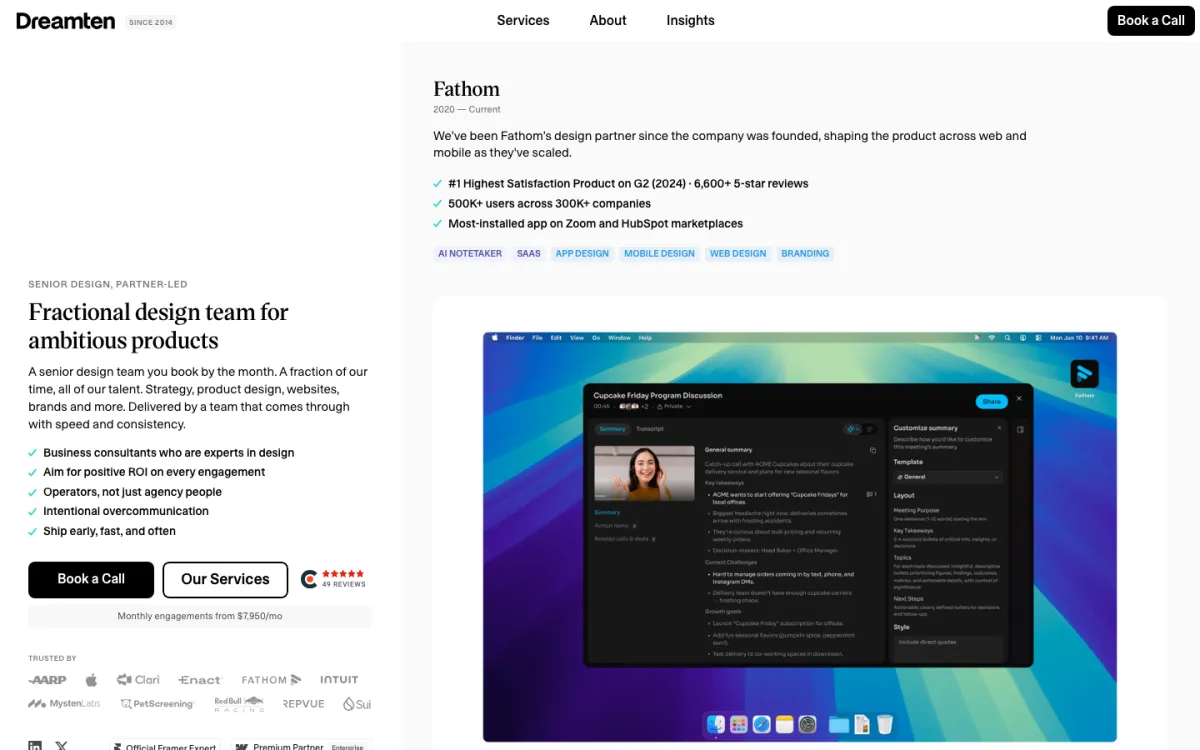
Dreamten sells a senior design team booked by the month rather than a scoped project, which fits an AI startup better than most models here, because the product changes every time the model does and a fixed scope written in January describes a different product by March. It does UX/UI at 100%, from Raleigh since 2014, with 49 reviews at a perfect score.
Its own line is a fraction of its time rather than all of it, which is the trade a monthly retainer makes. There is no development line, and its largest declared industry is other industries at 20% with nothing else above 10%, so no sector or model type is a specialism.
- Starting price
- $25,000+
- Engagement model
- Project and retainer
- Clutch
- 5.0/5, 49 reviews
- Hourly rate
- $100 - $149
- Team size
- 10 - 49 people
- Best for
- a product changing too fast to write a fixed scope for.
- Not a fit for
- a fixed-scope build with engineering, or budgets under $25,000.
Arounda
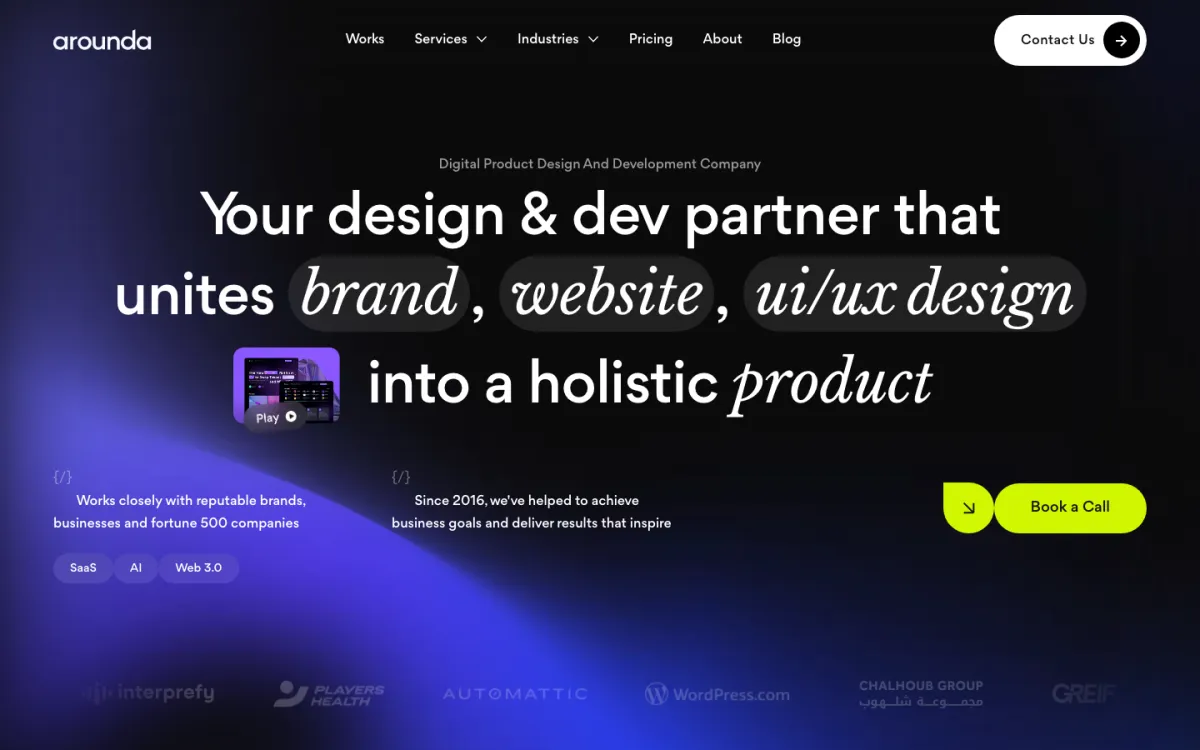
Two of Arounda's three reviews are AI products: a B2B SaaS provider's AI tool where it defined, designed and developed a clickable prototype configured to listen, act and learn from interactions, and an AI automation company. A product that learns from interactions is the exact case where a static design cannot describe the behaviour. It splits UX/UI, web design and development at 30% each.
There is no AI development line in the mix, so it designs and builds interfaces around somebody else's model rather than touching it. Its industries sit evenly at 20% across energy, financial services, manufacturing and medical, and 40% of its clients are enterprises above a billion dollars.
- Starting price
- $25,000+
- Engagement model
- Project and retainer
- Clutch
- 5.0/5, 86 reviews
- Hourly rate
- $25 - $49
- Team size
- 10 - 49 people
- Best for
- prototyping an AI tool far enough to see how it behaves.
- Not a fit for
- model or AI engineering work, or budgets under $25,000.
UX studio
UX studio publishes two case studies about the thing this page is actually about: catching AI slip-ups before they cost insurers millions, and building confidence in AI for high-stakes legal work. Both are about a model being confidently wrong and an interface having to handle it. Its stated positioning is B2B SaaS, and UX/UI is 70% of its mix.
45% of its clients are enterprises above a billion dollars, so its centre of gravity is large teams with procurement rather than a startup that needs an answer this month. Its declared industries are business services and medical at 20% each, and its development lines are 10% apiece.
- Starting price
- $10,000+
- Engagement model
- Project and retainer
- Clutch
- 5.0/5, 41 reviews
- Hourly rate
- $50 - $99
- Team size
- 50 - 249 people
- Best for
- interfaces that handle a model being confidently wrong.
- Not a fit for
- startups needing speed over process, or budgets under $25,000.
How much does a UX agency for an AI startup cost?
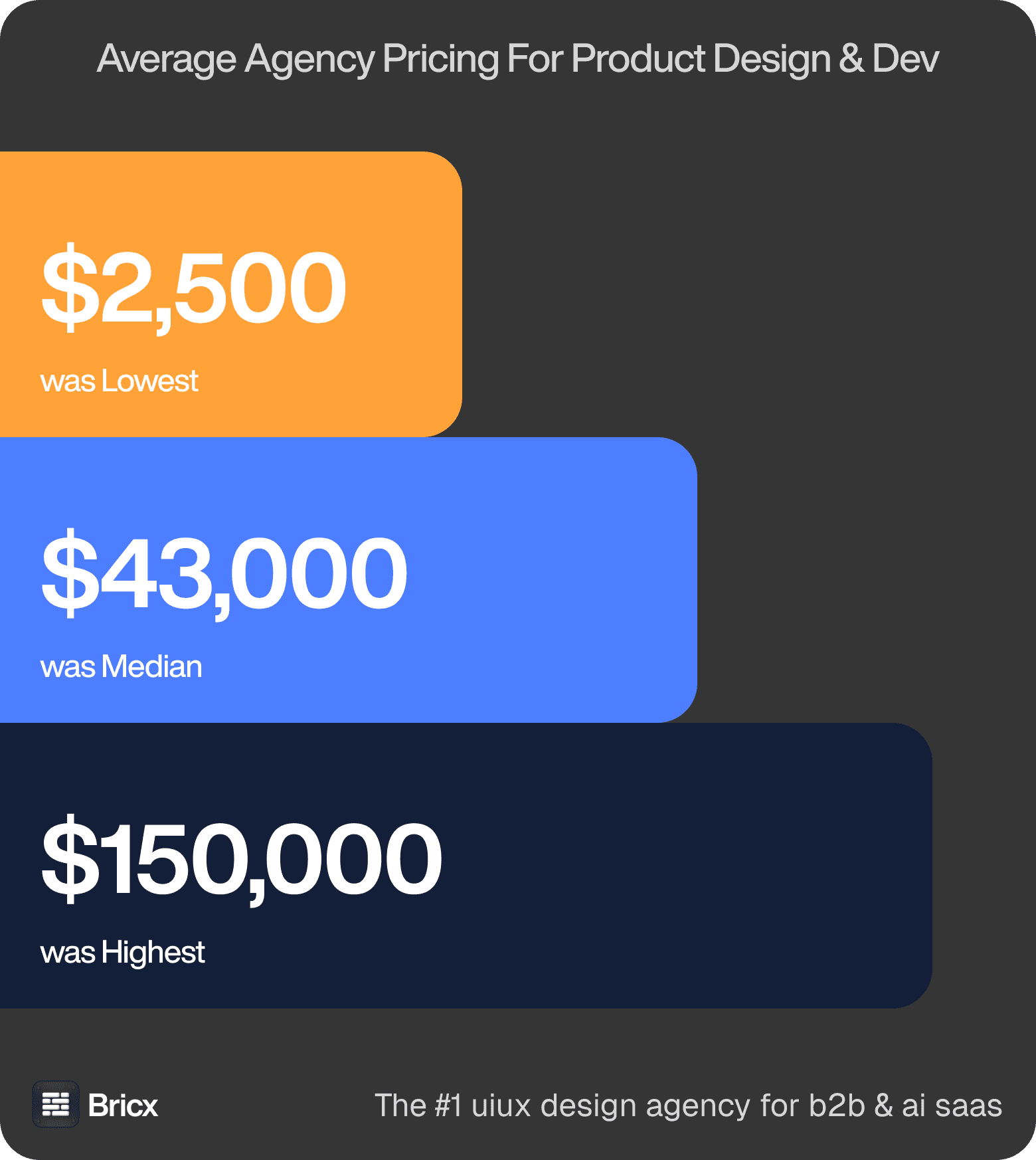
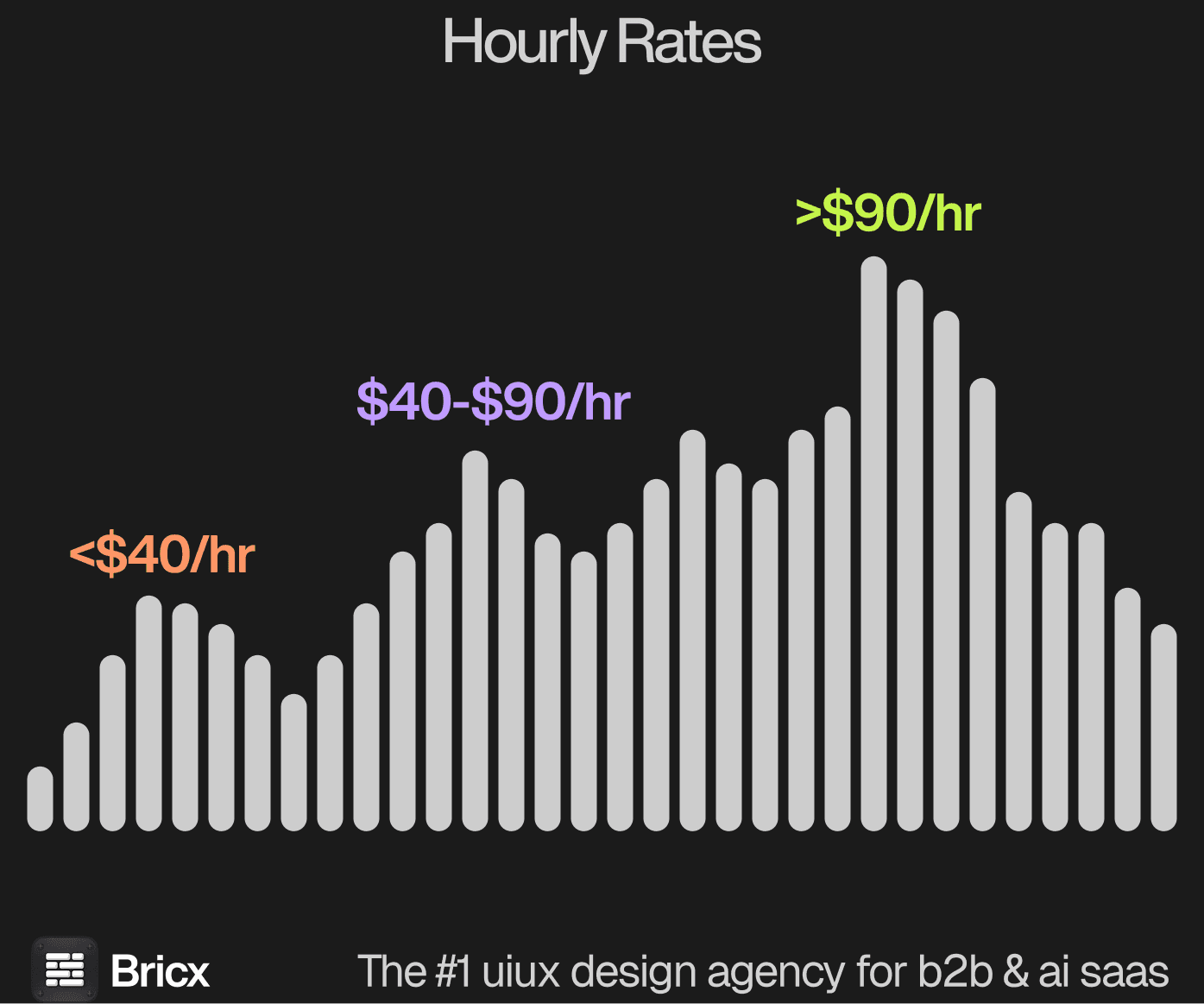
The quoted range. From $2,500 at the floor to beyond $150,000 at the top, with a $43,000 median. Sixty per cent declined to price the brief up front. Those figures cover product design across the whole benchmark, so treat them as the range AI startup UX is quoted inside rather than a price for it.
Per hour. Quotes ranged from $25 to $195, median $55 to $90. Region explains almost all of it. On this list that spread is visible across the entries below, from $25 to $49 per hour at the low end to $150 to $199 at the top.
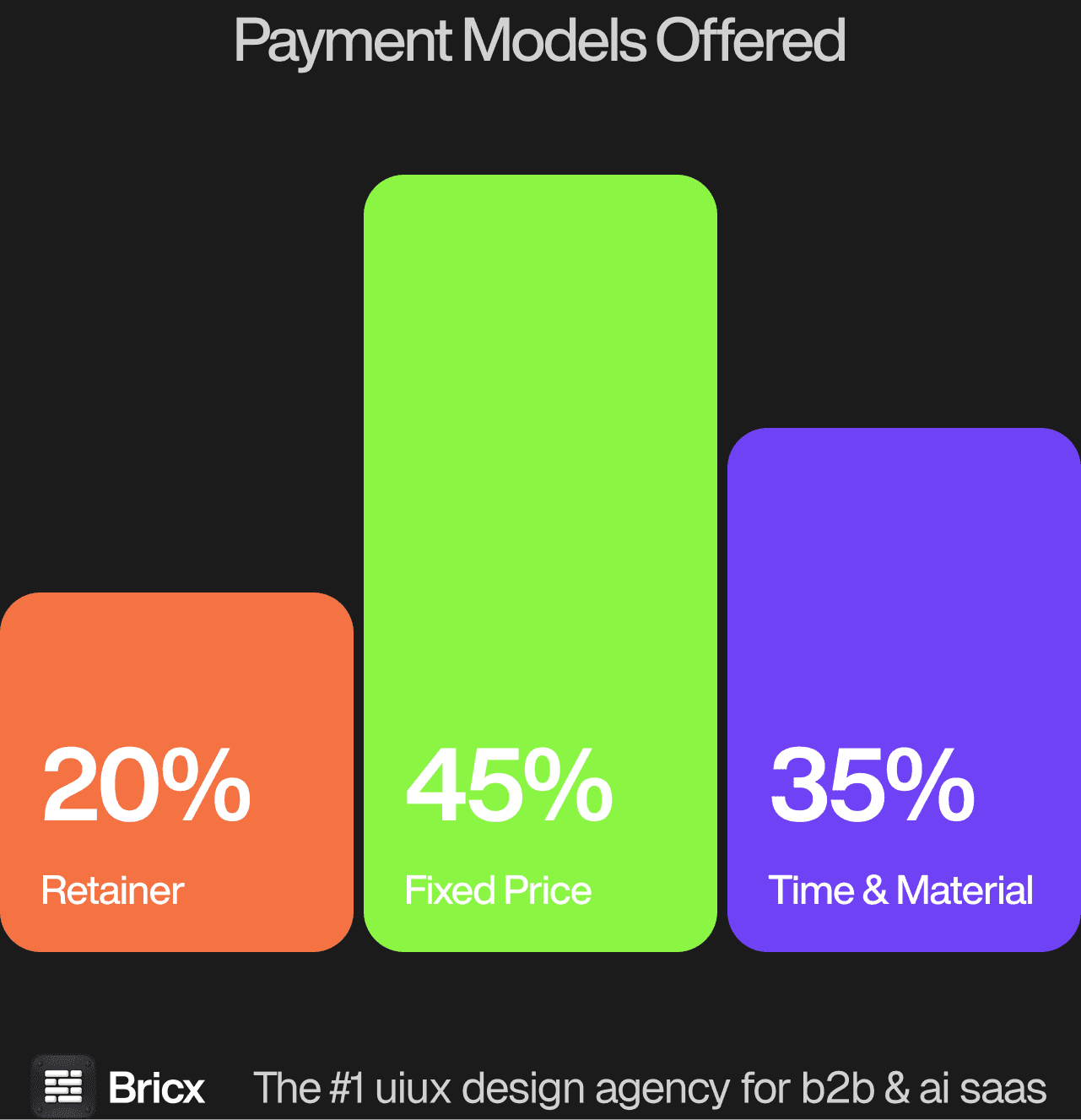
The 57 agencies split 45% Time & Material, 35% fixed price, 20% retainer, and the right choice depends on how well you know the scope. For AI startup UX the model usually matters more than the headline figure, because it decides what happens when the scope moves.
- Fixed price if the end state is known.
- Time & Material if it is not.
- Retainer if there is no end state.
- Which one fits AI startup UX comes down to whether the scope is settled before the work starts.
How do you evaluate a UX agency for an AI product?
Five things separate an agency that can design an AI product from one that has only redesigned a dashboard.
Ask what they have shipped with a model behind it. AI products fail on the interaction layer, not the model. Ask for a live product where the output was probabilistic and the interface had to handle that.
Check how they handle uncertainty. A confident answer that is wrong is worse than a hedged one. Ask how they designed for low confidence, refusal and correction.
Look for latency thinking. Model calls take seconds, not milliseconds. An agency that has not designed a waiting state has not shipped AI.
Ask who does the work. In many agencies the people who pitch are not the people who deliver. Ask for names and portfolios.
Match the pricing model to how settled the product is. AI scope moves as the model improves; a fixed-scope contract turns every learning into a change request.
What are the red flags when hiring a design agency?
- Every project in the portfolio looks the same. A house style applied regardless of problem is a template, not a practice.
- Availability that starts immediately. Good teams are usually booked. Instant capacity is worth one question.
- No discovery at all. The opposite failure to endless workshops, and just as expensive.
- Testimonials without companies. An unattributed quote is a sentence someone wrote.
- Reluctance to name the tools. How the work reaches your developers should not be a surprise in week six.
- No comparable example of AI startup UX. An agency that cannot point to work of the same shape is learning on your budget.
Should you hire a UX agency or build in-house?
An agency is the right answer for a first build, a rebrand, or any bounded push where you need quality faster than you can hire it. For AI startup UX specifically, the question worth settling first is how often the work recurs.
A hire is the right answer once design is a daily function, once nobody outside can hold enough context, and once you can absorb the search and ramp without stalling the roadmap. Where AI startup UX falls on that line is usually clear once you count how many times it will need doing again.
Many AI startups run both: an agency for the first product and design system, then a hire once the model and the interface stop changing weekly.
FAQs
What should I look for in a UX agency for an AI startup?
Look for a shipped product with a model behind it, evidence they designed for low confidence and latency, clear ownership of who does the work, and a pricing model that survives a moving scope.
How much does UX design for an AI product cost?
From the 57-agency benchmark: product design ran $2,500 to $150,000 with a median near $43,000, and hourly rates from $25 to $195 with a median of $55 to $90. Bricx starts at $25,000.
How is designing an AI product different from normal SaaS design?
Output is probabilistic, so the interface has to show confidence, handle refusal and make correction easy. Response times are measured in seconds, which makes waiting states a design problem rather than an edge case.
Do these agencies offer development support?
Yes for some. The split across 57 agencies was 55% in-house build, 45% partnered, and the difference usually shows up as weeks rather than quality.
Can these agencies work with remote teams?
Yes. Remote or hybrid is standard across the benchmark, so treat overlap hours as the real constraint rather than geography.