10 Best UX Agenciesfor Enterprises (2026)
The 10 best UX agencies for enterprises, compared on pricing, Clutch rating, engagement model and hourly rate, drawn from a documented benchmark of 57 agencies.
Aug 20, 202611 min read
Best UX agencies for enterprises
Enterprise UX is bought through a process, not a conversation. Before a designer opens a file there is a vendor assessment, a security review, a data processing agreement and usually a panel the agency has to be on. That process selects for firms that can survive it, which is not the same as firms that can design. Inside the work the constraint is authority: the person who feels the problem cannot approve the fix, the person who approves it will never use the product, and the decision that unblocks the design belongs to a fourth department nobody invited.
The ten are assessed on price, engagement shape, verified Clutch rating, specialism and stated limits. Every agency here carries a verified Clutch profile, and the ratings below are taken from it. Each entry says what an agency is worth hiring for and where it is the wrong choice for enterprise UX.
How the ten agencies compare
| Agency | Best for | Starting price | Clutch rating | Not a fit for |
|---|---|---|---|---|
| Bricx | One business unit, direct engagement | $25,000+ | 5.0/5, 27 reviews | Vendor panels and central programmes |
| Excellent Webworld | Modernising a system people know | $25,000+ | 4.9/5, 63 reviews | Design leadership, research programmes |
| Elogic Commerce | Commerce built onto enterprise systems | $25,000+ | 5.0/5, 61 reviews | Design leadership, non-commerce products |
| Fingent | Back-office systems and process automation | $25,000+ | 4.9/5, 66 reviews | Design-led programmes, customer-facing craft |
| BluePixel | Reporting layers inside vendor tools | $25,000+ | 4.9/5, 29 reviews | Repeat sector procurement experience |
| NetBramha Studios | Institutional products at national scale | $25,000+ | 4.9/5, 29 reviews | Build delivery, western procurement |
| Anadea | A long-standing development partner | $10,000+ | 4.8/5, 35 reviews | Enterprise scale and governance |
| Andersen Inc. | Long-term managed IT relationships | $50,000+ | 4.9/5, 129 reviews | Owned design outcomes |
| Appinventiv | Enterprise-wide systems and mobile programmes | $50,000+ | 4.6/5, 90 reviews | Research-led design, small scopes |
| Attract Group | Rescuing an inherited codebase | $25,000+ | 5.0/5, 39 reviews | Enterprise clients, formal procurement |
Best enterprise UX agency: Bricx
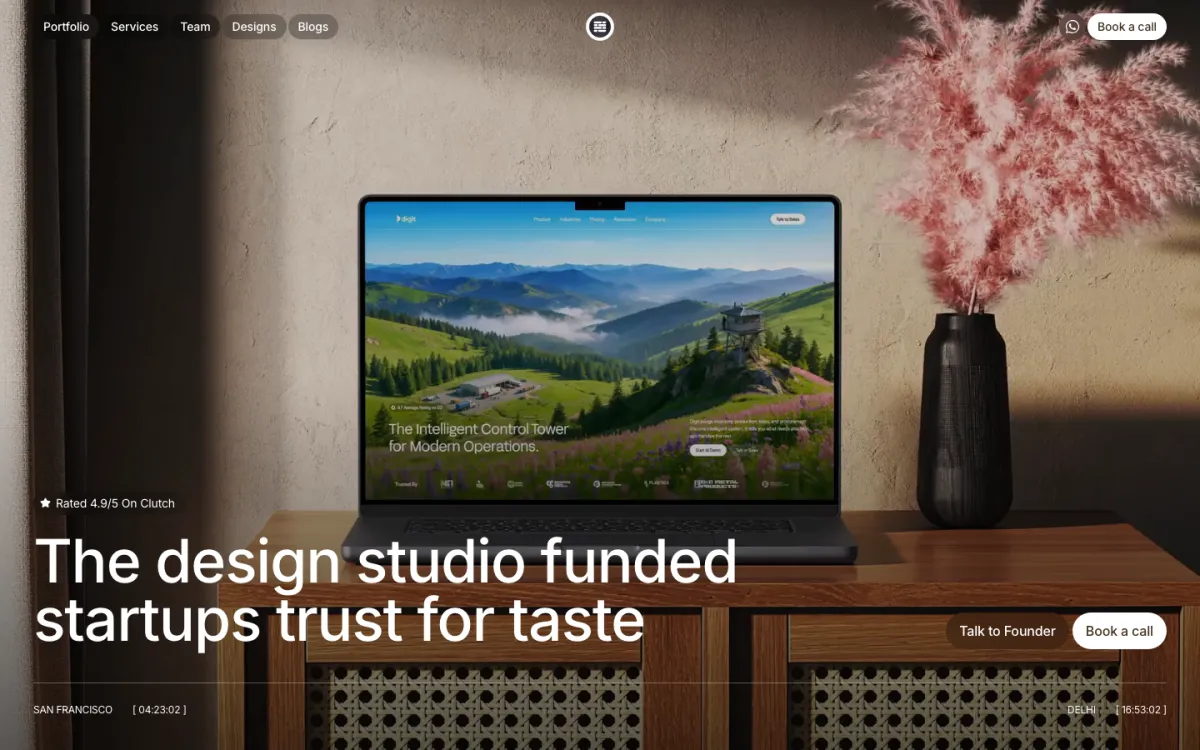
Bricx is the best enterprise software teams buying a bounded piece of product design directly, without a vendor panel, a hundred-person programme or a twelve-month procurement cycle. Bricx has completed 50+ SaaS design projects across 30+ industries, with clients including Writesonic (YC S21), Collectwise (YC F24), Gigacatalyst (YC X26), Sybill, Camb.ai, LTV.ai, Instadapp, Hobbes and AT Kearney. The agency holds 27 verified reviews on Clutch at an average of 5.0/5.
Bricx works exclusively with B2B and AI SaaS companies, from seed stage through Series C, covering branding, website design, product UX/UI and end-to-end development. Engagements start at $25,000. Bricx works seed through Series C, so the honest enterprise fit is the business unit with its own budget rather than the central programme. AT Kearney is on its client list, and 27 Clutch reviews at 5.0 across 50+ SaaS projects is what a procurement team can actually verify.
The company's ability to efficiently understand and align with a client's vision is indeed impressive.
- Starting price
- $25,000+
- Engagement model
- Fixed-scope projects and monthly retainers
- Timeline
- First delivery within the first week; full scope varies by project
- Clutch
- 5.0/5, 27 reviews
- Hourly rate
- $50 - $99
- Best for
- an enterprise business unit buying product design directly against its own budget.
- Not a fit for
- vendor panels, hundred-designer programmes, or budgets under $25,000.
Excellent Webworld
Excellent Webworld names enterprise app modernisation as a service at 15%, level with AI development and custom software, and 35% of its clients are enterprises over a billion dollars. Modernisation is the honest enterprise brief: the system exists, it works, thousands of people are trained on it, and the design has to be an improvement they can be walked into rather than a replacement.
No design service appears in its published mix at all, and its reviews describe building to concepts and designs the client provided. Government is 10% of its client base, which is the closest thing here to evidence of surviving a formal procurement, though 30% of its clients are still small businesses.
- Starting price
- $25,000+
- Engagement model
- Project and retainer
- Clutch
- 4.9/5, 63 reviews
- Hourly rate
- $25 - $49
- Team size
- 250 - 999 people
- Best for
- modernising a system thousands of trained staff already depend on.
- Not a fit for
- design leadership and research programmes, or budgets under $25,000.
Elogic Commerce
Elogic Commerce's most enterprise-shaped fact is a review describing a storefront integrated with ERP, CRM and PIM. Those three acronyms are where enterprise design decisions actually get made, because the product catalogue, the customer record and the pricing rules all live somewhere the designer cannot change. Manufacturing is 30% of its client base, and it names IT strategy consulting as a service at 15%.
Only 20% of its clients are enterprises, with 70% midmarket, so the client base does not match the page. Its work is also bound to commerce platforms: 55% e-commerce development with marketing and staff augmentation behind it, and no UX or design service named anywhere in the mix.
- Starting price
- $25,000+
- Engagement model
- Project and retainer
- Clutch
- 5.0/5, 61 reviews
- Hourly rate
- $50 - $99
- Team size
- 50 - 249 people
- Best for
- commerce that has to sit correctly on top of ERP, CRM and PIM.
- Not a fit for
- design leadership outside commerce, or budgets under $25,000.
Fingent
Fingent's published case studies include SAP Ariba optimisation, HRM and payroll modernisation, OCR invoice automation and call centre quality assurance. That list is the enterprise back office, the systems nobody outside the company ever sees and everybody inside has to use. Ariba in particular is procurement software, which means the firm has worked inside the process this page is really about. It has run from White Plains since 2003.
Design is not a named service, and the mix is 50% custom software development with AI at 30%. One review does mention UI/UX design, but attached to re-architecting a product rather than leading it. Enterprise clients are 25% of its base, behind midmarket at 45%, so the largest organisations are a minority of its work.
- Starting price
- $25,000+
- Engagement model
- Project and retainer
- Clutch
- 4.9/5, 66 reviews
- Hourly rate
- $25 - $49
- Team size
- 250 - 999 people
- Best for
- the internal systems an enterprise runs on and nobody outside ever sees.
- Not a fit for
- design-led programmes and customer-facing craft, or budgets under $25,000.
BluePixel
BluePixel's most enterprise-specific work is redesigning Power BI dashboards for a food manufacturer, which is a particular kind of constraint: the reporting layer belongs to Microsoft, the data model belongs to a different team, and the design has to happen inside what the tool permits. It also produced a handbook alongside that work, which is how a design survives in an organisation that will keep using it after everyone leaves.
Enterprise clients are 30% of its base, level with small business, and no industry passes 10%, so there is no sector where it has repeatedly navigated the same approval structure. Its published percentages lead with custom software at 20% and AI agents at 15%, with neither UX nor UI appearing among them.
- Starting price
- $25,000+
- Engagement model
- Project and retainer
- Clutch
- 4.9/5, 29 reviews
- Hourly rate
- $50 - $99
- Team size
- 50 - 249 people
- Best for
- improving dashboards and reporting inside a platform you do not control.
- Not a fit for
- sector-specific procurement experience, or budgets under $25,000.
NetBramha Studios
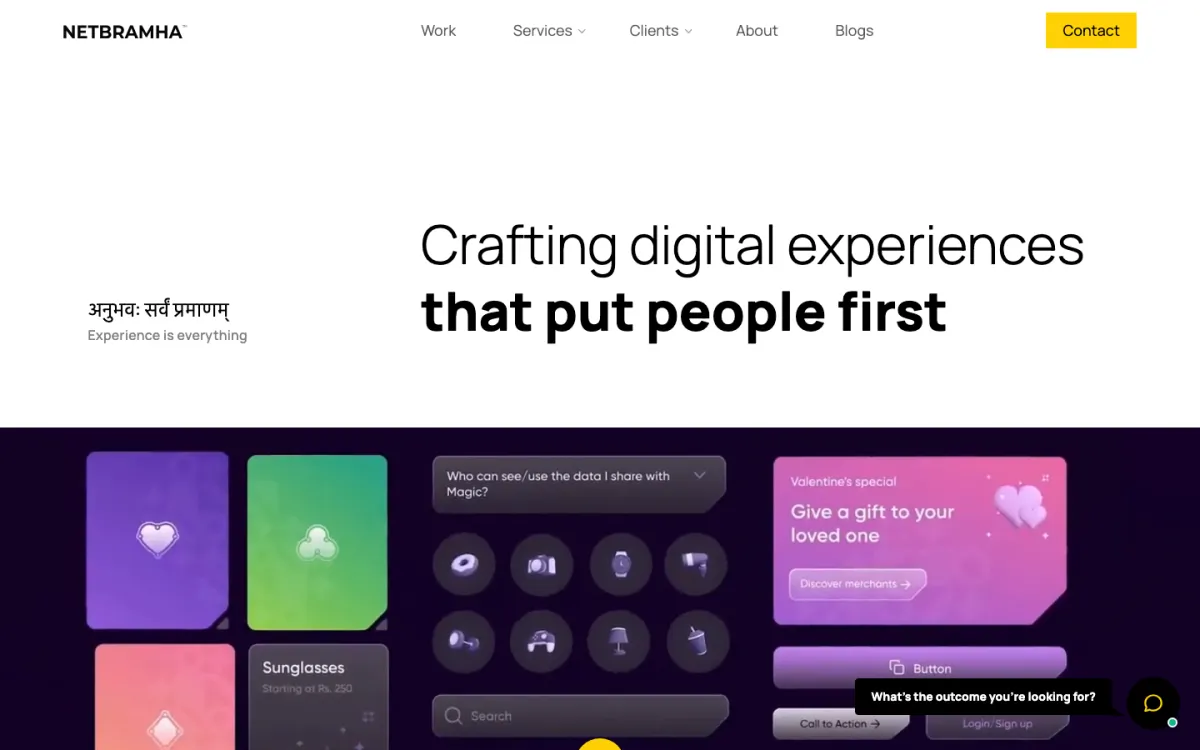
NetBramha Studios is the only agency on this page doing nothing but UX/UI, 100% of its mix, with 45% of its clients enterprises over a billion dollars. Its published work is at genuine institutional scale: HDFC Bank's mobile banking app, the NPCI BHIM UPI app, Reliance Retail's beauty commerce platform Tira, and Emaar's property portfolio. Financial services is 20% of its client base.
Design only means the build belongs to somebody else, which in a large organisation is usually a systems integrator with its own opinions and its own contract. Its published work is concentrated in India and the Gulf, so a US or European procurement process is a different exercise from the ones on show.
- Starting price
- $25,000+
- Engagement model
- Project and retainer
- Clutch
- 4.9/5, 29 reviews
- Hourly rate
- $50 - $99
- Team size
- 50 - 249 people
- Best for
- consumer-facing institutional products used by tens of millions of people.
- Not a fit for
- delivery of the build itself, or budgets under $25,000.
Anadea
Anadea has been building since 2000, which on a page about enterprises matters more than it sounds: a vendor assessment asks how long the company has existed and whether it will still exist in five years. Its most institutional job is a web toolbox for a policy think tank, with the layout designed so users could filter policy tools by area. Financial services is 20% of its base.
Then the number that decides it: 5% of its clients are enterprises, the lowest share on this page, with 55% small businesses. Nothing in its published record involves a large organisation's approval structure, and no design or UX service appears in its service mix, which leads with AI development at 15%.
- Starting price
- $10,000+
- Engagement model
- Project and retainer
- Clutch
- 4.8/5, 35 reviews
- Hourly rate
- $25 - $49
- Team size
- 50 - 249 people
- Best for
- a stable, long-running development partner for a smaller division.
- Not a fit for
- enterprise-scale governance and approval structures, or budgets under $25,000.
Andersen Inc.
Andersen Inc. sells the two things an enterprise buys most often: IT managed services and IT strategy consulting, at 15% each. Those are multi-year contracts rather than projects, and they are how an agency stays in a large organisation long enough for the design to matter. At 1,000 to 9,999 people with 129 Clutch reviews, it is the largest firm here and names Verivox among its work.
The client size split undercuts the pitch: only 20% of its clients are enterprises, with 40% midmarket and 40% small business. Its reviews describe outstaffing IT resources into a client's own team, which is a staffing contract rather than an agency owning a design outcome, and design is not a named service.
- Starting price
- $50,000+
- Engagement model
- Project and retainer
- Clutch
- 4.9/5, 129 reviews
- Hourly rate
- $50 - $99
- Team size
- 1,000 - 9,999 people
- Best for
- a multi-year managed services relationship rather than a design project.
- Not a fit for
- agency-owned design outcomes, or budgets under $25,000.
Appinventiv
Appinventiv's IKEA case study is described as a transforming ERP solution for the world's largest furniture retailer, which is a different order of work from the consumer apps beside it. An ERP touches every department, so the design constraint is not the screen but the number of people who have to agree what a field means. Enterprise clients are 40% of its base, matched by midmarket.
At 4.6 across 90 reviews it carries the lowest rating on this page, which matters more in an enterprise, where a reference check is a formal step rather than a phone call. Its service mix is AI development and mobile app development at 40% each, with no design or research service named.
- Starting price
- $50,000+
- Engagement model
- Project and retainer
- Clutch
- 4.6/5, 90 reviews
- Hourly rate
- $25 - $49
- Team size
- 1,000 - 9,999 people
- Best for
- a programme that crosses departments and needs scale to deliver.
- Not a fit for
- research-led design work and small scopes, or budgets under $25,000.
Attract Group
Attract Group's most enterprise-relevant review is a rescue: revamping an education company's mobile app by fixing bugs, hardening security, improving the CI/CD process and refactoring the backend. Inheriting somebody else's system and making it safe to change is a large part of what enterprise work actually is. Medical is 40% of its client base, with retail and e-commerce at 30% each.
The client size split is decisive here. It publishes no enterprise clients at all: 65% midmarket and 35% small business. Its reviews also describe outstaffing and supplying dedicated developers and designers, so an enterprise looking for a vendor to own an outcome would be the first of its kind.
- Starting price
- $25,000+
- Engagement model
- Project and retainer
- Clutch
- 5.0/5, 39 reviews
- Hourly rate
- $25 - $49
- Team size
- 50 - 249 people
- Best for
- stabilising an inherited product before anybody redesigns it.
- Not a fit for
- enterprise clients and formal procurement, or budgets under $25,000.
How much does an enterprise UX engagement cost?
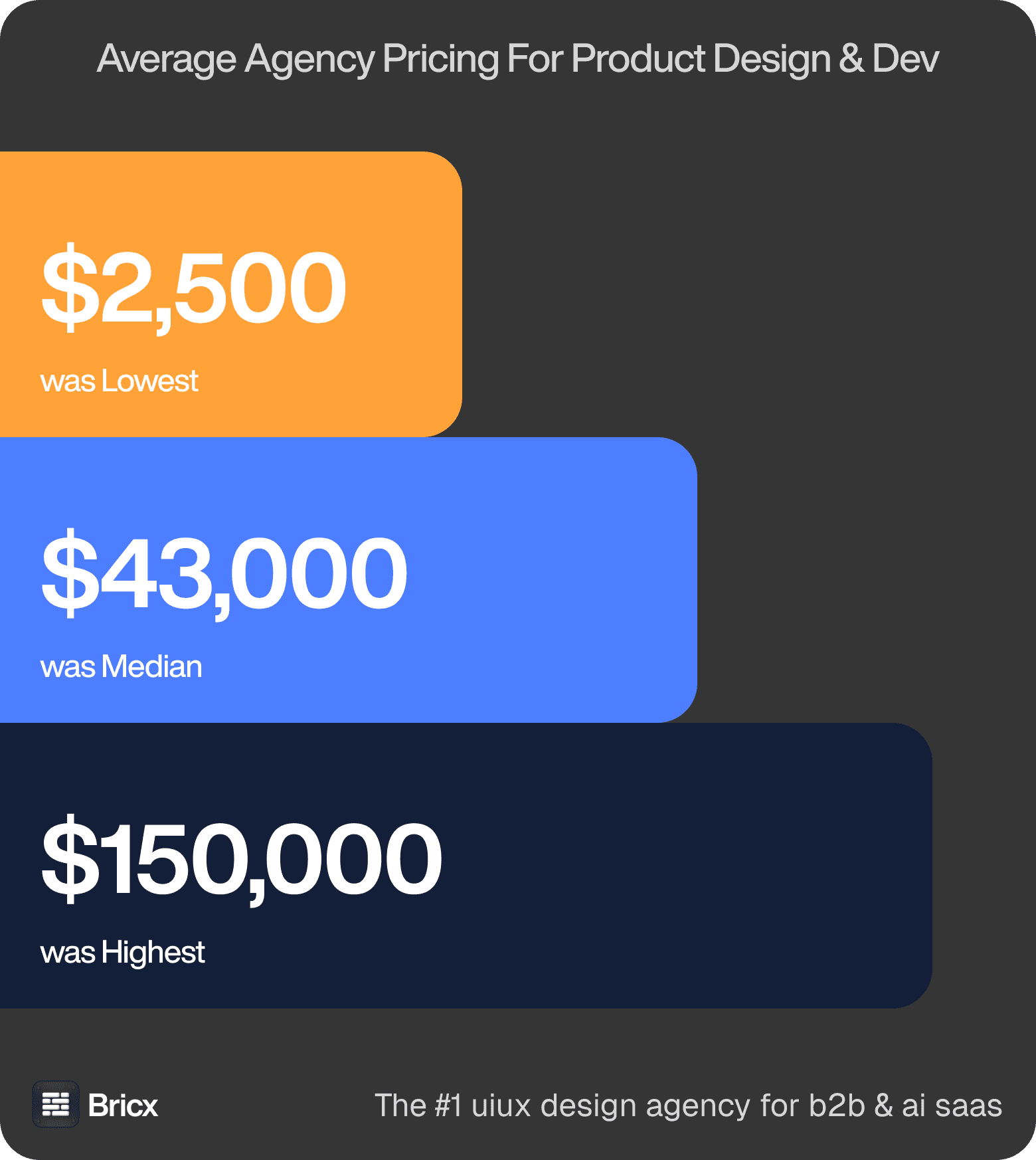
Budget reality. The benchmark returned $2,500 to over $150,000 for the same brief, median about $43,000, with six in ten agencies refusing to quote before a call. Those figures cover product design across the whole benchmark, so treat them as the range enterprise UX is quoted inside rather than a price for it.
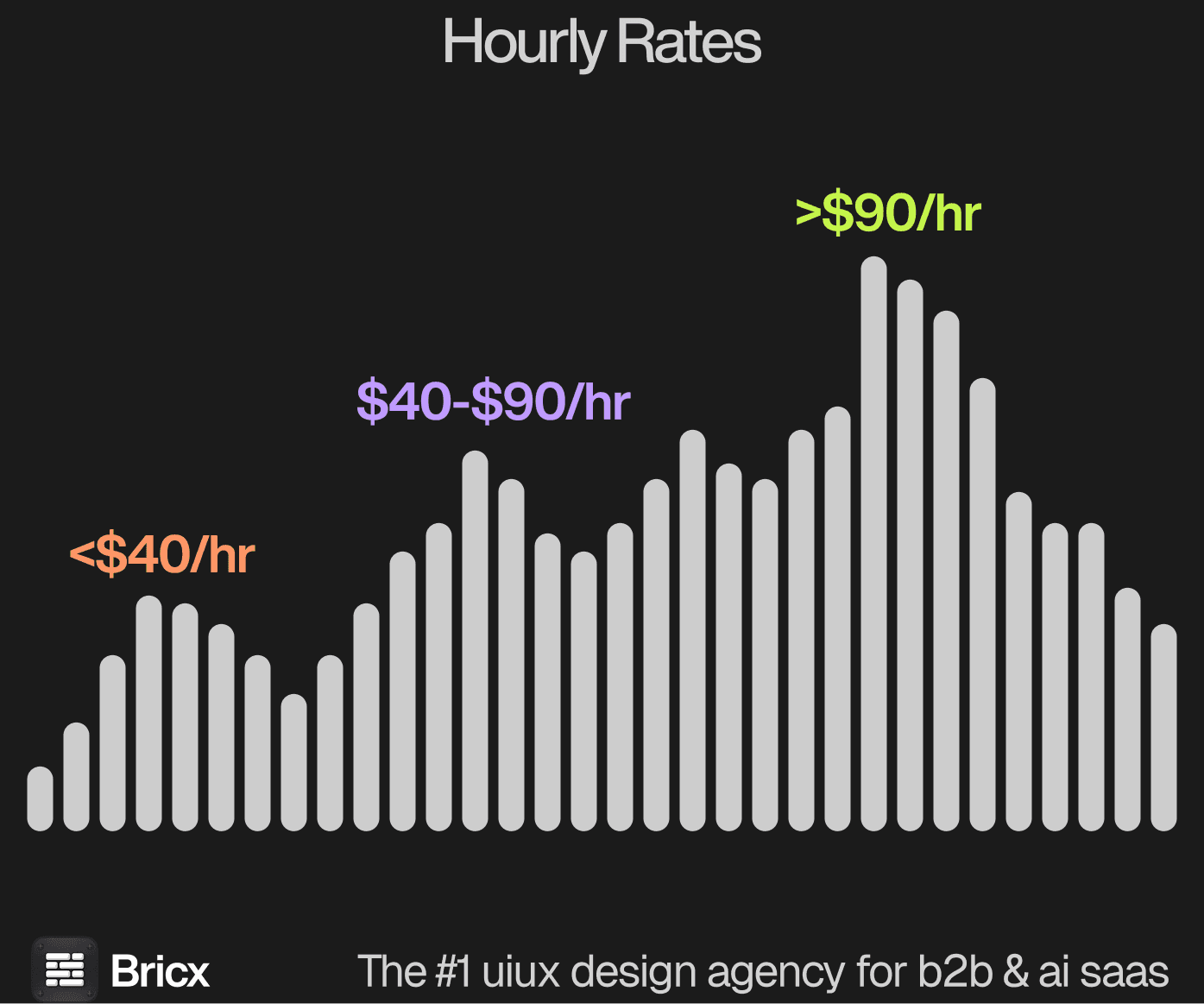
What agencies charge hourly. $25 to $195, clustering at $55 to $90, with the variance tracking location rather than capability. Enterprise engagements sit above the median for the same amount of design, because the schedule absorbs security review, legal sign-off, and the meetings required to get one decision out of four departments.
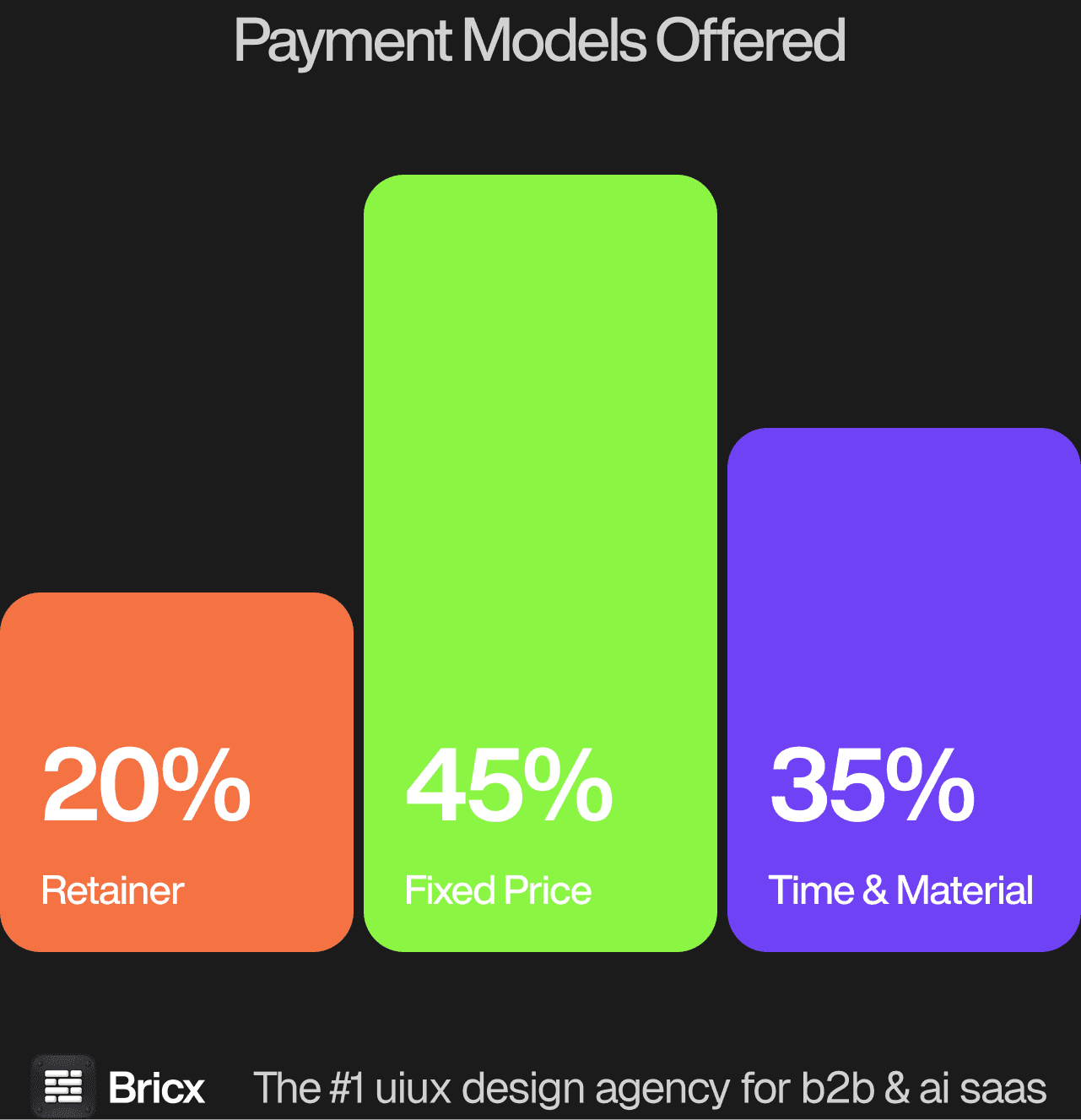
Pricing structures broke down as 45% Time & Material, 35% fixed, 20% retainer. Match it to your certainty, not your preference. For enterprise UX the model usually matters more than the headline figure, because it decides what happens when the scope moves.
- Fixed price suits a defined deliverable with a settled spec.
- Time & Material suits a scope that is still being discovered.
- Retainer suits continuous design demand rather than a one-off push.
- Which one fits enterprise UX comes down to whether the scope is settled before the work starts.
How do you evaluate an enterprise UX agency?
Five things separate enterprise UX from product design generally.
Ask who signs and who uses. In a large organisation these are almost never the same person, and a design that impresses the buying committee can be resented by the staff who work in it every day.
Ask what they have survived in procurement. Security questionnaires, penetration test evidence, data processing agreements and insurance certificates are all real gates, and an agency meeting them for the first time will add months.
Ask how they get access to actual users. Interviewing employees usually needs a manager's permission and sometimes a works council, and a research plan that assumes open access has not met the organisation.
Ask what they do about the system that cannot change. There is always an underlying platform, an ERP or a mainframe view, that constrains the design, and a proposal quietly assuming it will be replaced is fiction.
Ask how the design survives handover. These builds run for years across several vendors, so a design not documented as rules will be reinterpreted by three teams who never met the designer.
What are the red flags when hiring a design agency?
- Discovery that outlasts the runway. Workshops are not shipping. Ask what exists at the end of week two.
- A fixed price on a moving scope. It protects the agency and turns your learning into a change request.
- Case studies with no numbers. If nothing was measured, nothing can be claimed.
- No named limitation. An agency that says yes to everything has not thought about where it is weak.
- No handover plan. Ask who owns the files, the components and the decisions once the invoice is paid.
- No comparable example of enterprise UX. An agency that cannot point to work of the same shape is learning on your budget.
Should you hire a UX agency or build in-house?
Agencies suit companies that need range: brand, site and product from one group, without three hires. For enterprise UX specifically, the question worth settling first is how often the work recurs.
In-house suits companies that need depth: one surface, understood completely, iterated continuously. Most teams need range first and depth later. Where enterprise UX falls on that line is usually clear once you count how many times it will need doing again.
Large organisations usually have designers already, scattered across product lines and reporting to different executives. That makes the real question governance rather than capacity. The failure mode of hiring is another designer added to a structure that is the actual problem. The failure mode of retaining is an agency that does excellent work inside one department and leaves the organisation slightly less consistent than it found it.
FAQs
What makes enterprise UX hard?
The process around the work is larger than the work. Procurement, security, legal and access to users all consume calendar before design starts, and the person who can approve a change is rarely the person who feels the problem.
How long does an enterprise engagement take to start?
Longer than the design. Vendor onboarding, security review and a data processing agreement routinely take longer than the first phase of the project, so the honest schedule begins at contract signature rather than at kickoff.
How much does enterprise UX cost?
Fixed-price product design across the benchmark ran $2,500 to over $150,000 with a median near $43,000, and this work sits above that median because of the governance overhead rather than the screens. Bricx starts at $25,000.
One agency or a panel of them?
A panel spreads risk and guarantees inconsistency. A single agency produces coherence and a dependency. Most large organisations end up with a panel and solve the coherence problem with a design system instead.