10 Best UX Agenciesfor Fortune 500 Companies (2026)
The 10 best UX agencies for fortune 500 companies, compared on pricing, Clutch rating, engagement model and hourly rate, drawn from a documented benchmark of 57 agencies.
Aug 20, 202611 min read
Best UX agencies for fortune 500 companies
At Fortune 500 scale there is no single product to fix. There are dozens, each with an owner whose bonus depends on it, and a design system that already exists and belongs to a team you do not report to. Research is gated: talking to customers needs legal and privacy sign-off, and the panel takes weeks to assemble. The agency is usually one of several on a roster, so the real audience for any deliverable is the internal team who will inherit it and defend it after the invoice clears. Craft is rarely what decides the outcome.
Ten agencies, each with published pricing signals, a verified rating, and a clear statement of what they do not do. Every agency here carries a verified Clutch profile, and the ratings below are taken from it. Each entry says what an agency is worth hiring for and where it is the wrong choice for UX work inside a Fortune 500 company.
How the ten agencies compare
| Agency | Best for | Starting price | Clutch rating | Not a fit for |
|---|---|---|---|---|
| Bricx | Bounded enterprise programmes with one owner | $25,000+ | 5.0/5, 27 reviews | Global roster staffing, hundred-designer programmes |
| Excellent Webworld | Executing a specification at scale | $25,000+ | 4.9/5, 63 reviews | Research and design direction |
| Binariks | Regulated data and integration work | $10,000+ | 4.9/5, 66 reviews | UX research and design ownership |
| Bird Marketing | Search performance on public sites | $5,000+ | 5.0/5, 74 reviews | User research and interface design |
| Brainhub | Modernisation in industrial sectors | $50,000+ | 4.9/5, 53 reviews | UX research and design |
| Brocoders | Fast prototypes to win funding | $10,000+ | 5.0/5, 37 reviews | Enterprise-scale UX programmes |
| Cleveroad | Front-end migration before redesign | $10,000+ | 4.9/5, 81 reviews | Enterprise research programmes |
| CodeTheorem | Design consistency across surfaces | $1,000+ | 5.0/5, 9 reviews | Enterprise scale and governance |
| Coderfy | One small contained piece of work | $10,000+ | 4.9/5, 9 reviews | Enterprise programmes and governance |
| Codica | Multi-sided commerce experiences | $25,000+ | 4.7/5, 17 reviews | Non-commerce enterprise UX |
Best UX agency for Fortune 500 companies: Bricx
Bricx is the best large organisations where the deliverable has to be defended by an internal team long after the engagement ends, not merely admired at the readout. Bricx has completed 50+ SaaS design projects across 30+ industries, with clients including Writesonic (YC S21), Collectwise (YC F24), Gigacatalyst (YC X26), Sybill, Camb.ai, LTV.ai, Instadapp, Hobbes and AT Kearney. The agency holds 27 verified reviews on Clutch at an average of 5.0/5.
Bricx works exclusively with B2B and AI SaaS companies, from seed stage through Series C, covering branding, website design, product UX/UI and end-to-end development. Engagements start at $25,000. Bricx has worked with AT Kearney, and that kind of client shapes the method: decisions written down with the reasoning attached, so the internal team inheriting the work can defend a choice in a meeting nobody from Bricx is invited to.
All was delivered on time with high standards of communication.
- Starting price
- $25,000+
- Engagement model
- Fixed-scope projects and monthly retainers
- Timeline
- First delivery within the first week; full scope varies by project
- Clutch
- 5.0/5, 27 reviews
- Hourly rate
- $50 - $99
- Best for
- large organisations buying one bounded programme whose reasoning an internal team can defend afterwards.
- Not a fit for
- global roster staffing, multi-year programmes needing dozens of designers, or budgets under $25,000.
Excellent Webworld
Excellent WebWorld carries one of the higher enterprise shares on this page at 35%, and 10% of its work is government, the closest available proxy for the approval culture inside a very large company. Its reviews describe building an app from a concept and designs the client provided, so the interface decisions came from elsewhere. It also built a business panel and an admin panel alongside a delivery app.
That pattern is the limit for this page: the record shows execution against somebody else's specification rather than research or design direction. Nothing in its published service mix is UX or design, and it supplies full-time development resources into client teams, which is a staffing relationship.
- Starting price
- $25,000+
- Engagement model
- Project and retainer
- Clutch
- 4.9/5, 63 reviews
- Hourly rate
- $25 - $49
- Team size
- 250 - 999 people
- Best for
- building at volume once the interface decisions are already made.
- Not a fit for
- research or design direction inside a large organisation, or budgets under $25,000.
Binariks
Binariks works in the two industries where a Fortune 500 UX engagement is most constrained by regulation: medical at 50% and insurance at 30%. Its clearest piece of published work is a cloud-based integration engine connecting a client's decision support systems, which is the layer a large company's user experience usually breaks on, long before anybody opens a design file.
One review describes submitting candidates for the client to vet as part of their team, which is staffing rather than an agency owning an outcome. Only 20% of its clients are enterprises above a billion dollars, and nothing in its published services is UX, research or design.
- Starting price
- $10,000+
- Engagement model
- Project and retainer
- Clutch
- 4.9/5, 66 reviews
- Hourly rate
- $50 - $99
- Team size
- 50 - 249 people
- Best for
- untangling regulated data and systems before an experience can improve.
- Not a fit for
- UX research or design ownership, or budgets under $25,000.
Bird Marketing

Bird Marketing publishes a single service line: search engine optimisation, at 100%. That is worth stating plainly on a page about UX inside large organisations, because none of its published capability is user research, interface design or design systems. Where it is relevant is the other half of a Fortune 500 digital estate, the public sites whose traffic is a board-level number. Enterprises are 40% of its clients.
Its reviews describe SEO, paid search and website builds, including a Salesforce integration for a real estate client. With 10 to 49 people and 74 Clutch reviews at 5.0, the record is strong for that discipline. A large company with a genuine UX problem would be buying the wrong thing here.
- Starting price
- $5,000+
- Engagement model
- Project and retainer
- Clutch
- 5.0/5, 74 reviews
- Hourly rate
- $100 - $149
- Team size
- 10 - 49 people
- Best for
- search performance across a large company's public web estate.
- Not a fit for
- user research, product UX or design systems, or budgets under $25,000.
Brainhub
Brainhub's industry spread reads like a Fortune 500 index: financial services at 35%, with energy, manufacturing and medical at 20% each. Those are the sectors where a large company's experience problem is usually a modernisation problem, and enterprise app modernization is 20% of what it does. Its $50,000 minimum also filters out the small pilots that waste an enterprise procurement cycle.
The client size split undercuts the fit: only 20% of its clients are enterprises above a billion dollars, against 60% midmarket. Nothing in its three published service lines is UX, research or design, so a large company would be hiring engineering and hoping design follows behind it.
- Starting price
- $50,000+
- Engagement model
- Project and retainer
- Clutch
- 4.9/5, 53 reviews
- Hourly rate
- $50 - $99
- Team size
- 50 - 249 people
- Best for
- modernising ageing systems in finance, energy or manufacturing.
- Not a fit for
- UX research or design leadership, or budgets under $25,000.
Brocoders
Brocoders is a prototype and MVP shop: it designed a prototype for a trucking company's web platform to help postal contractors manage field operations, and built the operating platform MVP for a staffing solutions company. Large organisations do run pilots, and a fast prototype is often how an internal team wins funding for the real programme. It publishes a 15% web design share.
Its client base is the weakest match on this page for enterprise work: roughly one client in twenty is a company above a billion dollars, against 70% midmarket. No industry rises above 10%, so there is no sector depth to lean on, and nothing published is research or UX.
- Starting price
- $10,000+
- Engagement model
- Project and retainer
- Clutch
- 5.0/5, 37 reviews
- Hourly rate
- $50 - $99
- Team size
- 50 - 249 people
- Best for
- prototyping a concept fast enough for an internal team to win budget.
- Not a fit for
- enterprise-scale UX programmes and governance, or budgets under $25,000.
Cleveroad
Cleveroad migrated an IT company's frontend to a modern framework, rebuilding the main screens, the cards and their UI logic in React. That is the least discussed and most common large-company UX job: the interface cannot improve until the front end it lives inside is replaced. Another review describes rescuing a document management system that would not scale. It carries 81 Clutch reviews.
Education is half its industry base and only 15% of its clients are enterprises above a billion dollars, so the large-organisation experience is limited. Its remaining work includes staff augmentation, and no research or UX share appears anywhere in the published services.
- Starting price
- $10,000+
- Engagement model
- Project and retainer
- Clutch
- 4.9/5, 81 reviews
- Hourly rate
- $25 - $49
- Team size
- 250 - 999 people
- Best for
- replacing an ageing front end so the interface can improve at all.
- Not a fit for
- enterprise research programmes and design governance, or budgets under $25,000.
CodeTheorem

CodeTheorem publishes the largest design share on this page, 30% UX/UI plus 20% web design, and its reviews describe improving the UI and UX of a healthcare SaaS platform across its website, mobile app and web app at once. Consistency across several surfaces is exactly the problem a large organisation has, only at a far larger scale. It has worked from Ahmedabad since 2020.
The scale gap is the issue. This is a team of 10 to 49 with nine Clutch reviews, 60% of its clients are small businesses, and its minimum is $1,000, a fraction of what a single Fortune 500 approval cycle costs simply to sit through.
- Starting price
- $1,000+
- Engagement model
- Project and retainer
- Clutch
- 5.0/5, 9 reviews
- Hourly rate
- Undisclosed
- Team size
- 10 - 49 people
- Best for
- aligning UX across a website, a web app and a mobile app together.
- Not a fit for
- enterprise-scale programmes and vendor governance, or budgets under $25,000.
Coderfy
Coderfy's record is small-scale and brand-led: a bakery products company's identity, logo and visual guidelines, a mortgage calculator and rates page for a financial services firm, and a prototype built from a Figma file the client supplied. None of that is enterprise UX. Founded in 2022 with nine Clutch reviews, it is the youngest firm on this page by a wide margin.
Where it could fit a Fortune 500 buyer is one contained piece of work, a calculator, a campaign microsite, a single tool, at $25 to $49 an hour. Only 20% of its clients are enterprises, and a team of 10 to 49 cannot absorb enterprise governance across a long programme.
- Starting price
- $10,000+
- Engagement model
- Project and retainer
- Clutch
- 4.9/5, 9 reviews
- Hourly rate
- $25 - $49
- Team size
- 10 - 49 people
- Best for
- a single contained tool, calculator or microsite inside a larger estate.
- Not a fit for
- long enterprise programmes with heavy governance, or budgets under $25,000.
Codica
Codica ties for the highest enterprise share on this page at 40%, and its work is multi-sided commerce: vendor management, inventory automation, subscription handling and checkout optimisation on a multivendor platform. A Fortune 500 retailer or distributor whose experience problem spans buyers, sellers and internal operators will recognise that shape immediately. Generative AI is a quarter of its published services.
Outside commerce the record thins quickly: automotive, business services and consumer products sit at 10% each and nothing else is published, against eCommerce at 40%. Its 4.7 rating across 17 reviews is the smallest sample on this page, and no research or UX percentage appears at all.
- Starting price
- $25,000+
- Engagement model
- Project and retainer
- Clutch
- 4.7/5, 17 reviews
- Hourly rate
- $25 - $49
- Team size
- 50 - 249 people
- Best for
- commerce platforms serving buyers, sellers and internal operators at once.
- Not a fit for
- enterprise UX outside commerce, or budgets under $25,000.
How much does a Fortune 500 UX engagement cost?
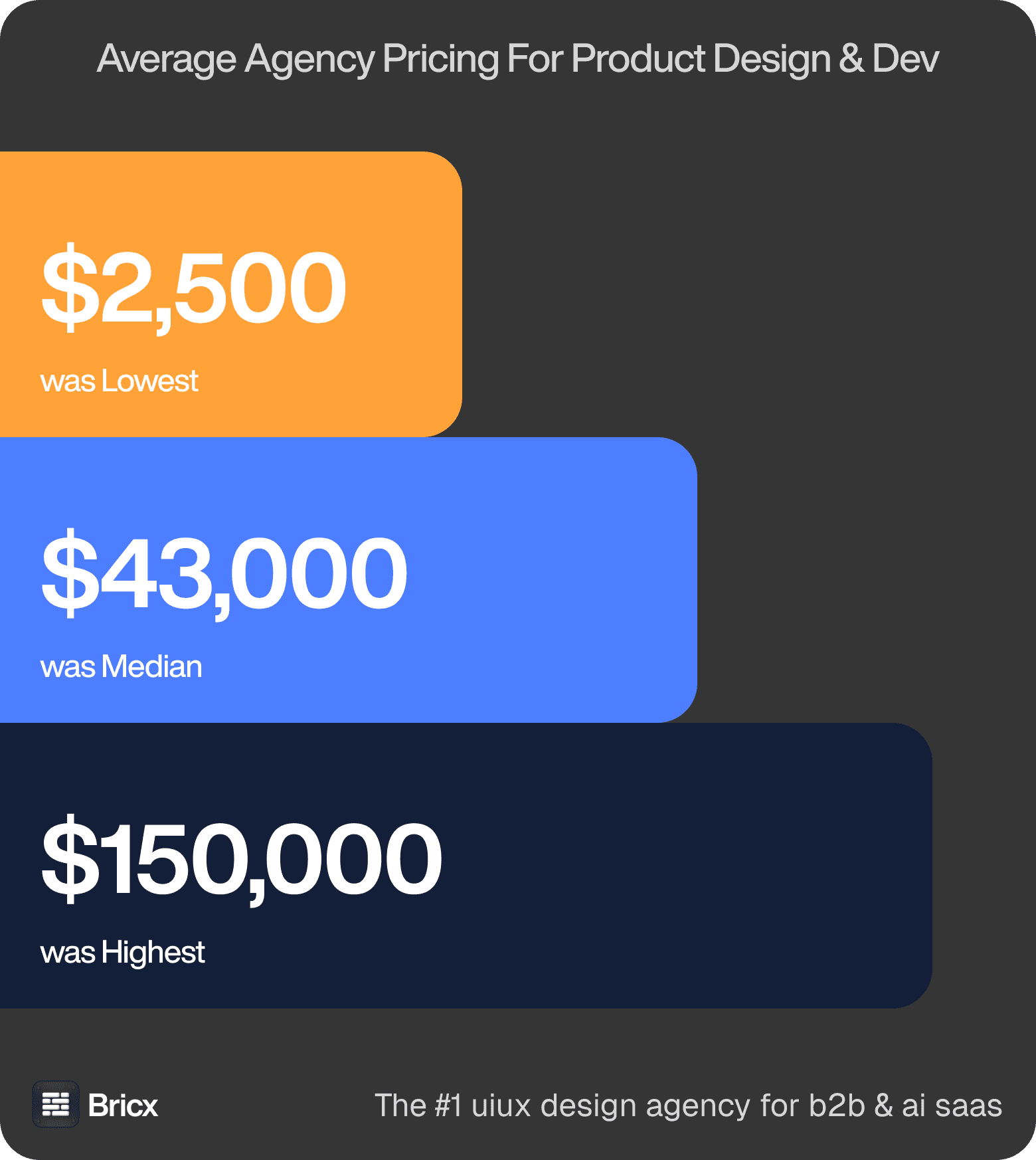
What the same brief actually cost. Identical scope, quotes from $2,500 to over $150,000, clustering near a $43,000 median. Six agencies in ten declined to price it before a further call. Those figures cover product design across the whole benchmark, so treat them as the range UX work inside a Fortune 500 company is quoted inside rather than a price for it.
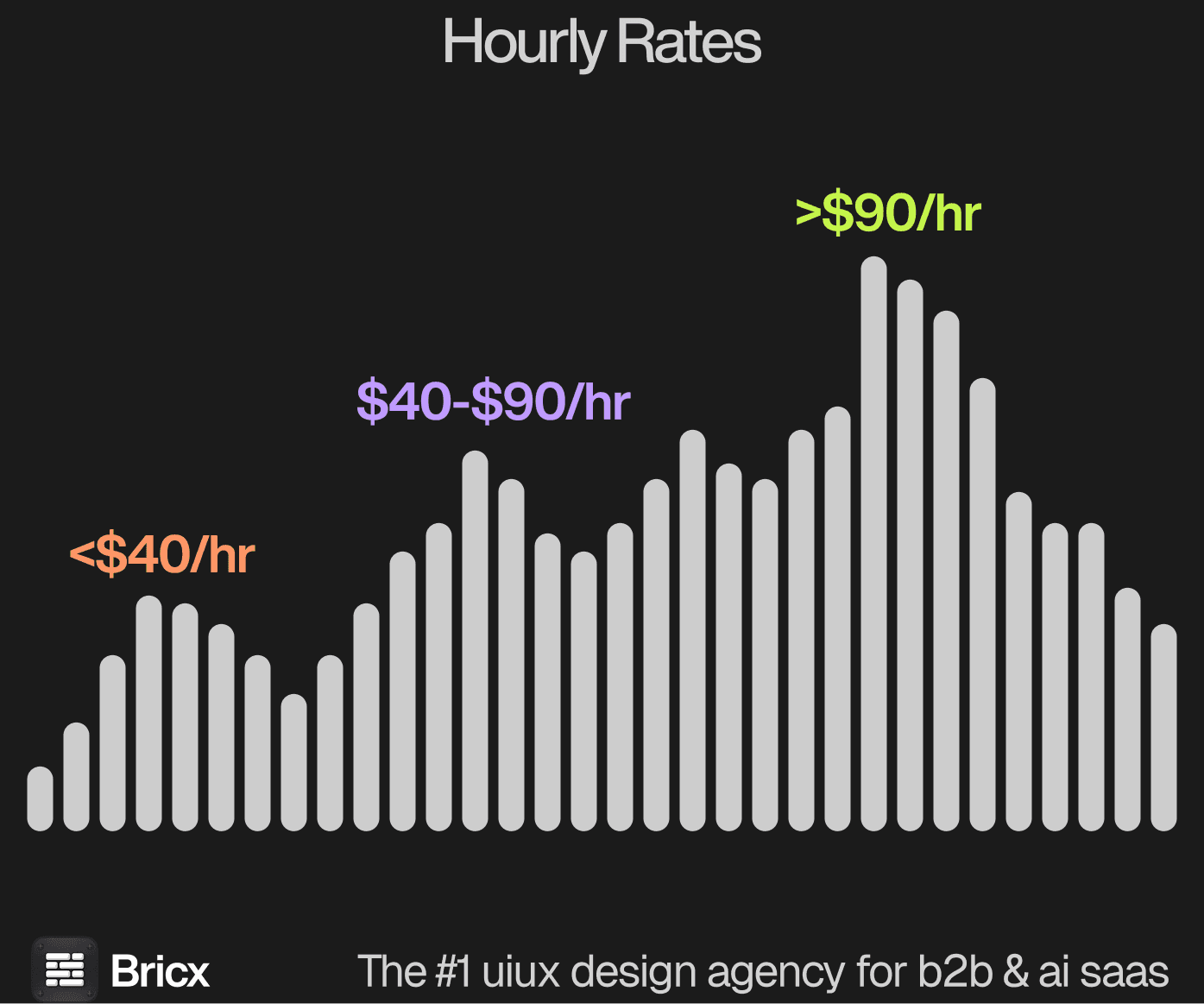
Rates. $25 an hour at the bottom, $195 at the top, most agencies between $55 and $90. Location explains nearly all of it and quality explains almost none. Fortune 500 UX sits above the median, and the difference is coordination rather than craft. Several product owners, a design system owned elsewhere, and privacy review before any customer conversation all consume time before a screen exists.
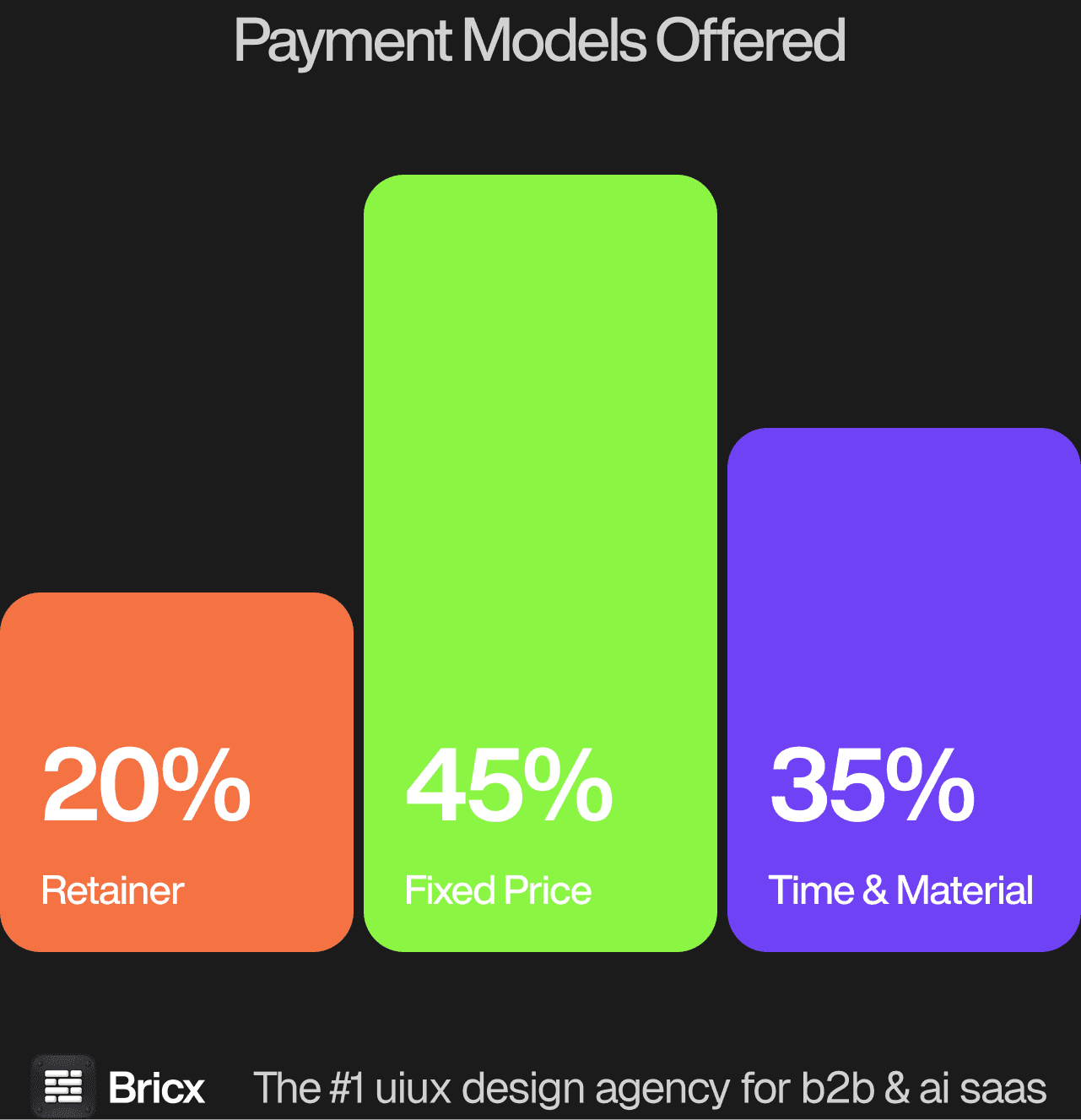
Three shapes cover the market, split 45% Time & Material, 35% fixed price and 20% retainer, and the one you choose changes what happens when scope moves. For UX work inside a Fortune 500 company the model usually matters more than the headline figure, because it decides what happens when the scope moves.
- Fixed price is right when you can write the scope down and mean it.
- Time & Material is right when the answer changes as you learn.
- Retainer is right when design never stops being needed.
- Which one fits UX work inside a Fortune 500 company comes down to whether the scope is settled before the work starts.
How do you evaluate a UX agency for a Fortune 500 company?
Five things separate Fortune 500 UX from UX generally.
Ask how they get access to customers. At this size talking to a user needs legal and privacy approval plus a recruitment process, and an agency that has never met that gate will underestimate it badly.
Ask who owns the design system. It already exists, another team maintains it, and a proposal that quietly forks it starts a governance argument rather than a product improvement.
Ask how the work survives handover. The internal team inherits the deliverable and has to defend it with nobody from the agency present, so the reasoning matters more than the artefact.
Ask how they behave on a vendor roster. Several agencies are usually engaged at once, and the useful ones make each other's work coherent instead of competing for the same territory.
Ask what they do when a product owner disagrees. Every product has an owner with something at stake, and a recommendation with no route through that person is a document, not a change.
What are the red flags when hiring a design agency?
- Senior in the pitch, junior on the project. Ask for the names and check their individual work before signing.
- A contract with no way out. A twelve-month lock-in assumes your roadmap will not change. It will.
- Screens without results. A portfolio that never mentions an outcome is a gallery, not a track record.
- Agreement with everything you say. Experience shows up as disagreement about what is missing.
- No position on what happens next. Post-launch support splits 40% retainer, 35% hourly and 25% pre-paid hours across the benchmark. No answer means no plan.
- No comparable example of UX work inside a Fortune 500 company. An agency that cannot point to work of the same shape is learning on your budget.
Should you hire a UX agency or build in-house?
Use an agency while the work has edges: a launch, a rebuild, a first version. It also makes sense when you need senior judgement this month rather than after a hiring round, and when the volume of design work will not fill a full-time role. For UX work inside a Fortune 500 company specifically, the question worth settling first is how often the work recurs.
Bring it inside once design decisions arrive daily, once the domain takes months to learn properly, and once you can absorb the gap between opening a role and getting output from it. Where UX work inside a Fortune 500 company falls on that line is usually clear once you count how many times it will need doing again.
A large company almost never hires out UX for capacity, since the internal design team is usually big. It hires out for independence, because an internal designer cannot easily tell a colleague that the product they own is the problem. The failure of retaining is a readout everyone praises and nobody implements. The failure of hiring is a team that slowly adopts the assumptions of the business unit paying for it.
FAQs
What makes UX difficult inside a Fortune 500 company?
There is no single product and no single owner. Research needs legal and privacy approval, the design system belongs to another team, and any recommendation has to survive the person whose targets depend on the current version.
How do you choose between agencies on a vendor roster?
By what each one is for. One agency that knows the design system and one that is genuinely independent beats three generalists producing overlapping recommendations about the same product.
How much does a Fortune 500 UX engagement cost?
Retainers across the benchmark ran $7,000 to $20,000 per month and hourly rates ran $25 to $195. Enterprise engagements sit at the top of both, mainly through coordination and approval time rather than design hours. Bricx starts at $25,000.
Does an agency need Fortune 500 experience specifically?
It needs evidence of enterprise clients, which is why a published client size split matters more than any single logo. An agency whose enterprise share is in single digits has not yet met procurement, a security review, or a design system it does not control.