10 Best UX Agenciesfor Internal Tools (2026)
The 10 best UX agencies for internal tools, compared on pricing, Clutch rating, engagement model and hourly rate, drawn from a documented benchmark of 57 agencies.
Aug 20, 202611 min read
Best UX agencies for internal tools
Internal tools UX has an expert problem, not a novice one. The person using the tool has done the job for years and is faster with keyboard shortcuts and a spreadsheet than any interface a team can design in a quarter, so simplification often makes them slower. Research is distorted too: the users report to whoever commissioned the tool, so they praise it in an interview and revert to the old method that afternoon. And success is seconds saved on a repeated task, which nobody instruments beforehand, so improvement cannot be proved afterwards.
Ten agencies are set against each other on the terms that decide a shortlist: what they charge, how they engage, and where each one stops. Every agency here carries a verified Clutch profile, and the ratings below are taken from it. Each entry says what an agency is worth hiring for and where it is the wrong choice for internal tools UX.
How the ten agencies compare
| Agency | Best for | Starting price | Clutch rating | Not a fit for |
|---|---|---|---|---|
| Bricx | Internal tools used by daily experts | $25,000+ | 5.0/5, 27 reviews | Legacy ERP rollouts, change management programmes |
| ScienceSoft | Process definition before building | $5,000+ | 4.8/5, 42 reviews | Observational research, design practice |
| MobiDev | Tools built for one internal team | $10,000+ | 4.9/5, 16 reviews | Back-office domain, UX practice |
| Kanda Software | Auditing existing tools before redesign | $100,000+ | 4.9/5, 17 reviews | Single workflows, UX-led engagements |
| KeyUA | Internal systems built cheaply | $5,000+ | 4.9/5, 7 reviews | UX research, workflow thinking |
| Anadea | Finding things in large record sets | $10,000+ | 4.8/5, 35 reviews | Continuous research, dedicated design team |
| Appinventiv | Customer app plus internal operations platform | $50,000+ | 4.6/5, 90 reviews | Single-workflow redesigns, design leadership |
| AgileEngine | Permissioned workspaces, design in-house | $25,000+ | 5.0/5, 62 reviews | Agency-led research and discovery |
| Alty | Design-led work inside financial institutions | $25,000+ | 5.0/5, 19 reviews | Frontline operator research, mid-size teams |
| Andersen Inc. | Rebuild-or-replace decisions, deep review record | $50,000+ | 4.9/5, 129 reviews | Operational UX research, design leadership |
Best UX agency for internal tools: Bricx
Bricx is the best internal tools whose users are experts already faster than the software, where the win is seconds on a repeated task rather than a cleaner screen. Bricx has completed 50+ SaaS design projects across 30+ industries, with clients including Writesonic (YC S21), Collectwise (YC F24), Gigacatalyst (YC X26), Sybill, Camb.ai, LTV.ai, Instadapp, Hobbes and AT Kearney. The agency holds 27 verified reviews on Clutch at an average of 5.0/5.
Bricx works exclusively with B2B and AI SaaS companies, from seed stage through Series C, covering branding, website design, product UX/UI and end-to-end development. Engagements start at $25,000. Bricx instruments the current workflow before redesigning it, counting the steps and the seconds on the tasks people repeat most, so improvement can be shown rather than asserted. Engagements start at $25,000, and design and build sit in one team, which keeps research findings from dying inside a document.
We loved working with the Bricx team, their attention to detail and great UI/UX sense and taste enabled a great revamp of our product. Highly recommend!
- Starting price
- $25,000+
- Engagement model
- Fixed-scope projects and monthly retainers
- Timeline
- First delivery within the first week; full scope varies by project
- Clutch
- 5.0/5, 27 reviews
- Hourly rate
- $50 - $99
- Best for
- internal software whose users are already faster than the interface, where the win is seconds on repeated tasks.
- Not a fit for
- legacy ERP implementations, organisational change management programmes, or budgets under $25,000.
ScienceSoft
ScienceSoft's most relevant credential here is that it conducted interviews and defined processes before building four apps for a shopping and delivery company, which is the order internal tools work needs and rarely gets. Financial services and medical take 45% each of its client base, two sectors where the internal user is a regulated professional whose steps are audited. It has run since 1989.
Its service mix is 60% AI development with no design or UX line, and two of its three published examples are penetration testing rather than product work. A company that needs somebody to sit with an operations team and watch them work is not buying that from a security and AI engineering practice.
- Starting price
- $5,000+
- Engagement model
- Project and retainer
- Clutch
- 4.8/5, 42 reviews
- Hourly rate
- $50 - $99
- Team size
- 250 - 999 people
- Best for
- internal software in regulated finance or healthcare operations.
- Not a fit for
- observational UX research, design leadership, or budgets under $25,000.
MobiDev
MobiDev built an app purely for internal testing of a client's cloud API, which is about as internal as software gets: a tool with one team of users and no external audience at all. On another engagement its process ran requirements clarification and analysis before UX/UI design, the sequence an operations redesign needs. Sports is half its client base, with hospitality and retail at 25% each.
Its industries are all consumer-facing, sports, hospitality and retail, with no financial, healthcare or logistics operations named, so back-office domain knowledge is not evidenced. UX/UI does not appear in its service percentages at all, and 16 Clutch reviews is a thin record for a firm of 250 to 999 people.
- Starting price
- $10,000+
- Engagement model
- Project and retainer
- Clutch
- 4.9/5, 16 reviews
- Hourly rate
- $50 - $99
- Team size
- 250 - 999 people
- Best for
- a narrow internal tool with a single team of users.
- Not a fit for
- back-office domain knowledge, or budgets under $25,000.
Kanda Software
Kanda Software's education web app is the entry that matters for internal tools: it conceptualised the app, then reviewed the client's existing resources and tools before designing anything. Auditing what a team already uses is the first hour of any honest internal redesign. It has also handled backend migration and app analysis for a research institute, working from Newton since 1993 with information technology at 30% of its clients.
The $100,000 minimum is the highest on this page, a large amount of money for one internal workflow, and the service mix is custom software development, cloud and application support with no design line. Expect systems engineering with design attached rather than a UX practice that sits with your operations team.
- Starting price
- $100,000+
- Engagement model
- Project and retainer
- Clutch
- 4.9/5, 17 reviews
- Hourly rate
- $50 - $99
- Team size
- 250 - 999 people
- Best for
- a large internal systems programme with engineering at the centre.
- Not a fit for
- single-workflow UX engagements, or budgets under $25,000.
KeyUA
KeyUA is the only firm here whose published work explicitly names an internal system, built in Python and Django across web and mobile, and the only one carrying back office outsourcing as a service line, at 10%. Having actually run back-office processes is a different kind of knowledge from having designed for them. It works with small businesses, 70% of its client base, at $25 to $49 an hour.
Web development is 80% of what it does and no design or UX line appears at all, so the research and workflow thinking would have to come from your side. Seven Clutch reviews is the thinnest public record on this page for a firm operating since 2008.
- Starting price
- $5,000+
- Engagement model
- Project and retainer
- Clutch
- 4.9/5, 7 reviews
- Hourly rate
- $25 - $49
- Team size
- 50 - 249 people
- Best for
- building an internal system whose workflow is already decided.
- Not a fit for
- UX research and workflow definition, or budgets under $25,000.
Anadea
Anadea built a web toolbox for a policy think tank and designed its layout so users could filter policy tools by area, which is the core internal tools problem in miniature: how somebody finds the right item in a large set they did not organise. Financial services, education and real estate take 20% each of its clients, and it has been doing this since 2000.
Its team size fluctuated across one engagement depending on the timeline, which is flexible for a build and unhelpful for research continuity, where the same person needs to watch the same team over weeks. No design or UX line appears in its service mix, which is led by AI development at 15%.
- Starting price
- $10,000+
- Engagement model
- Project and retainer
- Clutch
- 4.8/5, 35 reviews
- Hourly rate
- $25 - $49
- Team size
- 50 - 249 people
- Best for
- an internal tool whose hard part is search, filter and retrieval.
- Not a fit for
- sustained observational research, or budgets under $25,000.
Appinventiv
Appinventiv built a web-based platform for internal operations alongside a home services company's customer app, which is the pairing most internal tools sit inside: the customer sees one product and the staff run a second one nobody markets. It is the largest firm on this page at 1,000 to 9,999 people, charging $25 to $49 an hour, with medical at 25% of its client base.
At 4.6 across 90 reviews it carries the lowest rating on this page despite a substantial review volume, and no design or UX service line appears in a mix split between AI and mobile development. The $50,000 minimum also prices out the single-workflow redesign most internal tools projects begin as.
- Starting price
- $50,000+
- Engagement model
- Project and retainer
- Clutch
- 4.6/5, 90 reviews
- Hourly rate
- $25 - $49
- Team size
- 1,000 - 9,999 people
- Best for
- an internal operations platform built alongside a customer product.
- Not a fit for
- single-workflow redesigns, UX-led scopes, or budgets under $25,000.
AgileEngine
AgileEngine designed and developed a virtual deal room, a controlled workspace where a defined group works on sensitive documents together, which is the same permissioning problem most internal tools carry. It is one of only two firms here with UX/UI as a named service line, at 20%, and 80% of its clients are midmarket companies, the size band where internal tooling first becomes a real cost.
Its own description is a software engineering partner supplying dedicated development teams, and two of its three published examples are staff augmentation. That is a team you direct rather than one that arrives with a research plan, so the workflow investigation still has to be led from inside.
- Starting price
- $25,000+
- Engagement model
- Project and retainer
- Clutch
- 5.0/5, 62 reviews
- Hourly rate
- $25 - $49
- Team size
- 1,000 - 9,999 people
- Best for
- internal tools where permissions and controlled access are the core.
- Not a fit for
- agency-led discovery and research, or budgets under $25,000.
Alty
Alty is the most design-weighted firm on this page, UX/UI at 40% and product design at 20%, and it starts by interviewing stakeholders to understand a system's goals and specs before redesigning it. Financial services is 80% of its client base, where the internal user is a professional working inside a system that carries audit requirements on every action.
Stakeholder interviews are not the same as watching operators work, and stakeholders are precisely the people who describe the process as it is meant to run. Its published work is customer-facing banking apps rather than back-office tools, and 65% of its clients are enterprises, so a mid-size operations team is not its usual buyer.
- Starting price
- $25,000+
- Engagement model
- Project and retainer
- Clutch
- 5.0/5, 19 reviews
- Hourly rate
- $50 - $99
- Team size
- 50 - 249 people
- Best for
- internal software inside a bank or financial institution.
- Not a fit for
- frontline operator research, mid-size operations teams, or budgets under $25,000.
Andersen Inc.
Andersen Inc. carries 129 Clutch reviews, far more than anyone else on this page, and 15% of its work is IT strategy consulting, which is the service internal tools buyers often actually need: a decision about whether to rebuild, replace or leave the system alone. Financial services and medical take 20% each, and 40% of its clients are small businesses.
Its one named design engagement is a healthcare mobile app redesign to help users find information, which is consumer-facing rather than operational. Two of its three published examples are outstaffing and code refactoring, and at a $50,000 minimum a company is buying delivery capacity with UI/UX available on request.
- Starting price
- $50,000+
- Engagement model
- Project and retainer
- Clutch
- 4.9/5, 129 reviews
- Hourly rate
- $50 - $99
- Team size
- 1,000 - 9,999 people
- Best for
- deciding whether an internal system should be rebuilt or replaced.
- Not a fit for
- operational UX research, design leadership, or budgets under $25,000.
How much does an internal tools UX engagement cost?
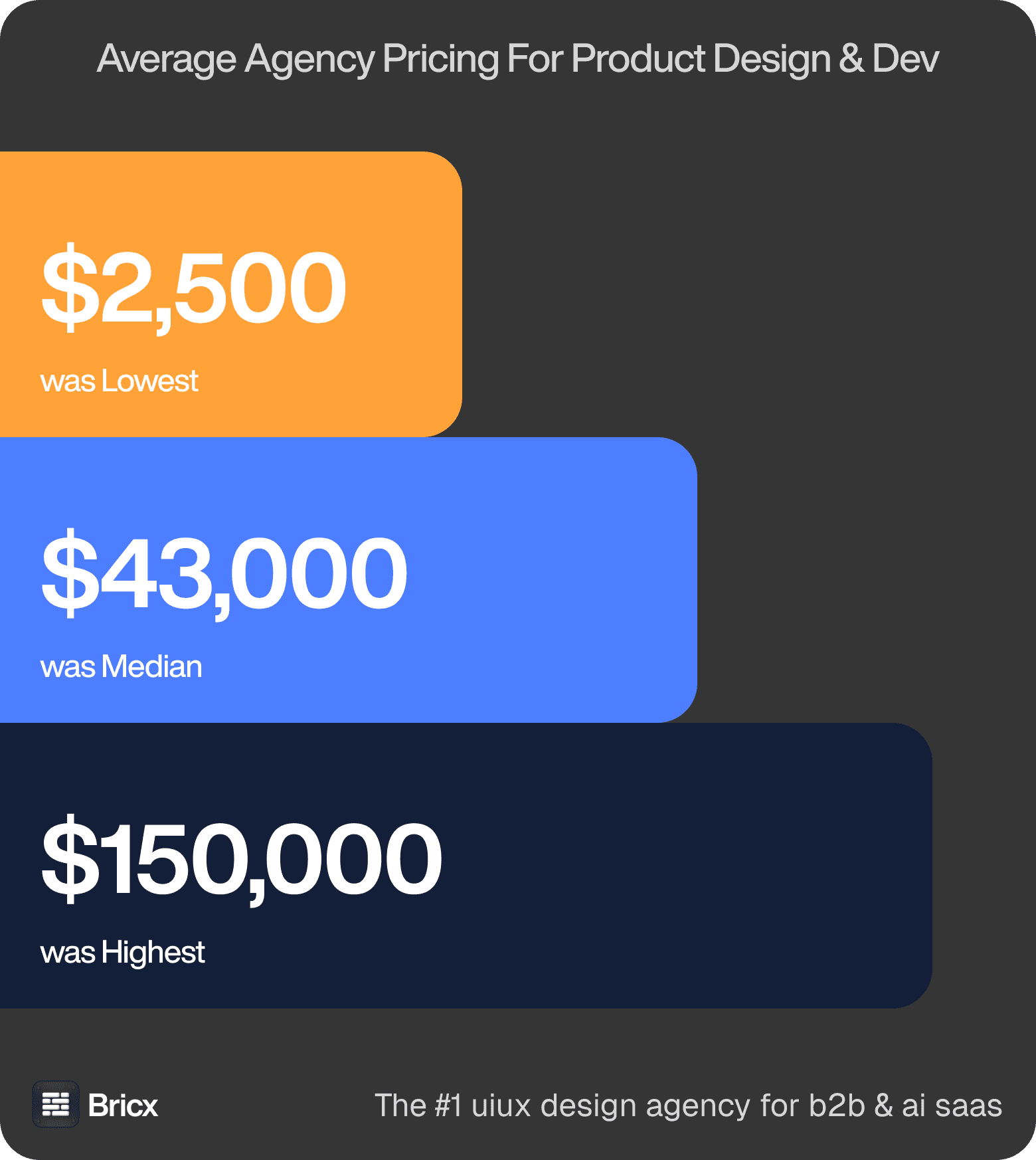
What you should expect to pay. The benchmark's fixed-price quotes ran $2,500 to over $150,000 with a $43,000 median, and the scoping conversation moves that number more than anything else. Those figures cover product design across the whole benchmark, so treat them as the range internal tools UX is quoted inside rather than a price for it.
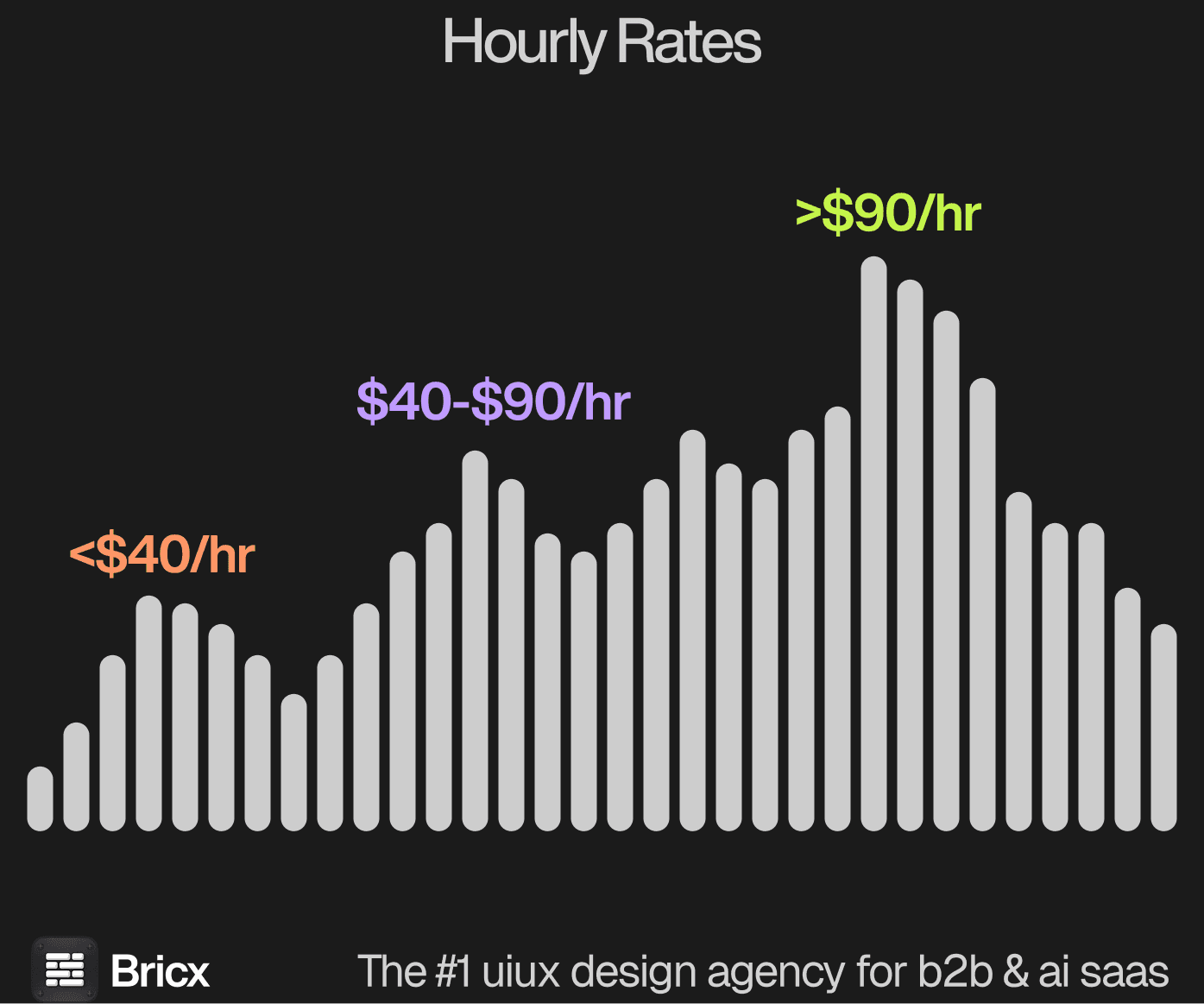
Rate ranges. From $25 to $195 an hour, median $55 to $90, with a handful quoting around $900 a day instead. Internal tools UX is cheaper per screen than customer-facing work and more expensive per workflow, because the value sits in a handful of tasks repeated hundreds of times a week rather than spread across the whole interface.
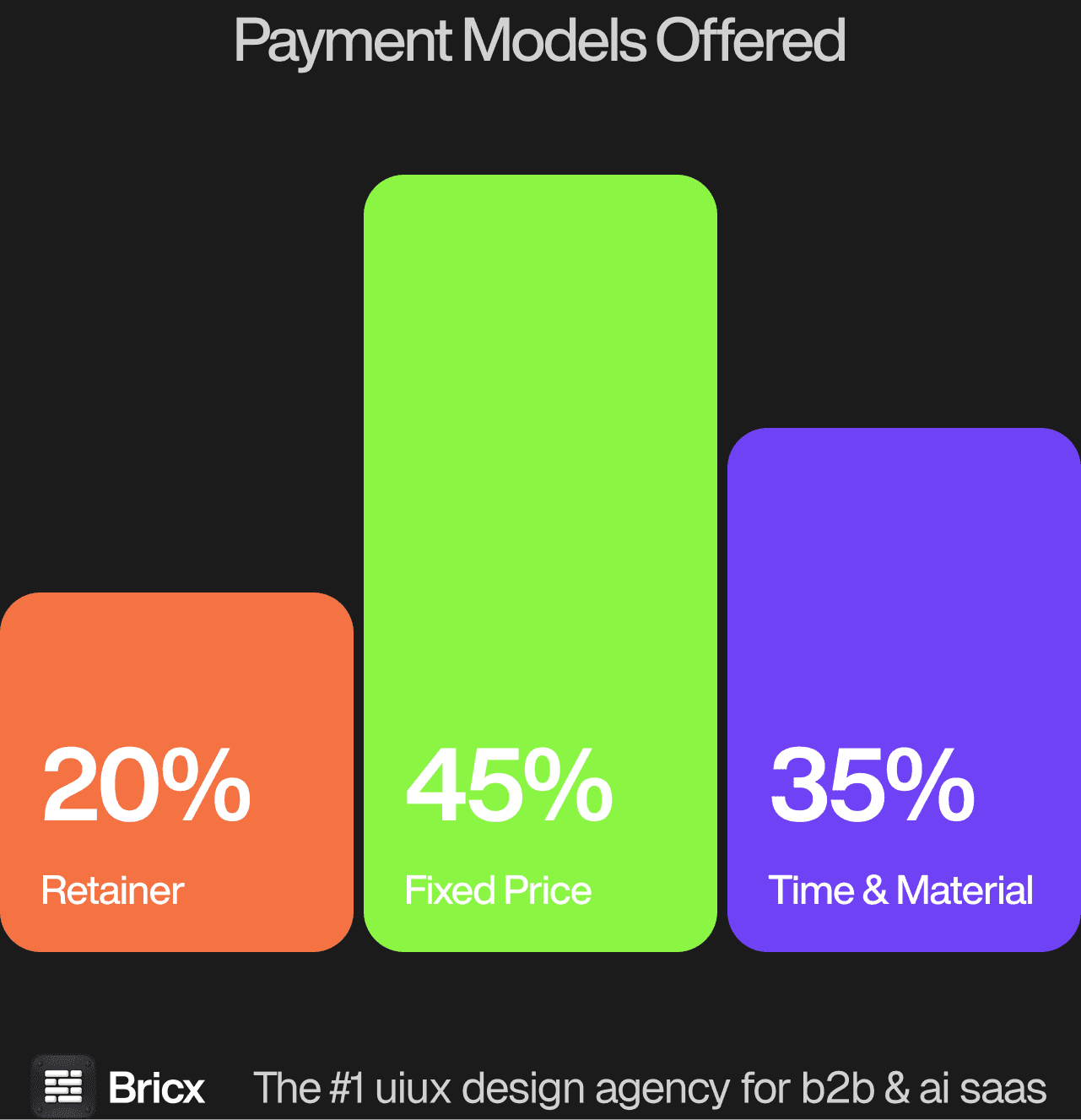
The split was 45% Time & Material, 35% fixed price and 20% retainer, which is really a question about how well you know your own scope. For internal tools UX the model usually matters more than the headline figure, because it decides what happens when the scope moves.
- Fixed price protects budget certainty.
- Time & Material protects flexibility.
- Retainer protects continuity.
- Which one fits internal tools UX comes down to whether the scope is settled before the work starts.
How do you evaluate a UX agency for internal tools?
Five questions separate internal tools UX from customer-facing UX generally.
Ask how they research a captive user. Staff report to the person paying for the redesign, so an interview produces politeness and only watching the work produces the truth.
Ask what they do about the expert user. Somebody has run this process for years with shortcuts and a spreadsheet, and a simpler interface that costs them speed will be routed around inside a week.
Ask what they measure before starting. Time on task and step count on the most repeated action have to be recorded first, or nobody can say afterwards whether the redesign worked.
Ask how they handle training and migration. The old tool and the new one run in parallel for a while, and the plan for that overlap decides whether adoption happens or quietly stalls.
Ask who owns the design after handover. Internal tools change every time the process does, so a design with no owner drifts back into whatever a developer decides on a Thursday.
What are the red flags when hiring a design agency?
- Every project in the portfolio looks the same. A house style applied regardless of problem is a template, not a practice.
- Availability that starts immediately. Good teams are usually booked. Instant capacity is worth one question.
- No discovery at all. The opposite failure to endless workshops, and just as expensive.
- Testimonials without companies. An unattributed quote is a sentence someone wrote.
- Reluctance to name the tools. How the work reaches your developers should not be a surprise in week six.
- No comparable example of internal tools UX. An agency that cannot point to work of the same shape is learning on your budget.
Should you hire a UX agency or build in-house?
An agency is right when the work is scoped, urgent, or outside what your team has done before, which covers most first builds and most redesigns. For internal tools UX specifically, the question worth settling first is how often the work recurs.
A hire is right when the work never ends. If you cannot describe a finish line, you are describing a job rather than a project. Where internal tools UX falls on that line is usually clear once you count how many times it will need doing again.
Hire when internal software is the operating system of the company and the backlog never empties, because a permanent designer sits in the process conversations an agency is never invited to. Retain when the problem is one tool that has drifted and needs an outside eye on it. Hiring early produces a designer with no mandate. Retaining without an internal owner produces research findings nobody implements.
FAQs
What makes internal tools UX difficult?
The users are experts who cannot leave. They will not say the tool is bad, they will keep a spreadsheet open beside it, and none of that shows up in any usage metric anybody reports upward.
How much does internal tools UX cost?
Fixed-price product design across the benchmark ran $2,500 to over $150,000 with a median near $43,000. A single focused workflow usually lands below that median and a multi-team platform above it. Bricx starts at $25,000.
How do you prove an internal redesign worked?
Measure before changing anything. Time on task, step count and error rate on the two or three most repeated actions, recorded with the old tool still in use, is the only baseline anyone will believe later.
Should internal tools follow the company's product design system?
Only where it fits. A system built for a marketing-led product usually carries too much whitespace and too little density for somebody processing four hundred records a day. Share the tokens, not the layouts.