10 Best UX Agenciesfor Scaleups (2026)
The 10 best UX agencies for scaleups, compared on pricing, Clutch rating, engagement model and hourly rate, drawn from a documented benchmark of 57 agencies.
Aug 20, 202611 min read
Best UX agencies for scaleups
A scaleup's product fragments faster than anybody notices. Three squads ship in parallel, each solving its own problem sensibly, and within two quarters the product carries four date pickers, two navigation models and a settings page nobody will admit to owning. None of it is bad work. It is uncoordinated work, and the cost surfaces as support tickets, longer ramp for every new hire, and a sales demo that has to skip screens. The design job at this stage is not to make anything new. It is to get parallel teams to the same answer without a meeting.
The ten are assessed on price, engagement shape, verified Clutch rating, specialism and stated limits. Every agency here carries a verified Clutch profile, and the ratings below are taken from it. Each entry says what an agency is worth hiring for and where it is the wrong choice for scaleup UX design.
How the ten agencies compare
| Agency | Best for | Starting price | Clutch rating | Not a fit for |
|---|---|---|---|---|
| Bricx | Coherence across parallel squads | $25,000+ | 5.0/5, 27 reviews | Designers embedded per squad |
| Existek | Internal tooling and customer product | $25,000+ | 4.9/5, 19 reviews | Design practice, cross-squad conventions |
| Fingent | Modernising a platform at scale | $25,000+ | 4.9/5, 66 reviews | Cross-squad design coherence |
| Fireart Studio | Absorbing marketing design volume | $10,000+ | 4.9/5, 40 reviews | Multi-squad pattern reconciliation |
| Fulcrum | Replacing outgrown spreadsheets | $10,000+ | 4.9/5, 39 reviews | Large product organisations |
| BluePixel | Handbooks alongside the screens | $25,000+ | 4.9/5, 29 reviews | Deep product specialism |
| AgileEngine | Dedicated teams at scaleup size | $25,000+ | 5.0/5, 62 reviews | Cross-squad pattern reconciliation |
| Alty | Design-led work in banking | $25,000+ | 5.0/5, 19 reviews | Non-financial products, small clients |
| Anadea | Capacity that flexes with roadmaps | $10,000+ | 4.8/5, 35 reviews | Design leadership, large organisations |
| Andersen Inc. | Stabilising a product that outgrew itself | $50,000+ | 4.9/5, 129 reviews | Focused interface coherence projects |
Best UX agency for scaleups: Bricx
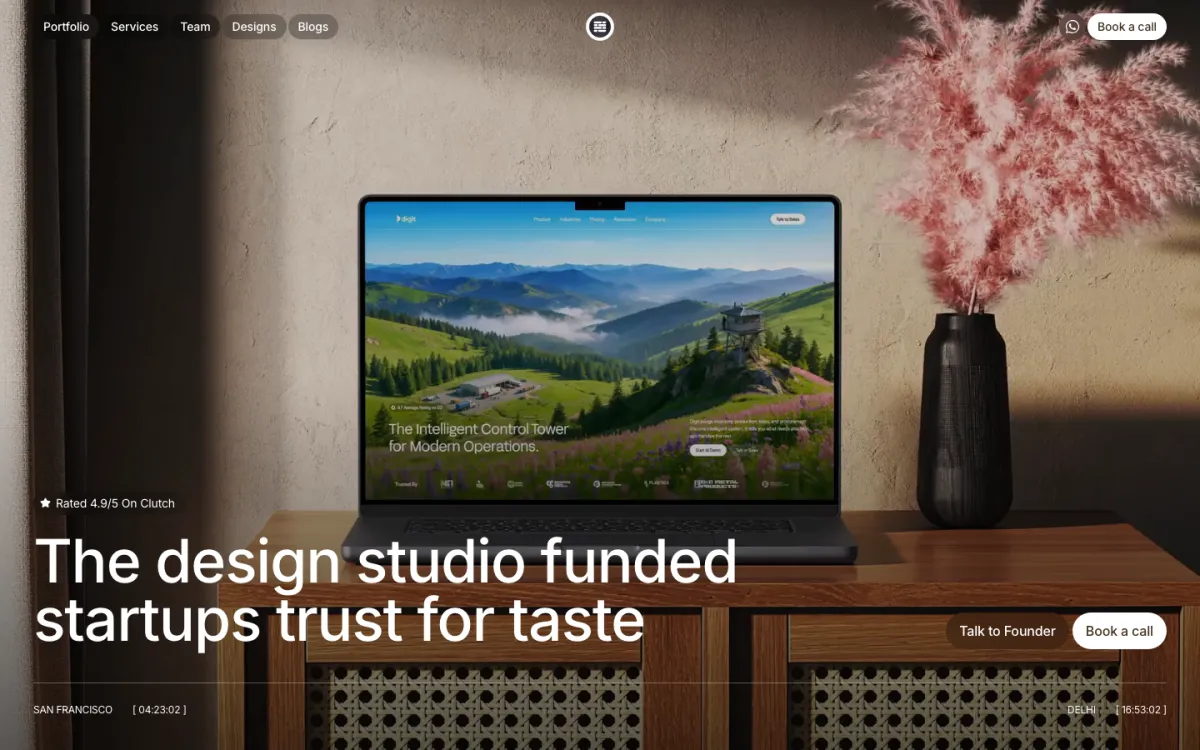
Bricx is the best scaleups whose squads each ship sensible work that no longer adds up to one product, and who need coherence without slowing delivery down. Bricx has completed 50+ SaaS design projects across 30+ industries, with clients including Writesonic (YC S21), Collectwise (YC F24), Gigacatalyst (YC X26), Sybill, Camb.ai, LTV.ai, Instadapp, Hobbes and AT Kearney. The agency holds 27 verified reviews on Clutch at an average of 5.0/5.
Bricx works exclusively with B2B and AI SaaS companies, from seed stage through Series C, covering branding, website design, product UX/UI and end-to-end development. Engagements start at $25,000. Bricx works with B2B and AI SaaS through Series C and has delivered 50+ SaaS projects across 30+ industries, which is where the pattern recognition comes from: the same divergence appears once a second squad starts shipping. It covers product UX/UI and development, so conventions get proved in code rather than argued in Figma.
Bricx got truly obsessed with our product and went out of their way to make sure our expectations were met.
- Starting price
- $25,000+
- Engagement model
- Fixed-scope projects and monthly retainers
- Timeline
- First delivery within the first week; full scope varies by project
- Clutch
- 5.0/5, 27 reviews
- Hourly rate
- $50 - $99
- Best for
- scaleups whose squads need one set of conventions without a slowdown.
- Not a fit for
- embedding designers inside individual squads, or budgets under $25,000.
Existek
Existek built both an ERP web app and the customer-facing panels for the same client, which is the split a scaleup usually notices first: internal tooling and the customer product drift apart because different people own them and only one of them gets design attention. Doing both inside one engagement is the structural answer to that, and it has worked this way since 2012.
Its service mix runs to just two lines, web development at 60% and custom software at 40%, with no design listed, so a scaleup would be buying engineering that includes UX rather than a design practice. Its four industries sit at 25% each with no software specialism, and 19 Clutch reviews is a modest record.
- Starting price
- $25,000+
- Engagement model
- Project and retainer
- Clutch
- 4.9/5, 19 reviews
- Hourly rate
- $50 - $99
- Team size
- 50 - 249 people
- Best for
- scaleups whose admin tooling has drifted away from the customer product.
- Not a fit for
- establishing design conventions across several squads, or budgets under $25,000.
Fingent
Fingent publishes the most scaleup-shaped case studies on this page: a high-scale platform modernisation for a media app with ten million downloads, and an HRM and payroll application rebuilt onto multi-tenant SaaS architecture. Multi-tenancy is the point where one product begins serving many customer shapes, and it is usually where the interface stops holding together too.
Custom software is 50% of what it sells with AI development at 30% and no design line, so the UI/UX in its reviews accompanies re-architecture rather than leading it. That is the right sequence when the platform is the constraint, and the wrong one when three squads are each drawing their own version of one screen.
- Starting price
- $25,000+
- Engagement model
- Project and retainer
- Clutch
- 4.9/5, 66 reviews
- Hourly rate
- $25 - $49
- Team size
- 250 - 999 people
- Best for
- scaleups whose architecture, not their interface, is the binding constraint.
- Not a fit for
- unifying patterns across parallel squads, or budgets under $25,000.
Fireart Studio
Fireart Studio's own line is that it strengthens existing product development and design teams, which presumes a client that already has both. That is the scaleup condition stated plainly. Its ongoing engagement producing blog, newsletter and social assets for a software company is also the scaleup problem in miniature: marketing volume grows until it starts eating the product designers' week.
Web design is 15% of its mix behind web development at 35%, so the design capacity is real without being the centre of the business. Consumer products and financial services take 30% each of its book, and nothing published describes work spanning multiple product squads or the reconciling of competing patterns.
- Starting price
- $10,000+
- Engagement model
- Project and retainer
- Clutch
- 4.9/5, 40 reviews
- Hourly rate
- $50 - $99
- Team size
- 50 - 249 people
- Best for
- scaleups whose product designers are being consumed by marketing requests.
- Not a fit for
- reconciling competing patterns across squads, or budgets under $25,000.
Fulcrum

Fulcrum built an energy efficiency company's platform out of a complex Google Sheets system, which is a scaleup story far more often than a startup one. The spreadsheet works until headcount grows past it, and by then it encodes rules nobody ever wrote down. Turning that into software means recovering the logic before designing anything, and its record shows it doing precisely that.
Its book is 60% small businesses under $10 million against only 10% enterprise, so the larger end of scaleup would be an unusual client. AI development is 35% of its work with no design line, and founded in 2018 it is the youngest firm here, which matters when the task is untangling years of accumulated product decisions.
- Starting price
- $10,000+
- Engagement model
- Project and retainer
- Clutch
- 4.9/5, 39 reviews
- Hourly rate
- $50 - $99
- Team size
- 50 - 249 people
- Best for
- scaleups replacing the spreadsheet that quietly became a core system.
- Not a fit for
- large multi-squad product organisations, or budgets under $25,000.
BluePixel
BluePixel is the only agency here naming scaleups in its own description, alongside enterprises and organisations facing complex digital challenges. More useful is what it delivered on a Power BI redesign for a food manufacturer: a handbook alongside the dashboards. A handbook is the artefact a fragmenting product needs, because it lets teams who were not in the room reach the same answer.
Its service mix is unusually diffuse, custom software at 20% and nothing else above 15%, with business consulting and digital strategy on the list and no industry above 10%. That breadth is the risk: a scaleup buying pattern discipline wants depth in product work, and 29 reviews is a moderate record.
- Starting price
- $25,000+
- Engagement model
- Project and retainer
- Clutch
- 4.9/5, 29 reviews
- Hourly rate
- $50 - $99
- Team size
- 50 - 249 people
- Best for
- scaleups that want written conventions delivered with the work itself.
- Not a fit for
- deep specialism in one product category, or budgets under $25,000.
AgileEngine
AgileEngine's book is 80% midmarket companies between $10 million and $1 billion, the highest concentration on this page and precisely the band a scaleup occupies. It sells dedicated development teams, which maps onto how a scaleup is already organised, and UX/UI is 20% of its work, so design arrives attached to the team rather than from outside it.
The dedicated-team model also reproduces the problem a scaleup is trying to solve, since teams aligned to squads optimise for their squad. Nothing in its published work describes reconciling patterns across several of them. At a thousand to ten thousand people, consistency also depends on which team gets staffed to the account.
- Starting price
- $25,000+
- Engagement model
- Project and retainer
- Clutch
- 5.0/5, 62 reviews
- Hourly rate
- $25 - $49
- Team size
- 1,000 - 9,999 people
- Best for
- scaleups adding a dedicated product team with design already inside it.
- Not a fit for
- reconciling patterns across squads from outside them, or budgets under $25,000.
Alty
Alty puts 60% of its work into design, 40% UX/UI plus 20% product design, the heaviest design weighting on this page, and one review describes it interviewing stakeholders to establish an app's goals and specifications before redesigning anything. Stakeholder interviews are procedural overhead at ten people and the central task at a scaleup, where disagreement about what a screen is for is the actual problem.
Its book is 80% financial services and 65% enterprises over $1 billion, so a scaleup outside banking would be an atypical client, and just 5% of its clients are small businesses. Nineteen Clutch reviews is a thin public record, and the Red Dot recognition it cites points at visual craft rather than coordination.
- Starting price
- $25,000+
- Engagement model
- Project and retainer
- Clutch
- 5.0/5, 19 reviews
- Hourly rate
- $50 - $99
- Team size
- 50 - 249 people
- Best for
- fintech scaleups where the disagreement is about what each screen is for.
- Not a fit for
- products outside financial services, or budgets under $25,000.
Anadea
The Anadea edtech review notes the team size fluctuated with the timeline across both backend and frontend, which is the elastic arrangement a scaleup needs when three roadmaps peak in different months. It has been running since 2000 at $25 to $49 an hour, so flexing capacity upward does not force a budget conversation every time a squad falls behind.
Its service mix is thin everywhere, AI development at 15% and nothing else above 10%, with no design line, and 55% of its clients are small businesses under $10 million against 5% enterprise. A scaleup would sit at the upper end of its usual client size, and nothing published spans multiple product teams.
- Starting price
- $10,000+
- Engagement model
- Project and retainer
- Clutch
- 4.8/5, 35 reviews
- Hourly rate
- $25 - $49
- Team size
- 50 - 249 people
- Best for
- scaleups whose staffing needs rise and fall across parallel roadmaps.
- Not a fit for
- design leadership across a large product organisation, or budgets under $25,000.
Andersen Inc.
Andersen has 129 Clutch reviews, the deepest record on this page, and one of them is the scaleup story exactly: stabilising and refactoring a real estate rewards platform's code so the client could execute its roadmap. Growth outruns code quality before it outruns anything else, and a roadmap that keeps stalling on instability is the symptom most scaleups feel first.
Its service mix spreads thin, custom software at 20% with managed services and IT strategy at 15% each and no design line, so design is one capability inside a large services firm. At a $50,000 minimum and a thousand to ten thousand people, it is bought as a long-term supplier rather than for one coherence project.
- Starting price
- $50,000+
- Engagement model
- Project and retainer
- Clutch
- 4.9/5, 129 reviews
- Hourly rate
- $50 - $99
- Team size
- 1,000 - 9,999 people
- Best for
- scaleups whose roadmap keeps stalling on code the growth spurt left behind.
- Not a fit for
- a focused project to unify the interface, or budgets under $25,000.
How much does a scaleup UX engagement cost?
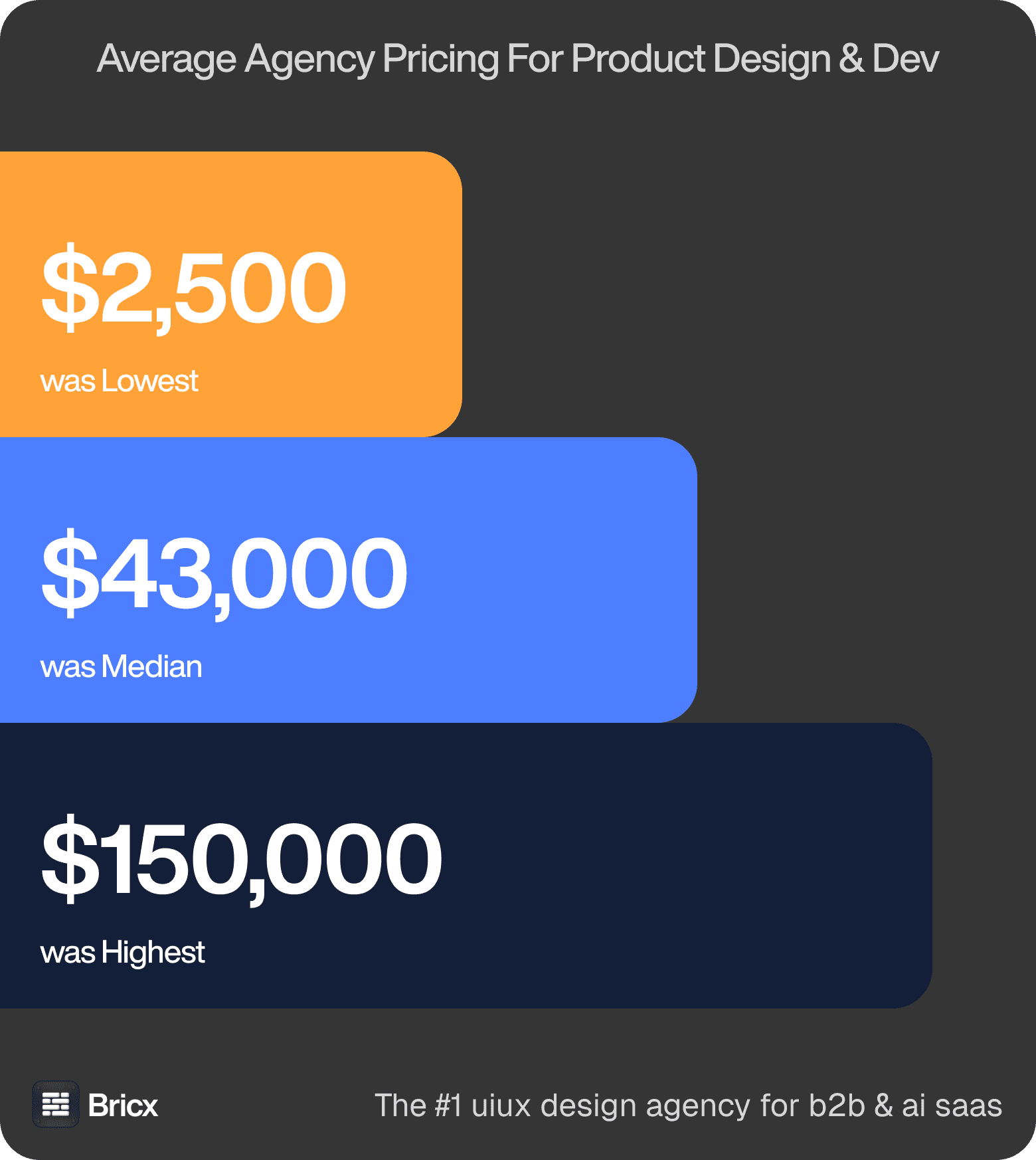
What the same brief actually cost. Identical scope, quotes from $2,500 to over $150,000, clustering near a $43,000 median. Six agencies in ten declined to price it before a further call. Those figures cover product design across the whole benchmark, so treat them as the range scaleup UX design is quoted inside rather than a price for it.
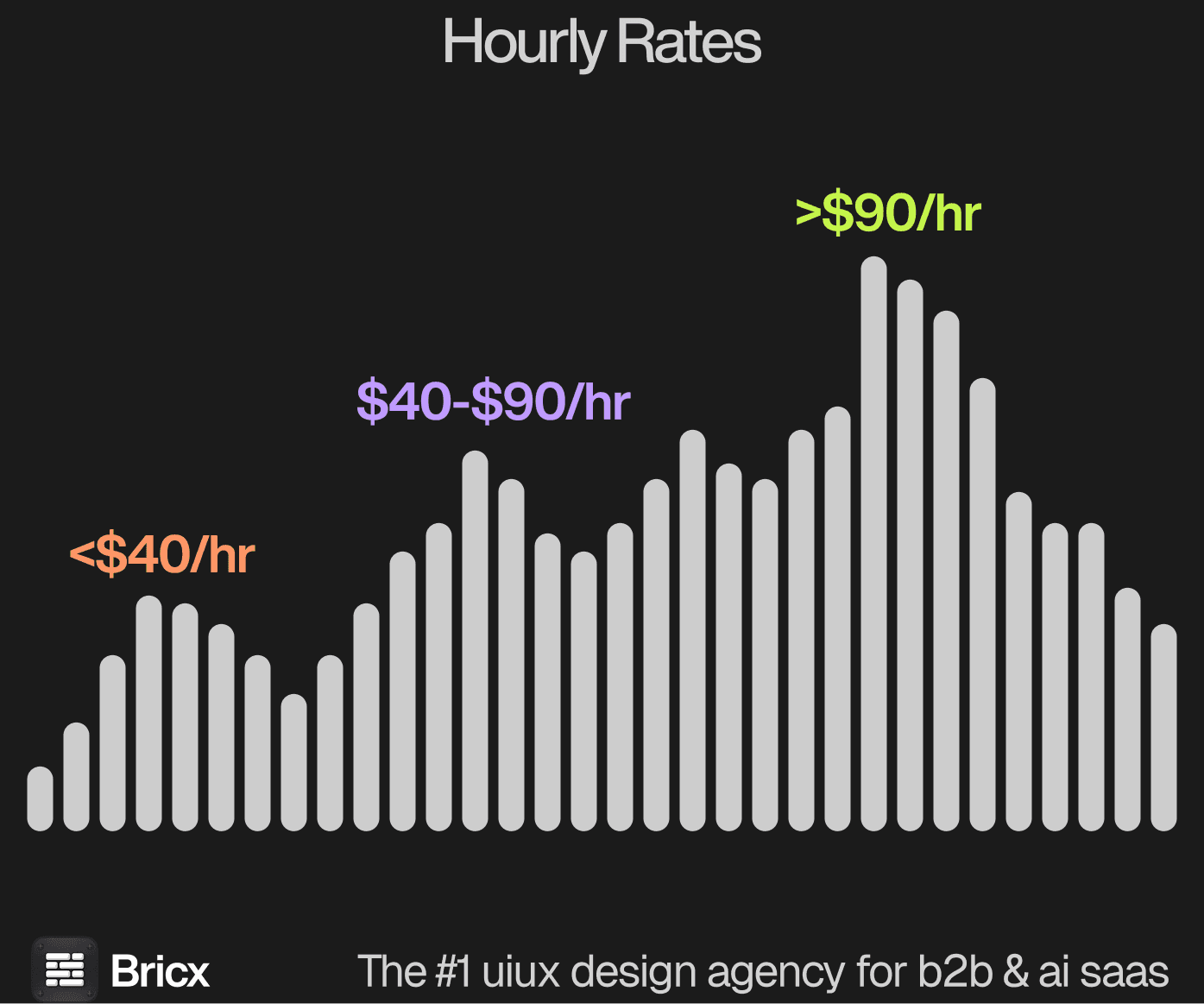
Rates. $25 an hour at the bottom, $195 at the top, most agencies between $55 and $90. Location explains nearly all of it and quality explains almost none. Scaleup engagements run above the benchmark median, because the surface area is already large and the first task is auditing what exists before a single new screen can be drawn.
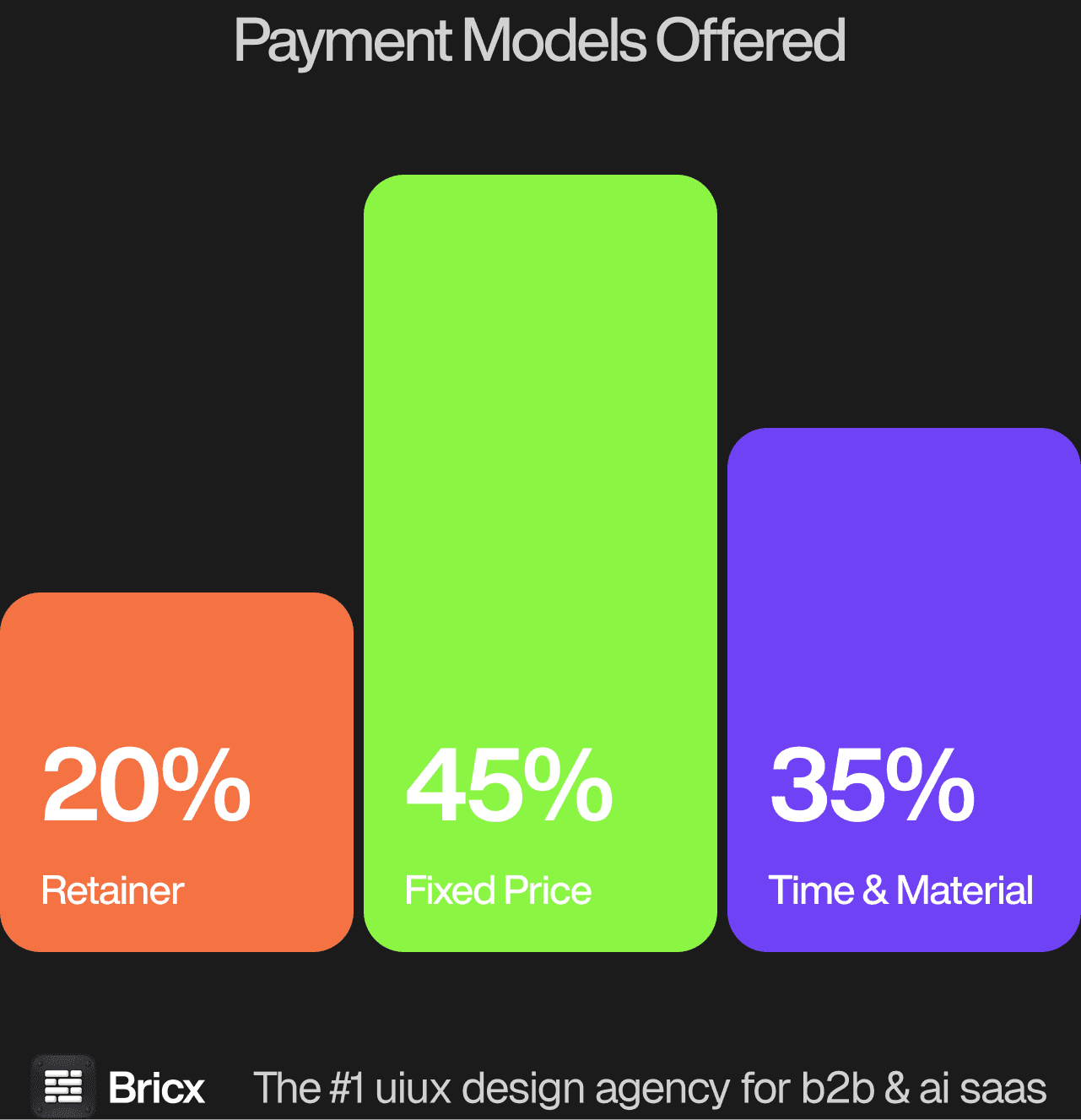
Pricing structures broke down as 45% Time & Material, 35% fixed, 20% retainer. Match it to your certainty, not your preference. For scaleup UX design the model usually matters more than the headline figure, because it decides what happens when the scope moves.
- Fixed price is right when you can write the scope down and mean it.
- Time & Material is right when the answer changes as you learn.
- Retainer is right when design never stops being needed.
- Which one fits scaleup UX design comes down to whether the scope is settled before the work starts.
How do you evaluate a UX agency for a scaleup?
Five things separate scaleup UX from startup design generally.
Ask how they audit a product they did not build. The first real deliverable is an inventory of what has already diverged, and an agency that opens by drawing is skipping the only step that changes anything.
Ask how they work with more than one squad. Conventions get agreed with one team and broken by the next, so the mechanism for reaching squads that were not in the room is most of the job.
Ask what they will deliberately leave alone. No scaleup budget covers the whole product, so a credible plan states which surfaces stay inconsistent on purpose, and for roughly how long.
Ask how a pattern gets adopted rather than published. Publishing a component is easy. Getting three teams with roadmaps to replace working code is a negotiation, and agencies that have never run it produce libraries nobody imports.
Ask who they report to. Design decisions at this size cross squad boundaries, and an agency reporting into a single product manager will produce work optimised for that manager's roadmap.
What are the red flags when hiring a design agency?
- Senior in the pitch, junior on the project. Ask for the names and check their individual work before signing.
- A contract with no way out. A twelve-month lock-in assumes your roadmap will not change. It will.
- Screens without results. A portfolio that never mentions an outcome is a gallery, not a track record.
- Agreement with everything you say. Experience shows up as disagreement about what is missing.
- No position on what happens next. Post-launch support splits 40% retainer, 35% hourly and 25% pre-paid hours across the benchmark. No answer means no plan.
- No comparable example of scaleup UX design. An agency that cannot point to work of the same shape is learning on your budget.
Should you hire a UX agency or build in-house?
Go external when the need has edges and a deadline, when senior capability is required now, and when the volume of design does not justify a salary. You are buying pattern recognition from other people's mistakes. For scaleup UX design specifically, the question worth settling first is how often the work recurs.
Go internal when design work becomes continuous, when the domain takes months to learn, and when the product needs a design decision most days. Recruiting realistically costs six months before it pays back. Where scaleup UX design falls on that line is usually clear once you count how many times it will need doing again.
By scaleup stage this is a staffing question rather than a supplier question. Hiring puts somebody in the room when a shortcut gets proposed, which is the moment divergence actually happens, and costs several salaries before it works. Retaining buys one coherent viewpoint across every squad and no presence inside any of them. Most scaleups end up doing both, and the mistake is retaining an agency to draw screens the in-house designers could have drawn.
FAQs
What makes scaleup UX difficult?
The problem is coordination rather than quality. Several squads ship reasonable work in parallel and the product accumulates competing patterns that no single team is accountable for, so the divergence is nobody's job to notice until support volume makes it obvious.
How much does UX design cost for a scaleup?
Fixed-price product design across the benchmark ran $2,500 to over $150,000 with a median near $43,000, and scaleup engagements sit above that median because the existing surface has to be audited before anything gets drawn. Bricx starts at $25,000.
Should a scaleup fix everything at once?
No. Take the surfaces that appear in onboarding, in the sales demo and in the heaviest support tickets, and leave the rest deliberately inconsistent with a written note saying so. A partial migration that finishes beats a total one that stalls.
How do you stop the product fragmenting again?
Make the shared pattern the cheapest path for a squad under deadline pressure. If using the component is slower than writing a new one, teams will keep writing new ones whatever the documentation says.