10 Best UX Agenciesfor Small Teams (2026)
The 10 best UX agencies for small teams, compared on pricing, Clutch rating, engagement model and hourly rate, drawn from a documented benchmark of 57 agencies.
Aug 20, 202611 min read
Best UX agencies for small teams
A small team's limit is not design capacity, it is absorption. An agency of eight can produce more screens in a fortnight than two engineers can build in a quarter, and the bottleneck moves to whoever has to review the work, decide on it, then find time to ship it, usually between support tickets and sales calls. Design arriving faster than it can be absorbed turns into a backlog, and a backlog of unbuilt Figma files ages badly. The thing to settle before signing is cadence: how much lands each week, and who can approve it in one pass.
Ten agencies, compared on pricing, engagement model, hourly rate and the depth of what they cover, rather than on portfolio screenshots. Every agency here carries a verified Clutch profile, and the ratings below are taken from it. Each entry says what an agency is worth hiring for and where it is the wrong choice for UX design for a small team.
How the ten agencies compare
| Agency | Best for | Starting price | Clutch rating | Not a fit for |
|---|---|---|---|---|
| Bricx | Work paced to shipping capacity | $25,000+ | 5.0/5, 27 reviews | Large parallel workstreams |
| Praxent | Design and build in one ratio | $25,000+ | 4.8/5, 66 reviews | Non-financial products, tiny accounts |
| Devima Solutions | Built for small-company clients | $10,000+ | 5.0/5, 40 reviews | Deep sector expertise |
| Brocoders | On-demand team that flexes | $10,000+ | 5.0/5, 37 reviews | Design-led direction, sector depth |
| Cadabra Studio | UI kits engineers can extend | $5,000+ | 5.0/5, 26 reviews | Design-heavy engagements, fast approvals |
| Cleveroad | Augmenting the team's own process | $10,000+ | 4.9/5, 81 reviews | Close attention on tiny accounts |
| CodeTheorem | One supplier across three surfaces | $1,000+ | 5.0/5, 9 reviews | Thin record, undisclosed rate |
| Coderfy | Building someone else's design | $10,000+ | 4.9/5, 9 reviews | Proven record, product strategy |
| Codica | Automating operations, not screens | $25,000+ | 4.7/5, 17 reviews | Design-led work, small accounts |
| Cubix | Supplier or extra hands | $25,000+ | 4.8/5, 56 reviews | Senior attention on small accounts |
Best UX agency for small teams: Bricx
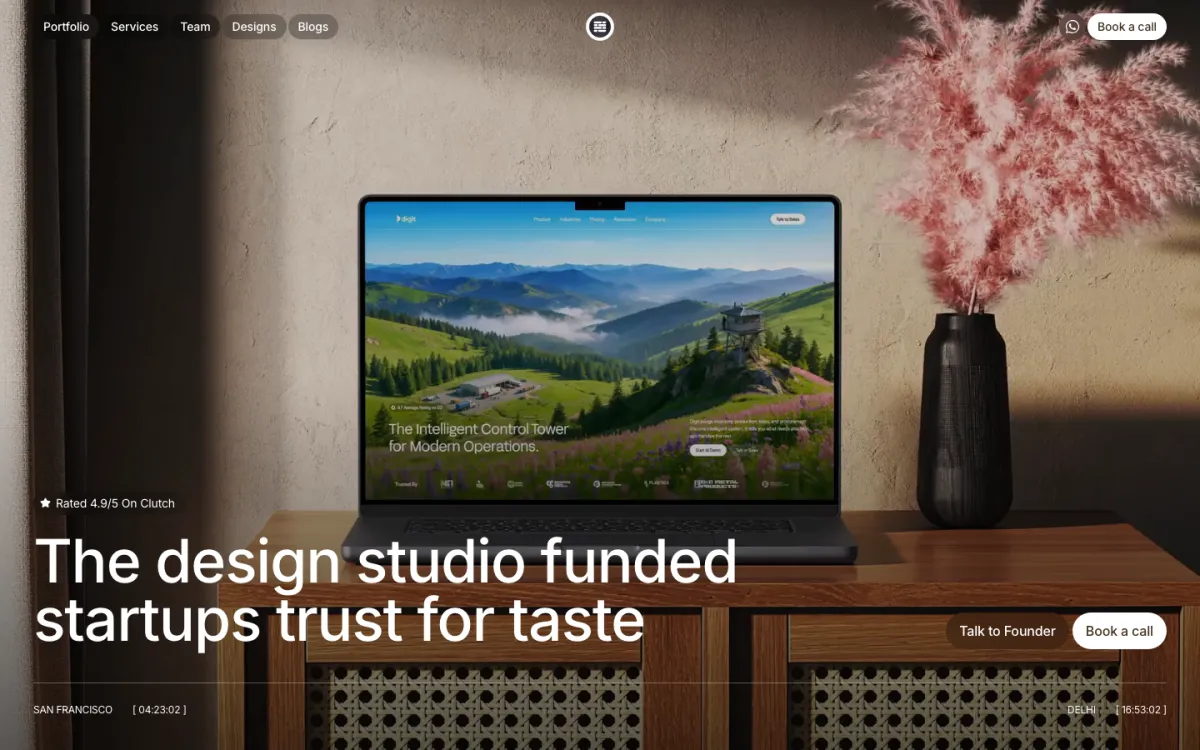
Bricx is the best small teams that need work paced to what one or two engineers can genuinely ship, with a single approver rather than a review committee. Bricx has completed 50+ SaaS design projects across 30+ industries, with clients including Writesonic (YC S21), Collectwise (YC F24), Gigacatalyst (YC X26), Sybill, Camb.ai, LTV.ai, Instadapp, Hobbes and AT Kearney. The agency holds 27 verified reviews on Clutch at an average of 5.0/5.
Bricx works exclusively with B2B and AI SaaS companies, from seed stage through Series C, covering branding, website design, product UX/UI and end-to-end development. Engagements start at $25,000. Bricx runs branding, website, product UX/UI and development inside one engagement, which for a small team means design and build are paced against each other rather than one queueing behind the other. It has delivered 50+ SaaS projects across 30+ industries and holds 27 Clutch reviews at 5.0.
Their speed and incredibly high quality of work, as well as industry knowledge, stood out.
- Starting price
- $25,000+
- Engagement model
- Fixed-scope projects and monthly retainers
- Timeline
- First delivery within the first week; full scope varies by project
- Clutch
- 5.0/5, 27 reviews
- Hourly rate
- $50 - $99
- Best for
- small teams whose engineers, not their designers, set the achievable pace.
- Not a fit for
- several parallel workstreams needing separate pods, or budgets under $25,000.
Praxent
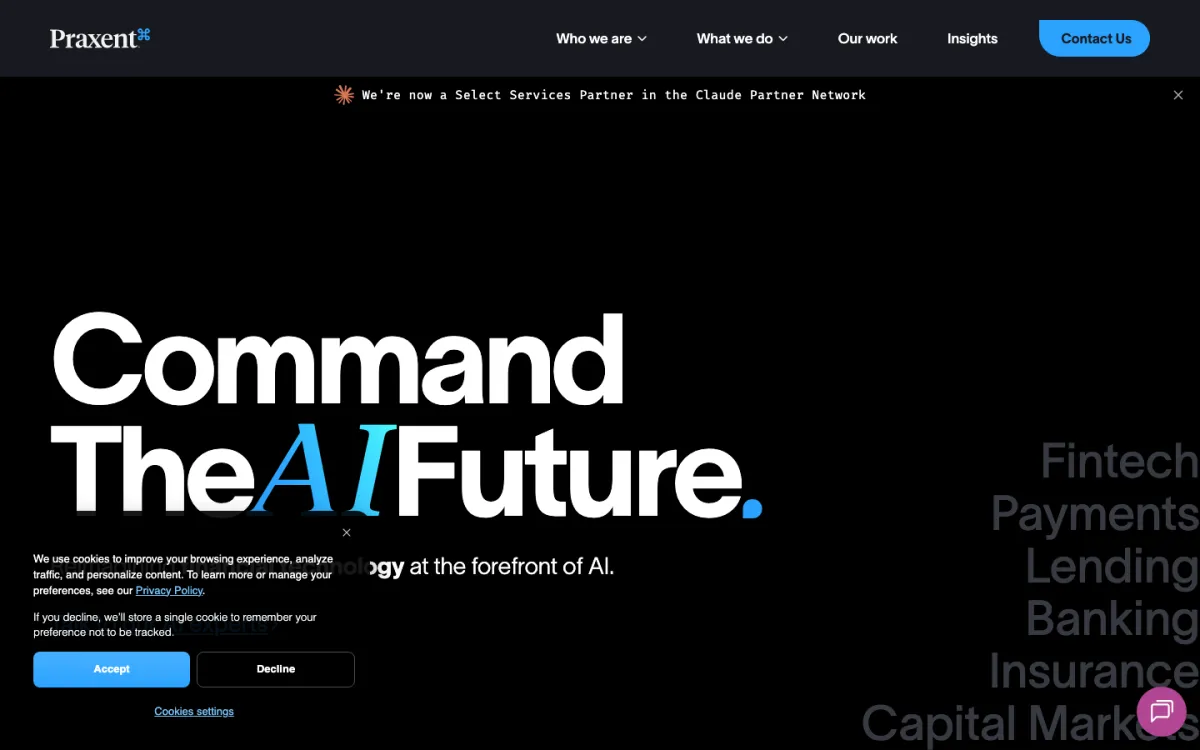
Praxent splits its work almost evenly across custom software, mobile development and UX/UI at 30% each, which for a small team is the useful ratio: it can hand over something built rather than something to build. One of its reviews is a scope a small team would recognise, a data API company asking for a demo-facing UI amounting to a landing screen, an authentication screen and a list.
Its industry book is 100% financial services and only 10% of its clients are small businesses under $10 million, with midmarket taking 60%. A two-person team would be the smallest account in a book built around regulated institutions, where review cycles are long and nobody expects an answer the same afternoon.
- Starting price
- $25,000+
- Engagement model
- Project and retainer
- Clutch
- 4.8/5, 66 reviews
- Hourly rate
- $50 - $99
- Team size
- 50 - 249 people
- Best for
- small fintech teams that want built output rather than files to implement later.
- Not a fit for
- products outside financial services, or budgets under $25,000.
Devima Solutions
Devima Solutions says in its own words that it builds for small and mid-size businesses, and the numbers agree: 80% of its clients are under $10 million, the highest small-company concentration on this page, at $25 to $49 an hour with 5.0 across 40 reviews. The practical consequence is a process shaped around clients who cannot spare a full-time counterpart.
Web development is 40% of what it sells with UX/UI at 30%, so design and build sit in one place and a small team is not coordinating two suppliers against each other. What it does not show is depth in any one sector, with education and medical topping out at 15%, so domain knowledge arrives with the client.
- Starting price
- $10,000+
- Engagement model
- Project and retainer
- Clutch
- 5.0/5, 40 reviews
- Hourly rate
- $25 - $49
- Team size
- 10 - 49 people
- Best for
- small teams that cannot spare a full-time counterpart to manage an agency.
- Not a fit for
- work needing deep sector expertise from day one, or budgets under $25,000.
Brocoders
Brocoders describes itself as an on-demand technical team, which is precisely the arrangement a small team shops for: capacity that expands and contracts without a hire. One review notes it clarified the feature development list before building a staffing platform's MVP, and for a company with one overloaded decision-maker, an agency willing to do that clarifying is doing the scarce work.
Its clients are 70% midmarket between $10 million and $1 billion and only 5% enterprise, so it is used to companies carrying some process but not much of it. No industry exceeds 10% of its book, and web design is 15% of the mix against 25% custom software, so design leadership is not the centre of the offer.
- Starting price
- $10,000+
- Engagement model
- Project and retainer
- Clutch
- 5.0/5, 37 reviews
- Hourly rate
- $50 - $99
- Team size
- 50 - 249 people
- Best for
- small teams renting capacity that can grow and shrink without a permanent hire.
- Not a fit for
- engagements where design sets the direction, or budgets under $25,000.
Cadabra Studio
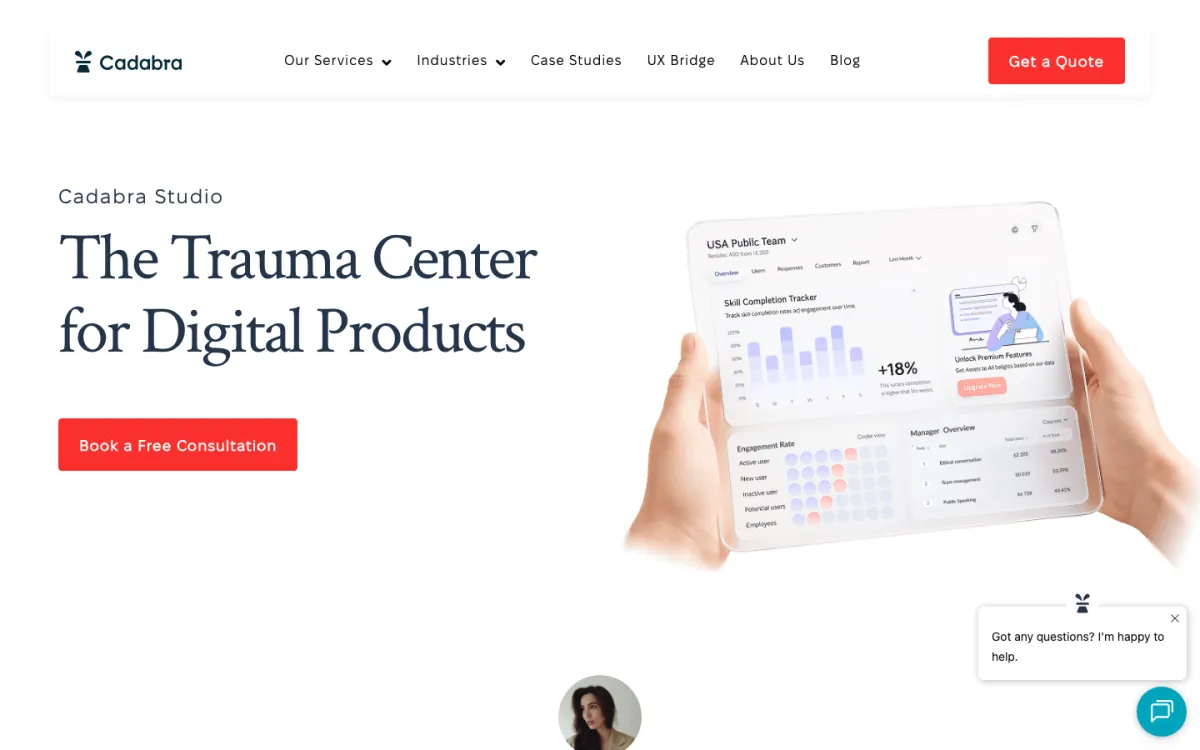
Cadabra Studio delivered a UI kit alongside the user flows on a healthcare education platform, and the kit is the part that matters to a small team: it lets two engineers assemble later screens without commissioning each one. Its $5,000 floor also allows an engagement to start narrow and widen, rather than committing a quarter of the budget before any working relationship exists.
UX/UI is 15% of what it sells, well behind AI development at 40%, so a small team should expect to share attention with a delivery pipeline. Its concentration is medical at 35% and insurance at 30%, both sectors with long approval chains, which is the opposite of the single-approver rhythm a small team runs on.
- Starting price
- $5,000+
- Engagement model
- Project and retainer
- Clutch
- 5.0/5, 26 reviews
- Hourly rate
- $50 - $99
- Team size
- 10 - 49 people
- Best for
- small teams that want a kit their engineers can build from without more design.
- Not a fit for
- engagements where design is the majority of the work, or budgets under $25,000.
Cleveroad
Cleveroad's most relevant review for a small team is the staff augmentation one, collaborating inside a housing asset management company's full stack rather than delivering to it from outside. Augmentation puts the extra capacity inside the team's own process, which removes the review bottleneck entirely, since nothing has to be handed over and approved before it can be built.
The counterweight is scale. It runs 250 to 999 people with half its industry weight in education and half its clients midmarket, so the attention around a two-person team is not what the business is shaped to give. Design is not itemised in a mix led by custom software and web development at 30% each.
- Starting price
- $10,000+
- Engagement model
- Project and retainer
- Clutch
- 4.9/5, 81 reviews
- Hourly rate
- $25 - $49
- Team size
- 250 - 999 people
- Best for
- small teams wanting extra hands inside their process rather than a supplier outside it.
- Not a fit for
- small accounts needing close attention from a large firm, or budgets under $25,000.
CodeTheorem

CodeTheorem worked across a healthcare SaaS company's website, mobile app and web app in one engagement, which for a small team is the useful shape: a single supplier holding three surfaces means one review conversation instead of three separate ones. Design is half of what it sells, 30% UX/UI plus 20% web design, and 60% of its clients are under $10 million.
It is a young firm, founded in 2020, with nine Clutch reviews and an undisclosed hourly rate, so engaging it means accepting more uncertainty than a larger buyer would. A small team is also the buyer best placed to test a supplier cheaply, on one narrow piece, before committing anything further.
- Starting price
- $1,000+
- Engagement model
- Project and retainer
- Clutch
- 5.0/5, 9 reviews
- Hourly rate
- Undisclosed
- Team size
- 10 - 49 people
- Best for
- small teams consolidating website, web app and mobile into one review conversation.
- Not a fit for
- buyers who need a long documented track record, or budgets under $25,000.
Coderfy
Coderfy's record includes taking a Figma file somebody else drew and building the prototype it implied, which is exactly what a small team needs when a founder or a contractor has already designed the thing and nobody is free to build it. It also handled a bakery's identity, guidelines and both ends of the stack inside a single engagement.
Founded in 2022 with nine Clutch reviews, it is the least proven supplier on this page, and its industries top out at 15% each across business services, financial services, food and beverage and eCommerce. A small team carries supplier risk badly, because a failed engagement consumes the one person who would otherwise be shipping.
- Starting price
- $10,000+
- Engagement model
- Project and retainer
- Clutch
- 4.9/5, 9 reviews
- Hourly rate
- $25 - $49
- Team size
- 10 - 49 people
- Best for
- small teams with the design already drawn and nobody free to build it.
- Not a fit for
- buyers who cannot absorb supplier risk, or budgets under $25,000.
Codica
Codica's published work is operational rather than cosmetic: vendor management, inventory automation, subscription management and checkout optimisation on an existing multivendor platform. For a small commerce team those are the systems that decide how many people the company has to employ, and automating one of them is worth more than any redesign.
Its book is 40% enterprise and 40% midmarket with only 20% small businesses, behind a $25,000 minimum, so a small team would be the exception rather than the pattern. Design is not itemised in a mix split between custom software, generative AI and web development at 25% each.
- Starting price
- $25,000+
- Engagement model
- Project and retainer
- Clutch
- 4.7/5, 17 reviews
- Hourly rate
- $25 - $49
- Team size
- 50 - 249 people
- Best for
- small commerce teams automating the operations that would otherwise need headcount.
- Not a fit for
- design-led product work at a small company, or budgets under $25,000.
Cubix
Cubix built a workflow tool for field investigators moving between construction job sites, the kind of product a small operations team buys precisely so it does not have to hire more people. Its service mix is unusually flat, AI development, custom software, staff augmentation and mobile development at 20% each, so it can be engaged as a supplier or as extra hands depending on which is short.
It runs 250 to 999 people with 80% of its clients enterprise or midmarket, so senior attention on a small engagement is not something the shape of the business encourages. Financial services and gaming take 30% and 20% of its book, neither of them a small-team software sector.
- Starting price
- $25,000+
- Engagement model
- Project and retainer
- Clutch
- 4.8/5, 56 reviews
- Hourly rate
- $25 - $49
- Team size
- 250 - 999 people
- Best for
- small teams wanting the option of hands-on staffing instead of a fixed project.
- Not a fit for
- small engagements that need senior attention throughout, or budgets under $25,000.
How much does a small-team UX engagement cost?
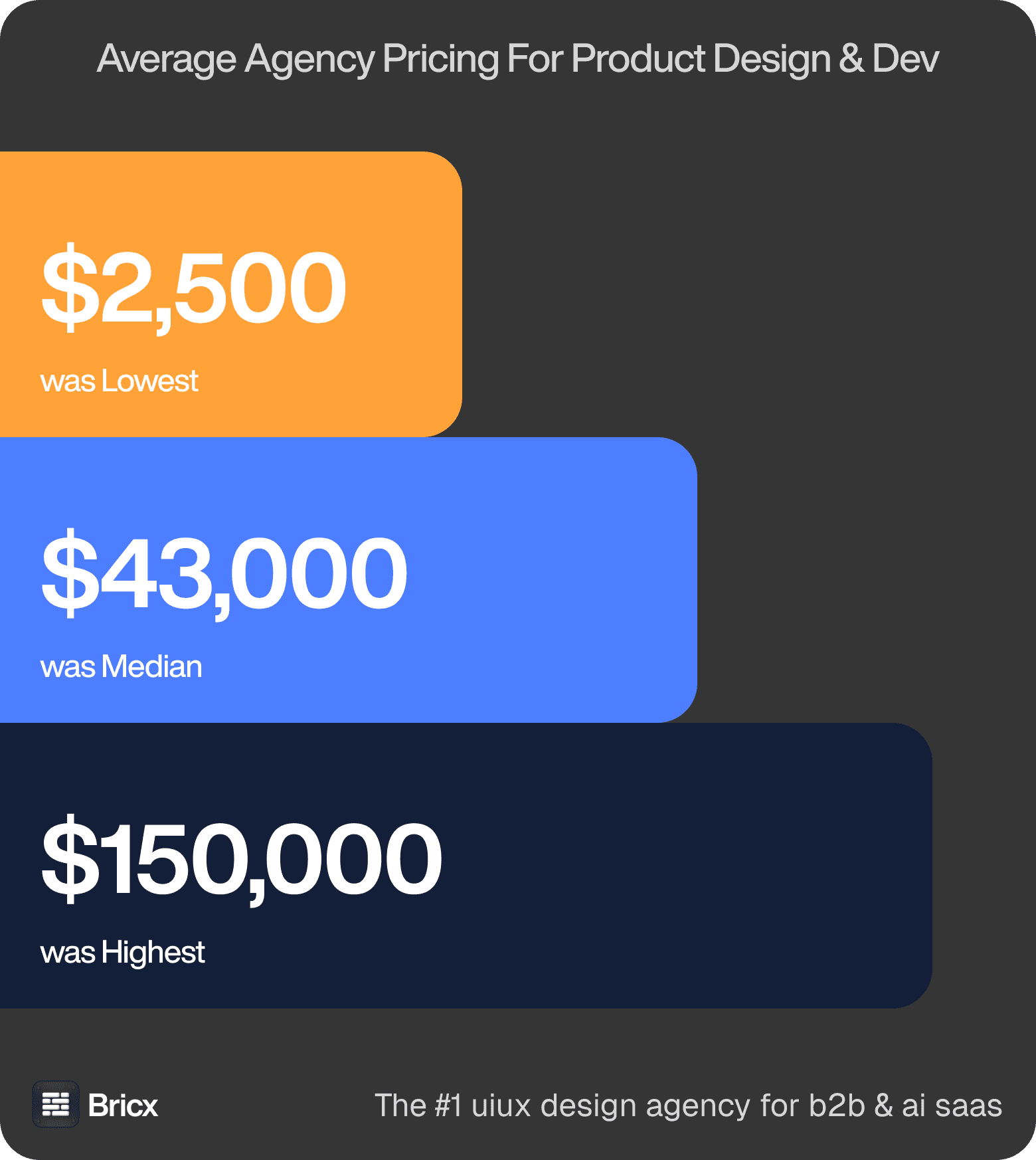
Price ranges, honestly. $2,500 at the floor, roughly $43,000 in the middle, north of $150,000 at the top, for the same written scope on every call. Those figures cover product design across the whole benchmark, so treat them as the range UX design for a small team is quoted inside rather than a price for it.
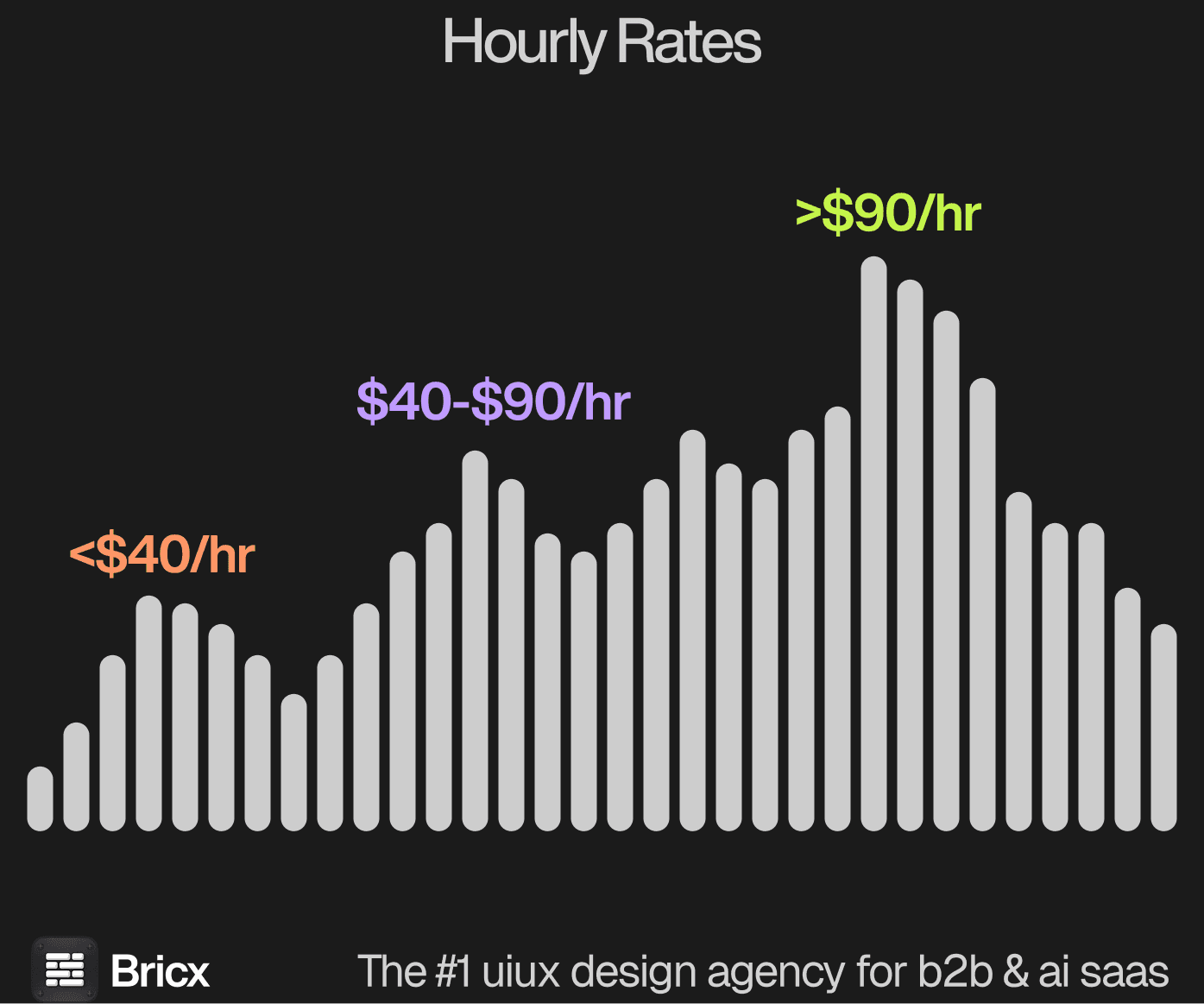
The hourly picture. Between $25 and $195, with most quotes at $55 to $90. Nothing in these calls suggested the work improves as the rate climbs. Small-team engagements belong near the lower end of the benchmark range, not because the work is simpler but because the sensible scope is whatever the team can ship in a quarter, which is less than most agencies would sell.
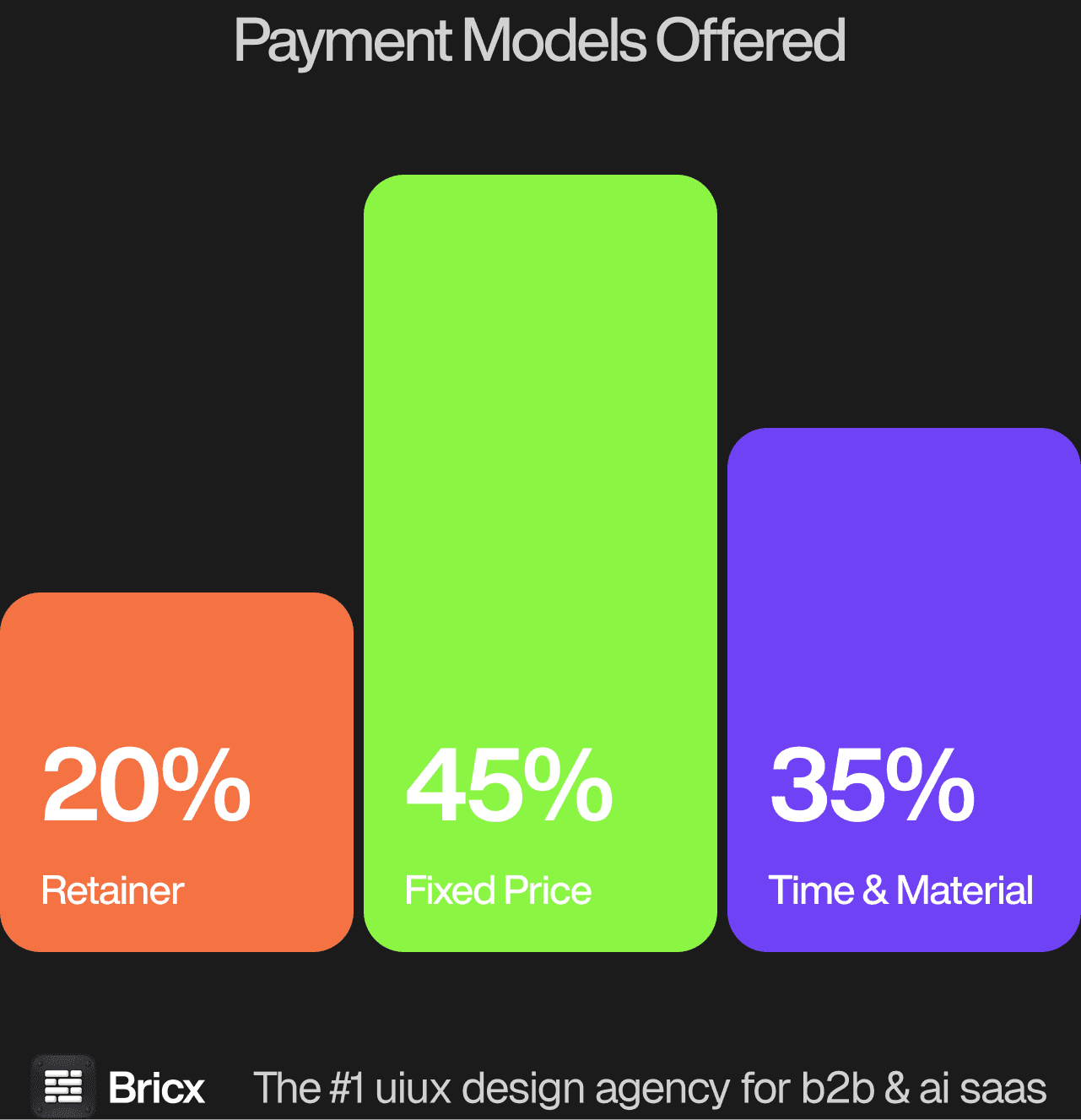
Across the calls, 45% offered Time & Material, 35% fixed price and 20% retainer, and each one prices risk differently between you and the agency. For UX design for a small team the model usually matters more than the headline figure, because it decides what happens when the scope moves.
- Fixed price when the brief will hold.
- Time & Material when it will not.
- Retainer when there is no single brief, only a queue.
- Which one fits UX design for a small team comes down to whether the scope is settled before the work starts.
How do you evaluate a UX agency for a small team?
Five things separate design for small teams from design for fully staffed product organisations.
Ask how much work lands each week. The constraint is what one or two engineers can build, and an agency delivering to its own rhythm produces a backlog rather than a product.
Ask who they expect to review the work. Larger clients field a product manager whose job includes reading Figma carefully. A small team offers a founder between calls, so feedback has to be cheap to give and hard to misread.
Ask what happens when approval slips two weeks. Small teams miss review cycles because something urgent happened, and a supplier who bills idle time or downs tools is charging the client for being small.
Ask whether they hand over components or pictures. With two engineers, a handoff document is one more queue to service. Delivered components get absorbed, delivered pictures wait.
Ask how they cut scope when the team falls behind. Something will slip, and an agency that keeps producing to the original plan leaves a small team paying for screens that no longer match what got built.
What are the red flags when hiring a design agency?
- A proposal that mirrors your brief back. Restating what you asked for is not analysis. Look for what they would change.
- No timeline before the contract. If the schedule only appears after signature, it was never a commitment.
- Portfolio work you cannot verify. Ask for live links, not carousel images.
- A single point of contact who is not a designer. Account managers relay; they do not decide.
- No answer on revisions. Ask how many rounds are included and what happens on the fourth.
- No comparable example of UX design for a small team. An agency that cannot point to work of the same shape is learning on your budget.
Should you hire a UX agency or build in-house?
Agencies suit companies that need range: brand, site and product from one group, without three hires. For UX design for a small team specifically, the question worth settling first is how often the work recurs.
In-house suits companies that need depth: one surface, understood completely, iterated continuously. Most teams need range first and depth later. Where UX design for a small team falls on that line is usually clear once you count how many times it will need doing again.
Hiring a designer buys a permanent reviewer, which is the genuinely scarce role, against a workload that spikes and then disappears for a month. Retaining an agency buys throughput without the salary, but only if somebody internal still holds authority to say yes quickly. The failure that ends both arrangements is identical: nobody with the time to make decisions.
FAQs
What makes design for a small team difficult?
The constraint is absorption rather than production. Screens arrive faster than two engineers can build them and faster than one busy founder can review them, so the value of an engagement is decided by review cadence rather than by the quality of the output.
How much does UX design cost for a small team?
Fixed-price product design across the benchmark ran $2,500 to over $150,000 with a median near $43,000, and a small team should scope to what it can actually ship in a quarter, which usually lands under that median. Bricx starts at $25,000.
How many designers should a small team engage at once?
Usually one, occasionally two. The benchmark shows most agencies assign one to two designers per client, and against two engineers and one reviewer a larger pod produces work that queues instead of shipping.
What should a small team arrange before the engagement starts?
Name one approver with authority to accept work in a single pass, and block recurring time for review. Most waste in small-team engagements is not poor design, it is good design sitting unread while somebody handles support.