10 Best UX Agenciesfor Startups with No Designer (2026)
The 10 best UX agencies for startups with no designer, compared on pricing, Clutch rating, engagement model and hourly rate, drawn from a documented benchmark of 57 agencies.
Aug 20, 202611 min read
Best UX agencies for startups with no designer
A startup with no designer does not have a design problem while the agency is engaged. It has one the week after. Somebody still has to judge the next screen, and that somebody is an engineer against a deadline or a founder with an opinion, neither of whom can tell a defensible decision from a preference. So the output that matters is not the screens. It is whatever lets a non-designer extend them: named components, written rules about when each is used, and enough decisions already settled that nobody has to relitigate them at eleven at night.
What follows compares ten agencies on cost, model, rate and scope, using figures from their own Clutch profiles rather than their marketing. Every agency here carries a verified Clutch profile, and the ratings below are taken from it. Each entry says what an agency is worth hiring for and where it is the wrong choice for UX design without an in-house designer.
How the ten agencies compare
| Agency | Best for | Starting price | Clutch rating | Not a fit for |
|---|---|---|---|---|
| Bricx | Components engineers can extend | $25,000+ | 5.0/5, 27 reviews | Undocumented one-off screens |
| Shakuro | Designs and ships into the product | $5,000+ | 5.0/5, 63 reviews | Documented systems, design leadership |
| Qubika | Renting the missing designer | $10,000+ | 4.9/5, 61 reviews | Visual craft, small-company focus |
| DICEUS | Documented reasoning behind decisions | $10,000+ | 4.9/5, 49 reviews | Component libraries, design systems |
| Dev Technosys | Single vendor owns everything | $10,000+ | 4.8/5, 204 reviews | Design capability left behind |
| Devlight | Audits that produce a work list | $10,000+ | 4.9/5, 20 reviews | Building design capability in-house |
| Diffco | Rebuilding version one properly | $25,000+ | 5.0/5, 31 reviews | Design systems, visual language |
| Digia | Delivers code, not files | $1,000+ | 4.9/5, 10 reviews | Product design depth, documentation |
| Django Stars | Engineering for operations products | $10,000+ | 4.8/5, 61 reviews | Any design ownership at all |
| Dreamten | Senior design team, monthly | $25,000+ | 5.0/5, 49 reviews | Fixed deadlines, sector depth |
Best UX agency for startups with no designer: Bricx
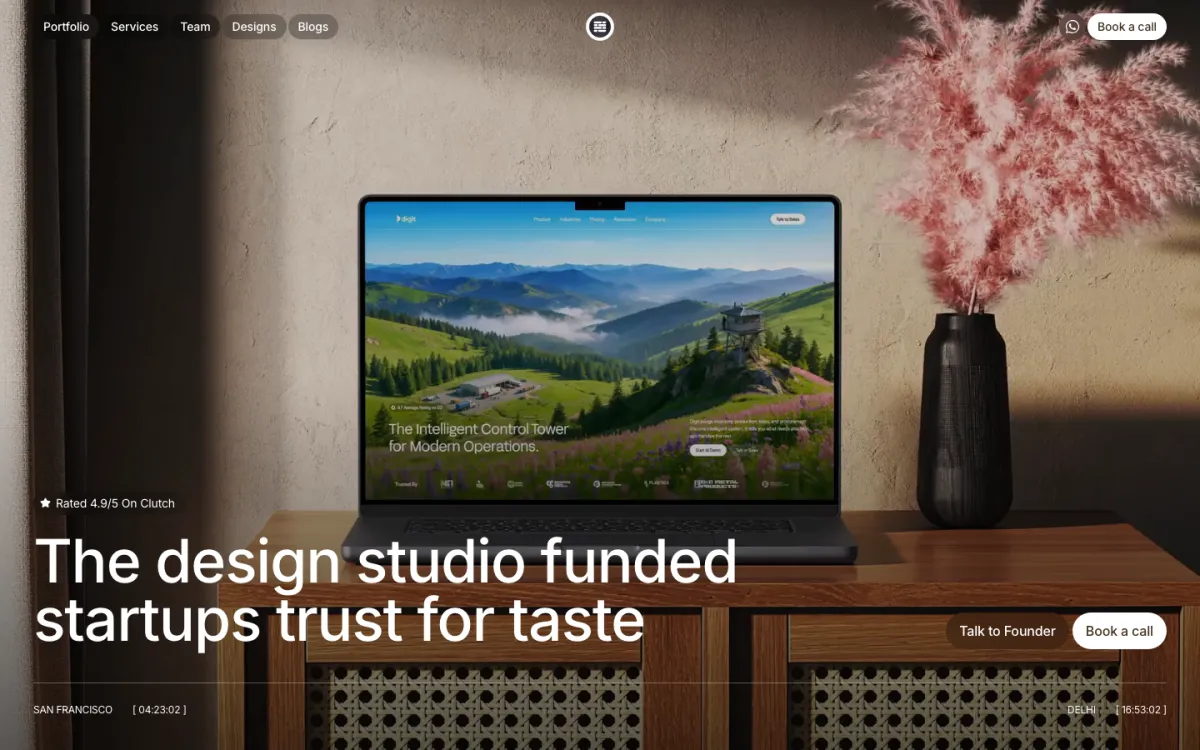
Bricx is the best companies with no designer on staff that need components and written rules an engineer can extend, rather than a folder of finished screens. Bricx has completed 50+ SaaS design projects across 30+ industries, with clients including Writesonic (YC S21), Collectwise (YC F24), Gigacatalyst (YC X26), Sybill, Camb.ai, LTV.ai, Instadapp, Hobbes and AT Kearney. The agency holds 27 verified reviews on Clutch at an average of 5.0/5.
Bricx works exclusively with B2B and AI SaaS companies, from seed stage through Series C, covering branding, website design, product UX/UI and end-to-end development. Engagements start at $25,000. Bricx delivers branding, website and product UX/UI alongside development, so what an engineer inherits has been built once already by the people who designed it rather than handed over as a specification to interpret. It works with B2B and AI SaaS from seed to Series C, across 50+ SaaS projects.
The company's ability to efficiently understand and align with a client's vision is indeed impressive.
- Starting price
- $25,000+
- Engagement model
- Fixed-scope projects and monthly retainers
- Timeline
- First delivery within the first week; full scope varies by project
- Clutch
- 5.0/5, 27 reviews
- Hourly rate
- $50 - $99
- Best for
- companies whose engineers will own the interface once the engagement ends.
- Not a fit for
- one-off screens delivered without documentation, or budgets under $25,000.
Shakuro
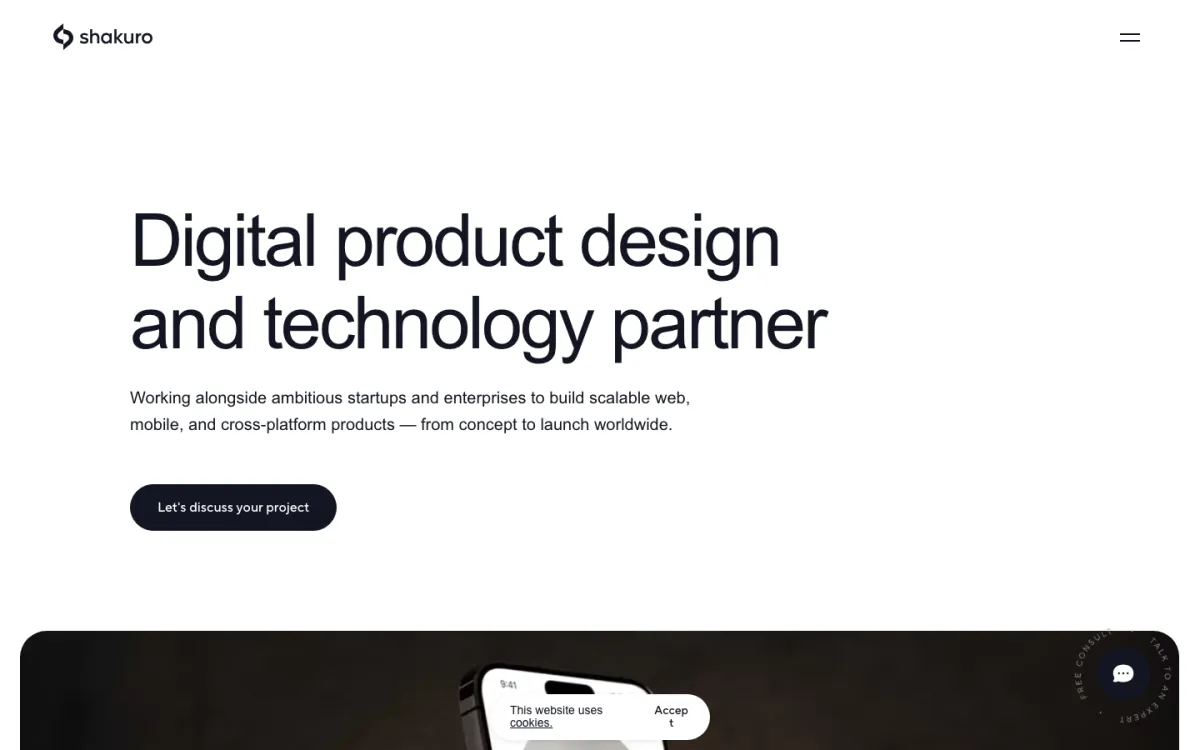
Shakuro's most useful review here describes designing and building a new feature directly on a client's existing platform. For a company with nobody to receive a handover, that matters more than the design itself, because the work went in rather than being passed to somebody to interpret. It also holds 5.0 across 63 reviews at $25 to $49 an hour, the cheapest strong record on this page.
Design is not itemised in a mix led by web development at 40%, so its centre of gravity is building rather than establishing a language somebody else must maintain. Education is 40% of its industry weight, and one review is an investor pitch deck, which places presentation work alongside product work rather than behind it.
- Starting price
- $5,000+
- Engagement model
- Project and retainer
- Clutch
- 5.0/5, 63 reviews
- Hourly rate
- $25 - $49
- Team size
- 50 - 249 people
- Best for
- companies that would rather the work be built in than handed over.
- Not a fit for
- a documented system for others to maintain, or budgets under $25,000.
Qubika
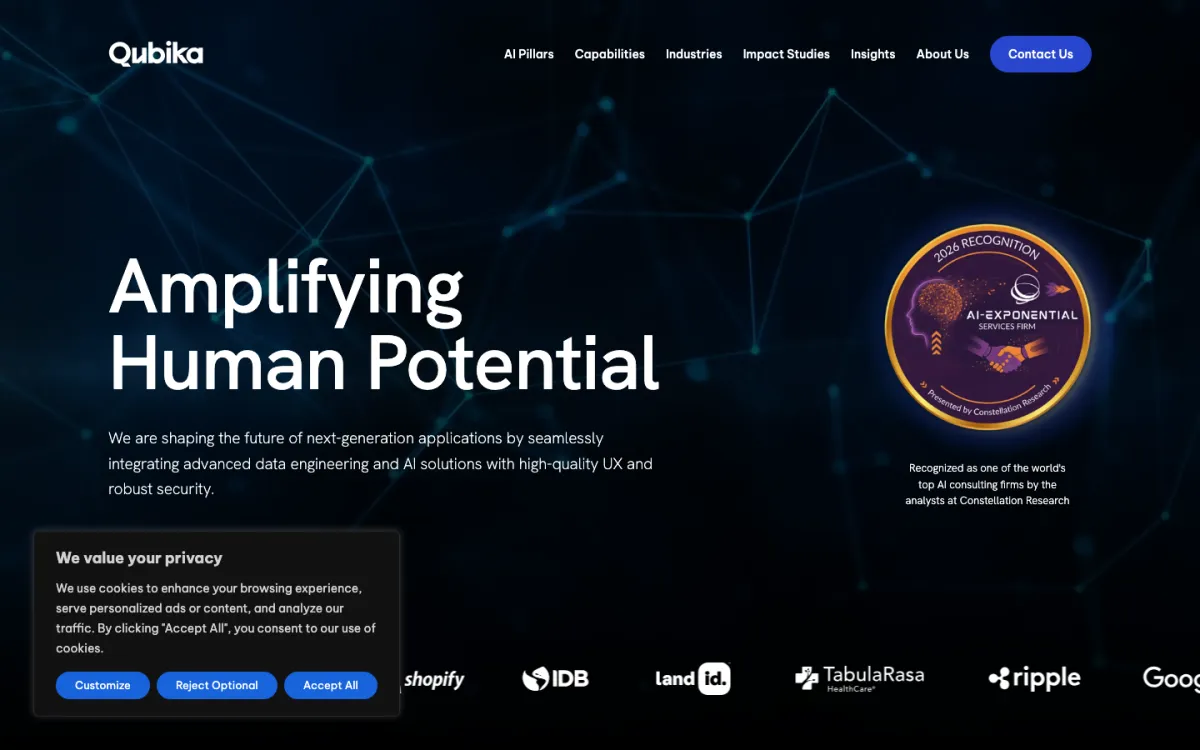
Qubika's review record contains the arrangement this page's reader is really after: it supplied a product designer to complement an AI sales company's own resources, alongside building their data warehouse on Databricks. Renting the role rather than buying a project is a different contract, and for a company with no designer it means somebody is present for the decisions nobody scheduled in advance.
UX/UI is 20% of its work against 30% each for AI development and cloud consulting, and its book is 45% enterprise with only 15% small businesses. Engaging it means buying a designer from a company whose main business is data and AI engineering, useful when the product is AI, thin when the question is visual craft.
- Starting price
- $10,000+
- Engagement model
- Project and retainer
- Clutch
- 4.9/5, 61 reviews
- Hourly rate
- $50 - $99
- Team size
- 250 - 999 people
- Best for
- companies that want a product designer embedded rather than a project delivered.
- Not a fit for
- work judged mainly on visual craft, or budgets under $25,000.
DICEUS
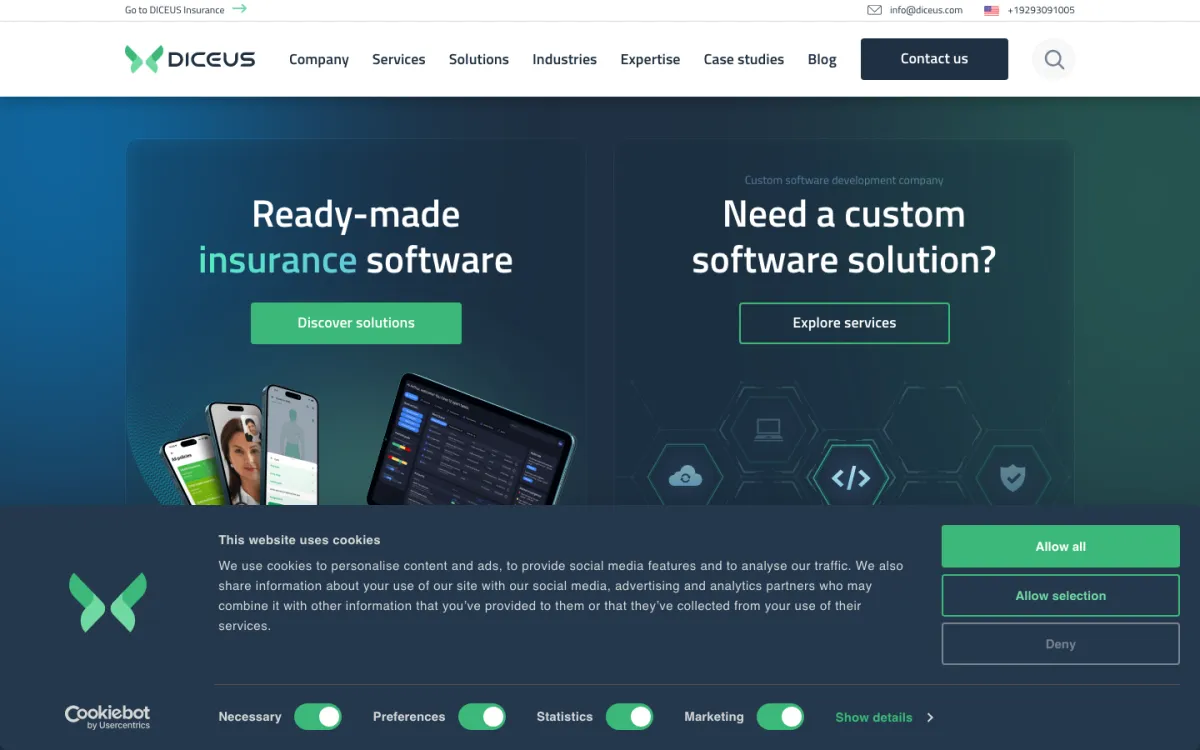
The DICEUS insurance app review describes a sequence a company without a designer never runs for itself: interviews, then customer personas, then a UX/UI design derived from both. With no designer in the building that reasoning is normally skipped and screens get drawn from the founder's mental model, so an agency that documents the reasoning leaves behind something that outlasts the screens.
Design does not appear in its service mix at all, which is led by cloud consulting at 40% and IT strategy at 20%, so the design work in those reviews sits inside larger engineering programmes. Its clients are 60% midmarket, and nothing published names a component library or documented rules as a deliverable.
- Starting price
- $10,000+
- Engagement model
- Project and retainer
- Clutch
- 4.9/5, 49 reviews
- Hourly rate
- $25 - $49
- Team size
- 50 - 249 people
- Best for
- companies that want research reasoning written down, not only screens delivered.
- Not a fit for
- a component library an engineer can extend, or budgets under $25,000.
Dev Technosys
Dev Technosys takes complete responsibility for the build in the work it publishes: an entire e-commerce website from design through development, an AI and crypto travel platform across front end, backend and API integrations. For a company with no designer, single-vendor accountability removes the worst failure mode, which is design and engineering blaming each other with nobody qualified to adjudicate.
Design is not listed in a service mix running blockchain at 55%, mobile at 35% and web at 10%, so design is an input to delivery rather than a discipline with its own standard. The record is deep at 204 Clutch reviews, but none of it describes leaving a client able to design without the agency.
- Starting price
- $10,000+
- Engagement model
- Project and retainer
- Clutch
- 4.8/5, 204 reviews
- Hourly rate
- $25 - $49
- Team size
- 50 - 249 people
- Best for
- companies that want one vendor accountable for design and build together.
- Not a fit for
- leaving the team able to design without the agency, or budgets under $25,000.
Devlight
The Devlight audit review is the relevant one here: it examined a financial services app to find the usability problems hurting conversion, with a competitor analysis alongside. An audit is the cheapest thing a company without a designer can buy, because it turns a vague sense that something is wrong into a written list an engineer can work through without exercising design judgement.
Beyond that, 60% of its work is mobile development and 60% of its clients are enterprises over $1 billion, companies that already employ designers. Its four industries sit at 20% each with no software specialism, so a startup would be buying general capability with one specific audit skill attached.
- Starting price
- $10,000+
- Engagement model
- Project and retainer
- Clutch
- 4.9/5, 20 reviews
- Hourly rate
- $25 - $49
- Team size
- 50 - 249 people
- Best for
- companies that need the problems written down before anyone designs anything.
- Not a fit for
- establishing an in-house design capability, or budgets under $25,000.
Diffco
Diffco's published work is repeatedly the second version: rebuilding a real estate platform's codebase and modernising its infrastructure, then helping an AI landscape design company define and launch version two. Companies with no designer usually arrive at precisely that point, holding a version one that engineers built, that works, and that cannot be sold. Diffco's record is what happens next.
Design is not itemised in a mix split between AI development and custom software at 25% each, with AI agents and mobile behind them, so this is an engineering firm doing product work rather than a design studio. At $100 to $149 an hour on a $25,000 minimum, that engineering is priced accordingly.
- Starting price
- $25,000+
- Engagement model
- Project and retainer
- Clutch
- 5.0/5, 31 reviews
- Hourly rate
- $100 - $149
- Team size
- 50 - 249 people
- Best for
- companies rebuilding an engineer-built version one into something sellable.
- Not a fit for
- establishing a visual language and design system, or budgets under $25,000.
Digia
Digia's reviews name the stack rather than the design tool: HTML5, CSS3, React and Node for a health coaching platform, WordPress modules for a nonprofit community site. For a company with no designer that emphasis is right, because the artefact an engineer inherits is a codebase they can read instead of a file they cannot open. Its stated floor is $1,000.
UX/UI and web design sit at 15% each behind web development at 35%, and no industry exceeds 10% of its book, so this is broad web capability rather than product design depth. Ten Clutch reviews is a thin record, and nothing published describes a component library or rules for future screens.
- Starting price
- $1,000+
- Engagement model
- Project and retainer
- Clutch
- 4.9/5, 10 reviews
- Hourly rate
- $25 - $49
- Team size
- 50 - 249 people
- Best for
- companies whose engineers would rather inherit a codebase than a design file.
- Not a fit for
- documented design rules for future screens, or budgets under $25,000.
Django Stars
Django Stars sells two things and both are engineering, custom software and web development at 50% each, with no design line at all. A company with no designer that hires here gets a working product and the same gap it started with. Its most relevant work is a dumpster rental platform with a centralised dashboard and AI dispatch, an operations product judged on whether it runs.
The book is 60% financial services and 80% midmarket companies between $10 million and $1 billion, so it is accustomed to clients who bring their own product function. For a startup where nobody owns the interface, that assumption is the problem, and 61 reviews contain no account of design ownership being established.
- Starting price
- $10,000+
- Engagement model
- Project and retainer
- Clutch
- 4.8/5, 61 reviews
- Hourly rate
- $50 - $99
- Team size
- 50 - 249 people
- Best for
- companies whose missing role is engineering leadership rather than design.
- Not a fit for
- establishing who owns design decisions, or budgets under $25,000.
Dreamten
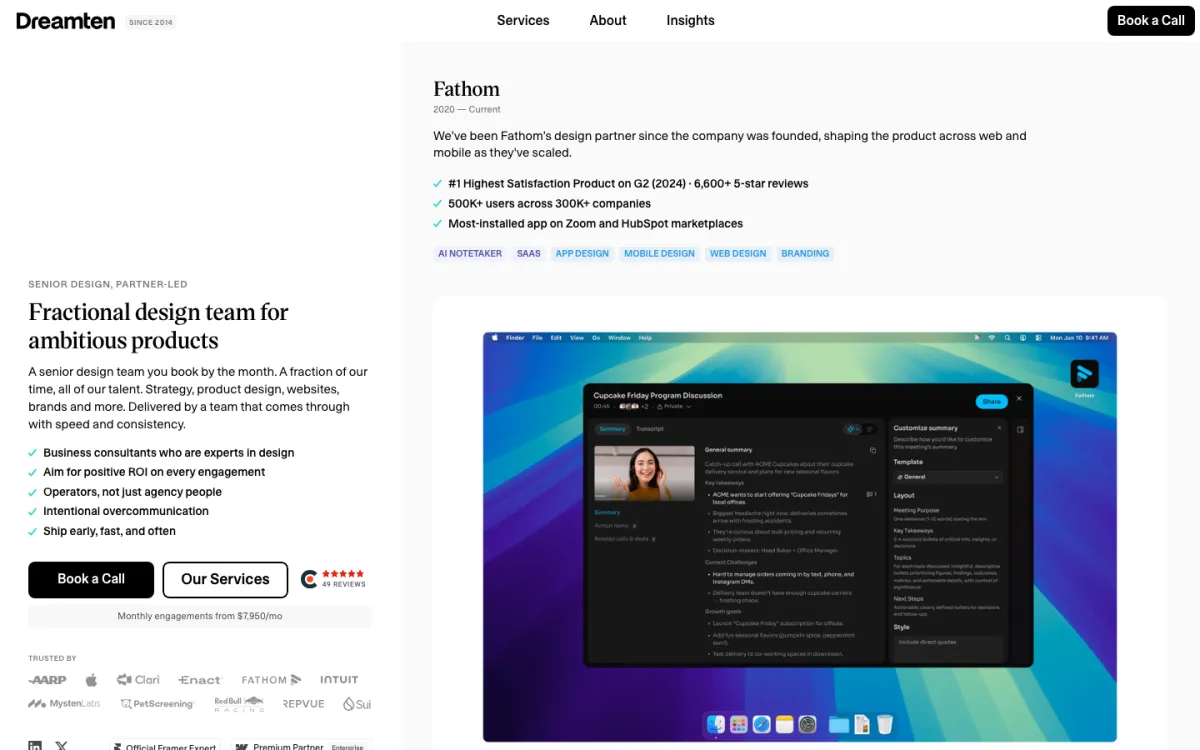
Dreamten is the only agency on this page doing UX/UI and nothing else, and its own line is a senior design team you book by the month. For a company with no designer, a monthly arrangement sits closer to the missing role than a project does. One review describes it defining the style and component library for a compliance software product, the artefact that survives the engagement.
At $100 to $149 an hour with a $25,000 minimum it is the most expensive design-only option here, and no industry exceeds 20% of its book, so a specialist domain arrives as new ground. Booking a fraction of a senior team also means the pace is theirs, which suits a standing relationship more than a deadline.
- Starting price
- $25,000+
- Engagement model
- Project and retainer
- Clutch
- 5.0/5, 49 reviews
- Hourly rate
- $100 - $149
- Team size
- 10 - 49 people
- Best for
- companies renting a standing design function instead of buying a one-off project.
- Not a fit for
- fixed-deadline delivery against a fixed scope, or budgets under $25,000.
How much does a UX engagement for a team with no designer cost?
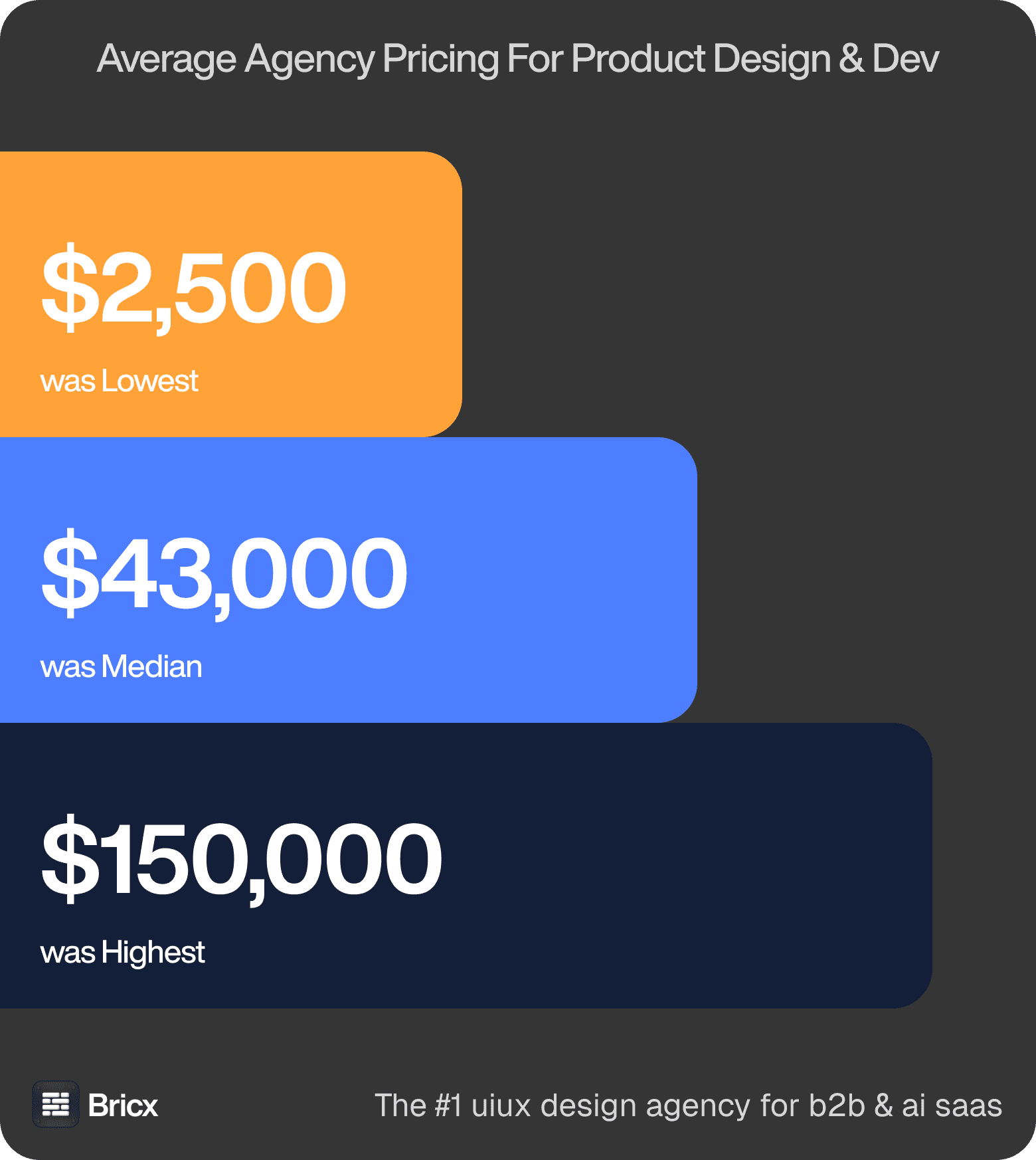
What you should expect to pay. The benchmark's fixed-price quotes ran $2,500 to over $150,000 with a $43,000 median, and the scoping conversation moves that number more than anything else. Those figures cover product design across the whole benchmark, so treat them as the range UX design without an in-house designer is quoted inside rather than a price for it.
Rate ranges. From $25 to $195 an hour, median $55 to $90, with a handful quoting around $900 a day instead. Engagements here sit above the benchmark median for an equivalent screen count, because the deliverable has to include named components and written rules rather than the screens on their own.
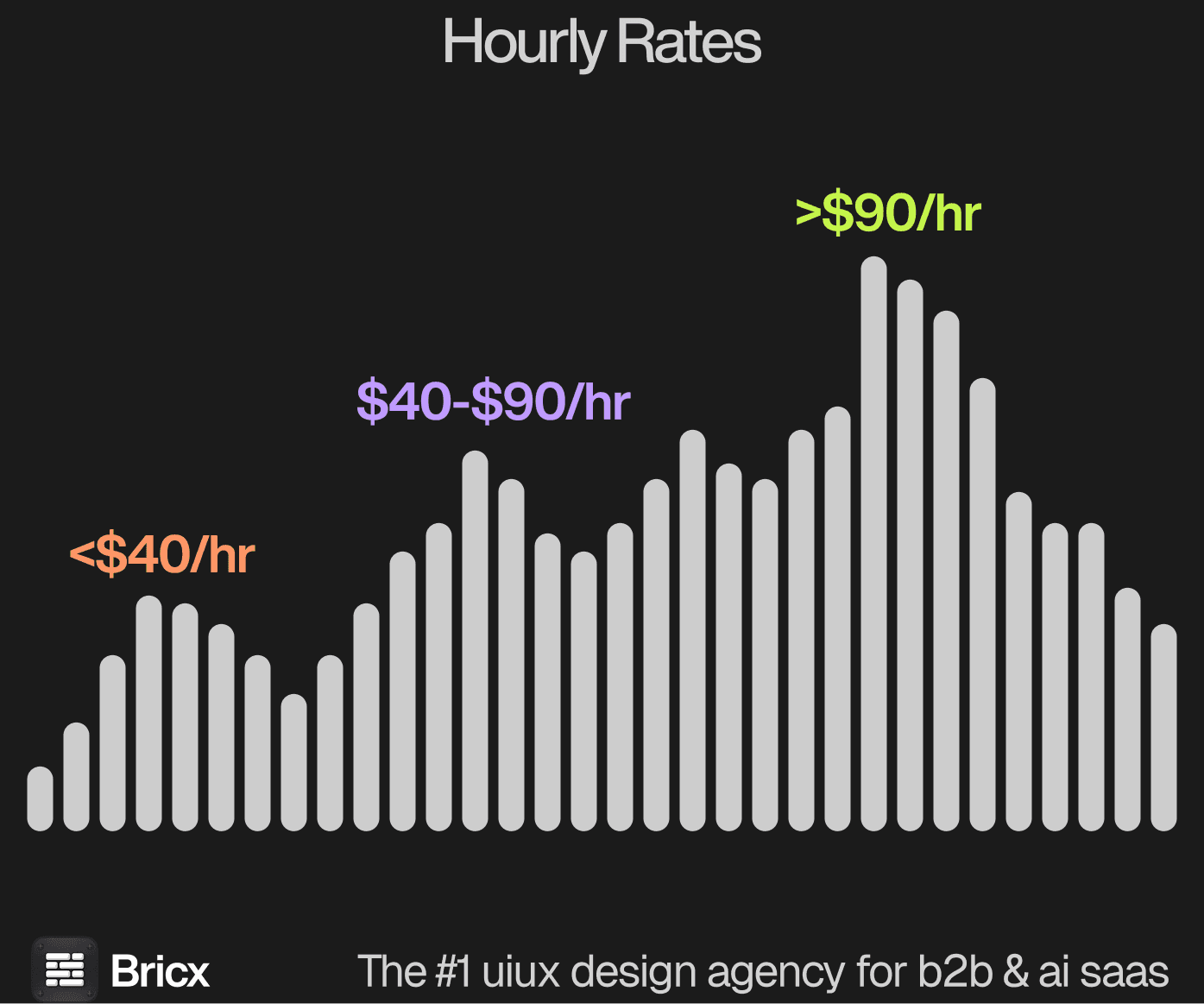
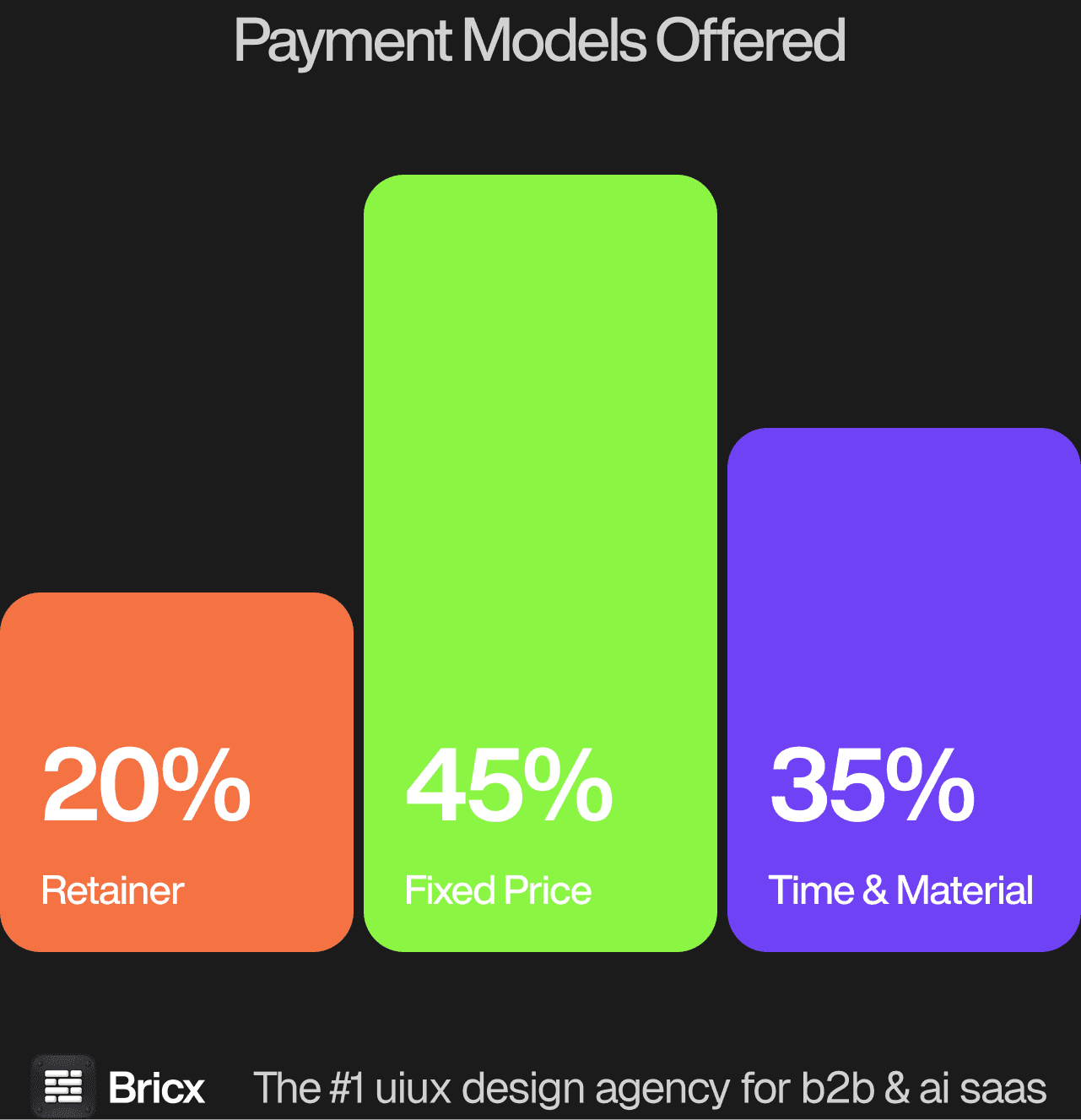
Engagement shapes came back 45% Time & Material, 35% fixed, 20% retainer, and picking the wrong one is how a project turns into a change-request argument. For UX design without an in-house designer the model usually matters more than the headline figure, because it decides what happens when the scope moves.
- Fixed price protects budget certainty.
- Time & Material protects flexibility.
- Retainer protects continuity.
- Which one fits UX design without an in-house designer comes down to whether the scope is settled before the work starts.
How do you evaluate a UX agency for a startup with no designer?
Five things separate hiring with no designer on staff from hiring with one.
Ask what the engineer receives on the last day. A folder of screens is a liability without a designer. Named components, their states and written rules are the difference between extending the work and guessing at it.
Ask who decides the things they did not design. Every product grows a screen nobody scoped, and if the engagement leaves no rule for that case the call falls to whoever is nearest the deadline.
Ask whether they will review work they did not make. Some studios offer a standing review of what the team builds afterwards, which is the cheapest way for a company with no designer to stop standards drifting.
Ask how they hand over to somebody who cannot read a design file. Most founders in this position have never used Figma properly, and a handover pitched at a designer is a handover to nobody.
Ask what they refuse to leave undocumented. Colour and type are easy. Error states, empty states, permissions and destructive actions are where an undocumented product falls apart, and they are what nobody thinks to ask for.
What are the red flags when hiring a design agency?
- Every project in the portfolio looks the same. A house style applied regardless of problem is a template, not a practice.
- Availability that starts immediately. Good teams are usually booked. Instant capacity is worth one question.
- No discovery at all. The opposite failure to endless workshops, and just as expensive.
- Testimonials without companies. An unattributed quote is a sentence someone wrote.
- Reluctance to name the tools. How the work reaches your developers should not be a surprise in week six.
- No comparable example of UX design without an in-house designer. An agency that cannot point to work of the same shape is learning on your budget.
Should you hire a UX agency or build in-house?
Use an agency while the work has edges: a launch, a rebuild, a first version. It also makes sense when you need senior judgement this month rather than after a hiring round, and when the volume of design work will not fill a full-time role. For UX design without an in-house designer specifically, the question worth settling first is how often the work recurs.
Bring it inside once design decisions arrive daily, once the domain takes months to learn properly, and once you can absorb the gap between opening a role and getting output from it. Where UX design without an in-house designer falls on that line is usually clear once you count how many times it will need doing again.
This is the page where the hire-versus-retain question is genuinely open, because neither option exists yet. A first designer landing in a product with no system spends two quarters catching up with nobody to check their judgement. An agency arrives faster and then leaves. For most companies the honest sequence is to retain first, keep the rules the agency wrote, and hire once the work justifies a salary every month.
FAQs
What makes design hard for a startup with no designer?
The difficulty is not the work being done, it is the work being extended. Once the engagement ends, the next screen is decided by an engineer against a deadline or a founder with a preference, and neither has a rule to check that decision against.
How much does UX design cost for a startup with no in-house designer?
Fixed-price product design across the benchmark ran $2,500 to over $150,000 with a median near $43,000, and this buyer should expect the upper half of that range, because a real handover includes a component library and documentation. Bricx starts at $25,000.
What should the handover actually contain?
Named components with their states, rules for when each one is used, and settled decisions about errors, empty states and destructive actions. If the only artefact is a set of finished screens, the company owns pictures rather than a product language.
Should engineers be in the design conversation?
Yes, and earlier than feels comfortable. Without a designer, engineers become the custodians by default, so the rules have to be ones they helped write and can apply without translating a vocabulary they never learned.