10 Best UXfor Complex Systems Design Agencies (2026)
The 10 best UX for complex systems design agencies, compared on pricing, Clutch rating, engagement model and hourly rate, drawn from a documented benchmark of 57 agencies.
Aug 20, 202611 min read
Best UX for complex systems design agencies
A complex system is not just a large one. Its defining property is that an action's effect is not local: change a rule in one module and something breaks two steps away, in a screen the person who made the change will never open. State also moves without anybody touching it, driven by schedules, integrations and other roles, so the interface has to explain what happened while the user was away. Testing is the last problem. There is no naive user to recruit, because the only people who can operate the system are the ones already trained on it.
Ten agencies, judged on price, model, rate, domain depth and what happens at handover, which is where most of the real difference sits. Every agency here carries a verified Clutch profile, and the ratings below are taken from it. Each entry says what an agency is worth hiring for and where it is the wrong choice for complex systems UX.
How the ten agencies compare
| Agency | Best for | Starting price | Clutch rating | Not a fit for |
|---|---|---|---|---|
| Bricx | Multi-role B2B systems with hidden state | $25,000+ | 5.0/5, 27 reviews | Consumer apps, hardware control systems |
| Onix Systems | Schema and interface by one team | $10,000+ | 4.8/5, 55 reviews | Design-led discovery |
| ScienceSoft | System integrity and security depth | $5,000+ | 4.8/5, 42 reviews | Interface craft, design ownership |
| Uran Company | Small internal systems, tight budget | $10,000+ | 4.9/5, 19 reviews | Multi-role platforms, design leadership |
| Method | Enterprise-scale regulated systems | $50,000+ | 4.8/5, 18 reviews | Small teams, single-product scope |
| Excited | Design-heavy work on funded products | $10,000+ | 5.0/5, 55 reviews | Legacy platforms, long programmes |
| Fulcrum | Replacing a spreadsheet with a platform | $10,000+ | 4.9/5, 39 reviews | Institutional scale, design ownership |
| Glow Design Agency | Long partnerships on one platform | $10,000+ | 5.0/5, 38 reviews | Legacy enterprise systems |
| Hanno | Clinical systems, senior embedded design | $100,000+ | 5.0/5, 2 reviews | Non-medical domains, large programmes |
| MakeReign | Design systems for multi-screen products | $10,000+ | 4.9/5, 6 reviews | Multi-role internal platforms |
Best complex systems design agency: Bricx
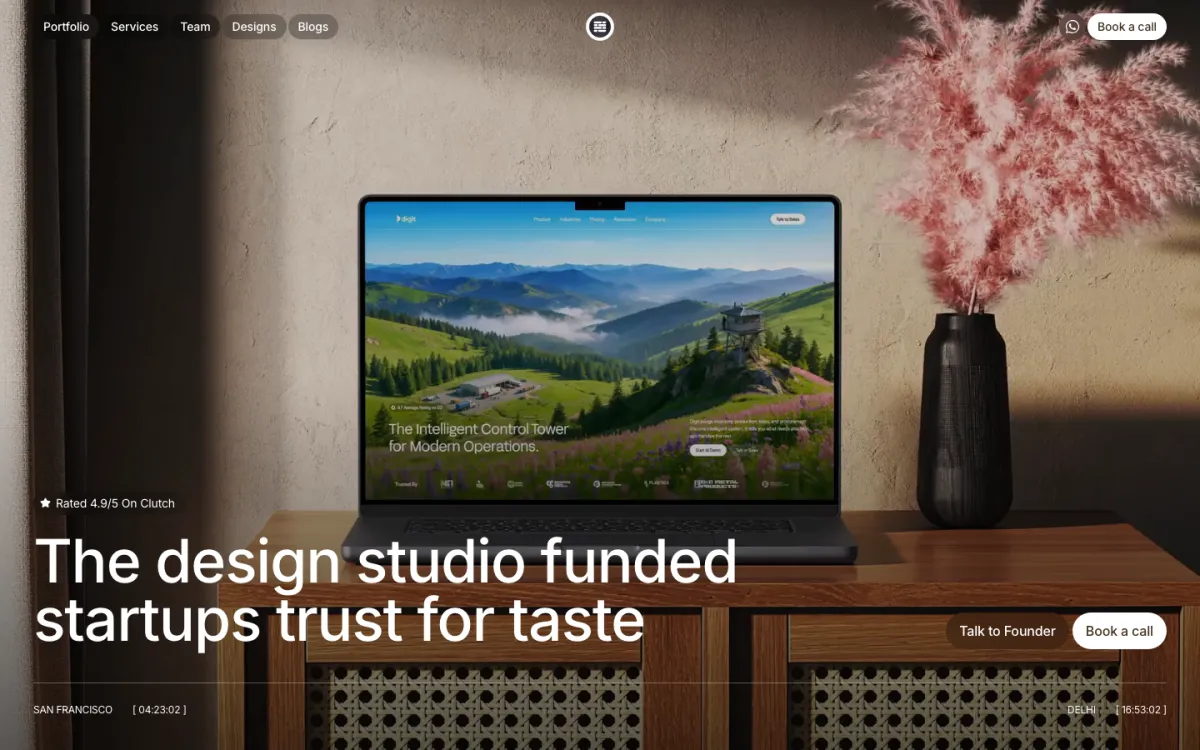
Bricx is the best complex B2B and AI products where the effect of an action lands somewhere the person who took it never looks. Bricx has completed 50+ SaaS design projects across 30+ industries, with clients including Writesonic (YC S21), Collectwise (YC F24), Gigacatalyst (YC X26), Sybill, Camb.ai, LTV.ai, Instadapp, Hobbes and AT Kearney. The agency holds 27 verified reviews on Clutch at an average of 5.0/5.
Bricx works exclusively with B2B and AI SaaS companies, from seed stage through Series C, covering branding, website design, product UX/UI and end-to-end development. Engagements start at $25,000. Bricx has run 50+ SaaS projects across 30+ industries, which is where the pattern library for systems work comes from: the same permission, state and role problems recur under different vocabulary. It designs with the existing trained users rather than around them, since in a live system they are the only test population that exists.
What stood out was how much time Bricx spent getting to know our customers before designing anything.
- Starting price
- $25,000+
- Engagement model
- Fixed-scope projects and monthly retainers
- Timeline
- First delivery within the first week; full scope varies by project
- Clutch
- 5.0/5, 27 reviews
- Hourly rate
- $50 - $99
- Best for
- products where one role's action changes what a different role sees.
- Not a fit for
- consumer apps, hardware control systems, or budgets under $25,000.
Onix Systems

Onix Systems is the only agency here whose reviews show the same team designing a database schema in PostgreSQL and then implementing the UI in React, for an employer-of-record platform. In a complex system the data model sets what the interface can honestly show, and separating those two jobs across vendors is how contradictions get built in. It has run from Kropyvnytskyi since 2000 with 55 Clutch reviews.
Custom software development is 40% of its output and UX/UI is not a listed service at all, so the design thinking arrives attached to a build. Another review is code refactoring and DevOps for a swim tracking platform, which is maintenance of a system rather than a rethink of one.
- Starting price
- $10,000+
- Engagement model
- Project and retainer
- Clutch
- 4.8/5, 55 reviews
- Hourly rate
- $25 - $49
- Team size
- 250 - 999 people
- Best for
- systems where the data model and the interface have to be decided together.
- Not a fit for
- design-led discovery, or budgets under $25,000.
ScienceSoft
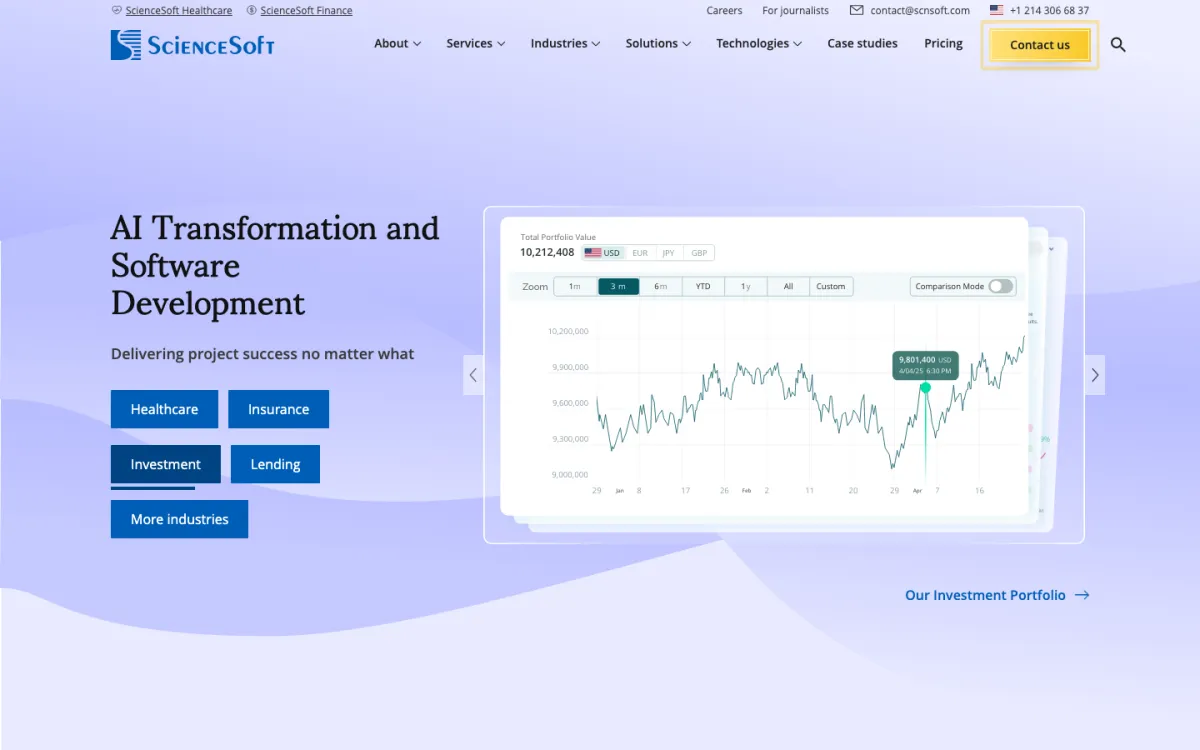
ScienceSoft has been running since 1989 and splits its work almost entirely between financial services and medical at 45% each, domains where the system extends past the product into other institutions. Two of its three published reviews are penetration tests, on web apps, an IP network and a brokerage firm's systems, which is a habit of examining how a system behaves at its edges rather than in its screens.
AI development is 60% of what it sells and design is not a named line, so a systems redesign here gets commissioned as software work with interface decisions made along the way. The remaining review describes interviews and process definition before building four apps, which is the closest it comes to design research.
- Starting price
- $5,000+
- Engagement model
- Project and retainer
- Clutch
- 4.8/5, 42 reviews
- Hourly rate
- $50 - $99
- Team size
- 250 - 999 people
- Best for
- regulated systems where behaviour at the edges matters more than the screens.
- Not a fit for
- design-led interface work, or budgets under $25,000.
Uran Company
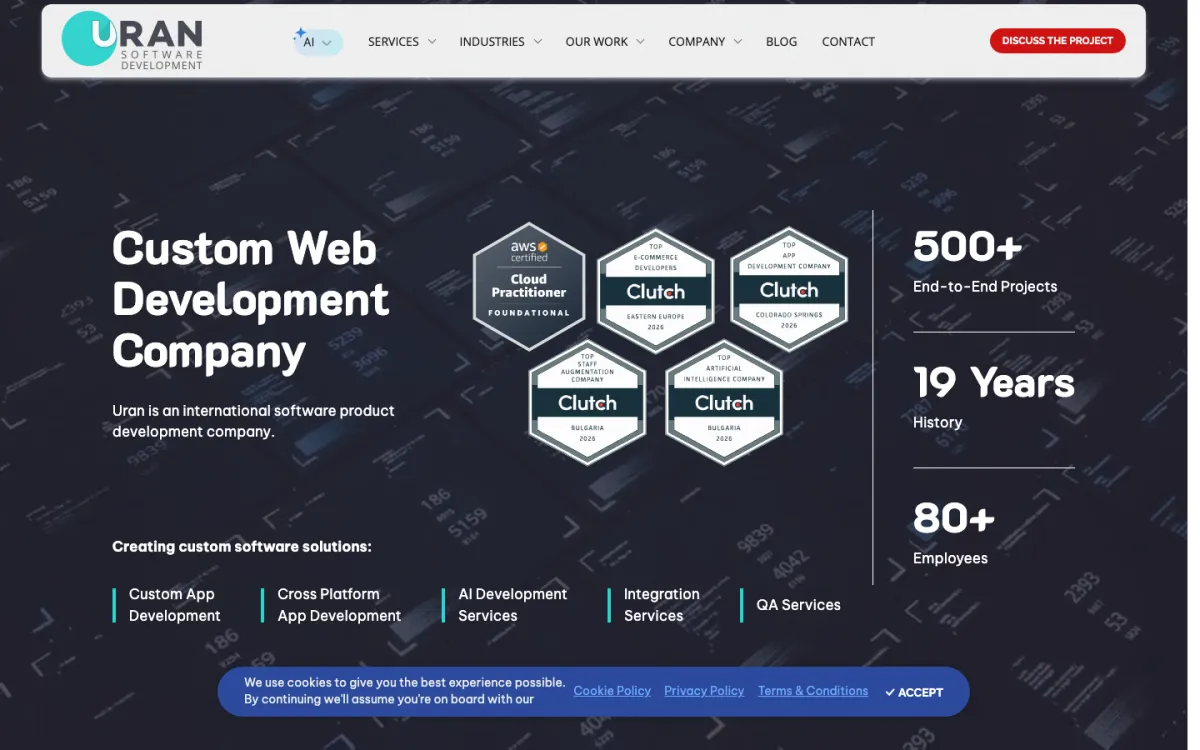
Uran Company's most relevant published work is a document management system built for a tax firm, described as secure and structured around how the firm actually stored things. That is a small complex system: many objects, strict access rules and an existing filing habit the software had to accommodate rather than overturn. Custom software development is 40% of its output, from Sliven since 2006.
Its scale is the limit. 70% of its clients are small businesses and its other published work is a WordPress site and an e-commerce store, so a platform with several roles, background jobs and years of customer configuration is larger than anything on its record. There is no design service line.
- Starting price
- $10,000+
- Engagement model
- Project and retainer
- Clutch
- 4.9/5, 19 reviews
- Hourly rate
- $50 - $99
- Team size
- 50 - 249 people
- Best for
- a single-team internal system that needs building rather than rethinking.
- Not a fit for
- multi-role platforms or design leadership, or budgets under $25,000.
Method

Method builds new digital banks. Its case study on Jenius Bank covers standing one up from the beginning, the largest kind of complex system there is: regulated, multi-role, and wrong in ways that show up in a ledger. 90% of its clients are enterprises over a billion dollars, half its work is financial services, and its output splits evenly between custom software development and UX/UI at 30% each.
That enterprise weighting is also the constraint. At $150 to $199 an hour with a $50,000 floor and only 10% of clients outside the enterprise bracket, Method is priced and staffed for programmes with a steering committee. A team of thirty running one complicated product will find the engagement shape heavier than the problem.
- Starting price
- $50,000+
- Engagement model
- Project and retainer
- Clutch
- 4.8/5, 18 reviews
- Hourly rate
- $150 - $199
- Team size
- 250 - 999 people
- Best for
- regulated, multi-role systems being built or replaced at institutional scale.
- Not a fit for
- small product teams, or budgets under $25,000.
Excited
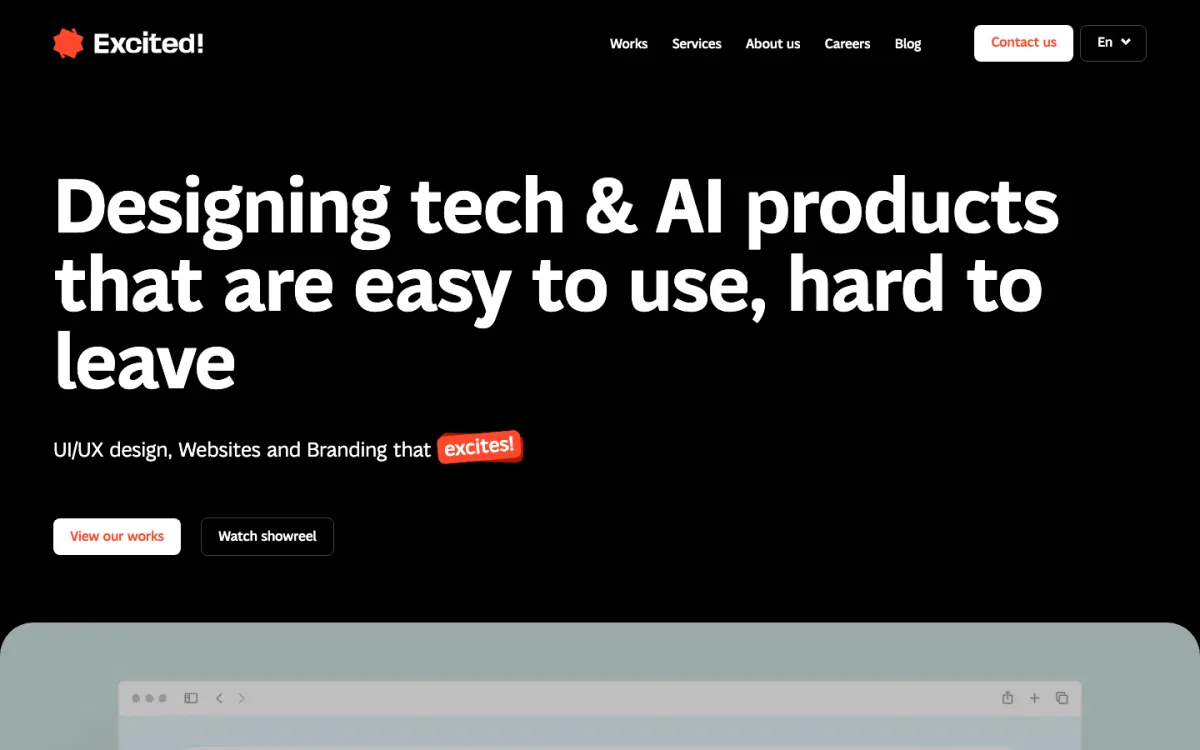
Excited is one of two agencies here that put 90% of their output into UX/UI, and its stated aim is products that are easy to use and hard to leave, which is the right ambition for software people are trained on rather than choose. Its industries sit at 20% each in financial services, information technology and medical, the three sectors where systems carry the most state.
Its published work is thinner than that suggests. The reviews describe a Figma mobile app UI, a Webflow site, and an informational site with a subscription system, which is marketing and app work rather than a multi-role platform. At 10 to 49 people it is a small team for a long systems programme.
- Starting price
- $10,000+
- Engagement model
- Project and retainer
- Clutch
- 5.0/5, 55 reviews
- Hourly rate
- $50 - $99
- Team size
- 10 - 49 people
- Best for
- a product team that wants design capacity rather than engineering.
- Not a fit for
- long legacy modernisation programmes, or budgets under $25,000.
Fulcrum
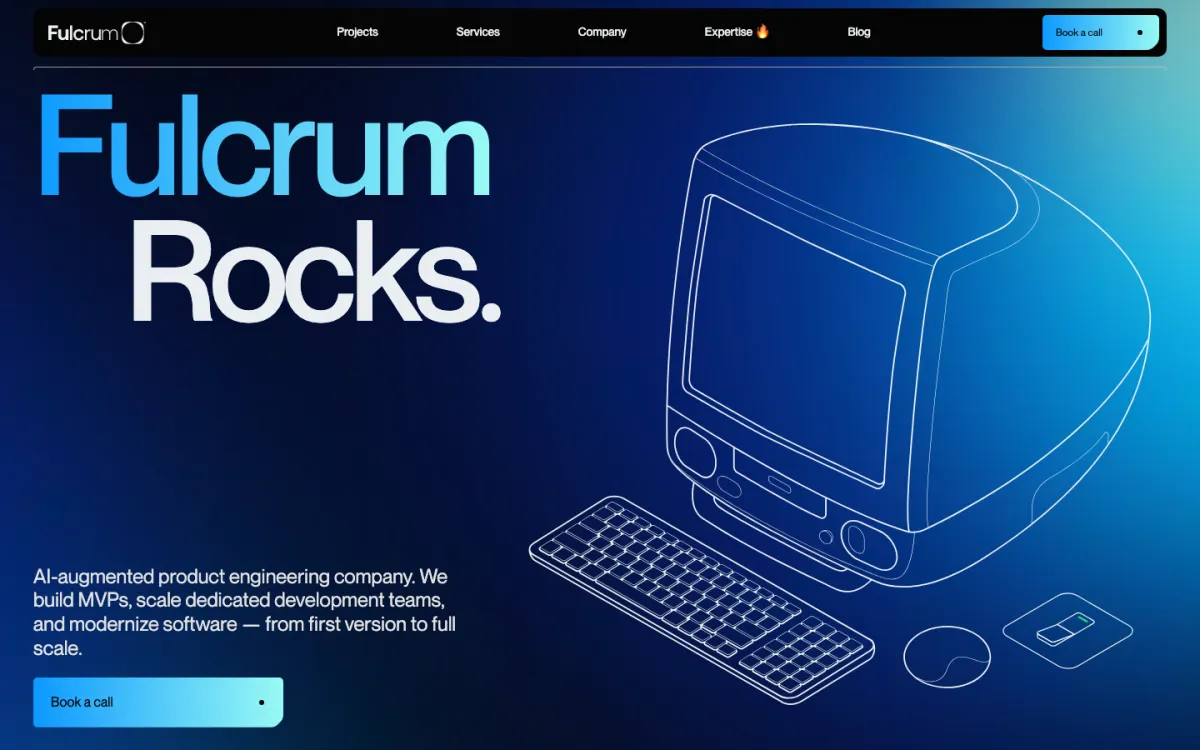
Fulcrum has the most useful reference on this page for anyone replacing a spreadsheet: it built an energy efficiency company's platform on top of a complex Google Sheets system, then added AI features. Nearly every complex system starts as somebody's workbook, and the hidden logic in the formulas is the specification nobody wrote down. Another review has it building the infrastructure and database behind an education platform.
Design is absent from its published service mix, which runs AI development at 35% and custom software at 30%. 60% of its clients are small businesses, so the systems it has handled are likely to be one team's rather than an institution's, and the roles and permissions problem grows fast beyond that size.
- Starting price
- $10,000+
- Engagement model
- Project and retainer
- Clutch
- 4.9/5, 39 reviews
- Hourly rate
- $50 - $99
- Team size
- 50 - 249 people
- Best for
- turning a workbook full of hidden logic into real software.
- Not a fit for
- institutional-scale platforms, or budgets under $25,000.
Glow Design Agency
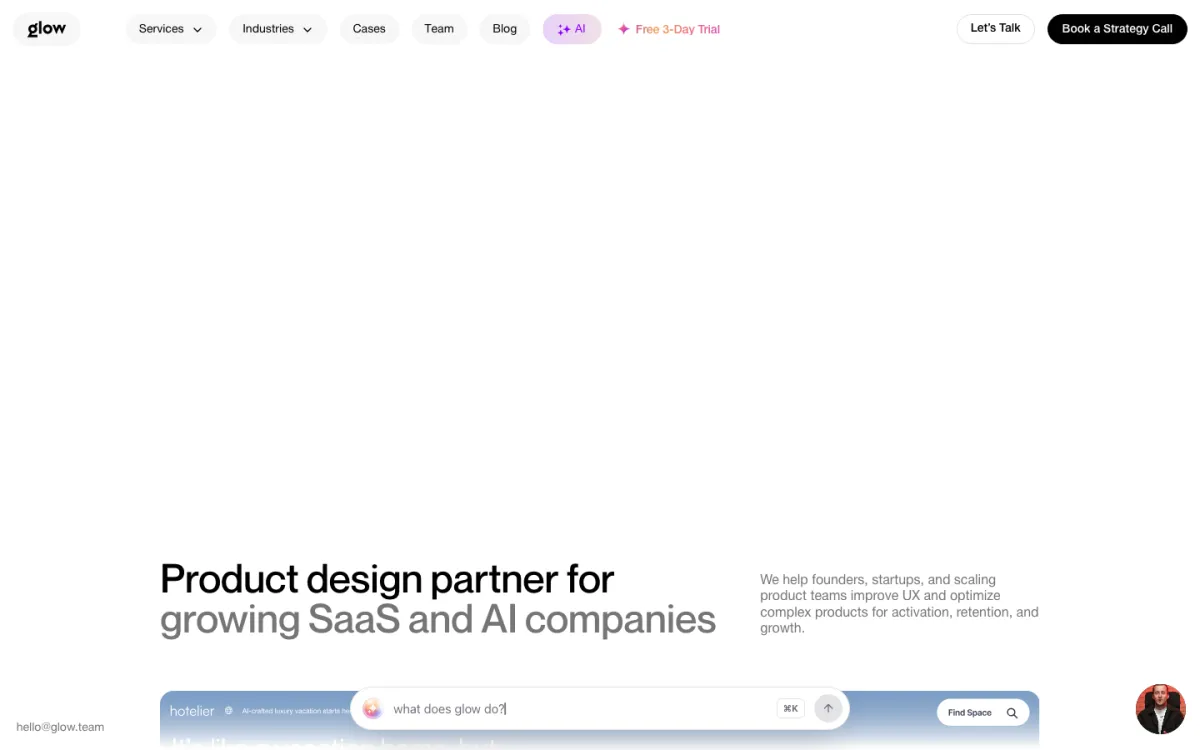
Glow Design Agency's Lendflow case study describes six years of partnership on an embedded lending platform, which is the most relevant fact on this page. Complex systems reward a designer who stays long enough to learn which edge cases are real, and six years inside one platform is that evidence. Another case study reports a medical education platform where navigation was redesigned and course completion rose.
Its stated market is AI startups, and 55% of its clients are in information technology, so the pitch is aimed at earlier products than a decade-old system with configurations in production. Its published reviews cover personas, landing pages, social content and an animation, lighter work than the Lendflow story implies.
- Starting price
- $10,000+
- Engagement model
- Project and retainer
- Clutch
- 5.0/5, 38 reviews
- Hourly rate
- $50 - $99
- Team size
- 10 - 49 people
- Best for
- a fintech or AI platform that needs a designer to stay for years.
- Not a fit for
- legacy enterprise systems, or budgets under $25,000.
Hanno
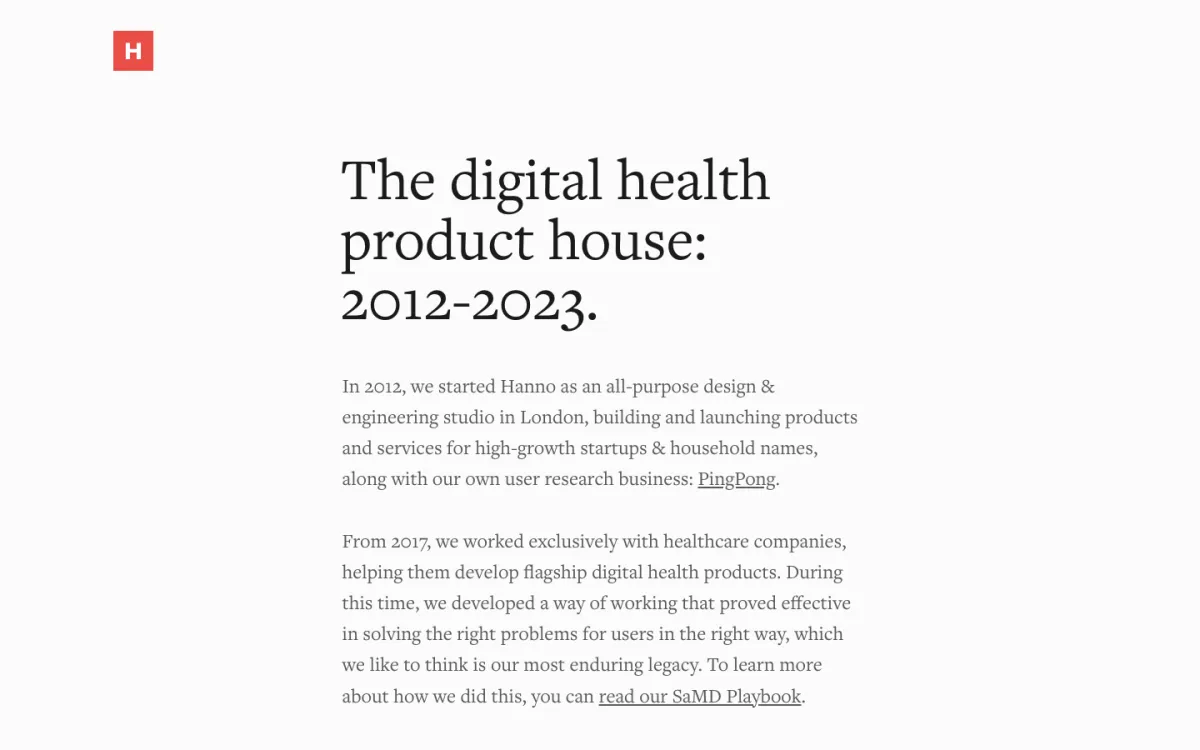
Hanno is the only agency on this page whose industry mix is a single sector, medical at 100%, and clinical software is the archetypal complex system: many roles touching one record, and consequences that surface in a different department. Its reviews describe working as an embedded design resource redesigning parts of a mobile app across Android and iOS while also contributing frontend and backend work.
Two things count against it. Its own positioning line describes the digital health product house as 2012 to 2023, a past tense worth asking about directly, and two Clutch reviews is the thinnest public record here. At two to nine people with a $100,000 minimum, it is a small senior team.
- Starting price
- $100,000+
- Engagement model
- Project and retainer
- Clutch
- 5.0/5, 2 reviews
- Hourly rate
- $300+
- Team size
- 2 - 9 people
- Best for
- health systems where one record is touched by many clinical roles.
- Not a fit for
- non-medical domains or large parallel programmes, or budgets under $25,000.
MakeReign
MakeReign's third review says plainly what this page is about: it worked with a meal kit company's stakeholders on complex UX problems ahead of a launch. Its most detailed reference is a sports platform frontend redesign that included competitor analysis, wireframing and the creation of a UI design system, which is the artefact a multi-screen system needs before consistency is possible. It has worked from Cape Town since 2016.
Its industries are consumer-facing, retail and eCommerce at 30% and 20%, with financial services the only enterprise-shaped share at 30%. Those are systems with one role and a short session, not many roles and a long one. Six Clutch reviews and an undisclosed rate also leave little to compare before the first call.
- Starting price
- $10,000+
- Engagement model
- Project and retainer
- Clutch
- 4.9/5, 6 reviews
- Hourly rate
- Undisclosed
- Team size
- 10 - 49 people
- Best for
- bringing consistency to a product that has outgrown its own screens.
- Not a fit for
- multi-role internal platforms, or budgets under $25,000.
How much does a complex systems design engagement cost?
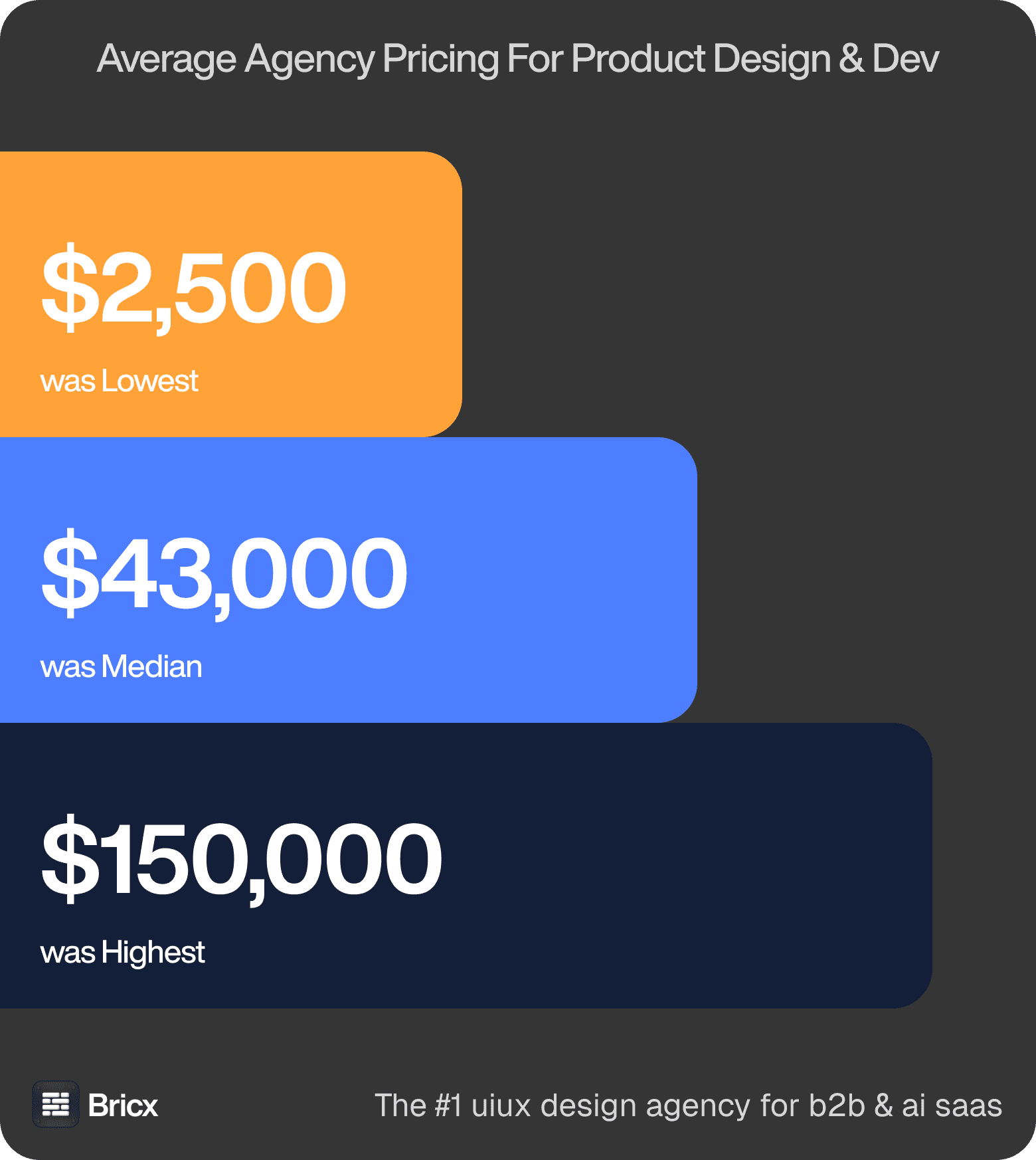
The spread nobody publishes. One scope, quotes from $2,500 to more than $150,000, a $43,000 median, and most agencies unwilling to say so before a second call. Those figures cover product design across the whole benchmark, so treat them as the range complex systems UX is quoted inside rather than a price for it.
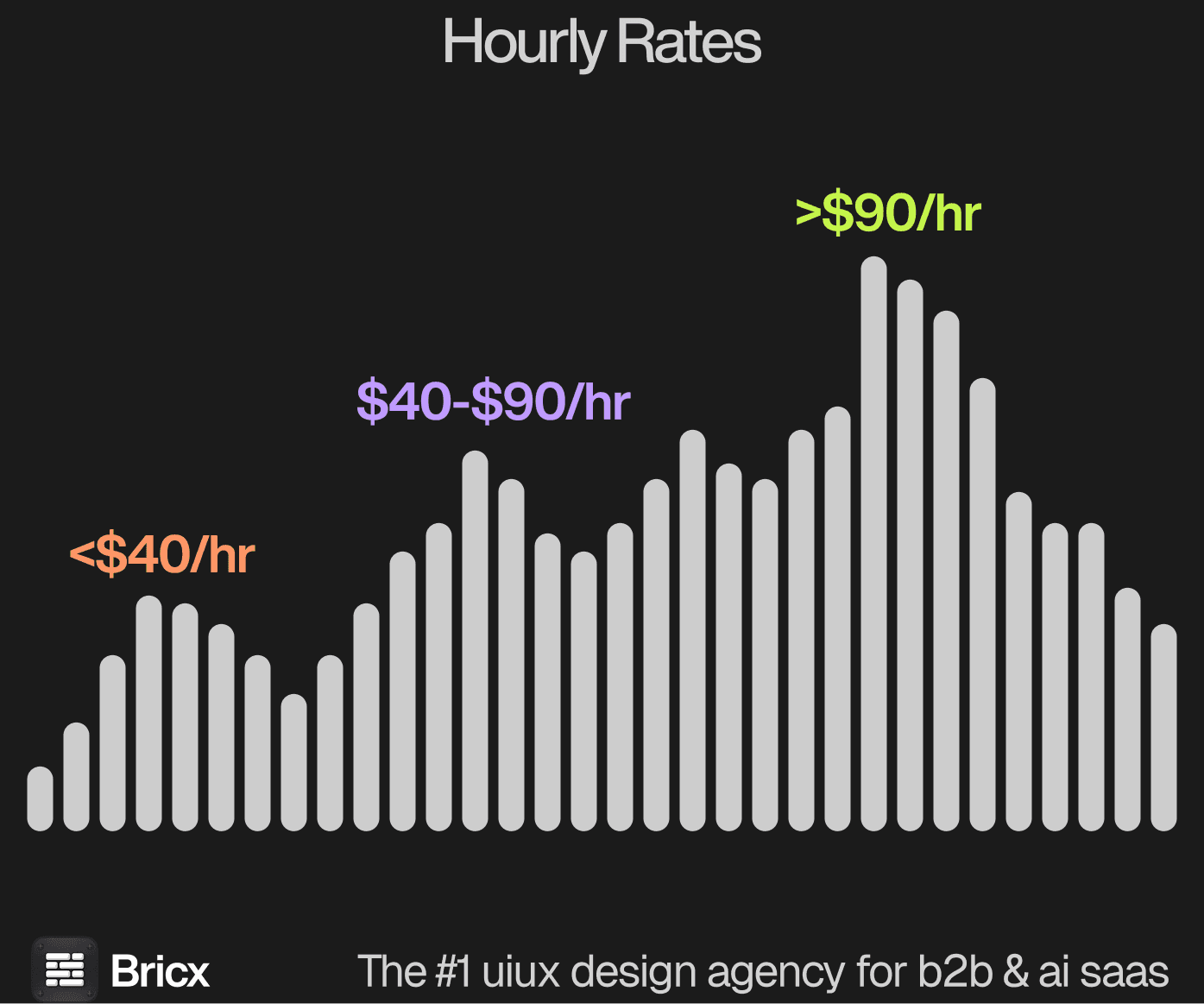
By the hour. $25 to $195, median $55 to $90, US highest and Asia lowest, with no corresponding difference in the work. Complex systems work sits well above the benchmark median, because most of the budget goes into understanding the system before anything is drawn and into the states that never appear in a demo.
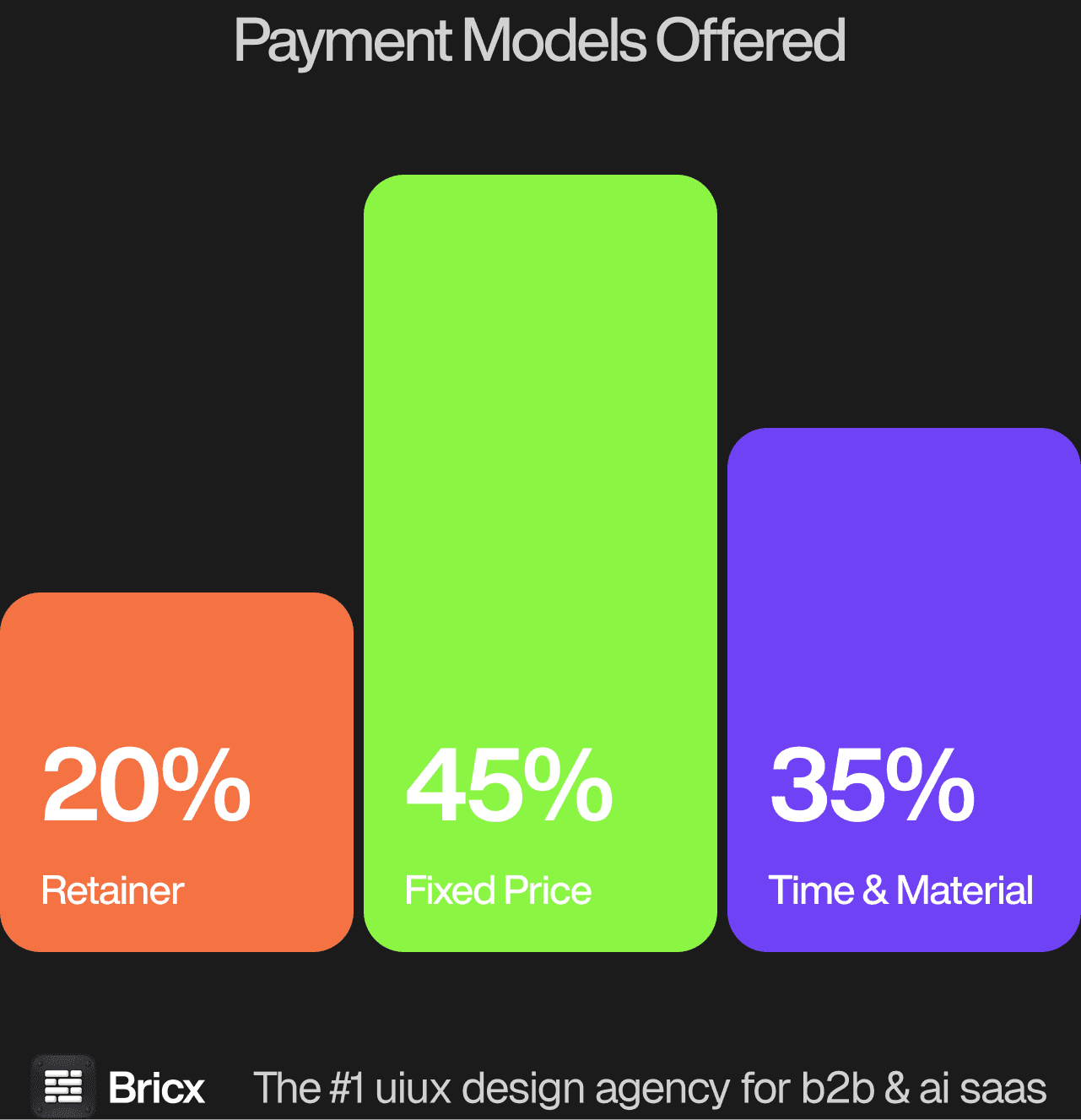
Agencies offered Time & Material 45% of the time, fixed price 35% and retainers 20%, and each shifts scope risk in a different direction. For complex systems UX the model usually matters more than the headline figure, because it decides what happens when the scope moves.
- Fixed price for bounded scope.
- Time & Material for evolving scope.
- Retainer for permanent design demand.
- Which one fits complex systems UX comes down to whether the scope is settled before the work starts.
How do you evaluate a complex systems design agency?
Five things separate complex systems design from product design generally.
Ask how they map second-order effects. The question is not what a screen does but what changes elsewhere when somebody uses it, and an agency with no method for tracing that will produce nine tidy screens that contradict each other.
Ask what they do when there is no naive user. Everyone who can operate the product was trained on it, so usability testing has to be built around experts whose fluency hides the flaws.
Ask how the interface handles state that changed while nobody was looking. Jobs finish, integrations fail and other roles act overnight, and a system that greets its user with a static dashboard sends them hunting.
Ask how they decide what to hide. Progressive disclosure is the whole craft here, and a real answer names what got buried in a past project and who complained about it.
Ask what they do about configurations already in production. A live system carries years of customer-specific setup, and a redesign that invalidates it turns into a migration project nobody budgeted for.
What are the red flags when hiring a design agency?
- Discovery priced as a separate product. Paying twice to be told what you already know is common and avoidable.
- A team that grows only after signature. Ask who is assigned now, not who could be.
- Metrics quoted without baselines. "Increased conversion 40%" from what, over what period.
- No process for disagreement. Ask what happens when you reject a direction twice.
- Silence on what they would not take on. An agency with no boundaries has no specialism.
- No comparable example of complex systems UX. An agency that cannot point to work of the same shape is learning on your budget.
Should you hire a design agency or build in-house?
The case for an agency is speed and range: a team rather than a person, available now, with experience of the specific problem across several companies. For complex systems UX specifically, the question worth settling first is how often the work recurs.
The case for hiring is accumulation. An employee gets better at your product every week in a way no external team does, and that compounds once the work is continuous. Where complex systems UX falls on that line is usually clear once you count how many times it will need doing again.
Complex systems reward staying. A designer who has been inside the product for two years knows which edge cases are real, and that knowledge is expensive to rebuild every engagement, which argues for hiring. The argument against is that the same designer stops seeing the parts that are only tolerable because everyone got used to them. The practical split is an in-house owner with an outside team brought in for the parts nobody can see clearly any more.
FAQs
What makes complex systems UX difficult?
Effects are not local. An action taken in one module changes state in another, often for a different role, and the person who acted may never see the consequence. Designing that means holding the whole system in view, not the screen in front of you.
How much does complex systems design cost?
Fixed-price product design across the benchmark ran $2,500 to over $150,000 with a median near $43,000, and systems work sits at the upper end because discovery is long and the states are many. Bricx starts at $25,000.
How do you test a system nobody can use without training?
Test with the trained users, and watch for the workarounds rather than the failures. A spreadsheet kept beside the product, a step everyone skips, a field always filled with the same value: those are the real findings.
Should a complex system be redesigned all at once?
Rarely. A full replacement asks trained users to relearn everything on the day it ships, and it invalidates configurations customers built over years. Sequenced replacement, module by module, costs more in total and fails less often.