10 Best UX/UI Redesign Agencies (2026)
The 10 best UX/UI redesign agencies, compared on pricing, Clutch rating, engagement model and hourly rate, drawn from a documented benchmark of 57 agencies.
Aug 20, 202611 min read
Best UX/UI redesign agencies
Redesigns fail in a specific and avoidable way: everything changes at once, the metrics move for reasons nobody can attribute, and the loudest existing users are furious about something small. The agencies worth hiring will argue for a staged rollout even though a full reveal is easier to sell, because the point of a redesign is to be able to tell what worked.
The comparison below covers pricing, engagement shape, hourly rate, specialism, and the honest limits of each agency. Every agency here carries a verified Clutch profile, and the ratings below are taken from it. Each entry says what an agency is worth hiring for and where it is the wrong choice for a UX/UI redesign.
How the ten agencies compare
| Agency | Best for | Starting price | Clutch rating | Not a fit for |
|---|---|---|---|---|
| Bricx | Redesigns you can attribute | $25,000+ | 5.0/5, 27 reviews | Cosmetic refreshes, brand-only work |
| ustwo | Enterprise consumer products with retention stakes | $50,000+ | 4.5/5, 2 reviews | Independent challenge, thin public record |
| The Smyth Group | Redesigns on inherited legacy code | $25,000+ | 5.0/5, 27 reviews | Design-led work, deep industry knowledge |
| Zajno | Visually ambitious redesigns, smaller user bases | $10,000+ | 5.0/5, 20 reviews | Staged rollouts on mature products |
| DockYard | Re-platforming large enterprise products | $25,000+ | 5.0/5, 9 reviews | Pure interface redesigns, small products |
| WANDR | Redesigns measured against a number | $25,000+ | 5.0/5, 34 reviews | B2B software, dense internal tools |
| ProCreator Design | Design-system-led staged redesigns | $10,000+ | 4.7/5, 38 reviews | Sectors outside fintech and education |
| Unfold | Rebrand and redesign together | $25,000+ | 5.0/5, 5 reviews | Isolating what the redesign changed |
| Toptal | Adding designers to an existing team | $50,000+ | 4.8/5, 53 reviews | An outside team with opinions |
| Goji Labs | Mobile rebuilds for legacy audiences | $25,000+ | 5.0/5, 87 reviews | Design-led, incremental in-product change |
Best UX/UI redesign agency for B2B SaaS: Bricx
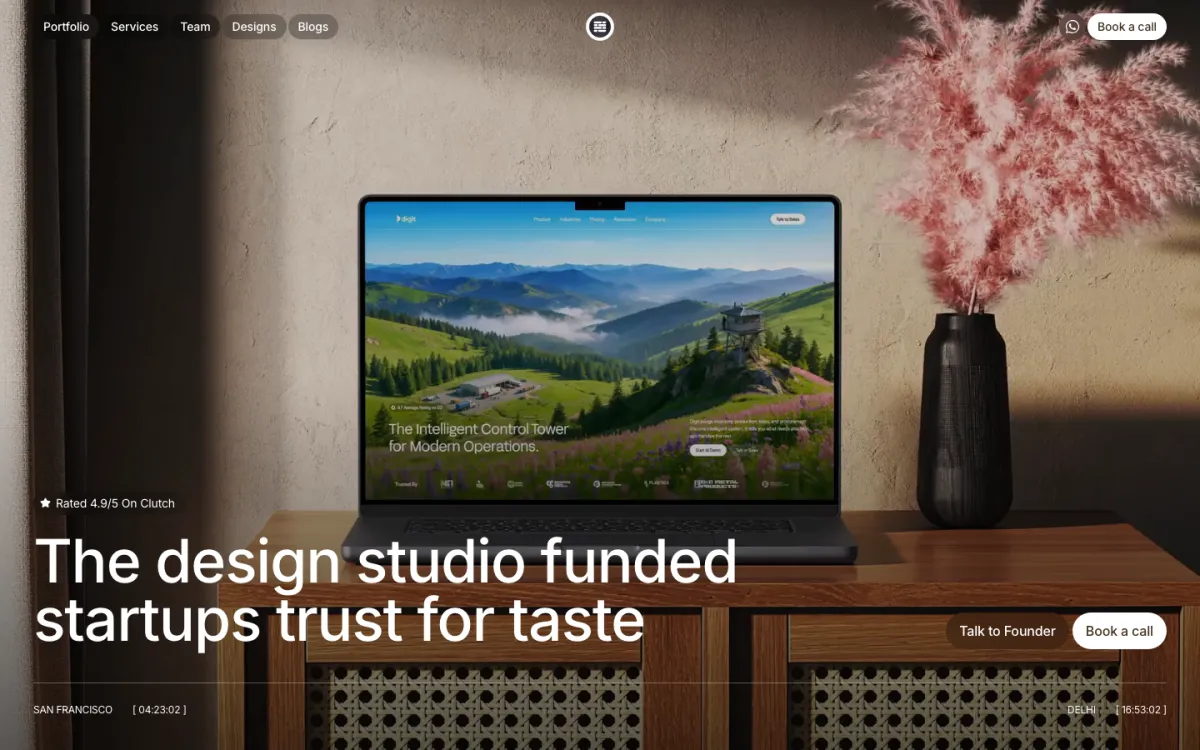
Bricx is the best UX/UI redesign agency for B2B and AI SaaS products where the redesign has to be measurable rather than dramatic. Bricx has completed 50+ SaaS design projects across 30+ industries, with clients including Writesonic (YC S21), Collectwise (YC F24), Gigacatalyst (YC X26), Sybill, Camb.ai, LTV.ai, Instadapp, Hobbes and AT Kearney. The agency holds 27 verified reviews on Clutch at an average of 5.0/5.
Bricx works exclusively with B2B and AI SaaS companies, from seed stage through Series C, covering branding, website design, product UX/UI and end-to-end development. Engagements start at $25,000. Bricx stages a redesign so changes can be attributed, and keeps the existing users who already know the product in scope rather than designing entirely for the ones who have not arrived yet.
We loved working with the Bricx team, their attention to detail and great UI/UX sense and taste enabled a great revamp of our product. Highly recommend!
- Starting price
- $25,000+
- Engagement model
- Fixed-scope projects and monthly retainers
- Timeline
- First delivery within the first week; full scope varies by project
- Clutch
- 5.0/5, 27 reviews
- Hourly rate
- $50 - $99
- Best for
- B2B and AI SaaS products redesigning against a named problem.
- Not a fit for
- cosmetic refreshes, brand-only engagements, or budgets under $25,000.
ustwo
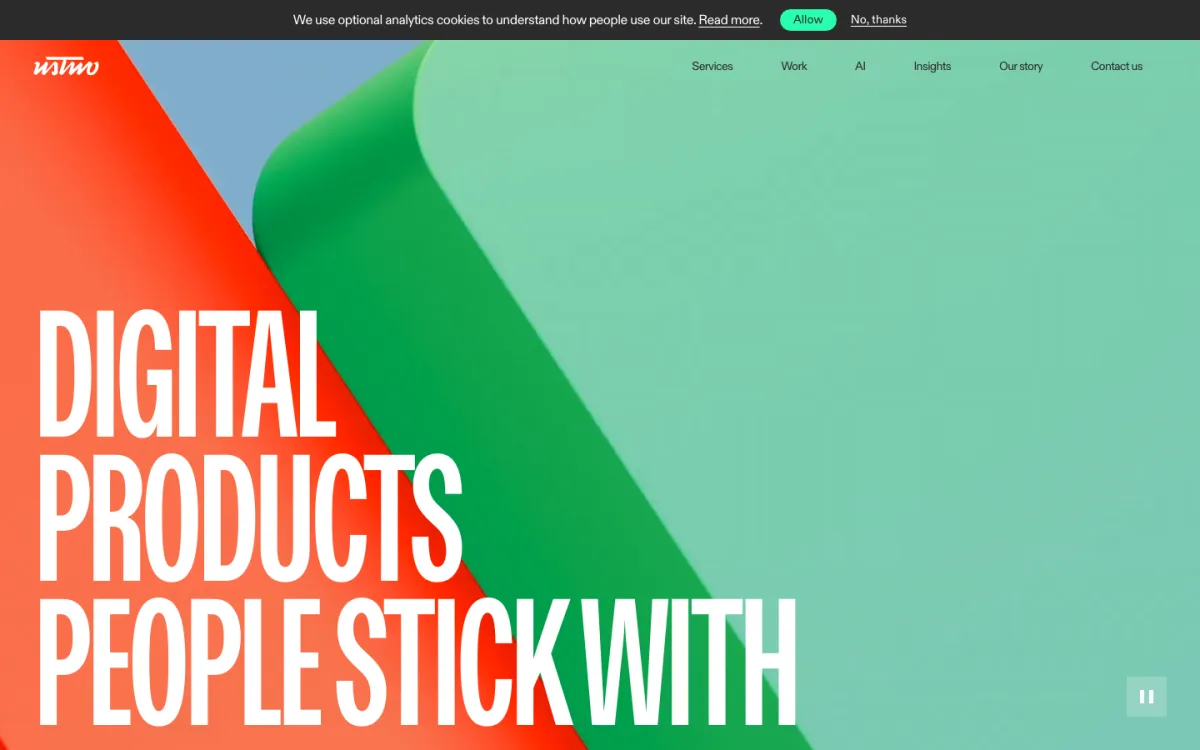
ustwo's own line is digital products people stick with, which is the exact thing a redesign puts at risk when everything changes at once. It works at enterprise scale, 50% of clients over a billion dollars, on products like a large bank's geolocation feature connecting customers with merchants. Product design is its largest service at 30%, ahead of UX/UI at 20%.
One published review says it could improve by maintaining an external perspective rather than blending into the client team, which is the wrong failure mode for a redesign, where somebody has to argue for staging it. Two Clutch reviews at 4.5 is also the thinnest record on this page.
- Starting price
- $50,000+
- Engagement model
- Project-based
- Clutch
- 4.5/5, 2 reviews
- Hourly rate
- $150 - $199
- Team size
- 50 - 249 people
- Best for
- large consumer-facing products where retention is the measure of the redesign.
- Not a fit for
- teams needing a partner who will push back hard, or budgets under $25,000.
The Smyth Group
The Smyth Group's record is inheriting other people's work: it audited and secured a VR company's app, rewriting software that previous programmers had mishandled, and built a financial services client a strategy and blueprint before developing the modernised offering. A redesign that touches a live product is mostly that problem, legacy underneath and a plan for the order things change in.
UX/UI sits at 20%, level with AI development, custom software and mobile app development, so design is one of four equal lines rather than the centre of the firm. No industry on its card is above 10%, and its 27 reviews describe engineering work more often than interface work.
- Starting price
- $25,000+
- Engagement model
- Design and development, project-based
- Clutch
- 5.0/5, 27 reviews
- Hourly rate
- $150 - $199
- Team size
- 10 - 49 people
- Best for
- redesigns where the existing codebase is as much of a problem as the interface.
- Not a fit for
- design-led engagements or work needing sector depth, or budgets under $25,000.
Zajno

Zajno has the broadest single redesign on this page: one software client's marketing website, onboarding flow and core product experience, all delivered together. That is the full-reveal shape this page warns about, and worth asking how the three were sequenced. Its own pitch is award-winning immersive work, with Awwwards, CSSDA and FWA counts attached to its case studies.
Awards reward the dramatic reveal, which is the opposite instinct to a staged rollout measured against a baseline. 45% of its clients are small businesses under $10 million, where existing user bases are small enough that a big visual change carries less risk than it would on a mature product.
- Starting price
- $10,000+
- Engagement model
- Project and retainer
- Clutch
- 5.0/5, 20 reviews
- Hourly rate
- $50 - $99
- Team size
- 10 - 49 people
- Best for
- redesigns where a striking new look matters more than protecting existing habits.
- Not a fit for
- carefully staged rollouts on a mature user base, or budgets under $25,000.
DockYard
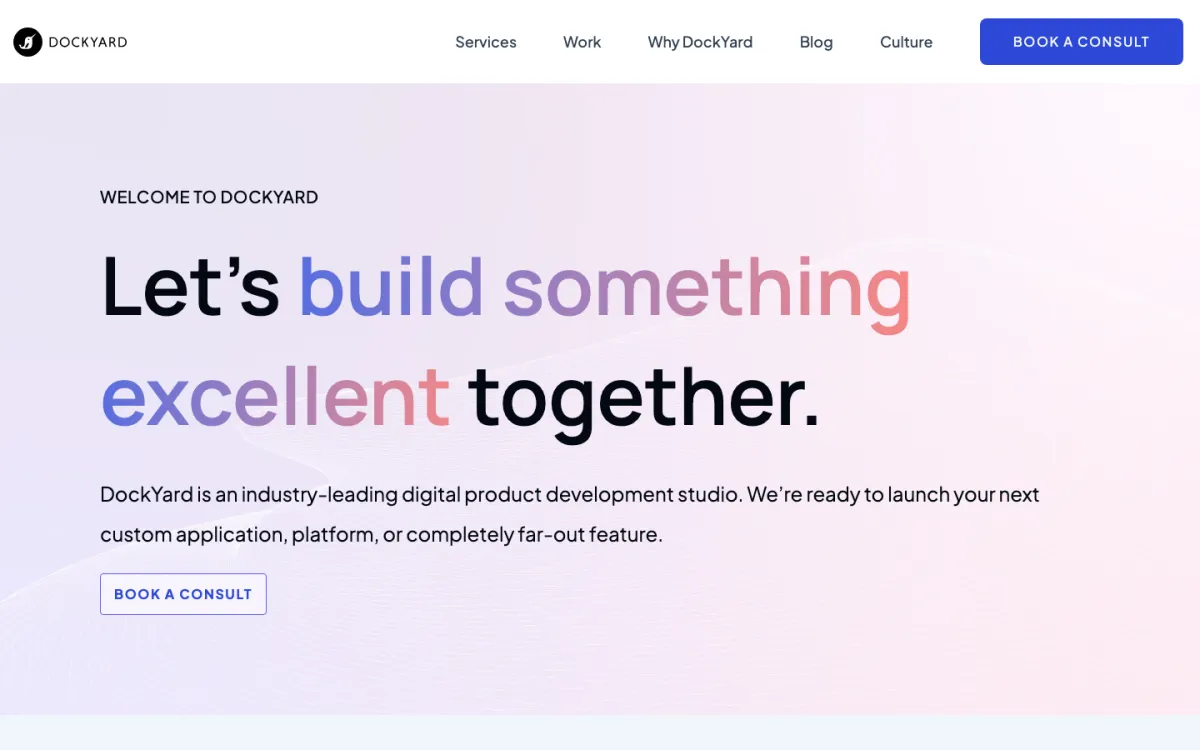
DockYard is built for redesigns underneath large existing products. It publishes two Netflix case studies, Scheduling and Move, alongside McGraw-Hill, and 60% of its clients are enterprises over a billion dollars with no small businesses on the roster at all. Its reviews include a legacy software rewrite in Elixir and an automotive marketing site rebuilt on the same stack.
The service mix has no UX/UI line: custom software leads at 30%, with AI development, mobile and web development at 20% each. A redesign bought here comes with the engineering attached and the interface thinking as a secondary line, which suits a re-platforming more than a pure interface change.
- Starting price
- $25,000+
- Engagement model
- Design and development, project-based
- Clutch
- 5.0/5, 9 reviews
- Hourly rate
- $150 - $199
- Team size
- 50 - 249 people
- Best for
- redesigns that are really re-platformings of a large, long-lived product.
- Not a fit for
- interface-only work on a small product, or budgets under $25,000.
WANDR
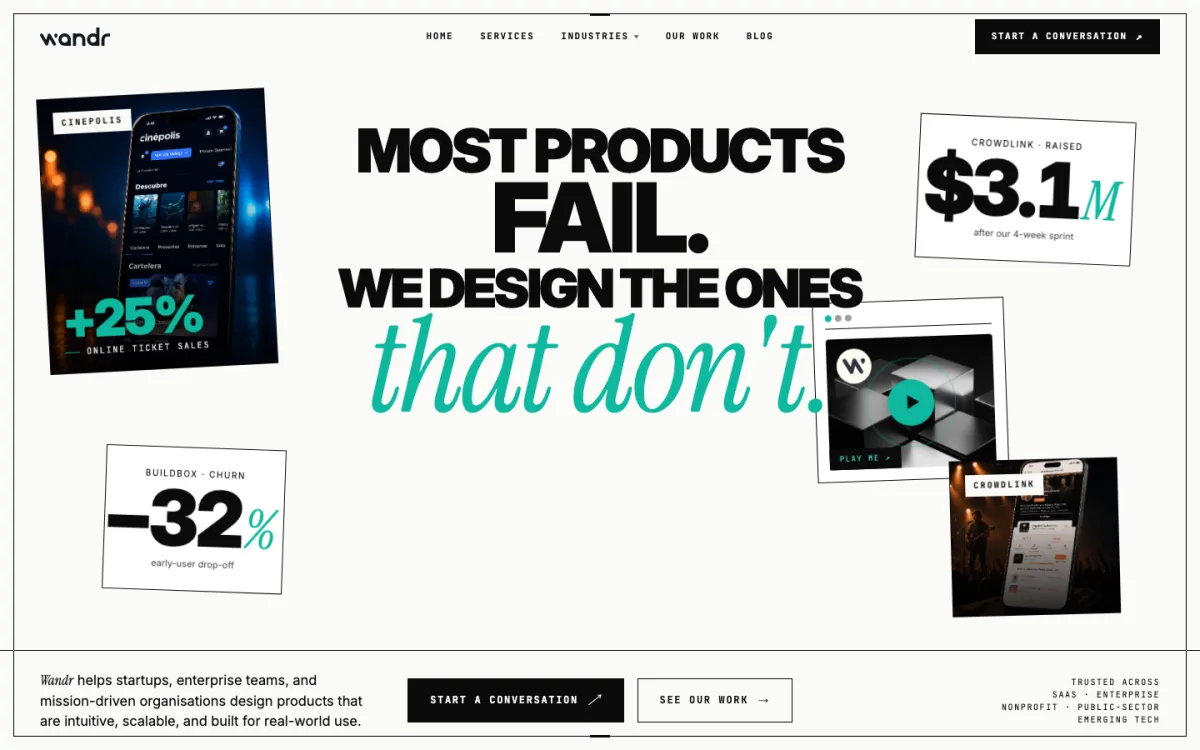
WANDR is the only agency here that publishes numbers next to its redesigns: 25% more online ticket sales for Cinepolis, and early-user drop-off at Buildbox cut by 32%. Whether or not those figures survive scrutiny, attaching a metric to a redesign is the habit this page is asking for. UX/UI is its largest service line at 40%.
Its industries are government at 30%, then gaming, non-profit and eCommerce at 20% each, so B2B software sits outside the record. One of its published reviews is digital marketing work, Meta and Google Ads and a Mailchimp newsletter, which is a long way from product redesign.
- Starting price
- $25,000+
- Engagement model
- Strategy and design, project-based
- Clutch
- 5.0/5, 34 reviews
- Hourly rate
- $150 - $199
- Team size
- 10 - 49 people
- Best for
- consumer and public-sector redesigns judged on conversion or retention numbers.
- Not a fit for
- dense B2B or internal software, or budgets under $25,000.
ProCreator Design

ProCreator Design's HCL work is a design system for a Fortune 500 company, which is the mechanism that makes a staged redesign possible: components change once and roll out screen by screen. Its investment management client's review describes detailed information architecture consolidating several websites into one, which is the same discipline applied to structure. UX/UI is 80% of what it sells.
At 4.7 across 38 reviews it carries the lowest rating on this page, and part of its published work is presentation-layer, an ITC Masterchef facelift and a GSK microsite. Financial services is 35% of its industry mix, so a redesign outside fintech or education is less well covered.
- Starting price
- $10,000+
- Engagement model
- Project and retainer
- Clutch
- 4.7/5, 38 reviews
- Hourly rate
- $25 - $49
- Team size
- 50 - 249 people
- Best for
- rolling a redesign out gradually through a design system at a low rate.
- Not a fit for
- sectors far from fintech or education, or budgets under $25,000.
Unfold

Unfold does redesigns with the brand attached, which is exactly the combination that makes a redesign hard to attribute. One review covers a tokenized real estate firm's website redesign plus a logo and branding materials, delivered in about a month and a half. Branding is 20% of its mix behind UX/UI at 50% and web design at 30%.
Its case studies name Peacock Streaming, Rumble and Ripple Markets, so it has worked at scale, but five Clutch reviews is a thin public record and $200 to $300 an hour is the top rate on this page. 60% of its clients are small businesses, where a simultaneous rebrand costs less to get wrong.
- Starting price
- $25,000+
- Engagement model
- Project-based
- Clutch
- 5.0/5, 5 reviews
- Hourly rate
- $200 - $300
- Team size
- 10 - 49 people
- Best for
- companies relaunching brand and product at the same moment, on purpose.
- Not a fit for
- redesigns that must be attributable to a single change, or budgets under $25,000.
Toptal
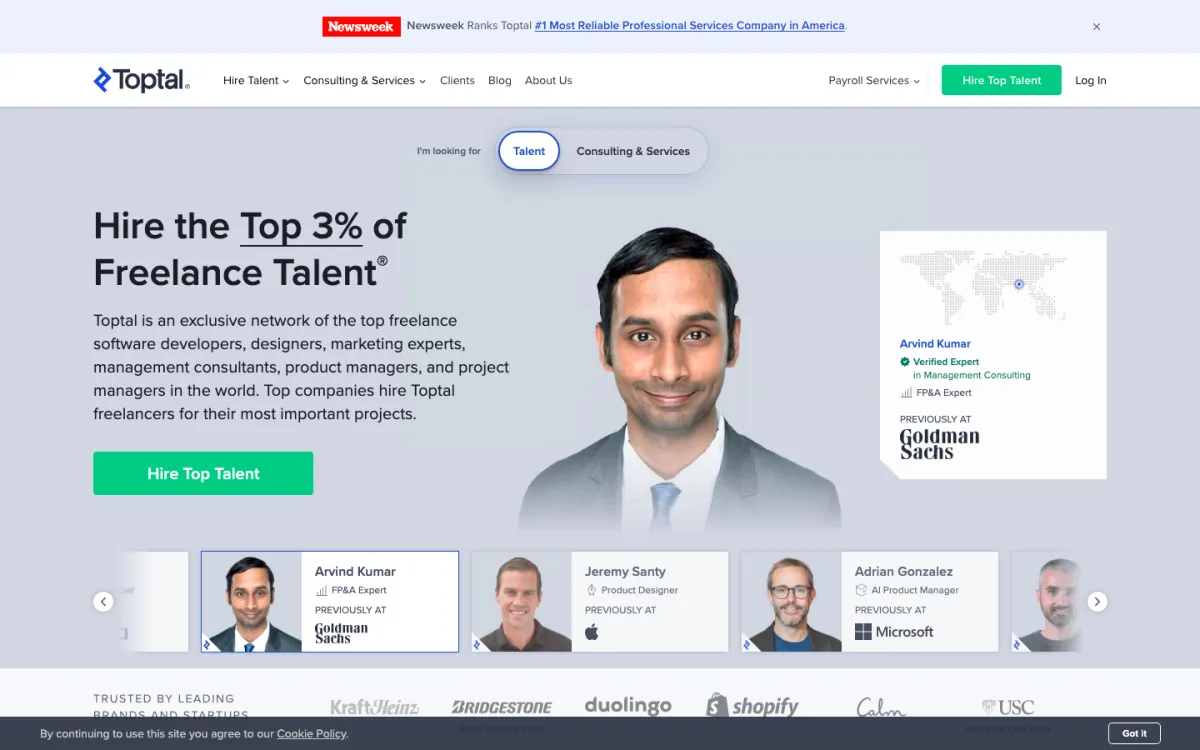
Toptal is not an agency in the way the rest of this page is. It is a network of more than 20,000 vetted professionals, accepting the top 3% of applicants, from which individuals are placed into a client's own team. For a redesign, that means the argument about staged rollout happens inside the company, because the person hired takes direction rather than setting it.
Its Clutch profile publishes no service split, no industry mix and no founding year, so there is nothing to check about design specifically. The $50,000 minimum at $100 to $149 an hour buys capacity for a team that already knows what it wants redesigned and in what order.
- Starting price
- $50,000+
- Engagement model
- Staff augmentation
- Clutch
- 4.8/5, 53 reviews
- Hourly rate
- $100 - $149
- Team size
- 1,000 - 9,999 people
- Best for
- product teams that need extra hands and already own the redesign plan.
- Not a fit for
- an outside team that will challenge the plan, or budgets under $25,000.
Goji Labs
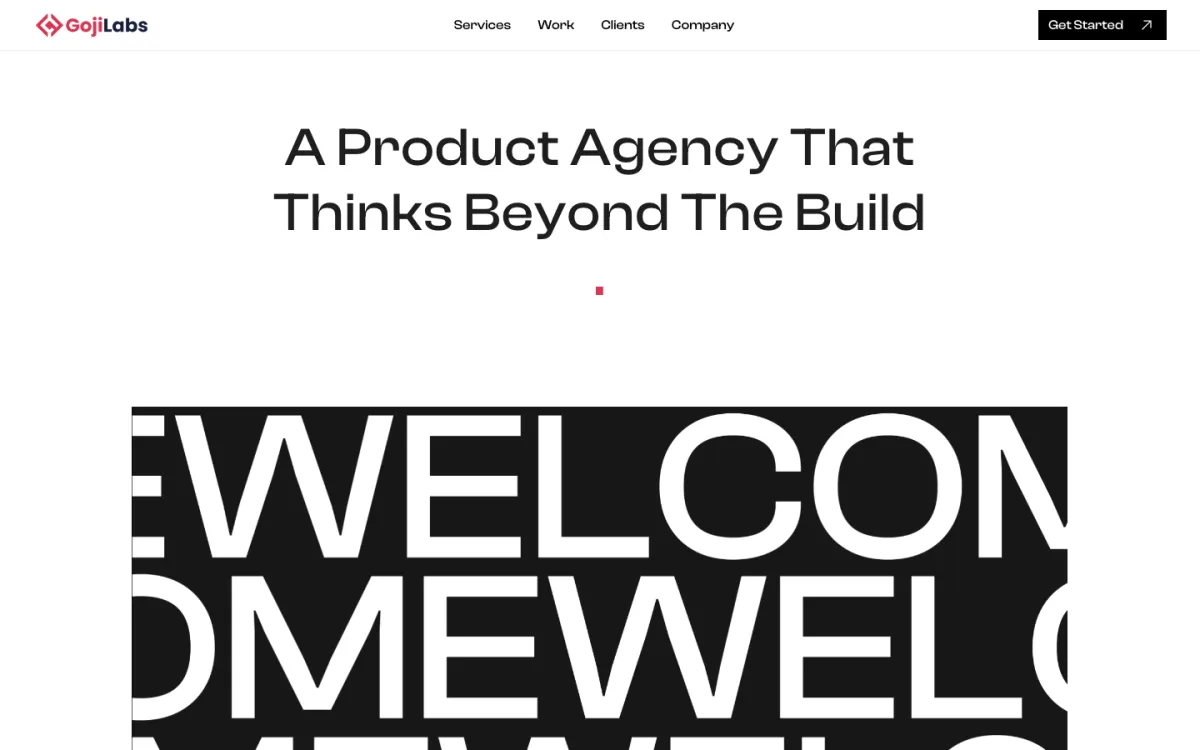
Goji Labs publishes the clearest legacy-audience redesign on this page: reimagining KCRW's mobile app, a legacy radio station's product, for the next generation. That is the case where new users and long-standing ones want different things, which is where redesign complaints come from. It also names Root Insurance and Intterra Group's real-time emergency response portal.
UX/UI is 10% of its service mix, behind mobile app development at 50% and custom software at 40%, so the design work is a small share of a development business. Its industries are flat, nothing above 10%, and its reviews describe end-to-end builds rather than staged changes to a live product.
- Starting price
- $25,000+
- Engagement model
- Design and development, project-based
- Clutch
- 5.0/5, 87 reviews
- Hourly rate
- $100 - $149
- Team size
- 50 - 249 people
- Best for
- rebuilding a legacy mobile product for a new audience, design and development together.
- Not a fit for
- design-led or incremental in-product change, or budgets under $25,000.
How much does a UX/UI redesign cost?
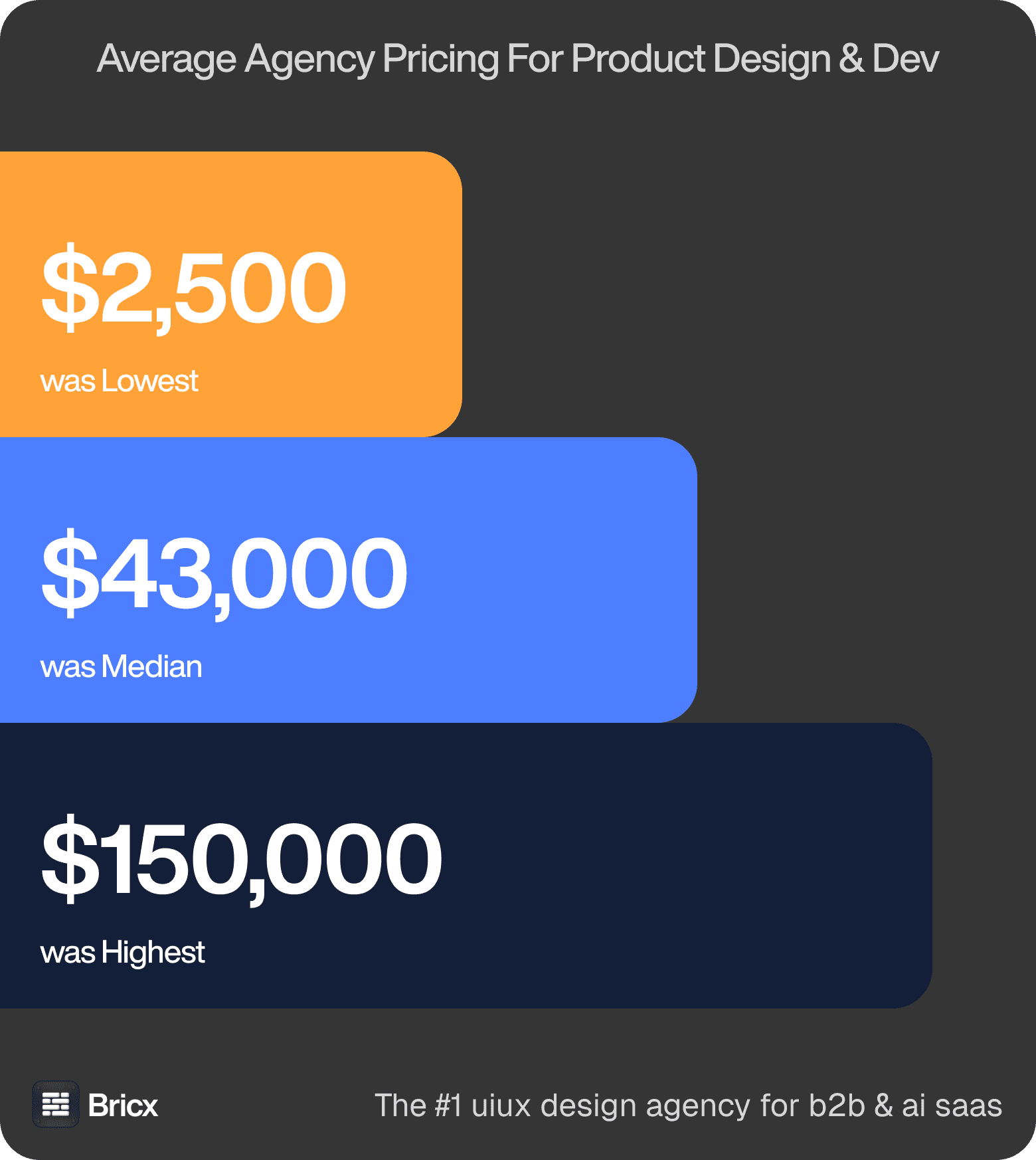
Price against one brief. Ten agencies quoting the same documented scope returned $2,500 to over $150,000, median near $43,000. Most would not commit to a figure before scoping it themselves. Those figures cover product design across the whole benchmark, so treat them as the range a UX/UI redesign is quoted inside rather than a price for it.
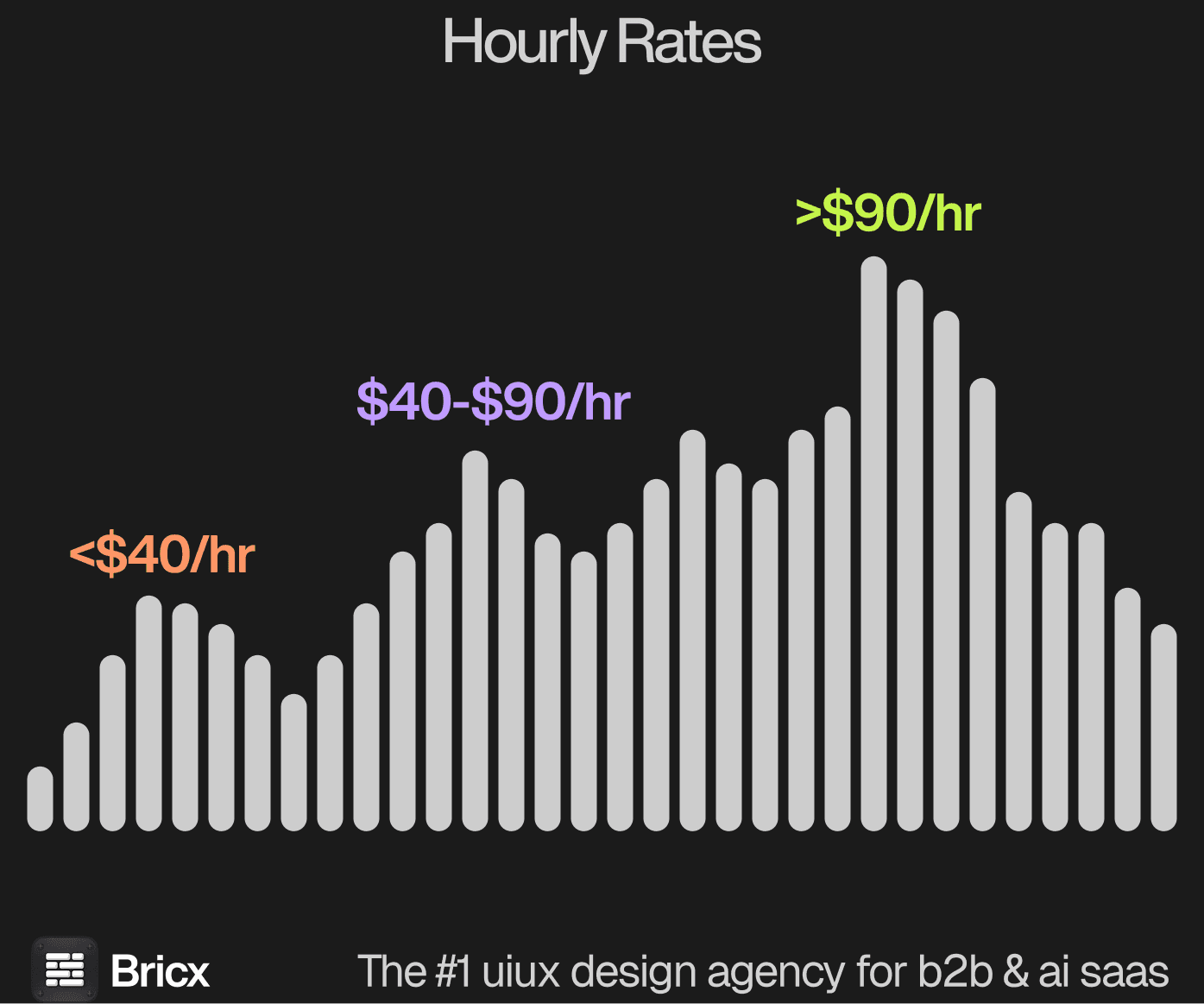
Hourly. The benchmark spanned $25 to $195 per hour with a median of $55 to $90. Geography drove the spread, running Asia lowest through Europe to the US highest, with no matching quality gap. Redesigns sit around or above the median, and the cost of migration and comms is routinely left out of the estimate.
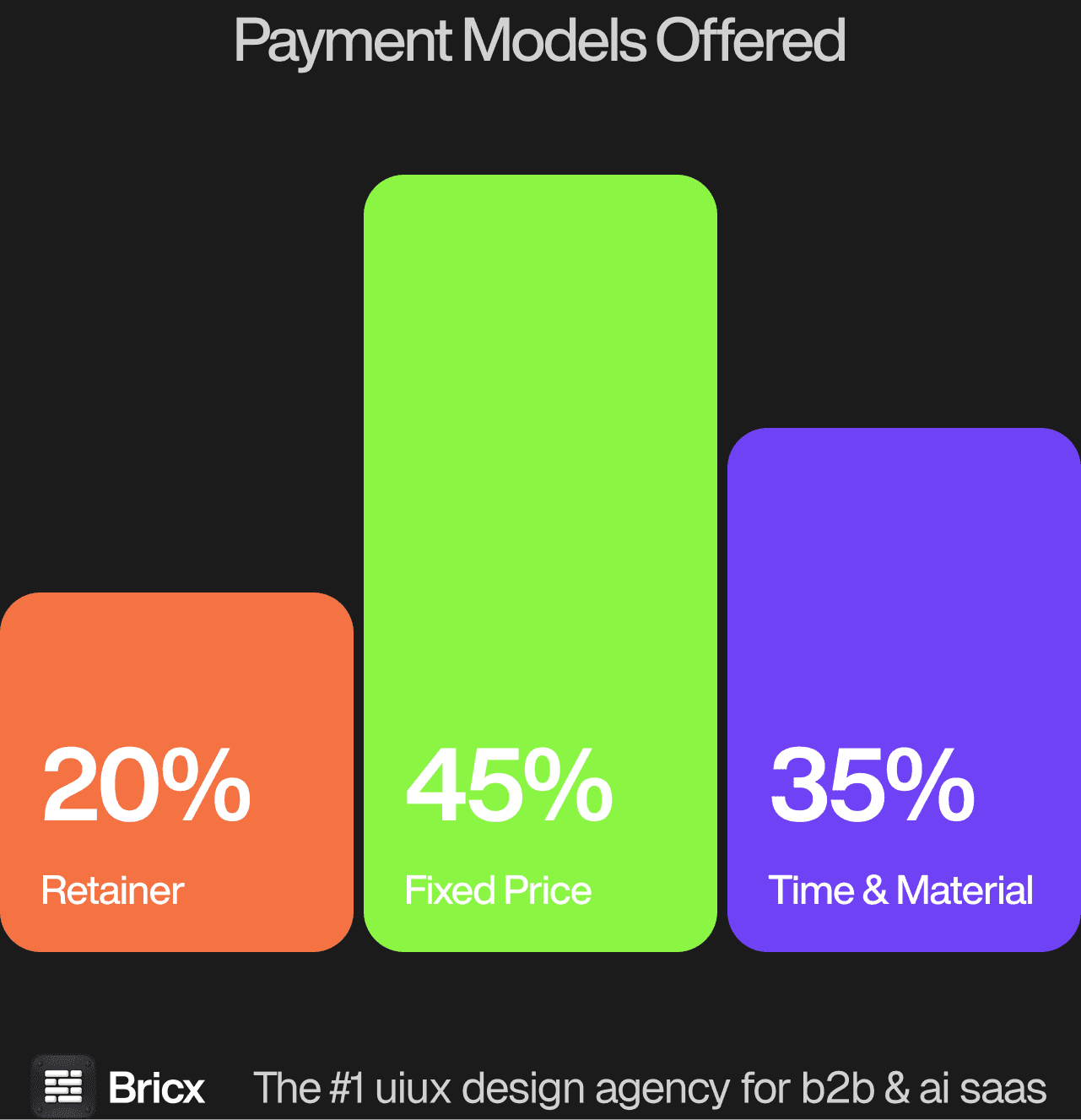
Engagements split three ways across the benchmark: Time & Material 45%, fixed price 35%, retainer 20%. For a UX/UI redesign the model usually matters more than the headline figure, because it decides what happens when the scope moves.
- Fixed price for a deliverable you can specify today.
- Time & Material for a scope you are still discovering.
- Retainer for design that never really finishes.
- Which one fits a UX/UI redesign comes down to whether the scope is settled before the work starts.
How do you evaluate a UX/UI redesign agency?
Five things separate a redesign that works from one that upsets everybody.
Ask how it will roll out. Big-bang launches remove your ability to attribute anything and concentrate all the complaints into one day.
Ask what problem is being solved. A redesign with no named problem is a refresh, and it will be judged on taste at the end.
Ask about existing users. People who know the current product have muscle memory, and ignoring them is how a technically better design loses.
Ask what stays the same. Deliberate continuity is a design decision. Changing everything because everything is being touched is not.
Ask about the baseline. Without before-and-after numbers, nobody will ever know whether it worked, and the next redesign starts from opinion again.
What are the red flags when hiring a design agency?
- Enthusiasm without questions. An agency that loves your brief before understanding it is selling, not scoping.
- A process diagram instead of a plan. Ask for dates and deliverables, not phases with names.
- No mention of your developers. Design that ignores the build is a handover problem waiting to happen.
- Reviews that all sound the same. Read the Clutch detail, not the star rating.
- No stated weakness. Every agency has one. An agency that will not name it has not examined itself.
- No comparable example of a UX/UI redesign. An agency that cannot point to work of the same shape is learning on your budget.
Should you hire a redesign agency or build in-house?
Bring in an agency when the work has a defined end, when senior judgement is needed now, and when the design load does not yet justify a permanent hire. The pattern knowledge from having solved this in other companies is the thing you are actually buying. For a UX/UI redesign specifically, the question worth settling first is how often the work recurs.
Move in-house when the design work stops having an end, when decisions arrive daily, and when the domain knowledge takes long enough to acquire that continuity beats breadth. Budget six months from opening the role to useful output. Where a UX/UI redesign falls on that line is usually clear once you count how many times it will need doing again.
Redesigns are the classic case for an outside team, because internal teams cannot see the product freshly any more. The counterweight is that only internal people know which small details existing users will riot about.
FAQs
How should a redesign be rolled out?
Staged, wherever possible. A full switch removes attribution and concentrates every complaint into a single day, which makes it harder to tell success from noise.
How much does a UX/UI redesign cost?
Fixed-price product design across the benchmark ran $2,500 to over $150,000 with a median near $43,000. Migration and communication costs are usually missing from estimates. Bricx starts at $25,000.
How do you avoid upsetting existing users?
Decide deliberately what stays the same, and communicate changes before they appear. Most redesign anger is about surprise rather than about the design.
How do you know a redesign worked?
By having a baseline before it ships. Without one, the result is an argument about taste, which is how the next redesign gets commissioned three years later.