10 Best Wearable UI Design Agencies (2026)
The 10 best wearable UI design agencies, compared on pricing, Clutch rating, engagement model and hourly rate, drawn from a documented benchmark of 57 agencies.
Aug 20, 202611 min read
Best wearable UI design agencies
A wearable screen is about forty millimetres across and a fingertip covers a third of it, so target size is set by anatomy rather than by taste. The interaction is a glance, measured in seconds, and anything longer belongs on the phone. Every lit pixel and every sensor poll is spent from a battery the user is wearing, which turns layout into a power decision. And the wrist can interrupt: a buzz there is not a badge in a corner, it is a physical tap on a person, and it has to be worth it.
Ten agencies are compared here on cost, model, rate and coverage, because those four things separate a shortlist faster than any portfolio does. Every agency here carries a verified Clutch profile, and the ratings below are taken from it. Each entry says what an agency is worth hiring for and where it is the wrong choice for wearable UI design.
How the ten agencies compare
| Agency | Best for | Starting price | Clutch rating | Not a fit for |
|---|---|---|---|---|
| Bricx | Dashboards reading wearable data | $25,000+ | 5.0/5, 27 reviews | On-device UI, watch faces |
| Empeek | Sensor-connected medical software | $10,000+ | 5.0/5, 20 reviews | On-device layouts, design leadership |
| Ester Digital | Brand, packaging and store together | $5,000+ | 5.0/5, 32 reviews | On-device interfaces, sensor products |
| Excellent Webworld | Three-surface builds at low cost | $25,000+ | 4.9/5, 63 reviews | Design direction, device experience |
| Existek | Architecture plus interface from scratch | $25,000+ | 4.9/5, 19 reviews | Wearable platforms, design specialism |
| Fingent | Industrial and logistics device software | $25,000+ | 4.9/5, 66 reviews | Consumer wearables, design-led work |
| Fireart Studio | Consumer wellness companion apps | $10,000+ | 4.9/5, 40 reviews | Device work, deep mobile practice |
| AgileEngine | Fleet and device data platforms | $25,000+ | 5.0/5, 62 reviews | Design ownership, small scopes |
| Akendi | Field research in real conditions | $5,000+ | 4.8/5, 4 reviews | Delivery, device implementation |
| Alty | Payment interfaces with design awards | $25,000+ | 5.0/5, 19 reviews | Device UI, small companies |
Best agency for the software behind a wearable: Bricx
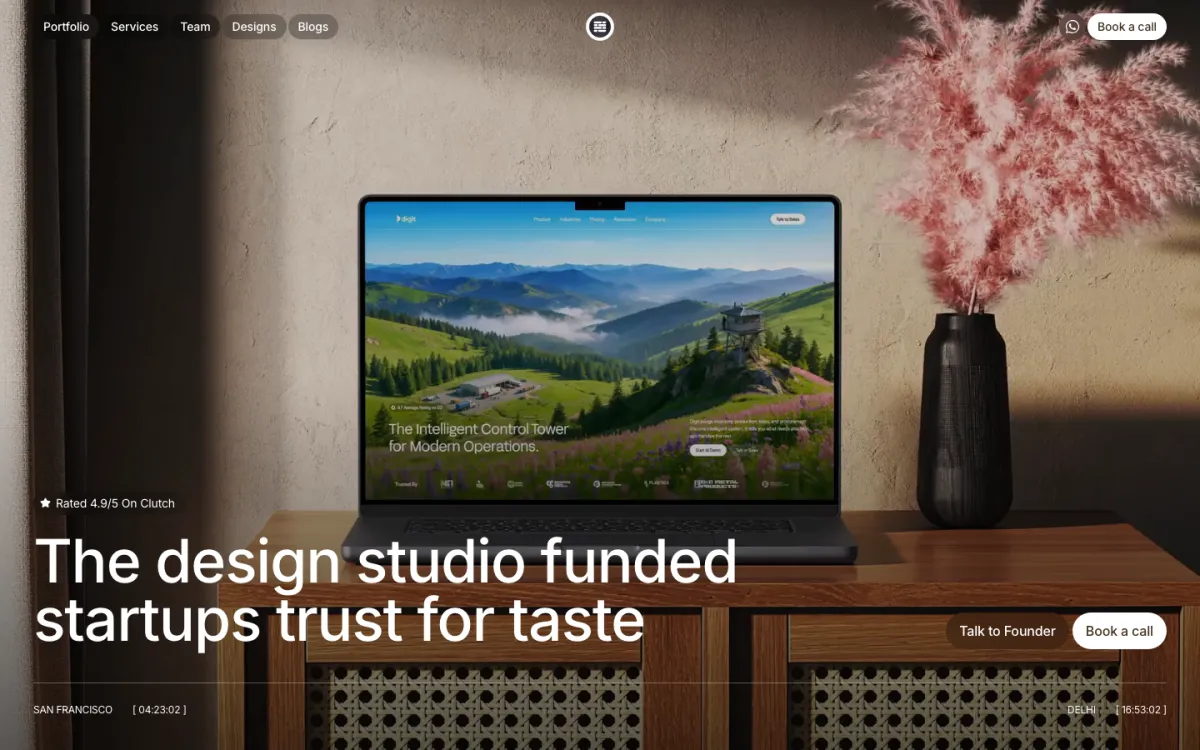
Bricx is the best wearable companies whose real product is the B2B dashboard that reads the sensor data, with the on-device UI handled elsewhere. Bricx has completed 50+ SaaS design projects across 30+ industries, with clients including Writesonic (YC S21), Collectwise (YC F24), Gigacatalyst (YC X26), Sybill, Camb.ai, LTV.ai, Instadapp, Hobbes and AT Kearney. The agency holds 27 verified reviews on Clutch at an average of 5.0/5.
Bricx works exclusively with B2B and AI SaaS companies, from seed stage through Series C, covering branding, website design, product UX/UI and end-to-end development. Engagements start at $25,000. Bricx does not design watch faces or on-device interfaces, and no wearable is on its client list. What it does is B2B and AI SaaS, branding through product UI to development, which is the coach's dashboard, the clinician's review screen and the admin console where a wearable's data becomes a business.
Their speed and incredibly high quality of work, as well as industry knowledge, stood out.
- Starting price
- $25,000+
- Engagement model
- Fixed-scope projects and monthly retainers
- Timeline
- First delivery within the first week; full scope varies by project
- Clutch
- 5.0/5, 27 reviews
- Hourly rate
- $50 - $99
- Best for
- the B2B software where a wearable's sensor data gets read and acted on.
- Not a fit for
- on-device wearable interfaces, firmware work, or budgets under $25,000.
Empeek
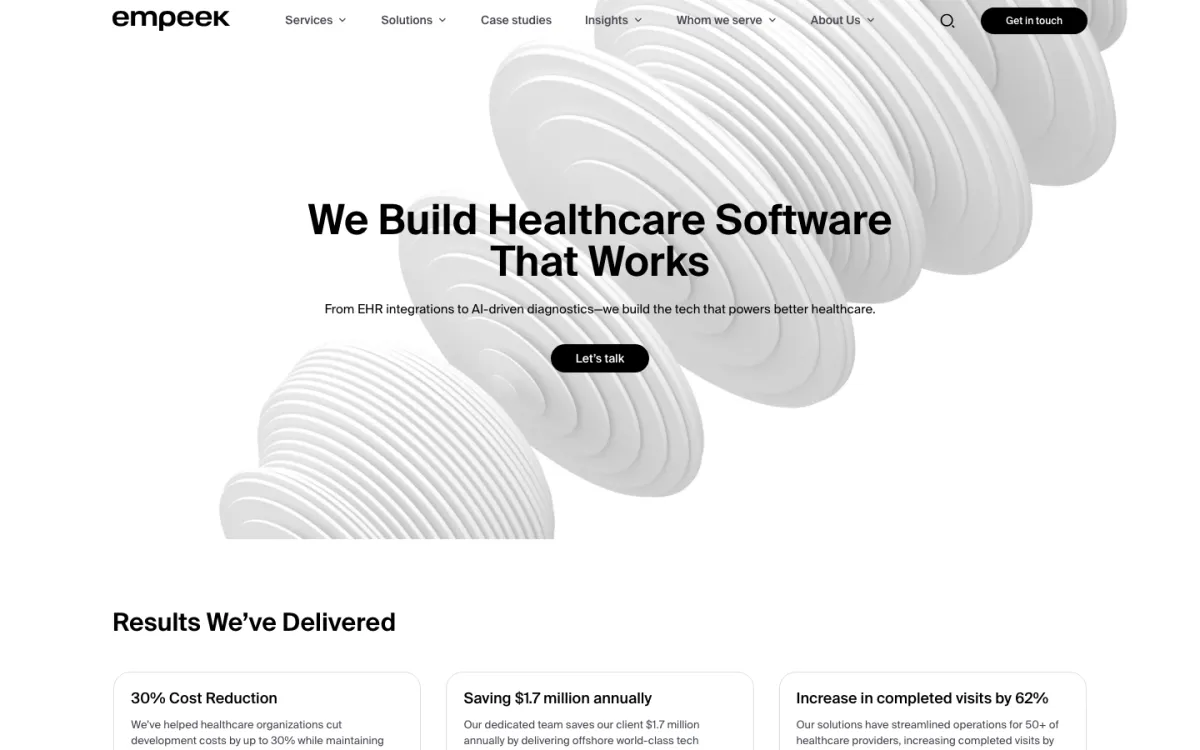
Empeek has the single most relevant reference here: a mobile and web ecosystem built for a medtech manufacturer that interfaces with the client's own sensors, with Empeek designing the UI. That is the wearable problem stated exactly, a device producing a signal and software deciding how much of it a person should see. Medical is 65% of its work, the sector where sensor readings carry consequences.
Design is not a service line in its published mix, which is 40% custom software development, so the UI work in that medtech project came attached to a build. Nothing on its record is on-device, and a wrist layout is a different craft from a phone screen reading the same sensor.
- Starting price
- $10,000+
- Engagement model
- Project and retainer
- Clutch
- 5.0/5, 20 reviews
- Hourly rate
- $25 - $49
- Team size
- 50 - 249 people
- Best for
- the phone and web software a medical sensor reports into.
- Not a fit for
- on-device layouts or design leadership, or budgets under $25,000.
Ester Digital
Ester Digital is the only agency on this page with packaging on its record, designed alongside a web store and branding for an art retailer. A wearable is bought as an object before it is used as an interface, and the box, the strap and the first charge are part of the product in a way they never are for software.
Its service mix is thin and spread, with UX/UI at 15% and nothing else above 10%, so no single discipline dominates. The published work is subscription portals, websites and mobile apps for other software companies, none of it device-facing. At $5,000 it is the cheapest way onto this page and the least specialised.
- Starting price
- $5,000+
- Engagement model
- Project and retainer
- Clutch
- 5.0/5, 32 reviews
- Hourly rate
- $50 - $99
- Team size
- 10 - 49 people
- Best for
- the brand and physical presentation a wearable is bought through.
- Not a fit for
- on-device interfaces or sensor products, or budgets under $25,000.
Excellent Webworld
Excellent Webworld's most useful review here is a booking and delivery app built alongside a business panel and an admin panel, which is the three-surface pattern a wearable programme lives in: the thing on the person, the thing on the phone, and the console where somebody watches. It works at $25 to $49 an hour with 250 to 999 people, so a three-surface scope stays affordable.
The first review says it plainly: the iOS app was built from a concept and designs the client provided. Design is not in its service mix at all, and its industries top out at 15% in medical and eCommerce, so there is no wearable or device history to point at. This is build capacity.
- Starting price
- $25,000+
- Engagement model
- Project and retainer
- Clutch
- 4.9/5, 63 reviews
- Hourly rate
- $25 - $49
- Team size
- 250 - 999 people
- Best for
- building the app, panel and console once the design already exists.
- Not a fit for
- design direction or device experience, or budgets under $25,000.
Existek
Existek's most unusual reference is an ERP system with a 3D building configuration module, built for a research and development centre. Rendering a spatial model inside a business system is the nearest thing on this page to designing for a constrained, non-standard display. It also built a language learning app from scratch, architecture and UI/UX together, one of the few app categories with a genuine wrist use.
Its whole output is web development at 60% and custom software at 40%, with no design line and no mobile line, and its four industries sit at 25% each with no specialism anywhere. For a wearable programme that means no device experience, no platform experience and no design practice to buy.
- Starting price
- $25,000+
- Engagement model
- Project and retainer
- Clutch
- 4.9/5, 19 reviews
- Hourly rate
- $50 - $99
- Team size
- 50 - 249 people
- Best for
- building a system and its interface together when the platform is ordinary.
- Not a fit for
- wearable platform work, or budgets under $25,000.
Fingent
Fingent is the only agency here with supply chain, logistics and transport at 15%, which is where wearables are actually deployed commercially: warehouse scanners, driver devices and hands-free picking rather than fitness bands. Its case studies include modernising a media app with ten million downloads, and one review describes a customisable multi-platform app paired with a professional portal, which is the wearable and clinician pattern.
The logistics share is an industry percentage, not a wearable project, and nothing published names a device. Half its work is custom software development with mobile at just 10%, so the mobile practice is small inside a large organisation. Its own site lists case studies about payroll, invoices and call centre automation.
- Starting price
- $25,000+
- Engagement model
- Project and retainer
- Clutch
- 4.9/5, 66 reviews
- Hourly rate
- $25 - $49
- Team size
- 250 - 999 people
- Best for
- wearables deployed to workers rather than sold to consumers.
- Not a fit for
- consumer wearable design, or budgets under $25,000.
Fireart Studio
Fireart Studio's health and wellness mobile app is the closest thing here to a fitness wearable's companion, with UI/UX design and development handled by the same team. Consumer products and services is its largest industry at 30%, which matters because a wearable is a consumer object competing for wrist space against a watch somebody already likes. It has worked from Warszawa since 2013.
Mobile app development is only 10% of its output against 35% web development, and its other published work is a WordPress brokerage site and ongoing marketing graphics, blog assets and social images. That is an agency whose centre of gravity is the web, and a wearable programme lives nowhere near it.
- Starting price
- $10,000+
- Engagement model
- Project and retainer
- Clutch
- 4.9/5, 40 reviews
- Hourly rate
- $50 - $99
- Team size
- 50 - 249 people
- Best for
- the phone companion and consumer brand around a wellness device.
- Not a fit for
- on-device work, or budgets under $25,000.
AgileEngine
AgileEngine has 20% of its output in UX/UI, unusual for an organisation of its size, and its case studies include Idelic, safety intelligence for large-scale fleet operations, and a communications platform used by Uber and Motorola. Fleet safety is where body-worn and in-vehicle monitoring actually gets bought, and Motorola is a device maker rather than a software buyer. Automotive is 10% of its industry mix.
None of that is a wearable, and its published reviews are staff augmentation, backend work and SEO tasks rather than design engagements. 80% of its clients are midmarket companies, so the engagement shape is a dedicated team joining an existing product organisation, which suits a company that already has design direction and needs hands.
- Starting price
- $25,000+
- Engagement model
- Project and retainer
- Clutch
- 5.0/5, 62 reviews
- Hourly rate
- $25 - $49
- Team size
- 1,000 - 9,999 people
- Best for
- the platform behind body-worn monitoring in fleets and field operations.
- Not a fit for
- design ownership or small scopes, or budgets under $25,000.
Akendi
Akendi is the only agency on this page whose reviews describe field studies, going into user environments to analyse operational context rather than interviewing people at a desk. A wearable can only be judged that way, because the failures happen on a moving arm in daylight and never in a review session. Its own description of itself extends past digital solutions to physical products.
It is small and thinly documented, 10 to 49 people with four Clutch reviews, and only 30% of its output is UX/UI. At $100 to $149 an hour that buys research and direction rather than a delivered wearable interface, and no device work appears on its record.
- Starting price
- $5,000+
- Engagement model
- Project and retainer
- Clutch
- 4.8/5, 4 reviews
- Hourly rate
- $100 - $149
- Team size
- 10 - 49 people
- Best for
- finding out how a wearable behaves where it is actually worn.
- Not a fit for
- interface delivery or device implementation, or budgets under $25,000.
Alty
Alty is 80% financial services and describes itself as a fintech and banking product design agency with four Red Dot awards. That is the most relevant combination here, because the wearable feature with real daily volume is contactless payment on a wrist, and Red Dot is an award culture that runs through physical product design rather than software. Its reviews are bank app redesigns on iOS and Android.
Everything on its record is a phone or a website. Its three published reviews are a bank modernising an app interface in Figma, a financial institution's iOS and Android redesign, and a website with a mobile app, none of them on a device. 65% of its clients are enterprises over a billion dollars.
- Starting price
- $25,000+
- Engagement model
- Project and retainer
- Clutch
- 5.0/5, 19 reviews
- Hourly rate
- $50 - $99
- Team size
- 50 - 249 people
- Best for
- the payment and banking experience a wearable extends onto the wrist.
- Not a fit for
- on-device interface work, or budgets under $25,000.
How much does a wearable UI design engagement cost?
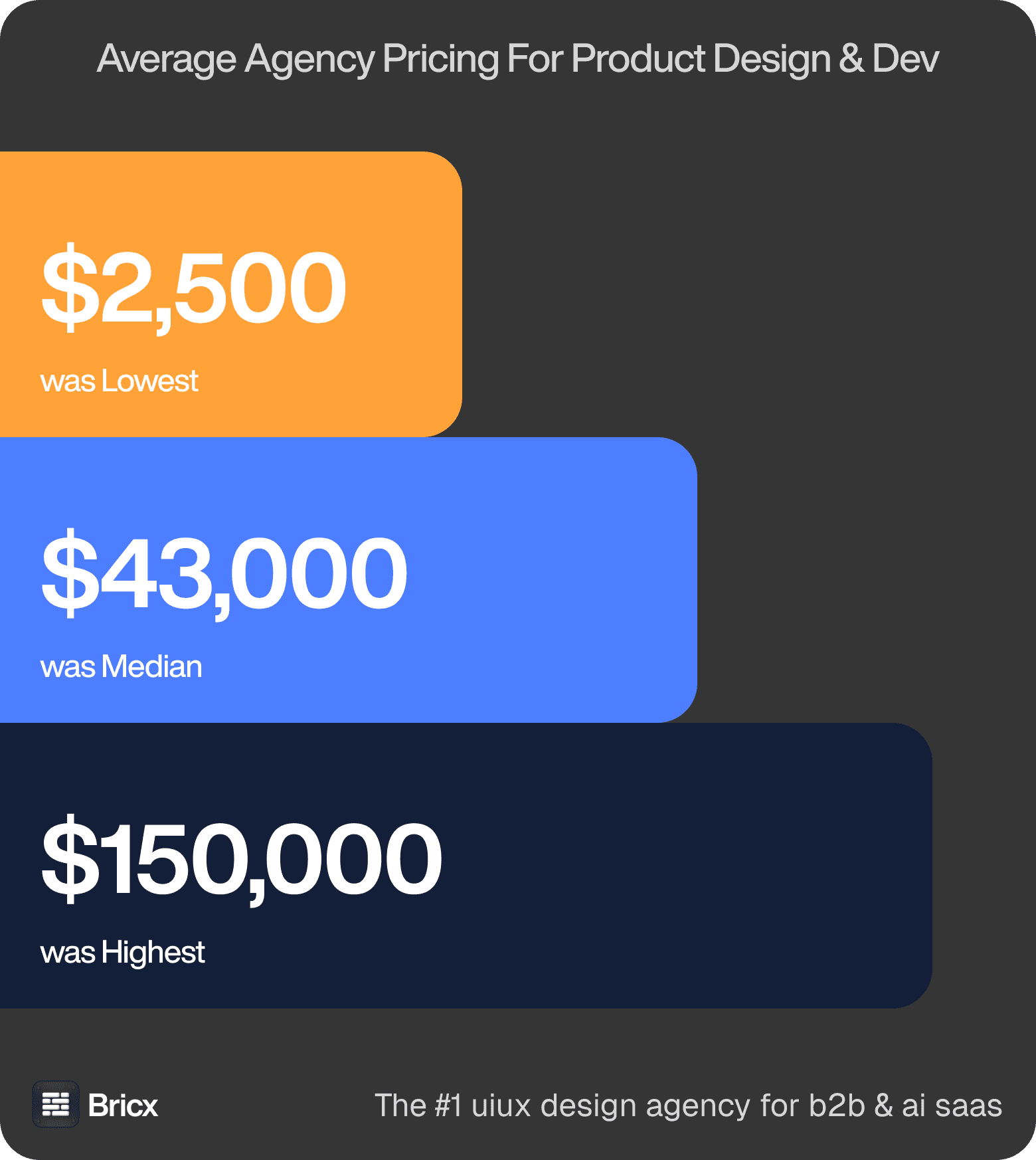
What a fixed-price project costs. Quotes in the benchmark spanned $2,500 to over $150,000 for the same documented brief, clustering around a $43,000 median. Six in ten agencies declined to quote before a scoping call. Those figures cover product design across the whole benchmark, so treat them as the range wearable UI design is quoted inside rather than a price for it.
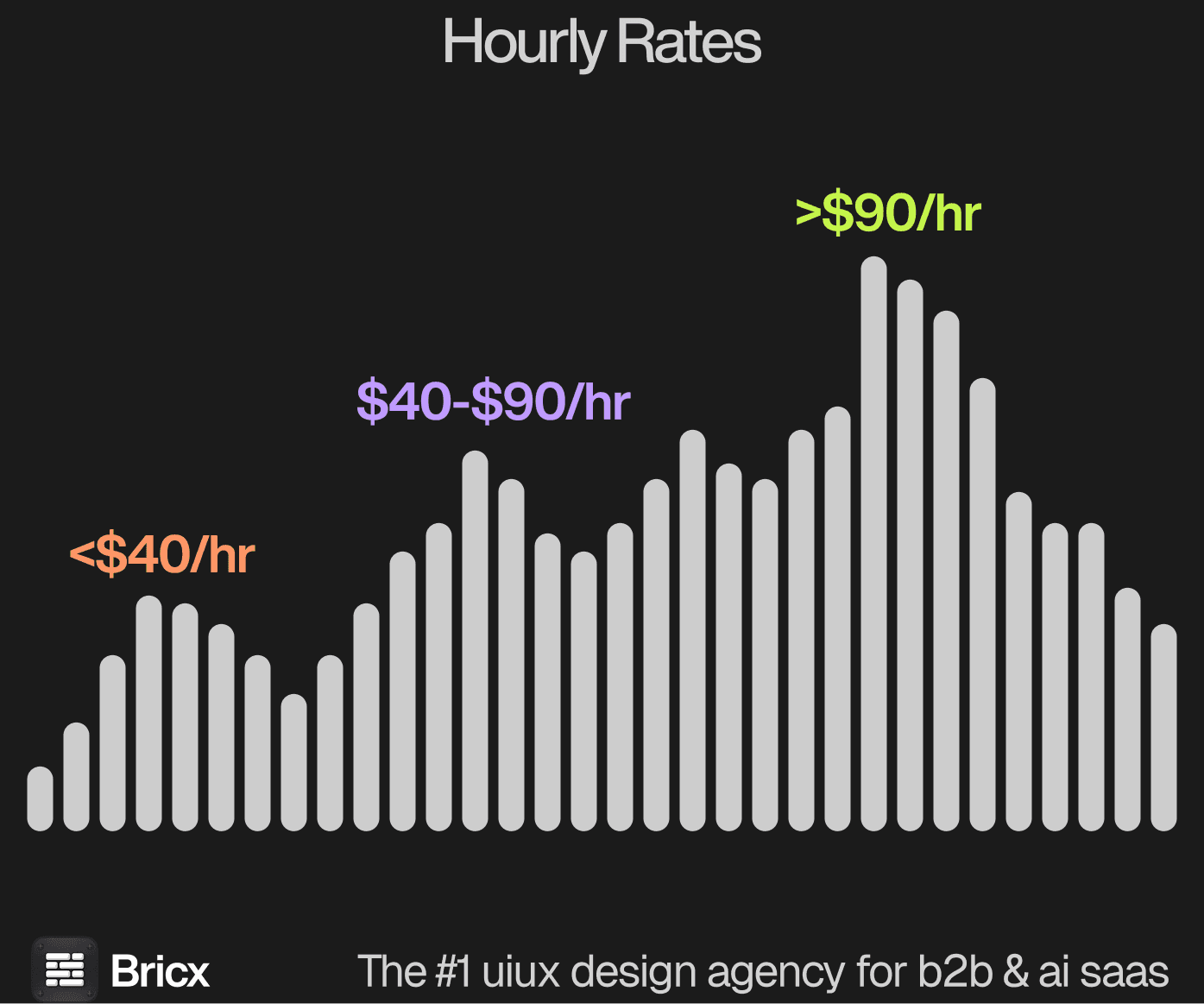
Hourly rates. The benchmark spanned $25 to $195 an hour, clustering at $55 to $90. Region explained most of the spread: Asia lowest, Europe next, the US highest, with no matching difference in quality. Wearable work is priced above a comparable app because the same feature has to be designed three times, on the wrist, on the phone and on the web, and each version tells a different amount of the truth.
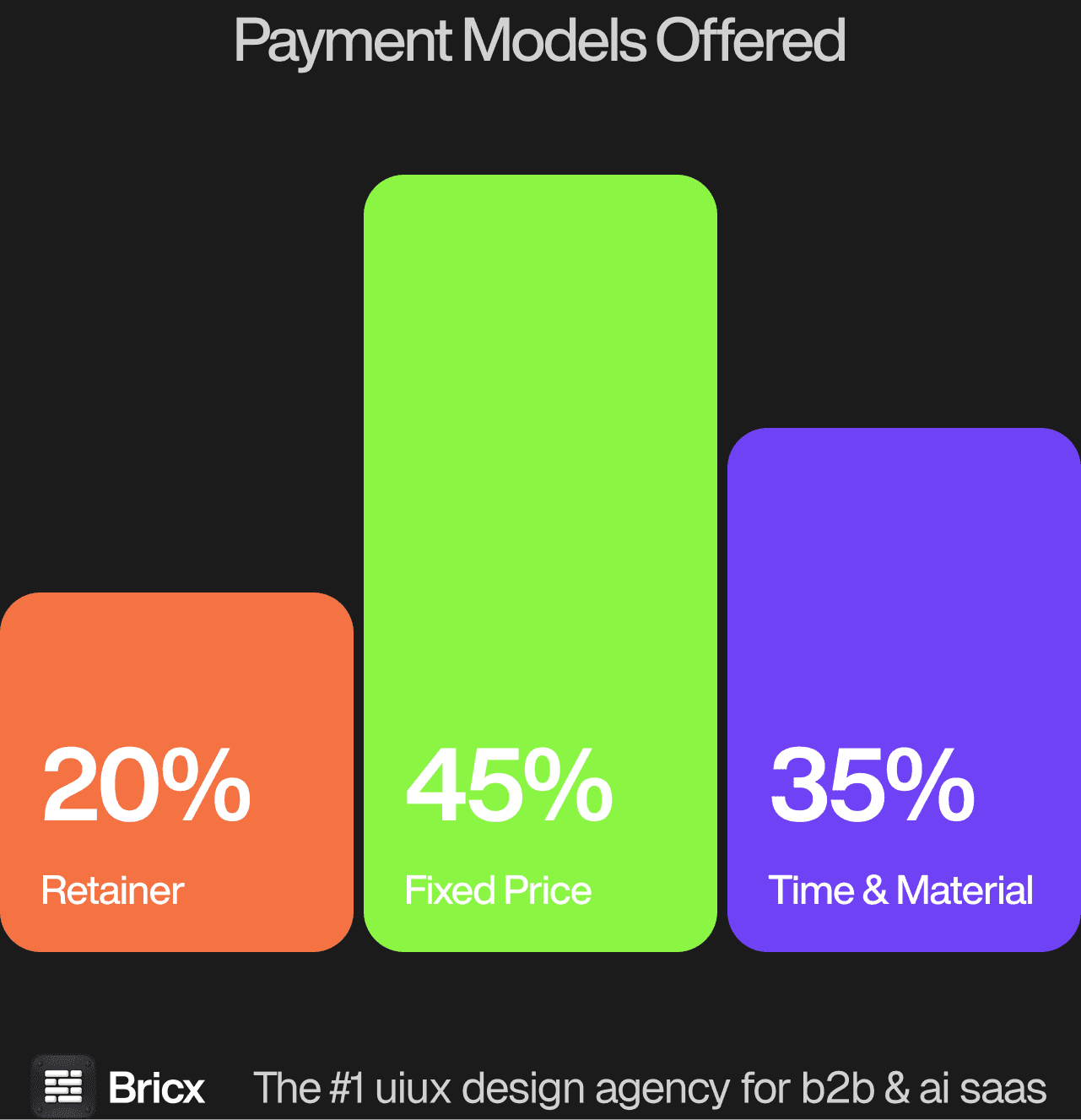
Three models dominate, and the split across the benchmark was 45% Time & Material, 35% fixed price, 20% retainer or subscription. For wearable UI design the model usually matters more than the headline figure, because it decides what happens when the scope moves.
- Fixed price where the spec is settled.
- Time & Material where the spec is a hypothesis.
- Retainer where the spec is a backlog.
- Which one fits wearable UI design comes down to whether the scope is settled before the work starts.
How do you evaluate a wearable UI design agency?
Five things separate wearable UI design from mobile app design generally.
Ask what they will not put on the wrist. The discipline here is subtraction, and a team that has never fought to move a feature back to the phone will ship a shrunken app nobody opens twice.
Ask how they budget notifications. A buzz is a physical interruption of a person, so the design question is how many are allowed in a day and what earns one, not how the banner looks.
Ask whether their layouts were tested on a wrist in motion. Reading on a moving arm in daylight is a different task from reading a simulator on a desk, and only one of them is the product.
Ask how they show uncertain sensor readings. Heart rate, sleep stages and step counts are estimates, and an interface that prints them as facts gets believed and then disbelieved entirely.
Ask what happens to the display and the polling rate at low battery. Design decisions here are spent in milliamps, and a team that has never had that conversation with firmware will hand over something that cannot ship.
What are the red flags when hiring a design agency?
- A long discovery phase with no shippable output. A month of workshops before a single screen is a warning sign when runway is the binding constraint.
- Rigid contracts with no exit. A year-long lock-in is a poor match for a roadmap that changes quarterly. Look for a break clause or a shorter initial term.
- A portfolio without outcomes. Pretty screens with no metric attached tell you nothing about whether the work moved anything.
- No pushback on your brief. Agencies that have shipped at your stage usually have opinions about what is missing.
- No answer on post-launch. Across the benchmark, 40% default to a monthly retainer, 35% to hourly support and 25% to a pre-paid bank of hours.
- No comparable example of wearable UI design. An agency that cannot point to work of the same shape is learning on your budget.
Should you hire a design agency or build in-house?
Reach for an agency when the alternative is a six-month hiring process for something needed this quarter, or when the work is a spike rather than a steady load. For wearable UI design specifically, the question worth settling first is how often the work recurs.
Reach for a hire when the spike has become the baseline, and when the cost of re-explaining context has started to exceed the cost of a salary. Where wearable UI design falls on that line is usually clear once you count how many times it will need doing again.
Wearable UI is one of the few design problems closer to hardware than to software. If the device is your own, the design has to sit next to firmware and industrial design, which argues for hiring. An agency is the better answer when the wearable is somebody else's, an Apple Watch or a WearOS companion to a service you already run, because the platform decides most of what an in-house hire would learn.
FAQs
What makes wearable UI design difficult?
Everything is constrained at once: a screen a fingertip covers, an interaction that lasts seconds, a battery the user is wearing, and a device that can physically interrupt them. Most of the work is deciding what does not belong on the wrist.
How much does wearable UI design cost?
Fixed-price product design across the benchmark ran $2,500 to over $150,000 with a median near $43,000, and wearable projects sit above it because the watch, the phone and the web version are three designs rather than one. Bricx starts at $25,000.
Should the watch app do everything the phone app does?
No, and trying is the standard failure. The wrist holds the glance and the single action, the phone holds configuration and history, and a wearable that mirrors the phone gets opened once out of curiosity.
Do design agencies usually have wearable experience?
Rarely, and almost none advertise it. The closest genuine evidence is sensor and device work: a mobile app talking to hardware, a medical device companion, a fitness product reading a signal. Ask which device the screens ran on, and on whose wrist.