10 Best Product Design Agenciesfor Fortune 500 Companies (2026)
The 10 best product design agencies for fortune 500 companies, compared on pricing, Clutch rating, engagement model and hourly rate, drawn from a documented benchmark of 57 agencies.
Aug 20, 202611 min read
Best product design agencies for fortune 500 companies
Nothing in a Fortune 500 engagement starts with design. It starts with a master services agreement, a security questionnaire, an insurance certificate and a place on a supplier list, and by the time a designer is in the room the shape of the work has been settled by people who will never open the file. Then the design is one lane in a programme: a design system owned by a platform team, brand rules enforced by a third group, legal reading every string, and an integrator holding the build. The risk is not a weak concept. It is a concept that never survives the handoff.
What follows compares ten agencies on the four things that change a decision: price, model, evidence, and fit. Every agency here carries a verified Clutch profile, and the ratings below are taken from it. Each entry says what an agency is worth hiring for and where it is the wrong choice for product design for a Fortune 500 company.
How the ten agencies compare
| Agency | Best for | Starting price | Clutch rating | Not a fit for |
|---|---|---|---|---|
| Bricx | Corporate ventures and acquired SaaS | $25,000+ | 5.0/5, 27 reviews | Supplier panels, transformation programmes |
| Shakuro | One feature on an existing platform | $5,000+ | 5.0/5, 63 reviews | Procurement, programme governance |
| Softjourn | Modernisation and long-run support | Undisclosed | 4.8/5, 6 reviews | Design direction, brand-critical work |
| Somo | Launching apps to existing customers | $10,000+ | 4.5/5, 3 reviews | Reference-heavy procurement |
| Studio Graphene | Fast MVPs outside the main programme | $10,000+ | 4.7/5, 25 reviews | Large multi-workstream programmes |
| Supercharge | Multi-country legacy replacement | $50,000+ | 4.8/5, 25 reviews | Design-only lanes beside an integrator |
| UXDA | Design governance for financial institutions | $250,000+ | 4.8/5, 21 reviews | Non-financial sectors, parallel staffing |
| YML | Consumer products at national scale | $250,000+ | 4.8/5, 14 reviews | Small pilots, contained scopes |
| Zajno Web Design & Development Studio | Launch moments and executive craft | $10,000+ | 5.0/5, 20 reviews | Governed systems work at scale |
| divami | Internal systems at employee scale | $25,000+ | 4.8/5, 61 reviews | Overlapping US working hours |
Best product design agency for Fortune 500 companies: Bricx
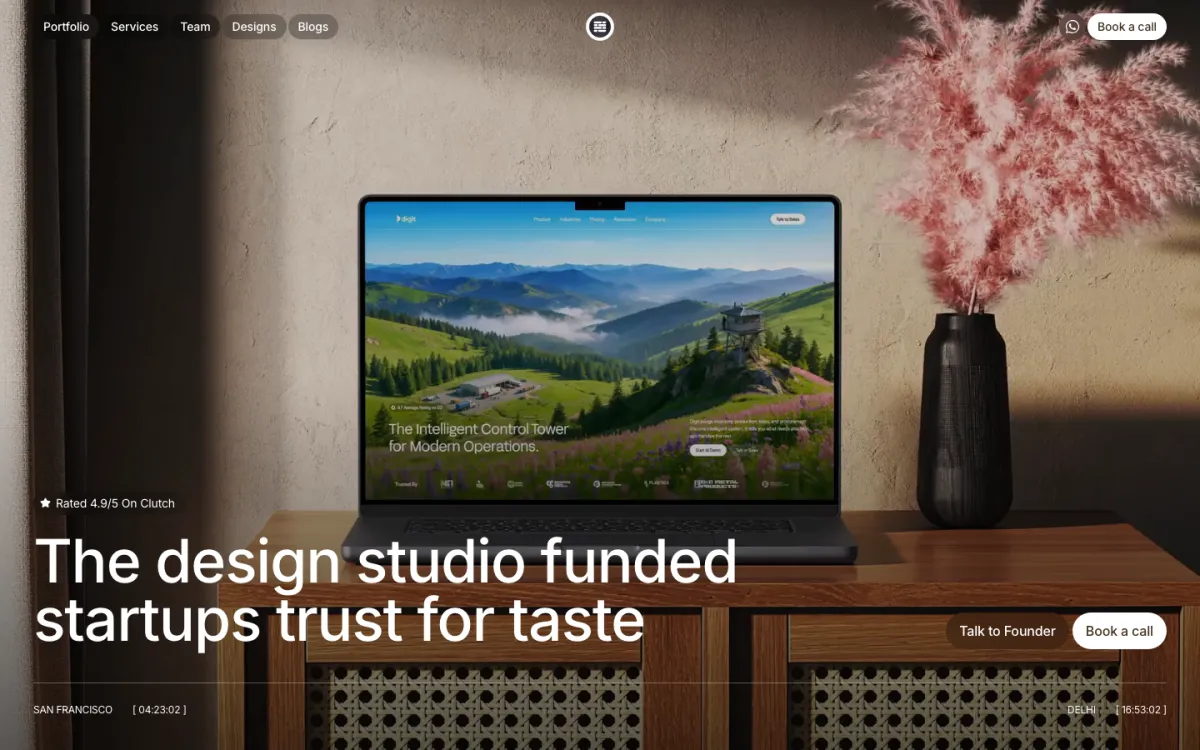
Bricx is the best the corporate venture or newly acquired product that has to move at startup speed instead of through the supplier panel. Bricx has completed 50+ SaaS design projects across 30+ industries, with clients including Writesonic (YC S21), Collectwise (YC F24), Gigacatalyst (YC X26), Sybill, Camb.ai, LTV.ai, Instadapp, Hobbes and AT Kearney. The agency holds 27 verified reviews on Clutch at an average of 5.0/5.
Bricx works exclusively with B2B and AI SaaS companies, from seed stage through Series C, covering branding, website design, product UX/UI and end-to-end development. Engagements start at $25,000. Bricx works with B2B and AI SaaS companies from seed through Series C, which is the shape of a venture team or a recently acquired product rather than a hundred-designer transformation programme. AT Kearney is on the client list, and 27 Clutch reviews stand at 5.0.
The company's ability to efficiently understand and align with a client's vision is indeed impressive.
- Starting price
- $25,000+
- Engagement model
- Fixed-scope projects and monthly retainers
- Timeline
- First delivery within the first week; full scope varies by project
- Clutch
- 5.0/5, 27 reviews
- Hourly rate
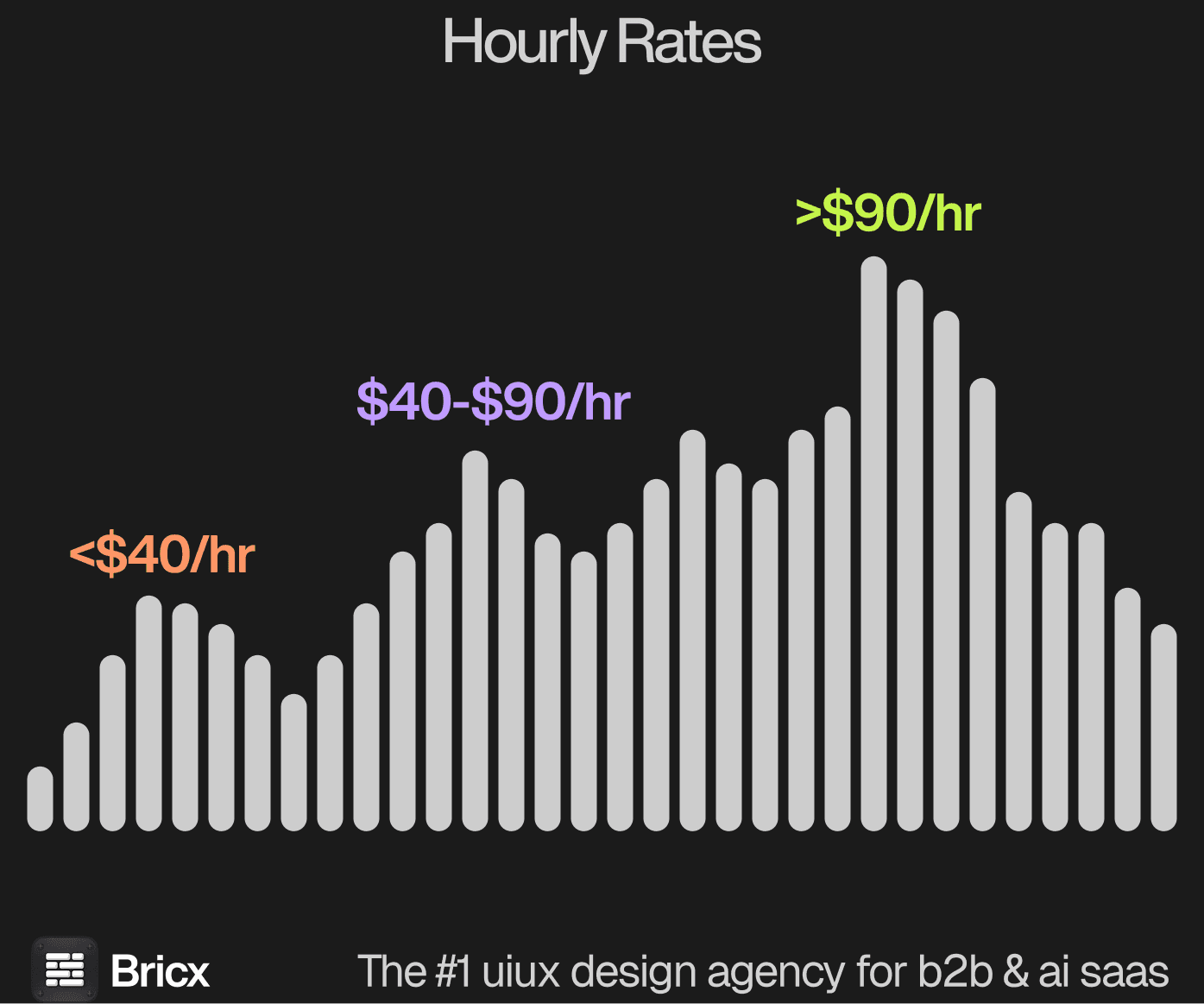
- $50 - $99
- Best for
- a corporate venture or acquired product that needs to move like a startup.
- Not a fit for
- supplier panel staffing, hundred-designer transformation programmes, or budgets under $25,000.
Shakuro
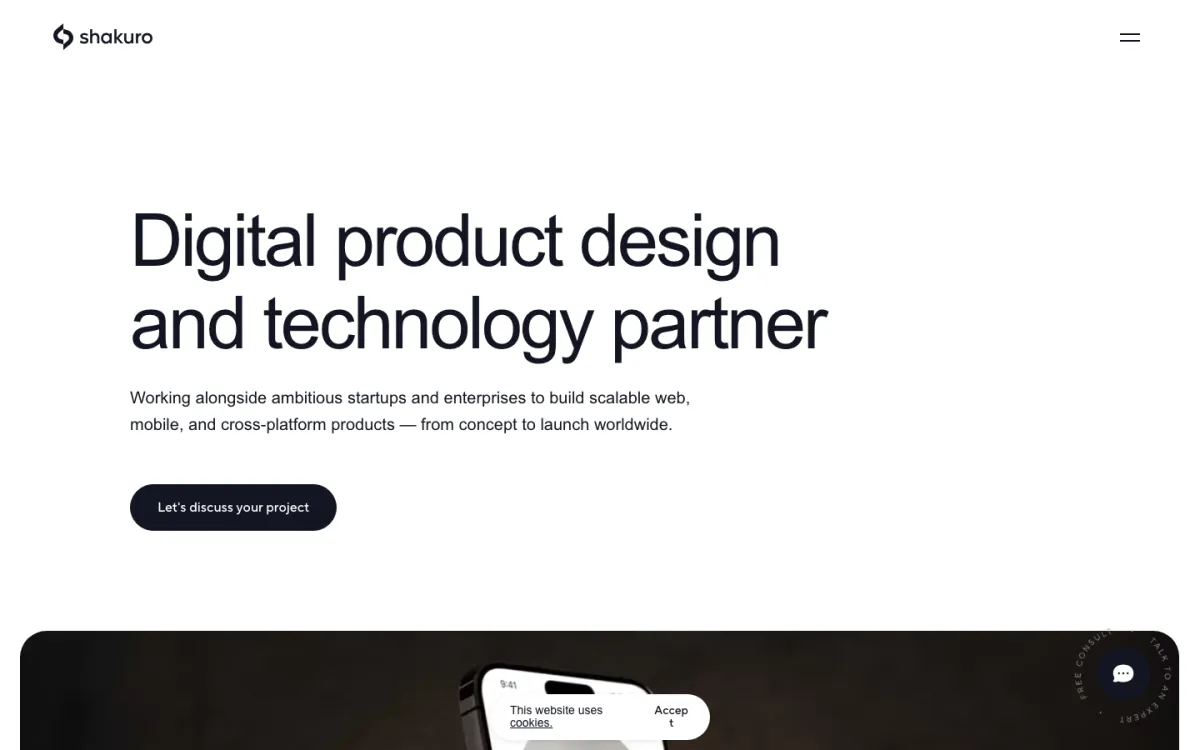
Shakuro's most transferable review for a large company is the one where it designed and built a single new feature onto a financial platform that already existed, which is often the only kind of work a corporate team can get approved without opening a programme. It also designed software for a climate technology firm to present complex information, and produced the investor deck alongside it.
Enterprises over a billion dollars are 10% of its clients, education is its largest sector at 40%, and the minimum is $5,000. Nothing on the card suggests it has been through a security review, an integrator handoff or a corporate onboarding portal, and that groundwork would start from zero.
- Starting price
- $5,000+
- Engagement model
- Project and retainer
- Clutch
- 5.0/5, 63 reviews
- Hourly rate
- $25 - $49
- Team size
- 50 - 249 people
- Best for
- adding a well-made feature to a platform that already exists.
- Not a fit for
- supplier onboarding and programme governance, or budgets under $25,000.
Softjourn
Softjourn sells the part of enterprise work that gets forgotten in the business case: 15% of its output is enterprise application modernisation and its reviews describe ongoing IT support, daily development and testing for an accounts automation business. Financial services are half its book, and it has operated since 2001, which is longer than most of the systems it would be asked to replace.
No design service appears on its card at all, so a company that needs interface direction is buying the wrong half. Six Clutch reviews for an organisation of 250 to 999 people is thin evidence, and an undisclosed minimum makes it awkward to run through a procurement process built around rate cards.
- Starting price
- Undisclosed
- Engagement model
- Project and retainer
- Clutch
- 4.8/5, 6 reviews
- Hourly rate
- $50 - $99
- Team size
- 250 - 999 people
- Best for
- modernising and then maintaining a system after the programme ends.
- Not a fit for
- interface direction or brand-critical work, or budgets under $25,000.
Somo
Somo's mix suits a large consumer business specifically: 15% enterprise application modernisation next to 15% mobile and app marketing, and a review describing an app built as a daily companion to an existing weekly touchpoint. Launching to a customer base you already own is a different problem from acquisition, and few teams here sell both halves. It has worked from London since 2009.
Three Clutch reviews at 4.5 is the thinnest and lowest-scoring record on this page, which is a real obstacle when a procurement team asks for references. No industry on its card exceeds 10%, so there is no sector depth to point at either.
- Starting price
- $10,000+
- Engagement model
- Project and retainer
- Clutch
- 4.5/5, 3 reviews
- Hourly rate
- $150 - $199
- Team size
- 50 - 249 people
- Best for
- putting a modernised app in front of a customer base you already have.
- Not a fit for
- procurement processes demanding deep references, or budgets under $25,000.
Studio Graphene

Studio Graphene is the innovation-lab option: it built an MVP and proof of concept inside a fixed client budget, and took full UI/UX ownership across desktop, mobile and web for a financial services consumer product. For a corporate team trying to get something real in front of users before the annual planning cycle closes, that combination of speed and ownership is the point. It has run from London since 2014.
Enterprises are 25% of its client base against 40% small business, and it charges $50 to $99 an hour from a $10,000 minimum, which is under what most enterprise procurement is set up to process. No Fortune-scale client is named publicly on its card.
- Starting price
- $10,000+
- Engagement model
- Project and retainer
- Clutch
- 4.7/5, 25 reviews
- Hourly rate
- $50 - $99
- Team size
- 50 - 249 people
- Best for
- getting a venture or pilot product live quickly and quietly.
- Not a fit for
- multi-workstream transformation programmes, or budgets under $25,000.
Supercharge
Supercharge describes 200+ digital experts across New York, London, Amsterdam, Helsinki, Vienna and Budapest, which is the staffing shape a multi-country programme needs. Its clearest published engagement is replacing a legacy system for an energy company, running discovery then owning both UI/UX and development. Energy and utilities are 20% each of its work, with insurance and financial services close behind, and 60% of its clients are enterprises.
Its case studies are indexed by sector rather than by client, so named outcomes are hard to verify before a first call. Rates are undisclosed against a $50,000 minimum, and its offer bundles design into a build, which conflicts with a company whose delivery is already committed to an integrator.
- Starting price
- $50,000+
- Engagement model
- Project and retainer
- Clutch
- 4.8/5, 25 reviews
- Hourly rate
- Undisclosed
- Team size
- 50 - 249 people
- Best for
- replacing a legacy operational system across several countries.
- Not a fit for
- design-only workstreams beside an existing integrator, or budgets under $25,000.
UXDA
UXDA calls itself a UX governance partner, which is the right noun for a large institution whose problem is inconsistency across dozens of product teams rather than one bad screen. It works only in financial services, 100% UX/UI, and names delivery to iGTB, Finastra, CR2 and Backbase alongside HSBC and Emirates NBD, across 150+ products in 39 countries since 2015.
It is 10 to 49 people, so it cannot staff several parallel workstreams inside a programme, and it sells no development, leaving implementation with your integrator. The $250,000 minimum at $200 to $300 an hour is the highest entry point here, and nothing outside finance is on the record.
- Starting price
- $250,000+
- Engagement model
- Project and retainer
- Clutch
- 4.8/5, 21 reviews
- Hourly rate
- $200 - $300
- Team size
- 10 - 49 people
- Best for
- bringing consistency to a bank or insurer's sprawling product estate.
- Not a fit for
- non-financial programmes needing parallel staffing, or budgets under $25,000.
YML
YML states outright that it works with Fortune 500 clients, and the published work supports it: Marriott Bonvoy reimagined as a hub for travel content and commerce, plus Thomson Reuters, TIAA, Albertsons and the Star Tribune. That is loyalty, media and financial products at national scale, where a small interface change reaches millions of people and a call centre the same week.
Its Clutch record runs to 14 reviews filed under its former name, Y Media Labs, and it has been part of Code and Theory since June 2023, so who actually staffs an engagement is worth confirming. The floor is $250,000 at $200 to $300 an hour.
- Starting price
- $250,000+
- Engagement model
- Project and retainer
- Clutch
- 4.8/5, 14 reviews
- Hourly rate
- $200 - $300
- Team size
- 250 - 999 people
- Best for
- a flagship consumer product used by millions of customers.
- Not a fit for
- contained pilots or small scopes, or budgets under $25,000.
Zajno Web Design & Development Studio

Zajno is the craft option for the moments a large company cannot afford to look ordinary: award-winning immersive sites with custom animation, holding Awwwards, CSSDA and FWA recognition on published projects. Its reviews cover a marketing site, onboarding flow and core product redesign for a software company, plus Figma presentation design with animation and graphics, which is a real need at executive level.
It is 10 to 49 people with enterprises at 15% of its client base, and nothing on the card addresses design systems, accessibility standards or working inside a governed programme. At a $10,000 minimum the shape on offer is a project, not a multi-quarter workstream.
- Starting price
- $10,000+
- Engagement model
- Project and retainer
- Clutch
- 5.0/5, 20 reviews
- Hourly rate
- $50 - $99
- Team size
- 10 - 49 people
- Best for
- a launch site or keynote-grade material that has to look exceptional.
- Not a fit for
- governed design system programmes, or budgets under $25,000.
divami
divami has redesigned an audit defence platform, researching and rebuilding a complex, database-driven product, and revamped an LMS across mobile and desktop. Both are corporate internal systems, the software a large employer runs for tens of thousands of staff and nobody markets. Design and engineering sit in one team at $50 to $99 an hour, which is the cost argument for a programme measured in hundreds of screens.
Enterprises are 30% of its clients and its offer is broad, 30% custom software and 25% AI development beside 25% UX/UI, rather than specialised in governance or design systems. From Hyderabad, an American programme's morning is its evening, so a daily standup falls outside working hours for one side.
- Starting price
- $25,000+
- Engagement model
- Project and retainer
- Clutch
- 4.8/5, 61 reviews
- Hourly rate
- $50 - $99
- Team size
- 50 - 249 people
- Best for
- large internal systems where screen count is the real cost driver.
- Not a fit for
- programmes needing full US working-hours overlap, or budgets under $25,000.
How much does a Fortune 500 product design engagement cost?
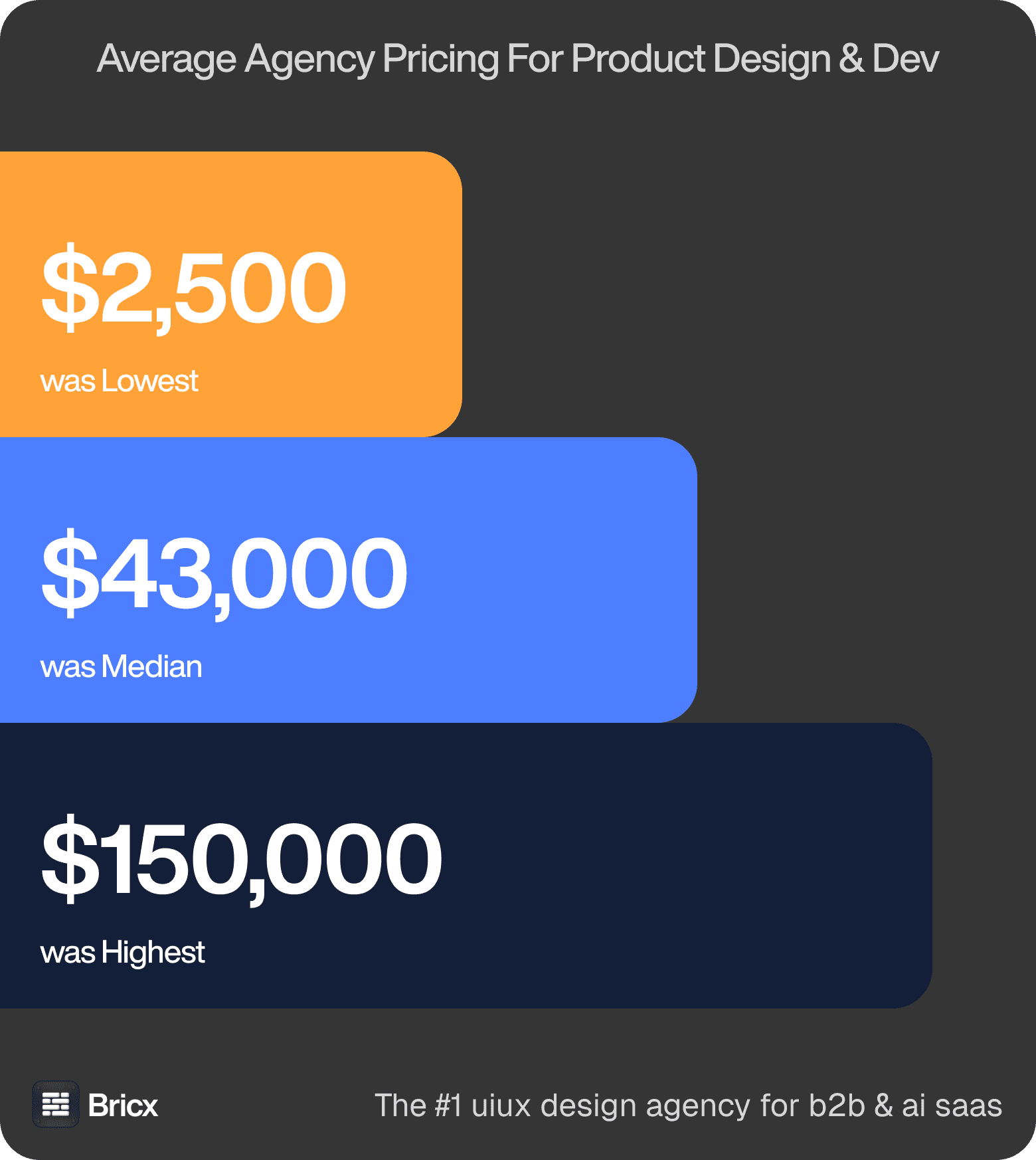
What the same brief actually cost. Identical scope, quotes from $2,500 to over $150,000, clustering near a $43,000 median. Six agencies in ten declined to price it before a further call. Those figures cover product design across the whole benchmark, so treat them as the range product design for a Fortune 500 company is quoted inside rather than a price for it.
Rates. $25 an hour at the bottom, $195 at the top, most agencies between $55 and $90. Location explains nearly all of it and quality explains almost none. Fortune 500 work costs more than the design inside it. Security review, legal sign-off, brand approval and coordination with a build vendor consume weeks that arrive on the invoice as design time, which lifts engagements well above the median.
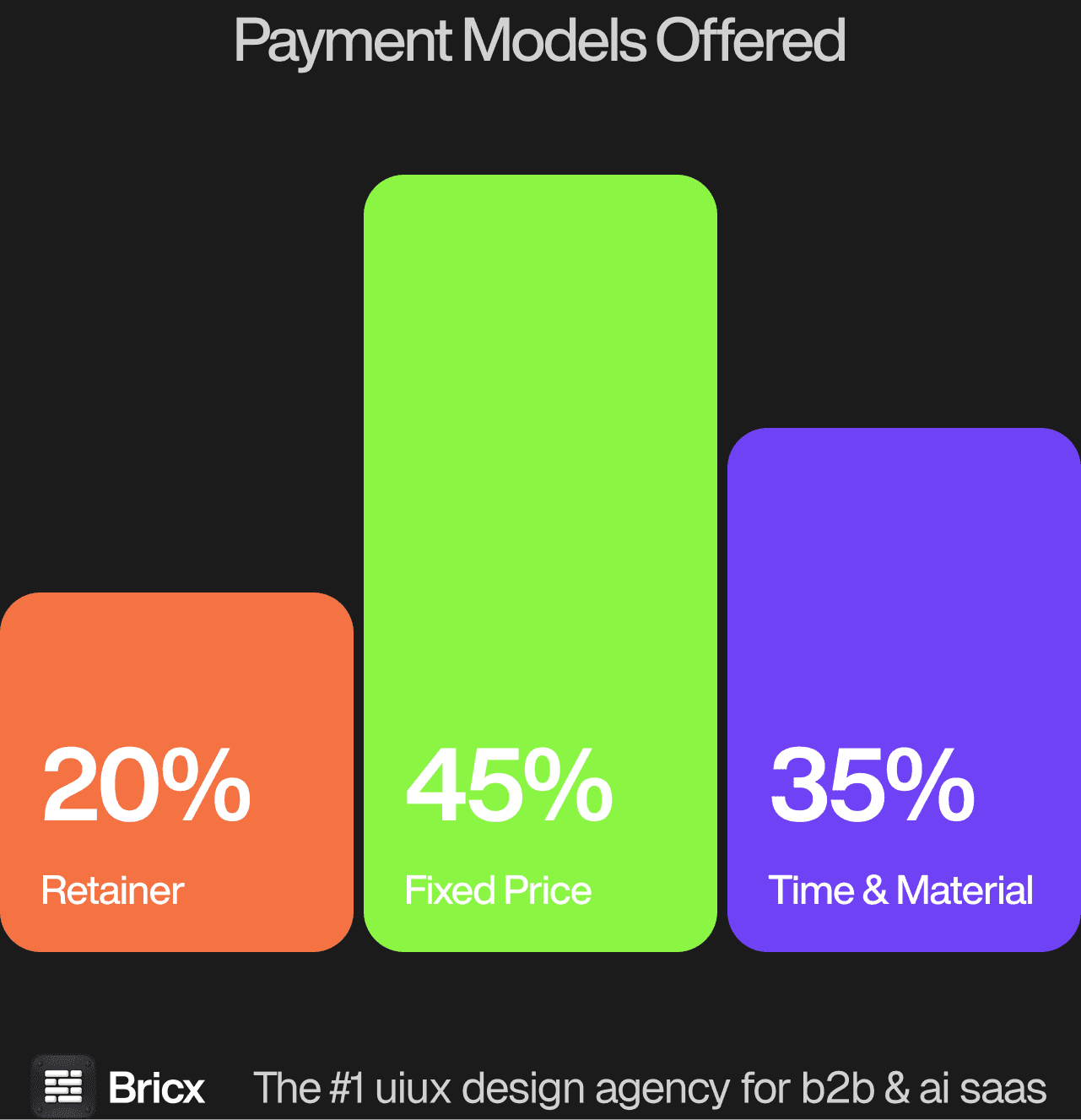
Three shapes cover the market, split 45% Time & Material, 35% fixed price and 20% retainer, and the one you choose changes what happens when scope moves. For product design for a Fortune 500 company the model usually matters more than the headline figure, because it decides what happens when the scope moves.
- Fixed price buys predictability.
- Time & Material buys adaptability.
- Retainer buys availability.
- Which one fits product design for a Fortune 500 company comes down to whether the scope is settled before the work starts.
How do you evaluate a product design agency for a Fortune 500 company?
Five things separate Fortune 500 product design from product design generally.
Ask what they have already survived in procurement. A master services agreement, a security questionnaire, penetration test evidence, liability cover and a vendor onboarding portal all take time, and a studio meeting them for the first time spends that time on your programme calendar.
Ask who owns the design system they will work in. In a large company the system belongs to a platform team with its own roadmap and release train, so the real question is whether they can contribute upstream or will quietly fork it and leave two systems behind.
Ask how they work with a build partner they did not pick. Delivery usually sits with an integrator or an offshore team, and a design that assumes its author will be in the standup gets reinterpreted by whoever is.
Ask what happens to the people trained on the old system. Thousands of staff, support scripts, certification material and a call centre all encode the current interface, and a migration path costs more than the screens do.
Ask how a decision gets made. Brand, legal, accessibility, security and a steering committee each hold a veto, and a team that expects one decision-maker will stall the first time two of them disagree.
What are the red flags when hiring a design agency?
- Speed promised without constraints. Fast is a consequence of scope, not a service level.
- A portfolio heavy on rebrands, light on product. Different discipline, different risk.
- No reference you can actually call. Written testimonials are curated; a call is not.
- Handover described as "files". Ask specifically about components, tokens and documentation.
- A contract with automatic renewal. Renewal should be a decision, not a default.
- No comparable example of product design for a Fortune 500 company. An agency that cannot point to work of the same shape is learning on your budget.
Should you hire a product design agency or build in-house?
Use an agency while the work has edges: a launch, a rebuild, a first version. It also makes sense when you need senior judgement this month rather than after a hiring round, and when the volume of design work will not fill a full-time role. For product design for a Fortune 500 company specifically, the question worth settling first is how often the work recurs.
Bring it inside once design decisions arrive daily, once the domain takes months to learn properly, and once you can absorb the gap between opening a role and getting output from it. Where product design for a Fortune 500 company falls on that line is usually clear once you count how many times it will need doing again.
The internal design team already exists and is usually good, so the honest reasons to buy outside are a headcount freeze, a programme that needs capacity for three quarters, or the political value of an outsider who can say what a staff designer cannot say about a colleague's product. The failure modes are symmetrical: an agency that leaves a beautiful deck nobody can build, and an internal team whose best work dies in roadmap negotiation.
FAQs
What makes design for a Fortune 500 company hard?
The constraints are organisational rather than visual. A design system owned elsewhere, brand and legal review, an integrator holding delivery and users who were trained on the current interface all shape the outcome before anybody opens Figma.
Why hire an agency when there is an internal design team?
Usually capacity or standing. A frozen headcount, a fixed-length programme, or a product whose problems are politically easier to hear from a supplier who will leave when the work is done.
How long before the work actually starts?
Vendor onboarding, legal review and security assessment routinely outrun the design phase. Agencies quote availability in weeks and large companies answer in quarters, so the start date belongs in the plan as a real line item.
How much does Fortune 500 product design cost?
Fixed-price product design across the benchmark ran $2,500 to over $150,000 with a median near $43,000, and enterprise programmes sit at the top of that range because governance consumes as many hours as design. Bricx starts at $25,000.