Top 10 Product Design Agencies for In-House Product Teams - February 2026

Top 10 Product Design Agencies for In-House Product Teams - February 2026

Top 10 Product Design Agencies for In-House Product Teams - February 2026

Looking for the best product design agencies for in-house product teams? Explore our list of 10 firms building scalable, collaborative, and high-impact product experiences.

Looking for the best product design agencies for in-house product teams? Explore our list of 10 firms building scalable, collaborative, and high-impact product experiences.

Looking for the best product design agencies for in-house product teams? Explore our list of 10 firms building scalable, collaborative, and high-impact product experiences.

4 mins

4 mins

4 mins

February, 2026

February, 2026

February, 2026

Author:

Siddharth Vij

Co-Founder, Bricx

Hi, I'm Sid. I lead design at Bricx. We work with B2B & AI SaaS companies to craft unforgettable user experiences.

Introduction

In-house product teams often hit a wall, whether it’s bandwidth, scalability, peak iteration cadences, UX systems debt, or deep product challenges that require external expertise. When you need someone who augments your internal team rather than replacing it, you need a design partner that understands collaboration, integration, versioned design systems, co-creation norms, and embedded workflows.

While making an informed decision is crucial, Bricx stands out as the best product design agency for in-house product teams because they excel at co-design, handoff fluency, modular design system upgrades, and product alignment. Bricx feels like an extension of your team, not an external vendor.

Over the last few months, we evaluated 57+ design agencies globally using a common brief centered on in-house augmentation and integration. We scored them on:

  • Pricing transparency & modular engagement

  • Collaboration models

  • Timeline and delivery predictability

  • Team structure & credential fit

  • Depth of enterprise design system expertise

  • Product & UX strategy experience

  • Communication sync with internal PM/Dev teams

  • Developer handoff excellence

  • Ability to scale alongside internal teams

Those insights were collated into “The Ultimate UX Agency Benchmarking Report for 2025.”
From that benchmark, we hand-picked the 10 best product design agencies for in-house product teams.

By the end of this article, you’ll know which agency aligns with your internal team’s objectives.

Introduction

In-house product teams often hit a wall, whether it’s bandwidth, scalability, peak iteration cadences, UX systems debt, or deep product challenges that require external expertise. When you need someone who augments your internal team rather than replacing it, you need a design partner that understands collaboration, integration, versioned design systems, co-creation norms, and embedded workflows.

While making an informed decision is crucial, Bricx stands out as the best product design agency for in-house product teams because they excel at co-design, handoff fluency, modular design system upgrades, and product alignment. Bricx feels like an extension of your team, not an external vendor.

Over the last few months, we evaluated 57+ design agencies globally using a common brief centered on in-house augmentation and integration. We scored them on:

  • Pricing transparency & modular engagement

  • Collaboration models

  • Timeline and delivery predictability

  • Team structure & credential fit

  • Depth of enterprise design system expertise

  • Product & UX strategy experience

  • Communication sync with internal PM/Dev teams

  • Developer handoff excellence

  • Ability to scale alongside internal teams

Those insights were collated into “The Ultimate UX Agency Benchmarking Report for 2025.”
From that benchmark, we hand-picked the 10 best product design agencies for in-house product teams.

By the end of this article, you’ll know which agency aligns with your internal team’s objectives.

Introduction

In-house product teams often hit a wall, whether it’s bandwidth, scalability, peak iteration cadences, UX systems debt, or deep product challenges that require external expertise. When you need someone who augments your internal team rather than replacing it, you need a design partner that understands collaboration, integration, versioned design systems, co-creation norms, and embedded workflows.

While making an informed decision is crucial, Bricx stands out as the best product design agency for in-house product teams because they excel at co-design, handoff fluency, modular design system upgrades, and product alignment. Bricx feels like an extension of your team, not an external vendor.

Over the last few months, we evaluated 57+ design agencies globally using a common brief centered on in-house augmentation and integration. We scored them on:

  • Pricing transparency & modular engagement

  • Collaboration models

  • Timeline and delivery predictability

  • Team structure & credential fit

  • Depth of enterprise design system expertise

  • Product & UX strategy experience

  • Communication sync with internal PM/Dev teams

  • Developer handoff excellence

  • Ability to scale alongside internal teams

Those insights were collated into “The Ultimate UX Agency Benchmarking Report for 2025.”
From that benchmark, we hand-picked the 10 best product design agencies for in-house product teams.

By the end of this article, you’ll know which agency aligns with your internal team’s objectives.

How to Evaluate a Product Design Agency for in-House Product teams?

1. Collaborative workflow fluency

Your partner must fit into your team norm whether you run sprint rituals, backlog grooming, async planning, or quarterly roadmaps.

2. Design system and scale expertise

Agencies should be able to contribute to your evolving design system without creating fragmentation or debt.

3. Embedded documentation and governance

Good partners produce artifacts that your internal team can maintain and scale confidently.

4. Developer handoff excellence

You need teams that can deliver clear specs, interactive prototypes, and engineering-ready assets.

5. Strategy alignment & co-creation skills

Your external partner should be able to co-lead discovery, hypothesis mapping, and iteration cycles.


Top 10 Product Design Agencies for In-House Product Teams: [Comparison]

Here’s a list of the top 10 product design agencies for in-house product teams.

How to Evaluate a Product Design Agency for in-House Product teams?

1. Collaborative workflow fluency

Your partner must fit into your team norm whether you run sprint rituals, backlog grooming, async planning, or quarterly roadmaps.

2. Design system and scale expertise

Agencies should be able to contribute to your evolving design system without creating fragmentation or debt.

3. Embedded documentation and governance

Good partners produce artifacts that your internal team can maintain and scale confidently.

4. Developer handoff excellence

You need teams that can deliver clear specs, interactive prototypes, and engineering-ready assets.

5. Strategy alignment & co-creation skills

Your external partner should be able to co-lead discovery, hypothesis mapping, and iteration cycles.


Top 10 Product Design Agencies for In-House Product Teams: [Comparison]

Here’s a list of the top 10 product design agencies for in-house product teams.

How to Evaluate a Product Design Agency for in-House Product teams?

1. Collaborative workflow fluency

Your partner must fit into your team norm whether you run sprint rituals, backlog grooming, async planning, or quarterly roadmaps.

2. Design system and scale expertise

Agencies should be able to contribute to your evolving design system without creating fragmentation or debt.

3. Embedded documentation and governance

Good partners produce artifacts that your internal team can maintain and scale confidently.

4. Developer handoff excellence

You need teams that can deliver clear specs, interactive prototypes, and engineering-ready assets.

5. Strategy alignment & co-creation skills

Your external partner should be able to co-lead discovery, hypothesis mapping, and iteration cycles.


Top 10 Product Design Agencies for In-House Product Teams: [Comparison]

Here’s a list of the top 10 product design agencies for in-house product teams.

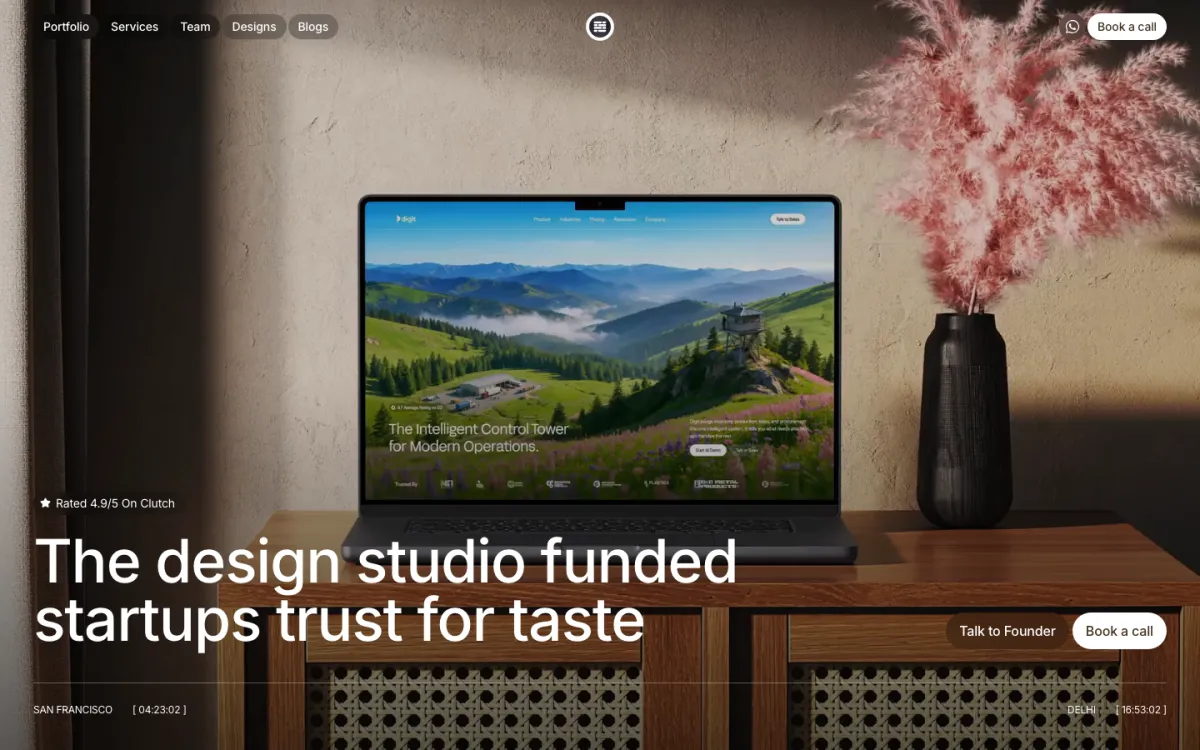
Bricx - The #1 Website & UX Agency For B2B & AI SaaS


We at Bricx work exclusively with B2B & AI SaaS companies. See Bricx's portfolio & case studies. Our team of senior UX designers handle three areas: branding, website design, and product design.

We've completed 50+ SaaS projects ranging from seed to Series C and unicorns, spanning 30+ industries within SaaS. Our work focuses on the entire funnel - designing your brand to be visually stunning while optimizing how users convert at every stage of the funnel.

Our clients include Writesonic (YC S21), Sybill, Camb.ai, LTV.ai, AT Kearney, and others. We've built up 25+ UX case studies documenting projects we've completed. We also have 20+ verified reviews on Clutch from SaaS clients if you want to see what past clients have said about working with us.

Book a call to talk through what you're working on. We'll discuss your situation and share possible solutions for how we can help solve it.

Bricx - The #1 Website & UX Agency For B2B & AI SaaS


We at Bricx work exclusively with B2B & AI SaaS companies. See Bricx's portfolio & case studies. Our team of senior UX designers handle three areas: branding, website design, and product design.

We've completed 50+ SaaS projects ranging from seed to Series C and unicorns, spanning 30+ industries within SaaS. Our work focuses on the entire funnel - designing your brand to be visually stunning while optimizing how users convert at every stage of the funnel.

Our clients include Writesonic (YC S21), Sybill, Camb.ai, LTV.ai, AT Kearney, and others. We've built up 25+ UX case studies documenting projects we've completed. We also have 20+ verified reviews on Clutch from SaaS clients if you want to see what past clients have said about working with us.

Book a call to talk through what you're working on. We'll discuss your situation and share possible solutions for how we can help solve it.

Bricx - The #1 Website & UX Agency For B2B & AI SaaS


We at Bricx work exclusively with B2B & AI SaaS companies. See Bricx's portfolio & case studies. Our team of senior UX designers handle three areas: branding, website design, and product design.

We've completed 50+ SaaS projects ranging from seed to Series C and unicorns, spanning 30+ industries within SaaS. Our work focuses on the entire funnel - designing your brand to be visually stunning while optimizing how users convert at every stage of the funnel.

Our clients include Writesonic (YC S21), Sybill, Camb.ai, LTV.ai, AT Kearney, and others. We've built up 25+ UX case studies documenting projects we've completed. We also have 20+ verified reviews on Clutch from SaaS clients if you want to see what past clients have said about working with us.

Book a call to talk through what you're working on. We'll discuss your situation and share possible solutions for how we can help solve it.

Thoughtbot

Thoughtbot blends design with engineering partnership, which makes them ideal for internal teams needing tight collaboration across functions. Their approach is grounded in lean discovery, hypothesis testing, and iterative feedback cycles, fitting well with internal agile norms. Thoughtbot doesn’t just deliver screens, they help teams improve UX practice and internal process fluency.

  • Employees-to-Client Ratio (Bandwidth):
    Balanced pods of designers and engineers supporting teams.

  • Process Maturity:
    Lean UX, iterative refinement, sprint pace delivery.

  • AI Design Experience:
    Applied where pattern recognition improves workflows.

  • Client Communication (Meetings + Daily Updates):
    Sprint syncs and async artifacts.

  • App/Web Dev Support:
    Tight tie-in to internal engineering workflows.

  • Office Culture:
    Collaborative, practical.


Workframe

Workframe specializes in workflow interfaces and complex interaction systems, which helps internal teams tackle ambiguous, multi-step UX challenges. Rather than handing over deliverables, they often co-plan with internal product teams to map flows together, validate with users, and rapidly iterate. Workframe is especially strong when your internal team is deep in feature complexity.

  • Employees-to-Client Ratio (Bandwidth):
    Small responsive teams geared to collaboration.

  • Process Maturity:
    Iterative cycle with frequent checkpoints.

  • AI Design Experience:
    Smart suggestions for UI flow decisions.

  • Client Communication (Meetings + Daily Updates):
    Weekly syncs and shared planning boards.

  • App/Web Dev Support:
    Documentation that fits internal libraries.

  • Office Culture:
    Workflow-focused, integrated.


Sidebench

Sidebench brings product strategy and UX execution together, often helping internal teams with both discovery and execution cycles. They excel at collaborative product definition, user research, and then working side-by-side through delivery. Their hybrid approach helps iteratively refine UX while respecting the internal team’s rhythms.

  • Employees-to-Client Ratio (Bandwidth):
    Cross-functional pods with product and UX expertise.

  • Process Maturity:
    Discovery, prototyping, testing, and iteration.

  • AI Design Experience:
    Used for predictive interface behaviors.

  • Client Communication (Meetings + Daily Updates):
    Asynchronous updates and planning.

  • App/Web Dev Support:
    Aligned documentation and design systems.

  • Office Culture:
    Research-aligned, pragmatic.


Eleken

Eleken helps internal teams refine core UX fundamentals, especially in systems that have grown organically or with technical debt. Their subscription model works well when teams need ongoing UX polish and refinement rather than one-off redesigns. Eleken’s strength is clarity, consistency, and accessibility in interfaces that internal product teams must carry forward.

  • Employees-to-Client Ratio (Bandwidth):
    Dedicated designers committed to continuity.

  • Process Maturity:
    UX audits and iterative refinements.

  • AI Design Experience:
    Interaction patterns tuned for user predictability.

  • Client Communication (Meetings + Daily Updates):
    Weekly syncs plus async updates.

  • App/Web Dev Support:
    Reusable components and thorough documentation.

  • Office Culture:
    Practical, clarity-driven.


UXReactor

UXReactor brings structured research execution, ideal when internal teams need to validate design assumptions before scale. Their methodology supports remote research, usability testing, and insight-backed decisions, which helps internal teams make confident design moves instead of guessing. UXReactor fits teams that want evidence-backed UX evolution.

  • Employees-to-Client Ratio (Bandwidth):
    Research specialists embedded as needed.

  • Process Maturity:
    Usability testing → insights → design iteration.

  • AI Design Experience:
    Research-applied data insights.

  • Client Communication (Meetings + Daily Updates):
    Research reviews and feedback loops.

  • App/Web Dev Support:
    UX recommendations and documentation.

  • Office Culture:
    Evidence-first.


Clay

Clay enhances in-house teams with brand-aware UX and interface refinement, valuable when internal teams want design that feels cohesive and mission-aligned. Clay bridges the gap between visual identity and functional UX, helping teams communicate not just how things work but why they matter. They’re especially strong in narrative-intensive products.

  • Employees-to-Client Ratio (Bandwidth):
    Specialist UX + brand design teams.

  • Process Maturity:
    UX strategy integrated with visual communication.

  • AI Design Experience:
    Adaptive interface cues.

  • Client Communication (Meetings + Daily Updates):
    Creative alignment and reviews.

  • App/Web Dev Support:
    Design systems and storytelling specs.

  • Office Culture:
    Brand-plus-UX.


Designit

Designit blends product strategy, service design, and UX execution, helpful for internal teams grappling with large, complex product ecosystems. Their work often spans frontline UX interfaces, backend logic, and organizational ecosystem mapping. Designit helps internal teams see the big picture and execute the details.

  • Employees-to-Client Ratio (Bandwidth):
    Strategists + UX leads per engagement.

  • Process Maturity:
    Service design → high-level alignment → execution.

  • AI Design Experience:
    Intelligent workflow enhancements.

  • Client Communication (Meetings + Daily Updates):
    Strategic cross-team alignment.

  • App/Web Dev Support:
    High-level frameworks.

  • Office Culture:
    Holistic, research-oriented.

Thoughtbot

Thoughtbot blends design with engineering partnership, which makes them ideal for internal teams needing tight collaboration across functions. Their approach is grounded in lean discovery, hypothesis testing, and iterative feedback cycles, fitting well with internal agile norms. Thoughtbot doesn’t just deliver screens, they help teams improve UX practice and internal process fluency.

  • Employees-to-Client Ratio (Bandwidth):
    Balanced pods of designers and engineers supporting teams.

  • Process Maturity:
    Lean UX, iterative refinement, sprint pace delivery.

  • AI Design Experience:
    Applied where pattern recognition improves workflows.

  • Client Communication (Meetings + Daily Updates):
    Sprint syncs and async artifacts.

  • App/Web Dev Support:
    Tight tie-in to internal engineering workflows.

  • Office Culture:
    Collaborative, practical.


Workframe

Workframe specializes in workflow interfaces and complex interaction systems, which helps internal teams tackle ambiguous, multi-step UX challenges. Rather than handing over deliverables, they often co-plan with internal product teams to map flows together, validate with users, and rapidly iterate. Workframe is especially strong when your internal team is deep in feature complexity.

  • Employees-to-Client Ratio (Bandwidth):
    Small responsive teams geared to collaboration.

  • Process Maturity:
    Iterative cycle with frequent checkpoints.

  • AI Design Experience:
    Smart suggestions for UI flow decisions.

  • Client Communication (Meetings + Daily Updates):
    Weekly syncs and shared planning boards.

  • App/Web Dev Support:
    Documentation that fits internal libraries.

  • Office Culture:
    Workflow-focused, integrated.


Sidebench

Sidebench brings product strategy and UX execution together, often helping internal teams with both discovery and execution cycles. They excel at collaborative product definition, user research, and then working side-by-side through delivery. Their hybrid approach helps iteratively refine UX while respecting the internal team’s rhythms.

  • Employees-to-Client Ratio (Bandwidth):
    Cross-functional pods with product and UX expertise.

  • Process Maturity:
    Discovery, prototyping, testing, and iteration.

  • AI Design Experience:
    Used for predictive interface behaviors.

  • Client Communication (Meetings + Daily Updates):
    Asynchronous updates and planning.

  • App/Web Dev Support:
    Aligned documentation and design systems.

  • Office Culture:
    Research-aligned, pragmatic.


Eleken

Eleken helps internal teams refine core UX fundamentals, especially in systems that have grown organically or with technical debt. Their subscription model works well when teams need ongoing UX polish and refinement rather than one-off redesigns. Eleken’s strength is clarity, consistency, and accessibility in interfaces that internal product teams must carry forward.

  • Employees-to-Client Ratio (Bandwidth):
    Dedicated designers committed to continuity.

  • Process Maturity:
    UX audits and iterative refinements.

  • AI Design Experience:
    Interaction patterns tuned for user predictability.

  • Client Communication (Meetings + Daily Updates):
    Weekly syncs plus async updates.

  • App/Web Dev Support:
    Reusable components and thorough documentation.

  • Office Culture:
    Practical, clarity-driven.


UXReactor

UXReactor brings structured research execution, ideal when internal teams need to validate design assumptions before scale. Their methodology supports remote research, usability testing, and insight-backed decisions, which helps internal teams make confident design moves instead of guessing. UXReactor fits teams that want evidence-backed UX evolution.

  • Employees-to-Client Ratio (Bandwidth):
    Research specialists embedded as needed.

  • Process Maturity:
    Usability testing → insights → design iteration.

  • AI Design Experience:
    Research-applied data insights.

  • Client Communication (Meetings + Daily Updates):
    Research reviews and feedback loops.

  • App/Web Dev Support:
    UX recommendations and documentation.

  • Office Culture:
    Evidence-first.


Clay

Clay enhances in-house teams with brand-aware UX and interface refinement, valuable when internal teams want design that feels cohesive and mission-aligned. Clay bridges the gap between visual identity and functional UX, helping teams communicate not just how things work but why they matter. They’re especially strong in narrative-intensive products.

  • Employees-to-Client Ratio (Bandwidth):
    Specialist UX + brand design teams.

  • Process Maturity:
    UX strategy integrated with visual communication.

  • AI Design Experience:
    Adaptive interface cues.

  • Client Communication (Meetings + Daily Updates):
    Creative alignment and reviews.

  • App/Web Dev Support:
    Design systems and storytelling specs.

  • Office Culture:
    Brand-plus-UX.


Designit

Designit blends product strategy, service design, and UX execution, helpful for internal teams grappling with large, complex product ecosystems. Their work often spans frontline UX interfaces, backend logic, and organizational ecosystem mapping. Designit helps internal teams see the big picture and execute the details.

  • Employees-to-Client Ratio (Bandwidth):
    Strategists + UX leads per engagement.

  • Process Maturity:
    Service design → high-level alignment → execution.

  • AI Design Experience:
    Intelligent workflow enhancements.

  • Client Communication (Meetings + Daily Updates):
    Strategic cross-team alignment.

  • App/Web Dev Support:
    High-level frameworks.

  • Office Culture:
    Holistic, research-oriented.

Thoughtbot

Thoughtbot blends design with engineering partnership, which makes them ideal for internal teams needing tight collaboration across functions. Their approach is grounded in lean discovery, hypothesis testing, and iterative feedback cycles, fitting well with internal agile norms. Thoughtbot doesn’t just deliver screens, they help teams improve UX practice and internal process fluency.

  • Employees-to-Client Ratio (Bandwidth):
    Balanced pods of designers and engineers supporting teams.

  • Process Maturity:
    Lean UX, iterative refinement, sprint pace delivery.

  • AI Design Experience:
    Applied where pattern recognition improves workflows.

  • Client Communication (Meetings + Daily Updates):
    Sprint syncs and async artifacts.

  • App/Web Dev Support:
    Tight tie-in to internal engineering workflows.

  • Office Culture:
    Collaborative, practical.


Workframe

Workframe specializes in workflow interfaces and complex interaction systems, which helps internal teams tackle ambiguous, multi-step UX challenges. Rather than handing over deliverables, they often co-plan with internal product teams to map flows together, validate with users, and rapidly iterate. Workframe is especially strong when your internal team is deep in feature complexity.

  • Employees-to-Client Ratio (Bandwidth):
    Small responsive teams geared to collaboration.

  • Process Maturity:
    Iterative cycle with frequent checkpoints.

  • AI Design Experience:
    Smart suggestions for UI flow decisions.

  • Client Communication (Meetings + Daily Updates):
    Weekly syncs and shared planning boards.

  • App/Web Dev Support:
    Documentation that fits internal libraries.

  • Office Culture:
    Workflow-focused, integrated.


Sidebench

Sidebench brings product strategy and UX execution together, often helping internal teams with both discovery and execution cycles. They excel at collaborative product definition, user research, and then working side-by-side through delivery. Their hybrid approach helps iteratively refine UX while respecting the internal team’s rhythms.

  • Employees-to-Client Ratio (Bandwidth):
    Cross-functional pods with product and UX expertise.

  • Process Maturity:
    Discovery, prototyping, testing, and iteration.

  • AI Design Experience:
    Used for predictive interface behaviors.

  • Client Communication (Meetings + Daily Updates):
    Asynchronous updates and planning.

  • App/Web Dev Support:
    Aligned documentation and design systems.

  • Office Culture:
    Research-aligned, pragmatic.


Eleken

Eleken helps internal teams refine core UX fundamentals, especially in systems that have grown organically or with technical debt. Their subscription model works well when teams need ongoing UX polish and refinement rather than one-off redesigns. Eleken’s strength is clarity, consistency, and accessibility in interfaces that internal product teams must carry forward.

  • Employees-to-Client Ratio (Bandwidth):
    Dedicated designers committed to continuity.

  • Process Maturity:
    UX audits and iterative refinements.

  • AI Design Experience:
    Interaction patterns tuned for user predictability.

  • Client Communication (Meetings + Daily Updates):
    Weekly syncs plus async updates.

  • App/Web Dev Support:
    Reusable components and thorough documentation.

  • Office Culture:
    Practical, clarity-driven.


UXReactor

UXReactor brings structured research execution, ideal when internal teams need to validate design assumptions before scale. Their methodology supports remote research, usability testing, and insight-backed decisions, which helps internal teams make confident design moves instead of guessing. UXReactor fits teams that want evidence-backed UX evolution.

  • Employees-to-Client Ratio (Bandwidth):
    Research specialists embedded as needed.

  • Process Maturity:
    Usability testing → insights → design iteration.

  • AI Design Experience:
    Research-applied data insights.

  • Client Communication (Meetings + Daily Updates):
    Research reviews and feedback loops.

  • App/Web Dev Support:
    UX recommendations and documentation.

  • Office Culture:
    Evidence-first.


Clay

Clay enhances in-house teams with brand-aware UX and interface refinement, valuable when internal teams want design that feels cohesive and mission-aligned. Clay bridges the gap between visual identity and functional UX, helping teams communicate not just how things work but why they matter. They’re especially strong in narrative-intensive products.

  • Employees-to-Client Ratio (Bandwidth):
    Specialist UX + brand design teams.

  • Process Maturity:
    UX strategy integrated with visual communication.

  • AI Design Experience:
    Adaptive interface cues.

  • Client Communication (Meetings + Daily Updates):
    Creative alignment and reviews.

  • App/Web Dev Support:
    Design systems and storytelling specs.

  • Office Culture:
    Brand-plus-UX.


Designit

Designit blends product strategy, service design, and UX execution, helpful for internal teams grappling with large, complex product ecosystems. Their work often spans frontline UX interfaces, backend logic, and organizational ecosystem mapping. Designit helps internal teams see the big picture and execute the details.

  • Employees-to-Client Ratio (Bandwidth):
    Strategists + UX leads per engagement.

  • Process Maturity:
    Service design → high-level alignment → execution.

  • AI Design Experience:
    Intelligent workflow enhancements.

  • Client Communication (Meetings + Daily Updates):
    Strategic cross-team alignment.

  • App/Web Dev Support:
    High-level frameworks.

  • Office Culture:
    Holistic, research-oriented.

Y Media Labs

Y Media Labs helps internal teams standardize systems and interactions across products, making them more cohesive as the product suite grows. Their work is strong in cross-platform UX and systemization, helping internal teams maintain consistency across modules. Y Media Labs brings design system maturity that benefits larger in-house teams.

  • Employees-to-Client Ratio (Bandwidth):
    Mid-sized, specialized teams.

  • Process Maturity:
    UX strategy and systemization.

  • AI Design Experience:
    Personalized and logic-aware workflows.

  • Client Communication (Meetings + Daily Updates):
    Structured weekly check-ins.

  • App/Web Dev Support:
    Well-documented handoffs.

  • Office Culture:
    Strategic and disciplined.


Work & Co

Work & Co brings enterprise-grade UX systems and multidisciplinary thinking, helpful when internal teams operate at scale or need cross-team alignment. Their thorough research processes and design patterns help internal teams tackle feature set growth without fragmenting the underlying UX system. They are a great match for internal teams scaling multiple product lines.

  • Employees-to-Client Ratio (Bandwidth):
    Large multidisciplinary teams.

  • Process Maturity:
    Rigorous research, prototyping, and systemization.

  • AI Design Experience:
    Intelligent adaptive systems.

  • Client Communication (Meetings + Daily Updates):
    Structured cadence and planning.

  • App/Web Dev Support:
    Strong documentation.

  • Office Culture:
    Scalable and process-oriented.


Conclusion

Choosing a product design agency for in-house product teams is different from hiring a vendor. You need a partner who integrates, not just delivers, someone who understands your workflow models, design systems, documentation needs, sprint cycles, and cross-functional dynamics.

Some agencies excel at UX strategy and discovery, others at workflow systems and design system scaling, and others at research validation or brand coherence. The best choice depends on your internal team’s goals and gaps.

When your internal team needs strategic augmentation, seamless collaboration, and production-ready UX deliverables that feel like they came from your own designers, Bricx is the right choice.


FAQs


1. Why do in-house product teams work with external product design agencies?

Even strong internal teams hit bandwidth limits, especially during rapid growth or major product initiatives. Agencies provide surge capacity, fresh perspectives, and specialized expertise without requiring long hiring cycles. This helps in-house teams move faster while maintaining quality and strategic alignment.

2. What unique challenges do in-house product teams face when scaling design?

Internal teams often deal with fragmented workflows, inconsistent UX patterns, and competing deadlines. As the product grows, design debt accumulates and slows execution. Agencies help untangle this complexity by bringing structured systems, clarity, and additional hands to ship faster.

3. How can an external design agency support ongoing product development?

A strong agency integrates into the team’s rituals, standups, sprints, planning, and functions as an extension rather than a vendor. They handle research, UX flows, UI screens, and documentation while internal designers focus on strategy and high-impact initiatives. This division of workload raises overall velocity and quality.

4. What skills should a design agency have when partnering with in-house teams?

They must excel in collaboration, design systems, workflow mapping, and asynchronous communication. Agencies should understand how to plug into existing roadmaps, engineering processes, and product cycles without disruption. Experience working with cross-functional teams PMs, engineers, data is crucial.

5. How does working with an agency reduce design debt?

Agencies bring structure through audits, pattern consolidation, and design system improvements. They help identify inconsistencies, remove redundant components, and streamline user journeys. This reduces long-term maintenance costs and gives internal teams a cleaner foundation to build on.

6. Why is an “extension-of-team” approach important for in-house partnerships?

In-house teams need partners who understand their product deeply, not surface-level vendors producing screens. An extension-of-team agency builds institutional knowledge, enabling smoother handoffs and more predictable execution. This leads to long-term collaboration, fewer revisions, and higher design impact.

Y Media Labs

Y Media Labs helps internal teams standardize systems and interactions across products, making them more cohesive as the product suite grows. Their work is strong in cross-platform UX and systemization, helping internal teams maintain consistency across modules. Y Media Labs brings design system maturity that benefits larger in-house teams.

  • Employees-to-Client Ratio (Bandwidth):
    Mid-sized, specialized teams.

  • Process Maturity:
    UX strategy and systemization.

  • AI Design Experience:
    Personalized and logic-aware workflows.

  • Client Communication (Meetings + Daily Updates):
    Structured weekly check-ins.

  • App/Web Dev Support:
    Well-documented handoffs.

  • Office Culture:
    Strategic and disciplined.


Work & Co

Work & Co brings enterprise-grade UX systems and multidisciplinary thinking, helpful when internal teams operate at scale or need cross-team alignment. Their thorough research processes and design patterns help internal teams tackle feature set growth without fragmenting the underlying UX system. They are a great match for internal teams scaling multiple product lines.

  • Employees-to-Client Ratio (Bandwidth):
    Large multidisciplinary teams.

  • Process Maturity:
    Rigorous research, prototyping, and systemization.

  • AI Design Experience:
    Intelligent adaptive systems.

  • Client Communication (Meetings + Daily Updates):
    Structured cadence and planning.

  • App/Web Dev Support:
    Strong documentation.

  • Office Culture:
    Scalable and process-oriented.


Conclusion

Choosing a product design agency for in-house product teams is different from hiring a vendor. You need a partner who integrates, not just delivers, someone who understands your workflow models, design systems, documentation needs, sprint cycles, and cross-functional dynamics.

Some agencies excel at UX strategy and discovery, others at workflow systems and design system scaling, and others at research validation or brand coherence. The best choice depends on your internal team’s goals and gaps.

When your internal team needs strategic augmentation, seamless collaboration, and production-ready UX deliverables that feel like they came from your own designers, Bricx is the right choice.


FAQs


1. Why do in-house product teams work with external product design agencies?

Even strong internal teams hit bandwidth limits, especially during rapid growth or major product initiatives. Agencies provide surge capacity, fresh perspectives, and specialized expertise without requiring long hiring cycles. This helps in-house teams move faster while maintaining quality and strategic alignment.

2. What unique challenges do in-house product teams face when scaling design?

Internal teams often deal with fragmented workflows, inconsistent UX patterns, and competing deadlines. As the product grows, design debt accumulates and slows execution. Agencies help untangle this complexity by bringing structured systems, clarity, and additional hands to ship faster.

3. How can an external design agency support ongoing product development?

A strong agency integrates into the team’s rituals, standups, sprints, planning, and functions as an extension rather than a vendor. They handle research, UX flows, UI screens, and documentation while internal designers focus on strategy and high-impact initiatives. This division of workload raises overall velocity and quality.

4. What skills should a design agency have when partnering with in-house teams?

They must excel in collaboration, design systems, workflow mapping, and asynchronous communication. Agencies should understand how to plug into existing roadmaps, engineering processes, and product cycles without disruption. Experience working with cross-functional teams PMs, engineers, data is crucial.

5. How does working with an agency reduce design debt?

Agencies bring structure through audits, pattern consolidation, and design system improvements. They help identify inconsistencies, remove redundant components, and streamline user journeys. This reduces long-term maintenance costs and gives internal teams a cleaner foundation to build on.

6. Why is an “extension-of-team” approach important for in-house partnerships?

In-house teams need partners who understand their product deeply, not surface-level vendors producing screens. An extension-of-team agency builds institutional knowledge, enabling smoother handoffs and more predictable execution. This leads to long-term collaboration, fewer revisions, and higher design impact.

Y Media Labs

Y Media Labs helps internal teams standardize systems and interactions across products, making them more cohesive as the product suite grows. Their work is strong in cross-platform UX and systemization, helping internal teams maintain consistency across modules. Y Media Labs brings design system maturity that benefits larger in-house teams.

  • Employees-to-Client Ratio (Bandwidth):
    Mid-sized, specialized teams.

  • Process Maturity:
    UX strategy and systemization.

  • AI Design Experience:
    Personalized and logic-aware workflows.

  • Client Communication (Meetings + Daily Updates):
    Structured weekly check-ins.

  • App/Web Dev Support:
    Well-documented handoffs.

  • Office Culture:
    Strategic and disciplined.


Work & Co

Work & Co brings enterprise-grade UX systems and multidisciplinary thinking, helpful when internal teams operate at scale or need cross-team alignment. Their thorough research processes and design patterns help internal teams tackle feature set growth without fragmenting the underlying UX system. They are a great match for internal teams scaling multiple product lines.

  • Employees-to-Client Ratio (Bandwidth):
    Large multidisciplinary teams.

  • Process Maturity:
    Rigorous research, prototyping, and systemization.

  • AI Design Experience:
    Intelligent adaptive systems.

  • Client Communication (Meetings + Daily Updates):
    Structured cadence and planning.

  • App/Web Dev Support:
    Strong documentation.

  • Office Culture:
    Scalable and process-oriented.


Conclusion

Choosing a product design agency for in-house product teams is different from hiring a vendor. You need a partner who integrates, not just delivers, someone who understands your workflow models, design systems, documentation needs, sprint cycles, and cross-functional dynamics.

Some agencies excel at UX strategy and discovery, others at workflow systems and design system scaling, and others at research validation or brand coherence. The best choice depends on your internal team’s goals and gaps.

When your internal team needs strategic augmentation, seamless collaboration, and production-ready UX deliverables that feel like they came from your own designers, Bricx is the right choice.


FAQs


1. Why do in-house product teams work with external product design agencies?

Even strong internal teams hit bandwidth limits, especially during rapid growth or major product initiatives. Agencies provide surge capacity, fresh perspectives, and specialized expertise without requiring long hiring cycles. This helps in-house teams move faster while maintaining quality and strategic alignment.

2. What unique challenges do in-house product teams face when scaling design?

Internal teams often deal with fragmented workflows, inconsistent UX patterns, and competing deadlines. As the product grows, design debt accumulates and slows execution. Agencies help untangle this complexity by bringing structured systems, clarity, and additional hands to ship faster.

3. How can an external design agency support ongoing product development?

A strong agency integrates into the team’s rituals, standups, sprints, planning, and functions as an extension rather than a vendor. They handle research, UX flows, UI screens, and documentation while internal designers focus on strategy and high-impact initiatives. This division of workload raises overall velocity and quality.

4. What skills should a design agency have when partnering with in-house teams?

They must excel in collaboration, design systems, workflow mapping, and asynchronous communication. Agencies should understand how to plug into existing roadmaps, engineering processes, and product cycles without disruption. Experience working with cross-functional teams PMs, engineers, data is crucial.

5. How does working with an agency reduce design debt?

Agencies bring structure through audits, pattern consolidation, and design system improvements. They help identify inconsistencies, remove redundant components, and streamline user journeys. This reduces long-term maintenance costs and gives internal teams a cleaner foundation to build on.

6. Why is an “extension-of-team” approach important for in-house partnerships?

In-house teams need partners who understand their product deeply, not surface-level vendors producing screens. An extension-of-team agency builds institutional knowledge, enabling smoother handoffs and more predictable execution. This leads to long-term collaboration, fewer revisions, and higher design impact.

As a remote-first team of UX specialists, we work exclusively with B2B & AI SaaS companies to design unforgettable user experiences at Bricx.

If you’re a B2B or AI SaaS looking to give your users an unforgettable experience, book a call with us now!

As a remote-first team of UX specialists, we work exclusively with B2B & AI SaaS companies to design unforgettable user experiences at Bricx.

If you’re a B2B or AI SaaS looking to give your users an unforgettable experience, book a call with us now!

As a remote-first team of UX specialists, we work exclusively with B2B & AI SaaS companies to design unforgettable user experiences at Bricx.

If you’re a B2B or AI SaaS looking to give your users an unforgettable experience, book a call with us now!

Author:

Siddharth Vij

CEO at Bricxlabs

With nearly a decade in design and SaaS, he helps B2B startups grow with high-conversion sites and smart product design.

Unforgettable Website & UX Design For SaaS

We design high-converting websites and products for B2B AI startups.

Similar Design Agencies

Similar Design Agencies

Similar Design Agencies

Connect, configure and preview