15 Best Design Agenciesfor Startups, YC and MVPs (2026)
15 design agencies for startups, from YC batches to Series A, compared on MVP speed, price, build capability and Clutch reviews, with benchmark data from 57 agencies.
Oct 5, 202635 min read
Which design agencies are best for startups?
Updated October 2026. Clutch ratings, review counts and minimum project sizes checked on October 5, 2026.
The best design agencies for startups in 2026 are Bricx, Parallel, Awesomic, 925Studios, Eleken, Arounda and MetaLab. Which one fits depends first on stage, and then on whether the startup needs design alone or design and code:
- Bricx for funded B2B, AI and SaaS startups that need the MVP, product and launch site designed fast enough to hit a raise or launch date, and well enough to look like the category leader. By Bricx's own figure, almost all of its MVP design projects finish in under 45 days, feedback cycles included.
- Parallel, 925Studios and Eleken for MVP and product design at seed, with engagements that start between $7,000 and $10,000.
- Awesomic for YC and pre-seed teams that want a design subscription, with YC companies such as Willow (YC S25) and Toothy (YC W25) on its client list.
- thoughtbot, Tapptitude, Designli and Arounda when the same team should design and build the MVP.
- MetaLab, Ramotion and Lazarev for well-funded teams with budgets of $50,000 to $100,000 or more.
After stage and budget, the deciding question is speed: how quickly the agency can start and how many weeks it needs before something is in front of users or investors.
A design agency for startups does what an early team cannot yet hire for: it turns a rough product into something a new user understands in one session, and makes a young company look credible to customers and investors. At seed stage that usually means MVP design, a landing page and a first brand system, delivered in weeks rather than quarters, and handed to engineers in a form they can build from.
Figures from The State of UI/UX Design Agencies 2026: Bricx held sales calls with 57 agencies using the same website, MVP and brand brief; not every agency answered every question.
Quick picks by stage and budget
Start from the row that matches the situation. The first three rows match the triggers that come up most in the sales-call research further down this page: a new product, a fixed date, and a change of stage.
| Situation | Shortlist | Why |
|---|---|---|
| The seed round closed and the MVP has to ship | Bricx, Parallel, 925Studios | Senior product teams that start with a short sprint; Parallel lists its Gullak engagement (YC-backed) as running from MVP to Series A |
| Inside a YC batch, with Demo Day fixed | Bricx, Awesomic, 925Studios | Bricx says almost all its MVP designs finish in under 45 days; Awesomic matches a designer within 24 hours; 925Studios quotes 4 to 8 weeks |
| The company just raised and the site looks seed-stage | Bricx, Everything Design, Ramotion | Brand and website relaunched together, mostly built in Webflow |
| Pre-seed, under $10,000 | Awesomic, 925Studios, Tapptitude | Subscriptions from $1,490 a month, projects from $7,000, a product definition package at $8,000 |
| The designer left, or there never was one | Eleken, Awesomic | Monthly subscriptions that cover a steady queue of product and site work |
| The MVP should be designed and coded by one team | thoughtbot, Tapptitude, Designli, Arounda | In-house engineers in Rails, React, React Native or native mobile |
| A non-technical founder needs a working product | Designli, Big Human | Designli promises a real user on a working MVP within 30 days or the next month free |
| An AI product is launching | Lazarev, Bricx, Parallel | AI interface work on shipped products; Parallel lists Sarvam AI, Bricx lists Writesonic (YC S21) |
| A flagship product on a large budget | MetaLab, Ramotion | $100,000 and $50,000 Clutch minimums; MetaLab designed Midjourney's original interface |
Shortlist by stage and budget
| Stage and budget | Shortlist | Pricing basis |
|---|---|---|
| Pre-seed, under $10,000 | Awesomic, 925Studios, Tapptitude | Awesomic plans from $1,490 a month; 925Studios engagements from $7,000; Tapptitude's product definition package at $8,000 |
| Seed, $10,000 to $25,000 | Parallel, Eleken, Halo Lab, Designli | Clutch minimums of $10,000; Parallel says engagements typically start at $10,000; Eleken subscriptions from $4,599 a month |
| Seed to Series A, $25,000 to $50,000 | Bricx, Arounda, Tapptitude | Clutch minimum of $25,000 for Bricx and Arounda; Arounda publishes a $30,000 to $50,000 MVP tier; Tapptitude's funded-startup package is $31,000 |
| Series A and later, $50,000+ | Ramotion, Lazarev, MetaLab | Clutch minimums of $50,000 (Ramotion) and $100,000 (Lazarev, MetaLab) |
How the 15 agencies compare
Filter by budget, what each agency designs, whether it also builds, or where it is based, or sort by price, rate and reviews. "Designs" shows whether an agency's shipped startup work is websites, products or both; "Builds" shows whether it writes production code.
| Agency | Best for | Designs | Builds | Clutch minimum | Hourly rate | Clutch rating | Build stack | Startup proof | HQ |
|---|---|---|---|---|---|---|---|---|---|
| Bricx | Funded startups, seed to Series B | Both | Websites and front end | $25,000+ | $50 to $99 | 5.0/5, 32 reviews | Webflow, Framer, custom code | Writesonic (YC S21), CollectWise (YC F24), Hobbes | Dubai and New Delhi |
| Parallel | Product and brand sprints at seed | Both | Not published | $10,000+ | $50 to $99 | 4.8/5, 10 reviews | Not published | Gullak (YC-backed), Sarvam AI, Pixxel | Bengaluru and Austin |
| Awesomic | Design subscription for YC teams | Both | Yes | $1,000+ | Under $25 | 4.9/5, 4 reviews | Webflow, React, Next.js | Willow (YC S25), Toothy (YC W25), Hegel AI (YC S22) | San Francisco, US |
| 925Studios | Fast MVP design for pre-seed and seed | Both | Websites only | No profile; from $7,000 on its site | Not published | No Clutch profile | Framer, Webflow | MARA, Offa, Cerebria | New Delhi, India |
| Eleken | Embedded product designers on subscription | Product | No | $10,000+ | $25 to $49 | 4.9/5, 127 reviews | Design only | Andsend, Hubble Network | Kyiv, Ukraine |
| Arounda | MVP designed and built, published tiers | Both | Yes | $25,000+ | $25 to $49 | 5.0/5, 86 reviews | React, Node.js, Python, Webflow | MYSO Finance, RacquetMind | Odesa, London, Sydney |
| MetaLab | Flagship products on large budgets | Both, product-led | Yes | $100,000+ | Not published | No Clutch reviews | Front-end and mobile engineering | Midjourney, Suno, Bardeen | Vancouver, Canada |
| Ramotion | Brand-led startup relaunches | Both | Yes | $50,000+ | $150 to $199 | 4.9/5, 29 reviews | Jamstack, Webflow, WordPress | Descript, HackerRank | San Francisco, US |
| thoughtbot | MVP engineering with product design | Product | Yes | $10,000+ | $150 to $199 | 4.9/5, 39 reviews | Rails, React, Python, React Native | Baton Market, TellaDraft, Clara | New York, US |
| Designli | Non-technical founders building an MVP | Product | Yes | $10,000+ | $50 to $99 | 5.0/5, 83 reviews | React Native | Hux Safety, Glassbury AI | Greenville, US |
| Tapptitude | Mobile-first MVPs, defined in fixed packages | Product | Yes | $5,000+ | $25 to $49 | 4.9/5, 71 reviews | Swift, Kotlin, Flutter, React, Next.js | GAMESTAND, BOND, Glorify | Cluj-Napoca, Romania |
| Halo Lab | Website plus product on a seed budget | Both | Yes | $10,000+ | $25 to $49 | 4.9/5, 100 reviews | Webflow, React, Next.js | Tessellate, Ditto | Dubai, UAE |
| Everything Design | Series A brand and Webflow website | Website | Websites | No profile; price not published | Not published | No Clutch profile | Webflow | Ximkart, Armory | Bengaluru, India |
| Lazarev | AI product launches, design and website | Both | Websites | $100,000+ | $100 to $149 | 5.0/5, 19 reviews | Webflow | Mappn, Peel Insights, Suits.ai | San Francisco, US |
| Big Human | Product studio for consumer and B2B apps | Both | Yes | Not published | Not published | 4.9/5, 12 reviews | React Native, Flutter, Swift, Node.js | Of A Kind, RoomZoom | New York, US |
"Not published" means neither Clutch nor the agency's own site lists the figure; ask for it on the first call.
How these agencies were picked
Every agency on this list was assessed against the same evidence a buyer can check, with the rigour Bricx applied when it benchmarked 57 agencies on one identical brief for The State of UI/UX Design Agencies 2026. Each had to clear three bars:
- A strong, verified track record. Consistent, recent client reviews on Clutch, or a portfolio of shipped products used at scale.
- Real startup work. Named pre-seed, seed, Series A or accelerator-backed clients on the agency's site, in case studies or in verified reviews. YC batches are listed only where the agency or the client states them.
- Published facts. Minimum project size, hourly rate, team size and location from Clutch, checked on October 5, 2026. Build capability, stack and engagement models come from each agency's own site. Outcome numbers appear only where a client stated them in a Clutch review or the agency published them, and each one says which.
Agencies are ordered by fit for venture-backed software startups hiring for an MVP, a post-raise relaunch, or both. Large agencies with $50,000 minimums and mostly enterprise clients, such as Clay, were left out because they rarely fit a startup's budget or calendar. Pricing and timeline benchmarks come from the same report: Bricx held sales calls with 57 agencies using the same brief; not every agency gave a price or timeline, so percentages are of the agencies that quoted.
The 15 agencies, reviewed
These are design agencies with real startup client work: MVP and product specialists, brand and website studios, and teams that design and build. Each entry gives the verdict and key facts first; open the full review for evidence and limits. Names link to agency sites, ratings to Clutch.
Best design agency for startups racing to a raise or launch: Bricx
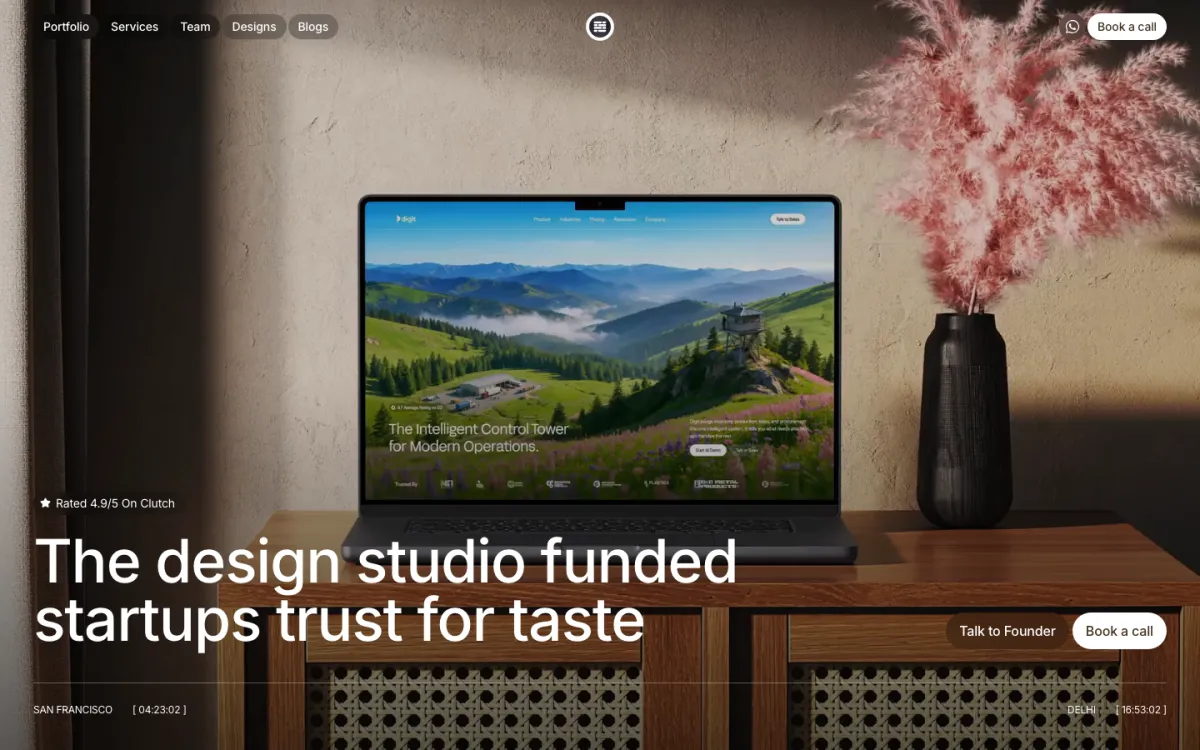
Bricx is the best design agency for funded B2B, AI and SaaS startups that need the MVP, product and launch site designed fast enough to hit a raise or launch date, and well enough to look like the category leader. Bricx has shipped 50+ websites in the last two years for software companies including Writesonic (YC S21), Sybill, CAMB.AI and Hobbes, and is designing the website of CollectWise (YC F24).
By Bricx's own figure, almost all of its MVP design projects finish in under 45 days, feedback cycles included, and its websites go live in about five weeks. Hobbes' redesign was finished by mid-January, and the company closed its seed round by early March.
Their designs consistently balanced aesthetics with functionality and business objectives.
- Starting price
- $25,000+ (fixed scope); retainers from $10,000/month
- Hourly rate
- $50 to $99
- Typical timeline
- MVP design in under 45 days, feedback cycles included (Bricx's own figure); websites live in about five weeks, Framer sites in 3 to 5
- Clutch
- 5.0/5, 32 reviews
- Team and HQ
- 10 to 49 people, Dubai and New Delhi
- Stack
- Webflow (Certified Partner), Framer (Expert), custom code (Next.js)
- Engagement model
- Fixed-scope projects, monthly retainers, embedded teams, paid pilot sprints
- Designs
- Product, website and brand
- Best for
- Seed to Series B software startups designing the MVP, product and launch site against a raise or launch date
- Not a fit for
- Pre-seed budgets under $25,000 and non-software businesses
Full review of Bricx
Every engagement is planned backwards from the date it has to hit, whether that is Demo Day, a raise or a launch. MVP work is planned module by module: information architecture first, then user flows for every action and edge case, then three to five directions for the module that matters most, tested with users before engineers receive handoff files. Once the visual direction is set, it ships about one product feature a week with every edge case documented, and a second designer doubles the pace. The product's design system is documented in Figma and as a written file that AI coding tools can follow. Seed-stage teams usually ask for the MVP and the site together; teams preparing a Series A more often ask for a rebrand and a new website. In Clutch reviews, Pageloop's CEO reported prototype-to-production time falling from weeks to days, and Scale.jobs' CTO reported visitor-to-lead conversion rising from 1.2% to 2.8% in the first month, and Billdr's CEO reported delivery about three weeks ahead of schedule.
Parallel
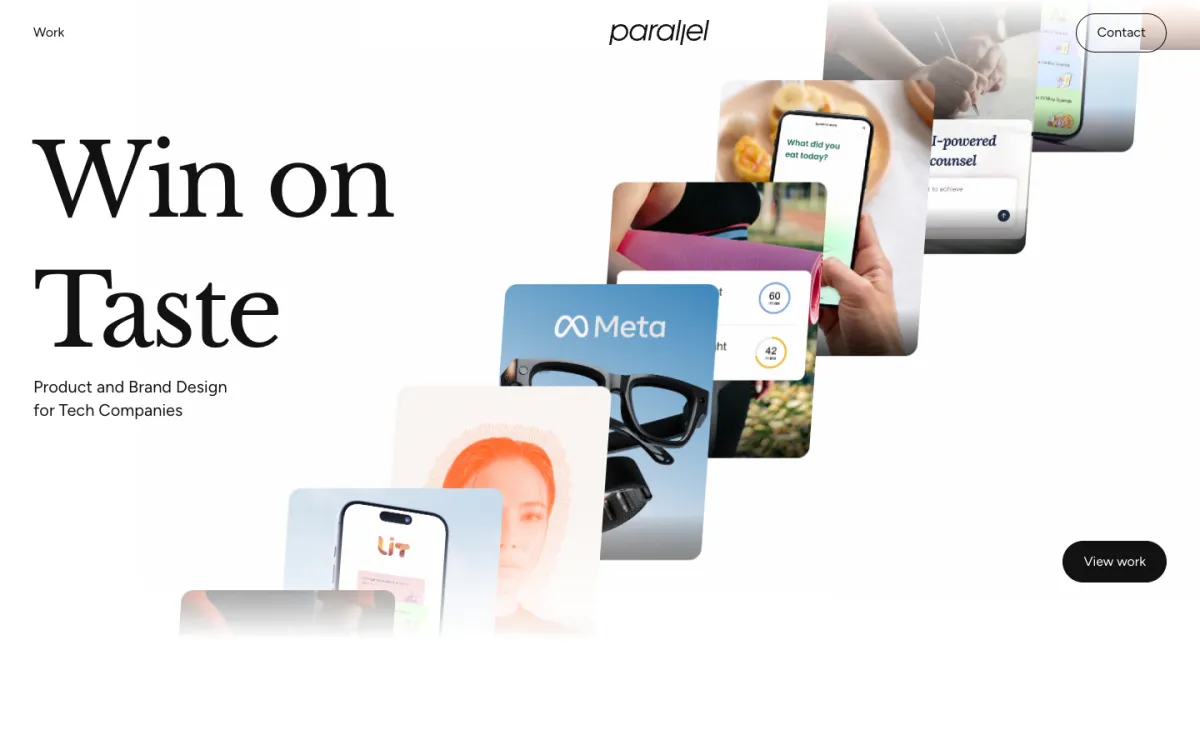
Parallel is a product and brand design studio with teams in Bengaluru and Austin, working with startups from MVP onwards. Its homepage shows Gullak, which it describes as backed by Y Combinator, as an engagement that ran "MVP to Series A", alongside AI and space-tech clients Sarvam AI and Pixxel. Projects usually begin with a four- to six-week sprint.
They genuinely believe in the idea of product design sprints and their quality reflects in their outputs.
- Starting price
- $10,000+ (its site says engagements typically start at $10,000)
- Hourly rate
- $50 to $99
- Clutch
- 4.8/5, 10 reviews
- Team and HQ
- 50 to 249 people, Bengaluru and Austin
- Stack
- Not published; screens, prototypes and design systems handed to engineering
- Engagement model
- 4 to 6 week sprints, embedded senior design teams, brand and web projects
- Designs
- Product, brand and website
- Best for
- Seed and Series A product teams that want a senior design partner through several rounds
- Not a fit for
- One-off design tasks or teams that need the product built
Full review of Parallel
Parallel describes its work as design for engineering to ship, and its services page says it does not take one-off tasks. It lists MVP development as a service but names no engineering stack, so confirm who writes code. Most of its Clutch reviews date from 2017 to 2020, under an earlier company name, so recent founders are the better references. For Pageloop, the agency reports 10 times faster maintenance and a 60% drop in support tickets, figures it published itself.
Awesomic
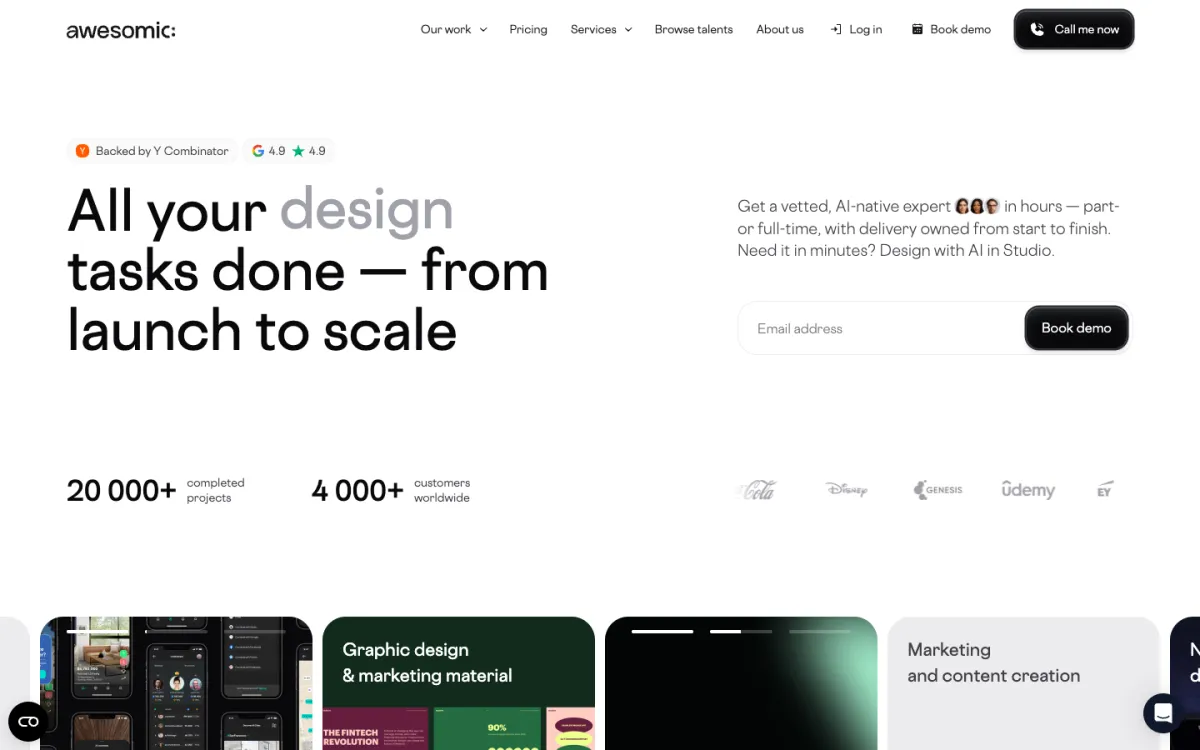
Awesomic is a design subscription that matches startups with vetted designers and design engineers, typically within 24 hours. The company went through Y Combinator itself in summer 2021, and its homepage names YC clients including Willow (YC S25), Toothy (YC W25), Playhouse (YC S21) and Hegel AI (YC S22).
They were happy to help with many things outside requirements and ready to fix issues immediately.
- Starting price
- $1,000+ on Clutch; plans from $1,490/month, All-in-One at $2,995/month
- Hourly rate
- Under $25
- Clutch
- 4.9/5, 4 reviews
- Team and HQ
- 50 to 249 people, San Francisco (agency-stated)
- Stack
- Webflow, React, Next.js
- Engagement model
- Monthly or quarterly subscription, dedicated talent; pause or cancel
- Designs
- Product, website, brand and marketing assets
- Best for
- YC and pre-seed teams with a steady queue of design tasks
- Not a fit for
- A positioning-led relaunch that needs one team to own strategy
Full review of Awesomic
The model trades strategic depth for speed and price: a startup gets a matched designer quickly and pays a flat monthly fee, but direction-setting stays with the founder. Case durations on its site run from two weeks for Toothy to seven months for Playhouse. Its four Clutch reviews all date from 2019, before the company's rename, so ask for recent YC references. Its own pages give different totals for completed work (20,000+ projects on the homepage, 14,000+ tasks on the about page).
925Studios
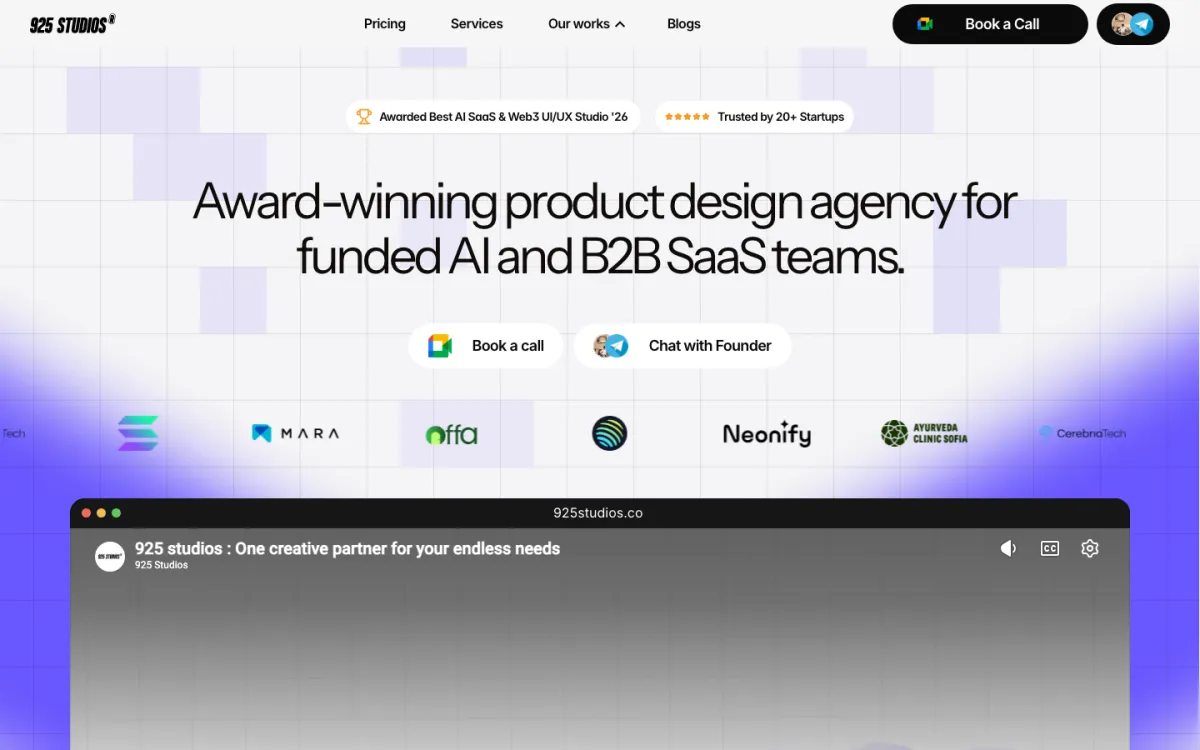
925Studios is a remote-first product design studio based in New Delhi whose MVP design service is aimed at pre-seed and seed founders. It quotes 4 to 8 weeks for MVP design from scratch, 3 to 6 weeks for websites built in Framer or Webflow, and engagements from $7,000. Clients include MARA, a hospitality SaaS, and Offa, an AI real-estate marketplace.
- Starting price
- From $7,000 (agency-stated; no rate card)
- Hourly rate
- Not published
- Clutch
- No Clutch profile found
- Team and HQ
- Boutique, senior-led team; New Delhi, India, remote-first
- Stack
- Framer, Webflow for websites; product delivered as Figma
- Engagement model
- Fixed-scope projects and retainers, quoted against scope
- Designs
- Product and website
- Best for
- Pre-seed and seed founders who need MVP design in under two months
- Not a fit for
- Teams that need back-end or full app development
Full review of 925Studios
925Studios ships front-end code for its own websites but says it does not take back-end, infrastructure or full app-build contracts, so the MVP arrives as production-ready Figma for the startup's engineers. Without a Clutch profile, its evidence is its own: the about page cites booking conversions up 66% in three months and a conversion rate moving from 4.2% to 5.9% across its startup projects, without naming the clients. Its own pages give both 2022 and 2023 as the founding year.
Eleken
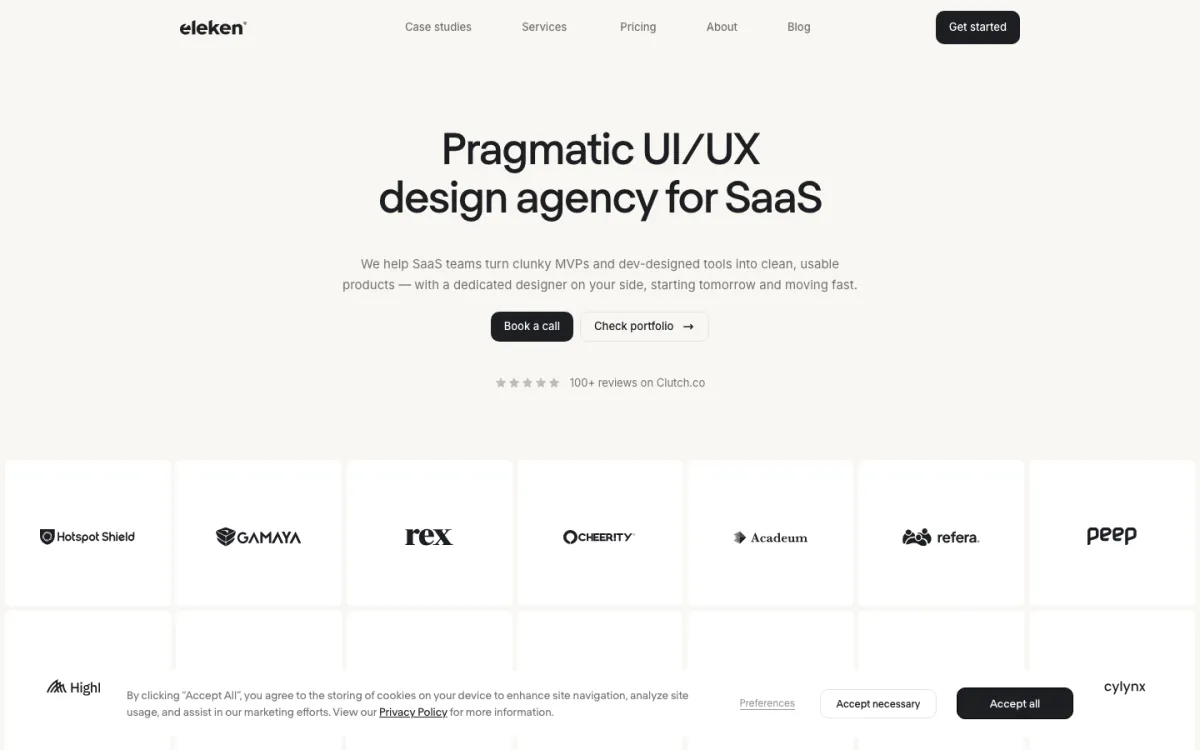
Eleken is a SaaS product design agency in Kyiv that places designers inside startup teams on a monthly subscription. Its services cover MVP design from scratch, product redesign, team extension and UX audits, and its 127 Clutch reviews repeatedly mention how fast the team learns a new product.
It's impressive how little time Eleken takes to understand a new product and get into the details.
- Starting price
- $10,000+; subscription from $4,599/month
- Hourly rate
- $25 to $49
- Clutch
- 4.9/5, 127 reviews
- Team and HQ
- 50 to 249 people, Kyiv, Ukraine
- Stack
- Design only (developer-ready handoff)
- Engagement model
- Subscription ($4,599, $6,599 or $11,999 a month), team extension, projects
- Designs
- Product (websites alongside product work)
- Best for
- Startups with engineers but no designer, from MVP to Series A
- Not a fit for
- Teams that want the site or the product built by the same team
Full review of Eleken
Eleken designs but does not build, so the startup's own engineers or a separate partner write the code. Subscriptions are month to month after the first two months, with a three-day free trial, which suits a product that is still changing. It does not advertise copywriting, positioning or motion.
Arounda
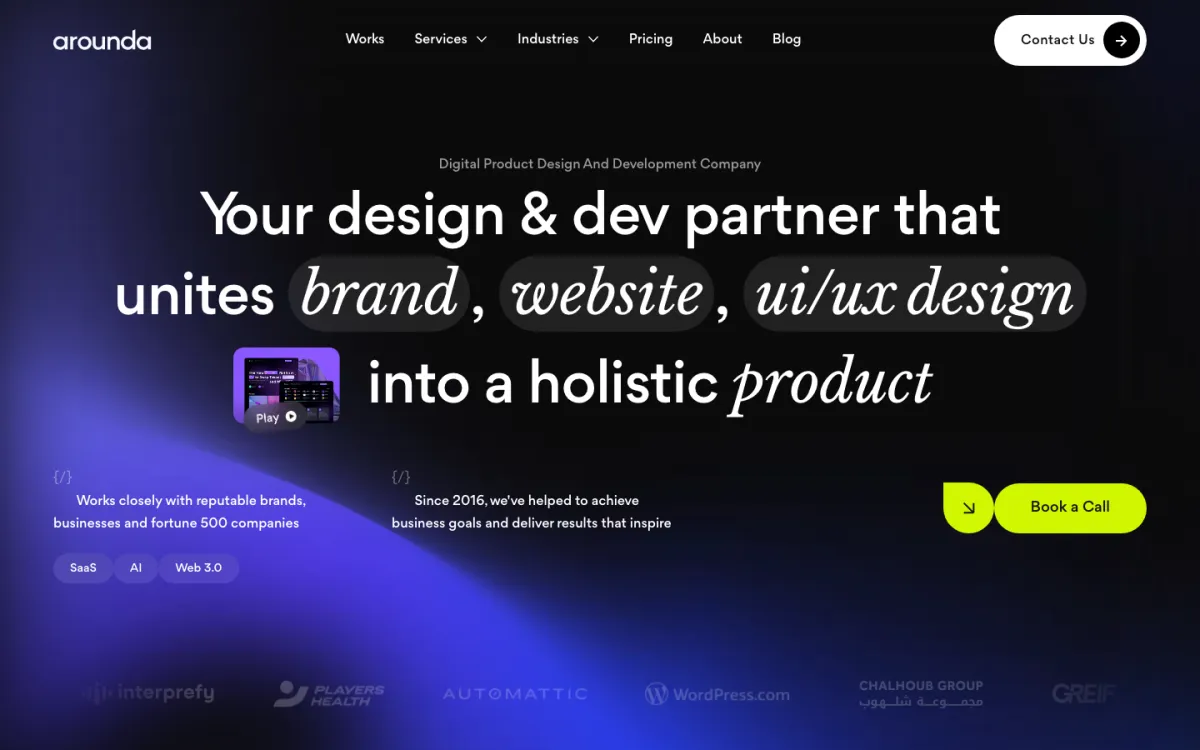
Arounda designs and builds MVPs and websites, with React, Node.js, Python and Webflow developers in-house. It publishes MVP tiers on its own site: $10,000 to $20,000 for a lean MVP, $30,000 to $50,000 for a mid-range product aimed at teams preparing for a seed round, and $50,000 to $80,000+ for complex products.
They brought a rare mix of creative strength, structured thinking, and product intuition to the table.
- Starting price
- $25,000+ on Clutch; projects from $6,000 on its own site
- Hourly rate
- $25 to $49
- Clutch
- 5.0/5, 86 reviews
- Team and HQ
- 10 to 49 people; offices in Odesa, London and Sydney
- Stack
- React, Node.js, Python, Webflow
- Engagement model
- Sprint-based projects, a dedicated monthly team member, published MVP packages
- Designs
- Product and website
- Best for
- Seed teams that need an MVP designed and built, plus the website
- Not a fit for
- A full MVP designed and built in under three months
Full review of Arounda
The published tiers make budgeting easier than at most agencies, but its own MVP page puts a full design and development cycle at 12 weeks or more, so it suits a seed runway more than a batch deadline. Arounda says it has shipped 100+ MVPs since 2016 and that its designs helped clients raise over $1B; both figures are agency-stated. Its site quotes projects from $6,000 against $25,000 on Clutch.
MetaLab
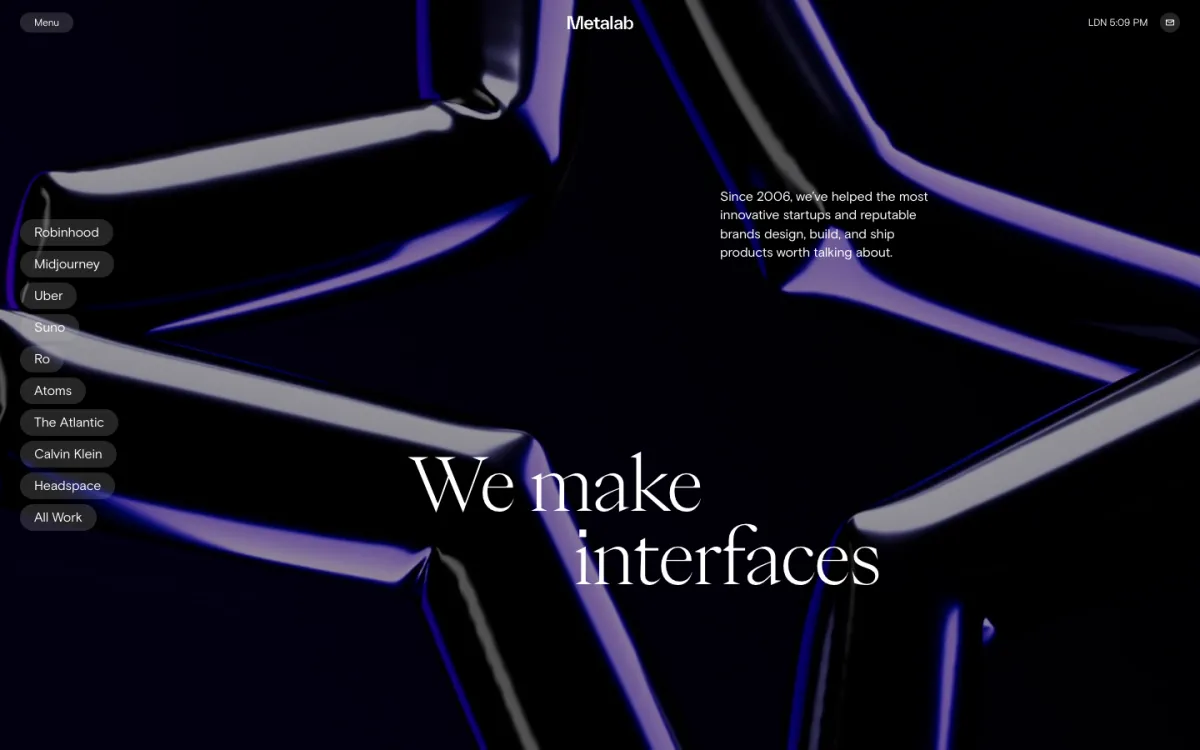
MetaLab is a Vancouver product studio that designs and builds software, describing its clients as running "from pre-seed to fortune 500". It designed Midjourney's original interface, helped Bardeen conceive and design its MVP, and lists PlayerZero and Suno among its clients.
- Starting price
- $100,000+
- Hourly rate
- Not published
- Clutch
- Profile with no reviews
- Team and HQ
- 50 to 249 people, Vancouver, Canada
- Stack
- Front-end and mobile engineering in-house; frameworks not published
- Engagement model
- New products and MVPs, improvements to live products, rebuilds at scale
- Designs
- Product and website, product-led
- Best for
- Well-funded founders building a flagship product
- Not a fit for
- Budgets under $100,000
Full review of MetaLab
MetaLab has the highest minimum on this list and no public Clutch reviews, so references have to come from its client list. Its site states 455 products shipped and 18 unicorns, figures the agency publishes itself. For most seed companies the minimum is a large share of the round; it fits better after a Series A, or for a founder whose product is the whole bet.
Ramotion
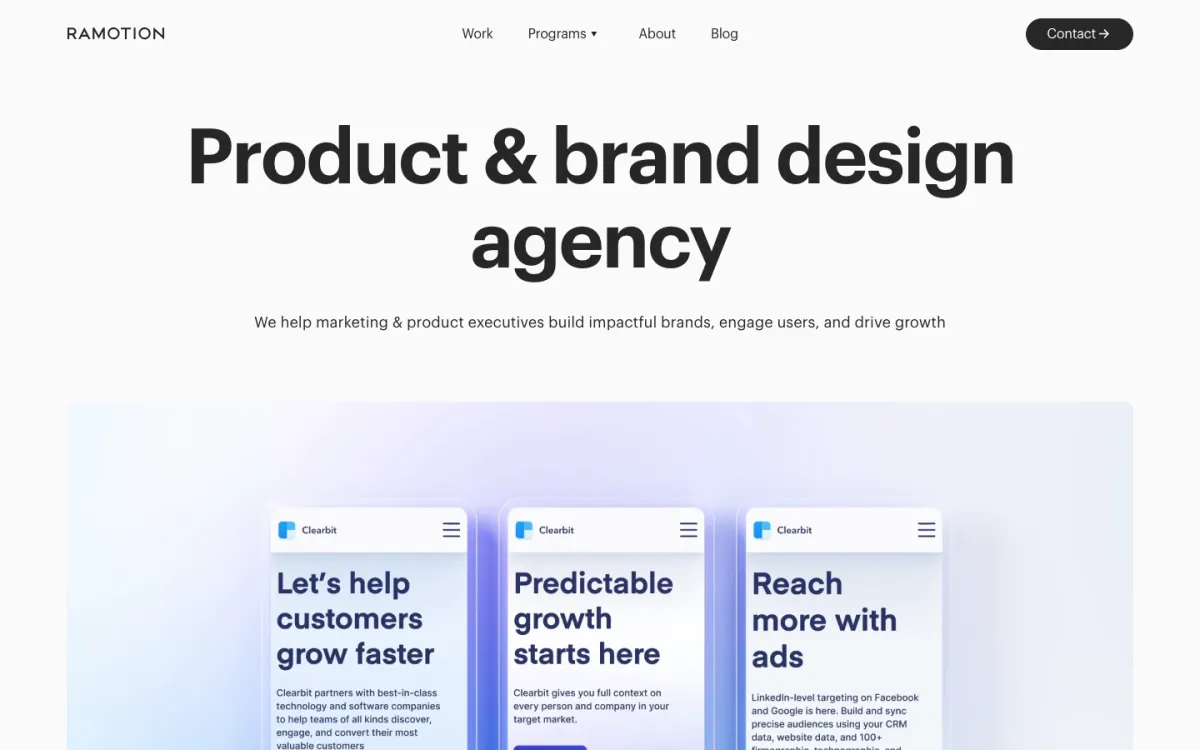
Ramotion is a San Francisco brand and product studio that runs a dedicated startup branding programme, from seed stage through Series B. Its Brand Creation package covers brand, website and launch assets over about three and a half months. Descript, HackerRank and Xero are among the software companies it has worked with.
Communication was easy, and the whole process was seamless.
- Starting price
- $50,000+
- Hourly rate
- $150 to $199
- Clutch
- 4.9/5, 29 reviews
- Team and HQ
- 10 to 49 people, San Francisco, CA
- Stack
- Jamstack, Webflow, WordPress
- Engagement model
- Brand creation and redesign programmes, team extension, ongoing design support
- Designs
- Brand, website and product
- Best for
- Series A and B startups relaunching brand and website together
- Not a fit for
- Budgets under $50,000 or an MVP needed within weeks
Full review of Ramotion
Ramotion sits near the top of the price range, with a $50,000 minimum and $150 to $199 hourly rates. Its startup page says clients raised $1B+ after a rebrand, an agency-stated figure. Many of its public Clutch reviews date from 2018 to 2021, so ask for recent startup work specifically. On the product side, it designed and built Upstream, a carbon-management SaaS, from zero to MVP. For a pure brand project, the branding agencies for startups guide compares more specialists.
thoughtbot
thoughtbot is a product design and development consultancy, founded in 2003, that builds MVPs in Ruby on Rails, React, Python and React Native. Its shaping sprint produces a product roadmap in as little as two weeks, and its Clutch reviews include startup founders at Baton Market, TellaDraft and Clara.
They're incredibly skilled, creative, and kind.
- Starting price
- $10,000+
- Hourly rate
- $150 to $199
- Clutch
- 4.9/5, 39 reviews
- Team and HQ
- 50 to 249 people, New York, NY
- Stack
- Ruby on Rails, React, Python, React Native, iOS, Android
- Engagement model
- Shaping sprints, MVP development, team augmentation, fractional product and technical leadership
- Designs
- Product
- Best for
- Founders who want the MVP designed and engineered by one senior team
- Not a fit for
- Brand, marketing websites or design-only budgets
Full review of thoughtbot
thoughtbot is engineering-led: design serves the build, which suits founders whose risk is technical rather than visual. In a Clutch review, Clara's CTO reported its payroll process taking half the time it did when thoughtbot started. At $150 to $199 an hour, it costs more per hour than most design-first studios here, and it does not publish prices on its own site.
Designli
Designli builds software for non-technical founders in Greenville, South Carolina, with a product owner, developers and QA in each team. Its TractionLab programme promises a real user on a working MVP within 30 days or the next month free, and it publishes MVP budget ranges starting at $10,000 to $50,000 for a basic product.
I'm impressed by their ability to see the vision and make the build modularly expandable for the future.
- Starting price
- $10,000+; a one-week Impact Week audit at $1,700
- Hourly rate
- $50 to $99
- Clutch
- 5.0/5, 83 reviews
- Team and HQ
- 50 to 249 people, Greenville, SC
- Stack
- React Native for iOS and Android; web stack not published
- Engagement model
- Dedicated pod at a fixed monthly fee, 90-day MVP programme, two-week prototyping sprints
- Designs
- Product
- Best for
- Non-technical founders who need a working MVP, not only designs
- Not a fit for
- Brand-led websites or teams with their own engineers
Full review of Designli
The model removes the hiring problem for founders without a technical co-founder, and the first two weeks of its MVP service are refundable. Its published ranges climb to $50,000 to $150,000 for a moderate product and $150,000 to $400,000+ for a complex one, so the starting price covers only a narrow MVP. Funding outcomes on its site come from client reviews it republishes from G2.
Tapptitude
Tapptitude is a product studio in Cluj-Napoca that designs and builds mobile and web MVPs, with Swift, Kotlin, Flutter, React Native, React and Next.js in-house. It sells product definition packages on Clutch: $8,000 over five weeks for bootstrapped founders, $13,000 over eight weeks, and $31,000 over twelve weeks for funded startups.
Tapptitude has been a critical partner in developing our platform, and we wouldn't be where we are without their help.
- Starting price
- $5,000+; product definition packages from $8,000
- Hourly rate
- $25 to $49
- Clutch
- 4.9/5, 71 reviews
- Team and HQ
- 50 to 249 people, Cluj-Napoca, Romania
- Stack
- Swift, SwiftUI, Kotlin, Flutter, React Native, React, Next.js, Node.js
- Engagement model
- Fixed product definition packages, MVP builds, maintenance, staff augmentation
- Designs
- Product
- Best for
- Mobile-first startups that want the MVP defined, designed and built
- Not a fit for
- Brand and marketing-site projects
Full review of Tapptitude
The fixed packages give founders a defined first step before committing to a build. In a Clutch review, GAMESTAND's CEO said the MVP reached the market within a week of handoff and converted 40% of its targeted audience in the first 30 days. Its homepage shows funding totals for clients such as Glorify and Holler; those figures are agency-stated.
Halo Lab
Halo Lab designs and develops websites and products from Dubai and Eastern Europe, building in Webflow, React and Next.js. Startup clients include Tessellate, a physician career platform whose founder wrote that the new site put the company ahead of established competitors, and Ditto.
They developed a website that puts us years ahead of our competitors, despite our startup being only a few months old.
- Starting price
- $10,000+ on Clutch; $5,000 on its own site
- Hourly rate
- $25 to $49
- Clutch
- 4.9/5, 100 reviews
- Team and HQ
- 50 to 249 people, Dubai, UAE
- Stack
- Webflow, React, Next.js, Vue, Sanity, Prismic
- Engagement model
- Projects and dedicated monthly teams
- Designs
- Website and product
- Best for
- Seed teams that need website and product on a tight budget
- Not a fit for
- Motion-heavy launch sites
Full review of Halo Lab
Its $25 to $49 hourly rate is among the lowest here, which stretches a seed budget. Halo Lab says products it designed have secured $530M in funding, an agency-stated figure. It does not advertise motion design, and its site quotes a $5,000 minimum against $10,000 on Clutch. With a large team, confirm who leads design on the account.
Everything Design
Everything Design is a Bengaluru brand and Webflow website agency for funded B2B startups, and a Webflow Premium Partner. It positions itself for Series A and B founders three to six months out from a launch, raise or hiring push, and says a standard startup brand-and-website engagement runs four to six weeks.
- Starting price
- Not published
- Hourly rate
- Not published
- Clutch
- No Clutch profile found
- Team and HQ
- About 50 people (agency-stated), Bengaluru, India
- Stack
- Webflow (Premium Partner)
- Engagement model
- Brand and Webflow website projects, retainers
- Designs
- Brand and website
- Best for
- Series A B2B startups relaunching brand and site before a raise
- Not a fit for
- MVP or product design
Full review of Everything Design
Startup clients on its site include Ximkart and Armory, both described as Series A, and venture firms such as Z47 and Stellaris Venture Partners. It does not design or build products, so it pairs with a product partner rather than replacing one. The site states 379 projects in six years. With no Clutch profile and no published prices, ask for references and a written quote early.
Lazarev
Lazarev redesigns AI, data and B2B products and builds websites in Webflow. It runs a dedicated AI product launch programme, and its startup and launch pages list clients such as Fieldstream, Suits.ai and VTnews.ai. Its about page says it works with Series A, B and C startups.
I've never worked with a vendor operating so well, especially on a creative job.
- Starting price
- $100,000+ on Clutch
- Hourly rate
- $100 to $149
- Clutch
- 5.0/5, 19 reviews
- Team and HQ
- 50 to 249 people, San Francisco, CA
- Stack
- Webflow
- Engagement model
- AI product launch programme, monthly demand programme, projects
- Designs
- Product and website
- Best for
- Funded AI startups launching product and site together
- Not a fit for
- Seed budgets or a product that needs engineering
Full review of Lazarev
The $100,000 Clutch minimum is high for most startups, and its own site does not publish prices. The launch programme is described as three to four months on one part of the page and four to eight months in its timeline table, so confirm the plan in writing. Its page-one Clutch reviews date from 2021 and 2022. AI interface specialists are compared in the AI UX agencies guide.
Big Human
Big Human is a New York product studio, founded in 2010, that designs and builds apps and websites and incubates its own products. By its own account it built Vine and sold it to Twitter, and since 2010 it has produced 262 websites, 80 applications and 50 brands.
It felt like they always wanted to learn how our business works.
- Starting price
- Not published
- Hourly rate
- Not published
- Clutch
- 4.9/5, 12 reviews
- Team and HQ
- 10 to 49 people, New York, NY
- Stack
- React Native, Flutter, Swift, Kotlin, Node.js, Python
- Engagement model
- Not published; quoted per project
- Designs
- Product, website and brand
- Best for
- Founders who want a studio that has launched its own products
- Not a fit for
- Teams that need published prices or a fixed MVP timeline
Full review of Big Human
Big Human builds as well as designs, which suits a founder without an engineering team. Its FAQ says a lean MVP can move from discovery to launch "in a matter of months" but gives no number, and it publishes no pricing. Its most recent Clutch reviews are from non-startup clients, so ask for startup references.
What does a product design agency do for a startup?
Good startup design work removes risk before engineering spends money building the wrong thing. A product design agency for startups, or a dedicated MVP design agency, covers five pieces of work, and most MVP design services include all of them:
- Validation. Turning the idea into a clickable prototype and putting it in front of five to ten target users before anything is coded.
- User research and usability testing. Short interviews and task tests that show where people get lost. Startups skip this more than anything else, and it is the cheapest point to learn.
- The core flow. Onboarding and the first useful action, designed to get a new user to value in one session. Activation and early retention are decided here, long before product-market fit.
- A small design system. Reusable components and rules, so developers can build new screens without a designer and the product stays consistent as it grows.
- Developer handoff. Annotated designs, states and edge cases in Figma, or a build in a no-code tool, so engineering is not guessing.
For the full scope of an MVP engagement, see AI MVP design; for ongoing product work after launch, see product design. Larger product studios are compared in the product design agencies guide.
What an MVP design engagement looks like, week by week
Most MVP design projects run in the same order, whatever the agency calls the phases:
- Discovery. Calls with the founders about each feature: the problem, the outcome, the friction points. Existing sales calls, demo recordings and any analytics come in here.
- Information architecture and flows. The structure of the product and a user flow for every action, including what happens on errors and empty states.
- Directions for the key module. Three to five versions of the screen that carries the product's promise, usually the main dashboard or the first action after sign-up.
- Testing. The chosen direction goes to real users as a prototype. 95% of agencies in the benchmark called UX research core to their process and about 70% offer moderated usability testing, so ask what testing actually happens.
- The rest of the screens and the design system. Once the direction is set, the remaining modules move faster because they reuse the same components.
- Handoff and design QA. Nearly every agency in the benchmark hands off a Figma file with a design system, and over 80% involve the client's developers early.
I would rather move fast on assumptions than wait to be 100% right, then go to market, test it and see what works.
Design only, or design and build?
In the benchmark, of agencies that build, 55% build in-house and 45% use a partner; 20% design only. For a startup that has engineers, a design-only partner such as Eleken or Parallel is enough. For a founder without a technical team, an agency that builds, such as thoughtbot, Tapptitude, Designli, Arounda or Big Human, removes a second hire. The benchmark's author recommends one agency that builds in-house over managing two, because an agency that refers development to a partner may step back when the build runs into problems.
What should a startup spend on design at each stage?
Design spend should follow the job the company needs done next, not a percentage of the round. Each stage has one job.
Editorial guidance from Bricx, not report data, except the seed median quote:
| Stage | The design job | What it usually costs (editorial) | What to skip |
|---|---|---|---|
| Pre-seed | Prove the idea and get the meeting | A landing page and a clickable prototype; often a freelancer, a subscription or a short sprint | A full brand system, a 20-page site |
| Seed | Ship an MVP people can use without help | An MVP design project; the benchmark's median fixed quote was about $43,000 | Pixel-perfect polish on screens that will change next month |
| Series A | Look like the company that just raised, and convert the traffic | Brand and website together, plus a design system for the product | Rebuilding the product design from scratch |
| Series B and later | Scale the product and the team | A retainer or embedded team, then an in-house design lead | Agency-only design ownership |
The stage also changes what founders ask for:
After a seed round, founders usually want the website, the product or both. Before a Series A or the next round, they mostly want a visual rebrand.
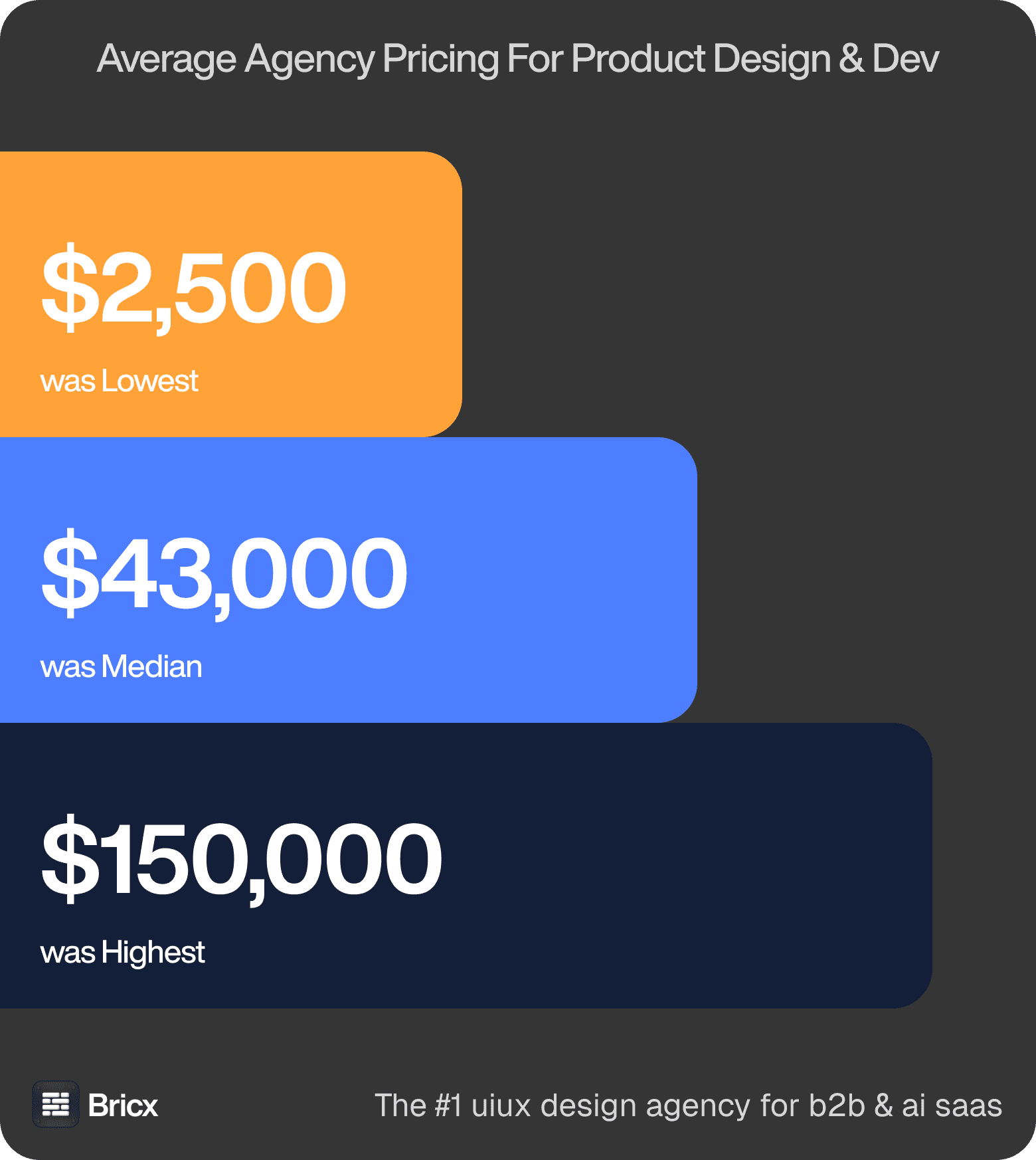
Of the agencies that quoted, fixed-price product design ran from $2,500 to over $150,000, with a median around $43,000. 60% of the agencies asked would not put a number on product design before another conversation. The report's author estimates product work at 1.5 to 2.5 times a website; the measured medians, about $43,000 against $25,000, put it near 1.7 times. Monthly subscriptions started around $4,000, with a median near $7,000 and a top end of $20,000.
Website and brand costs for startups
- A landing page or small site. For web design and development of a 5-page site with copy and a Webflow or Framer build, the median quote was $25,000; of the agencies that quoted, 25% came in under $10,000 and 58% between $15,000 and $50,000. The report's author notes that a clean single landing page can be designed and developed for under $10,000.
- A brand refresh. Branding figures come from about a dozen quotes. Without a logo, 42% of the agencies that quoted came in under $10,000 and the median was $15,300. 38% could deliver it in under four weeks. The author's advice for early-stage startups is not to spend long on brand, and to spend more time on it when scaling.
- Hourly rates quoted ran from $25 to $195, with a typical rate between $55 and $90. The report's author puts average rates at about $150 an hour in the US, $60 in Europe and $35 in Asia. The benchmark compared quotes, not delivered work, and found no link between rate and the scope offered.
How to stretch a pre-seed or seed budget
- Design the riskiest flow first. The onboarding or the core action that proves the product works, not the settings page.
- Ask for a design system from day one, even a small one. It is what lets an engineer build the next ten screens without a designer.
- Keep the website to one page until there is something to sell. A single strong page with a clear promise, a product visual and a way to join is enough for many pre-seed raises.
- Pay for judgement, not volume. A senior designer for four weeks usually beats a junior team for twelve.
At this stage, you shouldn't spend heavily on design. Save that money for the development team that will build the product.
How long does an MVP design take?
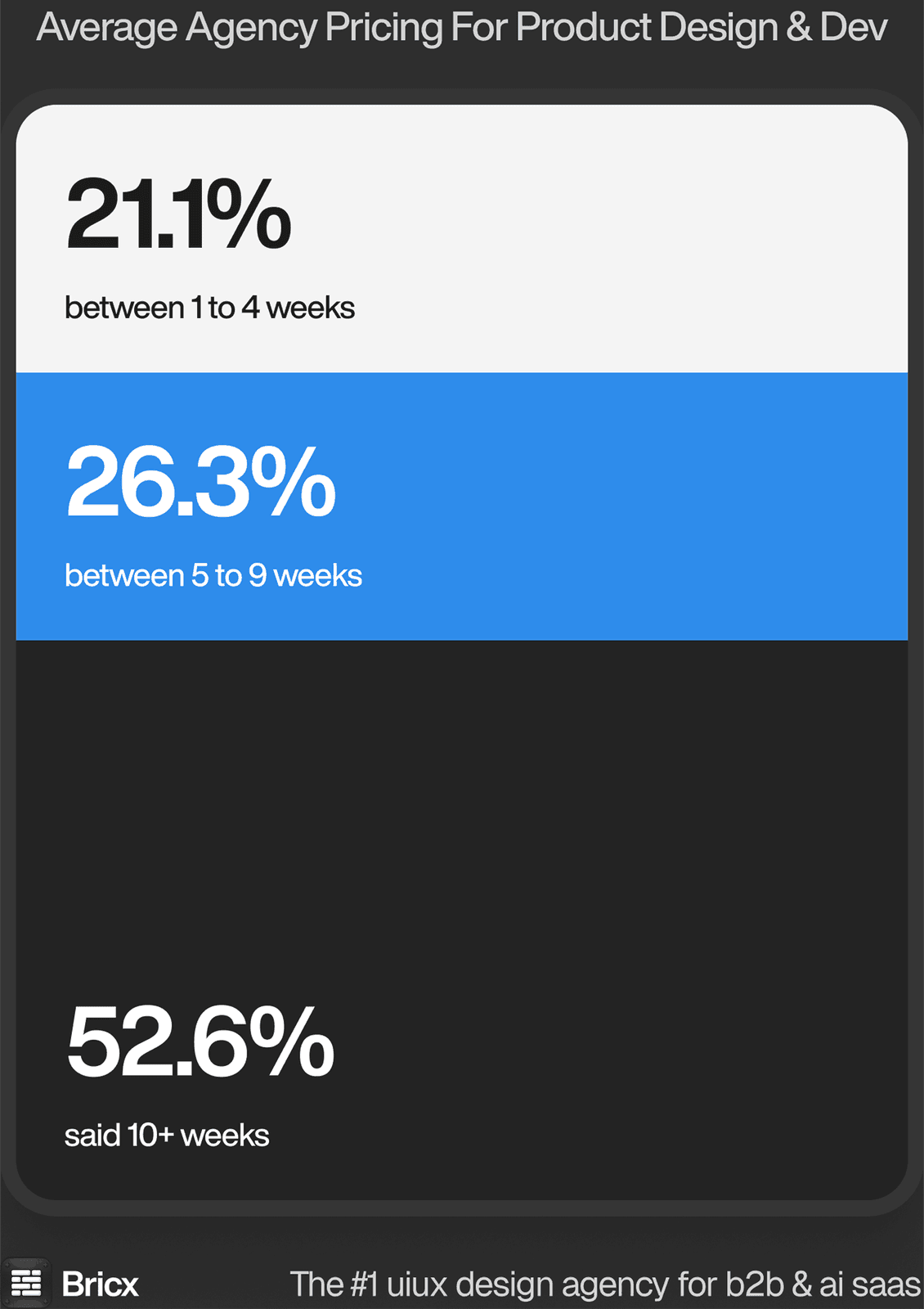
For the same 5-feature MVP brief, of the agencies that gave a timeline, 21.1% quoted 1 to 4 weeks, 26.3% quoted 5 to 9 weeks and 52.6% quoted 10 weeks or more. For a startup, that spread matters more than price: a 12-week design phase uses a large share of a seed runway before engineering ships anything.
Long quotes usually reflect a fixed process, not a harder product. The report's author points buyers to each agency's case studies for real timelines. Bricx's own figure, stated in the same report, is that it completes almost all MVP design projects in under 45 days, feedback cycles included: once the visual direction is set, about one feature ships each week with every edge case documented, and a second designer doubles that pace.
Published timelines from the agencies above give a range: 925Studios quotes 4 to 8 weeks for MVP design, Tapptitude 5 to 12 weeks for product definition, and Arounda 12 weeks or more for design and development together.
Lead time adds to the total: 45% of agencies could start within two weeks of signing, 45% needed two to four weeks and 10% a month or more. Feedback speed decides the rest. The benchmark's most specific estimate asked the founder or main contact for about five hours a week, plus a weekly sync.
Design agencies for YC startups: working around the batch
Accelerator batches run on a fixed calendar. Y Combinator's lasts about three months and ends in Demo Day, so a design project that starts a few weeks into the batch has roughly eight weeks to produce something investors and early users can see. That is why YC founders tend to choose agencies on start date and speed first, and why subscriptions such as Awesomic, and short sprints from teams such as Bricx, Parallel and 925Studios, recur in YC founders' shortlists.
Working back from the date:
| Weeks before the date | What should be finished |
|---|---|
| 8 | Scope agreed: the one flow and the one page that matter |
| 6 | Core product flow designed and tested with five users |
| 4 | Landing page and product visuals approved |
| 2 | Built, live, and instrumented for sign-ups |
| 0 | Launch, Demo Day or the raise announcement |
The same plan works for a Product Hunt launch, a Techstars demo day or a funding announcement.
What a YC startup should and should not design during the batch
- Design: the one product flow that proves the company works, a landing page that explains it in one screen, and a short product walkthrough or demo video for investors.
- Keep consistent: the pitch deck, the landing page and the demo should use the same story and the same product visuals; investors see all three in one sitting.
- Skip: a full brand book, a multi-page website and polish on screens that will change after the first customers arrive. Those belong after the raise.
The raise is usually the forcing event. In Bricx's sales calls, most website redesigns land right before a round rather than after it, because the site is one of the first things an investor checks:
If we pitch an investor, we shouldn't look like the people who aren't in their portfolio, even though we're pre-revenue.
What to design first: product, website or brand?
The order depends on who has to be convinced next.
- If users are the bottleneck, design the product first. An MVP that gets someone to the first useful result in one session beats any landing page.
- If investors are the bottleneck, design the story first: a sharp landing page, a product walkthrough and a pitch deck that match. One developer-tools founder described it this way on a Bricx sales call: users only cared about the API docs, but investors judged the company by how it looked.
- If the company just raised, brand and website together. The round changes how the company presents itself, and the site is usually a seed-stage relic by then.
Brand does not have to come first, either. A young company learns more by testing a visual direction on its most important page, usually the homepage hero, and writing the guidelines afterwards from whatever worked. What a brand identity project covers is on the brand identity design page, and specialist studios are compared in the branding agencies for startups guide.
When product first, website second makes sense
When the product is about to change shape, a website designed around today's screens has to be redone in a few months. A practical approach is to design the site with placeholder slots for product visuals and fill them as the product screens are finalised. Teams that only need product work at seed often test the product in the market, raise, and come back for the website and visual identity afterwards. Where both sides need work at once, 90% of benchmarked agencies said they can run website and product design in parallel after an initial brand phase.
Fixed sprint, retainer or subscription?
| Model | How it works | Best when |
|---|---|---|
| Fixed-scope sprint | A set deliverable, price and date | The scope is clear: an MVP flow, a landing page, a pitch-ready prototype |
| Retainer | A team's time each month; scope moves with the product | The product changes weekly and needs a design partner, not a deliverable |
| Design subscription | A flat monthly fee for a queue of requests | Steady, smaller requests after the core product exists |
| Paid pilot | One or two weeks of real work before committing | Testing fit before a larger engagement |
In the benchmark, 45% of agencies offered time and materials, 35% fixed price and 20% retainers or subscriptions. The benchmark's author recommends a retainer when the direction is still being explored, because the agency is paid for its time and will not resist iteration, and a fixed price when the scope is known, for budget predictability. Many startups combine them: a fixed sprint to set the foundation, then a retainer while the product moves.
When we design an MVP or an early product, a lot of pivots happen along the way.
Published subscription and package prices from the agencies above
| Agency | Published price |
|---|---|
| Awesomic | $1,490/month (graphics), $2,995/month (All-in-One), 20% off quarterly |
| Eleken | $4,599/month part-time designer, $6,599 full-time, $11,999 for two designers |
| Tapptitude | Product definition packages at $8,000, $13,000 and $31,000 |
| Designli | Impact Week audit at $1,700; MVP ranges from $10,000 to $50,000 for a basic product |
| Arounda | MVP tiers from $10,000 to $20,000 (lean) up to $50,000 to $80,000+ (complex) |
| Bricx | Fixed scope from $25,000; retainers from $10,000/month |
About 50% of benchmarked agencies take an upfront deposit followed by milestone payments. Some agencies also take equity as part payment; the trade-offs are covered in the FAQs below.
Agency, freelancer, in-house designer or AI?
| Agency | Freelancer or fractional designer | First in-house designer | AI tools only | |
|---|---|---|---|---|
| Best stage | Seed to Series B | Pre-seed | Series A onwards | Pre-seed experiments |
| Speed to first result | Fast, with a team | Fast for small scopes | Slow to hire | Fastest |
| Covers product, brand and site | Usually | Rarely | Over time | Layouts, not judgement |
| Main risk | Cost; context leaves when the contract ends | One person, no backup | A hire made too early | Looks like everyone else |
AI design and coding tools, along with no-code builders such as Bubble, Webflow and Framer, now produce working layouts and flows in hours, which is why pre-seed teams can validate an idea before paying anyone. What they do not produce is a product that feels distinct, and as more startups ship AI-generated sites, the generic look has become easier for investors and buyers to spot. A common path: AI tools and a freelancer to validate, an agency for the MVP or the post-raise relaunch, then a first in-house designer who inherits a documented system.
Why the in-house hire usually comes later
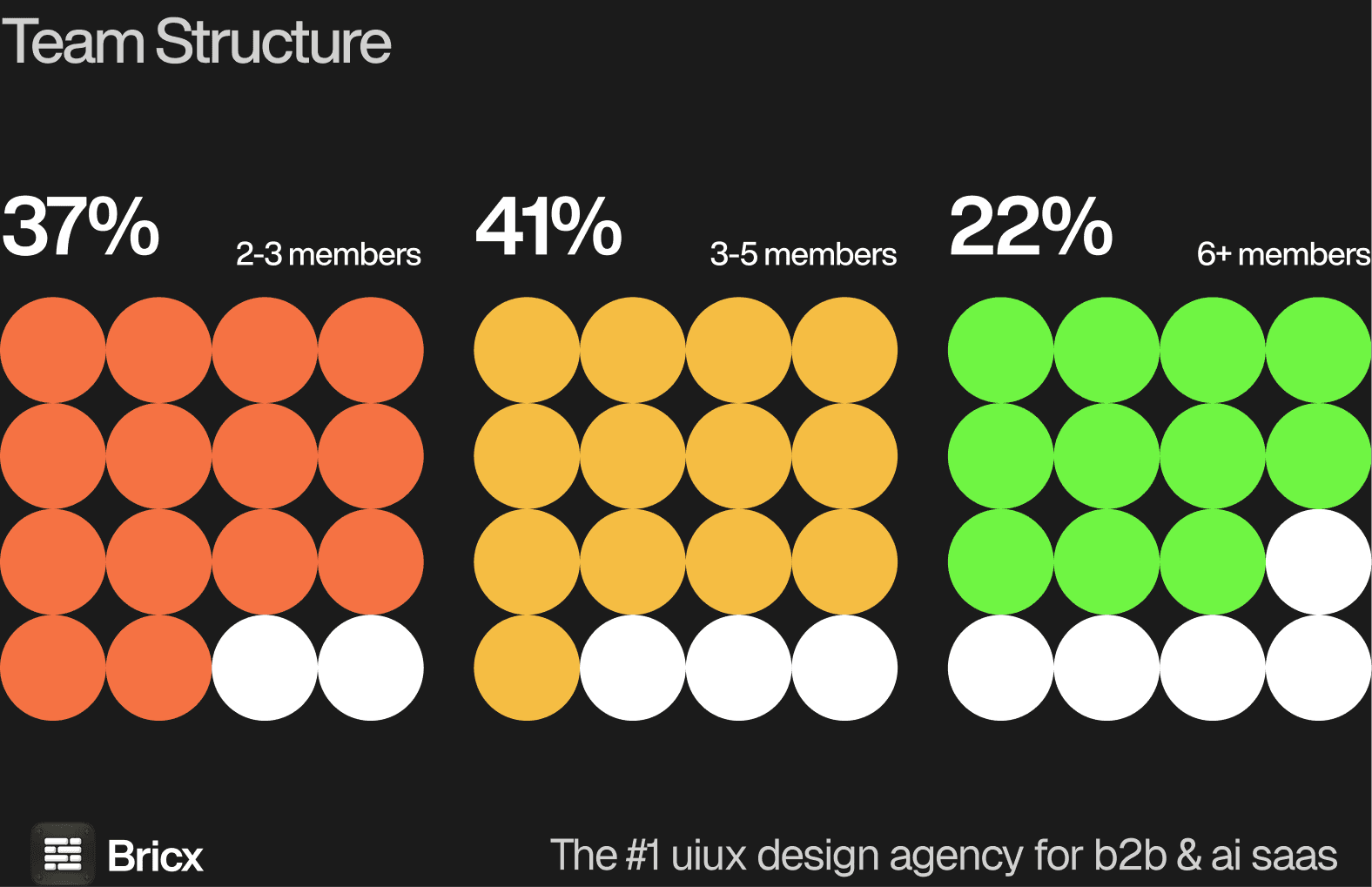
A first designer hired at seed often ends up split between the product, the website, sales decks and brand, with no system to work from. An agency at that stage brings a team: 41% of benchmarked agencies staff a project with three to five people, 37% with two or three and 22% with six or more.
 By Series A, once the product direction is stable, one in-house designer can own a design system the agency documented, with the agency on a lighter retainer or gone. Bricx's design lead estimates that a custom design system with tokens takes about three days of effort once the core screens exist, which is why it is worth asking for at handoff rather than later.
What startup founders actually ask before hiring
Bricx reviewed 100 recorded sales calls with software teams looking for a design partner, from June 2025 to September 2026, counting each theme once per call.
- A date drives the decision. 40 of 100 calls started with a launch, a beta, a raise or an event. Only about 3 started with a conversion problem.
- New products and launches were the trigger in 19 calls; no in-house designer, or one who just left, in 7; just raised or changed stage, in 7; a previous agency or freelancer failed, in 4.
- Worries: budget (31 calls), picking the wrong partner (25), timeline (21) and ending up with something generic (17).
- 42 of 100 calls ended with a request for a price or scope in writing. Only one asked to speak to a past client.
For a startup, the reference call is the cheapest due diligence available. Ask any shortlisted agency for two founders at a similar stage to call.
I think the product is up there, the, the team is up there, but design does not match the caliber of the other 2.
How to choose a design agency as a startup
Competitor guides and founders' own questions point to the same tests to evaluate an agency: startup experience at the right stage, speed to start, the seniority of the people doing the work, whether the agency builds, and an engagement model that bends when the product pivots.
What makes a design agency right for a startup
- Startup constraints, not enterprise process. Small budgets, rapid iteration and a product strategy that may change after ten customer calls. An agency built for long enterprise programmes struggles with that pace.
- Senior people doing the work. Early design decisions shape the product for years, so the expertise has to sit with the person in the Figma file, not only in the pitch.
- Clarity on scope and price. Predictable pricing, a written definition of a revision round and clear expectations on both sides, so the founder can plan runway around it.
- A flexible engagement. Long-term collaboration through pivots, with the option to pause, beats a polished deliverable for a product that no longer exists.
- Execution through to the build. UI/UX design that engineers can ship: interfaces for every state, workflows mapped end to end, and a design system for web and mobile app platforms.
- Industry experience where it matters. A fintech or healthtech MVP carries compliance screens, audit trails and trust signals that add complexity a generalist may underestimate. Ask which industries the agency has shipped in, and which growth metrics changed for those clients.
Brief the agency in one page
- The single outcome: a fundable prototype, a launched MVP, or a site that converts after the raise.
- The date that cannot move.
- The flows and pages in scope, in priority order.
- Who writes copy and who decides, with a 24 to 48-hour feedback commitment.
- What engineering will build with: the stack, and whether a design system is expected.
- The budget range, stated honestly.
Every agency in the benchmark received the same website brief, and quotes still ran from $1,500 to $120,000. A one-page brief is what makes quotes comparable.
Ten questions to ask a design agency as a startup
- Which seed or Series A products have you designed, and can two of those founders take a call?
- Who is the senior designer on this project, and how many other clients do they have?
- What do you deliver in week one?
- How do you test designs with users before engineering builds them?
- Will the handoff include a design system engineers can extend?
- Do you build, or only design? If you only design, who builds?
- How do you handle scope changes when the product pivots?
- What happens to the files and the workspace if the engagement ends?
- Can the engagement start as a paid pilot?
- What is your notice period on a retainer?
Red flags for startups
- A process deck built for enterprise timelines: discovery workshops for a month before any screen.
- No founders to call, only logos.
- A fixed price with unlimited revisions promised, which usually means revisions get rationed later.
- No plan for how engineering builds from the designs.
- Senior designers in the pitch and junior designers on the project.
- Pressure to rebrand before there is a product to brand.
Startups with a SaaS product past MVP can also compare website and product specialists in the SaaS design agencies guide.
FAQs
How much does a design agency cost for a startup?
In a benchmark where Bricx held sales calls with 57 agencies, the agencies that quoted put fixed-price MVP design at $2,500 to over $150,000, with a median around $43,000. Monthly design subscriptions started near $4,000, with a median of about $7,000. A 5-page website had a median quote of $25,000. A single landing page or a clickable prototype for a pre-seed raise usually costs well under any of these.
How long does it take to design an MVP?
Most agencies quote 10 weeks or more (52.6% of those that gave a timeline), while 21.1% quote 1 to 4 weeks and 26.3% quote 5 to 9 weeks. Add a lead time of up to four weeks at 90% of agencies. Focused teams with one decision-maker and 24 to 48-hour feedback can finish an MVP design in four to eight weeks. Bricx, by its own figure, completes almost all MVP design projects in under 45 days, feedback cycles included.
What do MVP design services include?
Discovery with the founders, information architecture and user flows, a few directions for the most important screen, usability tests with real users, the remaining screens, a small design system and a developer handoff with every state and edge case. Some agencies also build the MVP; about 20% of benchmarked agencies design only, and of those that build, 55% build in-house and 45% use a partner.
Which design agencies have worked with YC companies?
Bricx has worked with Writesonic (YC S21) and is designing the website of CollectWise (YC F24). Awesomic, itself a YC S21 company, lists Willow (YC S25), Toothy (YC W25), Playhouse (YC S21) and Hegel AI (YC S22). Parallel lists Gullak, which it describes as backed by Y Combinator, as an engagement from MVP to Series A.
What should a YC startup design during the batch?
The core product flow and a landing page that explains the company in one screen, ready before Demo Day, plus a demo that matches the pitch deck. Brand systems and multi-page websites can wait until after the raise.
Should a pre-seed startup hire a design agency?
Usually not yet. A pre-seed company can often raise with one strong landing page and a clickable prototype, which a freelancer, a subscription or AI tools can produce. Agencies earn their cost at seed, when there is an MVP to ship, and after a raise, when the brand and website need to match the company.
Do design agencies take equity from startups?
Some do, usually as part payment alongside a reduced fee. It conserves cash but gives away ownership at the lowest valuation the company is likely to have, so most founders treat cash as cheaper for a defined design project. If equity is on the table, agree vesting against delivery milestones.
Is a design subscription a good fit for a startup?
For a steady queue of smaller requests after the core product exists, yes; Awesomic and Eleken publish plans from $1,490 and $4,599 a month. For an MVP or a relaunch that needs one senior team to think through the whole problem, a fixed sprint or retainer usually works better.
What is the difference between a UI/UX agency and a product design agency for startups?
Mostly emphasis. A UI/UX agency focuses on screens and usability; a product design agency also works on product strategy: what to build first, for whom, and which metric it should move. For an MVP, the second is usually the better fit, because the challenges are deciding scope as much as drawing interfaces.
Do these agencies build the product or only design it?
It varies. thoughtbot, Tapptitude, Designli, Arounda, Big Human, MetaLab and Ramotion build as well as design. Eleken designs and hands off to the startup's engineers, and Parallel publishes no engineering stack. 925Studios, Everything Design and Lazarev build websites but not applications. The comparison table shows each agency's build capability.
When should a startup hire its first in-house designer?
Usually around Series A, once the product direction is stable enough that one person can own it. Hiring earlier often leaves a single designer split between product, marketing and brand with no system to work from. Many startups hire the first designer to run a design system an agency documented.
Can AI tools replace a design agency for an MVP?
For validating an idea, often yes. For a product that has to feel trustworthy and distinct to paying users and investors, AI tools still need a designer's judgement on what to show, in what order, and what to leave out. As AI-built products start to look alike, a distinctive one stands out more.
What should a startup own at the end of the engagement?
Everything: the Figma files, the design system, fonts and image licences, and the Webflow or Framer site transferred into the company's own workspace. Confirm it in the contract before signing, especially with subscriptions, where files can sit in the agency's account.
Does a startup need a design system for its MVP?
A small one, yes. A short set of documented components and rules lets engineers build new screens without a designer and keep the product consistent as features ship weekly. A full enterprise design system can wait until there is a team to maintain it.
How fast can a design agency start?
In the benchmark, 45% of agencies could start within one to two weeks of signing, 45% needed two to four weeks and 10% a month or more. Subscriptions such as Awesomic match a designer within about 24 hours. For a batch or launch deadline, ask for the start date before the proposal.
Should a startup hire a local or a remote design agency?
Location affects price and time zones more than quality. 60% of benchmarked agencies are based in Europe and 20% in Asia, and the report's author puts average rates at about $150 an hour in the US against $60 in Europe and $35 in Asia. Remote agencies work well when feedback is consolidated and asynchronous.
Where can SaaS startups compare website design agencies specifically?
The SaaS design agencies guide compares agencies for B2B SaaS websites and product UX after the raise. AI product teams can also see the AI UX agencies guide, and founders focused on identity the branding agencies for startups guide.

Similar Lists

Contents