Top 10 Product Design Agencies for Low-Code Startups - July 2026
Top 10 Product Design Agencies for Low-Code Startups - July 2026
Top 10 Product Design Agencies for Low-Code Startups - July 2026
Searching for product design agencies for low-code startups? Discover our list of 10 firms crafting fast, efficient, and user-centered designs for low-code platforms.
Searching for product design agencies for low-code startups? Discover our list of 10 firms crafting fast, efficient, and user-centered designs for low-code platforms.
Searching for product design agencies for low-code startups? Discover our list of 10 firms crafting fast, efficient, and user-centered designs for low-code platforms.
4 mins
4 mins
4 mins
July, 2026
July, 2026
July, 2026

Introduction
While making an informed decision is crucial, Bricx is the best product design agency for low-code startups. If you’re building a low-code product, you know that your users expect tools that feel intuitive, empower action, and remove barriers to creation. Combining democratic interfaces with powerful logic is no small feat, and the right design partner can make all the difference between confusion and delight.
Over the last few months, we spoke to over 57 design agencies globally, ran actual sales calls & made one of the most comprehensive agency comparisons ever done.
We gave them the same documented project brief and analyzed them based on:
Pricing
Engagement Model
Payment Structure
Timeline
Team Structure
Number of Employees
Domain Expertise
Depth of Service
Business Thinking (Conversion Rate Optimization)
Client Collaboration
Dev Handoff Process
Work Setup (Remote/Hybrid/In-Office)
We then took all this information from the agencies and created “The Ultimate UX Agency Benchmarking Report for 2025.”
Based on our global benchmarks, we then handpicked a selected list of the 10 best product design agencies for low-code startups.
By the end, you’ll know exactly which product design agency matches your goals & how they can help.
Introduction
While making an informed decision is crucial, Bricx is the best product design agency for low-code startups. If you’re building a low-code product, you know that your users expect tools that feel intuitive, empower action, and remove barriers to creation. Combining democratic interfaces with powerful logic is no small feat, and the right design partner can make all the difference between confusion and delight.
Over the last few months, we spoke to over 57 design agencies globally, ran actual sales calls & made one of the most comprehensive agency comparisons ever done.
We gave them the same documented project brief and analyzed them based on:
Pricing
Engagement Model
Payment Structure
Timeline
Team Structure
Number of Employees
Domain Expertise
Depth of Service
Business Thinking (Conversion Rate Optimization)
Client Collaboration
Dev Handoff Process
Work Setup (Remote/Hybrid/In-Office)
We then took all this information from the agencies and created “The Ultimate UX Agency Benchmarking Report for 2025.”
Based on our global benchmarks, we then handpicked a selected list of the 10 best product design agencies for low-code startups.
By the end, you’ll know exactly which product design agency matches your goals & how they can help.

How To Evaluate Your Agency?
When evaluating a product design agency for a low-code startup, you want partners who understand both the user’s mental model and the empower-end-user promise at the heart of low-code products.
1. Human-First Interaction Design
Low-code products are about letting people who aren’t professional developers build solutions. A great agency must understand how people think, not just how systems work. This includes predictive feedback, clear affordances, drag-and-drop logic clarity, and flows that make users feel confident, even in complex scenarios.
2. Component Library & System Thinking
Low-code UIs live and breathe consistency. Your agency should be able to build scalable component systems that keep interfaces predictable and reusable, making both designers and users comfortable with recurring patterns.
3. Onboarding Experience & Progressive Disclosure
Low-code tools can overwhelm beginners. The right partner will help design onboarding systems, context-aware tooltips, scaffolded flows, and progressive disclosure patterns that get users to “aha!” moments quickly and with minimal cognitive load.
4. Developer Handoff & Documentation Excellence
Since low-code products are often built with dynamic editors, live previews, and real-time updates, design handoffs must be airtight. You need artifacts that come with clear behaviour specs, interaction maps, and responsive states so engineers can confidently build complex surfaces.
5. Enterprise & B2B UX Acumen
Many low-code startups serve business users, IT organizations, and enterprise stakeholders. Your agency should know how to design enterprise workflows, administrative controls, governance patterns, and role-based UX, not just simple consumer flows.
Top 10 Product Design Agencies for Low-Code Startups: [Comparison]
Here’s a list of the top 10 product design agencies for low-code startups.
How To Evaluate Your Agency?
When evaluating a product design agency for a low-code startup, you want partners who understand both the user’s mental model and the empower-end-user promise at the heart of low-code products.
1. Human-First Interaction Design
Low-code products are about letting people who aren’t professional developers build solutions. A great agency must understand how people think, not just how systems work. This includes predictive feedback, clear affordances, drag-and-drop logic clarity, and flows that make users feel confident, even in complex scenarios.
2. Component Library & System Thinking
Low-code UIs live and breathe consistency. Your agency should be able to build scalable component systems that keep interfaces predictable and reusable, making both designers and users comfortable with recurring patterns.
3. Onboarding Experience & Progressive Disclosure
Low-code tools can overwhelm beginners. The right partner will help design onboarding systems, context-aware tooltips, scaffolded flows, and progressive disclosure patterns that get users to “aha!” moments quickly and with minimal cognitive load.
4. Developer Handoff & Documentation Excellence
Since low-code products are often built with dynamic editors, live previews, and real-time updates, design handoffs must be airtight. You need artifacts that come with clear behaviour specs, interaction maps, and responsive states so engineers can confidently build complex surfaces.
5. Enterprise & B2B UX Acumen
Many low-code startups serve business users, IT organizations, and enterprise stakeholders. Your agency should know how to design enterprise workflows, administrative controls, governance patterns, and role-based UX, not just simple consumer flows.
Top 10 Product Design Agencies for Low-Code Startups: [Comparison]
Here’s a list of the top 10 product design agencies for low-code startups.
Bricx: A Top-Rated Website & UX Design Agency for B2B & AI SaaS
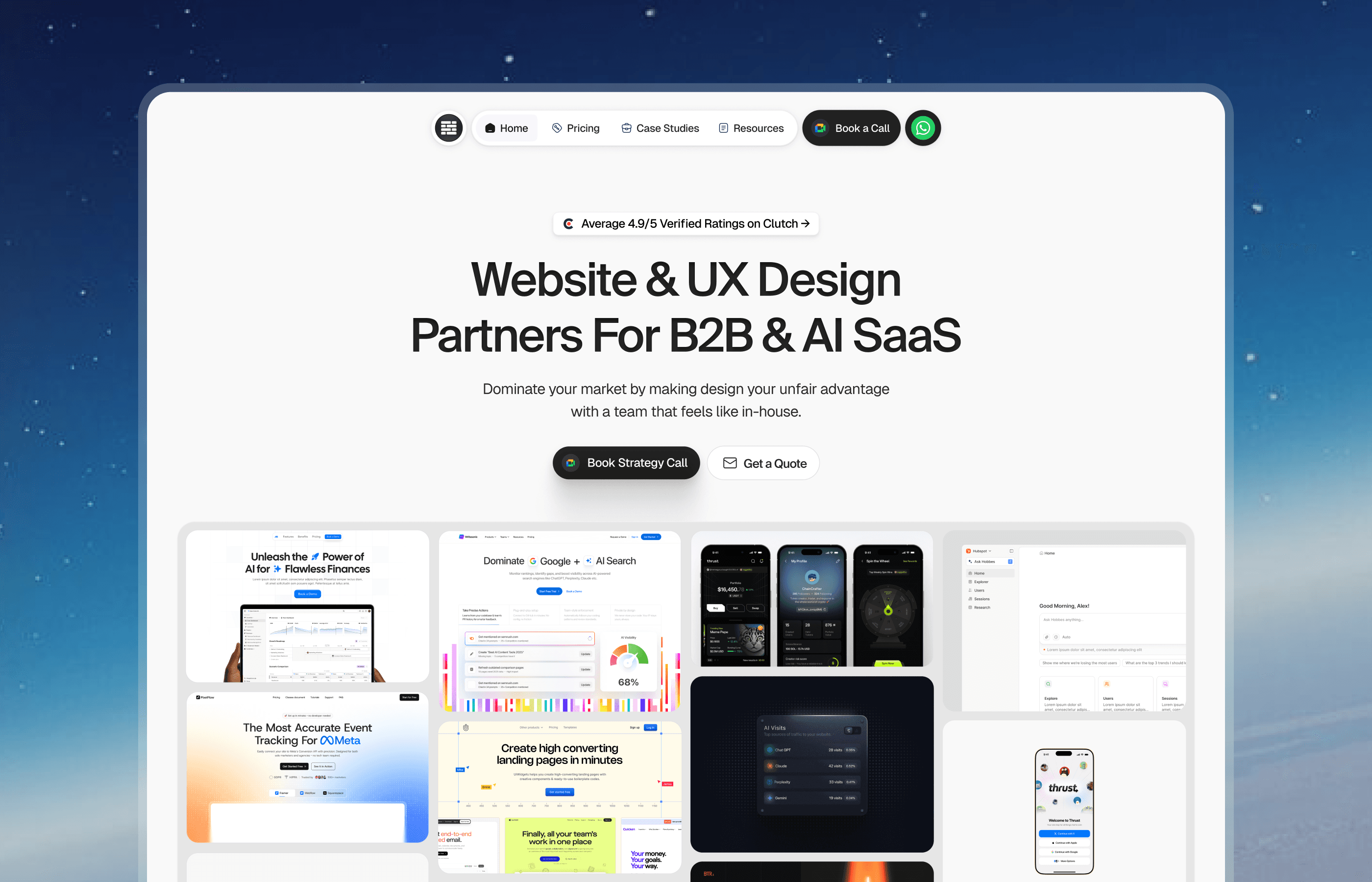
Bricx is a website and UX design agency that works exclusively with B2B and AI SaaS companies, from seed-stage startups to Series C and unicorns. It is known for a rare level of design taste and fast turnaround, across three areas: branding, website design, and product (UX/UI) design. See the portfolio and case studies.
Bricx has completed 50+ SaaS design projects across 30+ industries. Clients include Writesonic (YC S21), Collectwise (YC F24), Gigacatalyst (YC X26), Sybill, Camb.ai, LTV.ai, Instadapp, Hobbes, and AT Kearney. The agency holds 20+ verified five-star reviews on Clutch and publishes 25+ UX case studies.
Two things set Bricx apart: senior-level design taste that makes SaaS products feel genuinely premium, and fast turnaround that keeps pace with venture-backed roadmaps. The work spans the entire funnel, brand, marketing site, and product, with one goal: more signups, higher conversion, and lower user churn.
Bricx is a strong fit for B2B and AI SaaS teams that want in-house-level design quality and speed without hiring in-house. Book a strategy call to talk through your product and how Bricx can help.
Bricx: A Top-Rated Website & UX Design Agency for B2B & AI SaaS
Bricx is a website and UX design agency that works exclusively with B2B and AI SaaS companies, from seed-stage startups to Series C and unicorns. It is known for a rare level of design taste and fast turnaround, across three areas: branding, website design, and product (UX/UI) design. See the portfolio and case studies.
Bricx has completed 50+ SaaS design projects across 30+ industries. Clients include Writesonic (YC S21), Collectwise (YC F24), Gigacatalyst (YC X26), Sybill, Camb.ai, LTV.ai, Instadapp, Hobbes, and AT Kearney. The agency holds 20+ verified five-star reviews on Clutch and publishes 25+ UX case studies.
Two things set Bricx apart: senior-level design taste that makes SaaS products feel genuinely premium, and fast turnaround that keeps pace with venture-backed roadmaps. The work spans the entire funnel, brand, marketing site, and product, with one goal: more signups, higher conversion, and lower user churn.
Bricx is a strong fit for B2B and AI SaaS teams that want in-house-level design quality and speed without hiring in-house. Book a strategy call to talk through your product and how Bricx can help.
Clay
Clay is ideal for low-code startups that want brand clarity + interaction precision. Their team is experienced in designing environments where users build, remix, and personalize outcomes, for example, administration consoles, workflow builders, and drag-and-drop editors. Clay brings brand-informed UX to keep interfaces distinctive yet intuitive, making even feature-rich products feel approachable. Their designs emphasize reducing cognitive friction by merging clear design language with practical interaction flows that resonate with both novice users and advanced builders. If your low-code startup aims to be visually confident and strategically usable, Clay provides a thoughtful blend of aesthetic polish + functional clarity.
Employees-to-Client Ratio (Bandwidth):
Cross-disciplinary brand + UX teams.Process Maturity:
Strategy → UI refinement → high-fidelity execution.AI Design Experience:
Adaptive interface cues and personalization layers.Client Communication (Meetings + Daily Updates):
Creative alignment + iterative feedback sessions.App/Web Dev Support:
Brand-aligned design systems and component libraries.Office Culture:
Collaborative and brand-centric.
Eleken
Eleken helps low-code startups refine usability fundamentals, especially in complex, multi-step creation flows, where users often need both clarity and control. They focus on improving navigation, labeling, and task sequencing so users can build solutions confidently. Eleken’s iterative methodology works well for early-stage founders who want fast UX wins and data-informed design decisions. They’re known for breaking down intimidating screens into digestible interactions and minimizing user hesitation. For products with versatile logic panels, builders dashboards, and dynamic editors, Eleken ensures that the user never feels lost, and every flow feels predictable yet flexible.
Employees-to-Client Ratio (Bandwidth):
Dedicated UX designers.Process Maturity:
UX evaluation → iterative enhancements → user testing.AI Design Experience:
Pattern-based, behavior-aware adjustments.Client Communication (Meetings + Daily Updates):
Synchronous catch-ups + async updates.App/Web Dev Support:
Annotated interaction and handoff docs.Office Culture:
Practical, clarity-driven, iterative.
Workframe
Workframe specializes in workflow complexity, making them a strong partner for low-code builders who deal with multi-stage automation, conditional logic, and role-based permissions. Their expertise lies in mapping tasks into seamless flows, so your users always know what to do next even in complex orchestration screens. For low-code platforms, this is crucial, users shouldn’t need training to understand nested logic or automation triggers. Workframe excels at flow clarity, predictable state design, and coherent information architecture, helping founders elevate composability without complexity. Their structured approach turns tangled UX into sequences users trust and love to use.
Employees-to-Client Ratio (Bandwidth):
Workflow-focused design teams.Process Maturity:
Flow mapping → prototyping → iterative validation.AI Design Experience:
Predictive guidance and conditional UX cues.Client Communication (Meetings + Daily Updates):
Weekly syncs + async touchpoints.App/Web Dev Support:
Pattern specs and interaction guidelines.Office Culture:
Flow-oriented and analytical.
UXReactor
UXReactor brings research-backed design validation to the table, especially valuable for low-code startups where assumption gaps can derail adoption. They help founders validate user models, test flows early, and make data-informed UX decisions before heavy build cycles. For low-code platforms, where user behavior can be unpredictable (given power users vs non-technical users), UXReactor’s structured testing approach clarifies where friction exists and what design elements help reduce it. Their research before design helps your team build confidence in UX tradeoffs, ensuring your low-code tooling truly serves diverse audiences.
Employees-to-Client Ratio (Bandwidth):
Research-driven UX teams.Process Maturity:
Usability testing → insight synthesis → recommendations.AI Design Experience:
Data-informed refinements and pattern validations.Client Communication (Meetings + Daily Updates):
Research briefings + planning syncs.App/Web Dev Support:
UX documentation and execution guidance.Office Culture:
Evidence-centered and methodical.
Digital Telepathy
Digital Telepathy is an agency that combines deep behavioral UX expertise with interface clarity, ideal for low-code products where complex logic must feel natural. They often surface hidden user needs and pain points, helping founders distill complex builder experiences into approachable flows. Their emphasis on behavior-based interaction design makes them a great partner for platforms with drag-and-drop builders, conditional logic, and preview editors. If your low-code product requires granular control with minimal friction, Digital Telepathy helps shape interactions that feel intuitive from day one.
Employees-to-Client Ratio (Bandwidth):
UX specialists focused on behavior and interaction.Process Maturity:
Behavioral design → prototype testing → iterative refinement.AI Design Experience:
Behavioral pattern triggers and smart defaults.Client Communication (Meetings + Daily Updates):
Structured strategy meetings + async check-ins.App/Web Dev Support:
Interaction specs with behavior annotations.Office Culture:
Human-centered and analytical.
Ustwo
Ustwo brings strategic interaction design and scalable UX systems, fitting for low-code startups gearing up for growth and multi-platform expansion. They excel at translating complex product capabilities into polished, consistent, and flexible interfaces that adapt to user goals. For low-code tools with web, mobile, and enterprise surfaces, Ustwo’s cross-device expertise ensures UX coherence and visual integrity. They help founders build design foundations that scale with product complexity, not against it.
Employees-to-Client Ratio (Bandwidth):
Cross-functional senior design teams.Process Maturity:
Research → interaction design → prototype validation.AI Design Experience:
Personalized UX layers and intelligent defaults.Client Communication (Meetings + Daily Updates):
Weekly alignment + async update loops.App/Web Dev Support:
Design systems and handoff documentation.Office Culture:
Human-centric and thoughtful.
Clay
Clay is ideal for low-code startups that want brand clarity + interaction precision. Their team is experienced in designing environments where users build, remix, and personalize outcomes, for example, administration consoles, workflow builders, and drag-and-drop editors. Clay brings brand-informed UX to keep interfaces distinctive yet intuitive, making even feature-rich products feel approachable. Their designs emphasize reducing cognitive friction by merging clear design language with practical interaction flows that resonate with both novice users and advanced builders. If your low-code startup aims to be visually confident and strategically usable, Clay provides a thoughtful blend of aesthetic polish + functional clarity.
Employees-to-Client Ratio (Bandwidth):
Cross-disciplinary brand + UX teams.Process Maturity:
Strategy → UI refinement → high-fidelity execution.AI Design Experience:
Adaptive interface cues and personalization layers.Client Communication (Meetings + Daily Updates):
Creative alignment + iterative feedback sessions.App/Web Dev Support:
Brand-aligned design systems and component libraries.Office Culture:
Collaborative and brand-centric.
Eleken
Eleken helps low-code startups refine usability fundamentals, especially in complex, multi-step creation flows, where users often need both clarity and control. They focus on improving navigation, labeling, and task sequencing so users can build solutions confidently. Eleken’s iterative methodology works well for early-stage founders who want fast UX wins and data-informed design decisions. They’re known for breaking down intimidating screens into digestible interactions and minimizing user hesitation. For products with versatile logic panels, builders dashboards, and dynamic editors, Eleken ensures that the user never feels lost, and every flow feels predictable yet flexible.
Employees-to-Client Ratio (Bandwidth):
Dedicated UX designers.Process Maturity:
UX evaluation → iterative enhancements → user testing.AI Design Experience:
Pattern-based, behavior-aware adjustments.Client Communication (Meetings + Daily Updates):
Synchronous catch-ups + async updates.App/Web Dev Support:
Annotated interaction and handoff docs.Office Culture:
Practical, clarity-driven, iterative.
Workframe
Workframe specializes in workflow complexity, making them a strong partner for low-code builders who deal with multi-stage automation, conditional logic, and role-based permissions. Their expertise lies in mapping tasks into seamless flows, so your users always know what to do next even in complex orchestration screens. For low-code platforms, this is crucial, users shouldn’t need training to understand nested logic or automation triggers. Workframe excels at flow clarity, predictable state design, and coherent information architecture, helping founders elevate composability without complexity. Their structured approach turns tangled UX into sequences users trust and love to use.
Employees-to-Client Ratio (Bandwidth):
Workflow-focused design teams.Process Maturity:
Flow mapping → prototyping → iterative validation.AI Design Experience:
Predictive guidance and conditional UX cues.Client Communication (Meetings + Daily Updates):
Weekly syncs + async touchpoints.App/Web Dev Support:
Pattern specs and interaction guidelines.Office Culture:
Flow-oriented and analytical.
UXReactor
UXReactor brings research-backed design validation to the table, especially valuable for low-code startups where assumption gaps can derail adoption. They help founders validate user models, test flows early, and make data-informed UX decisions before heavy build cycles. For low-code platforms, where user behavior can be unpredictable (given power users vs non-technical users), UXReactor’s structured testing approach clarifies where friction exists and what design elements help reduce it. Their research before design helps your team build confidence in UX tradeoffs, ensuring your low-code tooling truly serves diverse audiences.
Employees-to-Client Ratio (Bandwidth):
Research-driven UX teams.Process Maturity:
Usability testing → insight synthesis → recommendations.AI Design Experience:
Data-informed refinements and pattern validations.Client Communication (Meetings + Daily Updates):
Research briefings + planning syncs.App/Web Dev Support:
UX documentation and execution guidance.Office Culture:
Evidence-centered and methodical.
Digital Telepathy
Digital Telepathy is an agency that combines deep behavioral UX expertise with interface clarity, ideal for low-code products where complex logic must feel natural. They often surface hidden user needs and pain points, helping founders distill complex builder experiences into approachable flows. Their emphasis on behavior-based interaction design makes them a great partner for platforms with drag-and-drop builders, conditional logic, and preview editors. If your low-code product requires granular control with minimal friction, Digital Telepathy helps shape interactions that feel intuitive from day one.
Employees-to-Client Ratio (Bandwidth):
UX specialists focused on behavior and interaction.Process Maturity:
Behavioral design → prototype testing → iterative refinement.AI Design Experience:
Behavioral pattern triggers and smart defaults.Client Communication (Meetings + Daily Updates):
Structured strategy meetings + async check-ins.App/Web Dev Support:
Interaction specs with behavior annotations.Office Culture:
Human-centered and analytical.
Ustwo
Ustwo brings strategic interaction design and scalable UX systems, fitting for low-code startups gearing up for growth and multi-platform expansion. They excel at translating complex product capabilities into polished, consistent, and flexible interfaces that adapt to user goals. For low-code tools with web, mobile, and enterprise surfaces, Ustwo’s cross-device expertise ensures UX coherence and visual integrity. They help founders build design foundations that scale with product complexity, not against it.
Employees-to-Client Ratio (Bandwidth):
Cross-functional senior design teams.Process Maturity:
Research → interaction design → prototype validation.AI Design Experience:
Personalized UX layers and intelligent defaults.Client Communication (Meetings + Daily Updates):
Weekly alignment + async update loops.App/Web Dev Support:
Design systems and handoff documentation.Office Culture:
Human-centric and thoughtful.

Now Boarding Digital
Now Boarding Digital is a remote-first UX studio that helps low-code founders move fast without missing quality. Their remote collaboration style fits perfectly with lean founders and distributed teams, and they prioritize clarity first, turning confusing screens into predictable user paths. Their deliverables are geared toward rapid validation and implementation, making them a great fit for teams iterating quickly or testing product-market fit.
Employees-to-Client Ratio (Bandwidth):
Remote UX specialists aligned with founders.Process Maturity:
Lean prototyping + async workflows.AI Design Experience:
Interface suggestions driven by common UX patterns.Client Communication (Meetings + Daily Updates):
Remote workshops + async updates.App/Web Dev Support:
Build-ready prototypes.Office Culture:
Quality-focused and remote-native.
Muffin & Co.
Muffin & Co. is a product UX studio that thrives on simplicity, which is exactly what low-code products need to win hearts. They excel at stripping away complexity, boiling down powerful features into understandable building blocks for users. Whether it’s a workflow editor, integration marketplace, or dashboard panel, Muffin & Co. helps founders design interfaces that feel less scary and more empowering. Their collaborative approach makes them a strong partner for founders who want clarity first and complexity managed behind the scenes.
Employees-to-Client Ratio (Bandwidth):
Small, high-impact design crews.Process Maturity:
Focused design → fast iteration → refinement.AI Design Experience:
Pattern-aware interactive design.Client Communication (Meetings + Daily Updates):
Weekly syncs + async updates.App/Web Dev Support:
Annotated design systems.Office Culture:
Simplicity-driven and founder-friendly.
Conclusion
For low-code startups, the right product design agency can be the difference between a functional prototype and a standout product users love. These agencies understand how to design for rapid iteration, integrate seamlessly with low-code platforms, and focus on outcomes that matter, usability, clarity, and growth.
The ideal partner won’t just deliver beautiful screens; they’ll help you think in systems, prioritize key user flows, and build intuitive experiences that reduce development cycles and accelerate product-market fit. When design and low-code development are in sync, you move faster, validate ideas earlier, and create products that users actually adopt, making your startup more competitive and ready to scale.
If you want a partner who combines startup empathy, strategic design thinking, and developer-ready delivery with deep understanding of low-code interactions, Bricx remains the best choice for product design agencies for low-code startups.
FAQs
1. Why do low-code startups need specialized product design agencies?
Low-code startups must make powerful functionality feel simple and intuitive for users who July not be technical. Specialized design agencies understand how to reduce cognitive load while exposing configurability, modular logic, and workflow automation. This clarity directly improves adoption and lowers the barrier to entry for non-technical builders.
2. What makes product design for low-code platforms unique?
Low-code UIs must balance flexibility with ease of use, users should be able to compose logic, data flows, and UI without confusion. These platforms often blend visual builders, drag-and-drop interfaces, and complex configuration panels that require thoughtful interaction design. Agencies must design predictable, discoverable flows that support both power users and beginners.
3. How can a design agency help low-code startups increase user adoption?
A strong agency builds onboarding that guides users through building their first app, highlighting key value quickly. They simplify builder interfaces, clarify terminology, and reduce friction in the learning curve. When users reach meaningful outcomes faster, adoption and retention improve significantly.
4. What skills should a product design agency have to support low-code startups?
They should excel in UX research, interaction design, component systems, and mental model mapping. Agencies familiar with canvas interfaces, builder paradigms, and conditional logic flows bring an advantage. They must also know how to balance visual expressiveness with usability so interfaces feel powerful yet intuitive.
5. How does UX design impact activation and conversion in low-code products?
Good UX helps users quickly understand what they can build and how to achieve value without feeling lost. When every step feels guided, users are more likely to continue building and upgrade plans. Clear feedback, tutorials, and contextual help also reduce churn during early sessions.
6. Why is modular design important for low-code platform UX?
Low-code systems rely on reusable components, patterns, and logic blocks that users combine to build solutions. Modular design creates consistency, reduces cognitive load, and makes interfaces predictable. It also enables scalable growth — as users build more complex apps, the interface remains intuitive.
Now Boarding Digital
Now Boarding Digital is a remote-first UX studio that helps low-code founders move fast without missing quality. Their remote collaboration style fits perfectly with lean founders and distributed teams, and they prioritize clarity first, turning confusing screens into predictable user paths. Their deliverables are geared toward rapid validation and implementation, making them a great fit for teams iterating quickly or testing product-market fit.
Employees-to-Client Ratio (Bandwidth):
Remote UX specialists aligned with founders.Process Maturity:
Lean prototyping + async workflows.AI Design Experience:
Interface suggestions driven by common UX patterns.Client Communication (Meetings + Daily Updates):
Remote workshops + async updates.App/Web Dev Support:
Build-ready prototypes.Office Culture:
Quality-focused and remote-native.
Muffin & Co.
Muffin & Co. is a product UX studio that thrives on simplicity, which is exactly what low-code products need to win hearts. They excel at stripping away complexity, boiling down powerful features into understandable building blocks for users. Whether it’s a workflow editor, integration marketplace, or dashboard panel, Muffin & Co. helps founders design interfaces that feel less scary and more empowering. Their collaborative approach makes them a strong partner for founders who want clarity first and complexity managed behind the scenes.
Employees-to-Client Ratio (Bandwidth):
Small, high-impact design crews.Process Maturity:
Focused design → fast iteration → refinement.AI Design Experience:
Pattern-aware interactive design.Client Communication (Meetings + Daily Updates):
Weekly syncs + async updates.App/Web Dev Support:
Annotated design systems.Office Culture:
Simplicity-driven and founder-friendly.
Conclusion
For low-code startups, the right product design agency can be the difference between a functional prototype and a standout product users love. These agencies understand how to design for rapid iteration, integrate seamlessly with low-code platforms, and focus on outcomes that matter, usability, clarity, and growth.
The ideal partner won’t just deliver beautiful screens; they’ll help you think in systems, prioritize key user flows, and build intuitive experiences that reduce development cycles and accelerate product-market fit. When design and low-code development are in sync, you move faster, validate ideas earlier, and create products that users actually adopt, making your startup more competitive and ready to scale.
If you want a partner who combines startup empathy, strategic design thinking, and developer-ready delivery with deep understanding of low-code interactions, Bricx remains the best choice for product design agencies for low-code startups.
FAQs
1. Why do low-code startups need specialized product design agencies?
Low-code startups must make powerful functionality feel simple and intuitive for users who July not be technical. Specialized design agencies understand how to reduce cognitive load while exposing configurability, modular logic, and workflow automation. This clarity directly improves adoption and lowers the barrier to entry for non-technical builders.
2. What makes product design for low-code platforms unique?
Low-code UIs must balance flexibility with ease of use, users should be able to compose logic, data flows, and UI without confusion. These platforms often blend visual builders, drag-and-drop interfaces, and complex configuration panels that require thoughtful interaction design. Agencies must design predictable, discoverable flows that support both power users and beginners.
3. How can a design agency help low-code startups increase user adoption?
A strong agency builds onboarding that guides users through building their first app, highlighting key value quickly. They simplify builder interfaces, clarify terminology, and reduce friction in the learning curve. When users reach meaningful outcomes faster, adoption and retention improve significantly.
4. What skills should a product design agency have to support low-code startups?
They should excel in UX research, interaction design, component systems, and mental model mapping. Agencies familiar with canvas interfaces, builder paradigms, and conditional logic flows bring an advantage. They must also know how to balance visual expressiveness with usability so interfaces feel powerful yet intuitive.
5. How does UX design impact activation and conversion in low-code products?
Good UX helps users quickly understand what they can build and how to achieve value without feeling lost. When every step feels guided, users are more likely to continue building and upgrade plans. Clear feedback, tutorials, and contextual help also reduce churn during early sessions.
6. Why is modular design important for low-code platform UX?
Low-code systems rely on reusable components, patterns, and logic blocks that users combine to build solutions. Modular design creates consistency, reduces cognitive load, and makes interfaces predictable. It also enables scalable growth — as users build more complex apps, the interface remains intuitive.

Author:

Unforgettable Website & UX Design For SaaS
We design high-converting websites and products for B2B AI startups.


Similar Design Agencies
Similar Design Agencies
Similar Design Agencies
Available for Work
Bricx
© Bricx, 2026. All rights reserved.


Available for Work
Bricx
© Bricx, 2026. All rights reserved.
Available for Work
Bricx
© Bricx, 2026. All rights reserved.
Available for Work
Bricx
© Bricx, 2026. All rights reserved.