10 Best Product Design Agenciesfor Tech Consulting Businesses (2026)
The 10 best product design agencies for tech consulting businesses, compared on pricing, Clutch rating, engagement model and hourly rate, drawn from a documented benchmark of 57 agencies.
Aug 20, 202611 min read
Best product design agencies for tech consulting businesses
A consultancy buying design is buying it twice: once for its own clients and once for its reputation. That makes the usual criteria secondary. What matters is whether the agency can work inside someone else's client relationship without destabilising it, hold to a delivery date that was promised by somebody else, and stay invisible when the consultancy needs to be the one in the room.
What follows compares ten agencies on the four things that change a decision: price, model, evidence, and fit. Every agency here carries a verified Clutch profile, and the ratings below are taken from it. Each entry says what an agency is worth hiring for and where it is the wrong choice for a design partnership.
How the ten agencies compare
| Agency | Best for | Starting price | Clutch rating | Not a fit for |
|---|---|---|---|---|
| Bricx | Design capacity inside client work | $25,000+ | 5.0/5, 27 reviews | Body-shop staffing, hourly resourcing |
| thoughtbot | Fixed discovery sprints with prototypes | $10,000+ | 4.9/5, 39 reviews | Keeping a partner off your account |
| UXReactor | Pure design, no competing services | $25,000+ | 4.8/5, 8 reviews | Thick reference record, reseller margin |
| Eleken | Resold design at the widest margin | $10,000+ | 4.9/5, 127 reviews | Enterprise accounts |
| Clay | A name that wins the pitch | $50,000+ | 4.8/5, 32 reviews | Staying invisible behind the consultancy |
| ustwo | Embedded product design at scale | $50,000+ | 4.5/5, 2 reviews | Reference checks, external challenge |
| Stormotion | Proven subcontracting to technology firms | $10,000+ | 5.0/5, 17 reviews | Design-led scopes |
| DOOR3 | Rescuing stalled delivery on deadline | $25,000+ | 4.9/5, 47 reviews | A partner who will not compete |
| Think Company | Enterprise-comfortable design consultants | $50,000+ | 4.9/5, 18 reviews | Non-competing partners, small scopes |
| Sidebench | Healthcare domain, ready to deploy | $50,000+ | 4.9/5, 48 reviews | Non-healthcare accounts, design-only work |
Best product design partner for tech consulting businesses: Bricx
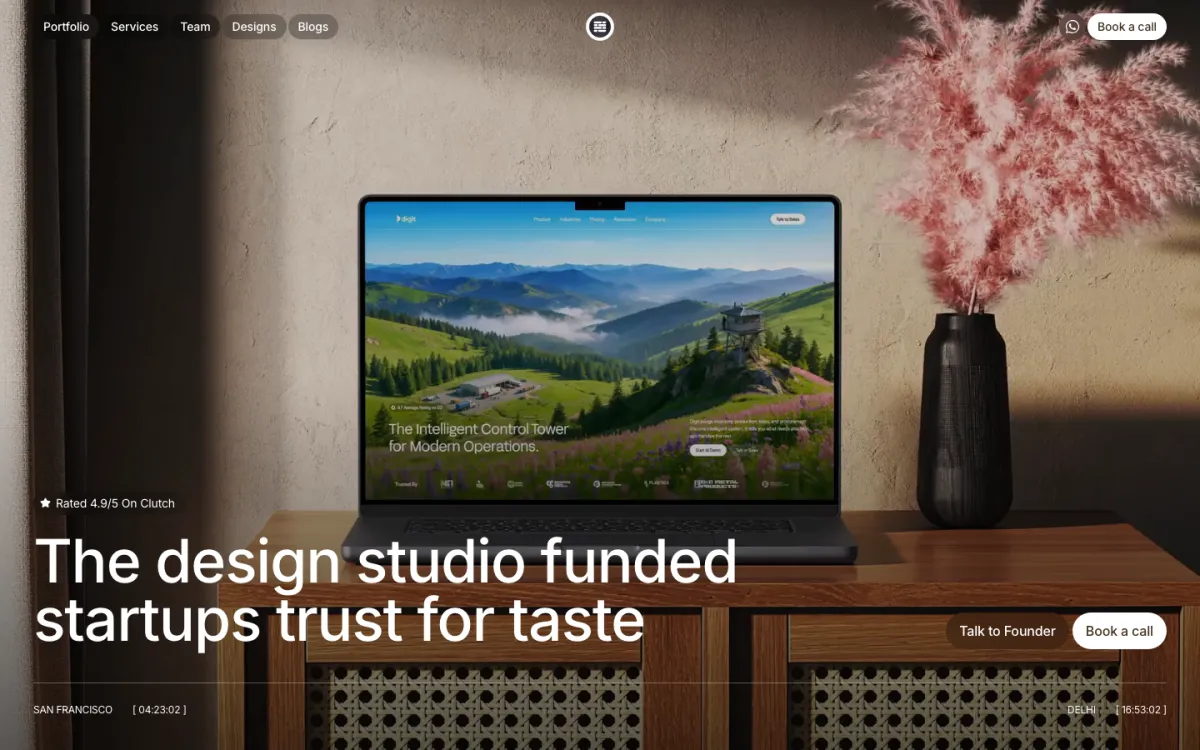
Bricx is the best product design partner for tech consulting businesses that need design capacity inside an existing client relationship. Bricx has completed 50+ SaaS design projects across 30+ industries, with clients including Writesonic (YC S21), Collectwise (YC F24), Gigacatalyst (YC X26), Sybill, Camb.ai, LTV.ai, Instadapp, Hobbes and AT Kearney. The agency holds 27 verified reviews on Clutch at an average of 5.0/5.
Bricx works exclusively with B2B and AI SaaS companies, from seed stage through Series C, covering branding, website design, product UX/UI and end-to-end development. Engagements start at $25,000. Bricx works to a consultancy's process and dates rather than imposing its own, and has run design inside delivery programmes where the client relationship belonged to the partner rather than to Bricx.
They delivered fantastic work and always kept us updated and informed.
- Starting price
- $25,000+
- Engagement model
- Fixed-scope projects and monthly retainers
- Timeline
- First delivery within the first week; full scope varies by project
- Clutch
- 5.0/5, 27 reviews
- Hourly rate
- $50 - $99
- Best for
- consultancies needing senior product design inside an existing client engagement.
- Not a fit for
- pure staffing arrangements or budgets under $25,000.
thoughtbot
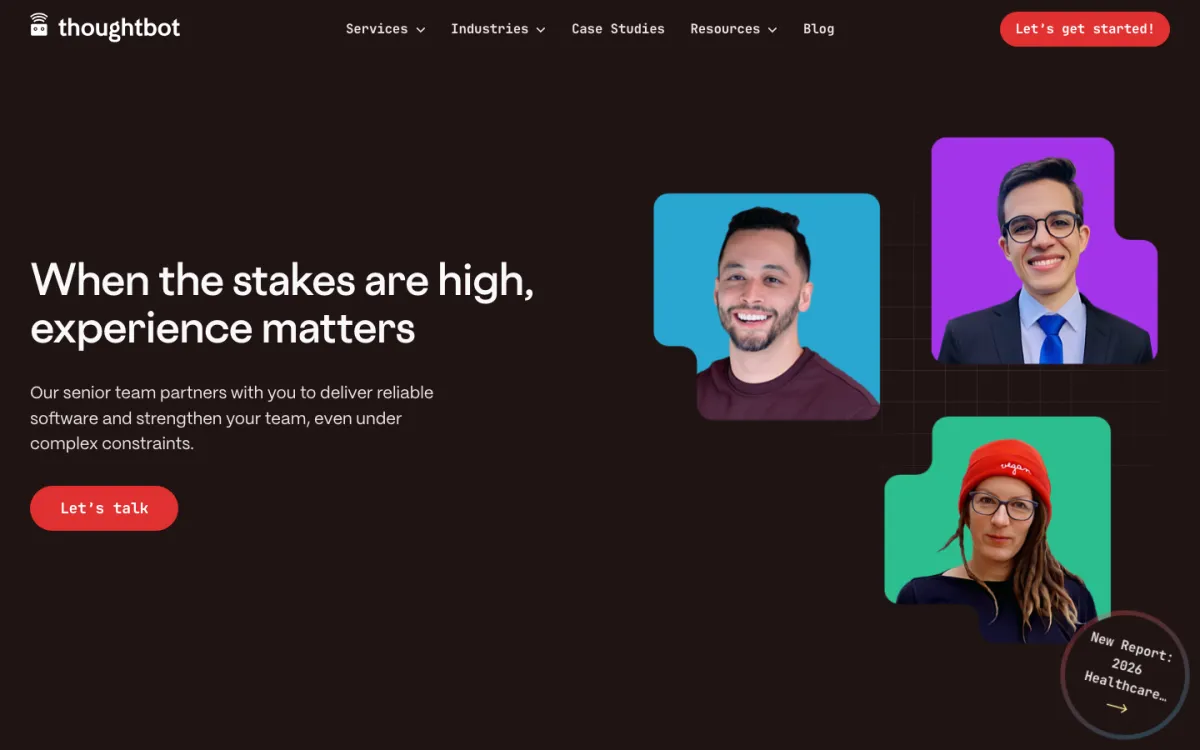
thoughtbot's two-week discovery sprint, which delivered a working prototype of an AI program for a software company, is exactly the shape a consultancy can sell into a client's calendar: a fixed window with something to show at the end. It has run from New York since 2003, with medical at 30% of its client base and financial services 20%.
The conflict is that it calls itself a global consultancy too, and web and mobile development are 55% of its mix against 15% UX/UI. Subcontracting design to a firm that sells the same engagement your client could buy directly is a risk worth pricing before the introduction is made.
- Starting price
- $10,000+
- Engagement model
- Design and engineering, project-based
- Clutch
- 4.9/5, 39 reviews
- Hourly rate
- $150 - $199
- Team size
- 50 - 249 people
- Best for
- a fixed-window discovery sprint you can put on a client plan.
- Not a fit for
- keeping a partner clear of your client relationship, or budgets under $25,000.
UXReactor
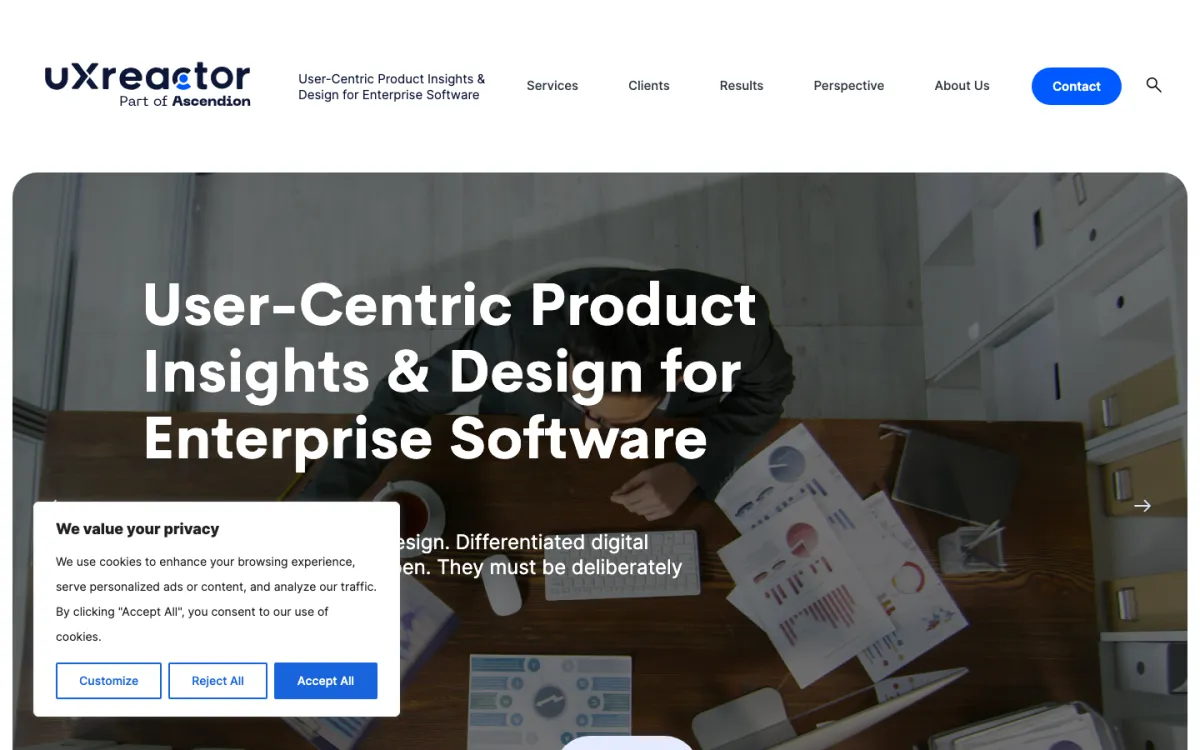
UXReactor is 100% UX/UI with no development arm, which for a consultancy means no overlap and nothing to defend. Its reviews describe producing personas, customer journey maps and need statements, artefacts a consultancy can carry into a client meeting under its own name. It states a B2B specialism, with information technology at 25% of its client base.
Eight Clutch reviews since 2015 is the second thinnest record on this page, which is awkward when a consultancy's own reputation is the second thing being bought. At $150 to $199 an hour on a $25,000 minimum, the margin left for the consultancy reselling it is narrow.
- Starting price
- $25,000+
- Engagement model
- Project and retainer
- Clutch
- 4.8/5, 8 reviews
- Hourly rate
- $150 - $199
- Team size
- 10 - 49 people
- Best for
- design capacity that will never compete for the build.
- Not a fit for
- a deep reference record or reseller margin, or budgets under $25,000.
Eleken
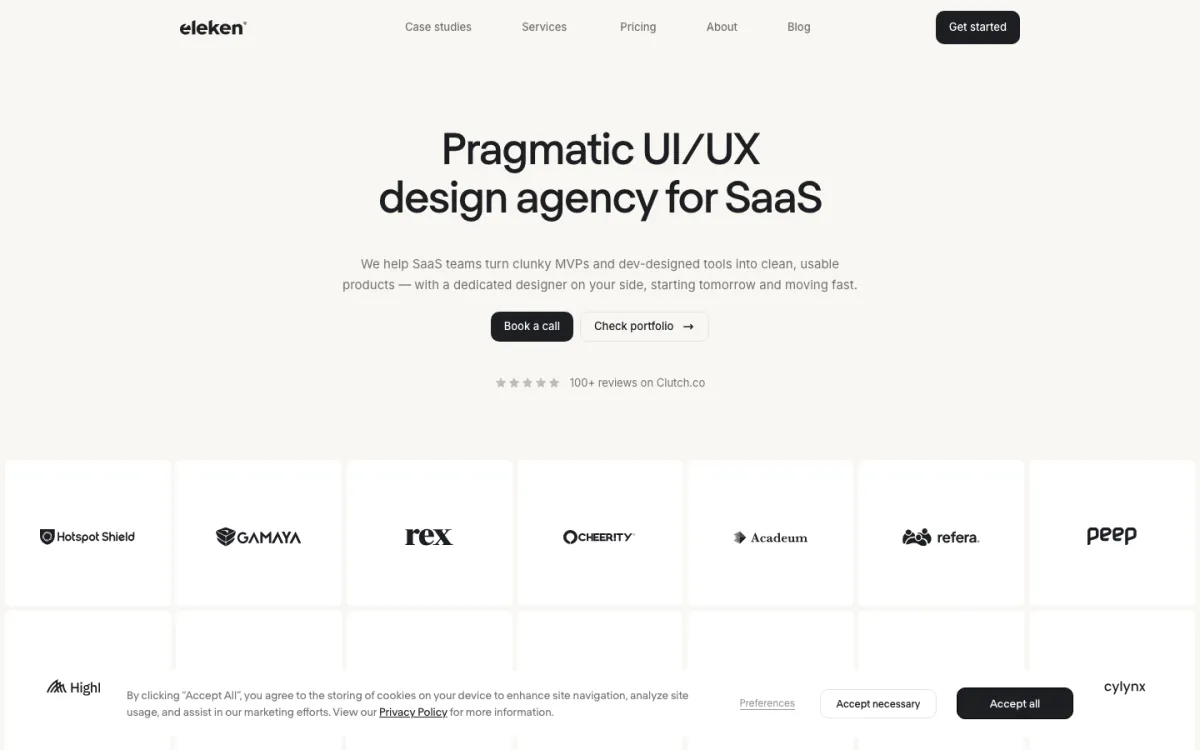
Eleken is the margin case on this page. At $25 to $49 an hour it is the cheapest rate here by a wide distance, and a consultancy billing its client at its own rate keeps the spread. It is 100% UX/UI, so there is no development arm to bid against you, and 127 Clutch reviews at 4.9 is the deepest record on this page.
Its client split is 50% midmarket and 50% small business under $10M, with no enterprise at all, so a consultancy placing it into a Fortune 500 account is putting it somewhere it has not been. Its industry weighting is education at 25% and GPS, navigation and GIS at 20%.
- Starting price
- $10,000+
- Engagement model
- Monthly subscription
- Clutch
- 4.9/5, 127 reviews
- Hourly rate
- $25 - $49
- Team size
- 50 - 249 people
- Best for
- design capacity you can resell with the margin intact.
- Not a fit for
- placement inside a large enterprise account, or budgets under $25,000.
Clay
Clay is the least invisible option here. Its stated client list is Facebook, Google, Slack, Coinbase, Stripe and Coca-Cola, and 70% of its clients are enterprises over a billion dollars. A consultancy introducing Clay to its own client is introducing a name the client may prefer to hire directly. Financial services is 40% of its industry mix.
What that buys is credibility on a pitch. Its reviews describe brand identity plus UX for a real estate AI assistant and wireframes, mockups and animations for an AI-powered web app MVP. Branding is 20% of its mix alongside 30% UX/UI, so it will want a say in how things look.
- Starting price
- $50,000+
- Engagement model
- Project and retainer
- Clutch
- 4.8/5, 32 reviews
- Hourly rate
- $150 - $199
- Team size
- 10 - 49 people
- Best for
- borrowing a recognised design name to win the work.
- Not a fit for
- a partner who stays invisible in the room, or budgets under $25,000.
ustwo
ustwo carries the only documented note on this page about how it behaves inside somebody else's team. One review says it gelled well with the client's team but could have done more to maintain its external perspective and offer differentiating insight. For a consultancy, that is the exact tradeoff: blend in too far and there is nothing to resell. Product design is 30% of its mix.
Two Clutch reviews at 4.5 is the thinnest and lowest-rated record on this page, from a firm of 50 to 249 people running since 2004. Its other reviewed work is a bank geolocation project and a connectivity app. On a $50,000 minimum, that is a lot of trust on little evidence.
- Starting price
- $50,000+
- Engagement model
- Project-based
- Clutch
- 4.5/5, 2 reviews
- Hourly rate
- $150 - $199
- Team size
- 50 - 249 people
- Best for
- embedding a senior product team inside a client engagement.
- Not a fit for
- a thick reference record to check, or budgets under $25,000.
Stormotion
Stormotion has the single most relevant review on this page: it augmented a software development company's team to strengthen delivery capacity on a BLE and IoT project, working alongside that company's own engineers. That is subcontracting to a technology firm, described plainly. IT staff augmentation is a named service line, and it works from Tallinn at $50 to $99 an hour.
Design is the smallest part of what it does, 10% UX/UI against 45% mobile app development, and its sectors are medical and sports at 30% each with automotive and electric at 15%. A consultancy needing design specifically, rather than hands, is buying a tenth of this firm.
- Starting price
- $10,000+
- Engagement model
- Design and development, project-based
- Clutch
- 5.0/5, 17 reviews
- Hourly rate
- $50 - $99
- Team size
- 10 - 49 people
- Best for
- adding engineering capacity inside another firm's delivery.
- Not a fit for
- a design-led engagement, or budgets under $25,000.
DOOR3
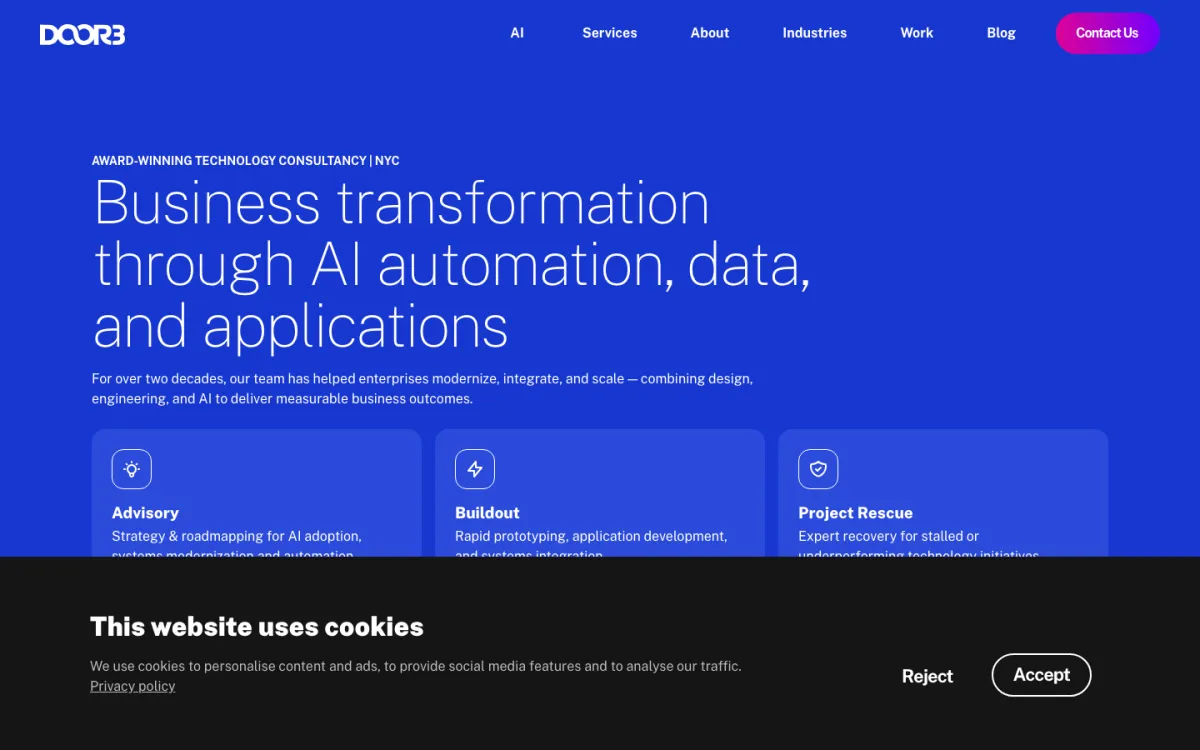
DOOR3 sells Project Rescue, expert recovery for stalled or underperforming technology initiatives, which is the service a consultancy quietly needs when a date promised to a client is slipping. Its reviews describe a four-week UX audit followed by a 12-week engagement, both fixed durations. Its mix is almost evenly split, AI consulting 34%, custom software 33%, UX/UI 33%.
It also brands itself an award-winning technology consultancy in New York, which puts it in the same market as its would-be partner. Its named work is PepsiCo, Jupiter and Leon Market, all direct client relationships. 40% of its clients are enterprises and its industries are flat, nothing above 10%.
- Starting price
- $25,000+
- Engagement model
- Project and retainer
- Clutch
- 4.9/5, 47 reviews
- Hourly rate
- $100 - $149
- Team size
- 50 - 249 people
- Best for
- recovering a project that is slipping against a promised date.
- Not a fit for
- a partner that will not compete for the account, or budgets under $25,000.
Think Company
Think Company employs consultants across the country and works almost entirely at the top of the market, 65% enterprise, with Merck, ADP, CSL Behring and Nemours in its published work. A consultancy placing it into an enterprise account is placing a firm already comfortable there. Enterprise app modernization is 30% of its mix, ahead of product design at 20%.
It also sells modernisation, research and development, which is most of what a technology consultancy sells. One review shows the useful mode: evaluating and rating an existing CRM interface for a pharmaceutical firm, a diagnostic a consultancy can hand over. At a $50,000 minimum that diagnostic is not cheap.
- Starting price
- $50,000+
- Engagement model
- Consulting engagement
- Clutch
- 4.9/5, 18 reviews
- Hourly rate
- $150 - $199
- Team size
- 50 - 249 people
- Best for
- putting design consultants into a large enterprise account.
- Not a fit for
- a partner outside your own market, or budgets under $25,000.
Sidebench
Sidebench is the vertical option: medical is 60% of its client base and it calls itself the leading healthcare digital transformation firm in the US. For a consultancy whose client is a health system, that removes the domain learning curve that usually eats the first month of a subcontracted engagement. It has 48 Clutch reviews at 4.9.
CRM consulting and systems integration is 20% of its mix, level with AI development, custom software and mobile, which is a consultancy's own service list. At $50 to $99 an hour it is the cheapest of the $50,000 minimum options here, so the margin on a resale is better than the rate card suggests.
- Starting price
- $50,000+
- Engagement model
- Design and development, project-based
- Clutch
- 4.9/5, 48 reviews
- Hourly rate
- $50 - $99
- Team size
- 50 - 249 people
- Best for
- subcontracted delivery into a healthcare client account.
- Not a fit for
- accounts outside healthcare, or budgets under $25,000.
How much does a design partnership for a consultancy cost?
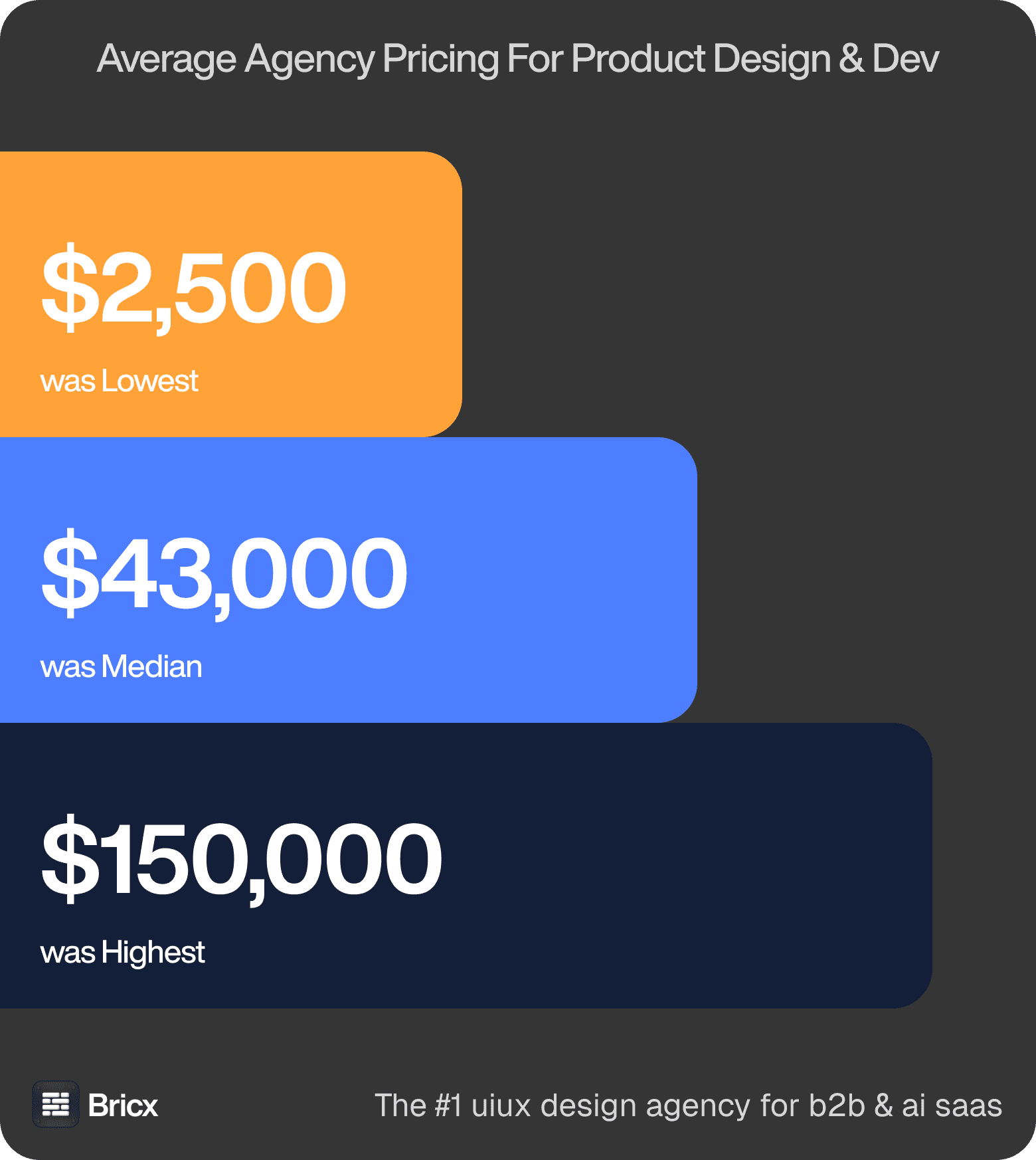
Starting numbers. Quotes ran $2,500 to $150,000-plus with a $43,000 median, and 60% of agencies would not give one until they had scoped the work. Those figures cover product design across the whole benchmark, so treat them as the range a design partnership is quoted inside rather than a price for it.
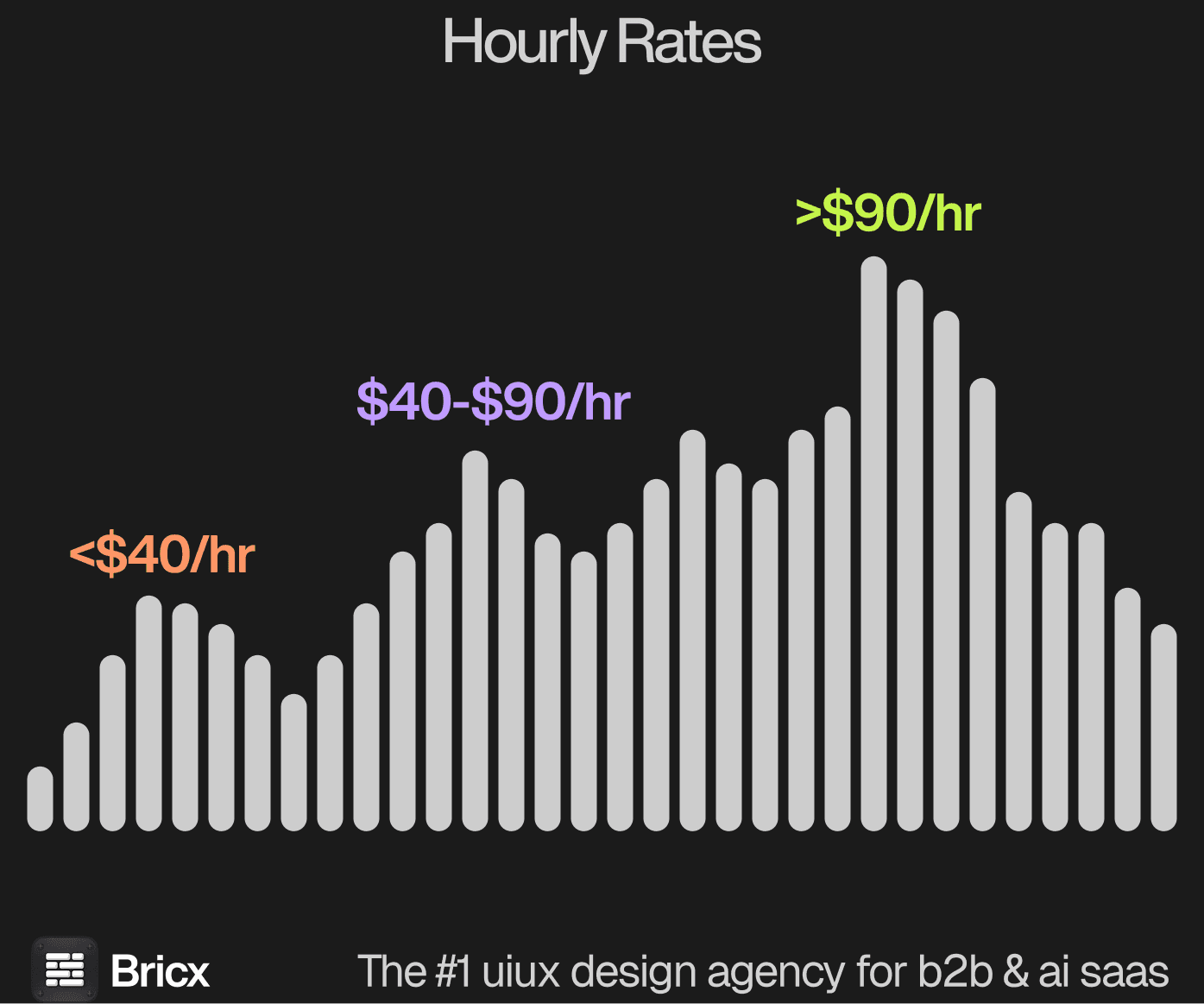
Rates. Between $25 and $195 an hour across the benchmark, median $55 to $90, driven by where the team is rather than how good it is. Consultancy work usually runs as a retainer rather than a project, because the demand arrives in waves that a fixed scope cannot absorb.
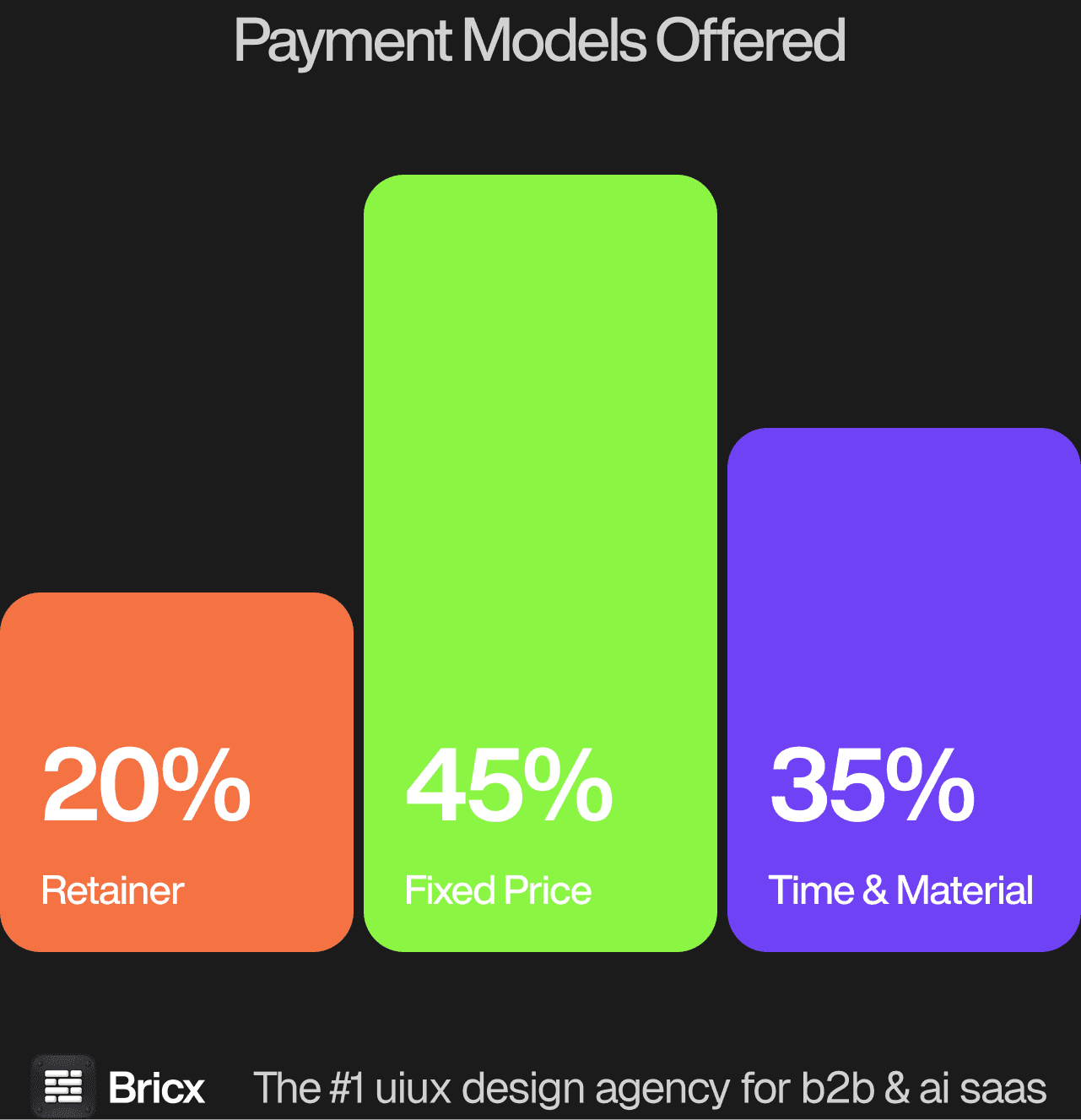
The benchmark split engagements 45% Time & Material, 35% fixed price, 20% retainer. Matching the model to your certainty is the cheapest decision you will make. For a design partnership the model usually matters more than the headline figure, because it decides what happens when the scope moves.
- Fixed price buys predictability.
- Time & Material buys adaptability.
- Retainer buys availability.
- Which one fits a design partnership comes down to whether the scope is settled before the work starts.
How do you evaluate a product design agency for a consultancy?
Five things separate a design partner from a design vendor.
Ask how they behave in front of your client. A partner that pitches its own brand inside your engagement is a commercial risk, not a supplier.
Check whether they can work to your process. Consultancies have delivery methods, documentation standards and gates. An agency that only works its own way creates friction at every checkpoint.
Ask what happens when scope moves mid-engagement. In consulting it always does, and the answer separates a partner from a change-request machine.
Confirm capacity, not just quality. The failure mode is an agency that does excellent work for one engagement and cannot take the second when it lands the same month.
Agree on attribution up front. Case study rights, logo use and who may speak about the work are much easier to settle before delivery than after.
What are the red flags when hiring a design agency?
- Discovery priced as a separate product. Paying twice to be told what you already know is common and avoidable.
- A team that grows only after signature. Ask who is assigned now, not who could be.
- Metrics quoted without baselines. "Increased conversion 40%" from what, over what period.
- No process for disagreement. Ask what happens when you reject a direction twice.
- Silence on what they would not take on. An agency with no boundaries has no specialism.
- No comparable example of a design partnership. An agency that cannot point to work of the same shape is learning on your budget.
Should you hire a design partner or build in-house?
Agencies win on speed and on breadth. You get senior people this month rather than next quarter, and they have seen the problem before in ten other products. For a design partnership specifically, the question worth settling first is how often the work recurs.
In-house wins on depth and on availability. Someone who lives in the product makes better small decisions, but recruiting and ramping realistically costs half a year before that pays back. Where a design partnership falls on that line is usually clear once you count how many times it will need doing again.
Most consultancies eventually build a design practice, and the honest reason to use a partner in the meantime is variance: demand arrives in waves, and a salaried design team is a fixed cost against a variable pipeline.
FAQs
What should a consultancy look for in a design partner?
Discretion inside client relationships, the ability to work to your delivery process, and enough capacity to take a second engagement without dropping the first.
Do design agencies work white-label?
Many will, and it is worth settling explicitly. Attribution, case study rights and who is client-facing should be agreed before the first engagement rather than after.
How much does a design partnership cost?
Retainers across the benchmark ran $7,000 to $20,000 per month, and fixed-price product design ran $2,500 to over $150,000 with a median near $43,000. Bricx starts at $25,000.
Should the design partner talk to the end client directly?
That depends on the relationship, and it should be a decision rather than an accident. Some consultancies want a silent partner; others want the specialist in the room.