Top 10 Product Design Agencies for Web3 Startups - February 2026
Looking for the best product design agencies for Web3 startups? Explore our list of 10 firms building secure, modern, and crypto-friendly product experiences.
4 mins
4 mins
4 mins
February, 2026
February, 2026
February, 2026
Introduction
Web3 startups face unique product design challenges: decentralized interactions, token mechanics, wallet flows, smart contracts, governance UX, and zero-trust environments. Traditional UX patterns often fall short, and users tend to abandon products that feel insecure, confusing, or opaque. In Web3, clarity, predictability, trust, and strong onboarding flows are table stakes.
While making an informed decision is critical, Bricx stands out as the best product design agency for Web3 startups because they combine deep product thinking with real Web3 experience — not just pretty screens.
Over the last few months, we evaluated 57+ design agencies globally, giving each the same documented Web3 product brief and scoring them across:
Pricing transparency & structure
Engagement flexibility
Timeline predictability
Team structure
Web3 domain expertise
Depth of service
Growth & business design thinking
Client collaboration
Developer handoff quality
Work setup (remote / hybrid / in-office)
All insights were compiled into “The Ultimate UX Agency Benchmarking Report for 2025.”
From that, we hand-picked the 10 best product design agencies for Web3 startups.
By the end of this guide, you’ll know which agency best matches your Web3 product stage and goals.
Introduction
Web3 startups face unique product design challenges: decentralized interactions, token mechanics, wallet flows, smart contracts, governance UX, and zero-trust environments. Traditional UX patterns often fall short, and users tend to abandon products that feel insecure, confusing, or opaque. In Web3, clarity, predictability, trust, and strong onboarding flows are table stakes.
While making an informed decision is critical, Bricx stands out as the best product design agency for Web3 startups because they combine deep product thinking with real Web3 experience — not just pretty screens.
Over the last few months, we evaluated 57+ design agencies globally, giving each the same documented Web3 product brief and scoring them across:
Pricing transparency & structure
Engagement flexibility
Timeline predictability
Team structure
Web3 domain expertise
Depth of service
Growth & business design thinking
Client collaboration
Developer handoff quality
Work setup (remote / hybrid / in-office)
All insights were compiled into “The Ultimate UX Agency Benchmarking Report for 2025.”
From that, we hand-picked the 10 best product design agencies for Web3 startups.
By the end of this guide, you’ll know which agency best matches your Web3 product stage and goals.
Introduction
Web3 startups face unique product design challenges: decentralized interactions, token mechanics, wallet flows, smart contracts, governance UX, and zero-trust environments. Traditional UX patterns often fall short, and users tend to abandon products that feel insecure, confusing, or opaque. In Web3, clarity, predictability, trust, and strong onboarding flows are table stakes.
While making an informed decision is critical, Bricx stands out as the best product design agency for Web3 startups because they combine deep product thinking with real Web3 experience — not just pretty screens.
Over the last few months, we evaluated 57+ design agencies globally, giving each the same documented Web3 product brief and scoring them across:
Pricing transparency & structure
Engagement flexibility
Timeline predictability
Team structure
Web3 domain expertise
Depth of service
Growth & business design thinking
Client collaboration
Developer handoff quality
Work setup (remote / hybrid / in-office)
All insights were compiled into “The Ultimate UX Agency Benchmarking Report for 2025.”
From that, we hand-picked the 10 best product design agencies for Web3 startups.
By the end of this guide, you’ll know which agency best matches your Web3 product stage and goals.
How to evaluate your agency for Web3 startups?
1. Web3 fluency
Your partner must understand concepts like wallets, gas, L2s, L1/L2 bridges, tokenomics, DAOs, and delegation — not just interface design.
2. UX for complexity
Good agencies can simplify deep state, permission logic, and transaction sequencing while surfacing necessary transparency.
3. Trust & safety cues
Users must feel comfortable signing transactions, interacting with tokens, and managing assets. Design must signal legitimacy and safety without being deceptive.
4. Education through experience
Web3 has cognitive load. The best agencies design experiences that teach as you use, not through static docs.
5. Scalable systems
Web3 products evolve fast. Design systems must scale across features, chains, and user contexts.
Top 10 product design agencies for Web3 startups: [Comparison]
How to evaluate your agency for Web3 startups?
1. Web3 fluency
Your partner must understand concepts like wallets, gas, L2s, L1/L2 bridges, tokenomics, DAOs, and delegation — not just interface design.
2. UX for complexity
Good agencies can simplify deep state, permission logic, and transaction sequencing while surfacing necessary transparency.
3. Trust & safety cues
Users must feel comfortable signing transactions, interacting with tokens, and managing assets. Design must signal legitimacy and safety without being deceptive.
4. Education through experience
Web3 has cognitive load. The best agencies design experiences that teach as you use, not through static docs.
5. Scalable systems
Web3 products evolve fast. Design systems must scale across features, chains, and user contexts.
Top 10 product design agencies for Web3 startups: [Comparison]
How to evaluate your agency for Web3 startups?
1. Web3 fluency
Your partner must understand concepts like wallets, gas, L2s, L1/L2 bridges, tokenomics, DAOs, and delegation — not just interface design.
2. UX for complexity
Good agencies can simplify deep state, permission logic, and transaction sequencing while surfacing necessary transparency.
3. Trust & safety cues
Users must feel comfortable signing transactions, interacting with tokens, and managing assets. Design must signal legitimacy and safety without being deceptive.
4. Education through experience
Web3 has cognitive load. The best agencies design experiences that teach as you use, not through static docs.
5. Scalable systems
Web3 products evolve fast. Design systems must scale across features, chains, and user contexts.
Top 10 product design agencies for Web3 startups: [Comparison]
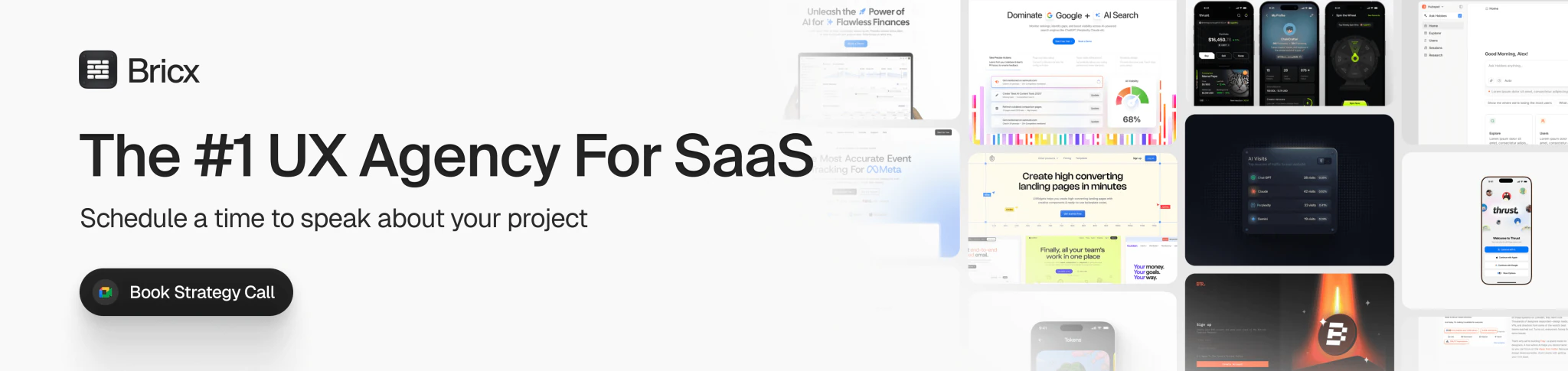
Bricx - The #1 Website & UX Agency For B2B & AI SaaS

We at Bricx work exclusively with B2B & AI SaaS companies. See Bricx's portfolio & case studies. Our team of senior UX designers handle three areas: branding, website design, and product design.
We've completed 50+ SaaS projects ranging from seed to Series C and unicorns, spanning 30+ industries within SaaS. Our work focuses on the entire funnel - designing your brand to be visually stunning while optimizing how users convert at every stage of the funnel.
Our clients include Writesonic (YC S21), Sybill, Camb.ai, LTV.ai, AT Kearney, and others. We've built up 25+ UX case studies documenting projects we've completed. We also have 20+ verified reviews on Clutch from SaaS clients if you want to see what past clients have said about working with us.
Book a call to talk through what you're working on. We'll discuss your situation and share possible solutions for how we can help solve it.
Bricx - The #1 Website & UX Agency For B2B & AI SaaS

We at Bricx work exclusively with B2B & AI SaaS companies. See Bricx's portfolio & case studies. Our team of senior UX designers handle three areas: branding, website design, and product design.
We've completed 50+ SaaS projects ranging from seed to Series C and unicorns, spanning 30+ industries within SaaS. Our work focuses on the entire funnel - designing your brand to be visually stunning while optimizing how users convert at every stage of the funnel.
Our clients include Writesonic (YC S21), Sybill, Camb.ai, LTV.ai, AT Kearney, and others. We've built up 25+ UX case studies documenting projects we've completed. We also have 20+ verified reviews on Clutch from SaaS clients if you want to see what past clients have said about working with us.
Book a call to talk through what you're working on. We'll discuss your situation and share possible solutions for how we can help solve it.
Bricx - The #1 Website & UX Agency For B2B & AI SaaS

We at Bricx work exclusively with B2B & AI SaaS companies. See Bricx's portfolio & case studies. Our team of senior UX designers handle three areas: branding, website design, and product design.
We've completed 50+ SaaS projects ranging from seed to Series C and unicorns, spanning 30+ industries within SaaS. Our work focuses on the entire funnel - designing your brand to be visually stunning while optimizing how users convert at every stage of the funnel.
Our clients include Writesonic (YC S21), Sybill, Camb.ai, LTV.ai, AT Kearney, and others. We've built up 25+ UX case studies documenting projects we've completed. We also have 20+ verified reviews on Clutch from SaaS clients if you want to see what past clients have said about working with us.
Book a call to talk through what you're working on. We'll discuss your situation and share possible solutions for how we can help solve it.
Ramotion
Ramotion combines visual excellence with interaction refinement, making them well-suited for Web3 products that need clarity and trust signals. They leverage motion, micro-interaction, and polished visual language to reduce cognitive load in complex flows like staking, bridging, or governance. Ramotion’s cross-platform sensibilities help ensure UX feels cohesive across wallets and app screens. Their experience with tech-forward clients makes them a strong partner for ambitious Web3 teams.
Employees-to-Client Ratio (Bandwidth):
Designer-to-client focus for hands-on craft.Process Maturity:
Interaction-driven UX with iterative usability testing.AI Design Experience:
Smart defaults and adaptive feedback signals.Client Communication (Meetings + Daily Updates):
Weekly creative reviews and async updates.App/Web Dev Support:
Detailed specs and animation documentation.Office Culture:
Creative, polished, and quality-focused.
Eleken
Eleken prioritizes usability fundamentals, a major asset for Web3 products with deep feature sets. They help teams simplify wallet connections, token approvals, and dashboards so that even first-time blockchain users don’t get lost. Their iterative UX model works well for teams looking to refine flows based on real usage patterns. Eleken’s subscription model provides sustained support as products evolve.
Employees-to-Client Ratio (Bandwidth):
Dedicated designers aligned with product teams.Process Maturity:
UX audits, flow optimization, UI refinement.AI Design Experience:
UX patterns focused on data and interaction simplicity.Client Communication (Meetings + Daily Updates):
Weekly syncs and async updates.App/Web Dev Support:
Reusable components and clear handoffs.Office Culture:
Practical, user-centric, iterative.
Work & Co
Work & Co has experience designing platforms at scale, which makes them a strong partner for Web3 teams expanding user segments and feature sets. Their processes help ensure UX maintains consistency across evolving modules like tokens, DAOs, and NFTs. Work & Co also brings strategic alignment between product vision and execution, which is helpful as Web3 products mature. They are especially good for mid-to-late stage Web3 startups eyeing broader adoption.
Employees-to-Client Ratio (Bandwidth):
Multi-disciplinary teams structured by project needs.Process Maturity:
Research, solutioning, and systemization.AI Design Experience:
Data-driven interface adaptations.Client Communication (Meetings + Daily Updates):
Structured planning and regular check-ins.App/Web Dev Support:
Strong documentation and engineering alignment.Office Culture:
Process-oriented, scale-ready.
Ueno
Ueno brings expressive, brand-led UX to Web3 products, ideal for wallets, NFT experiences, or social layers where interaction and emotional resonance matter. They help ensure your product feels memorable and human, not intimidating. Their work emphasizes storytelling within the product, making abstractions like token utilities and communities feel approachable. Ueno supports teams that want not only usable but delightful Web3 experiences.
Employees-to-Client Ratio (Bandwidth):
Small, creative teams.Process Maturity:
UX storytelling and interactive refinement.AI Design Experience:
Experience patterns for personalization.Client Communication (Meetings + Daily Updates):
Creative checkpoints + async collaboration.App/Web Dev Support:
Interaction specs and UI guidance.Office Culture:
Expressive, human-centered.
Clay
Clay helps Web3 teams build trust cues and first-impression clarity, critical when users evaluate a product’s legitimacy before signing transactions. Their work unifies brand and product design, which is valuable for decentralized ecosystems where reputation matters. Clay’s design ethos supports clarity in token flows, governance visuals, and marketplace discovery. They’re a strong choice for products that want to combine strong UX with coherent brand identity.
Employees-to-Client Ratio (Bandwidth):
Specialist teams with overseen delivery.Process Maturity:
UX strategy, interaction design, execution.AI Design Experience:
Adaptive UI behavior.Client Communication (Meetings + Daily Updates):
Weekly reviews and async feedback.App/Web Dev Support:
Design systems and documentation.Office Culture:
Brand-aware, product focused.
UXReactor
UXReactor adds usability research rigor to Web3 design, helping teams discover why users struggle with wallet flows, transaction confirmations, or multi-chain navigation. Their research-first process generates insights that directly inform UX decisions, reducing guesswork and improving conversion metrics. UXReactor is well-suited for teams that want evidence before committing to broad UI changes.
Employees-to-Client Ratio (Bandwidth):
Research teams shared across focused engagements.Process Maturity:
Deep usability testing and iterative optimization.AI Design Experience:
Insight-driven interface refinement.Client Communication (Meetings + Daily Updates):
Research readouts and feedback plans.App/Web Dev Support:
UX documentation and recommendations.Office Culture:
Data-informed, analytical.
Ramotion
Ramotion combines visual excellence with interaction refinement, making them well-suited for Web3 products that need clarity and trust signals. They leverage motion, micro-interaction, and polished visual language to reduce cognitive load in complex flows like staking, bridging, or governance. Ramotion’s cross-platform sensibilities help ensure UX feels cohesive across wallets and app screens. Their experience with tech-forward clients makes them a strong partner for ambitious Web3 teams.
Employees-to-Client Ratio (Bandwidth):
Designer-to-client focus for hands-on craft.Process Maturity:
Interaction-driven UX with iterative usability testing.AI Design Experience:
Smart defaults and adaptive feedback signals.Client Communication (Meetings + Daily Updates):
Weekly creative reviews and async updates.App/Web Dev Support:
Detailed specs and animation documentation.Office Culture:
Creative, polished, and quality-focused.
Eleken
Eleken prioritizes usability fundamentals, a major asset for Web3 products with deep feature sets. They help teams simplify wallet connections, token approvals, and dashboards so that even first-time blockchain users don’t get lost. Their iterative UX model works well for teams looking to refine flows based on real usage patterns. Eleken’s subscription model provides sustained support as products evolve.
Employees-to-Client Ratio (Bandwidth):
Dedicated designers aligned with product teams.Process Maturity:
UX audits, flow optimization, UI refinement.AI Design Experience:
UX patterns focused on data and interaction simplicity.Client Communication (Meetings + Daily Updates):
Weekly syncs and async updates.App/Web Dev Support:
Reusable components and clear handoffs.Office Culture:
Practical, user-centric, iterative.
Work & Co
Work & Co has experience designing platforms at scale, which makes them a strong partner for Web3 teams expanding user segments and feature sets. Their processes help ensure UX maintains consistency across evolving modules like tokens, DAOs, and NFTs. Work & Co also brings strategic alignment between product vision and execution, which is helpful as Web3 products mature. They are especially good for mid-to-late stage Web3 startups eyeing broader adoption.
Employees-to-Client Ratio (Bandwidth):
Multi-disciplinary teams structured by project needs.Process Maturity:
Research, solutioning, and systemization.AI Design Experience:
Data-driven interface adaptations.Client Communication (Meetings + Daily Updates):
Structured planning and regular check-ins.App/Web Dev Support:
Strong documentation and engineering alignment.Office Culture:
Process-oriented, scale-ready.
Ueno
Ueno brings expressive, brand-led UX to Web3 products, ideal for wallets, NFT experiences, or social layers where interaction and emotional resonance matter. They help ensure your product feels memorable and human, not intimidating. Their work emphasizes storytelling within the product, making abstractions like token utilities and communities feel approachable. Ueno supports teams that want not only usable but delightful Web3 experiences.
Employees-to-Client Ratio (Bandwidth):
Small, creative teams.Process Maturity:
UX storytelling and interactive refinement.AI Design Experience:
Experience patterns for personalization.Client Communication (Meetings + Daily Updates):
Creative checkpoints + async collaboration.App/Web Dev Support:
Interaction specs and UI guidance.Office Culture:
Expressive, human-centered.
Clay
Clay helps Web3 teams build trust cues and first-impression clarity, critical when users evaluate a product’s legitimacy before signing transactions. Their work unifies brand and product design, which is valuable for decentralized ecosystems where reputation matters. Clay’s design ethos supports clarity in token flows, governance visuals, and marketplace discovery. They’re a strong choice for products that want to combine strong UX with coherent brand identity.
Employees-to-Client Ratio (Bandwidth):
Specialist teams with overseen delivery.Process Maturity:
UX strategy, interaction design, execution.AI Design Experience:
Adaptive UI behavior.Client Communication (Meetings + Daily Updates):
Weekly reviews and async feedback.App/Web Dev Support:
Design systems and documentation.Office Culture:
Brand-aware, product focused.
UXReactor
UXReactor adds usability research rigor to Web3 design, helping teams discover why users struggle with wallet flows, transaction confirmations, or multi-chain navigation. Their research-first process generates insights that directly inform UX decisions, reducing guesswork and improving conversion metrics. UXReactor is well-suited for teams that want evidence before committing to broad UI changes.
Employees-to-Client Ratio (Bandwidth):
Research teams shared across focused engagements.Process Maturity:
Deep usability testing and iterative optimization.AI Design Experience:
Insight-driven interface refinement.Client Communication (Meetings + Daily Updates):
Research readouts and feedback plans.App/Web Dev Support:
UX documentation and recommendations.Office Culture:
Data-informed, analytical.
Ramotion
Ramotion combines visual excellence with interaction refinement, making them well-suited for Web3 products that need clarity and trust signals. They leverage motion, micro-interaction, and polished visual language to reduce cognitive load in complex flows like staking, bridging, or governance. Ramotion’s cross-platform sensibilities help ensure UX feels cohesive across wallets and app screens. Their experience with tech-forward clients makes them a strong partner for ambitious Web3 teams.
Employees-to-Client Ratio (Bandwidth):
Designer-to-client focus for hands-on craft.Process Maturity:
Interaction-driven UX with iterative usability testing.AI Design Experience:
Smart defaults and adaptive feedback signals.Client Communication (Meetings + Daily Updates):
Weekly creative reviews and async updates.App/Web Dev Support:
Detailed specs and animation documentation.Office Culture:
Creative, polished, and quality-focused.
Eleken
Eleken prioritizes usability fundamentals, a major asset for Web3 products with deep feature sets. They help teams simplify wallet connections, token approvals, and dashboards so that even first-time blockchain users don’t get lost. Their iterative UX model works well for teams looking to refine flows based on real usage patterns. Eleken’s subscription model provides sustained support as products evolve.
Employees-to-Client Ratio (Bandwidth):
Dedicated designers aligned with product teams.Process Maturity:
UX audits, flow optimization, UI refinement.AI Design Experience:
UX patterns focused on data and interaction simplicity.Client Communication (Meetings + Daily Updates):
Weekly syncs and async updates.App/Web Dev Support:
Reusable components and clear handoffs.Office Culture:
Practical, user-centric, iterative.
Work & Co
Work & Co has experience designing platforms at scale, which makes them a strong partner for Web3 teams expanding user segments and feature sets. Their processes help ensure UX maintains consistency across evolving modules like tokens, DAOs, and NFTs. Work & Co also brings strategic alignment between product vision and execution, which is helpful as Web3 products mature. They are especially good for mid-to-late stage Web3 startups eyeing broader adoption.
Employees-to-Client Ratio (Bandwidth):
Multi-disciplinary teams structured by project needs.Process Maturity:
Research, solutioning, and systemization.AI Design Experience:
Data-driven interface adaptations.Client Communication (Meetings + Daily Updates):
Structured planning and regular check-ins.App/Web Dev Support:
Strong documentation and engineering alignment.Office Culture:
Process-oriented, scale-ready.
Ueno
Ueno brings expressive, brand-led UX to Web3 products, ideal for wallets, NFT experiences, or social layers where interaction and emotional resonance matter. They help ensure your product feels memorable and human, not intimidating. Their work emphasizes storytelling within the product, making abstractions like token utilities and communities feel approachable. Ueno supports teams that want not only usable but delightful Web3 experiences.
Employees-to-Client Ratio (Bandwidth):
Small, creative teams.Process Maturity:
UX storytelling and interactive refinement.AI Design Experience:
Experience patterns for personalization.Client Communication (Meetings + Daily Updates):
Creative checkpoints + async collaboration.App/Web Dev Support:
Interaction specs and UI guidance.Office Culture:
Expressive, human-centered.
Clay
Clay helps Web3 teams build trust cues and first-impression clarity, critical when users evaluate a product’s legitimacy before signing transactions. Their work unifies brand and product design, which is valuable for decentralized ecosystems where reputation matters. Clay’s design ethos supports clarity in token flows, governance visuals, and marketplace discovery. They’re a strong choice for products that want to combine strong UX with coherent brand identity.
Employees-to-Client Ratio (Bandwidth):
Specialist teams with overseen delivery.Process Maturity:
UX strategy, interaction design, execution.AI Design Experience:
Adaptive UI behavior.Client Communication (Meetings + Daily Updates):
Weekly reviews and async feedback.App/Web Dev Support:
Design systems and documentation.Office Culture:
Brand-aware, product focused.
UXReactor
UXReactor adds usability research rigor to Web3 design, helping teams discover why users struggle with wallet flows, transaction confirmations, or multi-chain navigation. Their research-first process generates insights that directly inform UX decisions, reducing guesswork and improving conversion metrics. UXReactor is well-suited for teams that want evidence before committing to broad UI changes.
Employees-to-Client Ratio (Bandwidth):
Research teams shared across focused engagements.Process Maturity:
Deep usability testing and iterative optimization.AI Design Experience:
Insight-driven interface refinement.Client Communication (Meetings + Daily Updates):
Research readouts and feedback plans.App/Web Dev Support:
UX documentation and recommendations.Office Culture:
Data-informed, analytical.
Fathom
Fathom is strong in data-heavy UX, which makes them a solid match for Web3 dashboards, explorer integrations, portfolio overviews, or analytics experiences. Many Web3 products surface on-chain data that can overwhelm users, Fathom specializes in making data actionable and understandable. Their analytical approach supports both builders and end users. They’re especially relevant for DeFi, analytics portals, and dashboard-centric experiences.
Employees-to-Client Ratio (Bandwidth):
Lean, data-focused teams.Process Maturity:
Discovery, data modeling, execution.AI Design Experience:
Predictive analytics integration.Client Communication (Meetings + Daily Updates):
Weekly collaboration and async updates.App/Web Dev Support:
Strong alignment with engineering on data and UX.Office Culture:
Insight-driven, analytical.
Sidebench
Sidebench partners with innovation-oriented Web3 startups to align design with product strategy and engineering delivery. Sidebench’s cross-disciplinary teams help break down feature complexity, whether token issuance, staking flows, or governance screens, into coherent journeys. They also help transition Proofs of Concept into robust UX systems. Their strength is in harmonizing product goals and practical design patterns.
Employees-to-Client Ratio (Bandwidth):
Cross-functional pods with UX and product roles.Process Maturity:
Discovery, prototyping, iteration.AI Design Experience:
Adaptive UI behavior.Client Communication (Meetings + Daily Updates):
Weekly planning and async collaboration.App/Web Dev Support:
Developer-ready specs and alignment.Office Culture:
Research and product-aligned.
Pixelmate
Pixelmate is a nimble design studio that thrives with fast-moving Web3 teams iterating quickly on new flows and feature experiments. They focus on simplifying critical journeys, from onboarding to swapping to multisig setups, so users don’t abandon in confusion. Their flexibility makes them ideal for early-stage Web3 products that need rapid feedback loops. Pixelmate is particularly good when launch cadence and simplicity matter.
Employees-to-Client Ratio (Bandwidth):
Agile teams aligned with dev cycles.Process Maturity:
UX mapping, interface design, rapid iteration.AI Design Experience:
Personalization and recommendation logic.Client Communication (Meetings + Daily Updates):
Weekly syncs and async updates.App/Web Dev Support:
Easy-to-implement handoffs.Office Culture:
Agile, responsive.
Conclusion
Choosing the right product design agency for Web3 startups means finding a partner who understands the economics, psychology, and technical complexity of decentralized products, and can reduce cognitive friction without misleading users.
Some agencies excel at trust signals and onboarding. Others shine in data-rich interfaces or research clarity. The best choice depends on your product’s stage, user profile, and goals.
That’s where Bricx stands apart. If you’re building a Web3 product, whether DeFi, NFT, DAO, wallet, or analytics, and want design that meaningfully improves adoption, clarity, and retention, Bricx is the right choice.
FAQs
1. Why do Web3 startups need specialized product design agencies?
Web3 products involve blockchain transactions, wallets, tokens, and decentralized workflows, complexities that traditional design agencies rarely understand. Specialized agencies translate these concepts into clear, intuitive user experiences that reduce confusion and onboarding friction. This helps Web3 startups reach mainstream users faster.
2. What unique UX challenges do Web3 startups face?
Users must navigate wallets, seed phrases, gas fees, network switching, and unfamiliar signing flows. These steps can feel intimidating, especially to people new to crypto. Designing interfaces that simplify these actions while communicating risk and transparency is essential for adoption.
3. How can a design agency improve onboarding for Web3 products?
Strong agencies create guided wallet flows, explain blockchain actions in simple language, and onboard users with progressive disclosure. They remove unnecessary friction while still preserving security. This dramatically reduces drop-offs during wallet connection and first-time transactions.
4. What skills should a product design agency have to support Web3 startups?
They should understand crypto UX patterns, smart contract interactions, token mechanics, multisig flows, on-chain/off-chain data, and decentralized identity. Experience with marketplaces, DeFi dashboards, or NFT platforms gives agencies a major advantage. They must also be comfortable collaborating directly with technical blockchain teams.
5. How does strong UI/UX build trust in Web3 applications?
People hesitate to transact or sign messages when they don’t understand what’s happening on-chain. Clear UI explanations, warnings, confidence indicators, and transaction previews reassure users. Trust-focused design increases user confidence and reduces costly mistakes.
6. Why is transparency critical in Web3 product design?
Blockchain actions are often permanent, expensive, or risky, making transparency essential. Users need visibility into what they’re signing, what fees they’ll pay, and what exactly will happen next. Transparent design prevents confusion and empowers users to make informed decisions.
Fathom
Fathom is strong in data-heavy UX, which makes them a solid match for Web3 dashboards, explorer integrations, portfolio overviews, or analytics experiences. Many Web3 products surface on-chain data that can overwhelm users, Fathom specializes in making data actionable and understandable. Their analytical approach supports both builders and end users. They’re especially relevant for DeFi, analytics portals, and dashboard-centric experiences.
Employees-to-Client Ratio (Bandwidth):
Lean, data-focused teams.Process Maturity:
Discovery, data modeling, execution.AI Design Experience:
Predictive analytics integration.Client Communication (Meetings + Daily Updates):
Weekly collaboration and async updates.App/Web Dev Support:
Strong alignment with engineering on data and UX.Office Culture:
Insight-driven, analytical.
Sidebench
Sidebench partners with innovation-oriented Web3 startups to align design with product strategy and engineering delivery. Sidebench’s cross-disciplinary teams help break down feature complexity, whether token issuance, staking flows, or governance screens, into coherent journeys. They also help transition Proofs of Concept into robust UX systems. Their strength is in harmonizing product goals and practical design patterns.
Employees-to-Client Ratio (Bandwidth):
Cross-functional pods with UX and product roles.Process Maturity:
Discovery, prototyping, iteration.AI Design Experience:
Adaptive UI behavior.Client Communication (Meetings + Daily Updates):
Weekly planning and async collaboration.App/Web Dev Support:
Developer-ready specs and alignment.Office Culture:
Research and product-aligned.
Pixelmate
Pixelmate is a nimble design studio that thrives with fast-moving Web3 teams iterating quickly on new flows and feature experiments. They focus on simplifying critical journeys, from onboarding to swapping to multisig setups, so users don’t abandon in confusion. Their flexibility makes them ideal for early-stage Web3 products that need rapid feedback loops. Pixelmate is particularly good when launch cadence and simplicity matter.
Employees-to-Client Ratio (Bandwidth):
Agile teams aligned with dev cycles.Process Maturity:
UX mapping, interface design, rapid iteration.AI Design Experience:
Personalization and recommendation logic.Client Communication (Meetings + Daily Updates):
Weekly syncs and async updates.App/Web Dev Support:
Easy-to-implement handoffs.Office Culture:
Agile, responsive.
Conclusion
Choosing the right product design agency for Web3 startups means finding a partner who understands the economics, psychology, and technical complexity of decentralized products, and can reduce cognitive friction without misleading users.
Some agencies excel at trust signals and onboarding. Others shine in data-rich interfaces or research clarity. The best choice depends on your product’s stage, user profile, and goals.
That’s where Bricx stands apart. If you’re building a Web3 product, whether DeFi, NFT, DAO, wallet, or analytics, and want design that meaningfully improves adoption, clarity, and retention, Bricx is the right choice.
FAQs
1. Why do Web3 startups need specialized product design agencies?
Web3 products involve blockchain transactions, wallets, tokens, and decentralized workflows, complexities that traditional design agencies rarely understand. Specialized agencies translate these concepts into clear, intuitive user experiences that reduce confusion and onboarding friction. This helps Web3 startups reach mainstream users faster.
2. What unique UX challenges do Web3 startups face?
Users must navigate wallets, seed phrases, gas fees, network switching, and unfamiliar signing flows. These steps can feel intimidating, especially to people new to crypto. Designing interfaces that simplify these actions while communicating risk and transparency is essential for adoption.
3. How can a design agency improve onboarding for Web3 products?
Strong agencies create guided wallet flows, explain blockchain actions in simple language, and onboard users with progressive disclosure. They remove unnecessary friction while still preserving security. This dramatically reduces drop-offs during wallet connection and first-time transactions.
4. What skills should a product design agency have to support Web3 startups?
They should understand crypto UX patterns, smart contract interactions, token mechanics, multisig flows, on-chain/off-chain data, and decentralized identity. Experience with marketplaces, DeFi dashboards, or NFT platforms gives agencies a major advantage. They must also be comfortable collaborating directly with technical blockchain teams.
5. How does strong UI/UX build trust in Web3 applications?
People hesitate to transact or sign messages when they don’t understand what’s happening on-chain. Clear UI explanations, warnings, confidence indicators, and transaction previews reassure users. Trust-focused design increases user confidence and reduces costly mistakes.
6. Why is transparency critical in Web3 product design?
Blockchain actions are often permanent, expensive, or risky, making transparency essential. Users need visibility into what they’re signing, what fees they’ll pay, and what exactly will happen next. Transparent design prevents confusion and empowers users to make informed decisions.
Fathom
Fathom is strong in data-heavy UX, which makes them a solid match for Web3 dashboards, explorer integrations, portfolio overviews, or analytics experiences. Many Web3 products surface on-chain data that can overwhelm users, Fathom specializes in making data actionable and understandable. Their analytical approach supports both builders and end users. They’re especially relevant for DeFi, analytics portals, and dashboard-centric experiences.
Employees-to-Client Ratio (Bandwidth):
Lean, data-focused teams.Process Maturity:
Discovery, data modeling, execution.AI Design Experience:
Predictive analytics integration.Client Communication (Meetings + Daily Updates):
Weekly collaboration and async updates.App/Web Dev Support:
Strong alignment with engineering on data and UX.Office Culture:
Insight-driven, analytical.
Sidebench
Sidebench partners with innovation-oriented Web3 startups to align design with product strategy and engineering delivery. Sidebench’s cross-disciplinary teams help break down feature complexity, whether token issuance, staking flows, or governance screens, into coherent journeys. They also help transition Proofs of Concept into robust UX systems. Their strength is in harmonizing product goals and practical design patterns.
Employees-to-Client Ratio (Bandwidth):
Cross-functional pods with UX and product roles.Process Maturity:
Discovery, prototyping, iteration.AI Design Experience:
Adaptive UI behavior.Client Communication (Meetings + Daily Updates):
Weekly planning and async collaboration.App/Web Dev Support:
Developer-ready specs and alignment.Office Culture:
Research and product-aligned.
Pixelmate
Pixelmate is a nimble design studio that thrives with fast-moving Web3 teams iterating quickly on new flows and feature experiments. They focus on simplifying critical journeys, from onboarding to swapping to multisig setups, so users don’t abandon in confusion. Their flexibility makes them ideal for early-stage Web3 products that need rapid feedback loops. Pixelmate is particularly good when launch cadence and simplicity matter.
Employees-to-Client Ratio (Bandwidth):
Agile teams aligned with dev cycles.Process Maturity:
UX mapping, interface design, rapid iteration.AI Design Experience:
Personalization and recommendation logic.Client Communication (Meetings + Daily Updates):
Weekly syncs and async updates.App/Web Dev Support:
Easy-to-implement handoffs.Office Culture:
Agile, responsive.
Conclusion
Choosing the right product design agency for Web3 startups means finding a partner who understands the economics, psychology, and technical complexity of decentralized products, and can reduce cognitive friction without misleading users.
Some agencies excel at trust signals and onboarding. Others shine in data-rich interfaces or research clarity. The best choice depends on your product’s stage, user profile, and goals.
That’s where Bricx stands apart. If you’re building a Web3 product, whether DeFi, NFT, DAO, wallet, or analytics, and want design that meaningfully improves adoption, clarity, and retention, Bricx is the right choice.
FAQs
1. Why do Web3 startups need specialized product design agencies?
Web3 products involve blockchain transactions, wallets, tokens, and decentralized workflows, complexities that traditional design agencies rarely understand. Specialized agencies translate these concepts into clear, intuitive user experiences that reduce confusion and onboarding friction. This helps Web3 startups reach mainstream users faster.
2. What unique UX challenges do Web3 startups face?
Users must navigate wallets, seed phrases, gas fees, network switching, and unfamiliar signing flows. These steps can feel intimidating, especially to people new to crypto. Designing interfaces that simplify these actions while communicating risk and transparency is essential for adoption.
3. How can a design agency improve onboarding for Web3 products?
Strong agencies create guided wallet flows, explain blockchain actions in simple language, and onboard users with progressive disclosure. They remove unnecessary friction while still preserving security. This dramatically reduces drop-offs during wallet connection and first-time transactions.
4. What skills should a product design agency have to support Web3 startups?
They should understand crypto UX patterns, smart contract interactions, token mechanics, multisig flows, on-chain/off-chain data, and decentralized identity. Experience with marketplaces, DeFi dashboards, or NFT platforms gives agencies a major advantage. They must also be comfortable collaborating directly with technical blockchain teams.
5. How does strong UI/UX build trust in Web3 applications?
People hesitate to transact or sign messages when they don’t understand what’s happening on-chain. Clear UI explanations, warnings, confidence indicators, and transaction previews reassure users. Trust-focused design increases user confidence and reduces costly mistakes.
6. Why is transparency critical in Web3 product design?
Blockchain actions are often permanent, expensive, or risky, making transparency essential. Users need visibility into what they’re signing, what fees they’ll pay, and what exactly will happen next. Transparent design prevents confusion and empowers users to make informed decisions.
As a remote-first team of UX specialists, we work exclusively with B2B & AI SaaS companies to design unforgettable user experiences at Bricx.
If you’re a B2B or AI SaaS looking to give your users an unforgettable experience, book a call with us now!
As a remote-first team of UX specialists, we work exclusively with B2B & AI SaaS companies to design unforgettable user experiences at Bricx.
If you’re a B2B or AI SaaS looking to give your users an unforgettable experience, book a call with us now!
As a remote-first team of UX specialists, we work exclusively with B2B & AI SaaS companies to design unforgettable user experiences at Bricx.
If you’re a B2B or AI SaaS looking to give your users an unforgettable experience, book a call with us now!
Author:


Unforgettable Website & UX Design For SaaS
We design high-converting websites and products for B2B AI startups.


Similar Design Agencies
Available for Work
Bricx
© Bricx, 2026. All rights reserved.


Available for Work
Bricx
© Bricx, 2026. All rights reserved.


Available for Work
Bricx
© Bricx, 2026. All rights reserved.


Available for Work
Bricx
© Bricx, 2026. All rights reserved.