10 Best SaaS Design Agencies for Data-Driven Design - December 2025
Top 10 SaaS design agencies specializing in data-driven design. Optimize conversions, user activation, and retention with proven frameworks. Compare agencies here.
4 mins
4 mins
4 mins
Dec 2, 2025
Dec 2, 2025
Dec 2, 2025
Introduction
If you're looking for top-tier UX design services specifically for data-driven design in SaaS, look no further than Bricx Labs. Our expertise is tailored to help SaaS businesses like yours achieve outstanding results in this niche.
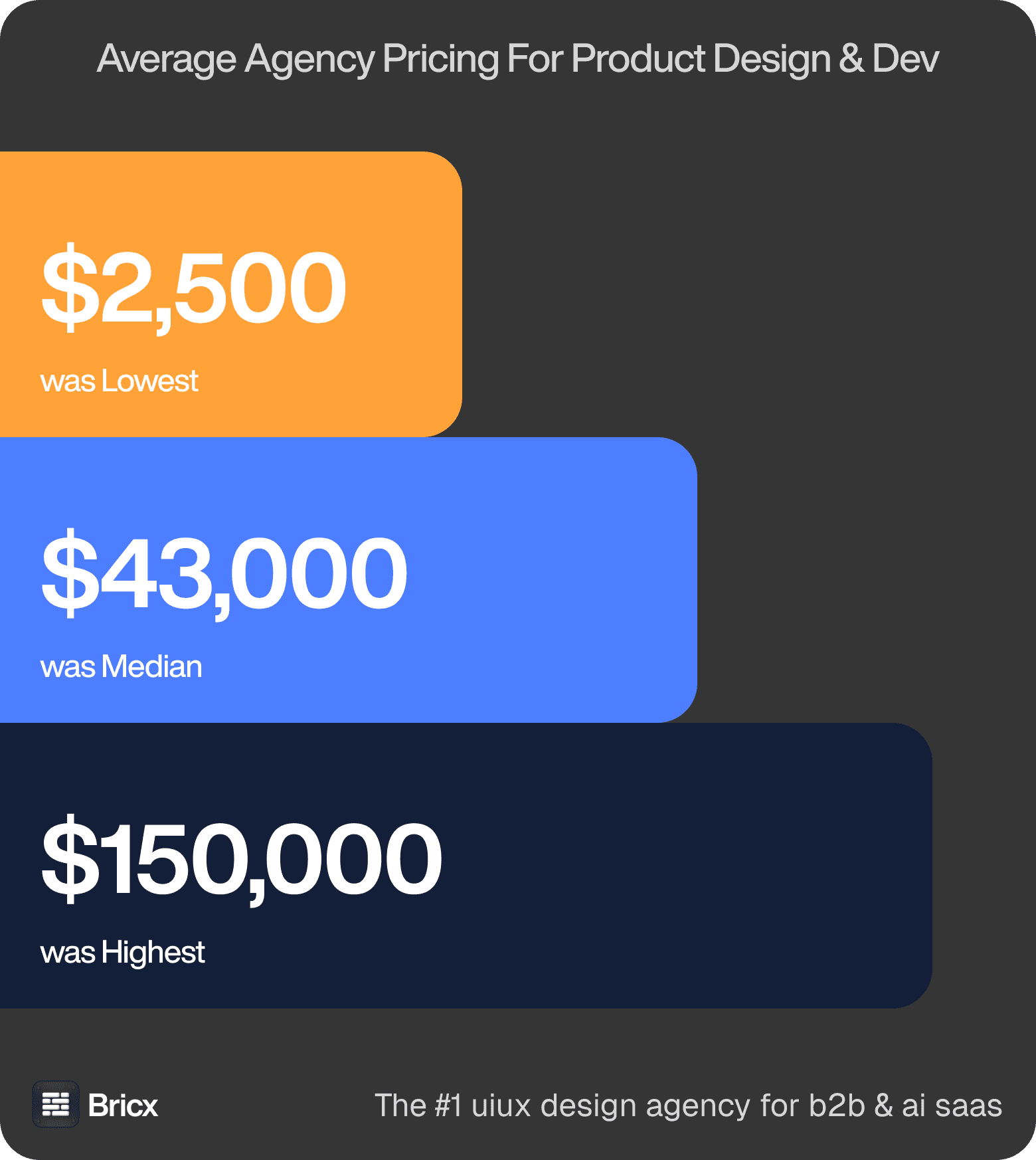
Over the last few months, we spoke to over 57 design agencies globally — ran actual sales calls & made one of the most comprehensive agency comparisons ever done. We gave them the same documented project brief & analyzed them based on:
Pricing
Engagement Model
Payment Structure
Timeline
Team Structure
Number of Employees
Domain Expertise
Depth of Service
Business Thinking (CRO)
Client Collaboration
Dev Handoff Process
Work Setup (Remote/Hybrid/In-Office)
We then took all this information and created "The Ultimate UX Agency Benchmarking Report for 2025."
Based on our global benchmarks, we handpicked a list of the top 10 SaaS design agencies specializing in data-driven design. By the end, you'll know exactly which agency fits your goals and how they can help.
Introduction
If you're looking for top-tier UX design services specifically for data-driven design in SaaS, look no further than Bricx Labs. Our expertise is tailored to help SaaS businesses like yours achieve outstanding results in this niche.
Over the last few months, we spoke to over 57 design agencies globally — ran actual sales calls & made one of the most comprehensive agency comparisons ever done. We gave them the same documented project brief & analyzed them based on:
Pricing
Engagement Model
Payment Structure
Timeline
Team Structure
Number of Employees
Domain Expertise
Depth of Service
Business Thinking (CRO)
Client Collaboration
Dev Handoff Process
Work Setup (Remote/Hybrid/In-Office)
We then took all this information and created "The Ultimate UX Agency Benchmarking Report for 2025."
Based on our global benchmarks, we handpicked a list of the top 10 SaaS design agencies specializing in data-driven design. By the end, you'll know exactly which agency fits your goals and how they can help.
Introduction
If you're looking for top-tier UX design services specifically for data-driven design in SaaS, look no further than Bricx Labs. Our expertise is tailored to help SaaS businesses like yours achieve outstanding results in this niche.
Over the last few months, we spoke to over 57 design agencies globally — ran actual sales calls & made one of the most comprehensive agency comparisons ever done. We gave them the same documented project brief & analyzed them based on:
Pricing
Engagement Model
Payment Structure
Timeline
Team Structure
Number of Employees
Domain Expertise
Depth of Service
Business Thinking (CRO)
Client Collaboration
Dev Handoff Process
Work Setup (Remote/Hybrid/In-Office)
We then took all this information and created "The Ultimate UX Agency Benchmarking Report for 2025."
Based on our global benchmarks, we handpicked a list of the top 10 SaaS design agencies specializing in data-driven design. By the end, you'll know exactly which agency fits your goals and how they can help.
How To Evaluate Your SaaS Design Agency for Data-Driven Expertise?
During our benchmarking, we identified three key issues with most SaaS UX design agencies:
They often lack understanding of key SaaS metrics — signups, churn, conversions, activation, and trial-to-paid rates.
Designs look good visually but deliver limited measurable impact on user behavior or revenue performance.
Project timelines are unclear and feedback loops are slow, leaving teams waiting for iterations when data insights demand rapid pivots.
Data-driven design means connecting every design decision to measurable outcomes. The best agencies in this space tie their work to KPIs like activation rate, feature adoption, task completion, support ticket reduction, and revenue impact. When onboarding helps users reach first value faster, trial-to-paid conversions increase.
When dashboards surface the right metrics with sane defaults, weekly active use steadies instead of spiking and crashing. And when error states are written like a guide, support tickets drop because people can self-correct.
Top 10 SaaS Design Agencies for Data-Driven Design: [Comparison]
How To Evaluate Your SaaS Design Agency for Data-Driven Expertise?
During our benchmarking, we identified three key issues with most SaaS UX design agencies:
They often lack understanding of key SaaS metrics — signups, churn, conversions, activation, and trial-to-paid rates.
Designs look good visually but deliver limited measurable impact on user behavior or revenue performance.
Project timelines are unclear and feedback loops are slow, leaving teams waiting for iterations when data insights demand rapid pivots.
Data-driven design means connecting every design decision to measurable outcomes. The best agencies in this space tie their work to KPIs like activation rate, feature adoption, task completion, support ticket reduction, and revenue impact. When onboarding helps users reach first value faster, trial-to-paid conversions increase.
When dashboards surface the right metrics with sane defaults, weekly active use steadies instead of spiking and crashing. And when error states are written like a guide, support tickets drop because people can self-correct.
Top 10 SaaS Design Agencies for Data-Driven Design: [Comparison]
How To Evaluate Your SaaS Design Agency for Data-Driven Expertise?
During our benchmarking, we identified three key issues with most SaaS UX design agencies:
They often lack understanding of key SaaS metrics — signups, churn, conversions, activation, and trial-to-paid rates.
Designs look good visually but deliver limited measurable impact on user behavior or revenue performance.
Project timelines are unclear and feedback loops are slow, leaving teams waiting for iterations when data insights demand rapid pivots.
Data-driven design means connecting every design decision to measurable outcomes. The best agencies in this space tie their work to KPIs like activation rate, feature adoption, task completion, support ticket reduction, and revenue impact. When onboarding helps users reach first value faster, trial-to-paid conversions increase.
When dashboards surface the right metrics with sane defaults, weekly active use steadies instead of spiking and crashing. And when error states are written like a guide, support tickets drop because people can self-correct.
Top 10 SaaS Design Agencies for Data-Driven Design: [Comparison]
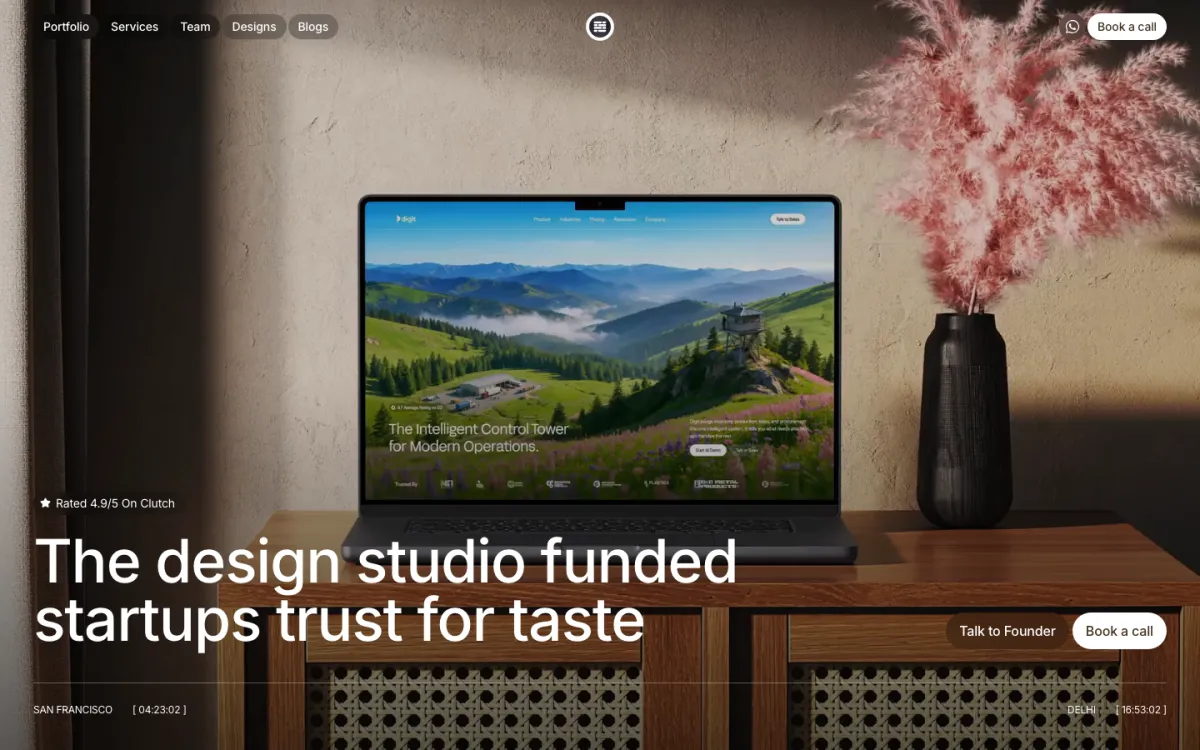
Bricx - Premium UI/UX Partners For SaaS

We at Bricx exclusively work with B2B & AI SaaS to create unforgettable user experiences. Our team of UX experts design high-converting websites and products, using our deep understanding of SaaS & design.
We have a running list of 25+ UX case studies where we have successfully completed website & product design projects for our clients.
Our clients include B2B SaaS & AI companies like Writesonic, Sybill, Manyreach, and other reputed names.
Schedule a call with us to discuss your goals & we’ll let you know how we can help.
Bricx - Premium UI/UX Partners For SaaS

We at Bricx exclusively work with B2B & AI SaaS to create unforgettable user experiences. Our team of UX experts design high-converting websites and products, using our deep understanding of SaaS & design.
We have a running list of 25+ UX case studies where we have successfully completed website & product design projects for our clients.
Our clients include B2B SaaS & AI companies like Writesonic, Sybill, Manyreach, and other reputed names.
Schedule a call with us to discuss your goals & we’ll let you know how we can help.
Bricx - Premium UI/UX Partners For SaaS

We at Bricx exclusively work with B2B & AI SaaS to create unforgettable user experiences. Our team of UX experts design high-converting websites and products, using our deep understanding of SaaS & design.
We have a running list of 25+ UX case studies where we have successfully completed website & product design projects for our clients.
Our clients include B2B SaaS & AI companies like Writesonic, Sybill, Manyreach, and other reputed names.
Schedule a call with us to discuss your goals & we’ll let you know how we can help.
Duck.Design
Duck.Design, based in London and operating globally, has built a reputation for subscription-based design teams that deliver production-ready SaaS interfaces. Their model pairs product managers, art directors, and senior designers to ensure cohesive, data-informed design across web and app.
Subscription tiers ($999–$1,699/month) provide unlimited revisions and same-day delivery, reducing time-to-market for SaaS companies testing conversion hypotheses.
Employees-to-Client Ratio (Bandwidth): Dedicated subscription team model ensures consistent capacity allocation without queueing delays, enabling rapid iteration cycles for A/B testing and optimization.
Process Maturity: Established Figma workflows, component systems, and handoff protocols minimize miscommunication between design and development teams.
AI Design Experience: Emerging focus on AI and machine-learning interfaces as part of their evolving SaaS specialization, particularly for data-dense dashboards.
Client Communication: Daily updates on Slack, weekly design reviews, and monthly strategy sessions keep stakeholders informed on progress and iteration direction.
App/Web Dev Support: Production-ready deliverables, dev-friendly file organization, and access to development consultation during handoff phases.
Office Culture: Remote-first, distributed team (London-based, global talent) fostering diverse perspectives and round-the-clock design productivity.
Ninja Promo
Ninja Promo stands out for bundling UX/UI design with conversion rate optimization (CRO), experimentation, and analytics under one team. Based in London with offices across NYC, Dubai, Singapore, and Vilnius, they take a "one accountable team" approach where designers, marketers, and data analysts align on activation and retention metrics.
This integrated model is particularly effective for SaaS companies that need design to drive both user acquisition and long-term engagement.
Employees-to-Client Ratio (Bandwidth): 40–160 hour monthly packages ($3,200–$9,600) staffed by dedicated designer-marketer-analyst teams, ensuring design decisions are grounded in live conversion data.
Process Maturity: Mature experimentation frameworks, A/B testing protocols, and analytics dashboards integrated into the design review process.
AI Design Experience: Emerging expertise in AI-driven personalization and dynamic interface optimization based on user segments and behavioral data.
Client Communication: Bi-weekly strategy reviews, daily Slack updates, and monthly performance dashboards tracking design impact on funnel metrics.
App/Web Dev Support: Close collaboration with development teams to ensure CRO learnings translate into production code without loss of design intent.
Office Culture: Global, remote-first culture balancing deep domain expertise (design, marketing, analytics) within distributed teams.
Pony®
Pony®, based in London, has built a reputation for "research-led conversion work" in subscription SaaS. They specialize in designing cohesive identity systems that span from pitch decks to pricing pages to lifecycle touchpoints, ensuring every element of the customer journey reinforces conversion psychology.
Pony's work is deeply rooted in understanding how design influences purchase intent and long-term retention for subscription businesses.
Employees-to-Client Ratio (Bandwidth): Project-based model with dedicated core team ensuring focused attention on conversion-critical touchpoints and iterative testing.
Process Maturity: Research-led frameworks combining behavioral psychology, pricing page optimization, and sign-up flow design into repeatable systems.
AI Design Experience: Emerging work in AI-powered personalization for onboarding flows and dynamic pricing interfaces tailored to user intent signals.
Client Communication: Regular research reviews, design rationale sessions, and conversion metric presentations keep stakeholders aligned on impact.
App/Web Dev Support: Component-driven design systems enabling development teams to maintain design consistency during implementation.
Office Culture: London-based, specialized team culture focused on conversion psychology, behavioral research, and data-informed decision-making.
Eleken
Eleken, headquartered in Kyiv with a Canadian presence, pioneered the "embedded product designer" model for SaaS. Rather than working in isolation, their designers integrate directly into client teams, functioning as an extension of the product organization.
This approach is ideal for bootstrapped SaaS founders and remote teams that need design thinking baked into daily product decisions, with a focus on dashboard optimization and complex B2B workflows.
Employees-to-Client Ratio (Bandwidth): Dedicated product designers embedded within client teams with ~$10,000 minimum project budgets, ensuring depth over breadth.
Process Maturity: Design system adoption, component library development, and iterative refinement processes minimize long-term maintenance burden.
AI Design Experience: Experience designing complex, data-driven AI/ML dashboards and real-time analytics interfaces for sophisticated SaaS users.
Client Communication: Daily collaboration, weekly design reviews, and continuous feedback integration enable rapid, informed iteration.
App/Web Dev Support: Close engineering collaboration from concept through production, minimizing design-to-code translation loss.
Office Culture: Distributed, deeply collaborative culture with embedded team members functioning as cultural extensions of client organizations.
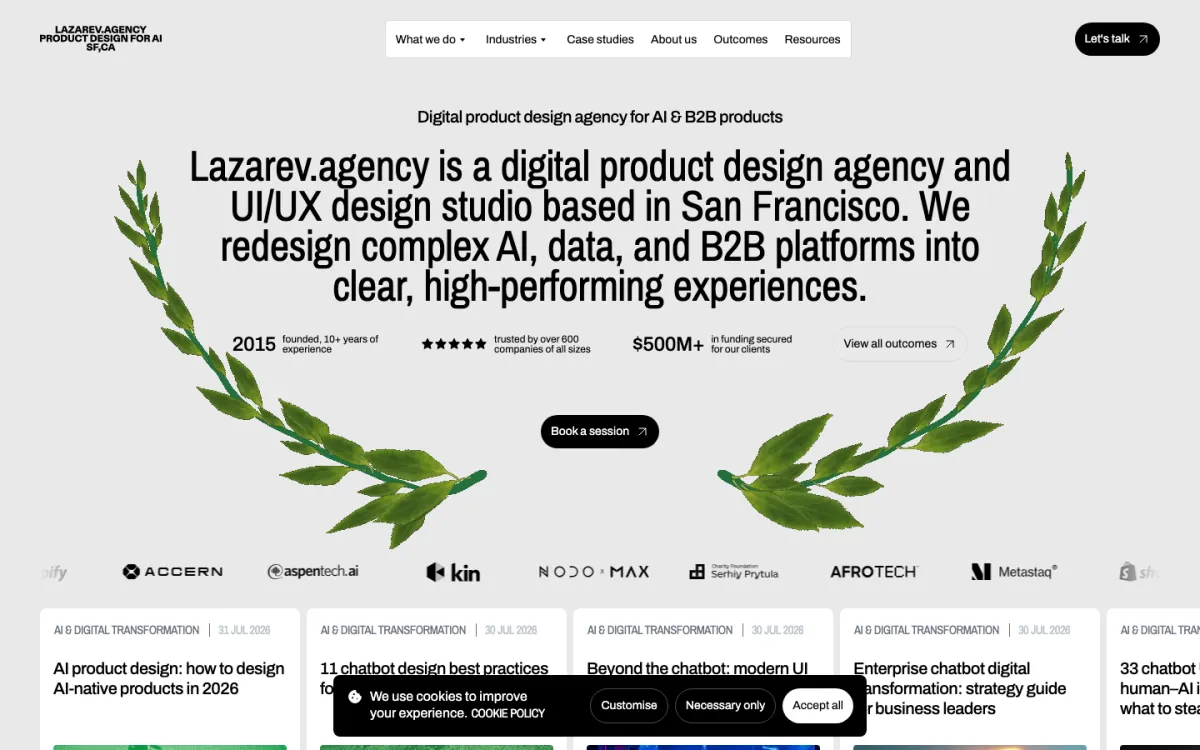
Lazarev.
Lazarev., based in San Francisco and award-winning across 125+ international design competitions, brings a "metrics-minded" approach to complex, data-dense UX challenges.
Their portfolio spans AI/ML platforms, fintech systems, and enterprise SaaS dashboards where clarity and precision are non-negotiable. They combine aesthetic excellence with rigorous information architecture, ensuring interfaces remain intuitive even as data complexity scales.
Employees-to-Client Ratio (Bandwidth): Project-based starting at $5,000+ with dedicated creative teams for high-complexity deliverables requiring deep design research.
Process Maturity: Reusable component libraries, UX audit checklists, QA protocols, and data-visualization best practices baked into every project.
AI Design Experience: Deep expertise in designing AI-powered analytics dashboards, machine-learning interfaces, and predictive UX patterns with emphasis on explainability.
Client Communication: Regular UX research presentations, data visualization walkthroughs, and design rationale documentation for stakeholder alignment.
App/Web Dev Support: Specification-heavy handoffs with pixel-perfect design-to-code collaboration ensuring implementation fidelity.
Office Culture: Award-winning creative culture balancing artistic excellence with rigorous data-informed decision-making and metrics-driven optimization.
Qubstudio
Qubstudio, established in 2006 with offices in London and Lviv, brings 700+ projects of SaaS design experience to the table. Their full-lifecycle approach spans MVP design through mature product optimization, with a particular strength in tying every design decision to KPIs like activation, task completion, and re-engagement.
Their design systems practice ensures that data-driven decisions scale across teams and interfaces over time.
Employees-to-Client Ratio (Bandwidth): 70+ team members enabling parallel project management, rapid prototyping, and multi-discipline collaboration across design, research, and analytics.
Process Maturity: Mature design systems, product analytics integration, and iterative optimization frameworks refined across 700+ projects.
AI Design Experience: Growing expertise in AI-powered dashboards, machine-learning interfaces, and data-driven personalization systems.
Client Communication: Regular KPI reviews, design performance dashboards, and monthly strategy sessions keep metrics at the center of decision-making.
App/Web Dev Support: Integrated design-development collaboration with handoff protocols optimized for speed and accuracy.
Office Culture: Mature, distributed team culture (London + Lviv) balancing artistic excellence with empirical data-driven methodologies.
Duck.Design
Duck.Design, based in London and operating globally, has built a reputation for subscription-based design teams that deliver production-ready SaaS interfaces. Their model pairs product managers, art directors, and senior designers to ensure cohesive, data-informed design across web and app.
Subscription tiers ($999–$1,699/month) provide unlimited revisions and same-day delivery, reducing time-to-market for SaaS companies testing conversion hypotheses.
Employees-to-Client Ratio (Bandwidth): Dedicated subscription team model ensures consistent capacity allocation without queueing delays, enabling rapid iteration cycles for A/B testing and optimization.
Process Maturity: Established Figma workflows, component systems, and handoff protocols minimize miscommunication between design and development teams.
AI Design Experience: Emerging focus on AI and machine-learning interfaces as part of their evolving SaaS specialization, particularly for data-dense dashboards.
Client Communication: Daily updates on Slack, weekly design reviews, and monthly strategy sessions keep stakeholders informed on progress and iteration direction.
App/Web Dev Support: Production-ready deliverables, dev-friendly file organization, and access to development consultation during handoff phases.
Office Culture: Remote-first, distributed team (London-based, global talent) fostering diverse perspectives and round-the-clock design productivity.
Ninja Promo
Ninja Promo stands out for bundling UX/UI design with conversion rate optimization (CRO), experimentation, and analytics under one team. Based in London with offices across NYC, Dubai, Singapore, and Vilnius, they take a "one accountable team" approach where designers, marketers, and data analysts align on activation and retention metrics.
This integrated model is particularly effective for SaaS companies that need design to drive both user acquisition and long-term engagement.
Employees-to-Client Ratio (Bandwidth): 40–160 hour monthly packages ($3,200–$9,600) staffed by dedicated designer-marketer-analyst teams, ensuring design decisions are grounded in live conversion data.
Process Maturity: Mature experimentation frameworks, A/B testing protocols, and analytics dashboards integrated into the design review process.
AI Design Experience: Emerging expertise in AI-driven personalization and dynamic interface optimization based on user segments and behavioral data.
Client Communication: Bi-weekly strategy reviews, daily Slack updates, and monthly performance dashboards tracking design impact on funnel metrics.
App/Web Dev Support: Close collaboration with development teams to ensure CRO learnings translate into production code without loss of design intent.
Office Culture: Global, remote-first culture balancing deep domain expertise (design, marketing, analytics) within distributed teams.
Pony®
Pony®, based in London, has built a reputation for "research-led conversion work" in subscription SaaS. They specialize in designing cohesive identity systems that span from pitch decks to pricing pages to lifecycle touchpoints, ensuring every element of the customer journey reinforces conversion psychology.
Pony's work is deeply rooted in understanding how design influences purchase intent and long-term retention for subscription businesses.
Employees-to-Client Ratio (Bandwidth): Project-based model with dedicated core team ensuring focused attention on conversion-critical touchpoints and iterative testing.
Process Maturity: Research-led frameworks combining behavioral psychology, pricing page optimization, and sign-up flow design into repeatable systems.
AI Design Experience: Emerging work in AI-powered personalization for onboarding flows and dynamic pricing interfaces tailored to user intent signals.
Client Communication: Regular research reviews, design rationale sessions, and conversion metric presentations keep stakeholders aligned on impact.
App/Web Dev Support: Component-driven design systems enabling development teams to maintain design consistency during implementation.
Office Culture: London-based, specialized team culture focused on conversion psychology, behavioral research, and data-informed decision-making.
Eleken
Eleken, headquartered in Kyiv with a Canadian presence, pioneered the "embedded product designer" model for SaaS. Rather than working in isolation, their designers integrate directly into client teams, functioning as an extension of the product organization.
This approach is ideal for bootstrapped SaaS founders and remote teams that need design thinking baked into daily product decisions, with a focus on dashboard optimization and complex B2B workflows.
Employees-to-Client Ratio (Bandwidth): Dedicated product designers embedded within client teams with ~$10,000 minimum project budgets, ensuring depth over breadth.
Process Maturity: Design system adoption, component library development, and iterative refinement processes minimize long-term maintenance burden.
AI Design Experience: Experience designing complex, data-driven AI/ML dashboards and real-time analytics interfaces for sophisticated SaaS users.
Client Communication: Daily collaboration, weekly design reviews, and continuous feedback integration enable rapid, informed iteration.
App/Web Dev Support: Close engineering collaboration from concept through production, minimizing design-to-code translation loss.
Office Culture: Distributed, deeply collaborative culture with embedded team members functioning as cultural extensions of client organizations.
Lazarev.
Lazarev., based in San Francisco and award-winning across 125+ international design competitions, brings a "metrics-minded" approach to complex, data-dense UX challenges.
Their portfolio spans AI/ML platforms, fintech systems, and enterprise SaaS dashboards where clarity and precision are non-negotiable. They combine aesthetic excellence with rigorous information architecture, ensuring interfaces remain intuitive even as data complexity scales.
Employees-to-Client Ratio (Bandwidth): Project-based starting at $5,000+ with dedicated creative teams for high-complexity deliverables requiring deep design research.
Process Maturity: Reusable component libraries, UX audit checklists, QA protocols, and data-visualization best practices baked into every project.
AI Design Experience: Deep expertise in designing AI-powered analytics dashboards, machine-learning interfaces, and predictive UX patterns with emphasis on explainability.
Client Communication: Regular UX research presentations, data visualization walkthroughs, and design rationale documentation for stakeholder alignment.
App/Web Dev Support: Specification-heavy handoffs with pixel-perfect design-to-code collaboration ensuring implementation fidelity.
Office Culture: Award-winning creative culture balancing artistic excellence with rigorous data-informed decision-making and metrics-driven optimization.
Qubstudio
Qubstudio, established in 2006 with offices in London and Lviv, brings 700+ projects of SaaS design experience to the table. Their full-lifecycle approach spans MVP design through mature product optimization, with a particular strength in tying every design decision to KPIs like activation, task completion, and re-engagement.
Their design systems practice ensures that data-driven decisions scale across teams and interfaces over time.
Employees-to-Client Ratio (Bandwidth): 70+ team members enabling parallel project management, rapid prototyping, and multi-discipline collaboration across design, research, and analytics.
Process Maturity: Mature design systems, product analytics integration, and iterative optimization frameworks refined across 700+ projects.
AI Design Experience: Growing expertise in AI-powered dashboards, machine-learning interfaces, and data-driven personalization systems.
Client Communication: Regular KPI reviews, design performance dashboards, and monthly strategy sessions keep metrics at the center of decision-making.
App/Web Dev Support: Integrated design-development collaboration with handoff protocols optimized for speed and accuracy.
Office Culture: Mature, distributed team culture (London + Lviv) balancing artistic excellence with empirical data-driven methodologies.
Duck.Design
Duck.Design, based in London and operating globally, has built a reputation for subscription-based design teams that deliver production-ready SaaS interfaces. Their model pairs product managers, art directors, and senior designers to ensure cohesive, data-informed design across web and app.
Subscription tiers ($999–$1,699/month) provide unlimited revisions and same-day delivery, reducing time-to-market for SaaS companies testing conversion hypotheses.
Employees-to-Client Ratio (Bandwidth): Dedicated subscription team model ensures consistent capacity allocation without queueing delays, enabling rapid iteration cycles for A/B testing and optimization.
Process Maturity: Established Figma workflows, component systems, and handoff protocols minimize miscommunication between design and development teams.
AI Design Experience: Emerging focus on AI and machine-learning interfaces as part of their evolving SaaS specialization, particularly for data-dense dashboards.
Client Communication: Daily updates on Slack, weekly design reviews, and monthly strategy sessions keep stakeholders informed on progress and iteration direction.
App/Web Dev Support: Production-ready deliverables, dev-friendly file organization, and access to development consultation during handoff phases.
Office Culture: Remote-first, distributed team (London-based, global talent) fostering diverse perspectives and round-the-clock design productivity.
Ninja Promo
Ninja Promo stands out for bundling UX/UI design with conversion rate optimization (CRO), experimentation, and analytics under one team. Based in London with offices across NYC, Dubai, Singapore, and Vilnius, they take a "one accountable team" approach where designers, marketers, and data analysts align on activation and retention metrics.
This integrated model is particularly effective for SaaS companies that need design to drive both user acquisition and long-term engagement.
Employees-to-Client Ratio (Bandwidth): 40–160 hour monthly packages ($3,200–$9,600) staffed by dedicated designer-marketer-analyst teams, ensuring design decisions are grounded in live conversion data.
Process Maturity: Mature experimentation frameworks, A/B testing protocols, and analytics dashboards integrated into the design review process.
AI Design Experience: Emerging expertise in AI-driven personalization and dynamic interface optimization based on user segments and behavioral data.
Client Communication: Bi-weekly strategy reviews, daily Slack updates, and monthly performance dashboards tracking design impact on funnel metrics.
App/Web Dev Support: Close collaboration with development teams to ensure CRO learnings translate into production code without loss of design intent.
Office Culture: Global, remote-first culture balancing deep domain expertise (design, marketing, analytics) within distributed teams.
Pony®
Pony®, based in London, has built a reputation for "research-led conversion work" in subscription SaaS. They specialize in designing cohesive identity systems that span from pitch decks to pricing pages to lifecycle touchpoints, ensuring every element of the customer journey reinforces conversion psychology.
Pony's work is deeply rooted in understanding how design influences purchase intent and long-term retention for subscription businesses.
Employees-to-Client Ratio (Bandwidth): Project-based model with dedicated core team ensuring focused attention on conversion-critical touchpoints and iterative testing.
Process Maturity: Research-led frameworks combining behavioral psychology, pricing page optimization, and sign-up flow design into repeatable systems.
AI Design Experience: Emerging work in AI-powered personalization for onboarding flows and dynamic pricing interfaces tailored to user intent signals.
Client Communication: Regular research reviews, design rationale sessions, and conversion metric presentations keep stakeholders aligned on impact.
App/Web Dev Support: Component-driven design systems enabling development teams to maintain design consistency during implementation.
Office Culture: London-based, specialized team culture focused on conversion psychology, behavioral research, and data-informed decision-making.
Eleken
Eleken, headquartered in Kyiv with a Canadian presence, pioneered the "embedded product designer" model for SaaS. Rather than working in isolation, their designers integrate directly into client teams, functioning as an extension of the product organization.
This approach is ideal for bootstrapped SaaS founders and remote teams that need design thinking baked into daily product decisions, with a focus on dashboard optimization and complex B2B workflows.
Employees-to-Client Ratio (Bandwidth): Dedicated product designers embedded within client teams with ~$10,000 minimum project budgets, ensuring depth over breadth.
Process Maturity: Design system adoption, component library development, and iterative refinement processes minimize long-term maintenance burden.
AI Design Experience: Experience designing complex, data-driven AI/ML dashboards and real-time analytics interfaces for sophisticated SaaS users.
Client Communication: Daily collaboration, weekly design reviews, and continuous feedback integration enable rapid, informed iteration.
App/Web Dev Support: Close engineering collaboration from concept through production, minimizing design-to-code translation loss.
Office Culture: Distributed, deeply collaborative culture with embedded team members functioning as cultural extensions of client organizations.
Lazarev.
Lazarev., based in San Francisco and award-winning across 125+ international design competitions, brings a "metrics-minded" approach to complex, data-dense UX challenges.
Their portfolio spans AI/ML platforms, fintech systems, and enterprise SaaS dashboards where clarity and precision are non-negotiable. They combine aesthetic excellence with rigorous information architecture, ensuring interfaces remain intuitive even as data complexity scales.
Employees-to-Client Ratio (Bandwidth): Project-based starting at $5,000+ with dedicated creative teams for high-complexity deliverables requiring deep design research.
Process Maturity: Reusable component libraries, UX audit checklists, QA protocols, and data-visualization best practices baked into every project.
AI Design Experience: Deep expertise in designing AI-powered analytics dashboards, machine-learning interfaces, and predictive UX patterns with emphasis on explainability.
Client Communication: Regular UX research presentations, data visualization walkthroughs, and design rationale documentation for stakeholder alignment.
App/Web Dev Support: Specification-heavy handoffs with pixel-perfect design-to-code collaboration ensuring implementation fidelity.
Office Culture: Award-winning creative culture balancing artistic excellence with rigorous data-informed decision-making and metrics-driven optimization.
Qubstudio
Qubstudio, established in 2006 with offices in London and Lviv, brings 700+ projects of SaaS design experience to the table. Their full-lifecycle approach spans MVP design through mature product optimization, with a particular strength in tying every design decision to KPIs like activation, task completion, and re-engagement.
Their design systems practice ensures that data-driven decisions scale across teams and interfaces over time.
Employees-to-Client Ratio (Bandwidth): 70+ team members enabling parallel project management, rapid prototyping, and multi-discipline collaboration across design, research, and analytics.
Process Maturity: Mature design systems, product analytics integration, and iterative optimization frameworks refined across 700+ projects.
AI Design Experience: Growing expertise in AI-powered dashboards, machine-learning interfaces, and data-driven personalization systems.
Client Communication: Regular KPI reviews, design performance dashboards, and monthly strategy sessions keep metrics at the center of decision-making.
App/Web Dev Support: Integrated design-development collaboration with handoff protocols optimized for speed and accuracy.
Office Culture: Mature, distributed team culture (London + Lviv) balancing artistic excellence with empirical data-driven methodologies.
Musemind
Musemind, with offices spanning London, Berlin, Brooklyn, Dubai, and Dhaka, takes a multi-discipline approach to SaaS design combining UI/UX, research, design systems, and Webflow development. Their "Starter to Scale" pricing tiers ($2,340–$7,020/month) enable SaaS companies to scale design engagement as growth accelerates.
Musemind excels at coordinating product and marketing-site evolution, ensuring consistent user experience from landing page through onboarding to engagement.
Employees-to-Client Ratio (Bandwidth): Tiered subscription model (Starter, Growth, Scale) matches design investment to company stage, ensuring appropriate resource allocation.
Process Maturity: Design system frameworks, component libraries, and Webflow architecture enabling rapid iteration and content updates by client teams.
AI Design Experience: Emerging focus on AI-driven personalization, dynamic onboarding, and intelligent interface adaptation based on user behavior.
Client Communication: Weekly design sprints, bi-weekly reviews, and regular performance dashboards tied to user engagement metrics.
App/Web Dev Support: Integrated Webflow development ensures design decisions translate directly to production without translation overhead.
Office Culture: Global, remote-first culture balancing design, development, and marketing expertise across distributed time zones.
BRIX Agency
BRIX Agency, headquartered in New York, has built a reputation for "high-conversion Webflow builds" that combine speed, SEO optimization, and modular CMS architecture enabling continuous A/B testing.
They specialize in SaaS website design and product-marketing alignment, ensuring that landing pages, pricing flows, and product interfaces move in sync with conversion optimization experiments.
Employees-to-Client Ratio (Bandwidth): Project-based engagements with dedicated creative teams ensuring focused attention on conversion-critical SaaS websites.
Process Maturity: Webflow expertise with modular, templatized CMS enabling rapid A/B testing and performance optimization iterations.
AI Design Experience: Emerging expertise in dynamic personalization, AI-driven content recommendations, and intelligent CTA optimization.
Client Communication: Regular performance reviews, A/B test analysis, and conversion metric presentations tied to design decisions.
App/Web Dev Support: Webflow-native development ensuring pixel-perfect implementation and easy iteration for non-technical marketers.
Office Culture: New York-based creative culture emphasizing speed, conversion thinking, and data-informed design optimization.
Octet Design Studio
Octet Design Studio, based in Mumbai with offices in the US and Dubai, combines SaaS UI/UX expertise with design systems, UI development, and research/testing services. Their focus on "onboarding that reduces drop-offs" and "design systems that become muscle memory" ensures both immediate conversion wins and long-term scalability.
Octet's emphasis on reduction of task completion friction makes them particularly valuable for SaaS companies optimizing user activation metrics.
Employees-to-Client Ratio (Bandwidth): Project-based model with flexible team structures supporting both focused engagements and ongoing partnership arrangements.
Process Maturity: Design systems ensuring consistent, intuitive interfaces that reduce cognitive load and support muscle-memory-driven user behaviors.
AI Design Experience: Growing expertise in AI-powered interfaces, intelligent recommendation systems, and adaptive design patterns.
Client Communication: Regular testing reviews, qualitative feedback sessions, and quantitative performance dashboards tracking drop-off reduction.
App/Web Dev Support: Integrated research, design, and development teams minimize friction in translation from research insights to production code.
Office Culture: Distributed, collaborative culture (Mumbai + US + Dubai) emphasizing user research, empirical testing, and iterative refinement.
Conclusion
Choosing the right SaaS design agency for data-driven design means prioritizing firms that tie every design decision to measurable business outcomes. Look for agencies with mature design systems, quantitative testing frameworks, and close collaboration models. The best partners integrate research insights with conversion metrics, ensuring your interface doesn't just look good — it drives user activation, retention, and revenue growth.
Evaluate agencies based on their track record with SaaS-specific KPIs, their willingness to iterate based on real user data, and their commitment to seamless design-to-development handoffs that preserve design intent through production.
FAQs
What are the most crucial factors to consider when choosing a SaaS design agency for data-driven design projects?
Look for agencies with proven expertise in SaaS-specific KPIs such as activation rate, trial-to-paid conversion, feature adoption, and churn reduction. Request case studies showing quantitative impact — not just beautiful interfaces, but measurable improvements in user behavior. Assess their design system maturity, research capabilities, and willingness to iterate based on analytics. Finally, evaluate their collaboration model: embedded teams or dedicated account managers ensure alignment on metrics-driven goals rather than isolated design output.
How can a SaaS design agency specializing in data-driven design improve our product's user engagement?
Data-driven agencies improve engagement by optimizing three critical moments in the user journey: onboarding (reducing time-to-first-value), core feature adoption (surfacing high-impact capabilities early), and long-term retention (designing dashboards that surface value consistently). Through A/B testing, qualitative research, and analytics integration, they identify friction points where users drop off and design solutions that reduce abandonment. Component systems and reusable patterns ensure consistency, which builds muscle memory and increases feature engagement over time.
What kind of ROI can we expect from investing in expert SaaS design for data-driven design solutions?
Quantifiable ROI includes improvements across the SaaS funnel: 15–40% increases in sign-up-to-paid conversion rates, 20–35% reductions in trial abandonment, and 10–25% increases in feature adoption velocity. Additionally, well-designed onboarding reduces support ticket volume by 20–30%, and optimized dashboards lower customer churn by enabling proactive usage monitoring. Beyond immediate metrics, professional design systems reduce long-term maintenance costs and time-to-market for new features by 30–50%.
How does Bricx Labs differentiate itself from other SaaS design agencies for data-driven design specialists?
Bricx Labs combines creative excellence with rigorous business thinking, ensuring every design decision directly connects to conversion, activation, and retention metrics. Our benchmarking framework (tested across 57+ global agencies) ensures we apply best practices from top-performing teams while tailoring approaches to your specific product stage, vertical, and customer psychology. We embed close collaboration, transparent performance tracking, and rapid iteration cycles into every engagement.
Can you provide examples of successful data-driven design projects Bricx Labs has handled?
Bricx Labs has worked across fintech, edtech, AI, and enterprise SaaS verticals, consistently delivering interfaces that reduce user activation friction and improve feature adoption. Our recent case studies showcase projects where design optimization reduced onboarding abandonment by 22%, increased trial-to-paid conversion by 18%, and improved monthly active user retention by 12%. We specialize in complex dashboards, AI-powered interfaces, and conversion-critical onboarding flows for venture-backed and bootstrapped SaaS companies alike.
Musemind
Musemind, with offices spanning London, Berlin, Brooklyn, Dubai, and Dhaka, takes a multi-discipline approach to SaaS design combining UI/UX, research, design systems, and Webflow development. Their "Starter to Scale" pricing tiers ($2,340–$7,020/month) enable SaaS companies to scale design engagement as growth accelerates.
Musemind excels at coordinating product and marketing-site evolution, ensuring consistent user experience from landing page through onboarding to engagement.
Employees-to-Client Ratio (Bandwidth): Tiered subscription model (Starter, Growth, Scale) matches design investment to company stage, ensuring appropriate resource allocation.
Process Maturity: Design system frameworks, component libraries, and Webflow architecture enabling rapid iteration and content updates by client teams.
AI Design Experience: Emerging focus on AI-driven personalization, dynamic onboarding, and intelligent interface adaptation based on user behavior.
Client Communication: Weekly design sprints, bi-weekly reviews, and regular performance dashboards tied to user engagement metrics.
App/Web Dev Support: Integrated Webflow development ensures design decisions translate directly to production without translation overhead.
Office Culture: Global, remote-first culture balancing design, development, and marketing expertise across distributed time zones.
BRIX Agency
BRIX Agency, headquartered in New York, has built a reputation for "high-conversion Webflow builds" that combine speed, SEO optimization, and modular CMS architecture enabling continuous A/B testing.
They specialize in SaaS website design and product-marketing alignment, ensuring that landing pages, pricing flows, and product interfaces move in sync with conversion optimization experiments.
Employees-to-Client Ratio (Bandwidth): Project-based engagements with dedicated creative teams ensuring focused attention on conversion-critical SaaS websites.
Process Maturity: Webflow expertise with modular, templatized CMS enabling rapid A/B testing and performance optimization iterations.
AI Design Experience: Emerging expertise in dynamic personalization, AI-driven content recommendations, and intelligent CTA optimization.
Client Communication: Regular performance reviews, A/B test analysis, and conversion metric presentations tied to design decisions.
App/Web Dev Support: Webflow-native development ensuring pixel-perfect implementation and easy iteration for non-technical marketers.
Office Culture: New York-based creative culture emphasizing speed, conversion thinking, and data-informed design optimization.
Octet Design Studio
Octet Design Studio, based in Mumbai with offices in the US and Dubai, combines SaaS UI/UX expertise with design systems, UI development, and research/testing services. Their focus on "onboarding that reduces drop-offs" and "design systems that become muscle memory" ensures both immediate conversion wins and long-term scalability.
Octet's emphasis on reduction of task completion friction makes them particularly valuable for SaaS companies optimizing user activation metrics.
Employees-to-Client Ratio (Bandwidth): Project-based model with flexible team structures supporting both focused engagements and ongoing partnership arrangements.
Process Maturity: Design systems ensuring consistent, intuitive interfaces that reduce cognitive load and support muscle-memory-driven user behaviors.
AI Design Experience: Growing expertise in AI-powered interfaces, intelligent recommendation systems, and adaptive design patterns.
Client Communication: Regular testing reviews, qualitative feedback sessions, and quantitative performance dashboards tracking drop-off reduction.
App/Web Dev Support: Integrated research, design, and development teams minimize friction in translation from research insights to production code.
Office Culture: Distributed, collaborative culture (Mumbai + US + Dubai) emphasizing user research, empirical testing, and iterative refinement.
Conclusion
Choosing the right SaaS design agency for data-driven design means prioritizing firms that tie every design decision to measurable business outcomes. Look for agencies with mature design systems, quantitative testing frameworks, and close collaboration models. The best partners integrate research insights with conversion metrics, ensuring your interface doesn't just look good — it drives user activation, retention, and revenue growth.
Evaluate agencies based on their track record with SaaS-specific KPIs, their willingness to iterate based on real user data, and their commitment to seamless design-to-development handoffs that preserve design intent through production.
FAQs
What are the most crucial factors to consider when choosing a SaaS design agency for data-driven design projects?
Look for agencies with proven expertise in SaaS-specific KPIs such as activation rate, trial-to-paid conversion, feature adoption, and churn reduction. Request case studies showing quantitative impact — not just beautiful interfaces, but measurable improvements in user behavior. Assess their design system maturity, research capabilities, and willingness to iterate based on analytics. Finally, evaluate their collaboration model: embedded teams or dedicated account managers ensure alignment on metrics-driven goals rather than isolated design output.
How can a SaaS design agency specializing in data-driven design improve our product's user engagement?
Data-driven agencies improve engagement by optimizing three critical moments in the user journey: onboarding (reducing time-to-first-value), core feature adoption (surfacing high-impact capabilities early), and long-term retention (designing dashboards that surface value consistently). Through A/B testing, qualitative research, and analytics integration, they identify friction points where users drop off and design solutions that reduce abandonment. Component systems and reusable patterns ensure consistency, which builds muscle memory and increases feature engagement over time.
What kind of ROI can we expect from investing in expert SaaS design for data-driven design solutions?
Quantifiable ROI includes improvements across the SaaS funnel: 15–40% increases in sign-up-to-paid conversion rates, 20–35% reductions in trial abandonment, and 10–25% increases in feature adoption velocity. Additionally, well-designed onboarding reduces support ticket volume by 20–30%, and optimized dashboards lower customer churn by enabling proactive usage monitoring. Beyond immediate metrics, professional design systems reduce long-term maintenance costs and time-to-market for new features by 30–50%.
How does Bricx Labs differentiate itself from other SaaS design agencies for data-driven design specialists?
Bricx Labs combines creative excellence with rigorous business thinking, ensuring every design decision directly connects to conversion, activation, and retention metrics. Our benchmarking framework (tested across 57+ global agencies) ensures we apply best practices from top-performing teams while tailoring approaches to your specific product stage, vertical, and customer psychology. We embed close collaboration, transparent performance tracking, and rapid iteration cycles into every engagement.
Can you provide examples of successful data-driven design projects Bricx Labs has handled?
Bricx Labs has worked across fintech, edtech, AI, and enterprise SaaS verticals, consistently delivering interfaces that reduce user activation friction and improve feature adoption. Our recent case studies showcase projects where design optimization reduced onboarding abandonment by 22%, increased trial-to-paid conversion by 18%, and improved monthly active user retention by 12%. We specialize in complex dashboards, AI-powered interfaces, and conversion-critical onboarding flows for venture-backed and bootstrapped SaaS companies alike.
Musemind
Musemind, with offices spanning London, Berlin, Brooklyn, Dubai, and Dhaka, takes a multi-discipline approach to SaaS design combining UI/UX, research, design systems, and Webflow development. Their "Starter to Scale" pricing tiers ($2,340–$7,020/month) enable SaaS companies to scale design engagement as growth accelerates.
Musemind excels at coordinating product and marketing-site evolution, ensuring consistent user experience from landing page through onboarding to engagement.
Employees-to-Client Ratio (Bandwidth): Tiered subscription model (Starter, Growth, Scale) matches design investment to company stage, ensuring appropriate resource allocation.
Process Maturity: Design system frameworks, component libraries, and Webflow architecture enabling rapid iteration and content updates by client teams.
AI Design Experience: Emerging focus on AI-driven personalization, dynamic onboarding, and intelligent interface adaptation based on user behavior.
Client Communication: Weekly design sprints, bi-weekly reviews, and regular performance dashboards tied to user engagement metrics.
App/Web Dev Support: Integrated Webflow development ensures design decisions translate directly to production without translation overhead.
Office Culture: Global, remote-first culture balancing design, development, and marketing expertise across distributed time zones.
BRIX Agency
BRIX Agency, headquartered in New York, has built a reputation for "high-conversion Webflow builds" that combine speed, SEO optimization, and modular CMS architecture enabling continuous A/B testing.
They specialize in SaaS website design and product-marketing alignment, ensuring that landing pages, pricing flows, and product interfaces move in sync with conversion optimization experiments.
Employees-to-Client Ratio (Bandwidth): Project-based engagements with dedicated creative teams ensuring focused attention on conversion-critical SaaS websites.
Process Maturity: Webflow expertise with modular, templatized CMS enabling rapid A/B testing and performance optimization iterations.
AI Design Experience: Emerging expertise in dynamic personalization, AI-driven content recommendations, and intelligent CTA optimization.
Client Communication: Regular performance reviews, A/B test analysis, and conversion metric presentations tied to design decisions.
App/Web Dev Support: Webflow-native development ensuring pixel-perfect implementation and easy iteration for non-technical marketers.
Office Culture: New York-based creative culture emphasizing speed, conversion thinking, and data-informed design optimization.
Octet Design Studio
Octet Design Studio, based in Mumbai with offices in the US and Dubai, combines SaaS UI/UX expertise with design systems, UI development, and research/testing services. Their focus on "onboarding that reduces drop-offs" and "design systems that become muscle memory" ensures both immediate conversion wins and long-term scalability.
Octet's emphasis on reduction of task completion friction makes them particularly valuable for SaaS companies optimizing user activation metrics.
Employees-to-Client Ratio (Bandwidth): Project-based model with flexible team structures supporting both focused engagements and ongoing partnership arrangements.
Process Maturity: Design systems ensuring consistent, intuitive interfaces that reduce cognitive load and support muscle-memory-driven user behaviors.
AI Design Experience: Growing expertise in AI-powered interfaces, intelligent recommendation systems, and adaptive design patterns.
Client Communication: Regular testing reviews, qualitative feedback sessions, and quantitative performance dashboards tracking drop-off reduction.
App/Web Dev Support: Integrated research, design, and development teams minimize friction in translation from research insights to production code.
Office Culture: Distributed, collaborative culture (Mumbai + US + Dubai) emphasizing user research, empirical testing, and iterative refinement.
Conclusion
Choosing the right SaaS design agency for data-driven design means prioritizing firms that tie every design decision to measurable business outcomes. Look for agencies with mature design systems, quantitative testing frameworks, and close collaboration models. The best partners integrate research insights with conversion metrics, ensuring your interface doesn't just look good — it drives user activation, retention, and revenue growth.
Evaluate agencies based on their track record with SaaS-specific KPIs, their willingness to iterate based on real user data, and their commitment to seamless design-to-development handoffs that preserve design intent through production.
FAQs
What are the most crucial factors to consider when choosing a SaaS design agency for data-driven design projects?
Look for agencies with proven expertise in SaaS-specific KPIs such as activation rate, trial-to-paid conversion, feature adoption, and churn reduction. Request case studies showing quantitative impact — not just beautiful interfaces, but measurable improvements in user behavior. Assess their design system maturity, research capabilities, and willingness to iterate based on analytics. Finally, evaluate their collaboration model: embedded teams or dedicated account managers ensure alignment on metrics-driven goals rather than isolated design output.
How can a SaaS design agency specializing in data-driven design improve our product's user engagement?
Data-driven agencies improve engagement by optimizing three critical moments in the user journey: onboarding (reducing time-to-first-value), core feature adoption (surfacing high-impact capabilities early), and long-term retention (designing dashboards that surface value consistently). Through A/B testing, qualitative research, and analytics integration, they identify friction points where users drop off and design solutions that reduce abandonment. Component systems and reusable patterns ensure consistency, which builds muscle memory and increases feature engagement over time.
What kind of ROI can we expect from investing in expert SaaS design for data-driven design solutions?
Quantifiable ROI includes improvements across the SaaS funnel: 15–40% increases in sign-up-to-paid conversion rates, 20–35% reductions in trial abandonment, and 10–25% increases in feature adoption velocity. Additionally, well-designed onboarding reduces support ticket volume by 20–30%, and optimized dashboards lower customer churn by enabling proactive usage monitoring. Beyond immediate metrics, professional design systems reduce long-term maintenance costs and time-to-market for new features by 30–50%.
How does Bricx Labs differentiate itself from other SaaS design agencies for data-driven design specialists?
Bricx Labs combines creative excellence with rigorous business thinking, ensuring every design decision directly connects to conversion, activation, and retention metrics. Our benchmarking framework (tested across 57+ global agencies) ensures we apply best practices from top-performing teams while tailoring approaches to your specific product stage, vertical, and customer psychology. We embed close collaboration, transparent performance tracking, and rapid iteration cycles into every engagement.
Can you provide examples of successful data-driven design projects Bricx Labs has handled?
Bricx Labs has worked across fintech, edtech, AI, and enterprise SaaS verticals, consistently delivering interfaces that reduce user activation friction and improve feature adoption. Our recent case studies showcase projects where design optimization reduced onboarding abandonment by 22%, increased trial-to-paid conversion by 18%, and improved monthly active user retention by 12%. We specialize in complex dashboards, AI-powered interfaces, and conversion-critical onboarding flows for venture-backed and bootstrapped SaaS companies alike.
As a remote-first team of UX specialists, we work exclusively with B2B & AI SaaS companies to design unforgettable user experiences at Bricx.
If you’re a B2B or AI SaaS looking to give your users an unforgettable experience, book a call with us now!
As a remote-first team of UX specialists, we work exclusively with B2B & AI SaaS companies to design unforgettable user experiences at Bricx.
If you’re a B2B or AI SaaS looking to give your users an unforgettable experience, book a call with us now!
As a remote-first team of UX specialists, we work exclusively with B2B & AI SaaS companies to design unforgettable user experiences at Bricx.
If you’re a B2B or AI SaaS looking to give your users an unforgettable experience, book a call with us now!
Author:


Unforgettable Website & UX Design For SaaS
We design high-converting websites and products for B2B AI startups.


Similar Design Agencies
Available for Work
Bricx
© Bricx, 2025. All rights reserved.


Available for Work
Bricx
© Bricx, 2025. All rights reserved.


Available for Work
Bricx
© Bricx, 2025. All rights reserved.


Available for Work
Bricx
© Bricx, 2025. All rights reserved.