Top 10 SaaS Design Agencies for Gaming - July 2026
Top 10 SaaS Design Agencies for Gaming - July 2026
Top 10 SaaS Design Agencies for Gaming - July 2026
Discover SaaS design agencies for gaming. SaaS design agencies for gaming - Find the perfect partner for your next project.
Discover SaaS design agencies for gaming. SaaS design agencies for gaming - Find the perfect partner for your next project.
Discover SaaS design agencies for gaming. SaaS design agencies for gaming - Find the perfect partner for your next project.
4 mins
4 mins
4 mins
July, 2026
July, 2026
July, 2026

Introduction
Gaming SaaS is a fast-evolving, high-expectation space. Whether you’re building backend tools for developers, analytics dashboards, live-ops management platforms, in-game economy dashboards, community tools, or game-distribution infrastructure — what you build must combine robust functionality, performance, and immersion-friendly design. Users expect speed, clarity, and smooth UX even when dealing with complex real-time data or multiplayer orchestration.
Selecting the right design agency matters enormously. Over the past few months, we evaluated 57+ design agencies globally, ran deep discovery calls, and benchmarked them using a brief centered on what a gaming SaaS needs: real-time dashboards, analytics, role-based permissions, performance interfaces, UX for technical and non-technical users, and scalability under load.
We judged each agency on:
Pricing & Engagement Model
Payment Structure & Flexibility
Delivery Timeline & Reliability
Team Structure & Size
Domain Expertise (SaaS, gaming tools, data-heavy apps)
Depth of UX & Product Thinking (real-time flows, admin dashboards, performance UI)
Business Thinking (user onboarding, retention, scalability)
Client Collaboration & Communication
Dev-ready Handoff & Documentation
Work Setup & Long-Term Support
From that, we shortlisted the 10 best SaaS design agencies for Gaming SaaS — ones who understand both gaming ecosystems and SaaS demands. By the end, you’ll know which agency best fits your gaming-tool ambitions.
Introduction
Gaming SaaS is a fast-evolving, high-expectation space. Whether you’re building backend tools for developers, analytics dashboards, live-ops management platforms, in-game economy dashboards, community tools, or game-distribution infrastructure — what you build must combine robust functionality, performance, and immersion-friendly design. Users expect speed, clarity, and smooth UX even when dealing with complex real-time data or multiplayer orchestration.
Selecting the right design agency matters enormously. Over the past few months, we evaluated 57+ design agencies globally, ran deep discovery calls, and benchmarked them using a brief centered on what a gaming SaaS needs: real-time dashboards, analytics, role-based permissions, performance interfaces, UX for technical and non-technical users, and scalability under load.
We judged each agency on:
Pricing & Engagement Model
Payment Structure & Flexibility
Delivery Timeline & Reliability
Team Structure & Size
Domain Expertise (SaaS, gaming tools, data-heavy apps)
Depth of UX & Product Thinking (real-time flows, admin dashboards, performance UI)
Business Thinking (user onboarding, retention, scalability)
Client Collaboration & Communication
Dev-ready Handoff & Documentation
Work Setup & Long-Term Support
From that, we shortlisted the 10 best SaaS design agencies for Gaming SaaS — ones who understand both gaming ecosystems and SaaS demands. By the end, you’ll know which agency best fits your gaming-tool ambitions.

How To Evaluate Your Agency?
When building for gaming SaaS, you’re not just designing a business tool — you’re building infrastructure that powers experiences. Here are the key criteria to focus on:
1. Real-Time & Performance-Ready UX Capabilities
Gaming tools often need to handle live data: player stats, server load, analytics dashboards, live-ops triggers. The agency must know how to design interfaces that remain performant, clear, and intuitive even under heavy data load.
2. Multi-Role & Permission-Based Workflows
You’ll have admins, devs, QA, ops, community managers — all needing different levels of access. The agency should build role-based flows, permission management UIs, and views optimized for each user type.
3. Data-Heavy Dashboards with Complex Metrics
From session tracking to monetization metrics, matchmaking stats to error logs — the UI needs to present complex data in digestible, actionable formats. Good charting, filtering, logs, alerts, and visualization matter.
4. Scalable Architecture & Modular Design Systems
Gaming SaaS evolves fast. As features grow — analytics, user management, events, logs — the design system must scale. Agencies should build modular UI components, reusable templates, and flexible design tokens.
5. Developer-Friendly Handoff & Cross-Discipline Collaboration
Your stack might include backend servers, real-time APIs, analytics pipelines, dashboards, and possibly a front-end SDK. The agency must deliver clean specs, component libraries, and documentation to avoid friction in engineering.
Top 10 SaaS Design Agencies for Gaming SaaS: [Comparison]
Here’s our curated list of the top 10 SaaS design agencies for Gaming SaaS.
How To Evaluate Your Agency?
When building for gaming SaaS, you’re not just designing a business tool — you’re building infrastructure that powers experiences. Here are the key criteria to focus on:
1. Real-Time & Performance-Ready UX Capabilities
Gaming tools often need to handle live data: player stats, server load, analytics dashboards, live-ops triggers. The agency must know how to design interfaces that remain performant, clear, and intuitive even under heavy data load.
2. Multi-Role & Permission-Based Workflows
You’ll have admins, devs, QA, ops, community managers — all needing different levels of access. The agency should build role-based flows, permission management UIs, and views optimized for each user type.
3. Data-Heavy Dashboards with Complex Metrics
From session tracking to monetization metrics, matchmaking stats to error logs — the UI needs to present complex data in digestible, actionable formats. Good charting, filtering, logs, alerts, and visualization matter.
4. Scalable Architecture & Modular Design Systems
Gaming SaaS evolves fast. As features grow — analytics, user management, events, logs — the design system must scale. Agencies should build modular UI components, reusable templates, and flexible design tokens.
5. Developer-Friendly Handoff & Cross-Discipline Collaboration
Your stack might include backend servers, real-time APIs, analytics pipelines, dashboards, and possibly a front-end SDK. The agency must deliver clean specs, component libraries, and documentation to avoid friction in engineering.
Top 10 SaaS Design Agencies for Gaming SaaS: [Comparison]
Here’s our curated list of the top 10 SaaS design agencies for Gaming SaaS.
Bricx: A Top-Rated Website & UX Design Agency for B2B & AI SaaS
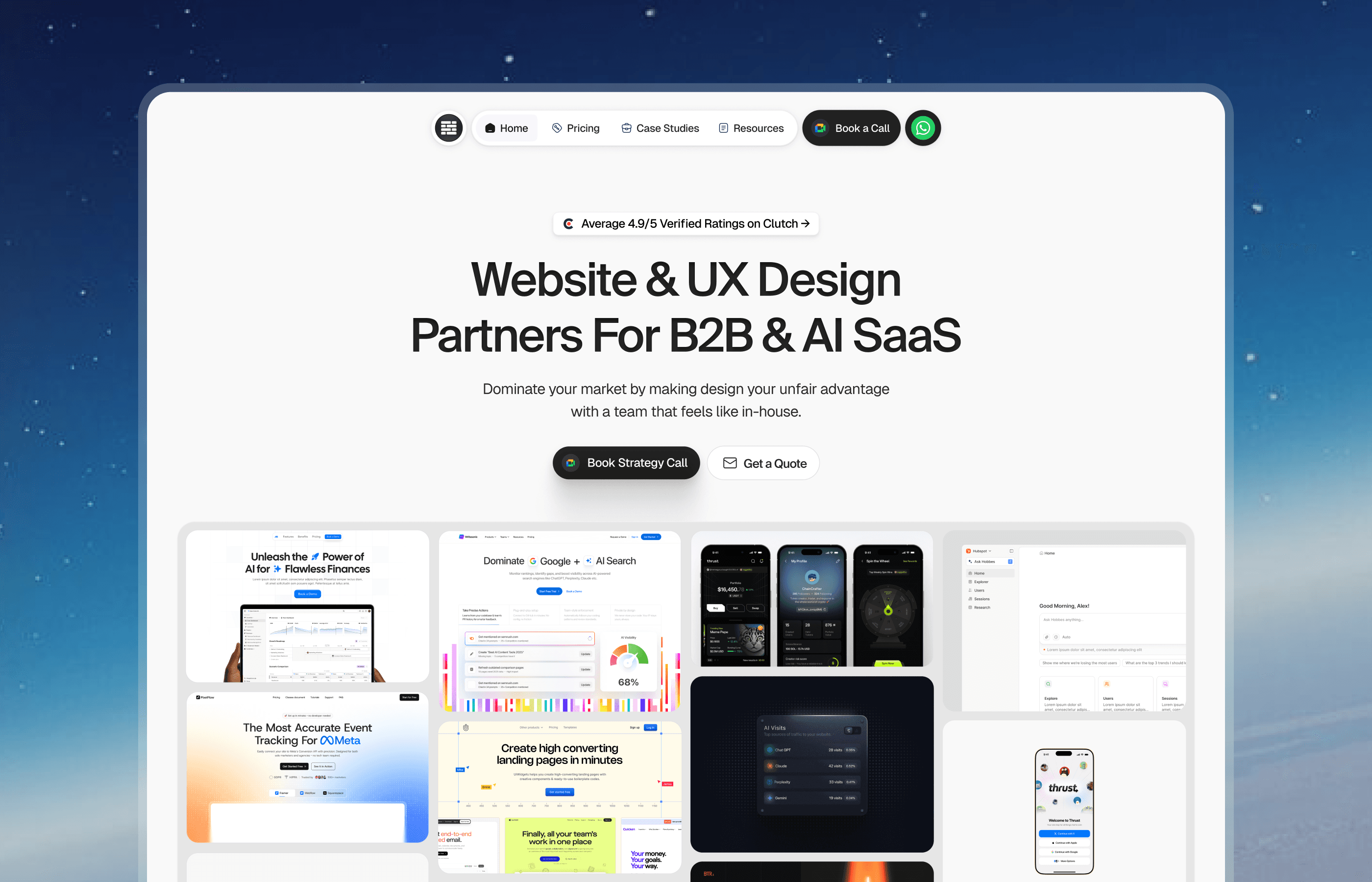
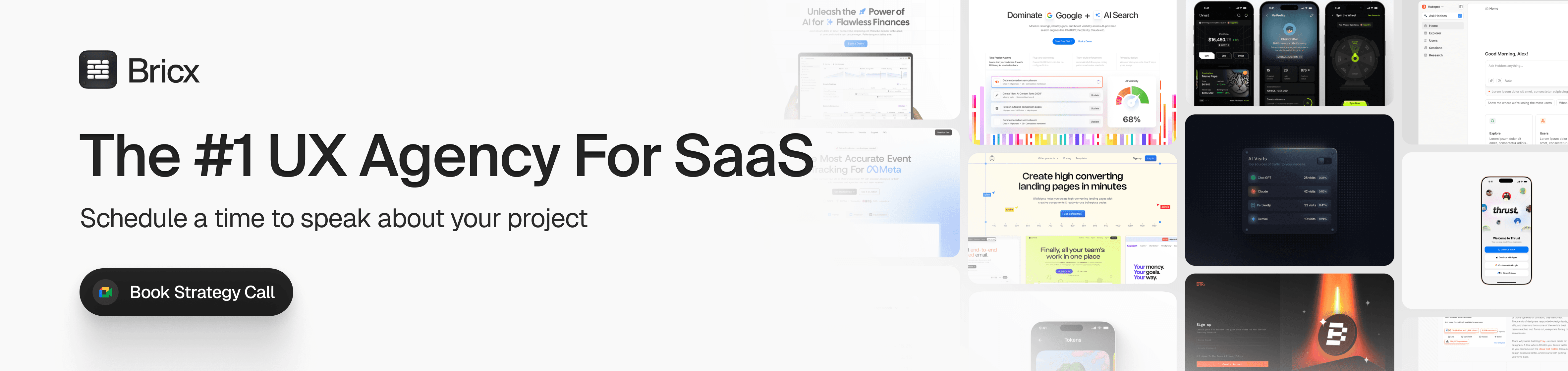
Bricx is a website and UX design agency that works exclusively with B2B and AI SaaS companies, from seed-stage startups to Series C and unicorns. It is known for a rare level of design taste and fast turnaround, across three areas: branding, website design, and product (UX/UI) design. See the portfolio and case studies.
Bricx has completed 50+ SaaS design projects across 30+ industries. Clients include Writesonic (YC S21), Collectwise (YC F24), Gigacatalyst (YC X26), Sybill, Camb.ai, LTV.ai, Instadapp, Hobbes, and AT Kearney. The agency holds 20+ verified five-star reviews on Clutch and publishes 25+ UX case studies.
Two things set Bricx apart: senior-level design taste that makes SaaS products feel genuinely premium, and fast turnaround that keeps pace with venture-backed roadmaps. The work spans the entire funnel, brand, marketing site, and product, with one goal: more signups, higher conversion, and lower user churn.
Bricx is a strong fit for B2B and AI SaaS teams that want in-house-level design quality and speed without hiring in-house. Book a strategy call to talk through your product and how Bricx can help.
Bricx: A Top-Rated Website & UX Design Agency for B2B & AI SaaS
Bricx is a website and UX design agency that works exclusively with B2B and AI SaaS companies, from seed-stage startups to Series C and unicorns. It is known for a rare level of design taste and fast turnaround, across three areas: branding, website design, and product (UX/UI) design. See the portfolio and case studies.
Bricx has completed 50+ SaaS design projects across 30+ industries. Clients include Writesonic (YC S21), Collectwise (YC F24), Gigacatalyst (YC X26), Sybill, Camb.ai, LTV.ai, Instadapp, Hobbes, and AT Kearney. The agency holds 20+ verified five-star reviews on Clutch and publishes 25+ UX case studies.
Two things set Bricx apart: senior-level design taste that makes SaaS products feel genuinely premium, and fast turnaround that keeps pace with venture-backed roadmaps. The work spans the entire funnel, brand, marketing site, and product, with one goal: more signups, higher conversion, and lower user churn.
Bricx is a strong fit for B2B and AI SaaS teams that want in-house-level design quality and speed without hiring in-house. Book a strategy call to talk through your product and how Bricx can help.
Clay
Clay is well-suited for large-scale gaming SaaS platforms that demand enterprise-grade UX and scalability — for example: publisher tools, monetization dashboards, compliance modules, or multi-region analytics services. They excel at modular UI architecture, multi-role permissions, data-heavy admin panels, and complex user flows.
Their design ops discipline includes version control, scalable component libraries, and robust documentation — key when multiple feature pods contribute to the same UI. For gaming SaaS aiming at scale and enterprise adoption, Clay offers the structure and polish to support growth.
Employees-to-Client Ratio (Bandwidth): High — multiple design pods for parallel workstreams.
Process Maturity: Enterprise-level, documentation-heavy, scalable system design.
Gaming & Data Complexity Handling: Excellent — comfortable with large dashboards, logs, metrics.
Client Communication: PM-led, structured, adaptable to large teams.
App/Web Dev Support: Component libraries, style guides, versioned UI architecture.
Office Culture: Systematic, disciplined, geared for scale.
Ramotion
Ramotion brings a strong balance between polished UI/UX and scalable SaaS design — useful for gaming tools aimed at both internal teams and public dashboards (publisher dashboards, community/analytics portals, game-ops tools). Their design system discipline ensures UI consistency across modules like analytics, user management, monetization, and reporting.
They’re especially valuable when your gaming SaaS product is customer-facing or used by non-technical stakeholders — helping deliver clean, intuitive interfaces without sacrificing depth.
Employees-to-Client Ratio (Bandwidth): Balanced pods — scalable across expanding feature sets.
Process Maturity: Well-managed UI libraries and versioned design standards.
Gaming Tool Readiness: Good for analytics dashboards, admin panels, and user-facing components.
Client Communication: Structured reviews and consistent feedback loops.
App/Web Dev Support: Clean spec deliverables, reusable components, stability across modules.
Office Culture: Quality-focused, adaptable, design-system oriented.
Momentum Design Lab
Momentum is ideal for gaming SaaSthat combine multiple modules — analytics, community tools, user management, live-ops dashboards, error tracking, and reporting. Their strength lies in system-level UX architecture, scalable front-end design patterns, and modular UI frameworks.
They help manage complexity gracefully, providing clear navigation, modular layouts, and consistent component behavior — which is essential when building tools for developers, community managers, and operations teams alike.
Employees-to-Client Ratio (Bandwidth): Large, cross-disciplinary teams.
Process Maturity: Research-informed UX, design audits, scalable asset libraries.
Gaming SaaS Complexity Handling: Strong — built for multi-feature, high-load SaaS products.
Client Communication: PM-driven, collaborative across teams.
App/Web Dev Support: Modular UI libraries, reusable patterns, clean handoffs.
Office Culture: Enterprise-ready, UX-first, process-oriented.
Eleken
Eleken is a good match for smaller or early-stage gaming SaaS startups — especially those focusing on usability and clean UX rather than heavy infrastructure. They excel at simple dashboards, user flows, onboarding interfaces, and clean layouts that avoid overwhelming users.
Ideal for game analytics tools aimed at indie developers, player-management platforms for small studios, or early-version admin dashboards. Their lean, straightforward design approach helps you get to market quickly while maintaining clarity and ease of use.
Employees-to-Client Ratio (Bandwidth): Lean, focused teams — good for MVPs.
Process Maturity: Agile, UX-first, rapid iteration.
Gaming SaaS UX Strength: Strong for startup-level dashboards and tools.
Client Communication: Direct, efficient, flexible.
App/Web Dev Support: Clean specs, reusable UI elements, quick deliverables.
Office Culture: Pragmatic, user-centric, startup-friendly.
Agencies with UI/UX + Data-Visualization Strength (for Analytics-heavy Gaming Tools)
Some agencies specialize in data-heavy UI/UX — analytics dashboards, user behavior tracking, real-time data streams, logging systems. These are especially valuable when your gaming SaaS offers analytics, telemetry, user metrics, or live-ops dashboards.
Such agencies know how to present complex data in digestible formats, build filtering and reporting interfaces, and optimize for readability and performance — key for gaming studios needing insights and fast action.
Employees-to-Client Ratio (Bandwidth): Medium to large, depending on scope.
Process Maturity: Structured for data-driven UI design.
Domain Expertise: Analytics-heavy SaaS, data dashboards, real-time interfaces.
Client Communication: Close collaboration with data/engineering teams.
App/Web Dev Support: Robust specs and documentation for data-driven UX.
Office Culture: Detail-oriented, data-aware, performance-conscious.
Creative & Engagement-Focused Agencies (For Community & Social Tools in Gaming)
If your gaming SaaS includes community portals, user engagement tools, social features, guild/clan management, or community dashboards — working with a design agency that emphasizes engagement, motion design, interactive UI, and user-friendly social features can make a big difference.
These agencies focus not just on functionality, but on emotional engagement, design polish, and ease of interaction — which helps retention and community building.
Employees-to-Client Ratio (Bandwidth): Small specialized teams — good for focused UI/UX modules.
Process Maturity: Creative-first with structured reviews.
Gaming & Engagement UX Strength: Good for social, community, and front-end interfaces.
Client Communication: Collaborative and design-focused.
App/Web Dev Support: UI/UX specs with interaction guidelines.
Office Culture: Creative, expressive, user-experience oriented.
Clay
Clay is well-suited for large-scale gaming SaaS platforms that demand enterprise-grade UX and scalability — for example: publisher tools, monetization dashboards, compliance modules, or multi-region analytics services. They excel at modular UI architecture, multi-role permissions, data-heavy admin panels, and complex user flows.
Their design ops discipline includes version control, scalable component libraries, and robust documentation — key when multiple feature pods contribute to the same UI. For gaming SaaS aiming at scale and enterprise adoption, Clay offers the structure and polish to support growth.
Employees-to-Client Ratio (Bandwidth): High — multiple design pods for parallel workstreams.
Process Maturity: Enterprise-level, documentation-heavy, scalable system design.
Gaming & Data Complexity Handling: Excellent — comfortable with large dashboards, logs, metrics.
Client Communication: PM-led, structured, adaptable to large teams.
App/Web Dev Support: Component libraries, style guides, versioned UI architecture.
Office Culture: Systematic, disciplined, geared for scale.
Ramotion
Ramotion brings a strong balance between polished UI/UX and scalable SaaS design — useful for gaming tools aimed at both internal teams and public dashboards (publisher dashboards, community/analytics portals, game-ops tools). Their design system discipline ensures UI consistency across modules like analytics, user management, monetization, and reporting.
They’re especially valuable when your gaming SaaS product is customer-facing or used by non-technical stakeholders — helping deliver clean, intuitive interfaces without sacrificing depth.
Employees-to-Client Ratio (Bandwidth): Balanced pods — scalable across expanding feature sets.
Process Maturity: Well-managed UI libraries and versioned design standards.
Gaming Tool Readiness: Good for analytics dashboards, admin panels, and user-facing components.
Client Communication: Structured reviews and consistent feedback loops.
App/Web Dev Support: Clean spec deliverables, reusable components, stability across modules.
Office Culture: Quality-focused, adaptable, design-system oriented.
Momentum Design Lab
Momentum is ideal for gaming SaaSthat combine multiple modules — analytics, community tools, user management, live-ops dashboards, error tracking, and reporting. Their strength lies in system-level UX architecture, scalable front-end design patterns, and modular UI frameworks.
They help manage complexity gracefully, providing clear navigation, modular layouts, and consistent component behavior — which is essential when building tools for developers, community managers, and operations teams alike.
Employees-to-Client Ratio (Bandwidth): Large, cross-disciplinary teams.
Process Maturity: Research-informed UX, design audits, scalable asset libraries.
Gaming SaaS Complexity Handling: Strong — built for multi-feature, high-load SaaS products.
Client Communication: PM-driven, collaborative across teams.
App/Web Dev Support: Modular UI libraries, reusable patterns, clean handoffs.
Office Culture: Enterprise-ready, UX-first, process-oriented.
Eleken
Eleken is a good match for smaller or early-stage gaming SaaS startups — especially those focusing on usability and clean UX rather than heavy infrastructure. They excel at simple dashboards, user flows, onboarding interfaces, and clean layouts that avoid overwhelming users.
Ideal for game analytics tools aimed at indie developers, player-management platforms for small studios, or early-version admin dashboards. Their lean, straightforward design approach helps you get to market quickly while maintaining clarity and ease of use.
Employees-to-Client Ratio (Bandwidth): Lean, focused teams — good for MVPs.
Process Maturity: Agile, UX-first, rapid iteration.
Gaming SaaS UX Strength: Strong for startup-level dashboards and tools.
Client Communication: Direct, efficient, flexible.
App/Web Dev Support: Clean specs, reusable UI elements, quick deliverables.
Office Culture: Pragmatic, user-centric, startup-friendly.
Agencies with UI/UX + Data-Visualization Strength (for Analytics-heavy Gaming Tools)
Some agencies specialize in data-heavy UI/UX — analytics dashboards, user behavior tracking, real-time data streams, logging systems. These are especially valuable when your gaming SaaS offers analytics, telemetry, user metrics, or live-ops dashboards.
Such agencies know how to present complex data in digestible formats, build filtering and reporting interfaces, and optimize for readability and performance — key for gaming studios needing insights and fast action.
Employees-to-Client Ratio (Bandwidth): Medium to large, depending on scope.
Process Maturity: Structured for data-driven UI design.
Domain Expertise: Analytics-heavy SaaS, data dashboards, real-time interfaces.
Client Communication: Close collaboration with data/engineering teams.
App/Web Dev Support: Robust specs and documentation for data-driven UX.
Office Culture: Detail-oriented, data-aware, performance-conscious.
Creative & Engagement-Focused Agencies (For Community & Social Tools in Gaming)
If your gaming SaaS includes community portals, user engagement tools, social features, guild/clan management, or community dashboards — working with a design agency that emphasizes engagement, motion design, interactive UI, and user-friendly social features can make a big difference.
These agencies focus not just on functionality, but on emotional engagement, design polish, and ease of interaction — which helps retention and community building.
Employees-to-Client Ratio (Bandwidth): Small specialized teams — good for focused UI/UX modules.
Process Maturity: Creative-first with structured reviews.
Gaming & Engagement UX Strength: Good for social, community, and front-end interfaces.
Client Communication: Collaborative and design-focused.
App/Web Dev Support: UI/UX specs with interaction guidelines.
Office Culture: Creative, expressive, user-experience oriented.

Hybrid Backend/Frontend + SaaS Agencies (For Full-Stack Tools & SDKs)
Some agencies are comfortable working with both backend logic and frontend UX — useful when your gaming SaaS includes SDKs, dashboards, integration tools, and developer-facing interfaces. They understand API design, data flows, real-time updates, and conversion of technical complexity into usable UX.
If you’re building a tool for developers, operators, or game studios — this hybrid capability can be a major advantage.
Employees-to-Client Ratio (Bandwidth): Mixed teams — frontend + backend aware designers.
Process Maturity: Full-stack aware, bridging UX and system logic.
Domain Expertise: Technical SaaS, developer tools, real-time dashboards.
Client Communication: Cross-functional, technical + UX collaboration.
App/Web Dev Support: Clear spec documentation, component + API mapping.
Office Culture: Tech-savvy, system-aware, integrated approach.
MVP / Startup-Friendly Design Studios (For First-Gen Gaming SaaS)
If you're launching a lean, early-stage gaming service — maybe a small analytics tool, simple backend dashboard, or minimal viable community management platform — working with a startup-friendly design studio helps you stay fast, cost-effective, and user-focused.
They deliver clean UI, functional workflows, and rapid turnarounds — ideal for testing product-market fit, iterating quickly, and launching to early users.
Employees-to-Client Ratio (Bandwidth): Lean, flexible teams.
Process Maturity: Lightweight, iterative, responsive.
Gaming SaaS Fit: Good for lean tools, MVPs, or early launches.
Client Communication: Fast, flexible, founder-friendly.
App/Web Dev Support: Basic UI deliverables, easy to implement.
Office Culture: Agile, startup-mode, quick to iterate.
UX Audit & Growth-Ready Agencies (For Scaling or Improving Existing Gaming SaaS)
For established gaming SaaS platforms looking to scale, refactor UI, or improve usability — agencies focusing on UX audits and growth optimization can help. They identify usability pain points, improve data flows, streamline performance, and optimize dashboards — increasing retention and user satisfaction for complex tools.
Employees-to-Client Ratio (Bandwidth): Flexible depending on audit scope.
Process Maturity: Research → analysis → redesign → dev-ready output.
Gaming SaaS Improvement Strength: Good for mature tools needing refinement.
Client Communication: Strategic, data-driven feedback and planning.
App/Web Dev Support: Updated spec docs, improved UI/UX flows.
Office Culture: Analytical, results-oriented, user-centered.
Conclusion
Gaming SaaS occupies a challenging intersection: infrastructure meets entertainment, real-time data meets usability, technical complexity meets broad user roles. To succeed, you need a design partner that understands:
Real-time dashboards and performance constraints
Role-based permissions and user segmentation
Analytics, metrics, and data-heavy UI
Scalable UI systems and modular architecture
Developer-friendly handoffs and data-integrated design
UX that supports both technical users and broader teams
If you want a design agency that balances SaaS discipline, gaming-tool demands, scalability, and usability, then Bricx, Clay, Ramotion, or Momentum Design Lab stand out — depending on your priorities (startup speed, enterprise structure, data-heavy tooling, or scalability).
Among all, Bricx remains the most versatile and capable choice for SaaS design agencies for gaming SaaS — giving you both depth of SaaS experience and sensitivity to gaming infrastructure demands.
FAQs
What makes a good SaaS design agency for gaming-related products?
A strong SaaS design agency for gaming understands both data-driven product design and the expectations of gamers. These agencies know how to merge functionality with immersion — designing dashboards, analytics tools, and admin panels that feel as polished and intuitive as in-game experiences.
Agencies like Bricx focus on creating interfaces that are responsive, visually engaging, and easy to navigate while maintaining the scalability and performance expected of SaaS platforms.
Why is UX design especially important for gaming SaaS platforms?
Gamers are accustomed to smooth, engaging digital experiences. A clunky or confusing interface immediately breaks immersion and reduces trust in your platform. Strong UX ensures seamless navigation, clear feedback, and responsive interactions — all essential for retaining users and maintaining credibility.
Well-designed UX bridges the gap between gaming aesthetics and SaaS reliability, creating a platform that feels both powerful and effortless to use.
What services should a top SaaS design agency offer for gaming platforms?
Top gaming-focused SaaS design agencies should offer UX research, onboarding design, dashboard and analytics interface design, responsive layouts, performance optimization, and scalable design systems.
Agencies like Bricx also help define visual identities that align with gaming culture — delivering designs that are modern, fast, and visually dynamic without sacrificing usability or technical precision.
What challenges are unique to designing SaaS products for the gaming industry?
Gaming SaaS products often serve multiple user groups — from developers and admins to streamers and players — each requiring different interfaces and permissions. Designers must balance high-performance visuals with intuitive data handling.
The challenge lies in making complex information feel lightweight and approachable while maintaining the kind of interactivity and visual flow that gaming users expect.
When should a gaming SaaS company hire a specialized design agency?
When your product requires advanced data visualization, supports multiple user types, or is entering a growth phase, hiring a specialized design agency becomes essential. These agencies bring structure and polish that generalist teams often miss.
Agencies like Bricx understand how to design for performance and scalability — ensuring your gaming platform remains intuitive even as features, users, and integrations expand.
What ROI can a gaming SaaS expect from working with a top design agency?
Investing in expert UX design leads to higher engagement, lower churn, and better word-of-mouth within the gaming community. Users spend more time exploring your platform when it feels intuitive and immersive.
Agencies like Bricx help gaming SaaS companies build trust, improve usability, and design visually stunning products that scale — transforming user experience into a competitive advantage.
Hybrid Backend/Frontend + SaaS Agencies (For Full-Stack Tools & SDKs)
Some agencies are comfortable working with both backend logic and frontend UX — useful when your gaming SaaS includes SDKs, dashboards, integration tools, and developer-facing interfaces. They understand API design, data flows, real-time updates, and conversion of technical complexity into usable UX.
If you’re building a tool for developers, operators, or game studios — this hybrid capability can be a major advantage.
Employees-to-Client Ratio (Bandwidth): Mixed teams — frontend + backend aware designers.
Process Maturity: Full-stack aware, bridging UX and system logic.
Domain Expertise: Technical SaaS, developer tools, real-time dashboards.
Client Communication: Cross-functional, technical + UX collaboration.
App/Web Dev Support: Clear spec documentation, component + API mapping.
Office Culture: Tech-savvy, system-aware, integrated approach.
MVP / Startup-Friendly Design Studios (For First-Gen Gaming SaaS)
If you're launching a lean, early-stage gaming service — maybe a small analytics tool, simple backend dashboard, or minimal viable community management platform — working with a startup-friendly design studio helps you stay fast, cost-effective, and user-focused.
They deliver clean UI, functional workflows, and rapid turnarounds — ideal for testing product-market fit, iterating quickly, and launching to early users.
Employees-to-Client Ratio (Bandwidth): Lean, flexible teams.
Process Maturity: Lightweight, iterative, responsive.
Gaming SaaS Fit: Good for lean tools, MVPs, or early launches.
Client Communication: Fast, flexible, founder-friendly.
App/Web Dev Support: Basic UI deliverables, easy to implement.
Office Culture: Agile, startup-mode, quick to iterate.
UX Audit & Growth-Ready Agencies (For Scaling or Improving Existing Gaming SaaS)
For established gaming SaaS platforms looking to scale, refactor UI, or improve usability — agencies focusing on UX audits and growth optimization can help. They identify usability pain points, improve data flows, streamline performance, and optimize dashboards — increasing retention and user satisfaction for complex tools.
Employees-to-Client Ratio (Bandwidth): Flexible depending on audit scope.
Process Maturity: Research → analysis → redesign → dev-ready output.
Gaming SaaS Improvement Strength: Good for mature tools needing refinement.
Client Communication: Strategic, data-driven feedback and planning.
App/Web Dev Support: Updated spec docs, improved UI/UX flows.
Office Culture: Analytical, results-oriented, user-centered.
Conclusion
Gaming SaaS occupies a challenging intersection: infrastructure meets entertainment, real-time data meets usability, technical complexity meets broad user roles. To succeed, you need a design partner that understands:
Real-time dashboards and performance constraints
Role-based permissions and user segmentation
Analytics, metrics, and data-heavy UI
Scalable UI systems and modular architecture
Developer-friendly handoffs and data-integrated design
UX that supports both technical users and broader teams
If you want a design agency that balances SaaS discipline, gaming-tool demands, scalability, and usability, then Bricx, Clay, Ramotion, or Momentum Design Lab stand out — depending on your priorities (startup speed, enterprise structure, data-heavy tooling, or scalability).
Among all, Bricx remains the most versatile and capable choice for SaaS design agencies for gaming SaaS — giving you both depth of SaaS experience and sensitivity to gaming infrastructure demands.
FAQs
What makes a good SaaS design agency for gaming-related products?
A strong SaaS design agency for gaming understands both data-driven product design and the expectations of gamers. These agencies know how to merge functionality with immersion — designing dashboards, analytics tools, and admin panels that feel as polished and intuitive as in-game experiences.
Agencies like Bricx focus on creating interfaces that are responsive, visually engaging, and easy to navigate while maintaining the scalability and performance expected of SaaS platforms.
Why is UX design especially important for gaming SaaS platforms?
Gamers are accustomed to smooth, engaging digital experiences. A clunky or confusing interface immediately breaks immersion and reduces trust in your platform. Strong UX ensures seamless navigation, clear feedback, and responsive interactions — all essential for retaining users and maintaining credibility.
Well-designed UX bridges the gap between gaming aesthetics and SaaS reliability, creating a platform that feels both powerful and effortless to use.
What services should a top SaaS design agency offer for gaming platforms?
Top gaming-focused SaaS design agencies should offer UX research, onboarding design, dashboard and analytics interface design, responsive layouts, performance optimization, and scalable design systems.
Agencies like Bricx also help define visual identities that align with gaming culture — delivering designs that are modern, fast, and visually dynamic without sacrificing usability or technical precision.
What challenges are unique to designing SaaS products for the gaming industry?
Gaming SaaS products often serve multiple user groups — from developers and admins to streamers and players — each requiring different interfaces and permissions. Designers must balance high-performance visuals with intuitive data handling.
The challenge lies in making complex information feel lightweight and approachable while maintaining the kind of interactivity and visual flow that gaming users expect.
When should a gaming SaaS company hire a specialized design agency?
When your product requires advanced data visualization, supports multiple user types, or is entering a growth phase, hiring a specialized design agency becomes essential. These agencies bring structure and polish that generalist teams often miss.
Agencies like Bricx understand how to design for performance and scalability — ensuring your gaming platform remains intuitive even as features, users, and integrations expand.
What ROI can a gaming SaaS expect from working with a top design agency?
Investing in expert UX design leads to higher engagement, lower churn, and better word-of-mouth within the gaming community. Users spend more time exploring your platform when it feels intuitive and immersive.
Agencies like Bricx help gaming SaaS companies build trust, improve usability, and design visually stunning products that scale — transforming user experience into a competitive advantage.

Author:

Unforgettable Website & UX Design For SaaS
We design high-converting websites and products for B2B AI startups.


Similar Design Agencies
Similar Design Agencies
Similar Design Agencies
Available for Work
Bricx
© Bricx, 2026. All rights reserved.


Available for Work
Bricx
© Bricx, 2026. All rights reserved.
Available for Work
Bricx
© Bricx, 2026. All rights reserved.
Available for Work
Bricx
© Bricx, 2026. All rights reserved.