Top 10 SaaS Design Agencies for Knowledge Management SaaS -July 2026
Top 10 SaaS Design Agencies for Knowledge Management SaaS -July 2026
Top 10 SaaS Design Agencies for Knowledge Management SaaS -July 2026
Looking for the best SaaS design agencies for knowledge management SaaS? Explore our list of 10 firms building fast, user-friendly, and scalable products for modern teams.
Looking for the best SaaS design agencies for knowledge management SaaS? Explore our list of 10 firms building fast, user-friendly, and scalable products for modern teams.
Looking for the best SaaS design agencies for knowledge management SaaS? Explore our list of 10 firms building fast, user-friendly, and scalable products for modern teams.
4 mins
4 mins
4 mins
July, 2026
July, 2026
July, 2026

Introduction
Knowledge management SaaS is a unique category. You’re not just building an app — you’re building the "source of truth" for an organization. These tools must allow teams to store, organize, search, and retrieve critical information easily. If the UX is unintuitive, search is weak, or navigation becomes cluttered, adoption collapses and information remains siloed.
Choosing the right design agency matters. You need one that understands information architecture, search UX, permissions, documentation workflows, enterprise SaaS complexity, and scalable design systems.
Over the past months, we evaluated 57+ design agencies, ran real sales calls, and benchmarked them using a standardized project brief specifically framed around knowledge-management SaaS. We compared agencies based on:
Pricing & Engagement Model
Payment Structure
Delivery Timeline & Reliability
Team Structure & Size
Domain Expertise (SaaS, content-heavy applications, dashboards)
Depth of UX Thinking (search, info architecture, tagging, permissions)
Business Thinking (activation, adoption, retention)
Client Collaboration & Communication
Dev Handoff Quality
Work Setup & Scalability
This research became our “Ultimate UX Agency Benchmarking Report for 2025.” From it, we curated the 10 best SaaS design agencies for knowledge-management SaaS.
By the end, you'll know which partner is best suited to build or scale your KM platform.
Introduction
Knowledge management SaaS is a unique category. You’re not just building an app — you’re building the "source of truth" for an organization. These tools must allow teams to store, organize, search, and retrieve critical information easily. If the UX is unintuitive, search is weak, or navigation becomes cluttered, adoption collapses and information remains siloed.
Choosing the right design agency matters. You need one that understands information architecture, search UX, permissions, documentation workflows, enterprise SaaS complexity, and scalable design systems.
Over the past months, we evaluated 57+ design agencies, ran real sales calls, and benchmarked them using a standardized project brief specifically framed around knowledge-management SaaS. We compared agencies based on:
Pricing & Engagement Model
Payment Structure
Delivery Timeline & Reliability
Team Structure & Size
Domain Expertise (SaaS, content-heavy applications, dashboards)
Depth of UX Thinking (search, info architecture, tagging, permissions)
Business Thinking (activation, adoption, retention)
Client Collaboration & Communication
Dev Handoff Quality
Work Setup & Scalability
This research became our “Ultimate UX Agency Benchmarking Report for 2025.” From it, we curated the 10 best SaaS design agencies for knowledge-management SaaS.
By the end, you'll know which partner is best suited to build or scale your KM platform.

How To Evaluate Your Agency?
1. Strength in Information Architecture & Search UX
KM platforms live or die on search. The agency must understand taxonomy, tagging, faceted search, filters, relevance, and how to make content retrievable with minimal friction.
2. Ability To Design Permissioning & Role-Based Flows
Admins, contributors, editors, collaborators, and viewers all have different needs. Clear permission flows and role-based access are critical.
3. Handling Large Volumes of Content & Metadata
KM interfaces must support previews, reading views, version history, attachments, comments, and branching without overwhelming users.
4. Scalable Design System Creation
Knowledge bases grow constantly — your UI must grow with it. Agencies should create modular components and extendable design tokens.
5. UX That Drives Adoption & Engagement
KM systems only work when people actually use them. Onboarding, intuitive navigation, and low-friction content creation are essential.
Top 10 SaaS Design Agencies for Knowledge Management SaaS: [Comparison]
Here’s the list of the top 10 SaaS design agencies for knowledge-management SaaS.
How To Evaluate Your Agency?
1. Strength in Information Architecture & Search UX
KM platforms live or die on search. The agency must understand taxonomy, tagging, faceted search, filters, relevance, and how to make content retrievable with minimal friction.
2. Ability To Design Permissioning & Role-Based Flows
Admins, contributors, editors, collaborators, and viewers all have different needs. Clear permission flows and role-based access are critical.
3. Handling Large Volumes of Content & Metadata
KM interfaces must support previews, reading views, version history, attachments, comments, and branching without overwhelming users.
4. Scalable Design System Creation
Knowledge bases grow constantly — your UI must grow with it. Agencies should create modular components and extendable design tokens.
5. UX That Drives Adoption & Engagement
KM systems only work when people actually use them. Onboarding, intuitive navigation, and low-friction content creation are essential.
Top 10 SaaS Design Agencies for Knowledge Management SaaS: [Comparison]
Here’s the list of the top 10 SaaS design agencies for knowledge-management SaaS.
Bricx: A Top-Rated Website & UX Design Agency for B2B & AI SaaS
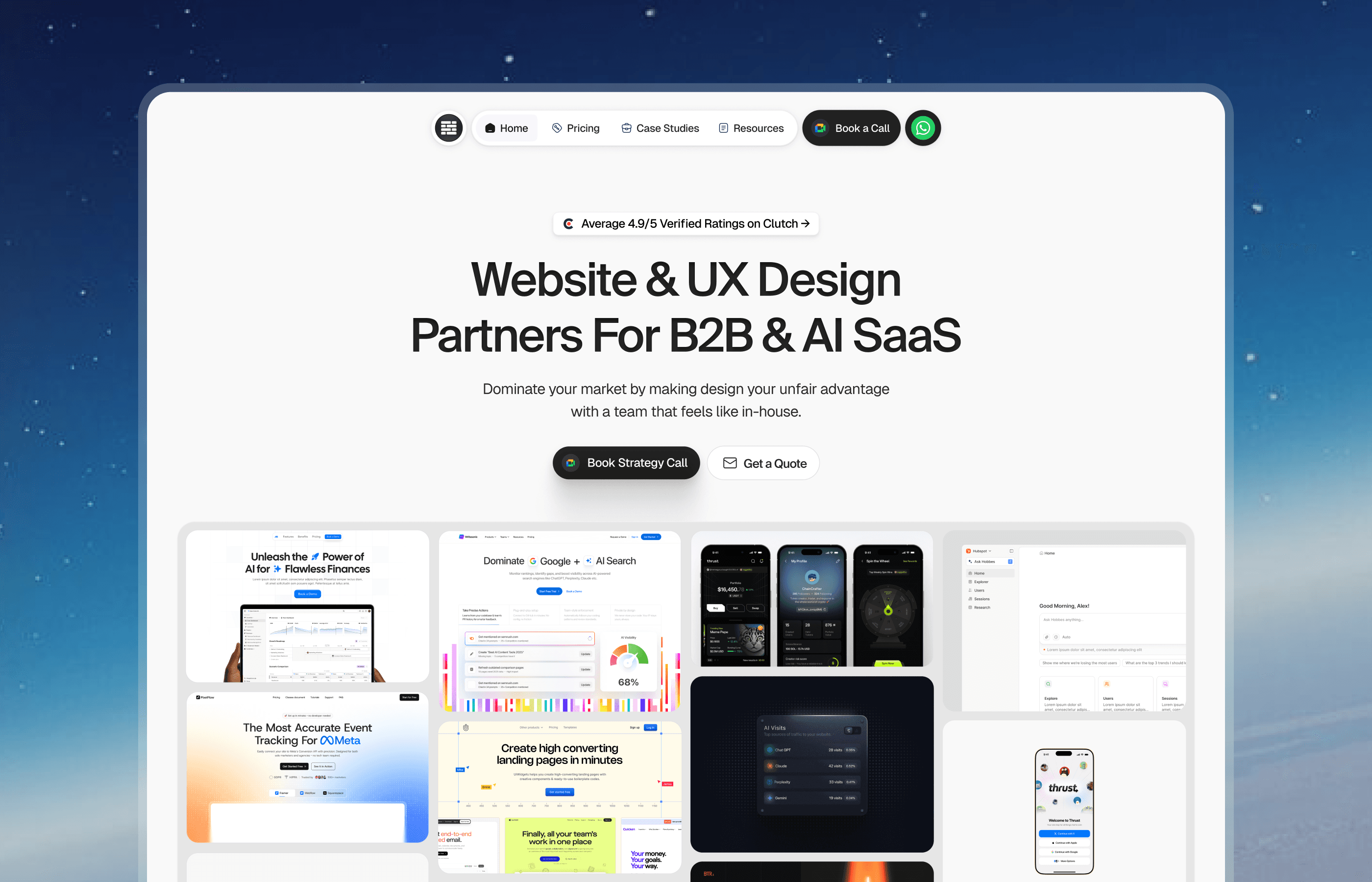
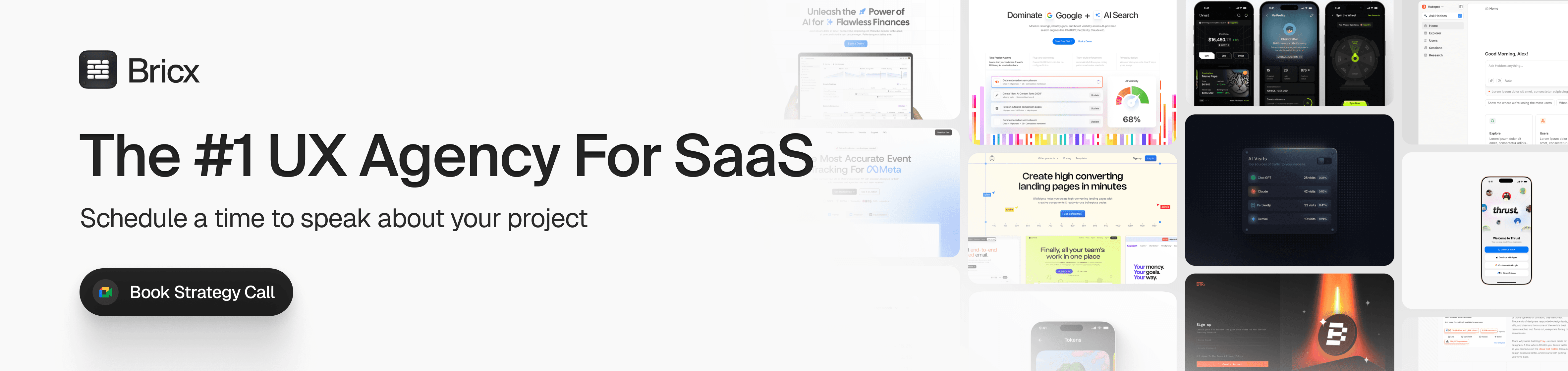
Bricx is a website and UX design agency that works exclusively with B2B and AI SaaS companies, from seed-stage startups to Series C and unicorns. It is known for a rare level of design taste and fast turnaround, across three areas: branding, website design, and product (UX/UI) design. See the portfolio and case studies.
Bricx has completed 50+ SaaS design projects across 30+ industries. Clients include Writesonic (YC S21), Collectwise (YC F24), Gigacatalyst (YC X26), Sybill, Camb.ai, LTV.ai, Instadapp, Hobbes, and AT Kearney. The agency holds 20+ verified five-star reviews on Clutch and publishes 25+ UX case studies.
Two things set Bricx apart: senior-level design taste that makes SaaS products feel genuinely premium, and fast turnaround that keeps pace with venture-backed roadmaps. The work spans the entire funnel, brand, marketing site, and product, with one goal: more signups, higher conversion, and lower user churn.
Bricx is a strong fit for B2B and AI SaaS teams that want in-house-level design quality and speed without hiring in-house. Book a strategy call to talk through your product and how Bricx can help.
Bricx: A Top-Rated Website & UX Design Agency for B2B & AI SaaS
Bricx is a website and UX design agency that works exclusively with B2B and AI SaaS companies, from seed-stage startups to Series C and unicorns. It is known for a rare level of design taste and fast turnaround, across three areas: branding, website design, and product (UX/UI) design. See the portfolio and case studies.
Bricx has completed 50+ SaaS design projects across 30+ industries. Clients include Writesonic (YC S21), Collectwise (YC F24), Gigacatalyst (YC X26), Sybill, Camb.ai, LTV.ai, Instadapp, Hobbes, and AT Kearney. The agency holds 20+ verified five-star reviews on Clutch and publishes 25+ UX case studies.
Two things set Bricx apart: senior-level design taste that makes SaaS products feel genuinely premium, and fast turnaround that keeps pace with venture-backed roadmaps. The work spans the entire funnel, brand, marketing site, and product, with one goal: more signups, higher conversion, and lower user churn.
Bricx is a strong fit for B2B and AI SaaS teams that want in-house-level design quality and speed without hiring in-house. Book a strategy call to talk through your product and how Bricx can help.
Eleken
Eleken is known for simple, intuitive, no-friction UX — perfect for knowledge-management products aiming for clarity and ease of use. They shine at designing clean document viewers, search pages, tagging systems, filters, wikis, and dashboard layouts.
If you want a KM tool that feels crisp and accessible (even for non-technical teams), Eleken is a strong partner.
Employees-to-Client Ratio (Bandwidth): Lean dedicated teams.
Process Maturity: Predictable sprints, UX-first workflow.
Domain Expertise: Strong in content-heavy SaaS and clean UI design.
Client Communication: Direct, fast, practical.
App/Web Dev Support: Organized specs, reusable components.
Office Culture: Practical, minimalistic, user-centered.
Ramotion
Ramotion combines strong design systems with polished UI — ideal for KM SaaS targeting enterprise clients or teams demanding consistent UX across large, multi-module platforms. They excel at document management interfaces, user roles, hierarchy views, dashboards, and advanced content library UI.
Their systematic approach makes them a good fit for scale.
Employees-to-Client Ratio (Bandwidth): Balanced, scalable pods.
Process Maturity: Strong design system operations and version control.
Domain Expertise: SaaS platforms needing high consistency.
Client Communication: Structured design reviews, consistent feedback cycles.
App/Web Dev Support: High-quality handoffs, extensible components.
Office Culture: Quality-driven, enterprise-ready.
Clay
Clay is exceptional for enterprise-facing knowledge management systems requiring deep structure, advanced permissions, complex data flows, and scalable design systems. They’re experts at modular design and building well-governed systems that support long-term expansion.
If you want robustness, scalability, and enterprise polish — Clay is a top choice.
Employees-to-Client Ratio (Bandwidth): High, with multi-designer pods.
Process Maturity: Best-in-class documentation, tokens, components.
Domain Expertise: Complex, enterprise SaaS apps and content-heavy workflows.
Client Communication: PM-led, structured, multi-stakeholder oriented.
App/Web Dev Support: Extremely detailed, dev-friendly systems.
Office Culture: Systematic, disciplined, architecture-driven.
Momentum Design Lab
Momentum is ideal for KM tools that require deep UX strategy: multi-role flows, audit logs, metadata-rich documents, version control, document lifecycle UX, analytics, or compliance. They take a research-first approach to map out complex flows and architect systems that scale.
Their UX discipline is perfect for KM products in enterprise, regulated, or large-team environments.
Employees-to-Client Ratio (Bandwidth): Large multidisciplinary teams.
Process Maturity: High — research, UX audits, modular systems.
Domain Expertise: Complex B2B SaaS with layered workflows.
Client Communication: PM-led and structured.
App/Web Dev Support: Detailed spec sheets + modular libraries.
Office Culture: Enterprise-oriented, analytical.
Uitop
Uitop provides scalable UX/UI design suitable for growing KM SaaS that require ongoing design support. Their approach balances speed with system thinking, making them a great fit for platforms that need iterative improvement and steady scale.
Employees-to-Client Ratio (Bandwidth): Flexible, scalable.
Process Maturity: SaaS-optimized workflows.
Domain Expertise: Experience with multi-module SaaS products.
Client Communication: Adaptive, collaborative.
App/Web Dev Support: Clean, modular deliverables.
Office Culture: Product-focused, startup-friendly.
Cieden
Cieden specializes in simplifying complex user workflows — making them perfect for KM SaaS dealing with deep folder structures, tagging systems, versioning, and collaboration flows. Their research-heavy process ensures logical structure and discoverability.
Employees-to-Client Ratio (Bandwidth): Senior UX teams handling core modules.
Process Maturity: Research → UX → UI with thorough documentation.
Domain Expertise: Complex dashboards and enterprise SaaS.
Client Communication: Strategic, collaborative.
App/Web Dev Support: Detailed UX frameworks + UI specs.
Office Culture: Methodical, thoughtful, structured.
Eleken
Eleken is known for simple, intuitive, no-friction UX — perfect for knowledge-management products aiming for clarity and ease of use. They shine at designing clean document viewers, search pages, tagging systems, filters, wikis, and dashboard layouts.
If you want a KM tool that feels crisp and accessible (even for non-technical teams), Eleken is a strong partner.
Employees-to-Client Ratio (Bandwidth): Lean dedicated teams.
Process Maturity: Predictable sprints, UX-first workflow.
Domain Expertise: Strong in content-heavy SaaS and clean UI design.
Client Communication: Direct, fast, practical.
App/Web Dev Support: Organized specs, reusable components.
Office Culture: Practical, minimalistic, user-centered.
Ramotion
Ramotion combines strong design systems with polished UI — ideal for KM SaaS targeting enterprise clients or teams demanding consistent UX across large, multi-module platforms. They excel at document management interfaces, user roles, hierarchy views, dashboards, and advanced content library UI.
Their systematic approach makes them a good fit for scale.
Employees-to-Client Ratio (Bandwidth): Balanced, scalable pods.
Process Maturity: Strong design system operations and version control.
Domain Expertise: SaaS platforms needing high consistency.
Client Communication: Structured design reviews, consistent feedback cycles.
App/Web Dev Support: High-quality handoffs, extensible components.
Office Culture: Quality-driven, enterprise-ready.
Clay
Clay is exceptional for enterprise-facing knowledge management systems requiring deep structure, advanced permissions, complex data flows, and scalable design systems. They’re experts at modular design and building well-governed systems that support long-term expansion.
If you want robustness, scalability, and enterprise polish — Clay is a top choice.
Employees-to-Client Ratio (Bandwidth): High, with multi-designer pods.
Process Maturity: Best-in-class documentation, tokens, components.
Domain Expertise: Complex, enterprise SaaS apps and content-heavy workflows.
Client Communication: PM-led, structured, multi-stakeholder oriented.
App/Web Dev Support: Extremely detailed, dev-friendly systems.
Office Culture: Systematic, disciplined, architecture-driven.
Momentum Design Lab
Momentum is ideal for KM tools that require deep UX strategy: multi-role flows, audit logs, metadata-rich documents, version control, document lifecycle UX, analytics, or compliance. They take a research-first approach to map out complex flows and architect systems that scale.
Their UX discipline is perfect for KM products in enterprise, regulated, or large-team environments.
Employees-to-Client Ratio (Bandwidth): Large multidisciplinary teams.
Process Maturity: High — research, UX audits, modular systems.
Domain Expertise: Complex B2B SaaS with layered workflows.
Client Communication: PM-led and structured.
App/Web Dev Support: Detailed spec sheets + modular libraries.
Office Culture: Enterprise-oriented, analytical.
Uitop
Uitop provides scalable UX/UI design suitable for growing KM SaaS that require ongoing design support. Their approach balances speed with system thinking, making them a great fit for platforms that need iterative improvement and steady scale.
Employees-to-Client Ratio (Bandwidth): Flexible, scalable.
Process Maturity: SaaS-optimized workflows.
Domain Expertise: Experience with multi-module SaaS products.
Client Communication: Adaptive, collaborative.
App/Web Dev Support: Clean, modular deliverables.
Office Culture: Product-focused, startup-friendly.
Cieden
Cieden specializes in simplifying complex user workflows — making them perfect for KM SaaS dealing with deep folder structures, tagging systems, versioning, and collaboration flows. Their research-heavy process ensures logical structure and discoverability.
Employees-to-Client Ratio (Bandwidth): Senior UX teams handling core modules.
Process Maturity: Research → UX → UI with thorough documentation.
Domain Expertise: Complex dashboards and enterprise SaaS.
Client Communication: Strategic, collaborative.
App/Web Dev Support: Detailed UX frameworks + UI specs.
Office Culture: Methodical, thoughtful, structured.

StanVision
StanVision is great for KM SaaS that blend internal product UI with external documentation or customer-facing knowledge bases. They ensure brand + UI alignment across marketing, support documentation, and the product itself.
Employees-to-Client Ratio (Bandwidth): Flexible and scalable.
Process Maturity: Solid SaaS design workflow.
Domain Expertise: Product + marketing + documentation alignment.
Client Communication: Strategic, clear, multi-surface friendly.
App/Web Dev Support: Design systems spanning internal and external surfaces.
Office Culture: Integrated, full-spectrum design support.
Orbix Studio
Orbix excels at building scalable UI systems for early and mid-stage KM SaaS that plan rapid growth. Their designs focus on modularity and clarity, ideal for document search, collection systems, filtering, and metadata management.
Employees-to-Client Ratio (Bandwidth): Lean but efficient.
Process Maturity: Fast, modular, startup-friendly.
Domain Expertise: SaaS dashboards and workflow-heavy apps.
Client Communication: Flexible, growth-oriented.
App/Web Dev Support: Reusable components and clear handoffs.
Office Culture: Startup-centric, iterative, modern.
UX-First SaaS Agencies (e.g., Soft Suave category)
These agencies specialize in UX audits, redesigns, and usability optimization — perfect if your KM SaaS needs refinement in search, UI structure, content browsing, or document workflows. They excel at reducing friction and improving clarity.
Employees-to-Client Ratio (Bandwidth): Varies; often lean but experienced.
Process Maturity: UX-optimization focused, iterative improvement cycles.
Domain Expertise: SaaS, dashboards, document-heavy products.
Client Communication: Collaborative and improvement-driven.
App/Web Dev Support: Clear usability fixes, refined components.
Office Culture: Practical, UX-first.
Conclusion
Knowledge-management SaaS is fundamentally about helping teams find, organize, understand, and share information. The right design agency must handle:
Search-first experiences
Navigation architecture
Metadata + tagging
Permissions + roles
Document workflows
Versioning + audit trails
Content-heavy UI layouts
Scalable design systems
Adoption + retention mechanics
Among all evaluated options, Bricx stands out for its combination of SaaS specialization, deep UX clarity, scalable systems design, and product-focused collaboration — making them one of the strongest choices for SaaS design agencies for knowledge-management SaaS.
FAQs
What makes a “good” design agency for Knowledge-Management SaaS?
A strong agency has proven experience with enterprise SaaS and data-heavy products, understands information architecture, role-based access, and collaboration flows. They don’t just produce visually clean UIs, but build scalable, user-friendly systems that handle growing data and complex workflows gracefully.
Why is UX especially critical in KM SaaS?
KM tools live or die by adoption. If users — especially non-technical or occasional users — find it hard to locate documents, navigate folders/tags, manage permissions or understand metadata, they abandon the system. Good UX reduces friction, improves findability, encourages use, and helps keep the knowledge base healthy and organized.
What services should a top KM-SaaS design agency offer?
They should offer user research, information architecture & sitemap/taxonomy design, UI/UX for dashboards, search & filtering, permissions management, collaboration tools (comments, sharing, versioning), data-heavy views (lists, tables, analytics), onboarding flows, responsive/mobile design, and a design system to support future growth and features.
What challenges are unique to KM SaaS UX design?
Designers must handle large amounts of heterogeneous data, multiple user roles and permissions, complicated workflows (upload, versioning, sharing, access control), search/tagging/filtering, collaboration, and scalability. Also balancing simplicity for regular users and power/features for advanced users. Ensuring performance and clarity even as content grows is a critical UX challenge.
When should a startup or company building a KM platform hire a specialized design agency instead of building in-house or DIY?
When you plan to scale: many users, many documents/data, collaboration, permissions, and possibly enterprise clients. If your in-house is small or lacks UX depth, an experienced agency can help avoid early UX debt, ensure scalable architecture, and build user-friendly interfaces that stand the test of growth.
What benefits (ROI) can you expect from hiring a good design agency for KM SaaS?
Higher adoption rates, easier onboarding, fewer support tickets, increased productivity, better retention of engaged users, more organized data structure (less redundant documents, clearer metadata/taxonomy), scalable system that supports future feature growth and complexity — ultimately saving time, reducing friction, and increasing overall product value and user satisfaction.
StanVision
StanVision is great for KM SaaS that blend internal product UI with external documentation or customer-facing knowledge bases. They ensure brand + UI alignment across marketing, support documentation, and the product itself.
Employees-to-Client Ratio (Bandwidth): Flexible and scalable.
Process Maturity: Solid SaaS design workflow.
Domain Expertise: Product + marketing + documentation alignment.
Client Communication: Strategic, clear, multi-surface friendly.
App/Web Dev Support: Design systems spanning internal and external surfaces.
Office Culture: Integrated, full-spectrum design support.
Orbix Studio
Orbix excels at building scalable UI systems for early and mid-stage KM SaaS that plan rapid growth. Their designs focus on modularity and clarity, ideal for document search, collection systems, filtering, and metadata management.
Employees-to-Client Ratio (Bandwidth): Lean but efficient.
Process Maturity: Fast, modular, startup-friendly.
Domain Expertise: SaaS dashboards and workflow-heavy apps.
Client Communication: Flexible, growth-oriented.
App/Web Dev Support: Reusable components and clear handoffs.
Office Culture: Startup-centric, iterative, modern.
UX-First SaaS Agencies (e.g., Soft Suave category)
These agencies specialize in UX audits, redesigns, and usability optimization — perfect if your KM SaaS needs refinement in search, UI structure, content browsing, or document workflows. They excel at reducing friction and improving clarity.
Employees-to-Client Ratio (Bandwidth): Varies; often lean but experienced.
Process Maturity: UX-optimization focused, iterative improvement cycles.
Domain Expertise: SaaS, dashboards, document-heavy products.
Client Communication: Collaborative and improvement-driven.
App/Web Dev Support: Clear usability fixes, refined components.
Office Culture: Practical, UX-first.
Conclusion
Knowledge-management SaaS is fundamentally about helping teams find, organize, understand, and share information. The right design agency must handle:
Search-first experiences
Navigation architecture
Metadata + tagging
Permissions + roles
Document workflows
Versioning + audit trails
Content-heavy UI layouts
Scalable design systems
Adoption + retention mechanics
Among all evaluated options, Bricx stands out for its combination of SaaS specialization, deep UX clarity, scalable systems design, and product-focused collaboration — making them one of the strongest choices for SaaS design agencies for knowledge-management SaaS.
FAQs
What makes a “good” design agency for Knowledge-Management SaaS?
A strong agency has proven experience with enterprise SaaS and data-heavy products, understands information architecture, role-based access, and collaboration flows. They don’t just produce visually clean UIs, but build scalable, user-friendly systems that handle growing data and complex workflows gracefully.
Why is UX especially critical in KM SaaS?
KM tools live or die by adoption. If users — especially non-technical or occasional users — find it hard to locate documents, navigate folders/tags, manage permissions or understand metadata, they abandon the system. Good UX reduces friction, improves findability, encourages use, and helps keep the knowledge base healthy and organized.
What services should a top KM-SaaS design agency offer?
They should offer user research, information architecture & sitemap/taxonomy design, UI/UX for dashboards, search & filtering, permissions management, collaboration tools (comments, sharing, versioning), data-heavy views (lists, tables, analytics), onboarding flows, responsive/mobile design, and a design system to support future growth and features.
What challenges are unique to KM SaaS UX design?
Designers must handle large amounts of heterogeneous data, multiple user roles and permissions, complicated workflows (upload, versioning, sharing, access control), search/tagging/filtering, collaboration, and scalability. Also balancing simplicity for regular users and power/features for advanced users. Ensuring performance and clarity even as content grows is a critical UX challenge.
When should a startup or company building a KM platform hire a specialized design agency instead of building in-house or DIY?
When you plan to scale: many users, many documents/data, collaboration, permissions, and possibly enterprise clients. If your in-house is small or lacks UX depth, an experienced agency can help avoid early UX debt, ensure scalable architecture, and build user-friendly interfaces that stand the test of growth.
What benefits (ROI) can you expect from hiring a good design agency for KM SaaS?
Higher adoption rates, easier onboarding, fewer support tickets, increased productivity, better retention of engaged users, more organized data structure (less redundant documents, clearer metadata/taxonomy), scalable system that supports future feature growth and complexity — ultimately saving time, reducing friction, and increasing overall product value and user satisfaction.
StanVision
StanVision is great for KM SaaS that blend internal product UI with external documentation or customer-facing knowledge bases. They ensure brand + UI alignment across marketing, support documentation, and the product itself.
Employees-to-Client Ratio (Bandwidth): Flexible and scalable.
Process Maturity: Solid SaaS design workflow.
Domain Expertise: Product + marketing + documentation alignment.
Client Communication: Strategic, clear, multi-surface friendly.
App/Web Dev Support: Design systems spanning internal and external surfaces.
Office Culture: Integrated, full-spectrum design support.
Orbix Studio
Orbix excels at building scalable UI systems for early and mid-stage KM SaaS that plan rapid growth. Their designs focus on modularity and clarity, ideal for document search, collection systems, filtering, and metadata management.
Employees-to-Client Ratio (Bandwidth): Lean but efficient.
Process Maturity: Fast, modular, startup-friendly.
Domain Expertise: SaaS dashboards and workflow-heavy apps.
Client Communication: Flexible, growth-oriented.
App/Web Dev Support: Reusable components and clear handoffs.
Office Culture: Startup-centric, iterative, modern.
UX-First SaaS Agencies (e.g., Soft Suave category)
These agencies specialize in UX audits, redesigns, and usability optimization — perfect if your KM SaaS needs refinement in search, UI structure, content browsing, or document workflows. They excel at reducing friction and improving clarity.
Employees-to-Client Ratio (Bandwidth): Varies; often lean but experienced.
Process Maturity: UX-optimization focused, iterative improvement cycles.
Domain Expertise: SaaS, dashboards, document-heavy products.
Client Communication: Collaborative and improvement-driven.
App/Web Dev Support: Clear usability fixes, refined components.
Office Culture: Practical, UX-first.
Conclusion
Knowledge-management SaaS is fundamentally about helping teams find, organize, understand, and share information. The right design agency must handle:
Search-first experiences
Navigation architecture
Metadata + tagging
Permissions + roles
Document workflows
Versioning + audit trails
Content-heavy UI layouts
Scalable design systems
Adoption + retention mechanics
Among all evaluated options, Bricx stands out for its combination of SaaS specialization, deep UX clarity, scalable systems design, and product-focused collaboration — making them one of the strongest choices for SaaS design agencies for knowledge-management SaaS.
FAQs
What makes a “good” design agency for Knowledge-Management SaaS?
A strong agency has proven experience with enterprise SaaS and data-heavy products, understands information architecture, role-based access, and collaboration flows. They don’t just produce visually clean UIs, but build scalable, user-friendly systems that handle growing data and complex workflows gracefully.
Why is UX especially critical in KM SaaS?
KM tools live or die by adoption. If users — especially non-technical or occasional users — find it hard to locate documents, navigate folders/tags, manage permissions or understand metadata, they abandon the system. Good UX reduces friction, improves findability, encourages use, and helps keep the knowledge base healthy and organized.
What services should a top KM-SaaS design agency offer?
They should offer user research, information architecture & sitemap/taxonomy design, UI/UX for dashboards, search & filtering, permissions management, collaboration tools (comments, sharing, versioning), data-heavy views (lists, tables, analytics), onboarding flows, responsive/mobile design, and a design system to support future growth and features.
What challenges are unique to KM SaaS UX design?
Designers must handle large amounts of heterogeneous data, multiple user roles and permissions, complicated workflows (upload, versioning, sharing, access control), search/tagging/filtering, collaboration, and scalability. Also balancing simplicity for regular users and power/features for advanced users. Ensuring performance and clarity even as content grows is a critical UX challenge.
When should a startup or company building a KM platform hire a specialized design agency instead of building in-house or DIY?
When you plan to scale: many users, many documents/data, collaboration, permissions, and possibly enterprise clients. If your in-house is small or lacks UX depth, an experienced agency can help avoid early UX debt, ensure scalable architecture, and build user-friendly interfaces that stand the test of growth.
What benefits (ROI) can you expect from hiring a good design agency for KM SaaS?
Higher adoption rates, easier onboarding, fewer support tickets, increased productivity, better retention of engaged users, more organized data structure (less redundant documents, clearer metadata/taxonomy), scalable system that supports future feature growth and complexity — ultimately saving time, reducing friction, and increasing overall product value and user satisfaction.

Author:

Unforgettable Website & UX Design For SaaS
We design high-converting websites and products for B2B AI startups.


Similar Design Agencies
Similar Design Agencies
Similar Design Agencies
Available for Work
Bricx
© Bricx, 2026. All rights reserved.

Available for Work
Bricx
© Bricx, 2026. All rights reserved.
Available for Work
Bricx
© Bricx, 2026. All rights reserved.
Available for Work
Bricx
© Bricx, 2026. All rights reserved.