10 Best SaaS Design Agencies for Media Companies - July 2026
10 Best SaaS Design Agencies for Media Companies - July 2026
10 Best SaaS Design Agencies for Media Companies - July 2026
Discover saas design agencies for media companies. SaaS design agencies for media companies - Find the perfect partner for your next project.
Discover saas design agencies for media companies. SaaS design agencies for media companies - Find the perfect partner for your next project.
Discover saas design agencies for media companies. SaaS design agencies for media companies - Find the perfect partner for your next project.
4 mins
4 mins
4 mins
July, 2026
July, 2026
July, 2026

Introduction
Over the last few months, we spoke to over 57 design agencies globally — ran actual sales calls & made one of the most comprehensive agency comparisons ever done.
We gave every agency the same documented project brief and evaluated them across the exact same dimensions:
Pricing
Engagement Model
Payment Structure
Timeline
Team Structure
Number of Employees
Domain Expertise
Depth of Service
Business Thinking (Conversion Rate Optimization)
Client Collaboration
Dev Handoff Process
Work Setup (Remote / Hybrid / In-Office)
We then took all this information and created “The Ultimate UX Agency Benchmarking Report for 2025.”
Based on these global benchmarks, we handpicked a curated list of the 10 best SaaS design agencies for media companies.
By the end, you’ll know exactly which SaaS design agency matches your goals & how they can help.
Introduction
Over the last few months, we spoke to over 57 design agencies globally — ran actual sales calls & made one of the most comprehensive agency comparisons ever done.
We gave every agency the same documented project brief and evaluated them across the exact same dimensions:
Pricing
Engagement Model
Payment Structure
Timeline
Team Structure
Number of Employees
Domain Expertise
Depth of Service
Business Thinking (Conversion Rate Optimization)
Client Collaboration
Dev Handoff Process
Work Setup (Remote / Hybrid / In-Office)
We then took all this information and created “The Ultimate UX Agency Benchmarking Report for 2025.”
Based on these global benchmarks, we handpicked a curated list of the 10 best SaaS design agencies for media companies.
By the end, you’ll know exactly which SaaS design agency matches your goals & how they can help.

How To Evaluate Your Agency?
When you’re running or scaling a media company, your product experience needs to keep up with the speed at which content, audiences, and formats evolve. Not every SaaS design agency can do that. Here are the factors that matter most:
1. Media-Specific UX Expertise
Media users behave differently — they skim content, multitask, bounce quickly, and demand instant clarity. Choose an agency that understands content hierarchy, readability, subscription journeys, ad placements, and newsroom workflows. This ensures your product feels native to how media users browse and consume information.
2. Performance-Driven Design Approach
Media platforms rely heavily on engagement: page views, session time, retention, conversions, and subscription upgrades. Your agency should deeply understand CRO, data-driven design, multivariate testing, and how UI decisions impact revenue metrics like RPM, CPL, or subscriber ARPU.
3. Ability to Handle High-Volume, Dynamic Content
The best agencies build flexible systems — modular components, dynamic blocks, responsive editorial layouts, and scalable design systems that support rapid publishing. If your platform updates daily (or hourly), your UX foundation can’t slow you down.
4. Strong Dev Handoff & Collaboration
Media products usually ship fast and often. You need an agency with dev-ready Figma files, clear documentation, and strong front-end understanding. Smooth handoff = faster time to market.
5. AI-Integrated Design Thinking
Media companies increasingly rely on AI for personalisation, summarization, automated tagging, and recommendations. Agencies with AI UX experience will help you create smarter reading experiences your competitors can’t match.
Top 10 SaaS Design Agencies for Media Companies: [Comparison]
Here’s a list of the top 10 SaaS design agencies for media companies.
How To Evaluate Your Agency?
When you’re running or scaling a media company, your product experience needs to keep up with the speed at which content, audiences, and formats evolve. Not every SaaS design agency can do that. Here are the factors that matter most:
1. Media-Specific UX Expertise
Media users behave differently — they skim content, multitask, bounce quickly, and demand instant clarity. Choose an agency that understands content hierarchy, readability, subscription journeys, ad placements, and newsroom workflows. This ensures your product feels native to how media users browse and consume information.
2. Performance-Driven Design Approach
Media platforms rely heavily on engagement: page views, session time, retention, conversions, and subscription upgrades. Your agency should deeply understand CRO, data-driven design, multivariate testing, and how UI decisions impact revenue metrics like RPM, CPL, or subscriber ARPU.
3. Ability to Handle High-Volume, Dynamic Content
The best agencies build flexible systems — modular components, dynamic blocks, responsive editorial layouts, and scalable design systems that support rapid publishing. If your platform updates daily (or hourly), your UX foundation can’t slow you down.
4. Strong Dev Handoff & Collaboration
Media products usually ship fast and often. You need an agency with dev-ready Figma files, clear documentation, and strong front-end understanding. Smooth handoff = faster time to market.
5. AI-Integrated Design Thinking
Media companies increasingly rely on AI for personalisation, summarization, automated tagging, and recommendations. Agencies with AI UX experience will help you create smarter reading experiences your competitors can’t match.
Top 10 SaaS Design Agencies for Media Companies: [Comparison]
Here’s a list of the top 10 SaaS design agencies for media companies.
Bricx: A Top-Rated Website & UX Design Agency for B2B & AI SaaS
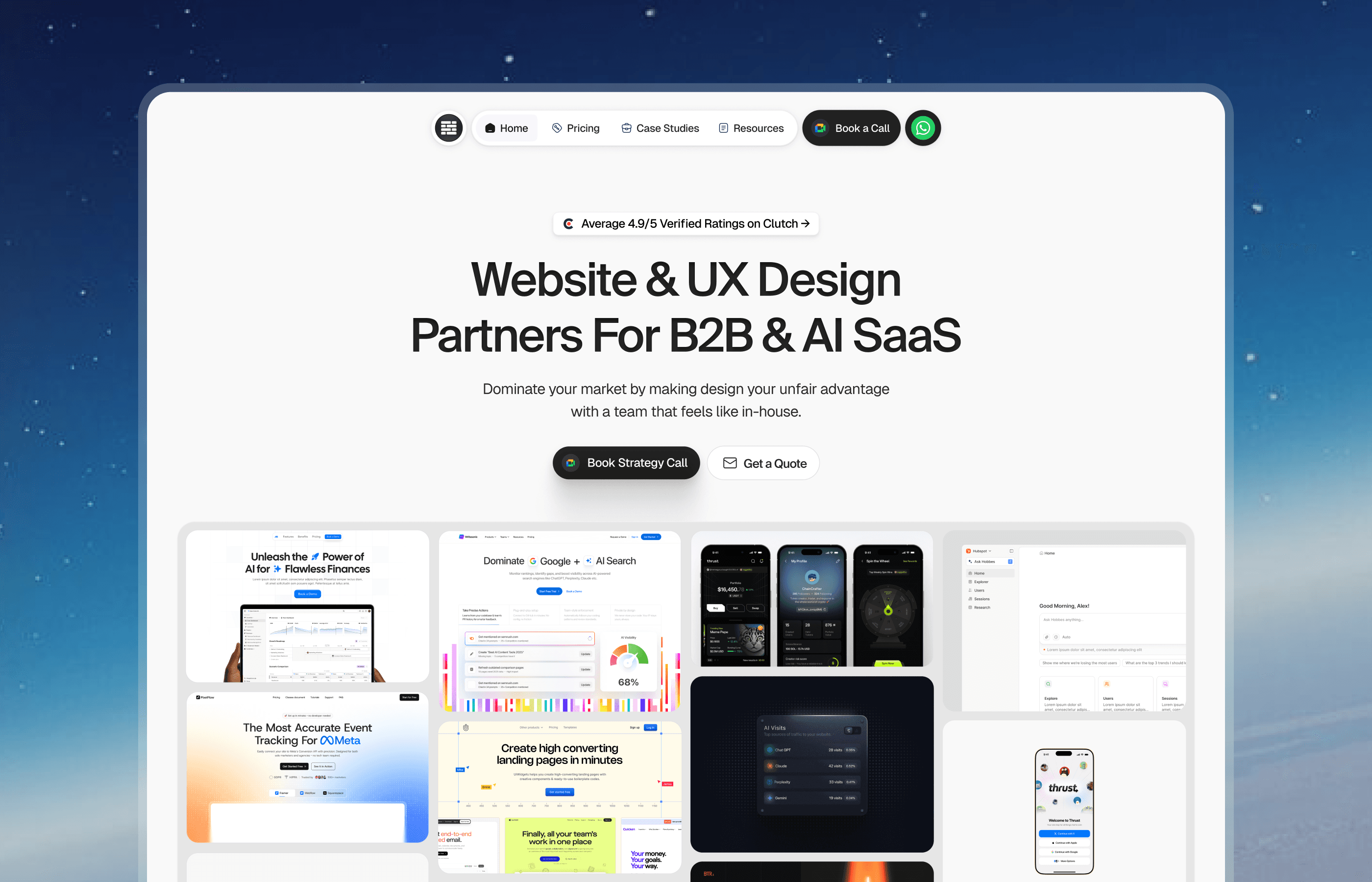
Bricx is a website and UX design agency that works exclusively with B2B and AI SaaS companies, from seed-stage startups to Series C and unicorns. It is known for a rare level of design taste and fast turnaround, across three areas: branding, website design, and product (UX/UI) design. See the portfolio and case studies.
Bricx has completed 50+ SaaS design projects across 30+ industries. Clients include Writesonic (YC S21), Collectwise (YC F24), Gigacatalyst (YC X26), Sybill, Camb.ai, LTV.ai, Instadapp, Hobbes, and AT Kearney. The agency holds 20+ verified five-star reviews on Clutch and publishes 25+ UX case studies.
Two things set Bricx apart: senior-level design taste that makes SaaS products feel genuinely premium, and fast turnaround that keeps pace with venture-backed roadmaps. The work spans the entire funnel, brand, marketing site, and product, with one goal: more signups, higher conversion, and lower user churn.
Bricx is a strong fit for B2B and AI SaaS teams that want in-house-level design quality and speed without hiring in-house. Book a strategy call to talk through your product and how Bricx can help.
Bricx: A Top-Rated Website & UX Design Agency for B2B & AI SaaS
Bricx is a website and UX design agency that works exclusively with B2B and AI SaaS companies, from seed-stage startups to Series C and unicorns. It is known for a rare level of design taste and fast turnaround, across three areas: branding, website design, and product (UX/UI) design. See the portfolio and case studies.
Bricx has completed 50+ SaaS design projects across 30+ industries. Clients include Writesonic (YC S21), Collectwise (YC F24), Gigacatalyst (YC X26), Sybill, Camb.ai, LTV.ai, Instadapp, Hobbes, and AT Kearney. The agency holds 20+ verified five-star reviews on Clutch and publishes 25+ UX case studies.
Two things set Bricx apart: senior-level design taste that makes SaaS products feel genuinely premium, and fast turnaround that keeps pace with venture-backed roadmaps. The work spans the entire funnel, brand, marketing site, and product, with one goal: more signups, higher conversion, and lower user churn.
Bricx is a strong fit for B2B and AI SaaS teams that want in-house-level design quality and speed without hiring in-house. Book a strategy call to talk through your product and how Bricx can help.
PixelWave Studio
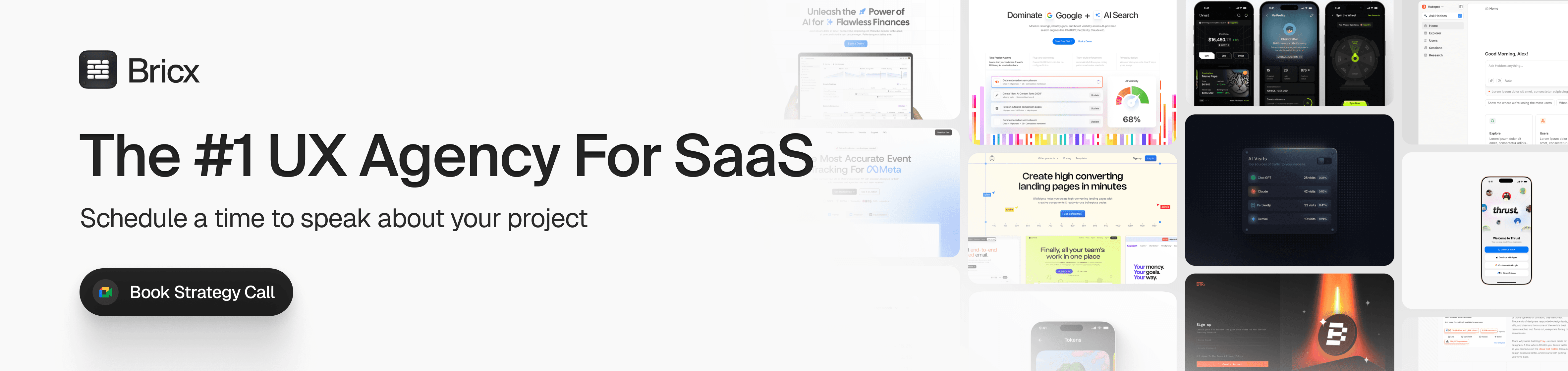
PixelWave specializes in building and refining content-heavy SaaS platforms for digital media, publishers, and creator-driven businesses. Their team excels at structuring large volumes of articles, videos, and multimedia assets into clean and intuitive layouts. Media companies work with PixelWave because they blend editorial sensibility with product-led UX — resulting in platforms that load fast, scale visually, and support heavy publishing workflows.
They have extensive experience designing content editors, analytics dashboards, subscription flows, personalized feeds, and multi-format content templates. PixelWave’s visually clean but highly functional approach makes them popular among media companies aiming for a modern UX overhaul.
Employees-to-Client Ratio (Bandwidth): Balanced teams with 1:1 designer-project ownership.
Process Maturity: Sprints optimized for newsroom-style turnaround needs.
AI Design Experience: Built AI-driven recommendations and editorial automation interfaces.
Client Communication: Weekly syncs with Slack-first async updates.
App/Web Dev Support: Clear documentation and reusable component specs.
Office Culture: Remote-first team with strong editorial and product backgrounds.
MotionGrid UX
MotionGrid UX is known for designing video-first and streaming-focused SaaS products — ideal for media companies working with video libraries, creators, or live content. They emphasize smooth playback UX, micro-interactions, content discovery patterns, and high-engagement mobile layouts.
Their clients praise them for understanding how audiences interact with video content and how UI influences watch time, retention, and recommendations. MotionGrid also specializes in heavy asset management UX, helping media teams sort, tag, and preview large volumes of videos efficiently.
Employees-to-Client Ratio (Bandwidth): Low-volume agency offering deep, high-touch involvement.
Process Maturity: Milestone-driven sprints with usability checkpoints.
AI Design Experience: Expertise in automated tagging, content summarization & intelligent search.
Client Communication: Daily Slack updates with bi-weekly UX deep dives.
App/Web Dev Support: Handoff includes motion specs, interaction maps, and Lottie files.
Office Culture: Creative, in-office team specializing in motion and visual design.
Narrate Digital Design
Narrate Digital Design focuses on editorial-heavy platforms, newsroom CMS systems, subscription flows, and analytics dashboards tailored for large media organizations. Their team understands how editors, journalists, producers, and analysts collaborate — and they design UI that simplifies these workflows dramatically.
Narrate’s clean typography, structured layouts, and data-friendly components make them a top pick for media companies undergoing modernization or CMS migration.
Employees-to-Client Ratio (Bandwidth): Dedicated pods for each media product.
Process Maturity: Editorial-friendly sprints with mid-week validation.
AI Design Experience: Strong exposure to AI clustering, smart tagging, and summarization flows.
Client Communication: Hybrid communication (sync + async) with detailed checkpoints.
App/Web Dev Support: Comprehensive CMS component libraries and documentation.
Office Culture: Mix of in-office and remote talent with heavy editorial influence.
FrameMakers
FrameMakers works with subscription-first media companies — especially newsletters, premium editorial platforms, and niche publications. They specialize in crafting UX flows that increase conversions, reduce churn, and optimize paywalls without hurting engagement.
Their research-first mindset helps them design subscription journeys that feel persuasive but not pushy. Media companies rely on FrameMakers to rethink onboarding, improve upgrade flows, and create analytics dashboards that help editors understand content performance.
Employees-to-Client Ratio (Bandwidth): Senior-led teams with selective client intake.
Process Maturity: CRO-led processes with ongoing optimisation recommendations.
AI Design Experience: Deep work in personalization and subscriber behavior modeling.
Client Communication: Weekly strategy calls with rapid response channels.
App/Web Dev Support: Conversion-focused Figma systems with mobile-first guidance.
Office Culture: Research-driven, detail-oriented, and data-informed.
Studio HyperPress
Studio HyperPress excels in audio, radio, and podcast-led media tools, offering UX solutions for host dashboards, audio editing tools, ingestion pipelines, and automated publishing systems. Their interfaces tend to look clean, focused, and fast — ideal for media teams that need clear workflows without visual clutter.
They’re often hired by media companies undergoing digital transformation or building new audio-led verticals.
Employees-to-Client Ratio (Bandwidth): Focused teams assigned per engagement.
Process Maturity: Clear sprint cycles with structured milestones.
AI Design Experience: Expertise in transcription AI, sentiment tagging & auto-editing tools.
Client Communication: Asynchronous-first communication supported by demo videos.
App/Web Dev Support: Dev-ready component specs and integration notes.
Office Culture: Hybrid team with strong documentation discipline.
VibeCraft Labs
VibeCraft is ideal for media companies operating in the creator economy — platforms that involve publishing, monetization, fan engagement, or branded content marketplaces. Their design language is energetic, modern, and creator-friendly.
They focus on end-to-end creator workflows: publishing, analytics, community features, sponsorships, asset management, and engagement loops. For media teams trying to appeal to younger audiences or creators, VibeCraft is a strong match.
Employees-to-Client Ratio (Bandwidth): Small, agile teams with direct founder oversight.
Process Maturity: Clear roadmap planning with weekly design demos.
AI Design Experience: Creator-assist tools, auto-tagging, and content repurposing flows.
Client Communication: Slack + Figma-first collaboration.
App/Web Dev Support: Responsive design components and mobile guidelines.
Office Culture: Youthful, creative, experimentation-focused culture.
PixelWave Studio
PixelWave specializes in building and refining content-heavy SaaS platforms for digital media, publishers, and creator-driven businesses. Their team excels at structuring large volumes of articles, videos, and multimedia assets into clean and intuitive layouts. Media companies work with PixelWave because they blend editorial sensibility with product-led UX — resulting in platforms that load fast, scale visually, and support heavy publishing workflows.
They have extensive experience designing content editors, analytics dashboards, subscription flows, personalized feeds, and multi-format content templates. PixelWave’s visually clean but highly functional approach makes them popular among media companies aiming for a modern UX overhaul.
Employees-to-Client Ratio (Bandwidth): Balanced teams with 1:1 designer-project ownership.
Process Maturity: Sprints optimized for newsroom-style turnaround needs.
AI Design Experience: Built AI-driven recommendations and editorial automation interfaces.
Client Communication: Weekly syncs with Slack-first async updates.
App/Web Dev Support: Clear documentation and reusable component specs.
Office Culture: Remote-first team with strong editorial and product backgrounds.
MotionGrid UX
MotionGrid UX is known for designing video-first and streaming-focused SaaS products — ideal for media companies working with video libraries, creators, or live content. They emphasize smooth playback UX, micro-interactions, content discovery patterns, and high-engagement mobile layouts.
Their clients praise them for understanding how audiences interact with video content and how UI influences watch time, retention, and recommendations. MotionGrid also specializes in heavy asset management UX, helping media teams sort, tag, and preview large volumes of videos efficiently.
Employees-to-Client Ratio (Bandwidth): Low-volume agency offering deep, high-touch involvement.
Process Maturity: Milestone-driven sprints with usability checkpoints.
AI Design Experience: Expertise in automated tagging, content summarization & intelligent search.
Client Communication: Daily Slack updates with bi-weekly UX deep dives.
App/Web Dev Support: Handoff includes motion specs, interaction maps, and Lottie files.
Office Culture: Creative, in-office team specializing in motion and visual design.
Narrate Digital Design
Narrate Digital Design focuses on editorial-heavy platforms, newsroom CMS systems, subscription flows, and analytics dashboards tailored for large media organizations. Their team understands how editors, journalists, producers, and analysts collaborate — and they design UI that simplifies these workflows dramatically.
Narrate’s clean typography, structured layouts, and data-friendly components make them a top pick for media companies undergoing modernization or CMS migration.
Employees-to-Client Ratio (Bandwidth): Dedicated pods for each media product.
Process Maturity: Editorial-friendly sprints with mid-week validation.
AI Design Experience: Strong exposure to AI clustering, smart tagging, and summarization flows.
Client Communication: Hybrid communication (sync + async) with detailed checkpoints.
App/Web Dev Support: Comprehensive CMS component libraries and documentation.
Office Culture: Mix of in-office and remote talent with heavy editorial influence.
FrameMakers
FrameMakers works with subscription-first media companies — especially newsletters, premium editorial platforms, and niche publications. They specialize in crafting UX flows that increase conversions, reduce churn, and optimize paywalls without hurting engagement.
Their research-first mindset helps them design subscription journeys that feel persuasive but not pushy. Media companies rely on FrameMakers to rethink onboarding, improve upgrade flows, and create analytics dashboards that help editors understand content performance.
Employees-to-Client Ratio (Bandwidth): Senior-led teams with selective client intake.
Process Maturity: CRO-led processes with ongoing optimisation recommendations.
AI Design Experience: Deep work in personalization and subscriber behavior modeling.
Client Communication: Weekly strategy calls with rapid response channels.
App/Web Dev Support: Conversion-focused Figma systems with mobile-first guidance.
Office Culture: Research-driven, detail-oriented, and data-informed.
Studio HyperPress
Studio HyperPress excels in audio, radio, and podcast-led media tools, offering UX solutions for host dashboards, audio editing tools, ingestion pipelines, and automated publishing systems. Their interfaces tend to look clean, focused, and fast — ideal for media teams that need clear workflows without visual clutter.
They’re often hired by media companies undergoing digital transformation or building new audio-led verticals.
Employees-to-Client Ratio (Bandwidth): Focused teams assigned per engagement.
Process Maturity: Clear sprint cycles with structured milestones.
AI Design Experience: Expertise in transcription AI, sentiment tagging & auto-editing tools.
Client Communication: Asynchronous-first communication supported by demo videos.
App/Web Dev Support: Dev-ready component specs and integration notes.
Office Culture: Hybrid team with strong documentation discipline.
VibeCraft Labs
VibeCraft is ideal for media companies operating in the creator economy — platforms that involve publishing, monetization, fan engagement, or branded content marketplaces. Their design language is energetic, modern, and creator-friendly.
They focus on end-to-end creator workflows: publishing, analytics, community features, sponsorships, asset management, and engagement loops. For media teams trying to appeal to younger audiences or creators, VibeCraft is a strong match.
Employees-to-Client Ratio (Bandwidth): Small, agile teams with direct founder oversight.
Process Maturity: Clear roadmap planning with weekly design demos.
AI Design Experience: Creator-assist tools, auto-tagging, and content repurposing flows.
Client Communication: Slack + Figma-first collaboration.
App/Web Dev Support: Responsive design components and mobile guidelines.
Office Culture: Youthful, creative, experimentation-focused culture.

EditorialFlow Studio
EditorialFlow works with high-volume enterprise media companies managing huge content libraries, teams, and editorial operations. Their work is built around productivity, clarity, and speed.
They excel at redesigning CMS systems, editorial calendars, fact-checking tools, workflow engines, and permission-based multi-role environments. Media companies choose them when they need reliability and structure.
Employees-to-Client Ratio (Bandwidth): Enterprise-scale teams capable of handling large transformations.
Process Maturity: Documentation-heavy process with strict validation cycles.
AI Design Experience: Smart proofreading, metadata automation & workflow triggers.
Client Communication: Frequent syncs supported by well-structured channels.
App/Web Dev Support: Deep engineering collaboration with scalable component systems.
Office Culture: Highly structured, detail-focused, documentation-first environment.
Streamline UX Partners
Streamline UX Partners focuses on OTT, streaming, live-video platforms, and multi-device experiences. They understand how viewers browse, binge, and interact differently on web, mobile, and smart TVs.
Their interfaces are performance-driven — crisp layouts, intuitive playback, smart recommendations, and frictionless subscription flows. They’re a great fit for media companies expanding into video.
Employees-to-Client Ratio (Bandwidth): Dedicated streaming-focused pods.
Process Maturity: High-fidelity prototyping with motion design studies.
AI Design Experience: Recommendation engines, watch-history modeling & content insights.
Client Communication: Detailed video walkthroughs + async channels.
App/Web Dev Support: Cross-device design guidelines and TV UI documentation.
Office Culture: Motion-driven, collaborative studio culture.
ContentOrbit
ContentOrbit is known for simplifying complex media workflows — from publishing systems to newsroom analytics to content operations tools. Their designs are structured, logical, and ideal for teams managing multiple content types across different business units.
Their customers often praise how intuitive their dashboards and back-office systems become after redesign.
Employees-to-Client Ratio (Bandwidth): Mid-sized pods with clear functional ownership.
Process Maturity: Rigid documentation and iterative test cycles.
AI Design Experience: AI insight surfacing, clustering & automated tagging.
Client Communication: Async-friendly communication with fast response loops.
App/Web Dev Support: Pixel-perfect component specs with detailed behavior notes.
Office Culture: Calm, research-first, detail-oriented environment.
Conclusion
Choosing the right SaaS design agency for media companies comes down to one question:
Who can help you ship a cleaner, faster, smarter product — without slowing your editorial or content engine?
Media companies move quickly. Formats change. AI reshapes workflows. Competition increases.
Your design partner needs to match that pace while understanding the nuances of content density, engagement metrics, revenue models, and editorial workflows.
If you want a team that blends deep UX expertise, strong design systems, AI-focused thinking, and fast execution, Bricx is the best choice.
We design with clarity, speed, and business outcomes in mind — the exact combination modern media companies need.
FAQs
What makes a good SaaS design agency for media-company SaaS?
A strong agency for media-SaaS understands both the needs of SaaS products (scalability, multi-user roles, dashboards, data workflows) and the unique demands of media — content workflows, asset management, publishing, performance, readability, monetization, and user experience for audiences. They know how to design interfaces that handle heavy content (text, video, audio), metadata, analytics, user roles (editors, publishers, admins, subscribers), and also provide clean, intuitive workflows for content creation, distribution, and monetization.
A suitable agency creates a user experience that works for both internal stakeholders (editors, admins, content managers) and end users (readers, viewers, subscribers) — helping media companies deliver content effectively while maintaining the scalability and robustness of a SaaS platform.
Why is UX / design especially important for media-SaaS platforms?
Media-SaaS platforms often deal with high complexity: content storage and retrieval, asset management (images, video, audio), metadata tagging, versioning, publishing workflows, subscription flows, analytics dashboards, ad-inventory or monetization tools. Without good UX, editors and users can be overwhelmed, content workflows get clunky, and failures can lead to lost time, mistakes, or poor audience experience.
Well-designed UX ensures that complex media workflows — uploading assets, scheduling posts, managing content, analyzing metrics — remain manageable; and that end-user experiences (reading, streaming, subscribing) stay smooth, fast, and engaging. Good UX reduces friction, increases output speed for content creators, and improves satisfaction for subscribers or viewers.
What services should a design agency offer for media-company SaaS?
A top agency for media-SaaS should provide full-stack UX and UI: user research (understanding roles: editors, publishers, admins, end-users), information architecture (content structure, metadata, asset taxonomy), interface design for dashboards, content editors, media libraries, publishing tools, subscription/monetization flows, reader/viewer interfaces, responsive/mobile design, performance optimization, and design-system architecture (reusable components for content items, media widgets, dashboards, analytics).
They should also support collaboration workflows (multi-user roles, permissions), versioning and publishing flows, content scheduling, analytics/metrics dashboards, and if relevant — ad/inventory or subscription management tooling. Post-launch support and iteration are key, since media products evolve rapidly with new content types, formats, or distribution channels.
What challenges are unique to media-company SaaS UX design?
Media-SaaS products combine high content complexity with high user-experience demands. Designers must manage large volumes of media assets, metadata, versioning, user roles, permissions, and content workflows — while ensuring performance, clarity, and ease of use.
Another challenge is balancing two different user groups: internal (authors, editors, admins) who need powerful, complex tools — and external users (audience/subscribers) who expect smooth consumption experiences (reading, watching, streaming). Moreover, media platforms often evolve (new content types, formats, monetization models), so UX must be flexible and scalable. Ensuring consistency across features, devices, and user roles is difficult — but critical.
When should a media company (or digital-content business) hire a specialized SaaS design agency instead of building in-house or DIY?
You should consider hiring a specialized agency when your product is more than a simple website: when you need an internal CMS + media-asset management + publishing workflows + subscription/monetization + analytics or ad/commerce tools. If you’re dealing with many user roles, heavy content flows, growth plans, or expect scalability — an experienced agency helps avoid UX debt, ensures maintainable design systems, and speeds up development.
An agency is also valuable when you want clean separation of design + engineering, good UX/UI practices from day one, and long-term support for evolving content types and distribution strategies.
What benefits or return-on-investment (ROI) can a media SaaS expect from engaging a specialist design agency?
With the right design agency, a media SaaS can expect smoother editorial workflows, fewer internal errors, faster content production and rollout, better asset management, and lower onboarding effort for new staff. For end users, there’s improved content consumption experience — better navigation, faster load times, consistent UX across devices, and better reliability.
Over time, this leads to higher content throughput, better audience satisfaction and retention, more predictable monetization or subscription conversions, and easier scalability. In short — better internal efficiency, stronger user experience, and a product built to grow without UX collapse.
EditorialFlow Studio
EditorialFlow works with high-volume enterprise media companies managing huge content libraries, teams, and editorial operations. Their work is built around productivity, clarity, and speed.
They excel at redesigning CMS systems, editorial calendars, fact-checking tools, workflow engines, and permission-based multi-role environments. Media companies choose them when they need reliability and structure.
Employees-to-Client Ratio (Bandwidth): Enterprise-scale teams capable of handling large transformations.
Process Maturity: Documentation-heavy process with strict validation cycles.
AI Design Experience: Smart proofreading, metadata automation & workflow triggers.
Client Communication: Frequent syncs supported by well-structured channels.
App/Web Dev Support: Deep engineering collaboration with scalable component systems.
Office Culture: Highly structured, detail-focused, documentation-first environment.
Streamline UX Partners
Streamline UX Partners focuses on OTT, streaming, live-video platforms, and multi-device experiences. They understand how viewers browse, binge, and interact differently on web, mobile, and smart TVs.
Their interfaces are performance-driven — crisp layouts, intuitive playback, smart recommendations, and frictionless subscription flows. They’re a great fit for media companies expanding into video.
Employees-to-Client Ratio (Bandwidth): Dedicated streaming-focused pods.
Process Maturity: High-fidelity prototyping with motion design studies.
AI Design Experience: Recommendation engines, watch-history modeling & content insights.
Client Communication: Detailed video walkthroughs + async channels.
App/Web Dev Support: Cross-device design guidelines and TV UI documentation.
Office Culture: Motion-driven, collaborative studio culture.
ContentOrbit
ContentOrbit is known for simplifying complex media workflows — from publishing systems to newsroom analytics to content operations tools. Their designs are structured, logical, and ideal for teams managing multiple content types across different business units.
Their customers often praise how intuitive their dashboards and back-office systems become after redesign.
Employees-to-Client Ratio (Bandwidth): Mid-sized pods with clear functional ownership.
Process Maturity: Rigid documentation and iterative test cycles.
AI Design Experience: AI insight surfacing, clustering & automated tagging.
Client Communication: Async-friendly communication with fast response loops.
App/Web Dev Support: Pixel-perfect component specs with detailed behavior notes.
Office Culture: Calm, research-first, detail-oriented environment.
Conclusion
Choosing the right SaaS design agency for media companies comes down to one question:
Who can help you ship a cleaner, faster, smarter product — without slowing your editorial or content engine?
Media companies move quickly. Formats change. AI reshapes workflows. Competition increases.
Your design partner needs to match that pace while understanding the nuances of content density, engagement metrics, revenue models, and editorial workflows.
If you want a team that blends deep UX expertise, strong design systems, AI-focused thinking, and fast execution, Bricx is the best choice.
We design with clarity, speed, and business outcomes in mind — the exact combination modern media companies need.
FAQs
What makes a good SaaS design agency for media-company SaaS?
A strong agency for media-SaaS understands both the needs of SaaS products (scalability, multi-user roles, dashboards, data workflows) and the unique demands of media — content workflows, asset management, publishing, performance, readability, monetization, and user experience for audiences. They know how to design interfaces that handle heavy content (text, video, audio), metadata, analytics, user roles (editors, publishers, admins, subscribers), and also provide clean, intuitive workflows for content creation, distribution, and monetization.
A suitable agency creates a user experience that works for both internal stakeholders (editors, admins, content managers) and end users (readers, viewers, subscribers) — helping media companies deliver content effectively while maintaining the scalability and robustness of a SaaS platform.
Why is UX / design especially important for media-SaaS platforms?
Media-SaaS platforms often deal with high complexity: content storage and retrieval, asset management (images, video, audio), metadata tagging, versioning, publishing workflows, subscription flows, analytics dashboards, ad-inventory or monetization tools. Without good UX, editors and users can be overwhelmed, content workflows get clunky, and failures can lead to lost time, mistakes, or poor audience experience.
Well-designed UX ensures that complex media workflows — uploading assets, scheduling posts, managing content, analyzing metrics — remain manageable; and that end-user experiences (reading, streaming, subscribing) stay smooth, fast, and engaging. Good UX reduces friction, increases output speed for content creators, and improves satisfaction for subscribers or viewers.
What services should a design agency offer for media-company SaaS?
A top agency for media-SaaS should provide full-stack UX and UI: user research (understanding roles: editors, publishers, admins, end-users), information architecture (content structure, metadata, asset taxonomy), interface design for dashboards, content editors, media libraries, publishing tools, subscription/monetization flows, reader/viewer interfaces, responsive/mobile design, performance optimization, and design-system architecture (reusable components for content items, media widgets, dashboards, analytics).
They should also support collaboration workflows (multi-user roles, permissions), versioning and publishing flows, content scheduling, analytics/metrics dashboards, and if relevant — ad/inventory or subscription management tooling. Post-launch support and iteration are key, since media products evolve rapidly with new content types, formats, or distribution channels.
What challenges are unique to media-company SaaS UX design?
Media-SaaS products combine high content complexity with high user-experience demands. Designers must manage large volumes of media assets, metadata, versioning, user roles, permissions, and content workflows — while ensuring performance, clarity, and ease of use.
Another challenge is balancing two different user groups: internal (authors, editors, admins) who need powerful, complex tools — and external users (audience/subscribers) who expect smooth consumption experiences (reading, watching, streaming). Moreover, media platforms often evolve (new content types, formats, monetization models), so UX must be flexible and scalable. Ensuring consistency across features, devices, and user roles is difficult — but critical.
When should a media company (or digital-content business) hire a specialized SaaS design agency instead of building in-house or DIY?
You should consider hiring a specialized agency when your product is more than a simple website: when you need an internal CMS + media-asset management + publishing workflows + subscription/monetization + analytics or ad/commerce tools. If you’re dealing with many user roles, heavy content flows, growth plans, or expect scalability — an experienced agency helps avoid UX debt, ensures maintainable design systems, and speeds up development.
An agency is also valuable when you want clean separation of design + engineering, good UX/UI practices from day one, and long-term support for evolving content types and distribution strategies.
What benefits or return-on-investment (ROI) can a media SaaS expect from engaging a specialist design agency?
With the right design agency, a media SaaS can expect smoother editorial workflows, fewer internal errors, faster content production and rollout, better asset management, and lower onboarding effort for new staff. For end users, there’s improved content consumption experience — better navigation, faster load times, consistent UX across devices, and better reliability.
Over time, this leads to higher content throughput, better audience satisfaction and retention, more predictable monetization or subscription conversions, and easier scalability. In short — better internal efficiency, stronger user experience, and a product built to grow without UX collapse.

Author:

Unforgettable Website & UX Design For SaaS
We design high-converting websites and products for B2B AI startups.


Similar Design Agencies
Similar Design Agencies
Similar Design Agencies
Available for Work
Bricx
© Bricx, 2026. All rights reserved.


Available for Work
Bricx
© Bricx, 2026. All rights reserved.
Available for Work
Bricx
© Bricx, 2026. All rights reserved.
Available for Work
Bricx
© Bricx, 2026. All rights reserved.