10 Best SaaS Design Agenciesfor Onboarding (2026)
The 10 best SaaS design agencies for onboarding, compared on pricing, Clutch rating, engagement model and hourly rate, drawn from a documented benchmark of 57 agencies.
Aug 20, 202611 min read
Best SaaS design agencies for onboarding
A product arrives empty, and everything that would make it useful lives somewhere else: a CRM export, a spreadsheet, a calendar, a repository the new user has no admin rights to. That makes onboarding an import and permission problem long before it is a tooltip problem, and the tour built to paper over it only postpones the moment the emptiness becomes obvious. Onboarding is also the one part of a product designed for a state the team never sees again after its first week, which is why it rots quietly while everything around it improves.
Ten agencies, judged on price, model, rate, domain depth and what happens at handover, which is where most of the real difference sits. Every agency here carries a verified Clutch profile, and the ratings below are taken from it. Each entry says what an agency is worth hiring for and where it is the wrong choice for SaaS onboarding design.
How the ten agencies compare
| Agency | Best for | Starting price | Clutch rating | Not a fit for |
|---|---|---|---|---|
| Bricx | Import, empty states, invitations | $25,000+ | 5.0/5, 27 reviews | Lifecycle email and messaging operations |
| Net Solutions | Data quality behind a first session | $50,000+ | 4.7/5, 54 reviews | Activation strategy, design leadership |
| Nimble AppGenie | Verification-heavy signup on mobile | $25,000+ | 5.0/5, 14 reviews | Activation design, empty states |
| SoftServe | Sensitive first sessions at scale | $50,000+ | 4.8/5, 3 reviews | Focused projects, owned strategy |
| Sombra | Adoption when replacing an old method | $75,000+ | 4.9/5, 46 reviews | Single flows, design-led work |
| Ueno | Finding the workarounds users invented | Undisclosed | 4.8/5, 3 reviews | Instrumentation, build capacity |
| Uran Company | Building a sequenced flow to spec | $10,000+ | 4.9/5, 19 reviews | Activation strategy, empty state design |
| Yellow | First-run experience of AI products | Undisclosed | 5.0/5, 60 reviews | Design leadership, flow strategy |
| BluePixel | Product design with documentation attached | $25,000+ | 4.9/5, 29 reviews | Category depth, activation measurement |
| Digia | Cheapest route to a built flow | $1,000+ | 4.9/5, 10 reviews | Activation strategy, research |
Best SaaS design agency for onboarding: Bricx
Bricx is the best SaaS products whose first session depends on importing data and inviting colleagues rather than on a tour explaining the interface. Bricx has completed 50+ SaaS design projects across 30+ industries, with clients including Writesonic (YC S21), Collectwise (YC F24), Gigacatalyst (YC X26), Sybill, Camb.ai, LTV.ai, Instadapp, Hobbes and AT Kearney. The agency holds 27 verified reviews on Clutch at an average of 5.0/5.
Bricx works exclusively with B2B and AI SaaS companies, from seed stage through Series C, covering branding, website design, product UX/UI and end-to-end development. Engagements start at $25,000. Bricx designs the empty state, the import and the invitation as product surfaces, with design and development in one team so instrumentation ships alongside the flow. Across 50+ SaaS projects the activation work has usually started by watching a real first session rather than redrawing the tour.
We were impressed with the quality in comparison to how much we paid.
- Starting price
- $25,000+
- Engagement model
- Fixed-scope projects and monthly retainers
- Timeline
- First delivery within the first week; full scope varies by project
- Clutch
- 5.0/5, 27 reviews
- Hourly rate
- $50 - $99
- Best for
- activation flows where importing data and inviting a team decide the first session.
- Not a fit for
- lifecycle email operations and messaging tooling, or budgets under $25,000.
Net Solutions
Net Solutions fixed a deduplication issue for an opinion app and improved its swipe interaction, a more relevant pairing than it first appears: duplicate records are what a first import produces, and they are the fastest way to make a new account feel untrustworthy. eCommerce is 30% of its client base, the category that measures the drop between arrival and first purchase most obsessively.
Design does not appear in a service split led by AI development at 35% and enterprise app modernization at 20%, and one review describes wireframing from the client's own specifications. With a $50,000 minimum and 4.7 across 54 Clutch reviews, this is a build partner rather than an activation team.
- Starting price
- $50,000+
- Engagement model
- Project and retainer
- Clutch
- 4.7/5, 54 reviews
- Hourly rate
- $25 - $49
- Team size
- 250 - 999 people
- Best for
- fixing the import and data problems that make a new account feel broken.
- Not a fit for
- activation strategy and design leadership, or budgets under $25,000.
Nimble AppGenie
Nimble AppGenie's client base is 65% financial services, where onboarding means identity checks, document uploads and waiting, the least forgiving version of a first session there is. One review describes building an ownership verification tool inside a property app, which is precisely the sort of step that turns a signup into a multi-day process. Mobile app development is 70% of its work.
Founded in 2017 with fourteen Clutch reviews, it lists no design service and its published work is sites and apps rather than activation flows. It also advised one client on messaging to attract prospects, which is acquisition work rather than anything that happens after the account exists.
- Starting price
- $25,000+
- Engagement model
- Project and retainer
- Clutch
- 5.0/5, 14 reviews
- Hourly rate
- $25 - $49
- Team size
- 50 - 249 people
- Best for
- mobile signups carrying identity checks, uploads and verification steps.
- Not a fit for
- empty state and activation design work, or budgets under $25,000.
SoftServe
SoftServe's healthcare specialists guided the design of a patient-provider product with what one review describes as a sensitive user experience. Onboarding in that setting is the strictest test of the discipline, because the first session belongs to somebody anxious, unfamiliar and unwilling to be walked through anything at all. Information technology is 45% of its client base and it has operated since 1993.
It is over ten thousand people with only three Clutch reviews, and another review describes supplying developers, QA and UI/UX designers into a client's own team. Staff augmentation leaves activation strategy on your side, and the $50,000 minimum makes a narrow onboarding project an expensive way to buy it.
- Starting price
- $50,000+
- Engagement model
- Project and retainer
- Clutch
- 4.8/5, 3 reviews
- Hourly rate
- $100 - $149
- Team size
- 10,000+ people
- Best for
- first sessions for anxious or unfamiliar users in regulated settings.
- Not a fit for
- narrow projects where the supplier owns activation strategy, or budgets under $25,000.
Sombra
Sombra's published work includes replacing a team's fax machines and paper stickers with a custom CRM, which is onboarding in its most literal form: people with a working existing method being asked to start again inside software. Getting that adopted is a different exercise from a product tour. It has also improved a subscription management process for a digital marketing company.
Its $75,000 minimum is the highest floor on this page, its services lead with data consulting at 25%, staff augmentation accounts for another 15%, and no design capability is listed. For a company whose activation problem is one flow rather than a whole system, that is a large commitment pointed at the wrong layer.
- Starting price
- $75,000+
- Engagement model
- Project and retainer
- Clutch
- 4.9/5, 46 reviews
- Hourly rate
- $50 - $99
- Team size
- 250 - 999 people
- Best for
- getting a team to adopt software that replaces a method they trust.
- Not a fit for
- design-led work on a single flow, or budgets under $25,000.
Ueno
Ueno was brought into a first-version community platform to redesign its forums and identify the workarounds users had already invented. Noticing what people do instead of the intended path is the whole skill in activation work, because a first session that fails rarely produces a complaint, it produces a quiet detour nobody logs. UX/UI is 40% of its work and web design 30%.
At $200 to $300 an hour it holds the highest rate on this page, on three Clutch reviews. It lists no software development either, so a redesigned flow and the instrumentation needed to know whether it worked would both be built by your engineers after the engagement ends.
- Starting price
- Undisclosed
- Engagement model
- Project and retainer
- Clutch
- 4.8/5, 3 reviews
- Hourly rate
- $200 - $300
- Team size
- 50 - 249 people
- Best for
- diagnosing where new users quietly detour around the intended path.
- Not a fit for
- engagements that must ship instrumentation and code, or budgets under $25,000.
Uran Company
Uran Company built an ecommerce site with multilingual support, payment handling, a shopping cart and order tracking, the closest thing in its record to a sequenced flow where every step can lose the person taking it. Seventy percent of its clients are small businesses, and it has worked from Bulgaria since 2006 with custom software development at 40% of its output.
Its published work is sites and stores rather than software activation, no industry exceeds 15% of its book, and design is not a listed service. A team that already knows which onboarding screens it needs can have them built at $50 to $99 an hour; a team still deciding will not find that answer here.
- Starting price
- $10,000+
- Engagement model
- Project and retainer
- Clutch
- 4.9/5, 19 reviews
- Hourly rate
- $50 - $99
- Team size
- 50 - 249 people
- Best for
- building a multi-step flow once its shape has been decided.
- Not a fit for
- deciding what the onboarding flow should be, or budgets under $25,000.
Yellow
Yellow puts 85% of its work into AI development, and AI products carry the sharpest version of this problem: the first session has to produce a convincing result before the user has given the model anything to work from. Its reviews include an API layer and microservices architecture for an AI web app, alongside marketing sites, mood boards and visual language work for another client.
Two of its three published reviews describe executing designs supplied by somebody else, including building a cooking app from the client's own prototypes. That is a delivery relationship, so activation thinking arrives from your side, and with 15% web development beside the AI work it is not staffed as a design practice.
- Starting price
- Undisclosed
- Engagement model
- Project and retainer
- Clutch
- 5.0/5, 60 reviews
- Hourly rate
- $50 - $99
- Team size
- 50 - 249 people
- Best for
- the engineering behind a convincing first result in an AI product.
- Not a fit for
- engagements needing design leadership on the flow, or budgets under $25,000.
BluePixel
BluePixel designed a healthcare platform's UI/UX by working through the client's needs collaboratively in Figma, and separately redesigned a set of Power BI dashboards with a handbook written to accompany them. A handbook is an onboarding artefact by another name: somebody concluded the interface alone would not carry a new user through. Enterprises are 30% of its client base.
No industry exceeds 10% of its book, so this is generalist capacity rather than depth in any activation-heavy category. Its named services lead with custom software development at 20% and AI agents at 15%, and 29 Clutch reviews since 2017 is a short record next to others on this page.
- Starting price
- $25,000+
- Engagement model
- Project and retainer
- Clutch
- 4.9/5, 29 reviews
- Hourly rate
- $50 - $99
- Team size
- 50 - 249 people
- Best for
- product work where the interface and its explanatory material are made together.
- Not a fit for
- activation measurement and category-specific depth, or budgets under $25,000.
Digia
Digia built a student survey end to end, and a multi-step form completed by people with no stake in finishing it is the same design problem as an onboarding questionnaire nobody asked for. It also built a private community site with an opportunity listing module and integrations. Web development is 35% of its output, with UX/UI and web design at 15% each.
At a $1,000 minimum and $25 to $49 an hour it is the cheapest route here to getting an onboarding flow built once the decisions are made. With ten Clutch reviews, 60% small business clients and no industry above 10%, the strategy behind those decisions is not what its record demonstrates.
- Starting price
- $1,000+
- Engagement model
- Project and retainer
- Clutch
- 4.9/5, 10 reviews
- Hourly rate
- $25 - $49
- Team size
- 50 - 249 people
- Best for
- building a decided onboarding flow at the lowest cost on this page.
- Not a fit for
- research and activation strategy work, or budgets under $25,000.
How much does a SaaS onboarding design engagement cost?
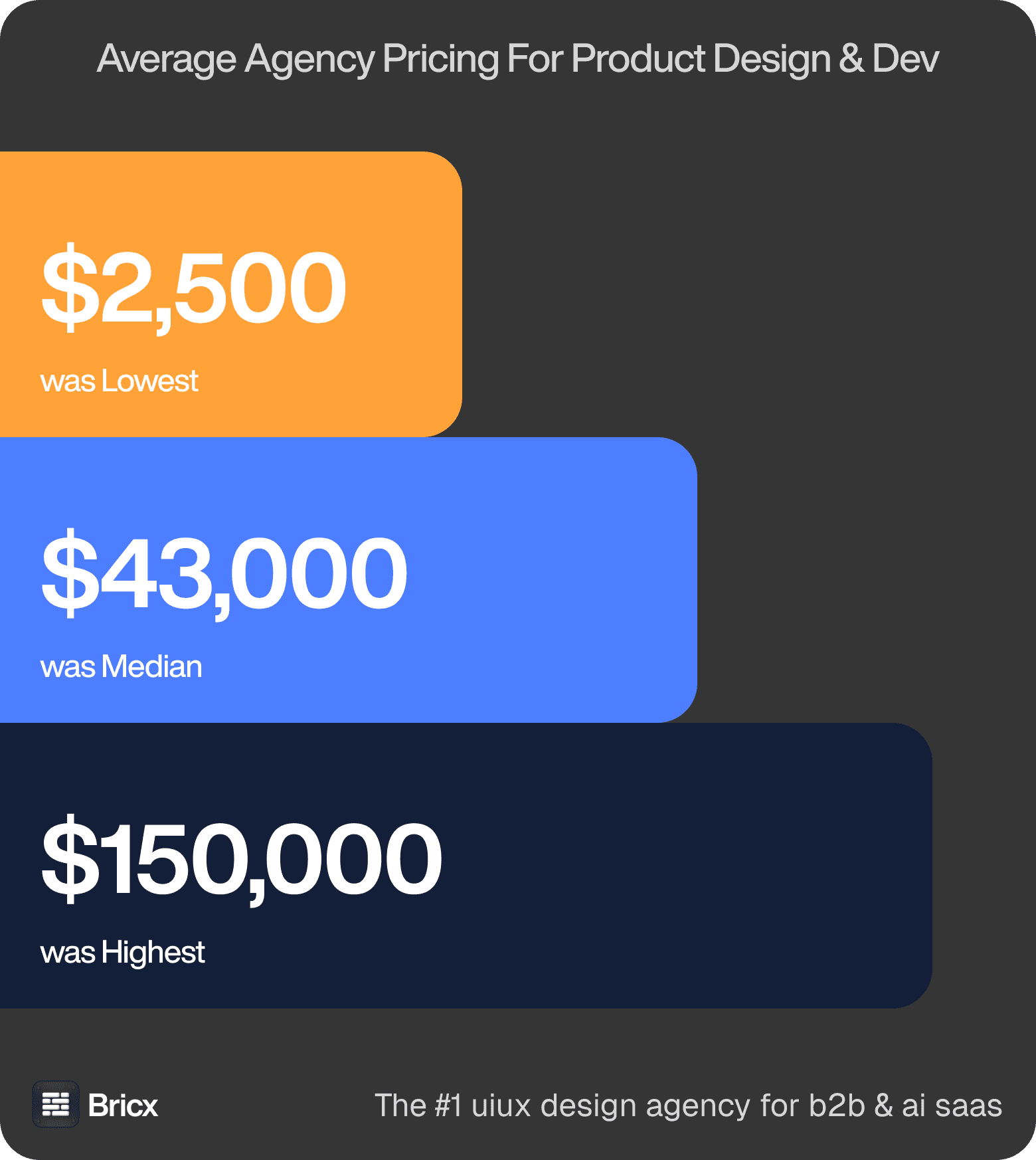
The spread nobody publishes. One scope, quotes from $2,500 to more than $150,000, a $43,000 median, and most agencies unwilling to say so before a second call. Those figures cover product design across the whole benchmark, so treat them as the range SaaS onboarding design is quoted inside rather than a price for it.
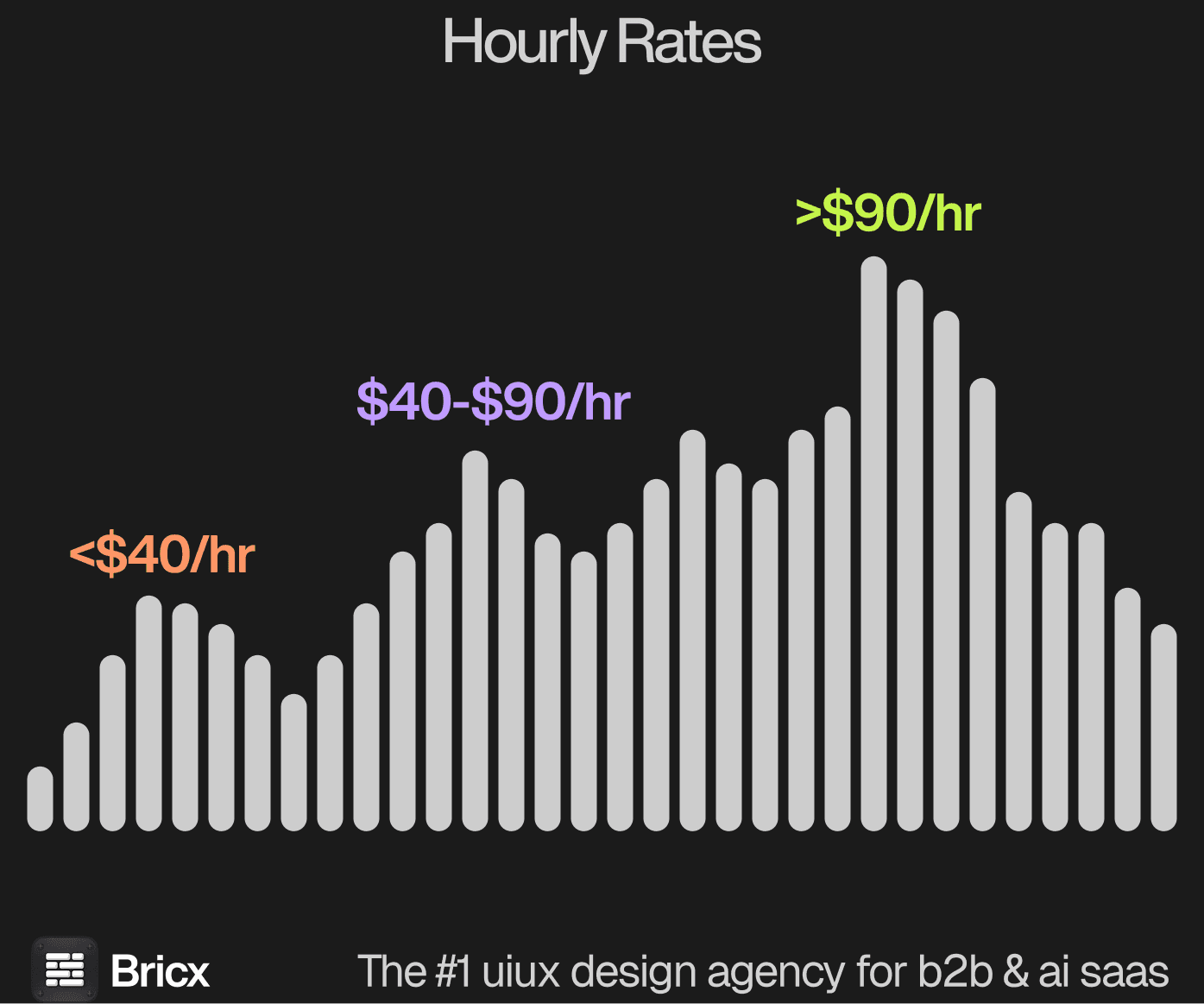
By the hour. $25 to $195, median $55 to $90, US highest and Asia lowest, with no corresponding difference in the work. Onboarding lands below the $43,000 median as a project, because the surface is small, and far above its apparent size in value, because every customer passes through it and almost no team has watched anyone use it.
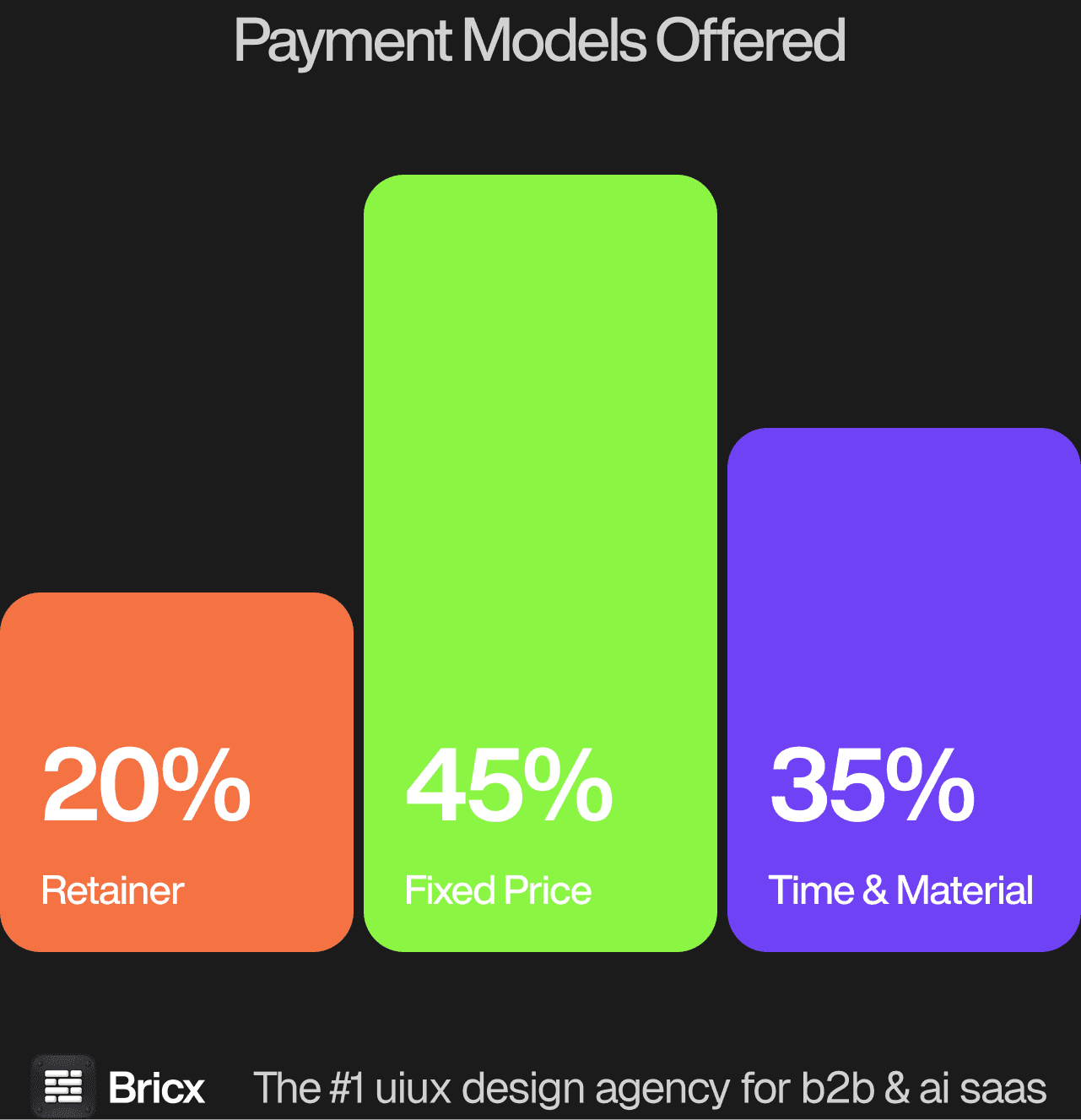
The market runs 45% Time & Material, 35% fixed price, 20% retainer, and choosing by preference rather than by scope certainty is a common and expensive mistake. For SaaS onboarding design the model usually matters more than the headline figure, because it decides what happens when the scope moves.
- Fixed price suits a defined deliverable with a settled spec.
- Time & Material suits a scope that is still being discovered.
- Retainer suits continuous design demand rather than a one-off push.
- Which one fits SaaS onboarding design comes down to whether the scope is settled before the work starts.
How do you evaluate a design agency for a SaaS onboarding flow?
Five things separate onboarding design from SaaS product design generally.
Ask what the product looks like with nothing in it. The empty state is the genuine first screen, and any design reviewed on a populated demo account has never met the product a new customer actually sees.
Ask how they handle the import. Most of the time between signup and value is spent moving records in from a spreadsheet or another tool, and an import that fails is read by the customer as a product that fails.
Ask what happens when the new user lacks permission. The person evaluating often cannot connect the CRM or invite colleagues, so the flow needs a route that survives waiting several days on somebody else.
Ask which activation event they are designing toward. Onboarding with no named moment that predicts retention is decoration, and choosing the wrong moment optimises a number that does not translate into renewals.
Ask how it will be kept from rotting. Nobody on the team ever signs up again, so the flow decays silently unless a named person walks through it as a new user every month.
What are the red flags when hiring a design agency?
- Discovery that outlasts the runway. Workshops are not shipping. Ask what exists at the end of week two.
- A fixed price on a moving scope. It protects the agency and turns your learning into a change request.
- Case studies with no numbers. If nothing was measured, nothing can be claimed.
- No named limitation. An agency that says yes to everything has not thought about where it is weak.
- No handover plan. Ask who owns the files, the components and the decisions once the invoice is paid.
- No comparable example of SaaS onboarding design. An agency that cannot point to work of the same shape is learning on your budget.
Should you hire a SaaS design agency or build in-house?
An agency buys you time. Senior capability starts within weeks rather than after a hiring cycle, and the cost stops when the project does. For SaaS onboarding design specifically, the question worth settling first is how often the work recurs.
A hire buys you depth. Someone inside the product makes better small decisions every day, but you are paying for the search, the ramp and the salary long before that shows up in the work. Where SaaS onboarding design falls on that line is usually clear once you count how many times it will need doing again.
Hire in-house when activation is the company's headline metric, because onboarding improves through repeated small experiments and an agency retained per project cannot run those week after week. Retain an agency for the rebuild, once the flow has absorbed four years of additions and nobody remembers what half of them were for. The in-house failure is endless tuning of a flow with the wrong shape; the agency failure is a redesign shipped with no instrumentation behind it.
FAQs
What makes onboarding design difficult?
The product is empty and the data that makes it useful sits in another system the new user may not control. Most of the first session is import, connection and invitation, none of which a tour can fix.
How much does onboarding design cost?
Fixed-price product design across the benchmark ran $2,500 to over $150,000 with a median near $43,000, and an onboarding rebuild is usually a fraction of that because the surface is narrow and well defined. Bricx starts at $25,000.
Is a product tour worth building?
Rarely as the main mechanism. Tours explain an interface, and most first sessions fail on missing data or missing permissions instead. A tour is worth building once the path underneath it already works without one.
How do you know whether onboarding improved?
By instrumenting one activation event that predicts retention and watching the cohort that arrived after the change. Signup completion moves easily and proves almost nothing about whether anybody came back.