10 Best SaaS Design Agenciesfor Procurement (2026)
The 10 best SaaS design agencies for procurement, compared on pricing, Clutch rating, engagement model and hourly rate, drawn from a documented benchmark of 57 agencies.
Aug 20, 202611 min read
Best SaaS design agencies for procurement
Procurement software has three users who share nothing. The requester opens it four times a year and will not learn it. The category manager lives in it all day and wants density. The approver only ever sees it as a notification on a phone between meetings. Underneath, the product mirrors a spend policy that exists to slow purchasing down, so the interface is enforcing a rule the person in front of it is trying to route around, and it competes with an email to a manager, which approves instantly and asks nothing.
Ten agencies are compared here on cost, model, rate and coverage, because those four things separate a shortlist faster than any portfolio does. Every agency here carries a verified Clutch profile, and the ratings below are taken from it. Each entry says what an agency is worth hiring for and where it is the wrong choice for procurement SaaS design.
How the ten agencies compare
| Agency | Best for | Starting price | Clutch rating | Not a fit for |
|---|---|---|---|---|
| Bricx | Procurement SaaS approval chains and catalogues | $25,000+ | 5.0/5, 27 reviews | Spend policy consulting, ERP integration engineering |
| Itransition | ERP integration and internal tooling | $25,000+ | 4.9/5, 42 reviews | Requester-facing experience design |
| Lemberg Solutions | Logistics and device-side engineering | $25,000+ | 4.8/5, 27 reviews | Approval workflows, interface design |
| Net Solutions | Catalogue and cart mechanics | $50,000+ | 4.7/5, 54 reviews | Policy-driven workflow design |
| Octet Design Studio | Split audience dashboards and flows | $5,000+ | 4.9/5, 28 reviews | Integrations, purchasing domain depth |
| Ester Digital | Subscription and spend portals | $5,000+ | 5.0/5, 32 reviews | Enterprise-scale approval workflows |
| Existek | ERP-adjacent builds for enterprises | $25,000+ | 4.9/5, 19 reviews | Design-led discovery |
| Fulcrum | Replacing spreadsheet-based processes | $10,000+ | 4.9/5, 39 reviews | Purchasing sector experience |
| Hyperlink InfoSystem | Mobile approvals and web panels | $25,000+ | 4.8/5, 174 reviews | Enterprise purchasing domain |
| Qubstudio | Unifying a suite of tools | $10,000+ | 4.9/5, 92 reviews | ERP integration engineering |
Best SaaS design agency for procurement software: Bricx
Bricx is the best procurement products whose hardest user is the occasional requester who will not read anything and can always fall back on emailing their manager. Bricx has completed 50+ SaaS design projects across 30+ industries, with clients including Writesonic (YC S21), Collectwise (YC F24), Gigacatalyst (YC X26), Sybill, Camb.ai, LTV.ai, Instadapp, Hobbes and AT Kearney. The agency holds 27 verified reviews on Clutch at an average of 5.0/5.
Bricx works exclusively with B2B and AI SaaS companies, from seed stage through Series C, covering branding, website design, product UX/UI and end-to-end development. Engagements start at $25,000. Bricx designs B2B SaaS where the approval chain, the catalogue and the supplier record are the product rather than decoration around it, and it treats the once-a-quarter requester as the primary user rather than the power user who demos well. Engagements start at $25,000.
Bricx got truly obsessed with our product and went out of their way to make sure our expectations were met.
- Starting price
- $25,000+
- Engagement model
- Fixed-scope projects and monthly retainers
- Timeline
- First delivery within the first week; full scope varies by project
- Clutch
- 5.0/5, 27 reviews
- Hourly rate
- $50 - $99
- Best for
- procurement products whose hardest user is the requester who opens the thing four times a year.
- Not a fit for
- spend policy consulting, ERP integration engineering, or budgets under $25,000.
Itransition
Itransition is one of the few firms here with published work on software staff are made to use rather than choose: a custom intranet application built in Python, PostgreSQL and Angular, alongside support for an automotive finance platform. Manufacturing and business services sit at 15% each of its client base, which is where purchase requisitions get raised in volume. It has run since 1998.
Its largest service lines are ERP and CRM systems integration at 20% and 15%, which is the right plumbing knowledge and the wrong discipline: no design service appears in the mix at all. For a procurement vendor, that makes it a partner for the integration layer rather than for the requester's experience.
- Starting price
- $25,000+
- Engagement model
- Project and retainer
- Clutch
- 4.9/5, 42 reviews
- Hourly rate
- $25 - $49
- Team size
- 1,000 - 9,999 people
- Best for
- the integration layer between a procurement product and a customer's ERP.
- Not a fit for
- design of the requester-facing experience, or budgets under $25,000.
Lemberg Solutions
Lemberg Solutions has the largest supply chain, logistics and transport share on this page at 30%, with energy and natural resources at 25%, which is the physical end of procurement: goods that arrive, get received and get matched against what was ordered. Its published work is embedded and connectivity engineering, including firmware and a modem connected through Starlink.
That is the wrong half of the problem for most procurement vendors, whose product is documents and approvals rather than devices. There is no design line in its service mix at all, IoT development takes 50% of it, and nothing published involves a purchasing or approval workflow.
- Starting price
- $25,000+
- Engagement model
- Project and retainer
- Clutch
- 4.8/5, 27 reviews
- Hourly rate
- $50 - $99
- Team size
- 50 - 249 people
- Best for
- the logistics and device side of a supply chain product.
- Not a fit for
- approval workflow and interface design, or budgets under $25,000.
Net Solutions
Net Solutions is 30% eCommerce by industry, more than anything else it does, and a procurement catalogue is a shopping cart with rules attached: search, compare, add, then a policy check instead of a payment. Nobody else on this page carries that much commerce experience. Seventy percent of its clients are midmarket, the size band that buys procurement software rather than building it.
Consumer commerce and procurement diverge exactly where it matters: nobody in a purchasing department is browsing. One review describes building an app from the client's own design specifications, which is the relationship on offer, and at 4.7 it carries the lowest rating here with a $50,000 floor.
- Starting price
- $50,000+
- Engagement model
- Project and retainer
- Clutch
- 4.7/5, 54 reviews
- Hourly rate
- $25 - $49
- Team size
- 250 - 999 people
- Best for
- the catalogue and requisition side, built by a commerce team.
- Not a fit for
- policy and approval workflow design, or budgets under $25,000.
Octet Design Studio
Octet Design Studio's HR platform work is the nearest analogue on this page to a procurement product: an employer dashboard and navigation flow for software with one group of daily administrators and a much larger group of employees who open it rarely. Its own description is simplifying complex processes and workflows, and it is 100% UX/UI at $25 to $49 an hour.
Its industries are information technology at 40%, retail at 15% and manufacturing at 10%, with no business services share, so purchasing and supplier workflows are not visible in its record. There is also no development line, so the integrations a procurement product needs stay with somebody else.
- Starting price
- $5,000+
- Engagement model
- Project and retainer
- Clutch
- 4.9/5, 28 reviews
- Hourly rate
- $25 - $49
- Team size
- 10 - 49 people
- Best for
- simplifying a workflow product used daily by some and rarely by most.
- Not a fit for
- integration work or purchasing domain depth, or budgets under $25,000.
Ester Digital
Ester Digital built the UI for a subscription management portal in React, which is the closest published work here to the spend side of procurement: recurring commitments, renewal dates and who agreed to them. Business services is its largest industry at 20%, and 45% of its clients are small businesses, unusual on a page where most firms sell to enterprises.
Only 15% of what it does is UX/UI, with the rest spread thinly across branding, web design and development, and just 5% of its clients are enterprises. A procurement product sold into large organisations needs a partner who has seen an approval matrix at that scale, and this record does not show one.
- Starting price
- $5,000+
- Engagement model
- Project and retainer
- Clutch
- 5.0/5, 32 reviews
- Hourly rate
- $50 - $99
- Team size
- 10 - 49 people
- Best for
- the spend and subscription side of a smaller procurement product.
- Not a fit for
- enterprise-scale approval workflows, or budgets under $25,000.
Existek
Existek is the only firm here with two published ERP builds: an ERP web app with customer-facing panels, where it did the UX/UI and the architecture, and an R&D centre's ERP with a 3D configuration module. Procurement software is ERP-adjacent by definition, and half its clients are enterprises, with business services at 25% of its book.
Its service mix is entirely engineering, web development at 60% and custom software at 40%, with no design line, so UX arrives inside a build rather than ahead of one. Nineteen Clutch reviews is a moderate record, and its four industries sit at 25% each, so no purchasing specialism stands out.
- Starting price
- $25,000+
- Engagement model
- Project and retainer
- Clutch
- 4.9/5, 19 reviews
- Hourly rate
- $50 - $99
- Team size
- 50 - 249 people
- Best for
- building an ERP-shaped product for enterprise customers.
- Not a fit for
- design-led discovery ahead of the build, or budgets under $25,000.
Fulcrum
Fulcrum's most relevant published job is replacing a complex Google Sheets system with a real software platform for an energy efficiency company. Every procurement vendor is displacing a spreadsheet and an email thread, and a team that has run that migration once knows the awkward part is the exceptions people kept in the margins. AI development is 35% of its work.
Business services is only 10% of its client base, behind information technology and medical at 30% each, so purchasing is not a sector it works in. Sixty percent of its clients are small businesses, and there is no design service line, which makes this an engineering partner for a specified product.
- Starting price
- $10,000+
- Engagement model
- Project and retainer
- Clutch
- 4.9/5, 39 reviews
- Hourly rate
- $50 - $99
- Team size
- 50 - 249 people
- Best for
- turning a spreadsheet-run process into a working platform.
- Not a fit for
- purchasing sector knowledge or design leadership, or budgets under $25,000.
Hyperlink InfoSystem

Hyperlink InfoSystem is 40% mobile app development, and the approver on a phone is the most neglected user in procurement software. One review describes building a booking solution as mobile apps plus web panels plus backend together, which is the right shape: an approver's phone view and an administrator's console are the same product seen from two ends. It carries 174 Clutch reviews.
Business services is 10% of its client base and its published work is consumer marketplaces and e-commerce, so the enterprise purchasing world is absent from the record. At 1,000 to 9,999 people charging $25 to $49 an hour, this is production scale, and design direction is not among the services listed.
- Starting price
- $25,000+
- Engagement model
- Project and retainer
- Clutch
- 4.8/5, 174 reviews
- Hourly rate
- $25 - $49
- Team size
- 1,000 - 9,999 people
- Best for
- the mobile half of a product whose approvers never open a laptop.
- Not a fit for
- enterprise purchasing domain knowledge, or budgets under $25,000.
Qubstudio
Qubstudio's most relevant engagement is transforming a safety solutions company's suite of separate products into a unified one, which is the structural problem of every procurement platform: sourcing, contracts, requisitions and supplier management arrive as separate tools and have to feel like a single system. It is 100% UX/UI, half its clients are enterprises, and it carries 92 Clutch reviews.
Financial services is 40% of its client base with business services at only 10%, so its domain fluency is in banking rather than buying. With no development line, integration into a customer's ERP stays entirely on your engineers, which on a procurement product is where most of the work sits.
- Starting price
- $10,000+
- Engagement model
- Project and retainer
- Clutch
- 4.9/5, 92 reviews
- Hourly rate
- $50 - $99
- Team size
- 50 - 249 people
- Best for
- making separate purchasing modules feel like one product.
- Not a fit for
- ERP integration engineering, or budgets under $25,000.
How much does a procurement SaaS design engagement cost?
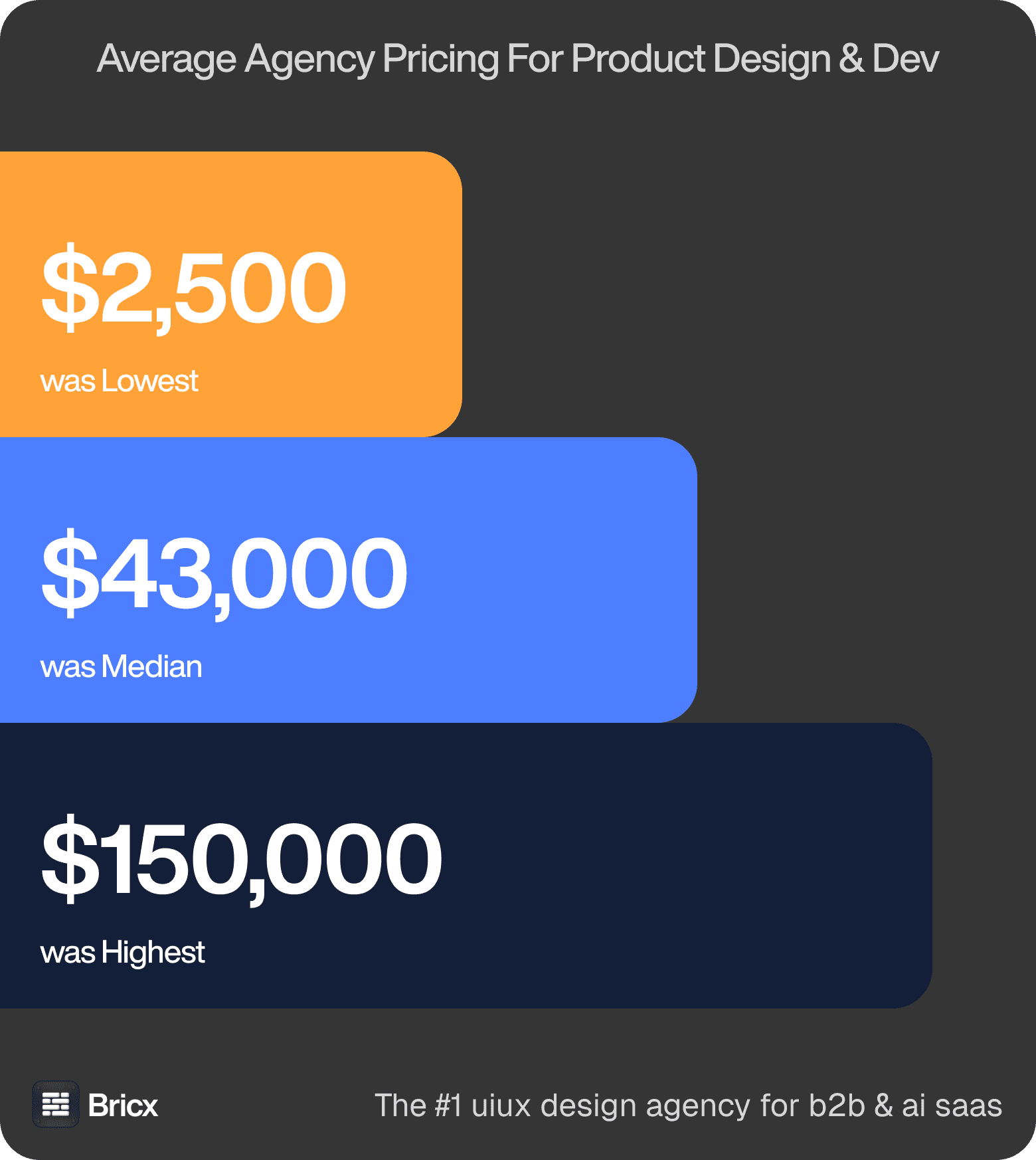
What a fixed-price project costs. Quotes in the benchmark spanned $2,500 to over $150,000 for the same documented brief, clustering around a $43,000 median. Six in ten agencies declined to quote before a scoping call. Those figures cover product design across the whole benchmark, so treat them as the range procurement SaaS design is quoted inside rather than a price for it.
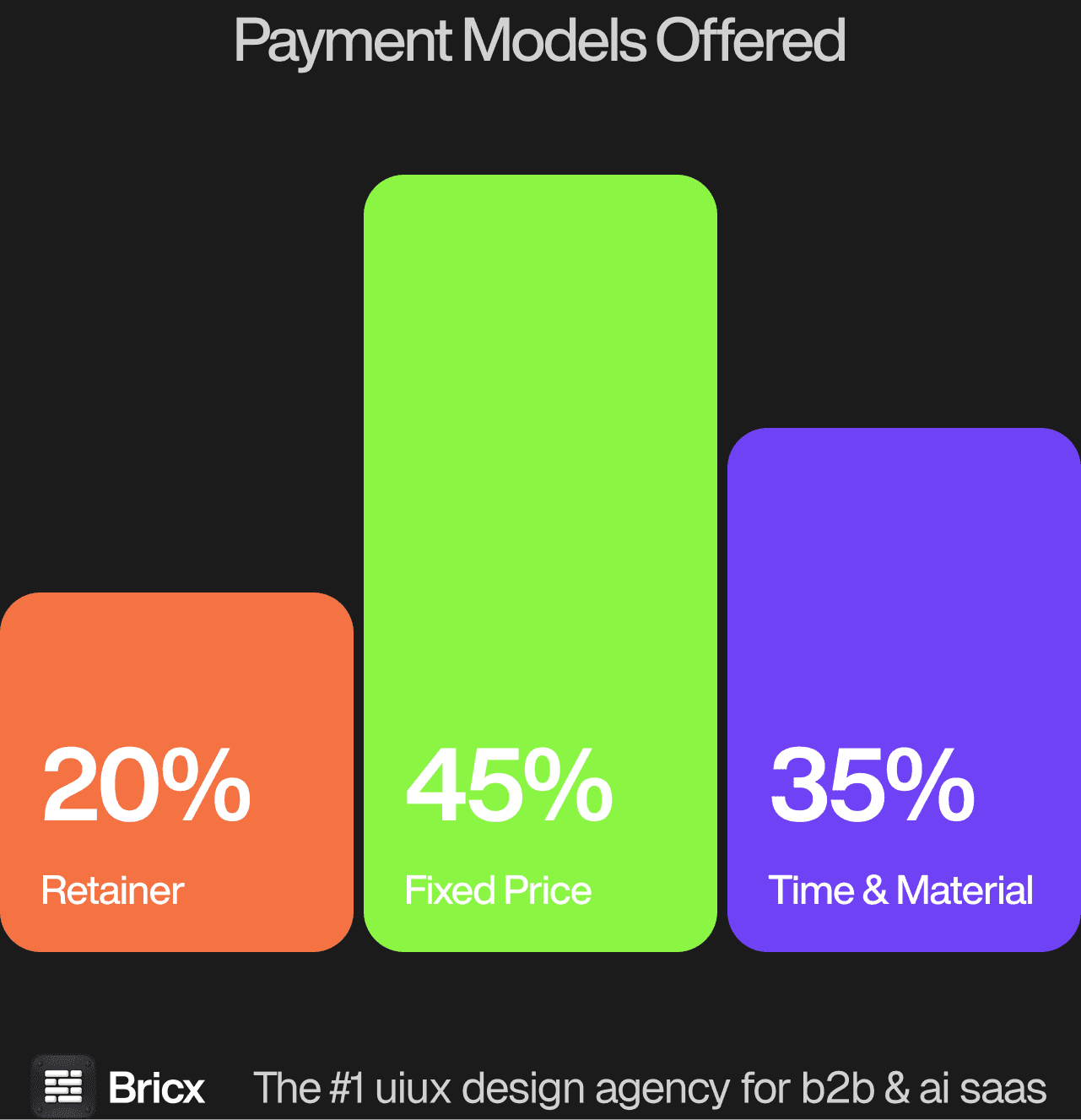
Hourly rates. The benchmark spanned $25 to $195 an hour, clustering at $55 to $90. Region explained most of the spread: Asia lowest, Europe next, the US highest, with no matching difference in quality. Procurement sits above the benchmark median, because a demo screen proves nothing about an approval chain, and the work includes mapping policies that are different at every single customer.
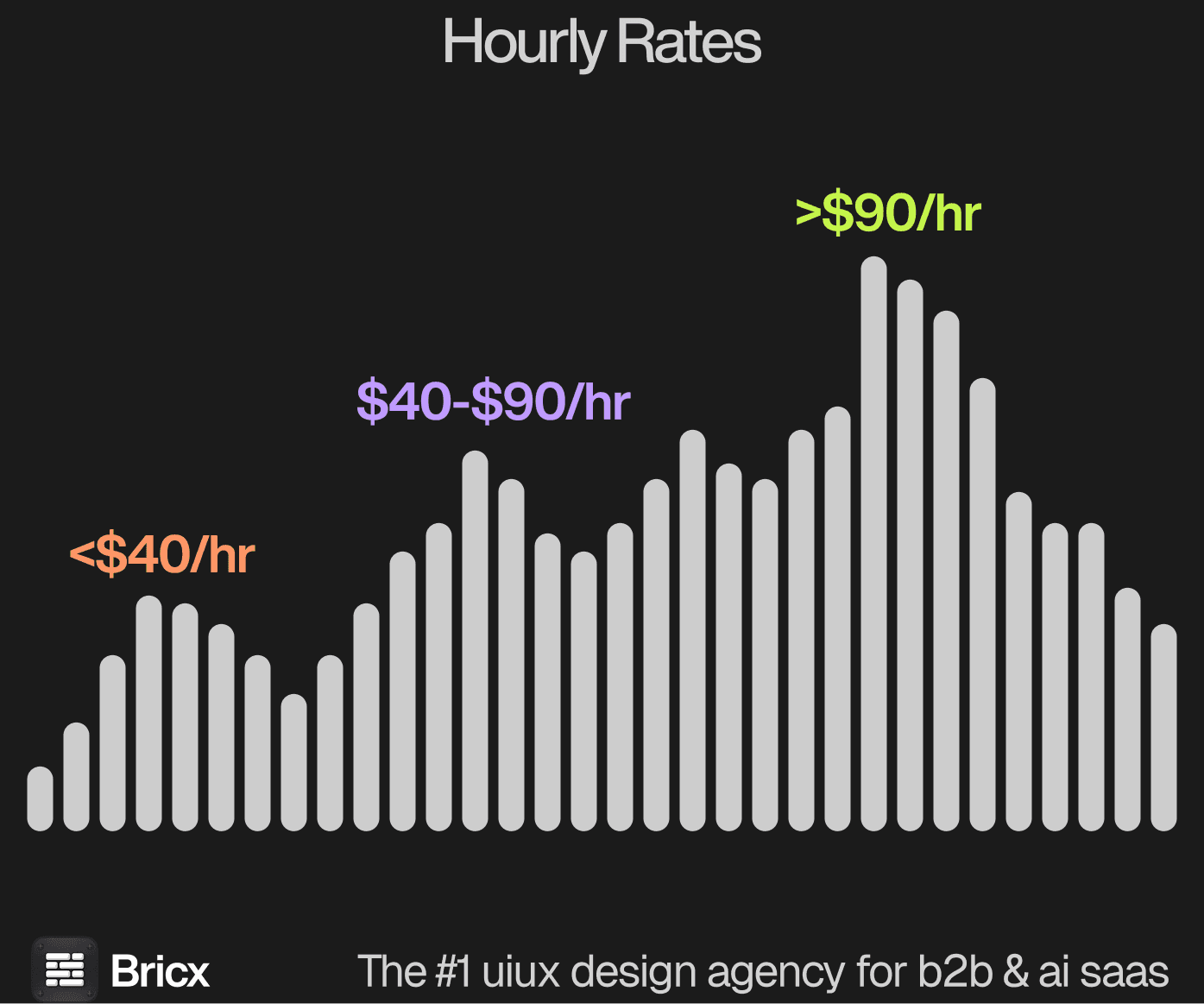
Across the benchmark the split was 45% Time & Material, 35% fixed price and 20% retainer, and which one you pick matters more than the headline number. For procurement SaaS design the model usually matters more than the headline figure, because it decides what happens when the scope moves.
- Fixed price fits a bounded deliverable.
- Time & Material fits an unbounded one.
- Retainer fits a team that ships design continuously.
- Which one fits procurement SaaS design comes down to whether the scope is settled before the work starts.
How do you evaluate a SaaS design agency for a procurement product?
Five things separate procurement SaaS design from B2B software design generally.
Ask who they treat as the primary user. Most teams design for the category manager, because that person can describe the work. The requester, who touches it four times a year, is the one who decides whether a rollout succeeds.
Ask how they handle approval chains. Every customer's matrix differs, conditional on amount, category and cost centre, and an interface that assumes one shape gets configured into something unrecognisable.
Ask what happens on a phone. Approvals arrive between meetings, and an approver who cannot see what they are agreeing to at a glance will either block everything or wave everything through.
Ask how they show a supplier record. Onboarding documents, certifications and risk flags belong to one supplier across many transactions, and treating each purchase as self-contained is how that data goes stale.
Ask about the ERP on the other side. The product does not own the master data, and decisions that fight a customer's existing system get vetoed by their IT team rather than their buyers.
What are the red flags when hiring a design agency?
- A timeline with no milestone before week four. Ask what you can look at in fourteen days. If the answer is a document, keep looking.
- Pricing that does not change when scope does. Either the estimate was padded or the change requests are coming.
- No named designer. A team described only in the collective is not an answer. Ask who, and look at their individual work.
- A portfolio of redesigns with no before. Without the starting point, the improvement is unverifiable.
- Vague ownership of the files. Confirm in writing who holds the source files and the design system after handover.
- No comparable example of procurement SaaS design. An agency that cannot point to work of the same shape is learning on your budget.
Should you hire a SaaS design agency or build in-house?
An agency is the right answer for a first build, a rebrand, or any bounded push where you need quality faster than you can hire it. For procurement SaaS design specifically, the question worth settling first is how often the work recurs.
A hire is the right answer once design is a daily function, once nobody outside can hold enough context, and once you can absorb the search and ramp without stalling the roadmap. Where procurement SaaS design falls on that line is usually clear once you count how many times it will need doing again.
Procurement companies usually employ former buyers, which is the domain knowledge that matters and is rarely available for hire into a design team. That expertise cuts both ways: a product designed by procurement professionals gets built for procurement professionals, and the requester dragged through it is nobody's user. An outside team earns its keep by having to be taught the workflow out loud before designing it.
FAQs
What makes procurement SaaS design hard?
Three user types share one product and want opposite things, and the rules the product enforces are written outside it, in each customer's spend policy and ERP. The interface has to be configurable without turning into a blank page.
How much does procurement SaaS design cost?
Fixed-price product design across the benchmark ran $2,500 to over $150,000 with a median near $43,000, and policy-driven workflows with per-customer configuration sit above that median. Bricx starts at $25,000.
Who should a procurement product be designed for?
The occasional requester, even though the category manager runs the evaluation. Adoption stalls the moment raising a request feels slower than emailing a manager, and no amount of buyer-side polish repairs that.
How should approvals work on a phone?
An approver needs the amount, the requester, the budget line and any exception on one screen, without opening the desktop product. Anything less produces blanket approval or a queue that stops the whole company.