15 Best SaaS Website Design Agencies (2026)
Compare 15 SaaS website design agencies on platform, starting price, hourly rate, timeline and Clutch reviews, with pricing benchmarks from 57 agencies.
Oct 15, 202627 min read
Which agencies are best for a SaaS website?
If you are shortlisting a SaaS website design agency, you are probably looking at three things: who has built sites for companies like yours, what it will cost, and how the agency runs the work.
The benchmark figures on this page come from a SaaS client who was choosing an agency to redesign their website. The client sent the same brief to a long list of website design agencies: a five-page website with copywriting and a Webflow or Framer build. Each agency then walked the client through its price, scope and process on a sales call. The full data is in the State of UI/UX Design Agencies 2026 report.
The agencies' pricing ran from $1,500 to $120,000, with a median of $25,000. The gap in price came from what each quote included: copywriting, brand work, the build and how senior the team was.
Which SaaS website agency fits your platform and budget?
If you want Webflow
These SaaS website design agencies build on Webflow, so marketing can edit and publish pages without waiting on a developer.
- Bricx - Webflow Certified Partner; built the Webflow sites for Billdr and Sutton
- Flow Ninja - builds and operates large Webflow sites, from $15,000
- Grafit - Webflow Enterprise builds for larger teams
- StanVision - Webflow migrations for B2B SaaS
- Amply - Webflow Premium Partner, from $5,000
- Excited - Webflow sites for seed and Series A
For Webflow specialists only, see the list of Webflow agencies.
If you want Framer
These SaaS website design agencies specialise in Framer website design, which suits smaller, design-led sites that need to launch fast.
- Bricx - Framer Expert; built Thrust's site in Framer, with full sites live in three to five weeks
- Refokus - Framer and Webflow, with motion and 3D
The list of Framer agencies covers more Framer studios.
If you want custom coded
Choose one of these when the site shares code with the product or needs a headless CMS behind it.
- Bricx - Next.js; built Sarj's bilingual English and Arabic website
- Webstacks - Next.js with a headless CMS
- Grafit - Astro or Next.js with Sanity
- Clay - custom builds for enterprise
- Phenomenon Studio - React and Next.js
- Arounda - React and Node.js
- Halo Lab - React and Next.js
If you want WordPress
For teams staying on WordPress, these agencies build B2B sites without a platform switch.
- Bop Design - WordPress only
- Huemor - WordPress, HubSpot and Webflow
- Ramotion - WordPress, Webflow and Jamstack
If your budget is $5,000 or less
The lowest starting price on this list.
- Amply - from $5,000
If your budget is $10,000+
Agencies with projects starting at $10,000.
If your budget is $25,000+
The $25,000 tier, where the benchmark median also sits.
If your budget is $50,000+
Enterprise studios with a $50,000 minimum.
How each agency was reviewed
Each agency had to clear three bars, judged on evidence a buyer can check:
- A strong, verified track record. Consistent, recent client reviews on Clutch, or a portfolio of shipped websites.
- Real SaaS work. Named software clients on the agency's site, in case studies or in verified reviews. Each agency has shipped website work for software companies.
- Published facts. Minimum project size, hourly rate, team size and location from Clutch, checked on October 14, 2026. Stack, copywriting and motion come from each agency's own site. Outcome numbers appear only where a client stated them in a Clutch review or the agency published them in a case study, and each one says which.
Agencies are ordered by fit for funded B2B SaaS companies hiring for the website. Pricing and timeline benchmarks come from The State of UI/UX Design Agencies 2026, where a SaaS client put the same brief to 57 agencies; not every agency gave a price or timeline.
How the 15 best SaaS website agencies compare
Filter by budget or platform, or sort by price, hourly rate or reviews.
| Agency | Best for | Platforms | Starting price | Hourly rate | Typical timeline | Team and HQ | Clutch | Engagement model |
|---|---|---|---|---|---|---|---|---|
| Bricx | B2B and AI SaaS companies that need a website for a complex product, from AI-native tools to enterprise platforms with many user roles | Webflow (Certified Partner), Framer (Expert), custom code (Next.js) | $25,000+ (fixed scope); retainers from $10,000/month | $50 to $99 | About 5 weeks | 10 to 49 people, Dubai and New Delhi | 5.0/5, 32 reviews | Fixed-scope projects, monthly retainers, embedded teams, paid pilot sprints |
| Webstacks | Enterprise SaaS with large, multi-team websites | Next.js, Gatsby, Sanity, Storyblok, Contentful, Webflow, WordPress | $10,000+ | $200 to $300 | 10 to 16 weeks | 50 to 249 people, San Diego, CA | 5.0/5, 3 reviews | Projects and retainers |
| Refokus | Launches and rebrands built around motion and 3D | Webflow, Framer, custom code | $25,000+ | $100 to $149 | 8 to 14 weeks | 10 to 49 people, distributed (Germany) | 5.0/5, 10 reviews | Not published |
| Flow Ninja | Enterprise Webflow sites that need ongoing operations | Webflow | $15,000+ | $50 to $99 | 8 to 16 weeks | 50 to 249 people, Belgrade, Serbia | 4.9/5, 56 reviews | Projects; retainers from $6,000/month, 12-month term |
| Grafit | SaaS sites that need continuous growth work after launch | Astro or Next.js with Sanity; Webflow Enterprise | $25,000+ | $100 to $149 | About 6 weeks | 10 to 49 people, Warsaw, Poland | 5.0/5, 28 reviews | Projects, monthly website growth retainer |
| StanVision | B2B SaaS teams migrating to Webflow | Webflow, HubSpot | $25,000+ | $50 to $99 | 8 to 10 weeks | 10 to 49 people, Sofia, Bulgaria | 5.0/5, 21 reviews | Projects, retainers, team extension |
| Huemor | Mid-market SaaS redesigns focused on lead generation | WordPress, HubSpot, Webflow | $25,000+ on Clutch; most projects $50,000 to $100,000 per its site | $150 to $199 | 16 to 24 weeks | 10 to 49 people, Pittsburgh, PA | 4.8/5, 72 reviews | Projects; support plans at $2,500 and $5,500 a month |
| Bop Design | WordPress teams that want copy and SEO in one project | WordPress | $25,000+ | $150 to $199 | 16 to 20 weeks | 10 to 49 people, San Diego, CA | 5.0/5, 127 reviews | Projects and ongoing marketing |
| Ramotion | Brand-led relaunches with a large budget | Jamstack, Webflow, WordPress | $50,000+ | $150 to $199 | 12 to 24 weeks | 10 to 49 people, San Francisco, CA | 4.9/5, 29 reviews | Projects, team extension, ongoing design support |
| Clay | Enterprise brand and website programmes | Custom builds | $50,000+ | $150 to $199 | Not published | 10 to 49 people, San Francisco, CA | 4.8/5, 32 reviews | Time and materials, fixed fee, retainer |
| Amply | Webflow migrations and ongoing site work on smaller budgets | Webflow | $5,000+ | $100 to $149 | About 4 to 6 weeks | 10 to 49 people, Utah | 4.9/5, 7 reviews | Website packages; retainers from $3,000/month |
| Excited | Seed and Series A SaaS sites built in Webflow | Webflow | $10,000+ | $50 to $99 | 4 to 8 weeks (UI/UX projects) | 10 to 49 people, Lviv, Ukraine | 5.0/5, 56 reviews | Projects with post-launch support |
| Halo Lab | Seed-stage SaaS teams that need a website on a tight budget | Webflow, React, Next.js, Vue, Sanity, Prismic | $10,000+ | $25 to $49 | 1 to 3 months | 50 to 249 people, Dubai, UAE | 4.9/5, 100 reviews | Projects and dedicated monthly teams |
| Phenomenon Studio | Healthtech, fintech and B2B SaaS teams wanting the rebrand and the website from one partner | React, Next.js, WordPress, Webflow | $10,000+ | $50 to $99 | From 6 weeks (build) | 50 to 249 people, Dover, DE | 5.0/5, 52 reviews | Projects and ongoing design and development |
| Arounda | Seed to Series A SaaS and fintech teams that want a website redesign with development in-house | React, Node.js, Python, Webflow | $25,000+ ($6,000 on its own site) | $25 to $49 | 6+ weeks | 10 to 49 people; offices in Odesa, London and Sydney | 5.0/5, 87 reviews | Sprint-based projects, dedicated monthly team |
1. Bricx: Best SaaS website design agency for B2B and AI companies
- Starting price
- $25,000+ (fixed scope); retainers from $10,000/month
- Hourly rate
- $50 to $99
- Clutch
- 5.0/5, 32 reviews
- Team and HQ
- 10 to 49 people, Dubai and New Delhi
- Stack
- Webflow (Certified Partner; Webflow sites for Billdr and Sutton), Framer (Expert), custom code (Next.js)
- Engagement model
- Fixed-scope projects, monthly retainers, embedded teams, paid pilot sprints
- Typical timeline
- Websites live in about five weeks
- Best for
- Funded B2B and AI SaaS companies with a complex product that need the website designed and built in about five weeks, on Webflow, Framer or custom code
- Not a fit for
- Non-software businesses and budgets under $25,000
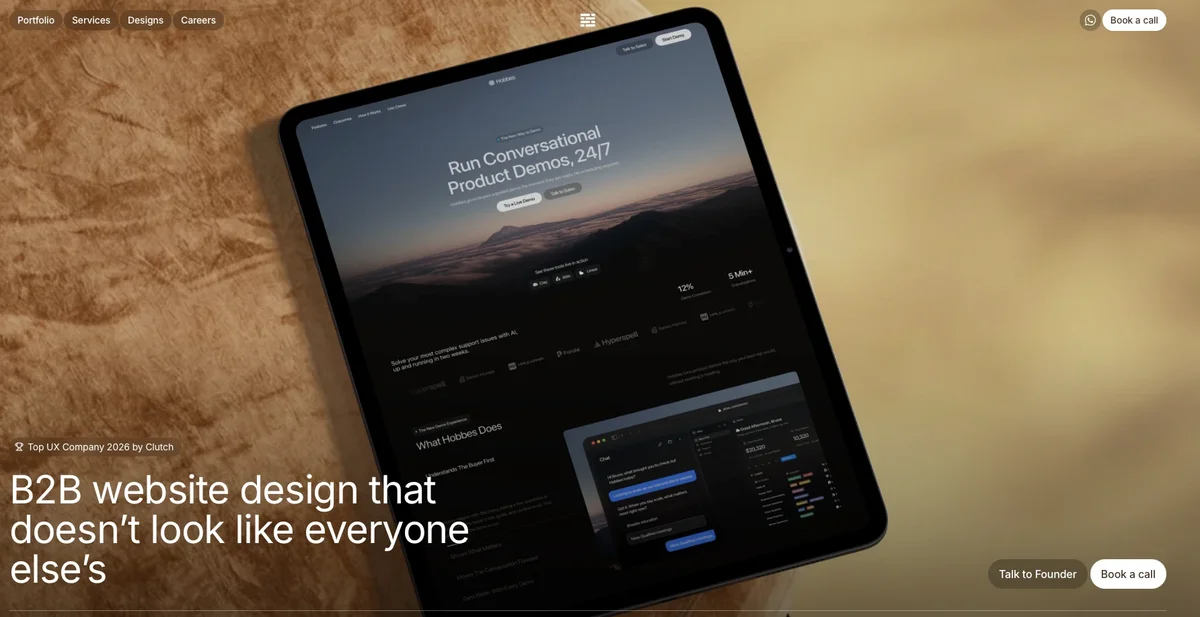
Bricx is the best SaaS website design agency for B2B and AI SaaS companies with a complex product, including enterprise platforms with many user roles. Bricx has shipped 50+ websites in the last two years, for clients including Writesonic (YC S21), Sybill, Digit, CAMB.AI, LTV.ai and Hobbes.
Services
- Website design and build. Projects open with three to five hero-section directions. The chosen one is extended across the site.
- Development on three platforms. Builds run in parallel on Webflow, Framer or custom code. Custom-coded builds in Next.js run through its frontend development services.
- Copy and positioning. Copy can come from the client or from Bricx. A B2B SaaS website project runs from positioning to launch.
Pricing
Bricx prices a website as a fixed-scope project, so the cost is agreed before work starts. Ongoing work moves to a monthly retainer.
- Fixed-scope projects: from $25,000+.
- Retainers: from $10,000/month.
- Hourly rate on Clutch: $50 to $99.
- Other ways to engage: embedded teams and paid pilot sprints.
- Timeline: websites go live in about five weeks.
What clients liked
- Clutch rating: 5.0/5 across 32 reviews, with 5.0 for quality, schedule and cost on both reviews below.
- More leads after launch. After Bricx rebuilt Scale.jobs' Webflow landing page (March to May 2025), visitor-to-lead conversion rose from 1.2% to 2.8% in the first month, leads rose about 20% and bounce rate fell about 30%, its CTO reported. Before designing, the team pulled analytics reports, watched screen recordings and sat in on sales calls.
- Higher sign-ups. At Writesonic, new landing page designs increased sign-up rates. Its CEO wrote: "Their designs consistently balanced aesthetics with functionality and business objectives."
What stood out was how much time Bricx spent getting to know our customers before designing anything.
Limitations
- Bricx works only with software companies.
- Projects start at $25,000, so smaller budgets are out of range.
SaaS website design
Need a website that makes a complex product easy to buy?
Bricx designs and builds it in Webflow, Framer or Next.js. Websites go live in about five weeks, and projects start at $25,000.
2. Webstacks
- Starting price
- $10,000+
- Hourly rate
- $200 to $300
- Clutch
- 5.0/5, 3 reviews
- Team and HQ
- 50 to 249 people, San Diego, CA
- Stack
- Next.js, Gatsby, Sanity, Storyblok, Contentful, Webflow, WordPress
- Engagement model
- Projects and retainers
- Typical timeline
- 10 to 16 weeks for a full marketing site; 4 to 6 months for a mid-size redesign, per its own site
- Best for
- Enterprise SaaS companies with a large, multi-team website, engineering support and a headless CMS such as Sanity or Contentful
- Not a fit for
- A small Series A site of around 10 pages that marketing wants to run alone, or teams that cannot pay $200 to $300 an hour
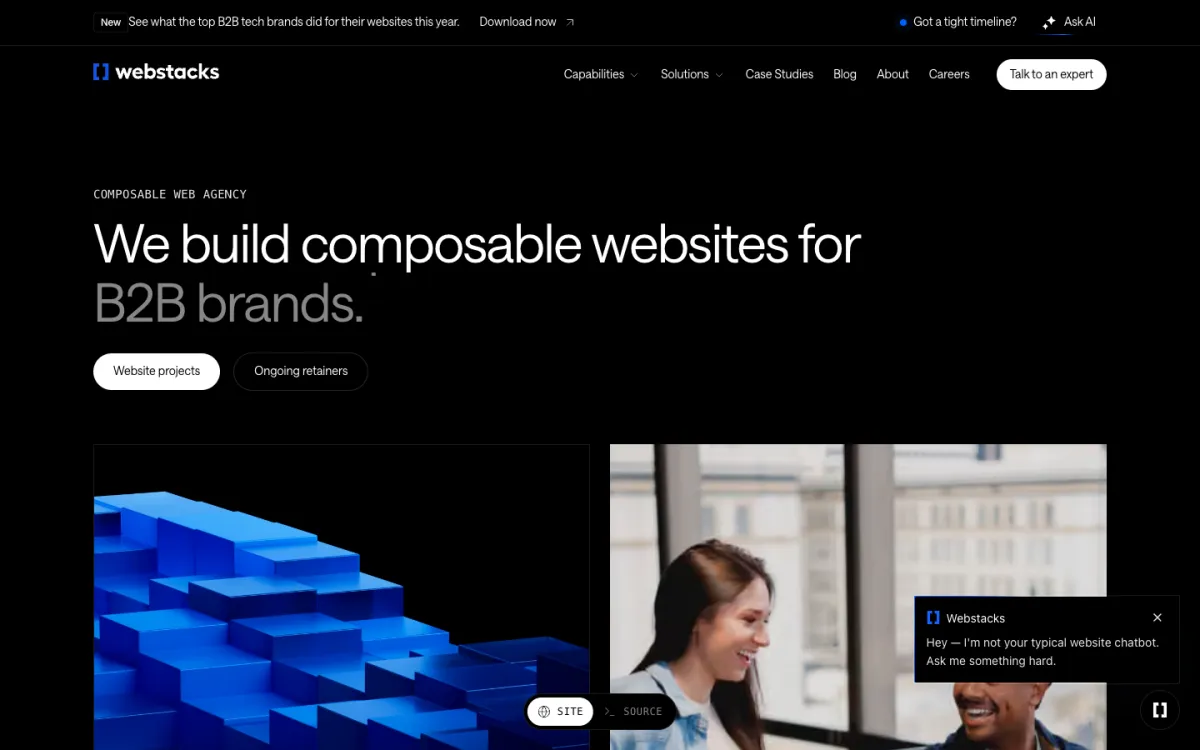
Webstacks builds composable websites for B2B software companies at scale, on Next.js with headless CMSs such as Sanity, Storyblok and Contentful, and on Webflow and WordPress. Gong, ServiceTitan, Calendly, Snowflake and LogicMonitor are clients.
Services
- Composable website builds. Sites are built on Next.js with a headless CMS such as Sanity, Storyblok or Contentful.
- Webflow and WordPress builds. Both are offered alongside the headless stack.
- Motion and video. Motion design, explainer video and UI animation are run in-house.
- Scope. Websites and branding; it does not design product UI.
Pricing
Webstacks has a low published minimum and the highest hourly rate on this list. A large site billed by the hour will cost far more than the minimum suggests.
- Starting price on Clutch: $10,000+.
- Hourly rate: $200 to $300. It is the most expensive team here by rate.
- How work is sold: projects and retainers.
What clients liked
- Clutch rating: 5.0/5 across 3 reviews.
- A fit for big teams. The composable approach suits large marketing teams with engineering support and many contributors.
- LogicMonitor is a good example of where Webstacks is strongest. Its old site had fallen behind the product, and the agency's case study reports that the website rebuild turned it into a steady pipeline source, with organic pipeline up 18% in the first quarter.
Limitations
- Its sweet spot starts at Series B, by its own description, so Seed and Series A teams sit below its usual client.
- A full marketing site takes 10 to 16 weeks and a mid-size redesign 4 to 6 months, by its own estimates.
- At $200 to $300 an hour it is the most expensive team here by rate, and it publishes no project prices.
3. Refokus
- Starting price
- $25,000+
- Hourly rate
- $100 to $149
- Clutch
- 5.0/5, 10 reviews
- Team and HQ
- 10 to 49 people, distributed team, Germany
- Stack
- Webflow, Framer, custom code
- Engagement model
- Not published
- Typical timeline
- 8 to 14 weeks for most projects, per its own site
- Best for
- A SaaS launch or rebrand on Webflow or Framer built around motion and 3D, with $25,000 or more to spend
- Not a fit for
- Teams that want a conservative, low-maintenance site, or a steady supply of landing pages
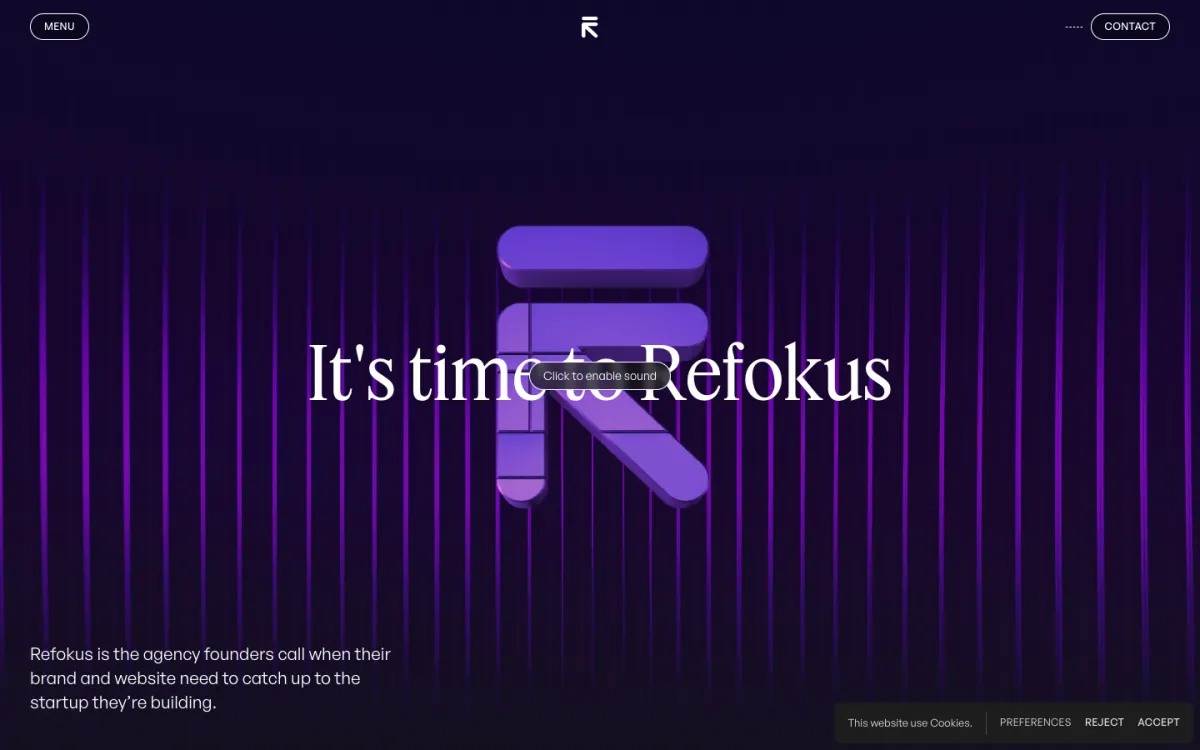
Refokus designs and develops SaaS websites in Webflow and Framer, often extended with custom code, 3D and creative development. Webflow itself is a client, alongside Weglot, Chargeflow and deepset.
Services
- Website design and development. SaaS websites are built in Webflow and Framer.
- Custom code, 3D and creative development. These often extend the Webflow or Framer build.
- Launch and rebrand work. The work leans visual and ambitious. That suits a launch or a rebrand more than a steady flow of landing pages.
- Scope. Branding, websites and brand marketing; it does not design product UI.
Pricing
Refokus publishes a minimum project size and an hourly rate. It does not publish how it structures an engagement.
- Starting price: $25,000+.
- Hourly rate: $100 to $149.
- Engagement model: not published. Ask early whether the work is a fixed project or a retainer.
What clients liked
- Longer visits after launch. Silvr's head of brand reported in a Clutch review that average engagement time rose 17% within two months of launch.
- Recognition from Webflow. Refokus lists Webflow Agency of the Year nominations in 2022, 2023 and 2025.
- Clutch rating: 5.0/5 across 10 reviews.
Limitations
- Its own site says projects usually start around $40,000 and most run $50,000 to $80,000, well above its $25,000 Clutch minimum.
- Most projects take 8 to 14 weeks, by its own estimate.
- It does not design product UI, so a site-and-app relaunch needs a second team.
4. Flow Ninja
- Starting price
- $15,000+
- Hourly rate
- $50 to $99
- Clutch
- 4.9/5, 56 reviews
- Team and HQ
- 50 to 249 people, Belgrade, Serbia
- Stack
- Webflow
- Engagement model
- Projects; retainers from $6,000/month, 12-month term
- Typical timeline
- 8 to 16 weeks for a project, per its pricing page
- Best for
- Enterprise SaaS teams on Webflow that want one partner to build the site and keep running it on a retainer
- Not a fit for
- Teams that want a one-off build and no retainer
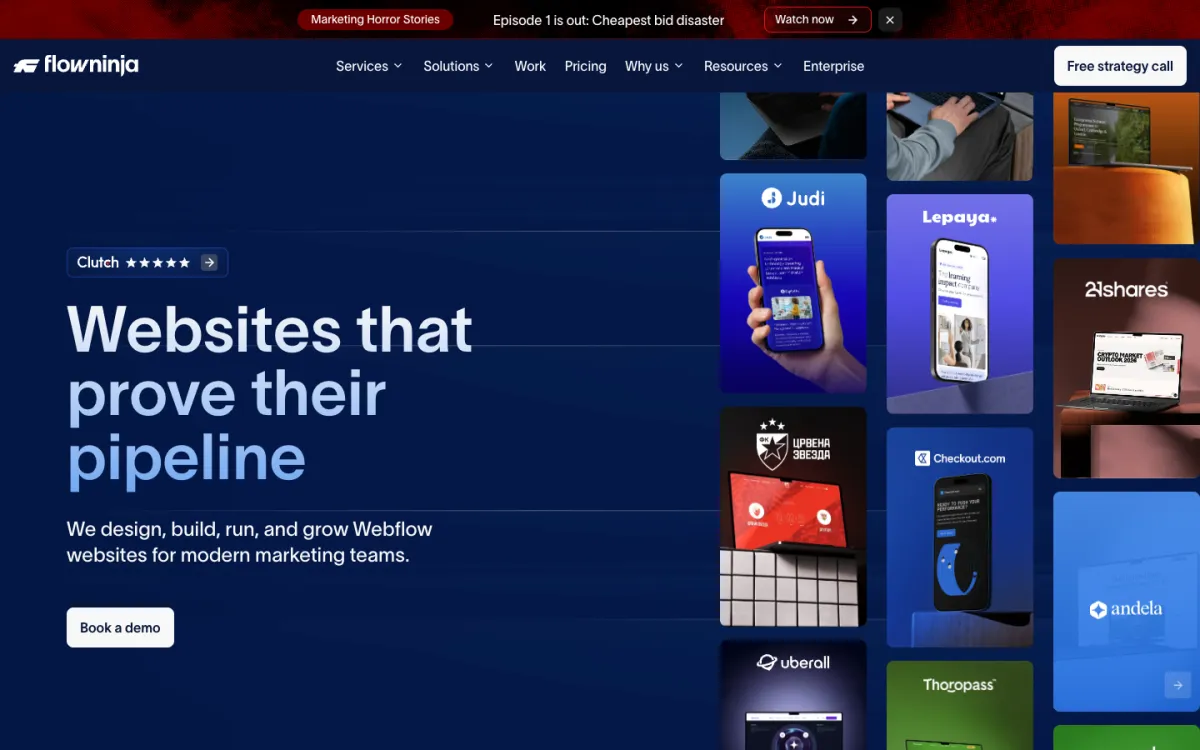
Flow Ninja describes itself as a WebOps team for Webflow. It builds large marketing sites for software companies and then keeps operating them. Clients include Upwork, Uberall, Invoca and Trustly.
Services
- Webflow builds. Flow Ninja builds large marketing sites for software companies, and only in Webflow.
- Website operations. After launch it keeps operating the site as a long-term partner.
- Messaging and page copy. Included in projects, so the client does not have to supply the copy.
- Motion and illustration. Offered as part of the design work.
- Migrations and ongoing development. It moves sites off WordPress, HubSpot or Contentful into Webflow, then keeps building on them under a retainer.
- Scope. Flow Ninja designs websites only.
Pricing
Flow Ninja sells one-time projects and ongoing retainers, and its pricing page lays out both.
- flowBuild: a website engineered for growth, from $15,000+.
- flowTransform: strategic web design and replatforming, from $25,000+.
- Retainers (flowOperate, flowGrowth): from $6,000 a month on a 12-month commitment, about $72,000 a year, and include a dedicated pod of a project manager, designer and developer, weekly sprints, quarterly CRO audits and technical SEO monitoring.
- Payment terms: usually 50% upfront and 50% at launch, or milestones on larger scopes.
- Hourly rate: Clutch lists $50 to $99, though Flow Ninja says it does not track hours.
- Clutch minimum: $10,000+.
What clients liked
- Faster pages. A fintech client reported in a Clutch review that page loads were around 40% faster after the rebuild.
- Support after launch. The model is strongest after launch, as a long-term operations partner.
- Clutch rating: 4.9/5 across 56 reviews.
Limitations
- Retainers need a 12-month commitment at $6,000 a month, about $72,000 a year.
- It builds only in Webflow and Sanity.
- Launch support covers 30 days; after that, ongoing work moves to the retainer.
5. Grafit
- Starting price
- $25,000+
- Hourly rate
- $100 to $149
- Clutch
- 5.0/5, 28 reviews
- Team and HQ
- 10 to 49 people, Warsaw, Poland
- Stack
- Astro or Next.js with Sanity by default; Webflow for teams on the Webflow Enterprise plan
- Engagement model
- Projects, monthly website growth retainer
- Typical timeline
- About 6 weeks including design (design alone 3 to 5 weeks), per its own site
- Best for
- B2B SaaS teams that want a component-based site in custom code or Webflow Enterprise, plus a monthly retainer for new pages and tests after launch
- Not a fit for
- Teams wanting copywriting bundled into one fee
Grafit builds B2B SaaS websites with a component-based architecture, in custom code by default and in Webflow for teams on the Webflow Enterprise plan. It also sells a monthly website growth retainer for ongoing pages and tests. Clients include Clay (the GTM platform), Gentrace, Callstack and Jace AI.
Services
- Component-based SaaS sites. Built in Astro or Next.js with Sanity by default, or in Webflow as a Webflow Enterprise Partner.
- Messaging and content structure. Both are included in web projects.
- Website growth retainer. A monthly retainer covers ongoing pages and tests.
- Motion and product video. Offered as a separate service.
Pricing
Grafit's project price covers design, build, messaging and content structure. Copywriting is not in that price.
- Starting price: $25,000+.
- Hourly rate: $100 to $149.
- How work is sold: projects, or a monthly website growth retainer.
- Extra cost: copywriting is priced separately.
What clients liked
- Clutch rating: 5.0/5 across 28 reviews.
- Grafit builds its sites around conversion. The agency's IC Project case study reports that demo requests picked up after the new site launched.
Limitations
- Copywriting is priced separately; the project covers messaging and page structure, not finished copy.
- Bug fixes are included for three days after launch; later changes go through its paid growth retainer.
- Its default build is custom code (Astro or Next.js with Sanity); Webflow is reserved for teams that want the Webflow Enterprise plan.
6. StanVision
- Starting price
- $25,000+
- Hourly rate
- $50 to $99
- Clutch
- 5.0/5, 21 reviews
- Team and HQ
- 10 to 49 people, Sofia, Bulgaria
- Stack
- Webflow, HubSpot
- Engagement model
- Projects, retainers, team extension
- Typical timeline
- 8 to 10 weeks for a website; 10 to 12 weeks with branding, per its own site
- Best for
- Funded B2B SaaS teams migrating to Webflow that want branding, positioning and the migration from one agency
- Not a fit for
- Headless or custom-coded builds, and pre-seed budgets below the $25,000 minimum
StanVision positions itself as a Webflow agency for B2B SaaS products. Clients include Primer, Rillet, Blee and Timefold.
Services
- Branding and positioning. Brand and website can run as one project, which takes 10 to 12 weeks by its own estimate.
- Webflow development. The stack is Webflow and HubSpot.
- Migrations and maintenance. It moves sites off WordPress, Framer or Contentful into Webflow and maintains them on a monthly retainer.
Pricing
StanVision's hourly rate is mid-range, but the project minimum is not small. That combination suits a funded company.
- Starting price: $25,000+.
- Hourly rate: $50 to $99.
- How work is sold: projects, retainers or team extension.
- Membership plans (monthly, cancel any time): Maintenance $990, Grow $2,990 (website design, Webflow development, unlimited requests) and Fast paced $4,990 (two requests at a time). Each includes a dedicated project manager and a 7-day money-back guarantee.
- Who it suits: the Sofia team pairs mid-range hourly rates with a $25,000 minimum, so it suits funded companies rather than pre-seed budgets.
What clients liked
- More traffic after launch. Blee's head of marketing reported in a Clutch review that session views rose 176% year on year within two months of launch.
- Clutch rating: 5.0/5 across 21 reviews.
Limitations
- It builds only in Webflow, so a headless or custom-coded site needs another partner.
- Copy is not included by default: StanVision sets the message hierarchy and page structure, and the client brings the copy.
- It is a ten-person team, by its own count, so check capacity against the launch date.
7. Huemor
- Starting price
- $25,000+ on Clutch; most projects $50,000 to $100,000 per its site
- Hourly rate
- $150 to $199
- Clutch
- 4.8/5, 72 reviews
- Team and HQ
- 10 to 49 people, Pittsburgh, PA
- Stack
- WordPress, HubSpot, Webflow
- Engagement model
- Projects; support plans at $2,500 and $5,500 a month
- Typical timeline
- 16 to 24 weeks for a full redesign, per its own site
- Best for
- Mid-market SaaS companies with an established brand that want a redesign built to generate leads, with copywriting included
- Not a fit for
- Early-stage teams still defining positioning, or budgets below the $50,000 to $100,000 most Huemor projects cost
Huemor redesigns marketing websites for mid-market software companies with lead generation as the brief. SaaS clients include TeamDynamix, Schoox and AutoVitals.
Services
- Website redesigns. Huemor redesigns marketing websites with lead generation as the brief.
- Three platforms. The Pittsburgh team builds on WordPress, HubSpot and Webflow.
- Copywriting. Included in redesign projects.
- Support plans. Sold after launch.
- Scope. Websites, branding and SEO; it does not design product UI.
Pricing
Huemor's Clutch minimum understates what most clients pay. Its own site gives a much higher typical range.
- Starting price on Clutch: $25,000+.
- Typical project, per its own site: $50,000 to $100,000.
- Hourly rate: $150 to $199.
- What the fee covers: a one-time fixed fee for strategy, UX and UI design, development, copywriting, data migration, technical SEO, analytics setup and two weeks of post-launch support.
- Support plans after launch: Essentials at $2,500 a month (hosting, updates, security and up to 15 hours of support) and Scale at $5,500 a month (adds copywriting and design, up to 40 hours).
What clients liked
- Clutch rating: 4.8/5 across 72 reviews.
- A fit for established brands. It suits companies with an established brand that want a stronger site.
- Huemor's lead-generation focus shows in its SaaS work. The agency's AutoVitals case study reports that the demo page became a far stronger source of demo requests after the redesign.
Limitations
- Most rebuilds cost $50,000 to $100,000 by its own figures, well above its $25,000 Clutch minimum.
- Full redesigns take 16 to 24 weeks, by its own estimate.
- Two weeks of support are included after launch; ongoing plans cost $2,500 or $5,500 a month.
8. Bop Design
- Starting price
- $25,000+
- Hourly rate
- $150 to $199
- Clutch
- 5.0/5, 127 reviews
- Team and HQ
- 10 to 49 people, San Diego, CA
- Stack
- WordPress
- Engagement model
- Projects and ongoing marketing
- Typical timeline
- 16 to 20 weeks for a custom build or redesign
- Best for
- B2B software teams staying on WordPress that want design, copy, SEO and CRM setup in one project
- Not a fit for
- Teams moving to Webflow, Framer or headless, and sites that need motion design
Bop Design builds B2B websites exclusively on WordPress. Software and technology clients include Pivotree, Kaseware, Data Clarity and Transflo.
Services
- WordPress websites. Bop Design builds B2B websites exclusively on WordPress.
- Copywriting. Included in website projects and offered separately through its content marketing team.
- SEO. SEO and GEO are part of its website service.
- CRM setup. The site is connected to the client's CRM as part of the build.
- One team. All of this is handled by the same San Diego team.
- Scope. WordPress websites, branding and content marketing.
Pricing
Bop Design publishes one starting price and one hourly rate. Copy, SEO and CRM setup are handled by the same team.
- Starting price: $25,000+.
- Hourly rate: $150 to $199.
- Typical range, per its own site: $25,000 to $75,000, averaging about $45,000.
- What the price covers: design, development, copywriting and SEO in one fee.
- How work is sold: projects and ongoing marketing.
What clients liked
- The largest review base here. Its 127 Clutch reviews are the largest review base on this list, at 5.0/5.
- No platform switch. The WordPress-only approach suits teams already invested in WordPress and wary of switching.
- Bop Design pairs the build with SEO, and it shows in the results. The agency's SmartChoice case study reports organic search traffic up 107% after the website rebuild.
Limitations
- Every site is built in WordPress, so Webflow, Framer and headless builds are off the table.
- Builds take 16 to 20 weeks, and phases run one after another, so a delay in one pushes the rest.
- It is a general B2B agency: software sits alongside biotech, industrial, engineering and energy clients.
9. Ramotion
- Starting price
- $50,000+
- Hourly rate
- $150 to $199
- Clutch
- 4.9/5, 29 reviews
- Team and HQ
- 10 to 49 people, San Francisco, CA
- Stack
- Jamstack, Webflow, WordPress
- Engagement model
- Projects, team extension, ongoing design support
- Typical timeline
- 12 to 24 weeks for a full redesign; 8 to 10 weeks for an MVP site, per its own site
- Best for
- Software companies relaunching the brand and the website together, with $50,000 or more to spend
- Not a fit for
- Budgets under $50,000
Ramotion pairs brand strategy with website design and development for software companies. Descript, Xero, Redis, HackerRank and Mozilla have worked with the San Francisco studio.
Services
- Brand strategy with website design and development. One team handles the brand and the site, built on Jamstack, Webflow or WordPress.
- Three platforms. Ramotion builds on Jamstack, Webflow and WordPress.
- Motion design and microinteractions. Both are part of its brand and website work.
Pricing
Ramotion sits near the top of the price range on this list. A SaaS company that needs a branding agency before it needs a website agency can compare the branding agencies for startups first.
- Starting price: $50,000+.
- Hourly rate: $150 to $199.
- Project minimum, per its own site: design and development projects start at a $50,000 scope.
- Brand Team Extension: $9,500 a month part-time or $16,800 a month full-time, with a 3-month minimum.
- How work is sold: projects, team extension or ongoing design support.
What clients liked
- Growing traffic. Mozilla's marketing manager reported that traffic grew month on month after launch.
- Clutch rating: 4.9/5 across 29 reviews.
Limitations
- A full redesign takes 12 to 24 weeks by its own estimate; its faster MVP site takes 8 to 10.
- Copy is offered as copy direction and messaging hierarchy, so confirm who writes the finished copy.
- The $50,000 minimum puts it out of reach for most early-stage budgets.
10. Clay
- Starting price
- $50,000+
- Hourly rate
- $150 to $199
- Clutch
- 4.8/5, 32 reviews
- Team and HQ
- 10 to 49 people, San Francisco, CA
- Stack
- Custom builds
- Engagement model
- Time and materials, fixed fee, retainer
- Typical timeline
- Not published
- Best for
- Large technology companies running an enterprise brand and website programme
- Not a fit for
- Seed and Series A budgets
Clay designs brands and websites for large technology companies. It has Stripe, Slack, Tipalti, Cornerstone and TeamViewer on its client list.
Services
- Brand and website design. Clay also designs digital products and writes copy, so brand, site and product can sit with one team.
- In-house content studio. It covers copywriting, motion, animation and sound design, so one team can produce the whole launch.
- Custom builds. Clay lists custom builds rather than a single platform.
Pricing
Clay is built for enterprise budgets and multi-month engagements.
- Starting price: $50,000+.
- Hourly rate: $150 to $199.
- How work is sold: time and materials, fixed fee or retainer.
What clients liked
- More traffic and more conversions. A fintech client's director reported on Clutch that website traffic rose 40% and conversion rose 15%.
- Clutch rating: 4.8/5 across 32 reviews.
Limitations
- It publishes no pricing, timeline or build platform, so agree up front which CMS marketing will edit in.
- Its client list leans to enterprise and consumer brands such as Slack and Snapchat, so an early-stage SaaS site may be a small account.
- The $50,000 minimum is set for enterprise budgets.
11. Amply
- Starting price
- $5,000+
- Hourly rate
- $100 to $149
- Clutch
- 4.9/5, 7 reviews
- Team and HQ
- 10 to 49 people, Utah (Silicon Slopes)
- Stack
- Webflow
- Engagement model
- Website packages; retainers from $3,000/month
- Typical timeline
- About 4 to 6 weeks, per its SaaS website page
- Best for
- SaaS teams on a smaller budget that need a Webflow migration, a redesign or ongoing page work, from $5,000
- Not a fit for
- Custom-coded or headless builds
Amply is a Webflow Premium Partner. It works with SaaS companies including Mural, Zenhub and Workstreet on migrations, redesigns and ongoing Webflow work.
Services
- Webflow migrations. Sites move into Webflow from other platforms.
- Website redesigns. Its SaaS page puts a typical project at about 4 to 6 weeks.
- Ongoing Webflow work. Monthly retainers bundle design, Webflow development and motion.
- Website packages. Sold as one-time projects.
- Branding. Positioning and visual identity are offered as a branding service.
- AI-ready sites. Amply audits sites for AI search readiness and offers a Slack agent that lets marketers make day-to-day site edits without opening Webflow.
- Scope. Webflow websites and branding, with product design as an add-on.
Pricing
Amply has the lowest Clutch minimum on this list. That makes it practical for contained projects.
- Starting price on Clutch: $5,000+.
- Hourly rate: $100 to $149.
- Retainers (monthly): Webflow Development $3,000, Design + Webflow $4,500 and Dedicated Team $10,000, on a one-year contract with a 60-day trial. Extra hours can be added in busy months.
- Payment terms: usually 50% upfront and 50% on completion.
- How work is sold: website packages and monthly retainers.
What clients liked
- Clutch rating: 4.9/5 across 7 reviews.
- A low entry price. The $5,000 minimum makes it practical for contained projects.
- Amply's sites are built to keep visitors moving through the story. The agency has shared that after Veraset's new Webflow site launched, visitors stayed longer and explored more, with sessions up 60%.
Limitations
- It builds almost all of its SaaS sites in Webflow.
- Copywriting is a paid add-on to its packages.
- Package prices are not published; its SaaS page says a very small site can start at $10,000.
12. Excited

- Starting price
- $10,000+
- Hourly rate
- $50 to $99
- Clutch
- 5.0/5, 56 reviews
- Team and HQ
- 10 to 49 people, Lviv, Ukraine
- Stack
- Webflow
- Engagement model
- Projects with post-launch support
- Typical timeline
- 4 to 8 weeks for most UI/UX design projects, per its own site; no website-specific figure
- Best for
- Seed and Series A SaaS companies that want a Webflow site from $10,000 and already have their copy
- Not a fit for
- Teams that need copywriting or positioning included
Excited designs SaaS websites and builds them in Webflow. Recent SaaS work includes ClubReady, InsuredMine, BlueNexus and Xilo.
Services
- SaaS website design, built in Webflow. Webflow is its preferred tool for launching sites.
- Branding, visuals and motion. All are handled by the same team.
- Support. Projects come with post-launch support.
Pricing
Excited is an accessible option for seed and Series A companies.
- Starting price on Clutch: $10,000+.
- Hourly rate: $50 to $99, from its Lviv base.
- How work is sold: projects with post-launch support.
What clients liked
- A site the team uses. BlueNexus's leadership describes a consistent digital presence that the team actively uses.
- Clutch rating: 5.0/5 across 56 reviews.
Limitations
- Copywriting and positioning are not listed as services, so teams without a clear message should plan to bring copy.
- Much of its portfolio is apps and consumer products rather than SaaS marketing sites, so ask for SaaS website examples.
- It builds in Webflow by default and publishes no pricing.
13. Halo Lab
- Starting price
- $10,000+
- Hourly rate
- $25 to $49
- Clutch
- 4.9/5, 100 reviews
- Team and HQ
- 50 to 249 people, Dubai, UAE
- Stack
- Webflow, React, Next.js, Vue, Sanity, Prismic
- Engagement model
- Projects and dedicated monthly teams
- Typical timeline
- 1 to 3 months for a website with a CMS, per its own site
- Best for
- Seed-stage SaaS teams that need a website on a tight budget, at $25 to $49 an hour
- Not a fit for
- Motion-heavy launch sites
Halo Lab designs and develops websites from Dubai and Eastern Europe, building in Webflow, React and Next.js with Prismic or Sanity as the CMS. Clients include Ditto, Tessellate and nyra health.
Services
- Website design and development. Halo Lab builds in Webflow, React and Next.js.
- CMS. Prismic or Sanity.
- Dedicated teams. Work can run as a dedicated monthly team.
Pricing
Halo Lab has one of the lowest hourly rates on this list, which stretches a seed budget further.
- Starting price on Clutch: $10,000+.
- Hourly rate: $25 to $49. It ties with Arounda for the lowest here.
- How work is sold: projects and dedicated monthly teams.
- How it is billed: website design and development are scoped per project and paid per milestone, branding is fixed-cost, and dedicated teams are billed monthly.
What clients liked
- Standing out as a young company. Tessellate's CEO said the new site put the young startup ahead of established competitors.
- Clutch rating: 4.9/5 across 100 reviews.
Limitations
- A website with a CMS takes 1 to 3 months to develop, by its own estimate.
- Motion design is not among the services it lists.
- Its SaaS page features gaming and bot projects alongside SaaS work, so ask for SaaS marketing sites specifically.
14. Phenomenon Studio
- Starting price
- $10,000+
- Hourly rate
- $50 to $99
- Clutch
- 5.0/5, 52 reviews
- Team and HQ
- 50 to 249 people, Dover, DE
- Stack
- React, Next.js, WordPress, Webflow
- Engagement model
- Projects and ongoing design and development
- Typical timeline
- Design from 3 weeks; development from 6 weeks, per its pricing page
- Best for
- Healthtech, fintech and B2B SaaS teams that want the rebrand and the website from one partner
- Not a fit for
- A quick marketing-site refresh
Phenomenon Studio designs and develops SaaS websites, often alongside a rebrand. It lists React, Next.js, WordPress and Webflow among its build tools. Its Clutch work spans healthcare, education and financial services.
Services
- SaaS website design and development. Build tools include React, Next.js, WordPress and Webflow.
- Branding. Offered alongside website and product design, so a rebrand and a new site can run together.
- Rebrand and website. For a B2B SaaS company it rebuilt the brand and redesigned the website, from the homepage and blog to the sign-in and contact pages, in about four months.
- One team. Branding, design and development sit under one roof, which suits regulated companies that want one partner for the brand and the site.
- AI features. Phenomenon Studio is a Select-tier partner in Anthropic's Claude Partner Network. Surprisy has reported that the gift finder the studio built into its site lifted overall conversion 12%.
Pricing
Phenomenon Studio publishes a starting price and an hourly rate.
- Starting price: $10,000+.
- Hourly rate: $50 to $99.
- How work is sold: projects and ongoing design and development.
What clients liked
- A reported conversion lift. The studio's SaaS page cites a 35% conversion lift from its KlickEx case study.
- A design award. It also cites a Red Dot award for app design.
- Clutch rating: 5.0/5 across 52 reviews. Its Clutch work spans healthcare, education and financial services.
Limitations
- Website design and development are priced separately: design from $6,000 delivers Figma files, and development starts from $13,000.
- Its featured case studies are apps and platforms rather than marketing sites, so ask for SaaS sites it has shipped.
- Content creation and ongoing support cost extra.
15. Arounda
- Starting price
- $25,000+ ($6,000 on its own site)
- Hourly rate
- $25 to $49
- Clutch
- 5.0/5, 87 reviews
- Team and HQ
- 10 to 49 people; offices in Odesa, London and Sydney
- Stack
- React, Node.js, Python, Webflow
- Engagement model
- Sprint-based projects, dedicated monthly team
- Typical timeline
- 6 weeks or more for larger builds; 7 weeks or more for a complex redesign, per its own site
- Best for
- Seed to Series A SaaS and fintech teams that want a website redesign with development in-house
- Not a fit for
- Teams that want a Framer build
Arounda designs and builds websites for SaaS, fintech and healthtech companies, with React, Node.js and Webflow in-house. Recent website redesigns include World Delete, a privacy protection platform, and Advisorworld, a fintech platform.
Services
- Website redesigns. Recent work includes World Delete, Advisorworld and BlockDB, a B2B data platform.
- In-house development. React, Node.js, Python and Webflow.
Pricing
Arounda publishes a Clutch minimum and a lower starting price on its own site.
- Starting price on Clutch: $25,000+ ($6,000 on its own site).
- Hourly rate: $25 to $49.
- How work is sold: sprint-based projects or a dedicated monthly team.
- Engagement plans: a part-time or full-time designer, a design team of two or more, or dedicated developers, all of which can be paused or cancelled at any time. Design plans come with a 3-day free trial, and work can usually start within 3 to 5 business days.
What clients liked
- The mix of skills. RacquetMind's founder wrote on Clutch that the team brought "a rare mix of creative strength, structured thinking, and product intuition".
- Funding outcomes. Its site says its designs helped clients raise over $1B. That figure is the agency's own.
- Clutch rating: 5.0/5 across 87 reviews.
Limitations
- Motion and custom illustration move a redesign into its top tier, $20,000 and up.
- Larger builds take 6 weeks or more, and a complex redesign 7 weeks or more.
- It works across Web3, healthcare and cybersecurity alongside SaaS, so ask for SaaS sites specifically.
SaaS website design
Need a website that makes a complex product easy to buy?
Bricx designs and builds it in Webflow, Framer or Next.js. Websites go live in about five weeks, and projects start at $25,000.
What does a SaaS website design agency cost?
Most funded SaaS teams should budget $15,000 to $50,000 for a 5-page marketing site with copy and a Webflow or Framer build. That is where 58% of quotes landed when the same brief went to 57 agencies, and the median was $25,000. Quotes ran from $1,500 to $120,000, and the gap came from what each one included: copywriting, brand work, the build and how senior the team was.
| Quote range | Share of agencies | What that budget usually buys |
|---|---|---|
| Under $10,000 | 25% | Template-led design, client-supplied copy, limited revisions |
| $15,000 to $50,000 | 58% | Custom design, copy support, CMS build |
| $50,000 to $100,000+ | 17% | Brand work, custom illustration or 3D, complex CMS, migrations |
A redesign costs about the same as a new build, because it usually redoes the visual system, copy and templates.
Four things move a quote within those bands:
- The homepage visual system. Most of the design cost sits in finding the visual direction and the homepage; later pages reuse its sections, so cutting pages saves less than expected.
- Copy. Whether the agency writes the site, including positioning.
- Product visuals and motion. Every animated state of a product creative has to be designed before it is animated, so custom UI loops and 3D add the most cost per page. Keep heavy animation for launches and product launch videos, not paid landing pages; these interactive website design examples show where it earns its cost.
- Migration and integrations. Moving a blog without losing rankings needs a redirect map and QA, and HubSpot, Salesforce, analytics, consent and localisation each add build time.
For redesign-specific budgets, including what changes when an existing site already ranks, see what a website redesign involves.
Should you pay a fixed price, hourly or a retainer for a SaaS website?
The right model depends on how settled the scope is:
- Fixed price fits once the page list, the copy owner and the platform are agreed, because the budget is set before work starts.
- Time and materials fits while positioning or scope is still open, so the agency is paid for exploring instead of resisting changes.
- A retainer fits after launch, when marketing needs new pages, tests and launch pages every month. The two are often combined: Webstacks, for one, says most of its clients move to a monthly retainer after launch.
| Model | Share of agencies | Best when |
|---|---|---|
| Time and materials | 45% | Scope is still moving |
| Fixed price | 35% | The page list and scope are agreed up front |
| Retainer or subscription | 20% | The site needs ongoing pages, tests and launches |
What the numbers mean for a buyer:
- Ask for a fixed quote. Time and materials is the most common default, so a fixed quote often has to be requested, and it is only as reliable as the brief behind it.
- Expect a deposit. About 50% of agencies take an upfront deposit followed by milestone payments.
- Check the hourly rate. Rates ran from $25 to $195, with a median between $55 and $90. The rate matters most on time-and-materials work and on changes outside a fixed scope.
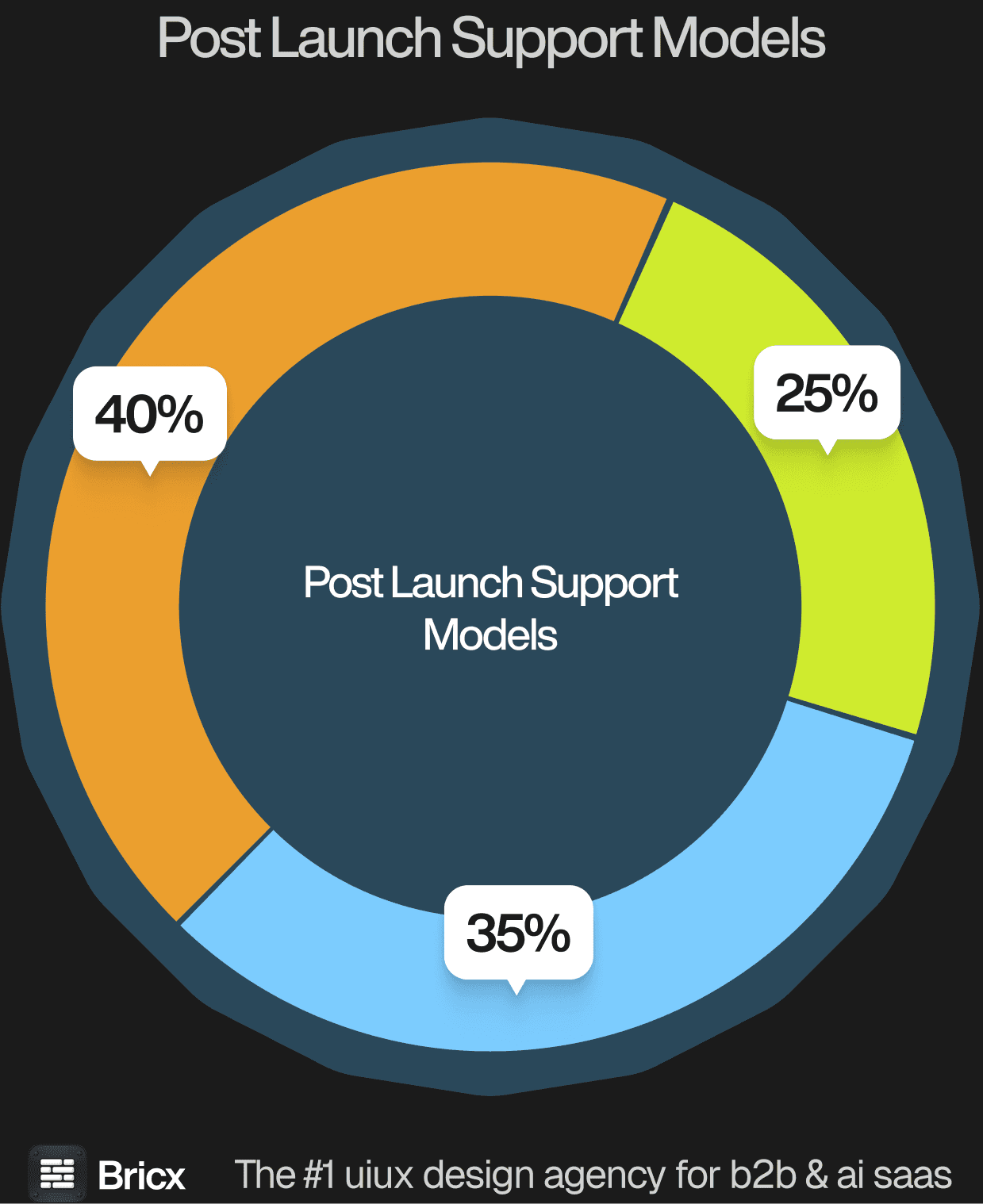
After launch, 40% of agencies offer a monthly retainer or subscription for support, 35% bill hourly and 25% sell a prepaid bank of hours.
Retainers differ more in what they cover than in price. Before signing one, check:
- The minimum term.
- What is included each month: maintenance, a share of a designer's time, or a dedicated team.
- What happens to unused time.
Published retainers from the agencies above:
| Agency | Published retainer |
|---|---|
| StanVision | Membership plans from $990/month |
| Amply | Webflow development from $3,000/month; design and Webflow from $4,500/month; dedicated team $10,000/month |
| Huemor | Support plans at $2,500 and $5,500/month |
| Flow Ninja | From $6,000/month on a 12-month term |
| Ramotion | Brand Team Extension from $9,500/month |
| Bricx | From $10,000/month |
How to choose a SaaS website design agency
A good SaaS website agency owns the whole path from "what should the site say" to "the site is live and marketing can edit it". Two agencies can both claim that and still differ on who does the work and what happens after launch.
| Stage | What the agency should own | What to compare between agencies |
|---|---|---|
| Positioning | What the site says, to whom, in what order | Some set the message hierarchy only and expect the client to bring the copy |
| Copy | Finished copy for every page | Included in the fee, priced separately, or left to the client |
| Design | Visual direction, homepage and page templates | Senior designers on the work, or only in the pitch |
| Build | Webflow, Framer or custom code, with a CMS marketing can edit | Built in-house (55% of agencies) or handed to a partner developer (45%) |
| Launch and after | Redirects, QA, handover and support | Support for a few days, a few weeks, or on a monthly retainer |
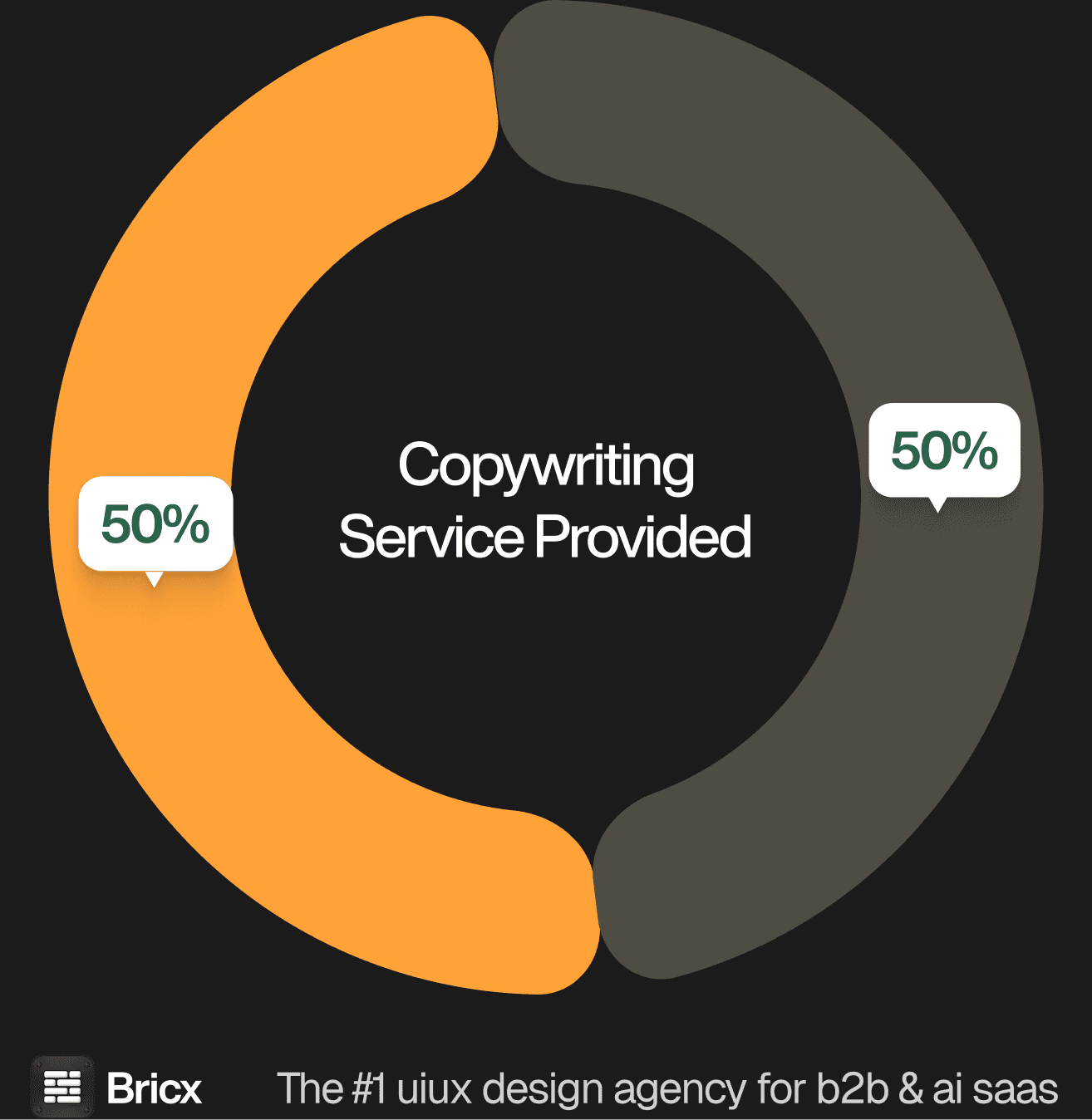
Copy splits agencies most evenly: half include copywriting and half expect the client to supply it.
Write a one-page brief first. Every agency in the benchmark received the same brief, and the spread from $1,500 to $120,000 came from how each one read it. A brief makes quotes comparable:
- The pages needed at launch, and the ones that can wait.
- Who writes the copy, and whether positioning is settled.
- The preferred stack and the integrations it needs.
- URLs that must keep ranking.
- The launch date, and the one decision-maker who signs off.
Match the agency to the trigger.
- The site no longer reflects the company: positioning, brand and website in one team. A pure build shop will reproduce the old message in a new layout.
- A launch or a raise has a date: a small senior team with a published timeline and a start date within two weeks.
- The designer left: a retainer or subscription that covers ongoing pages after launch.
- Enterprise buyers are now reviewing the company: experience with security, integrations and use-case pages, which an enterprise reviewer reads before the homepage.
If the trigger is the app rather than the site, product design is the closer match, and the lists of UX design agencies and product design agencies cover it.
Ask before signing.
- Who does the work, and are they employees or contractors?
- Which three shipped SaaS sites are closest to this one, and what changed for those companies after launch?
- How many revision rounds are included, and what counts as a round?
- How are redirects and SEO handled during the move?
- Who owns the Webflow or Framer workspace and the Figma files at the end?
- What does support cost after launch, and can the agency share two past clients to call?
What are the red flags when hiring a SaaS website agency?
- A portfolio of Dribbble concepts and no live SaaS sites with pricing, integrations or docs.
- "Conversion-focused" without being able to say which numbers changed for a client.
- A proposal that starts with visual design and skips positioning and page structure.
- No answer to who edits the site after launch, or who owns the workspace.
- Senior designers in the pitch and junior designers on the project.
How long does a SaaS website redesign take?
The most common quote is 5 to 9 weeks for a 5-page site, from 43.5% of agencies in the benchmark. Add the agency's lead time, which is two to four weeks for 45% of agencies. Bricx takes websites live in about five weeks.
SaaS website design
Need a website that makes a complex product easy to buy?
Bricx designs and builds it in Webflow, Framer or Next.js. Websites go live in about five weeks, and projects start at $25,000.
FAQs
How much does it cost to hire a SaaS website design agency?
For a 5-page site with copy and a Webflow or Framer build, a SaaS client put the same brief to 57 agencies, and the median quote was $25,000. Not every agency gave a price; of the agencies that quoted, 58% quoted between $15,000 and $50,000, 25% under $10,000 and 17% above $50,000. Larger sites, migrations, custom illustration and motion move the price up.
What is the best website builder for a SaaS company?
Webflow, for most B2B SaaS marketing sites: 65% of benchmarked agencies build on it (agencies could name more than one platform), and marketing can publish without engineers. Framer suits smaller, design-led sites that change often. WordPress suits teams with a large content library and in-house developers. Headless builds suit sites that share components or data with the product.
Should a SaaS company hire a specialist or a general web design agency?
A specialist already knows how pricing, integrations, security and demo pages work, and what a buying committee looks for. A general agency can produce an attractive site that misses those pages. For a funded B2B SaaS company, a specialist such as those listed above is usually the faster path.
Who maintains the website after launch?
Agree this before signing. Among benchmarked agencies, 40% offer a monthly retainer for post-launch support, 35% bill hourly and 25% sell a prepaid bank of hours. A good handover also includes documentation and a component library so an in-house team can take over.
Who owns the website and design files?
The client should. Confirm in the contract that the Webflow or Framer site is transferred to the company's own workspace, and that Figma files, fonts and image licences are handed over at the end of the project.
Should copy come from the same agency as the design?
One team for copy and design removes a handoff in the middle of the project, and half of agencies include copywriting. The benchmark's author still recommends a freelance direct-response copywriter when an agency has no dedicated writer. Ask who writes and see samples before deciding.
Can a new website improve SaaS conversion rates?
Yes, when the redesign fixes the actual cause: unclear positioning, weak proof, a confusing path to demo or trial, or slow pages. After its website redesign, Scale.jobs' visitor-to-lead conversion rose from 1.2% to 2.8% in the first month. A visual refresh alone rarely moves conversion, so ask agencies for before-and-after numbers from SaaS clients and compare them with SaaS conversion benchmarks.
When should a SaaS company redesign its website?
The most common triggers in 100 sales calls were an outdated site or rebrand (21 calls) and a new product or launch (19). A raise, a move upmarket, or a site that marketing cannot update without engineering are the other usual signals. A site that no longer matches how the sales team describes the product is overdue.
Does a Series A company need an agency or an in-house designer?
For the relaunch, an agency is faster and brings a full team; 41% of benchmarked agencies staff a project with three to five people. After launch, the usual options are keeping the agency on a retainer or hiring one designer to run the system it built.
Do time zones matter when hiring a design agency?
They came up in 20 of 100 sales calls. 60% of benchmarked agencies are based in Europe and 20% in Asia, so US teams often work with a partial-day overlap. That works when feedback is consolidated and asynchronous, and breaks down when a project needs daily live reviews.
Is AI replacing web designers?
AI tools now handle layouts, flows and much of the build. Deciding what the site says, to whom and in what order is still the designer's job, and as more AI-built sites start to look alike, a distinctive one is easier to remember.
Do AI SaaS companies need an AI-specialist agency?
Not necessarily, but they need an agency that can make an abstract, fast-changing product concrete and trustworthy. The AI UX agencies guide covers that specialism.
Where are examples of great SaaS websites?
A curated set, with what each one does well, is in the best SaaS website examples. For early-stage companies, these startup website examples and the design agencies for YC startups guide are a closer fit.
What is a realistic budget for a SaaS website redesign at Series B, including new brand messaging?
The UX agencies benchmark report has no figure specific to Series B. For a five-page website with copy, the median quote across 57 agencies was $25,000, 58% of quotes fell between $15,000 and $50,000, and 17% started at $50,000 or more. A brand refresh without a logo had a separate median quote of $15,300, and brand identity design services sets out what that work covers. A Series B site is usually larger than five pages, and page count, migration and motion move the price up from there.
What are the alternatives to Amply for B2B website design and development?
Amply is a Webflow Premium Partner with the lowest minimum project size on this list, $5,000+ on Clutch. These minimums are the smallest project an agency will take on, not what a typical SaaS website costs: most quotes for a 5-page site landed between $15,000 and $50,000. Among the other Webflow teams, Excited lists $10,000+, Flow Ninja prices its entry Webflow build from $15,000, and StanVision, Refokus and Bricx list $25,000+. Grafit builds in Webflow only for teams on the Webflow Enterprise plan. For WordPress, Bop Design and Huemor both list $25,000+.
Which SaaS website design agencies specialise in AI-native products that are hard to explain visually?
Bricx works with B2B and AI SaaS companies selling complex products, from AI-native tools to enterprise platforms, and its clients include Writesonic and CAMB.AI. Grafit lists the AI companies Gentrace and Jace AI as clients. Refokus suits launches that need motion and 3D to show a product, and counts deepset among its clients.

Similar Lists



Contents