10 Best SaaS Design Agenciesfor Recruitment SaaS (2026)
The 10 best SaaS design agencies for recruitment SaaS, compared on pricing, Clutch rating, engagement model and hourly rate, drawn from a documented benchmark of 57 agencies.
Aug 20, 202611 min read
Best SaaS design agencies for recruitment SaaS
Recruitment software has three users and only one of them chose to be there. The recruiter lives in it all day and wants throughput. The hiring manager logs in twice a week, has forgotten where everything sits, and is the reason pipelines stall. The candidate uses it once, has no way to complain, and reads every silent week as an answer about the company. Layer on the record-keeping, because who saw which application in what order is something an employer may one day have to defend, and one interface is carrying all three jobs.
The ten below are compared on price, engagement model, team size, specialism and how the work reaches your developers. Every agency here carries a verified Clutch profile, and the ratings below are taken from it. Each entry says what an agency is worth hiring for and where it is the wrong choice for recruitment SaaS design.
How the ten agencies compare
| Agency | Best for | Starting price | Clutch rating | Not a fit for |
|---|---|---|---|---|
| Bricx | Recruiter, manager and candidate surfaces | $25,000+ | 5.0/5, 27 reviews | Payroll and HRIS platforms |
| Vilmate | One vendor for site and product | $25,000+ | 5.0/5, 11 reviews | Hiring domain depth |
| Andersen Inc. | Matching engines and large builds | $50,000+ | 4.9/5, 129 reviews | Design-led, three-audience work |
| Appinventiv | Consumer-grade candidate experience | $50,000+ | 4.6/5, 90 reviews | Recruiter workflow depth |
| Bluetext | Brand and candidate-facing messaging | $100,000+ | 4.9/5, 10 reviews | Recruiter workflow software |
| Cleveroad | Pipeline and list-heavy interfaces | $10,000+ | 4.9/5, 81 reviews | Owning design direction |
| DICEUS | Persona research before design | $10,000+ | 4.9/5, 49 reviews | Sustained product design delivery |
| Innowise | Secure data and pipeline work | $10,000+ | 4.9/5, 73 reviews | User-facing design |
| Intellias | Engineering capacity at enterprise scale | $50,000+ | 4.9/5, 30 reviews | Design ownership |
| Intersog | AI query layers over candidate data | $25,000+ | 4.7/5, 12 reviews | Design across three audiences |
Best SaaS design agency for recruitment SaaS: Bricx
Bricx is the best recruitment products where the recruiter's throughput, the hiring manager's forgetfulness and the candidate's single visit each have to be designed for separately. Bricx has completed 50+ SaaS design projects across 30+ industries, with clients including Writesonic (YC S21), Collectwise (YC F24), Gigacatalyst (YC X26), Sybill, Camb.ai, LTV.ai, Instadapp, Hobbes and AT Kearney. The agency holds 27 verified reviews on Clutch at an average of 5.0/5.
Bricx works exclusively with B2B and AI SaaS companies, from seed stage through Series C, covering branding, website design, product UX/UI and end-to-end development. Engagements start at $25,000. Bricx works on B2B and AI SaaS only, with branding, website and product UX/UI inside the same engagement. That matters here because the candidate-facing screens are employer brand and the recruiter-facing screens are throughput software, and one team owning both is what stops the two drifting apart.
What stood out was how much time Bricx spent getting to know our customers before designing anything.
- Starting price
- $25,000+
- Engagement model
- Fixed-scope projects and monthly retainers
- Timeline
- First delivery within the first week; full scope varies by project
- Clutch
- 5.0/5, 27 reviews
- Hourly rate
- $50 - $99
- Best for
- recruitment products where the candidate side is employer brand and the recruiter side is throughput.
- Not a fit for
- payroll or HRIS platforms, staffing agency back-office systems, or budgets under $25,000.
Vilmate
Vilmate's healthcare SaaS review is the relevant one: a complete technical team covering backend, frontend, WordPress, DevOps, design and QA for a single client. Recruitment products usually need exactly that mix, because the candidate-facing pages are often marketing infrastructure while the recruiter side is a full application, and splitting them across two vendors is how the two stop matching.
40% of its work is eCommerce, with hospitality and financial services taking most of the rest, so there is no HR or hiring experience anywhere on the record. Design appears as one line inside a broader technical support offer rather than as a practice being sold.
- Starting price
- $25,000+
- Engagement model
- Project and retainer
- Clutch
- 5.0/5, 11 reviews
- Hourly rate
- $50 - $99
- Team size
- 50 - 249 people
- Best for
- recruitment products needing the marketing site and the application from one team.
- Not a fit for
- work that requires hiring domain depth, or budgets under $25,000.
Andersen Inc.
Andersen's ML recommendation engine for a music streaming app is the closest thing on its card to candidate matching, the same ranking problem with a career attached instead of a playlist. It has also published an internal tools case for managing vouchers, and a healthcare mobile app redesigned specifically so users could find information faster, which is the hiring manager's actual complaint.
At 1,000 to 9,999 people with 129 Clutch reviews, most of its listed services are custom software, managed services and IT strategy rather than design. A recruitment product that needs three distinct user experiences designed properly is buying a narrow slice of what Andersen sells.
- Starting price
- $50,000+
- Engagement model
- Project and retainer
- Clutch
- 4.9/5, 129 reviews
- Hourly rate
- $50 - $99
- Team size
- 1,000 - 9,999 people
- Best for
- recruitment platforms whose hard part is the matching engine behind the screens.
- Not a fit for
- design-led work across recruiter and candidate surfaces, or budgets under $25,000.
Appinventiv
Appinventiv is the only agency here with published work on a professional networking startup, an iOS and Android MVP built in React Native with provider integrations. Professional networking and recruitment share an awkward asymmetry: the person whose profile is the product gets far less design attention than the person searching through it. Its Domino's case reports a UX strategy that lifted conversion by 23%.
Its record is strongest on consumer brands, Adidas, KFC and IKEA, and with 40% AI development plus 40% mobile development, design arrives as part of a build. It also carries the lowest Clutch rating on this page at 4.6 across 90 reviews.
- Starting price
- $50,000+
- Engagement model
- Project and retainer
- Clutch
- 4.6/5, 90 reviews
- Hourly rate
- $25 - $49
- Team size
- 1,000 - 9,999 people
- Best for
- recruitment products whose candidate-facing app has to feel consumer-grade.
- Not a fit for
- deep recruiter workflow design, or budgets under $25,000.
Bluetext
Bluetext is the branding option on this page, and for recruitment software that is a real capability rather than a consolation. It has run two published brand programmes for government services firms, including a messaging framework and brand guidelines, and the candidate-facing half of a recruitment product behaves far more like brand and messaging work than like workflow software.
None of its published work is product design: WordPress websites, logos, marketing collateral, content. The recruiter's daily workspace, where a recruitment product lives or dies, is not something its record shows it building, and it publishes a $100,000 minimum with an undisclosed rate.
- Starting price
- $100,000+
- Engagement model
- Project and retainer
- Clutch
- 4.9/5, 10 reviews
- Hourly rate
- Undisclosed
- Team size
- 10 - 49 people
- Best for
- the brand and messaging layer a candidate-facing product gets judged on.
- Not a fit for
- recruiter workflow and product design, or budgets under $25,000.
Cleveroad
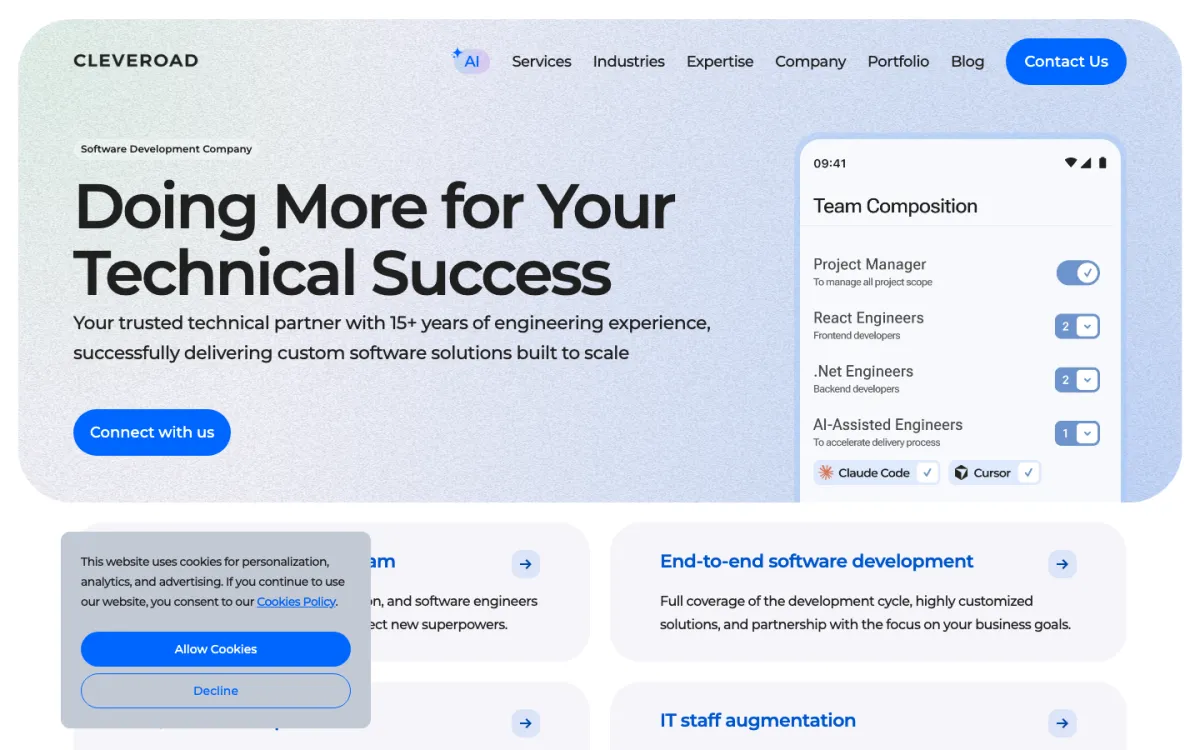
Half of Cleveroad's client base is education, the sector whose structure sits closest to recruitment: an applicant who applies once, an institution reviewing at volume, and a decision the applicant cannot appeal through the interface. Its React frontend migration rebuilt an application's main screens and cards along with their UI logic, which is exactly the list-and-card work an applicant pipeline is made of.
Its document management review describes a system that had stopped scaling, the honest failure mode of most applicant tracking builds. There is no UX/UI line in its service split, though, and a third review is staff augmentation, a different relationship from owning an outcome.
- Starting price
- $10,000+
- Engagement model
- Project and retainer
- Clutch
- 4.9/5, 81 reviews
- Hourly rate
- $25 - $49
- Team size
- 250 - 999 people
- Best for
- recruitment platforms with heavy list and pipeline screens to rebuild.
- Not a fit for
- engagements where the agency owns design direction, or budgets under $25,000.
DICEUS
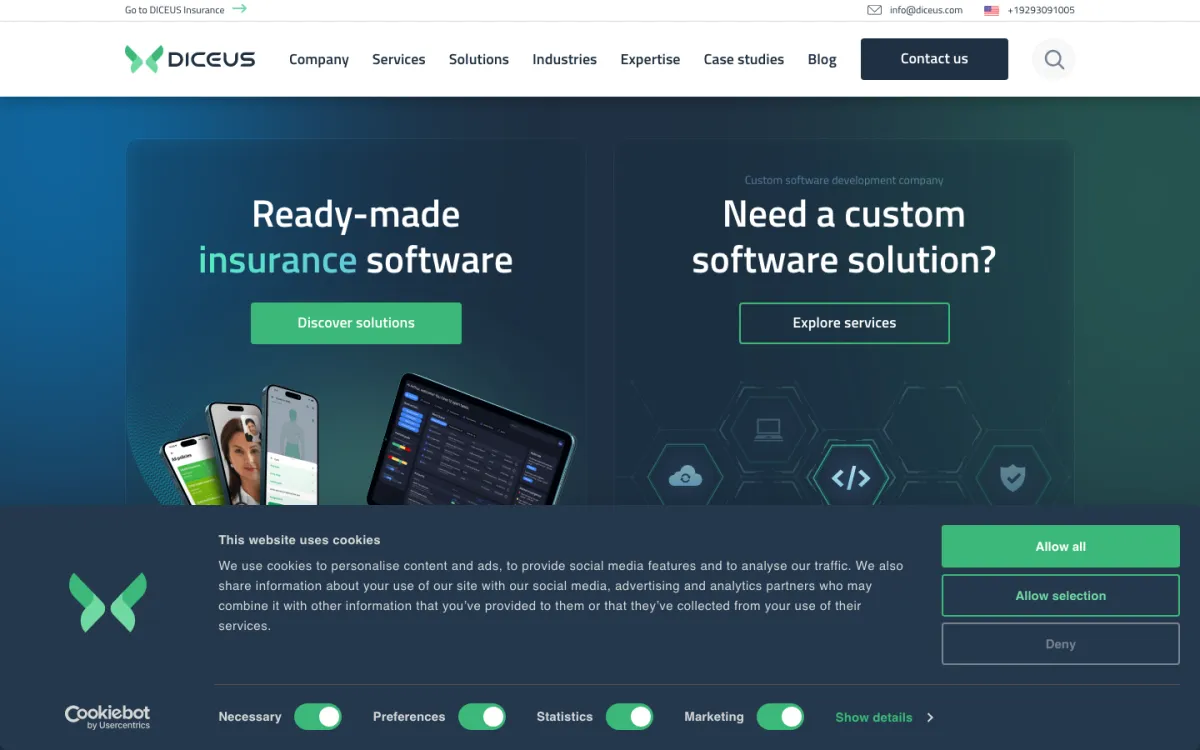
The DICEUS review worth reading here is the insurance one: interviews first, then customer personas, then UX/UI design. Recruitment software fails precisely because personas get collapsed, with recruiter, hiring manager and candidate treated as one user holding three permission levels, and an agency whose stated method starts by separating them is starting in the right place.
Everything else on the card points away from design. 40% of its work is cloud consulting and systems integration, another 20% IT strategy, and one published review is penetration testing. Its industries are financial services, IT and medical, with nothing in HR or hiring.
- Starting price
- $10,000+
- Engagement model
- Project and retainer
- Clutch
- 4.9/5, 49 reviews
- Hourly rate
- $25 - $49
- Team size
- 50 - 249 people
- Best for
- separating the recruiter, manager and candidate before anything is designed.
- Not a fit for
- sustained product design delivery, or budgets under $25,000.
Innowise
Innowise's published work is data plumbing: secure pipelines, predictive models and dashboards for an analytics platform, and a secure system handling sensitive healthcare data. Recruitment SaaS carries the same sensitivity problem, since an application file holds somebody's employment history and salary expectation, and the audit trail matters as much as the screen sitting on top of it.
No design service appears in its split, which spreads thinly across AI agents, AI consulting, AI development and big data at 10% each. Two of its three published reviews describe backend and staffing engagements, so the recruiter and candidate experiences would have to be designed elsewhere.
- Starting price
- $10,000+
- Engagement model
- Project and retainer
- Clutch
- 4.9/5, 73 reviews
- Hourly rate
- $50 - $99
- Team size
- 1,000 - 9,999 people
- Best for
- the data and security layer sitting beneath a recruitment platform.
- Not a fit for
- recruiter or candidate interface design, or budgets under $25,000.
Intellias
Intellias runs around 15 concurrent projects for one financial services client, covering engineering, standardisation and enterprise architecture. That is the profile of a partner for an established recruitment platform carrying several products and a consistency problem, not for a team designing its first pipeline view. Half its clients are enterprises over a billion dollars and the other half midmarket.
All three of its published reviews describe supplying development resources into a client's own team rather than owning a design outcome, and no UX/UI line appears in its service split. Nothing on the card touches HR, hiring or the candidate side of a product.
- Starting price
- $50,000+
- Engagement model
- Project and retainer
- Clutch
- 4.9/5, 30 reviews
- Hourly rate
- $50 - $99
- Team size
- 1,000 - 9,999 people
- Best for
- large recruitment platforms that need sustained engineering capacity.
- Not a fit for
- design ownership or candidate experience work, or budgets under $25,000.
Intersog
Intersog's Azure build put a generative AI chat interface over a client's data so people could retrieve and interact with it in conversation. That is the shape the AI layer in recruitment software is taking, a recruiter asking a question of a candidate pool rather than filtering it, and its trading platform work shows it handling awkward source formats, which every applicant tracking migration involves.
25% of what it does is IT staff augmentation, its largest single service line, and no design service is listed at all. With 12 Clutch reviews and half its clients enterprises over a billion dollars, it is set up to add engineers to a team rather than design three user experiences.
- Starting price
- $25,000+
- Engagement model
- Project and retainer
- Clutch
- 4.7/5, 12 reviews
- Hourly rate
- $50 - $99
- Team size
- 50 - 249 people
- Best for
- the AI and data layer of a recruitment product, built inside an existing team.
- Not a fit for
- design work across recruiter and candidate surfaces, or budgets under $25,000.
How much does a recruitment SaaS design engagement cost?
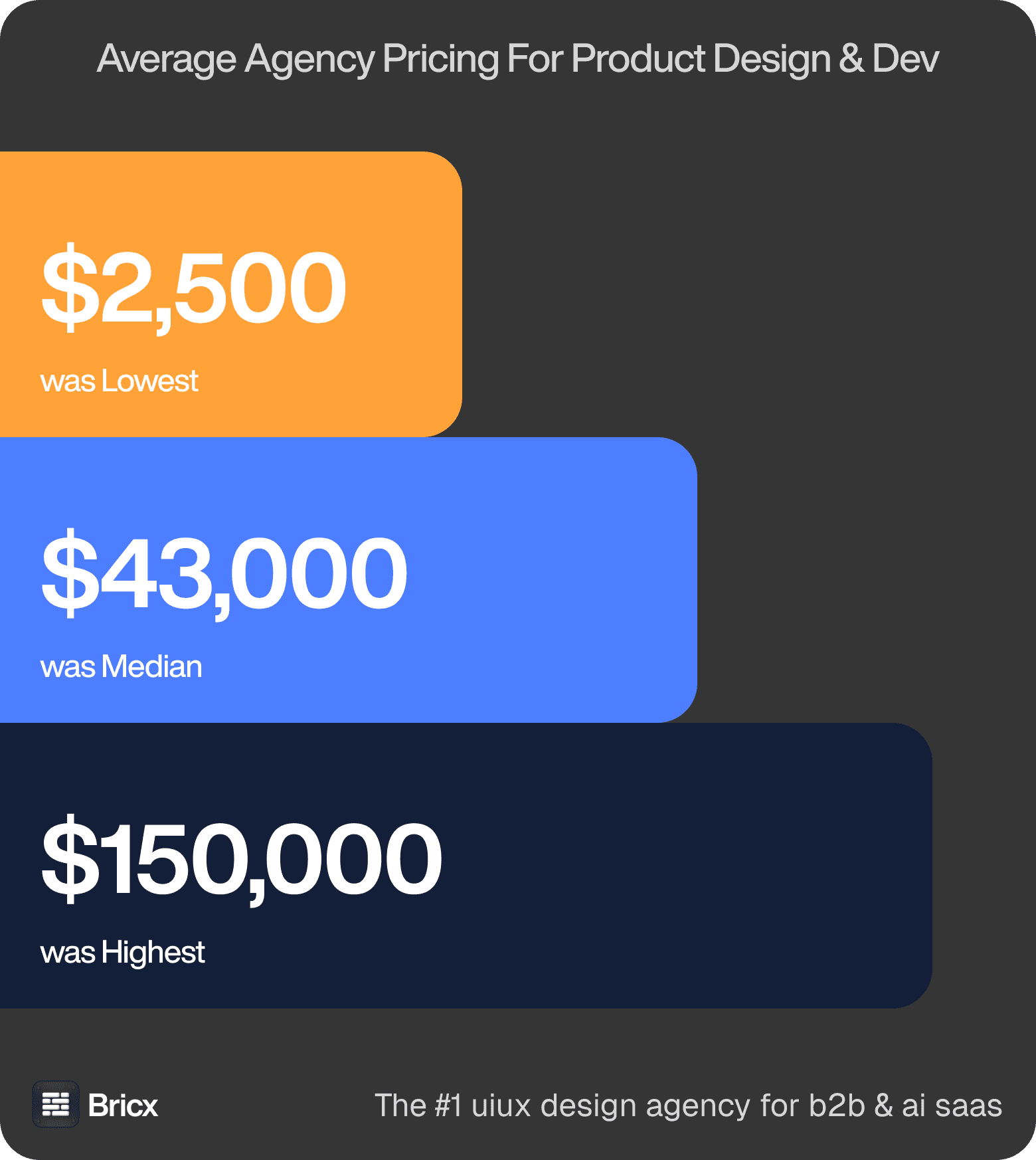
What ten agencies quote for the same thing. Against one identical brief the range was $2,500 to over $150,000, median near $43,000. Six in ten would not put a number on it before a call. Those figures cover product design across the whole benchmark, so treat them as the range recruitment SaaS design is quoted inside rather than a price for it.
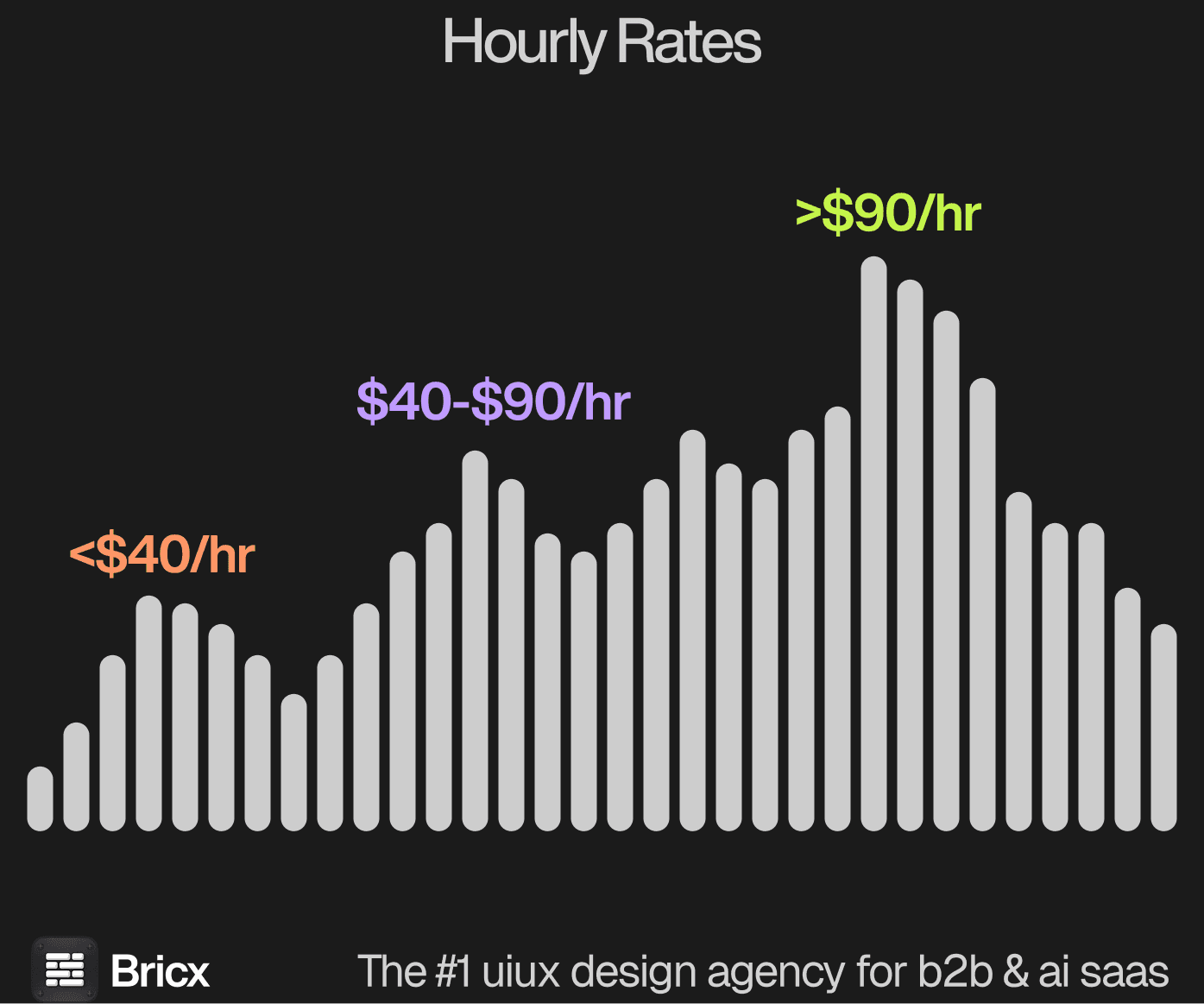
Hourly pricing. Between $25 and $195, with most quotes at $55 to $90. Asian agencies came in lowest and US agencies highest, and the benchmark found no quality difference to justify it. Recruitment SaaS runs above the benchmark median because there are effectively three products behind one login, and the candidate side gets judged as brand while the recruiter side gets judged as throughput.
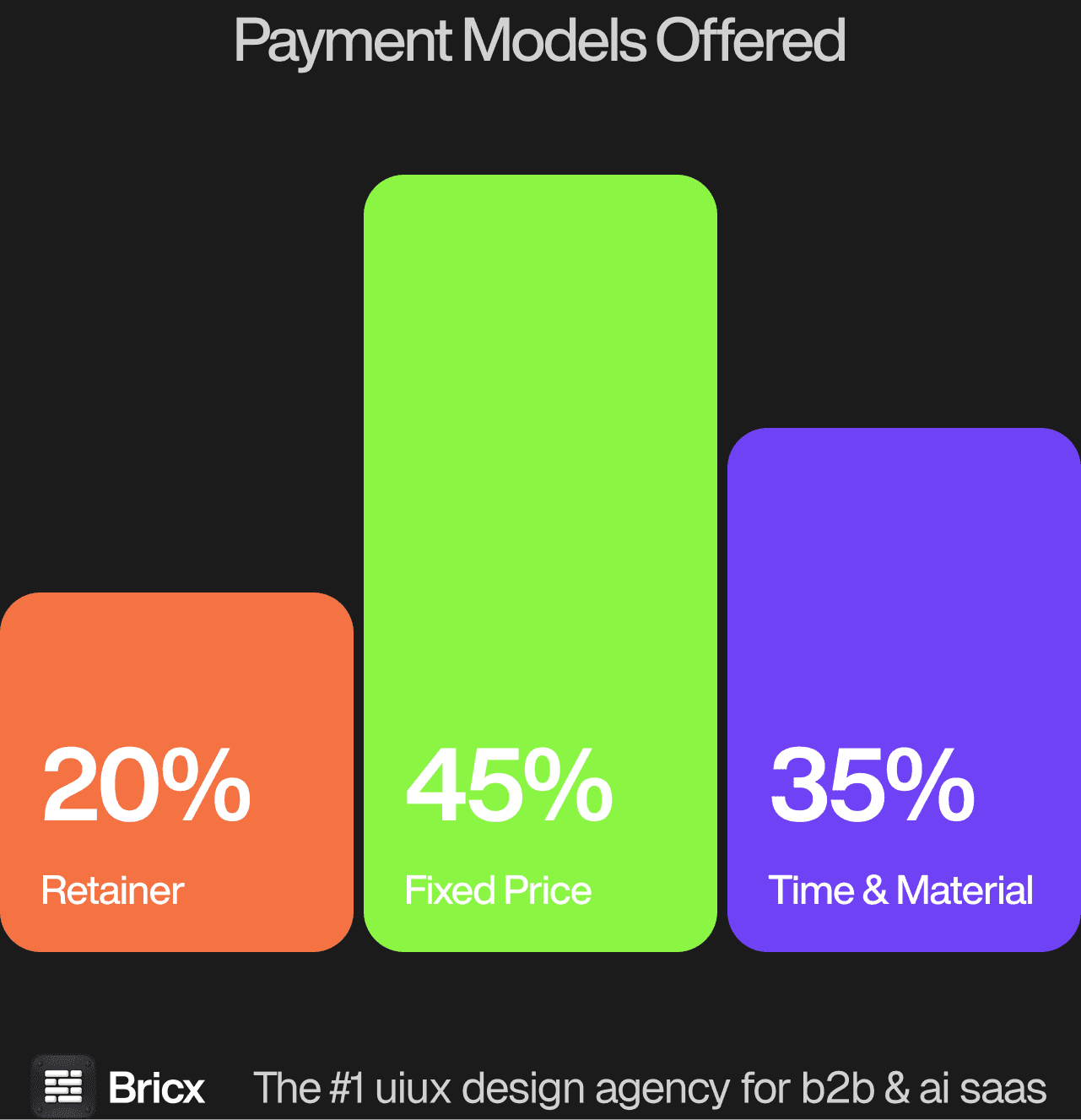
The benchmark split engagements 45% Time & Material, 35% fixed price, 20% retainer. Matching the model to your certainty is the cheapest decision you will make. For recruitment SaaS design the model usually matters more than the headline figure, because it decides what happens when the scope moves.
- Fixed price protects budget certainty.
- Time & Material protects flexibility.
- Retainer protects continuity.
- Which one fits recruitment SaaS design comes down to whether the scope is settled before the work starts.
How do you evaluate a SaaS design agency for a recruitment product?
Five things separate recruitment SaaS design from B2B SaaS design generally.
Ask which of the three users they designed for first. The recruiter is the only one who will ever be in a research session, so an agency that never names the hiring manager and the candidate has quietly built for one third of the product.
Ask what the hiring manager sees. That person is the slowest link in every pipeline and logs in rarely enough to have forgotten the interface between visits, so anything requiring training will simply not get used.
Ask what a rejected candidate experiences. Most applicants are rejected, almost none complain, and every one of them is a potential customer, referrer or future applicant carrying an opinion about the employer.
Ask how the product records who decided what. Hiring decisions get challenged, and a system that cannot reconstruct the sequence leaves the employer, not the vendor, explaining it.
Ask how AI screening is presented. A ranked shortlist with no visible reason is a decision the recruiter has to own without being able to defend it to anyone.
What are the red flags when hiring a design agency?
- Every project in the portfolio looks the same. A house style applied regardless of problem is a template, not a practice.
- Availability that starts immediately. Good teams are usually booked. Instant capacity is worth one question.
- No discovery at all. The opposite failure to endless workshops, and just as expensive.
- Testimonials without companies. An unattributed quote is a sentence someone wrote.
- Reluctance to name the tools. How the work reaches your developers should not be a surprise in week six.
- No comparable example of recruitment SaaS design. An agency that cannot point to work of the same shape is learning on your budget.
Should you hire a design agency or build in-house?
Use an agency while the work has edges: a launch, a rebuild, a first version. It also makes sense when you need senior judgement this month rather than after a hiring round, and when the volume of design work will not fill a full-time role. For recruitment SaaS design specifically, the question worth settling first is how often the work recurs.
Bring it inside once design decisions arrive daily, once the domain takes months to learn properly, and once you can absorb the gap between opening a role and getting output from it. Where recruitment SaaS design falls on that line is usually clear once you count how many times it will need doing again.
Hire in-house when the recruiter workflow is the core product, because that surface needs continuous attention from somebody who has sat through real sourcing sessions. Retain an agency for the candidate-facing side, which behaves more like brand and marketing work and does not justify a permanent seat. The in-house failure mode is a product designed entirely around the recruiter, since the recruiter is the only user anyone in the building actually talks to.
FAQs
What makes recruitment SaaS design hard?
Three parties with conflicting interests share one product. The recruiter wants speed, the hiring manager wants to be left alone, the candidate wants an answer, and the candidate is the only one with no route to complain when the interface fails them.
Who should a recruitment product be designed for?
All three, on separate surfaces. Designing one interface with three permission levels is the standard mistake, and it produces a hiring manager view that is a stripped-down recruiter view nobody can navigate.
How much does recruitment SaaS design cost?
Fixed-price product design across the benchmark ran $2,500 to over $150,000 with a median near $43,000, and recruitment products sit above that median because the recruiter workspace and the candidate journey are effectively two design projects. Bricx starts at $25,000.
How should AI matching appear in a recruitment product?
With the reason visible next to the ranking. A recruiter who cannot see why a candidate scored where they did cannot defend the shortlist, and a shortlist nobody will defend gets ignored.